
- Roof extension in addition to various alterations including replacing pergola with canopy, re-roofing with slate, raising and replacing rear decking and white render finish to external walls
 1 Cranford Close Exmouth EX8 2HRRef. No: 23/2353/FUL | Validated: Fri 03 Nov 2023 | Status: Awaiting decision
 - Proposed construction of single storey rear extension Evellen Road From Hutching Farm To Daneshill Cross Dalwood Devon EX13 7HJRef. No: 23/2346/FUL | Validated: Fri 03 Nov 2023 | Status: Awaiting decision
- Certificate of existing lawful use for works commenced within the time limit of three years as per condition 1 under planning permission number 89/P1565 Land North Of Southerton House Southerton Ottery St MaryRef. No: 23/2347/CPE | Validated: Fri 03 Nov 2023 | Status: Awaiting decision
- Proposed single storey rear extension 13 Boyne Road Budleigh Salterton Devon EX9 6SERef. No: 23/2351/FUL | Validated: Fri 03 Nov 2023 | Status: Awaiting decision
- Construction of two-storey rear extension and erection of two storey car port/home office and associated works. Cowley Barton Farm Cowley EX5 5EJRef. No: 23/2338/FUL | Validated: Thu 02 Nov 2023 | Status: Awaiting decision
- Change of use from agriculture to a flexible commercial use, specifically a Class C1 (guesthouse) use Barn Opposite Hembury Close Broadhembury Honiton EX14 3LERef. No: 23/2341/PDR | Validated: Thu 02 Nov 2023 | Status: Awaiting decision
- Removal of juniper tree leaning towards the highway and public electrical supply cables as advised by National Grid tree surveyor Removal of dead cherry tree Cherry Tree Cottage Broadway
- Woodbury EX5 1NRRef. No: 23/2332/TCA | Validated: Thu 02 Nov 2023 | Status: Awaiting decision
- Construction of new single storey garage [previously submitted under 23/0516/FUL] 7 Highcliffe Close Lympstone Devon EX8 5HFRef. No: 23/2334/FUL | Validated: Thu 02 Nov 2023 | Status: Awaiting decision
- Demolition and removal of garage, shed and caravan to be replaced with new annexe and double garage. Hayne Cooks Lane Axminster Devon EX13 5SJRef. No: 23/2333/FUL | Validated: Fri 03 Nov 2023 | Status: Awaiting decision
- T1 – Stone Pine: fell Limekiln House The Strand Lympstone Devon EX8 5EYRef. No: 23/2322/TCA | Validated: Tue 31 Oct 2023 | Status: Awaiting decision
- Certificate of Proposed Lawful Use/Development for the creation of a toilet and washing room area45 Exeter Road Exmouth EX8 1PXRef. No: 23/2323/CPL | Validated: Wed 01 Nov 2023 | Status: Awaiting decision
- T1, Birch: fell; T2, Birch: fell; T3, Birch: reduce to standing deadwood; T4, Pine: fell; T5, Pine: fell; T6, Pine: fell; G7, Birch (8), Willow(3), Oaks (5): fell. Hullum Pit Land Off B3179 Higher Marley Road Exmouth EX8 5DTRef. No: 23/2327/TRE | Validated: Wed 01 Nov 2023 | Status: Awaiting decision
- Construction of a single storey side extension, removal of chimney and extension of rear first floor dormer. 90 Winslade Road Sidmouth EX10 9EZRef. No: 23/2317/FUL | Validated: Tue 31 Oct 2023 | Status: Awaiting decision
- Certificate of Proposed Lawful Development for alterations to existing loft conversion and addition of a rear dormer7 Hill View Winters Lane Ottery St Mary EX11 1ATRef. No: 23/2325/CPL | Validated: Tue 31 Oct 2023 | Status: Approved
- T51. Turkey Oak: dismantle in stages to near ground level. T52, Sweet Chestnut: reduce height by 6m. Land Lying To The South Of Rowlands ShuteRef. No: 23/2324/TRE | Validated: Tue 31 Oct 2023 | Status: Awaiting decision
- T5, Sycamore : crown reduce by approximately 5m, maximum diameter of cuts 100mm; crown lift above garage to achieve 2m of clearance. T3, Beech : prune western aspect away from property to achieve 1.5m of clearance. Salcombe Court Salcombe Hill Road Sidmouth Devon EX10 8JRRef. No: 23/2326/TRE | Validated: Tue 31 Oct 2023 | Status: Awaiting decision
- Proposal for additional external cladding to an existing agricultural building Sowton Farm Buckerell Devon EX14 3EHRef. No: 23/2296/FUL | Validated: Mon 30 Oct 2023 | Status: Awaiting decision
- Certificate of Proposed Lawful Development for internal works to the existing Garage / Workshop, to convert the workshop space to ancillary accommodation to the existing dwellingUphills Greenway Lane Sidmouth EX10 0LZRef. No: 23/2295/CPL | Validated: Mon 30 Oct 2023 | Status: Awaiting decision
- Permission in principle for the erection of 1no. dwelling Land At South Of Uplyme Public Footpath 19 Harcombe Uplyme DT7 3RNRef. No: 23/2307/PIP | Validated: Mon 30 Oct 2023 | Status: Awaiting decision
- T1, Silver Birch: reduce height of tree by approximately 2.5m and prune to reshape; remove low limb growing over driveway. T2, Eucalyptus: reduce tree by approximately 2m in height and approximately 1m in lateral crown spread. T3, Eucalyptus: pollard tree to unions at approximately 1.5m above ground level. T4, Sycamore: lift crown of tree by approximately 1.5m. T5, Sycamore: reduce tree via thinning aiming to reduce height by approximately 3m in height and prune to reshape; remove approximately 3 primary limbs to lift crown by approximately 1.5m. T6, Sycamore: lift crown of tree by removing approximately 5 low primary branches growing over putting green. T7, Monterey Pine: remove one low limb growing over garden area. T8, Monterey Pine: lift crown of tree by removing approximately 3 low limbs growing over neighbours shed; remove dead branch. T9, Crab Apple: reduce height of tree by approximately 0.75m; reduce lateral crown spread by approximately 1m. Flat 1 Norton Garth Court Station Road Sidmouth Devon EX10 8NYRef. No: 23/2298/TCA | Validated: Mon 30 Oct 2023 | Status: Awaiting decision
- Car park extension. Playing Fields Exmouth Road Exton EX8 5APRef. No: 23/2303/FUL | Validated: Thu 02 Nov 2023 | Status: Awaiting decision
- Loft conversion incorporating a raised ridge and dormer windows and the construction of a garden building (loft to house bats) Yarde Lodge Luppitt Devon EX14 4TARef. No: 23/2301/FUL | Validated: Wed 01 Nov 2023 | Status: Awaiting decision
- T1, Beech: reduce radial spread over the office by approx 3m; reducing over extended growth to allow more light into office and reduce risk of failure onto building. T2, Turkey Oak: reduce radially by up to 2m.; crown lift to 3.5m to allow grass maintenance by crown lifting; reduction to reduce over extended growth. T3, Turkey Oak: remove deadwood and crown lift by 3.5m. To allow grass maintenance by crown lifting. T4, Turkey Oak: remove deadwood; crown lift by 3.5m amd reduce radial spread over the shed; and, crown section over the drive by 2m lifting over the lawn to allow grass maintenance; radial reductions to reduce over extended growth. Rectory Oaks Plymtree Devon EX15 2JURef. No: 23/2305/TRE | Validated: Mon 30 Oct 2023 | Status: Awaiting decision
- Loft conversion with front and rear dormers and replacement solid roof to existing rear conservatory. 18 Newlands Avenue Exmouth EX8 4AXRef. No: 23/2302/FUL | Validated: Mon 30 Oct 2023 | Status: Awaiting decision
- Permission in principle for demolition of dwelling and construction of 3 no. new dwellings 28 Cranford Avenue Exmouth EX8 2PZRef. No: 23/2299/PIP | Validated: Thu 02 Nov 2023 | Status: Awaiting decision
- T1: Oak – reduce NE aspect by 1.5 metres, cuts no greater than 50mm in diameter. Reduce SE extended lower limb by 1.5m metres, cuts no greater than 50mm in diameter. Reduce NW lower aspect by 1.5 metres, cuts no greater than 50mm in diameter. Broomleigh Elm Farm Lane Colyford Devon EX24 6QSRef. No: 23/2293/TRE | Validated: Mon 30 Oct 2023 | Status: Awaiting decision
- Construction of a steel-frame balcony and external staircase to the western elevation of the property Woodcroft Weston Honiton EX14 3NYRef. No: 23/2282/FUL | Validated: Mon 30 Oct 2023 | Status: Awaiting decision
- Erection of roof over existing livestock yard. Lower Beavor Farm Axminster EX13 5SERef. No: 23/2285/FUL | Validated: Fri 03 Nov 2023 | Status: Awaiting decision
- Construction of single storey extension on north elevation, covered raised veranda on south elevation. Partial cladding on exterior walls. New driveway and landscaping. Crealy Barton Sidmouth Road Clyst St Mary Devon EX5 1DRRef. No: 23/2269/FUL | Validated: Fri 03 Nov 2023 | Status: Awaiting decision
- Prior approval for the conversion and change of use of an agricultural building to a single dwelling Agricultural Building (James Barn) Kerswell Cullompton EX15 2ESRef. No: 23/2272/PDQ | Validated: Tue 31 Oct 2023 | Status: Awaiting decision
- Removal of occupancy condition no.2 of permission ref: 7/39/02/P1130/00114 to allow use as an unrestricted dwelling The Barn And Pinn Cottage Bowd Sidmouth EX10 0NDRef. No: 23/2262/VAR | Validated: Fri 03 Nov 2023 | Status: Awaiting decision
- Replacement of existing single pane window with a 3 in1 pane window. Estuary Cottage The Strand Lympstone Devon EX8 5EYRef. No: 23/2247/FUL | Validated: Wed 01 Nov 2023 | Status: Awaiting decision
- Construction of four commercial, business and service units (Class E) and nine detached dwellings with associated access, parking and infrastructure Land At Old Tithebarn Lane Clyst HonitonRef. No: 23/2214/MFUL | Validated: Fri 03 Nov 2023 | Status: Awaiting decision
- Extension to existing guest house to accommodate 3 additional guest bedrooms and associated landscaping arrangements. Woodhayne Farm Bishopswood Chard TA20 3SBRef. No: 23/2196/FUL | Validated: Tue 31 Oct 2023 | Status: Awaiting decision
- Two proposed one bedroom apartments over an existing public house Flat, The York Inn 21 Imperial Road Exmouth Devon EX8 1BYRef. No: 23/2175/FUL | Validated: Tue 31 Oct 2023 | Status: Awaiting decision
- Erection of seagull netting on roof of Tanyard’s Court [Retrospective] Tanyards Court Beer Road Seaton Devon EX12 2PARef. No: 23/2167/FUL | Validated: Mon 30 Oct 2023 | Status: Awaiting decision
- Permission in principle for 4no. dwellings Land West Of Backwells Mead NorthleighRef. No: 23/2373/PIP | Validated: Tue 31 Oct 2023 | Status: Awaiting decision
- 1 no. illuminated fascia sign and 1 no. illuminated projecting sign 4 – 6 Chapel Street Exmouth EX8 1LURef. No: 23/2146/ADV | Validated: Thu 02 Nov 2023 | Status: Awaiting decision
- Erection of a garden shed (retrospective) Flat 7 Kings Gardens Kerslakes Court Honiton EX14 1FLRef. No: 23/1934/FUL | Validated: Mon 30 Oct 2023 | Status: Awaiting decision
- Retrospective application for construction of raised decking area 2475 wide by 2500 reducing to 1550 by the fence – height of raised platform 800mm 21 Burnards Field Road Colyton Devon EX24 6PERef. No: 23/1856/FUL | Validated: Mon 30 Oct 2023 | Status: Awaiting decision
- Certificate of existing lawfulness for the change of use of land from agricultural to residential Oaklands Wilmington EX14 9JURef. No: 23/1486/CPE | Validated: Mon 30 Oct 2023 | Status: Awaiting decision
Daily Archives: 15 Nov 2023
Will Simon Jupp now reinvent himself as a “wet”
Under the headline:
Rishi Sunak’s reshuffle gamble has set up a life and death struggle with the Tory right
the political editor of the Express reports:
“There is a belief widely shared that the reshuffle was “about destroying the right of the party.”
In so doing, it was also about “abandoning the new Red Wall seats won in 2019.”
One MP noted: “All the campaign cash is going to wet MPs in the south of England. They are more worried about dealing with the Lib Dem vote.”
This would mean that after an election the party will be “dominated by lefty Lib Dem-ish wets” as one put it.”
Using 1980’s terminology, do we think Simon Jupp is a “wet”, as defined above, or one of the right wing “dries”.
One thing is certain is that Simon Jupp is clearly politically ambitious gaining his experience in “interesting” company.
He started his political career as a SpAd to Dominic Raab, generally described as a rightwinger, even as being more rightwing on education than Thatcher.
This seemed to give him an entrée into being selected as the Tory candidate to follow Hugo Swire and he was elected an MP in 2019.
Fast forward.
In October 2022 he “united” behind Liz Truss and was rewarded by being newly promoted as a PPS to right-winger Simon Clarke when he became Secretary of State for Levelling-up, Housing and Communities.
His old boss Simon Clarke used unsubtle sporting metaphors on Monday to make his position clear:
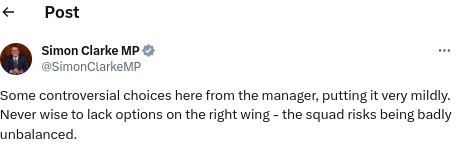

Owl’s view is that Leopards don’t change their spots: be on the lookout for Simon trying to “reinvent” himself as a lefty LibDemish wet.
“Care in the community” – Does the Minister know much of it is unsustainable?
In answer to Richard Foord’s debate on the closure of the Seaton Hospital wing, the Minister for Social Care, Helen Whately, extolled the virtue of virtual care and care in the community in place of hospital beds, saying:
“Across the country, we have achieved a lot as part of our commitment to move more care out into the community.”
However, as described in the article below, much Social Care is contracted out to public charities on an unsustainable basis, for example:
The Stroke Association, which is contracted by the NHS and local authorities to deliver stroke recovery services for tens of thousands of patients once they have been discharged from hospital, said last year it was paid just under £11m for services costing nearly £17m, with the £6m gap met through public fundraising.
What happens when this “outsourcing” dries up? – Owl
English charities ‘near insolvency’ after subsidising public sector contracts
Patrick Butler www.theguardian.com
Charities in England are on the brink of insolvency after subsidising heavily underfunded local authority and NHS contracts to the tune of hundreds of millions of pounds donated to them by the public, voluntary sector leaders have warned.
Donations, will legacies and charity shop profits are being used to prop up thousands of state-funded services in danger of closure, including care homes, homeless shelters, addiction projects and physical rehabilitation support schemes.
One charity told the Guardian it used £6m a year raised from the public and other donors to subsidise clinical and care services it provided under contract to the NHS and local authorities, a sum it described as “unsustainable”.
The refusal of local authorities, the NHS and government departments to fund the real cost of local service contracts – and the built-in assumption that voluntary sector will deliver “on the cheap” – was threatening the existence of vital local services, the National Council for Voluntary Organisations (NCVO) said.
“It’s potentially catastrophic for communities if these services stop,” said Sarah Vibert, the chief executive of NCVO. “Many services, like homelessness interventions and support for victims of domestic violence or sexual abuse, wouldn’t currently exist without charities.”
She added: “For too long, the goodwill of charities has been taken for granted. [Public sector contract managers] know charities will do everything possible, including subsidising public services with charitable funds, to prevent closing their door to someone. But this can’t continue.”
Although charities have been embedded in delivery of public services for years, the scale of the funding gap has pushed many charities to the edge as inflation and demand has soared, and councils and NHS bodies, many in financial crisis themselves, slash grants and refuse to uplift the value of contracts.
The Stroke Association, which is contracted by the NHS and local authorities to deliver stroke recovery services for tens of thousands of patients once they have been discharged from hospital, said last year it was paid just under £11m for services costing nearly £17m, with the £6m gap met through public fundraising.
It said the funding gap was unsustainable, meaning it would have to cut the volume and quality of services or walk away from contracts. “This will have an impact on people’s recovery from their stroke, emotionally and physically,” said Jen Garner, the Stroke Associations’s associate director in north-west England.
Charities fear more will follow in the footsteps of Leonard Cheshire, the social care charity that has been forced to shut care homes and evict vulnerable residents as a result of a financial crisis caused when its multimillion pound subsidy of hundreds of underfunded council contracts became unsustainable.
A detailed NCVO survey of its members reveals bitterness and frustration among charities who feel their focus on the needs of vulnerable beneficiaries is exploited by public bodies which routinely expect charities not to charge for the full cost of the service or to deliver it for “next to nothing”.
One respondent said: “[The local authority] see contract payments as ‘handouts to do-gooders’ instead of recognising that they are paying us to work for them because we able to do it better, cheaper, faster and with a more human and empathic approach.”
The survey of more than 330 charities found:
- The vast majority were subsidising the cost of providing public services. Nearly half had not received an uplift in the value of the contract in the past two years, despite increasing demand and rising wage and energy costs.
- Contracts were often only viable by freezing or cutting staff pay and conditions. One charity made a senior member of staff redundant, then took them back on as a volunteer to do their old job to keep vital services afloat.
- A social care charity started a public fundraising campaign, and sold a building it owned, to raise the cash to maintain a service the council would only part fund. “[We are] not sure we can carry on unless something changes,” it said.
Although there is sympathy for councils and NHS bodies which are themselves in dire financial straits there is anger at public sector “double standards” that accept private contractors must make a profit while routinely expecting charities to run services at a loss, with donors picking up the tab.
A government spokesperson said: “We are backing the NHS with record funding. The NHS resource budget in England will be £165.9bn in 2024-25 – and that doesn’t include the additional £8.1bn for adult social care and discharge over two years.
“Local authorities have seen an increase in core spending power of up to £5.1bn or 9.4% in cash terms on 2022-23, with almost £60bn available for local government in England.”
“Local people helping local people” is how Nick Ralph describes the Good Neighbours network, a loose federation of 123 neighbourhood groups providing low-level informal care to vulnerable people across Hampshire in south-east England.
Its 4,000 volunteers drive isolated older citizens to hospital appointments, help them with shopping, dog walking or DIY tasks, and organise lunch clubs and other social events. It is classic preventive charity work, knitting communities together and reducing pressure on overstretched hospital and care services.
“It keeps vulnerable people independent and in their homes for longer, and out of expensive hospital beds. It’s the oil that keeps community wheels turning,” says Ralph, the executive director of the Council for Social Responsibility, a charity that supports the scheme on behalf of the Church of England diocese of Portsmouth.
The scheme costs £150,000 a year to run, but is under threat. Hampshire county council – itself facing financial “meltdown” – scrapped its grant in March and local NHS commissioners say their own £50,000 a year grant is at risk.
The charity, whose four staff ensure the countywide army of volunteers are trained, insured and security checked, will use its own funds to keep the service running until April. After that, it is unclear how many local groups will be able to continue.
Ralph understands the council’s predicament – its budget has been squeezed by government cuts – but believes the savings are shortsighted. “There will a loss of community support and as a result much more cost will be thrown on to the state,” he said.
Alarm raised over water firm job of new environment secretary’s wife
The new State for the Environment is surely going to have to “recuse” himself from any decision regarding pollution our rivers and seas or have we not moved on one iota from recent Tory sleaze? – Owl
Sandra Laville www.theguardian.com
Campaigners have raised concerns over a potential conflict of interest for the new UK environment secretary, Steve Barclay, whose wife is a senior executive at Anglian Water.
Barclay took on the environment role in Rishi Sunak’s cabinet reshuffle this week. His wife, Karen Barclay, holds a senior position at the water company, as head of major infrastructure (DCO) planning and stakeholder engagement.
As secretary of state, Barclay is responsible for overseeing the regulation of water companies. He is responsible for ensuring the water firms make improvements regarding sewage pollution via the government’s storm overflow reduction plan.
Anglian Water is one of six companies under investigation by the regulator Ofwat for potential illegal dumping of raw sewage. The Environment Agency is separately in the middle of a huge criminal investigation into illegal sewage dumping by water companies involving more than 2000 water treatment works.
Water companies are pressing government and the regulator Ofwat to approve £96bn investment in infrastructure improvements to fix leaks, stop sewage discharges and build more capacity at treatment plants, which they want customers to pay for via bill rises. Many critics say the public has already paid once for the investment, and should not be made to pay again for fixing problems which put the companies in breach of their legal duties.
Tim Farron, the rural spokesperson for the Liberal Democrats, said: “Ministers’ spouses do of course have the right to their own careers, but I do worry about the possible conflict of interest here for the man charged with forcing the water companies to clean up their act.
“We need to make sure the secretary of state is fully committed to doing everything in his power to stop the sewage scandal.”
This summer, Anglian Water pleaded guilty to allowing millions of litres of untreated sewage to overflow from a water recycling centre in Essex. It was fined £2.65m, the largest penalty imposed for environmental offences in the east of England region.
Ashley Smith, of Windrush Against Sewage Pollution, said there was a possible conflict of interest for the new secretary of state.
“It’s not just that the new environment secretary’s wife holds a senior post at Anglian Water, it is the fact that the water industry routinely operates outside the law, has misappropriated billions of bill payers’ money and now holds the country to ransom to hike bills to fix the mess it made and cannot be trusted to not make off with another windfall gifted by government,” said Smith.
A government spokesperson said: “All Defra ministers declare their interests in line with the ministerial code.
“There is an established regime in place for the declaration and management of interests held by ministers. This ensures that steps are taken to avoid or mitigate any potential or perceived conflicts of interest.”
Craig Bennett, the chief executive of the Wildlife Trusts, who chairs Anglian Water’s independent challenge board, said: “It would prudent for him to make sure this has been declared publicly and that it is all out in the open. Then it is something that can be managed.”
Karen Barclay has been approached for a comment. Anglian Water did not comment.
Concerns over new Health Secretary Victoria Atkins’ ‘conflict of interest’ in war on obesity as it’s revealed 47-year-old’s husband is sugar tycoon
Conflict of interest concerns were today raised over the appointment of Victoria Atkins as Health Secretary.
This government will have integrity, professionalism and accountability at every level. – Owl
www.dailymail.co.uk (Extract)
Just hours after being handed a prominent role in Rishi Sunak’s cabinet reshuffle, details of Ms Atkins’ husband role as chief executive of a world-leading sugar firm circled online.
Department of Health chiefs said Ms Atkins ‘will recuse herself’ from decisions that may be impacted by ‘outside interests’ because of Paul Kenward’s role at ABF Sugar, which supplies supermarkets and food manufacturers……..

7 hidden side effects of sugar
- Sugar makes your organs fat. …
- It can lead to heart disease. …
- It plays havoc with cholesterol levels. …
- It’s linked with Alzheimer’s disease. …
- It turns you into an addict. …
- It disables your appetite control. …
- It can make you depressed.
“Carry On with Traditional Values”
What a crowd. The new health secretary’s husband runs British Sugar, the new environment minister’s wife is an executive at water polluting Anglian Water, the PM’s wife was a non dom when he was Chancellor, and that is all we know so far ……
 East Devon Watch