Covid-19: Exeter residents invited to have say as inquiry visits city – Urgent

The UK Covid-19 inquiry is set to come to Exeter on Monday, with residents invited to share their pandemic experiences in person.

www.bbc.co.uk

The Every Story Matters programme was designed to remove the formality of giving evidence or attending a public hearing, organisers said.

Drop-in sessions are being held at Exeter Community Centre, or people can book 30-minute slots online.

Hearings for the national inquiry are expected to conclude in 2026.

People who visit the community centre will be able to speak to the inquiry staff.

Inquiry secretary Ben Connah said: “Each of us has a story to tell about the pandemic.

“Sadly, hundreds of thousands of people lost loved ones, and many more became ill or suffered hardship or isolation. We really want to hear what you have to say.”

Speaking on BBC Radio Devon, he added that the session was helping to ensure the “human impact of the pandemic is at the centre of this inquiry.

The inquiry was established to “examine the preparedness for, the response to, and the impact of the pandemic and to learn lessons for the future”.

Baroness Heather Hallett opened the national inquiry in June 2022.

It has since opened seven investigations, with more expected.

UK Covid-19 Inquiry – Every Story Matters Drop in Event

www.eventbrite.co.uk

About this event

Come and meet our team in Exeter at the Exeter Phoenix, and help us to understand how the pandemic affected you and your community.

The pandemic affected every single person in the UK and, in many cases, continues to have a lasting impact on lives. This is your opportunity to share the impact it had on you, and your life, to shape the Inquiry’s investigations and help lessons to be learned.The pandemic affected every single person in the UK and, in many cases, continues to have a lasting impact on lives.

Every Story Matters, the Inquiry’s UK-wide listening exercise, is the public’s opportunity to share the personal impacts of the pandemic with the Inquiry, without the formality of giving evidence or attending a public hearing. It will support the UK Covid-19 Inquiry’s investigations by providing evidence about the human impact of the pandemic on the UK population.

The Drop In session at Phoenix Exeter on Tuesday 28th November 2023. It starts at 10am and ends at 12.30pm.


You can just turn up on the day but if you need support, you can also book in for a private 1-2-1 session..

The Drop In session is in Studio 1, 1st floor and for the Private 1-2-1, go ot the Meeting Room, 1st Floor.

The event has been specially created to explain how you can share the impact it had on you, and your life, to shape the Inquiry’s investigations and help lessons to be learned.

Planning applications validated by EDDC for week beginning 13 November

Does the camera ever lie?

Well, maybe if it’s a Tory camera.

The photos recording David Reed’s selection as Tory candidate for Exmouth in July were found by observant readers to be a “stitch up” with some people appearing twice!

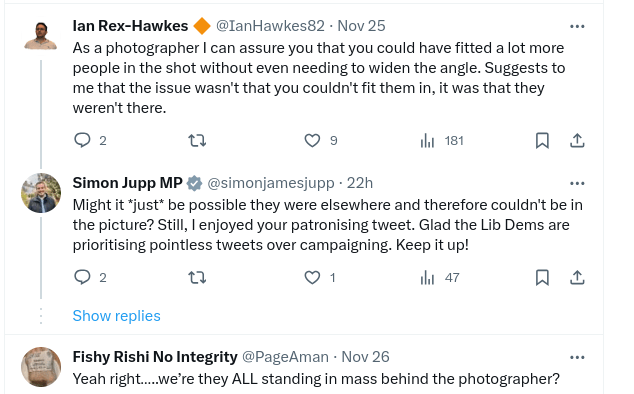
Now Simon Jupp is “padding out” supporter numbers by claiming that he can’t get them all in the picture (when he clearly can, as pointed out by Ian Rex-Hawkes). 

Anyone remember the school photo with little Simon sitting cross legged in the front?

Jeremy Hunt’s budget cuts spark fears of ‘existential threat’ to English councils

Has he pushed Devon County over the brink? – Owl

Jeremy Hunt has been warned he will trigger a fire sale of public assets, reduce councils to an emergency service and put the vulnerable at greater risk after an autumn statement pointing to a new wave of austerity.

Michael Savage www.theguardian.com 

There will be a significant increase in the number of councils in effect “returning the town hall keys” to government because they are no longer sustainable, according to council leaders. In a furious response to the autumn statement, they said several “flagship blue counties” could go bankrupt just as next year’s election is called.

The backlash comes after economists concluded that the chancellor’s tax cuts last week in effect came at the expense of future public spending. Once settlements for Scotland, Wales and Northern Ireland are taken into account, non-protected government departments in England face an annual cut of 3.4% for five years.

The state of prisons, backlogs in the legal system and pressure on further education have caused most immediate alarm. Sir Bob Neill, the Tory MP who chairs the Commons justice select committee, said that there was a case for “revisiting which departments should be given protection” from spending cuts.

Traditionally, ministers have chosen to prioritise the NHS and schools.

However, local government sources said that after austerity since 2010, there was now an “existential threat” to local services – while big council tax increases could be on the cards.

“Things are starting to fall apart at the seams,” said one despairing leader. Another warned: “We need to have a recognition that if we aren’t properly funded the rest of the country will fall over.” A third said: “The system is totally and utterly broken.”

One senior Tory said: “The Treasury is fully aware that some flagship blue counties are right on the edge: falling over just before the election won’t look good.”

Mel Lock, director of adult services for Somerset, warned of a real human cost. “No doubt about it, it’s going to be older and disabled people not getting timely support,” she said.

“Some will end up in hospitals, or will be delayed leaving. That means lives will be restricted and foreshortened. That’s the bottom line to it.”

Shaun Davies, leader of Telford and Wrekin council and chair of the Local Government Association, said there would be a big increase in the number of councils in financial distress. “Any suggestion of any further cuts on top of the current deficit we face and we’ll see the number of councils set to go bankrupt rise from one in 10 to a significantly higher number.

“They’ve done the restructures. They’ve done the asset sales, they’ve done the staff reduction, they’ve done the service redesign and they’ve done the transformation. They’ve used the reserves already. Once those things are gone, they’re gone. My concern is that there is a wave of councils that will effectively return the town hall keys back to the government because there is just no way out of this.”

Councils that in effect fall into bankruptcy can issue a section 114 notice, signalling that they cannot balance their budgets. Jonathan Carr-West, chief executive of the Local Government Information Unit which has just surveyed the opinions of council leaders, said he was “starting to talk about this as a sort of existential threat to local government”.

“What has surprised me in the last couple of days is just how angry leaders are,” Carr-West said. “It’s big Labour cities like Bradford, but it’s also Kent and Hampshire – big Conservative councils.

“I don’t believe that there is a conspiracy to destroy local government. But I think we are sleepwalking towards a position where councils just won’t be viable.”

He said that while assets could be sold off in the short term, it would lead to a big transfer of wealth of public assets into private hands.

Elsewhere, there are concerns over the condition of the prison estate and a lack of experienced officers. Charlie Taylor, the chief inspector of prisons, saidthe situation was “very fragile” and his biggest worry was the lack of activity for prisoners and the impact on their rehabilitation.

“Out of 37 prisons we inspected in our last annual reporting area, only one of them was good or reasonably good for purposeful activity,” Taylor said. “The risk is that the revolving door of people committing crime going back into prison, costing the taxpayer a huge amount of money, simply continues.”

There are also concerns about further education funding over the next five years. Louis Hodge, an associate director at the Education Policy Institute, said: “Cuts in funding for further education have been around twice the rate experienced in schools and over a quarter of children now live in relative poverty, based on data that does not yet fully reflect the effects of rapidly rising prices over the last year.”

He added: “Whatever the outcome of the next election, it is clear there is much to do to get education back on track following a hugely disruptive pandemic and a decade dominated by funding cuts.”

Portreath: Swimmers protest 26 consecutive sewage alerts 

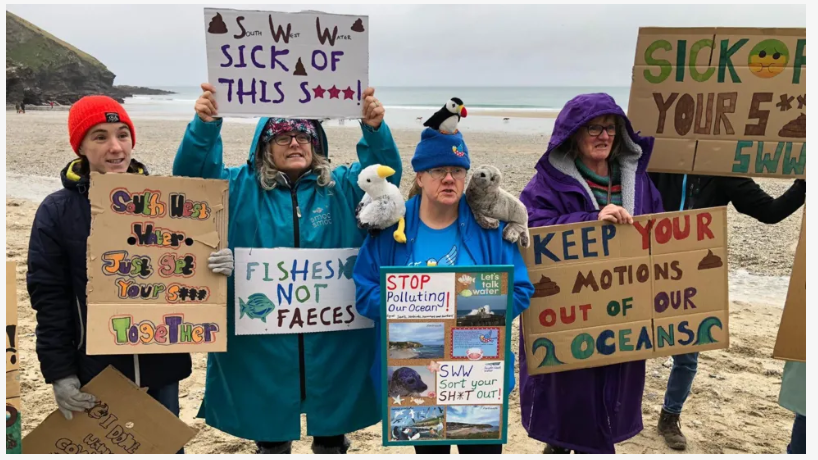
A protest has taken place on Portreath Beach in Cornwall as locals say there have been sewage alerts for 26 consecutive days.

Swimmers said they had not been able to enter the water there, and that South West Water (SWW) had not given them any explanation.

Campaigning charity Surfers Against Sewage (SAS) said multiple sewage alerts had also been flagged at Porthtowan, St Agnes, Godrevy and Gwithian recently.

SWW declined to comment.

He said: “That should only happen in exceptional circumstances when the rain is such and [sewage systems] cannot handle it.

“But, quite clearly, the system cannot handle it day-by-day right now.”

Tina Dennett, from Portreath & Porthtowan Bluetits swimming group, said if it was “something really simple, like a stuck valve, then they need to take action”.

He said: “If it is something more serious and we have had 26 days continuously of overspill here, then something drastic needs to be done about it.

“It’s shameful – shame on you South West Water.”

Sea swimmer Alison King said people and animals should not be swimming in sewage.

She said: “We want to come to a local beach and be able to swim at a local beach.

“I love animals as well and birds, and I don’t think they should be swimming in all our all our rubbish.”