The zombie Tory government staggers on

 Chris Riddell www.theguardian.com

The real s.. hole in this country is parliament.

The way it has treated the citizens of this country is utterly disgusting.

A housing crisis that has not been dealt with in more than 40 years.

A sewage system that has not had any proper level of investment in over 40 years.

No new reservoir built in over 40 year despite a big increase in population.

The total lack of investment in public services.

The promise of lower prices and more efficiency through privatization.

We appear to have a banking system that prefers to invest in the inflation of house prices rather than invest in businesses. This in turn then means that people cant afford to get on the housing ladder. It also means that the big multi nationals (who all off shore as much of their profit as possible) have effective monopolies in the market. They are allowed to offshore huge profits while at the same time paying poverty levels of wages that need to be topped up with in work benefits.

We shovel huge sums to big business. For example we are giving the big oil companies £42 million per week with the tax relief that goes to new oil and gas drilling while these companies are making massive profits. Around 90% of the cost of new oil and gas fields is being paid for by the tax payer through these tax reliefs.

Then people wonder why it is that we have so many low waged jobs in this country. We are continually told that they are going to turn us into a high skilled high wage economy and then never deliver what they tell us. They fail time and time again to invest in education and health properly.

We are continually told they are making things more efficient and that deregulation will lead to higher levels of growth.

If we have seen all of the efficiency improvements that we have seen governments bang on and on and on about why is it that housing is now so insanely expensive when compared to 50 years ago?

If we have seen all of the efficiency improvements that we see the government bang on and on and on about why is it that public services are on their knees?

Our whole system is in a total mess and the stench emanates from those who are running the country.

We are constantly fed a diet of lies and misinformation while watching the rich get richer and the poor get poorer.

‘A disgrace’: headteachers attack Hunt’s failure to provide money for schools in autumn statement

Headteachers have called the government’s failure to invest in school staff and crumbling buildings in the autumn statement “an absolute disgrace”.

Anna Fazackerley www.theguardian.com 

Unions said this weekend that the government had now lost any vestiges of credibility among teachers after the chancellor, Jeremy Hunt, failed to announce any new investment for schools on Wednesday – despite Rishi Sunak’s pledge at last month’s Conservative party conference that education would be his “main funding priority”.

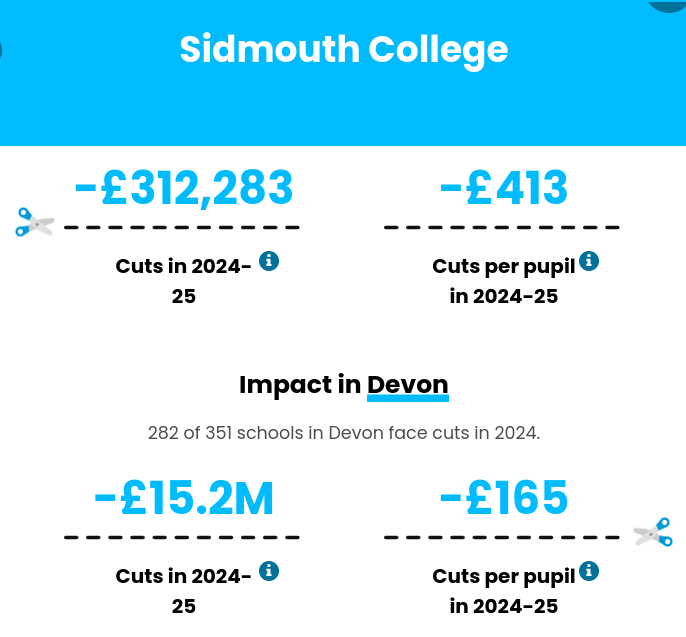
With education unions determined to make staff shortages an election issue, parents can now search the newly relaunched School Cuts website to see whether their local school may be forced to shed teaching staff next year. The unions warn that 99 per cent of state secondary schools and 91 per cent of primaries will have to make cuts to survive in 2024.

[Examples of searches on the School Cuts website]

Garry Ratcliffe, chief executive of the Golden Thread Alliance, which runs nine primary academy schools in Dartford and Gravesend in Kent, told the Observer: “Especially with support staff, when someone leaves for a better paid position in a supermarket, most schools are now asking: ‘Can we afford to replace them?’”

Ratcliffe’s schools are now focusing on helping struggling families with food and cheap presents for Christmas, despite fighting to cope with rising costs themselves. He added: “People in schools have given up hope that this government will suddenly start to invest in children’s education.”

A primary school head in a deprived area of north-west England, who asked not to be named to avoid alarming parents, said the potentially dangerous reinforced autoclaved aerated concrete (Raac) recently discovered in his school’s roof was far from the only problem. “The list is endless: asbestos, flooding, damp, cracked windows,” the head explained.

“And we need urgent safety upgrades to our school entrance and car park which have been delayed because of Raac. The fact that education spending is going to be flat is an absolute disgrace.”

The head said he had had to “really fight” to get the Department for Education to approve a temporary “crash deck” to make the school usable after it joined the growing list of schools deemed unsafe due to Raac. However, the department is refusing to provide any timetable for a decision on what to do to make the school safe permanently, or whether it will need to be demolished.

Tim Warneford, a consultant who advises academies on their buildings, said the autumn statement would lead to “further deterioration” of thousands of schools as they faced another winter with serious issues including Raac, leaking roofs, broken boilers and asbestos.

He said: “This has to be another reason for poor attendance. Why would you want to come in if your school isn’t safe or warm or dry? What message does that send to children about how much they are valued?”

A damning parliamentary inquiry into the school estate found that 700,000 pupils are learning in classrooms that need a major rebuild or refurbishment, but many schools have no hope of an overhaul because of the Raac crisis.

Paul Whiteman, general secretary of the National Association of Head Teachers, said: “Teaching assistants and support staff will probably be the first roles to go as schools try to make savings, and of course that will hit the most vulnerable children who need extra support that won’t be there.”

He added that after the autumn statement, the government has “completely lost the trust of the teaching profession”.

Geoff Barton, general secretary of the Association of Schools and College Leaders union, said: “On current funding levels, schools will only be able to afford a 1% pay award for staff next year – and this is in the midst of the worst recruitment and retention crisis in living memory.”

A Department for Education spokesperson said: “Our school rebuilding programme is transforming 500 schools over the next decade, with the first 400 projects selected ahead of schedule. The education secretary has already confirmed we will fully fund the removal of Raac from our schools – either through grant funding or through the school rebuilding programme.”

Pay-and-display parking for Sidmouth and Honiton?

County council announces a public consultation for eight Devon towns

Pay-and-display parking could be on the cards for the East Devon towns of Sidmouth and Honiton, the county council has revealed.

Becca Gliddon eastdevonnews.co.uk

Once the Traffic Orders are advertised at the November, and into December, the public will have just 21 to make their views known.

Devon County Council (DCC) said comments received through the public consultation will be considered before any final decision is made,

DCC said installing pay-and-display parking in Sidmouth and Honiton would bring the towns in line, locally, with Exmouth and Exeter.

It said the proposals included free parking for the first hour and would result in converting existing limited waiting bays.

The proposed changes have been announced for eight towns across Devon – Braunton, Crediton, Dartmouth, Honiton, Okehampton, Salcombe, Sidmouth and Tavistock.

A Devon County Council spokesman said: “The proposals are for communities which do not already have -or have very little – pay-and-display.

“The proposals are located in busy town centres where vehicles often spend time circulating looking for parking places and where off-street parking is available.”

The county council believes the restrictions will:

  • Manage congestion
  • Improve air quality
  • Provide a safer environment for pedestrians and cyclists
  • Maintain reasonable access to premises
  • Encourage off-street car park use and shorter stay parking

A DCC spokesman said: “Pay and display parking is widely used, both across Devon and nationally, with well-established schemes in communities such as Bideford, Barnstaple, Newton Abbot, Totnes, Exmouth and Exeter.

“It can help reduce congestion and encourages the turn-over of vehicles and availability of parking spaces, particularly in busy town centres, thereby helping to support the local economy and the use of local shops and businesses.

“Following discussions with local members and community representatives, the proposals also include one-hour free parking in the new pay and display spaces in all eight communities.

“This is to ensure that the new parking policy strikes the right balance of keeping costs down for users while delivering the benefits we have identified.”

Councillor Stuart Hughes, DCC cabinet member for highways management, said: “I understand there may be concerns about pay and display, and that is why we have talked to local groups and elected members to ensure that the first hour parking is free.

“Pay and display has been in place in many communities in Devon for some years and we believe it is one of the components that is needed to ensure a healthy high street and community.

“It encourages turnover of parking spaces thereby increasing the availability of town centre parking in busy areas, it reduces congestion and may encourage some to walk and cycle more.”

The proposals follow a review of parking management agreed by the county council in November 2022.

Exmouth seawall fix to cost £1.1 million

100-year-old structure has no foundations

Wall isn’t all it’s cracked up to be (image courtesy: EDDC)

A barrier of vertical steel sheet piles costing more than a million pounds could be the solution to save a section of Exmouth’s sea wall.  

Will Goddard, local democracy reporter www.radioexe.co.uk

Cracks in the wall, which is believed to be around 100 years old, appeared in August in front of the Sideshore development. 

A storm at the end of October significantly dropped beach levels and caused the wall to “crack and slump,” putting it “at serious risk of collapse.”

Concrete blocks were then put at its base ahead of Storm Ciaran, which helped keep it intact. 

The wall has failed because it has no foundations at this location and has been undermined, according to a report to East Devon District Council (EDDC)’s cabinet, which estimates the repair cost at £1.1 million.

When waves wash out sand from underneath, the structure cracks. A further storm may remove the stone, which would eventually lead to all of the sea wall “unzipping” and land behind being lost to the sea. 

To fix the problem, a vertical steel sheet piled wall in front of the current wall has been suggested. This could be in place indefinitely or at least until next autumn. 

The sloping seaward revetments would be removed, or alternatively repaired or replaced for aesthetic purposes. 

Other options such as beach recharges and rock defences were considered, but thrown out because of high costs. 

Currently only 90 metres of the 255-metre section between Coastwatch House and Sideshore has failed. 

But the remaining 165 metres of wall is “of the same construction and at risk of failure”, the report warns, and would be more expensive to repair later. 

The Environment Agency could help cover between £250,000 and £400,000 of the cost, but this is not guaranteed. 

Works are “unlikely to start until January and there will probably be further costs as temporary repairs are made until then. But there is a chance they could start next month. Installing the piles will take eight and a half weeks. 

“The main risk is that the wall falls completely before we start with the end solution”, the report warns.  

East Devon District Council’s cabinet will decide what to do when it meets next Wednesday.

‘Ground-breaking’ Devon super council explained

Interesting to conjecture what the impact of hiving off the two concentrated urban areas of Plymouth and Torbay into combined authorities has been on the rural economy of Devon. Obviously services can be provided more efficiently to urban areas than to rural ones. Despite this Torbay has been struggling. – Owl

Guy Henderson www.devonlive.com

A devolution deal which will see more power and money coming Devon’s way has been hailed as ‘fantastic’ by the leader of Torbay Council. And while Devon County Council ’s top councillor agrees it is hugely significant, his counterpart at Plymouth City Council has decided it would be a ‘backward step’ and wants no part of it at all.

Under the deal announced by the government last week, Torbay and Devon will become one powerful combined local authority.

But Plymouth will not be part of the union. Exeter City Council and Devon’s other district councils – West Devon, Mid Devon, East Devon, North Devon, Torridge, Teignbridge and South Hams – are also not part of the deal and will remain intact.

The people involved in Torbay and at Devon County Council are adamant that the new combined authority is not a merger, but instead two councils coming together as equal partners.

For football fans, imagine Exeter and all of those districts are in League Two. As unitary authorities, Torbay and Plymouth are currently with Devon County Council in League One.

But the devolution deal means that while Plymouth will choose to stay where it is, the new Torbay/Devon combo will be promoted to the higher-stakes Championship of local government.

The Premier League remains the domain of giant mayor-led authorities like those in Greater Manchester, Liverpool and South Yorkshire. The Torbay/Devon combined authority will not have an elected mayor. But it should have more resources.

The new partnership will be run by a ‘cabinet’ consisting of three elected councillors from Torbay and three from Devon, probably the leader of each council and two more.

The district councils will have four seats at the table between them, and there will be places for other people to be appointed. These could include business leaders, education chiefs and the county’s police and crime commissioner.

An overall leader will be chosen by members of the ‘cabinet.’

Supporters of the deal say it will give the combined authority (CA) a seat at the top table when the government doles out grants and support for projects covering issues such as local transport, adult education and the drive to achieve ‘net zero’ in carbon emissions.

Nigel Long of the Local Government Information Unit says that by this time next year the majority of the population in England will be living in council areas covered by a combined authority.

More powers are coming, too. Housing investment and the regulation of social housing are among the policies being considered for devolution by the current government.

And in the future, says Mr Long, devolved local authorities could even take back control of energy, transport and water for the first time in decades.

The Local Government Association says a combined authority allows a group of two or more councils to collaborate and take collective decisions across council boundaries. It says it is ‘far more robust’ than an informal partnership or even a joint committee.

It goes on: “The creation of a CA means that member councils can be more ambitious in their joint working and can take advantage of powers and resources devolved to them from national government.”

The government says a transfer of power from Whitehall to local leaders will help to address weak economic performance and the high regional levels of inequality.

In July, the Institute for Government said: “Devolution has led to improved decision-making in many places – but is no silver bullet. Devolution deals have enabled local leaders to allocate resources, regenerate their economies and reshape public services in light of local needs and preferences.”

Labour supports devolution, too, meaning that the Torbay/Devon process is unlikely to be derailed whatever happens at the next general election.

Torbay says the new deal is “ground-breaking” and will build on the bay’s long history of working as partners with the county council. Projects like the A380 South Devon Highway were founded on the close partnership between the authorities.

Torbay Council leader David Thomas said: “We see real opportunities from our continued working together on transport and other key issues across Devon and Torbay, and we are confident this devolution deal will bring positive benefits for our residents, economy and communities.”

And John Hart, leader of Devon County Council, added: “It will put Devon and Torbay in a new and very different relationship with government, one where we will have a stronger voice in Whitehall and an ability to influence policy.

“We have, for a long time, worked well as neighbouring authorities to deliver good public services for Devon residents and to tackle key local priorities. The prospect of significant government funding and powers devolved locally will enable us as a partnership to make a real difference to people’s lives.”

A public consultation will now be launched, and a final decision on whether or not the promotion to the ‘Championship’ goes ahead is expected early in 2024.

However, Plymouth City Council leader Tudor Evans has warned the proposed deal was “unreasonable and unrealistic.”

He said it would have seen Plymouth having less power and control over transport in the city, with no commitment to increased resources. The city has been working alongside Devon and Torbay on the deal for more than two years, from before the current Labour administration took over, but has now decided it doesn’t make sense for Plymouth.

Cllr Evans said: “The final deal on the table would have been a step backwards given that 25 years ago Plymouth became a unitary authority and took back responsibility for key areas such as education and transport.

“The aim of a devolution deal was to hand control from Whitehall to a Devon combined authority, not take away existing powers from Plymouth. The government is insisting that we surrender our powers and funding regarding transport. Therefore, we have no choice but to withdraw. It is massively disappointing.

“In the meantime, we wish our Devon and Torbay colleagues well in progressing a deal that is right for them.”

How risky was the Autumn Statement?

Bearing in mind the damage done only a year ago by Liz Truss, these two paragraphs from Paul Johnson spell out the risks, short and long term ,of what the Tories have now done. – Owl

 Paul Johnson, Director of the IFS ifs.org.uk:

Two paragraphs from his response to the Autumn Statement 2023 

Announcing immediate tax cuts in response to highly uncertain changes in assumptions about the UK’s medium-term economic prospects does not feel like a recipe for good management of the public finances, especially when some extra “space” is opened up by announcing another year of very low increases in public service spending, and cuts in investment spending, which may prove hard to deliver.

This may turn out to be risky even in the short run. His so called “headroom” against a rather loose fiscal target is minuscule and the OBR could easily take it away in the Spring Budget with some very small changes to forecasts. What will he do then? Certainly, whoever is Chancellor after the next general election is going to have very little room for manoeuvre.

Holy Batshit – he’s done it again!

Tory Mayor Calls On James Cleverly To Apologise Over Stockton ‘S***hole’ Row

A Tory mayor has called on James Cleverly to apologise after he was accused of calling an English town a “shithole” in the Commons.

Kevin Schofield www.huffingtonpost.co.uk 

The home secretary has denied making the comment about Stockton North during prime minister’s questions yesterday.

It came after Alex Cunningham, the Labour MP for Stockton North, asked Rishi Sunak why 34% of children in his constituency lived in poverty.

Cleverly has insisted that he actually called Cunningham “a shit MP”.

But in an extraordinary intervention, Ben Houchen, the Conservative mayor for Tees Valley, effectively called his party colleague a liar by demanding he say sorry.

In a statement posted on X (formerly Twitter), he said: “I’m not interested in excuses and I will always put our area above party politics, and it is clear to me that the home secretary should apologise for dragging Stockton’s name through the mud.

“Having made huge progress in recent years with major investment, thousands of jobs and Teesside forging a brighter future in the in the industries of the future including a new era of steelmaking, this type of language only furthers the outdated and inaccurate stereotypes we’ve battled for years.

“We’re a wonderful place and passionate and proud community, and people across the world are looking at the exciting future that is emerging before us – but childish and unprofessional language used by Westminster politicians, who should know better, does nothing to help our plans for progress.”

When the row erupted yesterday, a spokesman for Cleverly said: “He didn’t say that. He wouldn’t say that. He’s disappointed anyone would accuse him of it.”

But in response to Houchen’s comments, a source close to the home secretary said: “James made a comment. He called Alex Cunningham a shit MP. He apologises for unparliamentary language.

“As was made clear yesterday, he would never criticise Stockton. He’s campaigned in Stockton and is clear that it is a great place.”

Exeter named UK’s toughest city on crime

Exeter has been named as the UK city where police are “toughest” on crime. New figures show that it has the highest percentage of reported crimes resulting in a charge.

Mary Stenson www.devonlive.com

Analysis of crimes reported in cities across the UK has shown police in Exeter to have had the highest percentage of suspects charged from June 2022 to June 2023. Out of 1,423 incidents reported to the police in that time frame, 20.1 per cent resulted in someone being charged.

The South West dominated the top spots, with Devon’s other city Plymouth coming in second place having a charge rate of 16.85 per cent out of 3,063 reports, while Bristol came in third and had a rate of of 15.56 per cent out of 26,746 reports. The rest of the top ten consists of cities in the North of England, as well as Wrexham in Wales.

Both cities in Devon had a significantly lower number of reported crimes than most other cities. However, all of the top ten cities were way above the national average for suspects being charged, which sits at 6.37 per cent.

In the data, analysed by Lawhive, police reports in each city were also broken down by crime category. Exeter was in the top three in the majority of crimes listed and ranked at number one for the percentage of charges relating to criminal damage and arson.

A number of other outcomes were listed for reported crimes, with the most common being “unable to prosecute suspect” which represented 510 cases. In 6 incidents formal action was “not in the public interest”, in 462 investigations no suspect was identified, a local resolution was found in 66 cases and an offender was given a caution in 93 cases. In the remaining 286 cases, a suspect was charged.

It comes just weeks after Devon & Cornwall Police was named the safest force area in the country by the Office of National Statistics (ONS). There had been concerns that previous issues with the force having been placed into special measures and a lack of crime figures in 2022 due to issues with installing a new crime recording system. ONS was able to confirm to PlymouthLive that all these factors had been taken into account and Devon & Cornwall Police had still come out on top.

While crime figures for Devon and Cornwall are now back in the public domain, there is still a lag with restoring hyper-local figures to police.uk. Earlier this month a Freedom of Information request by DevonLive revealed a snapshot of the figures that are missing from public record, showing that 849 crimes had been recorded in the city in August this year. Devon & Cornwall Police say they are having to carry out thorough checks on locations before they can fill in the backlog on police.uk’s crime maps.

Report delays celebrity chef’s Sidmouth seafront Rockfish restaurant plans

Celebrity chef Mitch Tonks has delayed putting his Sidmouth Rockfish restaurant proposals in front of planners, writes local democracy reporter Bradley Gerrard.

eastdevonnews.co.uk

The Rockfish restaurant chain owner has been asked by the Environment Agency to provide more detailed flood risk assessments before his plan for the town’s Drill Hall goes to East Devon District Council’s (EDDC) planning committee.

The proposed build, at the former headquarters of the Sidmouth Territorial Army branch, was set to be debated by Councillors on Tuesday (November 21), but will now be considered at a future date.

The Environment Agency has asked Mr Tonks for a flood evacuation plan before the committee considers the scheme.

East Devon District Council, which owns the land, said it is committed, alongside Rockfish, to “achieve the redevelopment of the seafront site”, and that Mr Tonks would work hard to get the application in front of planners soon.

Mr Tonks originally hoped the restaurant would open to the public in the autumn of 2020.

Rockfish owner Mitch Tonks says he is looking forward to opening an eatery in Sidmouth.

The scheme, which would involve replacing existing public toilets with fewer cubicles, had split opinion.

A total of 15 out of 24 public comments were objections, which cited the negative impact on views to Port Royal, the loss of recreation land, and loss of existing shelters and seating next to the building.

However, those in support acknowledged that redevelopment was “much needed” and recognised the potential for new jobs.

They also welcomed the removal of the shelters, stating that this could help decrease anti-social behaviour there.

Sidmouth Town Council supported the application, but highlighted a “missed opportunity to provide an exceptional building which would take full advantage of the views of the World Heritage Site and be a credit to Sidmouth”.

The town council added that it did not feel that two unisex toilets were sufficient to replace the current public conveniences.

£27bn “Headroom” comes from  reducing public services – Welcome to Austerity 3.0

This is the impact on Local Authorities.

Will Devon now go bust? – Owl

www.localgov.co.uk

The Office for Budget Responsibility’s fiscal outlook published today says ‘it is mainly due to the Chancellor’s decision to leave departmental spending broadly unchanged’ that borrowing is reduced by £27bn in 2027/28 compared to its March forecast.

The OBR estimates that day-to-day spending in departments which are not protected like health and care, education, defence and international development would need to fall by 2.3% a year in real terms from 2025/6 after the end of the current Spending Review to meet current forecasts. The OBR says this would ‘present challenges’ and mentions the 11 s114 notices issued by councils as an example of ‘signs of strain.’

It adds that use by councils of current reserves for current spending increased by £2.3bn in 2022/23 for the first time since 2019-20 and predicts that ‘there will be further drawdowns during the current Spending Review period, of £1.5bn in 2023/24 and £0.8bn in 2024/25 ‘compared to an assumption of no drawdown in both years in our March forecast.’

The OBR says that ‘delivering these spending plans while maintaining or improving public services would require significant improvements in public sector productivity.’

The Autumn Statement says that ‘the government has therefore driven even greater efficiencies than those assumed at Spending Review 2021 to manage down these pressures and ensure departments can live within their settlements and deliver the service outcomes the public expect.’

Cllr Sir Stephen Houghton, Chair of the Special Interest Group of Municipal Authorities (SIGOMA) said: ‘With a 1% rise in spending on public services set for the coming years, unprotected departments like local government will face another round of damaging austerity, following the decade of cuts since 2010.’

Autumn Statement  – bad news for Lord “Big Dave”?

As the Chancellor seeks to recoup £5bn in unpaid taxes.

“We will ensure that over time the growth in public spending is lower than the growth in the economy whilst always protecting the services the public value. I will also provide HMRC with the resources they need to ensure everyone pays the tax they owe, raising an additionFromal £5 billion across the forecast period.”

From: Autumn Statement

See:

HMRC examines if David Cameron failed to fully disclose Greensill private flights as taxable perks

Autumn Statement explained by Paul Johnson in 90 seconds

We’re not in a good place. – Owl

Expanded version below:

Paul Johnson, director of the IFS, has just issued his early analysis of the autumn statement.

Johnson starts by “getting a few things straight”:

The public finances haven’t meaningfully improved. The growth outlook has weakened. Inflation is expected to stay higher for longer. Higher inflation pushes up tax receipts by more than it pushes up spending on debt interest or social security benefits.

But rather than use the proceeds to ease the ongoing ‘fiscal drag’ effects of threshold freezes, or to compensate public services for higher costs, the Chancellor opted to cut other taxes – most notably National Insurance and corporation tax.

These tax cuts won’t be enough to prevent this from being the biggest tax raising parliament in modern times.

Johnson then warns that announcing immediate and certain tax cuts in response to highly uncertain changes in assumptions about the UK’s medium-term economic prospects is “not a recipe for good management of the public finances”.

One reason the Chancellor feels he has space for tax cuts is that the forecasts have rolled forward, giving him another year to get debt falling under his fiscal rules, buying him an extra £5 billion to play with – but this hardly represents an underlying improvement in the state of things.

Spending the entirety of such a windfall, but allowing borrowing to rise when bad news comes along, is not the route to fiscal sustainability.

Johnson says the “prudent thing” would have been to build in a larger buffer into his plans, rather than only aim to meet the government’s “poorly designed, and loose” fiscal target by a tiny margin.

That’s especially true when one considers the possibility that things move against the Chancellor in the spring. But instead we got tax cuts, which will limit the room for manoeuvre for whoever is Chancellor after the next general election. That might make for good politics. It does not make for good policymaking.

Having said all that, Johnson concludes, Hunt has chosen a “pretty sensible set of taxes to cut”.

Making full expensing permanent rather than temporary is welcome, though it’s a shame there was no hint of an appetite for more structural reform. Cutting National Insurance is a good way to boost employment.

But these tax cuts have been ‘paid for’, in effect, by a bigger squeeze on the real-terms value of public service budgets and an even bigger squeeze on public investment, which is frozen in cash terms. There’s a material risk that those plans prove undeliverable and today’s tax cuts will not prove to be sustainable.”

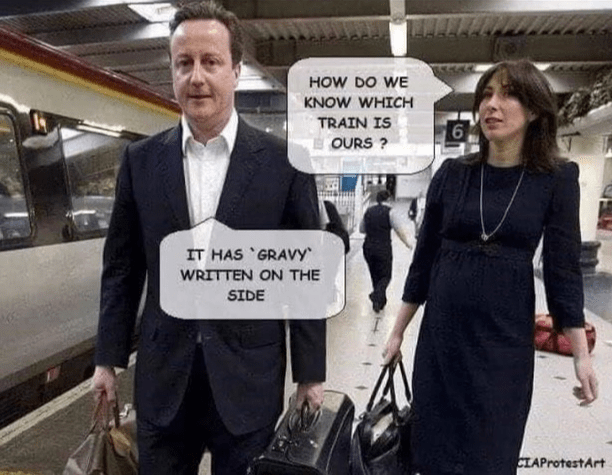
HMRC examines if David Cameron failed to fully disclose Greensill private flights as taxable perks

Oooops! – Owl

Tax officials are understood to be examining whether David Cameron failed to fully disclose taxable perks such as flights on private planes when he worked for the collapsed lender Greensill Capital, the Guardian can reveal.

Anna Isaac www.theguardian.com [Extract]

In particular, officials are said to be looking at a number of flights that took off or landed near his house in Oxfordshire and also in Cornwall, where the foreign secretary has a holiday home. They are also examining an offshore trust that it is understood was created by Greensill to pay him extra benefits.

It comes amid wider concerns that the process for appointing the former prime minister to the House of Lords, and other background checks for his cabinet appointment, were rushed through in a bid to keep the details of Rishi Sunak’s reshuffle secret…..

Sort the trains to get Britain back on track

Where is the PPS to the Transport Secretary when you need him, following his boss’s line that trains are becoming redundant perhaps? – Owl

“It’s 6am on Monday at Tiverton station, still dark and dank, but platform two is heaving. We have just been told — yet again — that the first London train has been cancelled: inclement weather or staff shortages, it’s not clear. We must wait 50 minutes for the next arrival. Many trundle disconsolately back to the freezing waiting room and queue for the coffee machine.”

Alice Thomson www.thetimes.co.uk [Extract]

Then a second announcement confirms that the next train is delayed by 38 minutes due to overrunning engineering works. It had given up on Cornwall altogether and had started in Exeter. By the time the headlights emerge from the gloom, it is clear work interviews and hospital appointments will be missed. Teenagers are running late for lessons in Taunton and a woman is in tears.

A noticeboard reminds passengers that there will be a series of strikes in the run-up to Christmas. Attendance at office parties and carol services will have to be cancelled. Roads will be jammed as families struggle with travel arrangements. A year ago, few would have cared. After the pandemic the station and car park were almost empty on Mondays. Now there is an air of quiet desperation.

If the prime minister and chancellor want to encourage people back to work they need to sort out public transport. Mark Harper is the latest Tory transport secretary to imply that trains are becoming redundant when he said passenger numbers had plummeted 50 per cent in the past three years. But the figures show he’s wrong.

Commuters and recreational train travellers are making a comeback. On some routes passenger numbers are higher than pre-pandemic. Meanwhile, the new Elizabeth Line is crammed at 8am and 6pm as workers abandon their Zoom calls and head into London offices from Slough and Brentwood.

Young adults rely on public transport. Only one in four under-21s and fewer than two thirds of under-30s have a driving licence, saying they are priced out by the cost of lessons, owning a car and insurance, according to the National Travel Survey. On top of that, rent increases and house prices have forced many young employees further out of towns and cities, too far to walk or bike to work. They need reliable journeys that don’t make them look flaky to bosses.

Trains are environmentally justifiable and save on inner-city parking space; they should provide time to read and relax and entice older people out of their cars. Yet new rolling stock isn’t made for comfort: the seats are hard, the carriages heaving. Train travel has become an ordeal……

Defra’s failure to protect and restore water bodies ‘unlawful’, high court rules

“Lawyers acting for the campaigners believe the ruling could force the government to strengthen its entire water plans including its much derided “plan for water”, which was announced earlier this year.”

Helena Horton www.theguardian.com 

The government and environment agency failed in their duty to restore and protect waterways from pollution, the high court has ruled in a significant case that could force an overhaul of the government’s plans.

Fish Legal and Pickering Fishery Association took the government to judicial review over its river basin management plan for the Costa Beck river in the Humber district, which had a reputation as one of the best fly fishing spots in the UK until a few years ago.

The lawyers presented the court with evidence that the Costa Beck is failing for fish under the Water Framework Directive regulations. One of the reasons for that, they argued, is sewage pollution – Yorkshire Water’s “storm” sewage overflow at Pickering treatment works discharged into the Costa Beck more than 250 times in 2020 and more than 400 times in 2019.

They argued that the Environment Agency had failed to follow through with its proposed action against polluters.

The high court ruled that the government and the Environment Agency had failed in their mandatory legal duties to review, update and put in place measures to restore rivers and other water bodies under the Water Framework Directive regulations. The judge concluded there was no evidence the programme of measures could be expected to achieve the stated environmental objectives.

The judge accepted discharges were contributing to the poor condition of the river and said that, under the regulations, discharges for specific rivers such as the Costa Beck need to be regulated more tightly, if their condition is to improve.

The judge characterised the approach of the secretary of state for the environment as one of “smoke and mirrors”. The angling club, which won the court case, said the secretary of state was planning to fail.

Lawyers believe the ruling means the basis for the government’s plans to protect waterways from pollution – which have been criticised as weak – could be unlawful, and ministers could be forced to strengthen their measures.

This has potentially created a mess for the new environment secretary, Steve Barclay, who may have to overhaul the plans of the Department for Environment, Food and Rural Affairs (Defra).

It could open the door for other groups to bring similar challenges for the other river basin plans across the country, as the court found that the fundamental requirement to assess and identify specific measures to achieve the legally mandatory targets for each water body – such as tightened environmental permits for controlling sewage pollution – had unlawfully not been done.

Andrew Kelton, a solicitor at Fish Legal, said: “This case goes to the heart of why government has failed to make progress towards improving the health of rivers and lakes in England. Only 16% of water bodies – 14% of rivers – are currently achieving ‘good ecological status’, with no improvement for at least a decade, which comes as no surprise to us having seen how the Environment Agency at first proposed, but then for some reason failed to follow through with the tough action needed against polluters in this case.

“The Upper Costa Beck is just one of 4,929 water bodies, but it is a case study in regulatory inaction in the face of evidence of declining river health.”

He added: “The Environment Agency and the government have taken a high-level, generic – and effectively non-committal – approach to achieving targets when what was needed was a water-body-by-water-body plan of real action to stop ongoing damage.

“We hope this ruling will lead to actual environmental improvements, not only on the Costa Beck but on every other ‘failing’ river and lake across the country.”

Lawyers acting for the campaigners believe the ruling could force the government to strengthen its entire water plans including its much derided “plan for water”, which was announced earlier this year.

Penelope Gane, head of practice at Fish Legal, said: “The environmental objectives and information in river basin management plans underpin all sorts of long-term statutory plans and other strategic planning, including the government’s plan for water, water company business plans, water resources regional plans and the chalk stream restoration strategy. This legal action exposes that all of those policies and plans are effectively built on foundations of sand.”

A spokesperson for Yorkshire Water previously said: “The EA has undertaken water framework directive assessments at Costa Beck. These indicate that neither the water industry nor sewage are either confirmed or even probable causes of the watercourse failing to achieve good ecological status.

“Yorkshire Water is not party to this ongoing case. Nevertheless, we continue to work in partnership with the local angling association on this issue.”

The shadow secretary of state for the environment, Steve Reed, said: “The water industry is broken after 13 years of Conservative failure, with stinking, toxic sewage swilling through our rivers, lakes, and seas. This Conservative government’s plan is so weak it’s now been declared unlawful. They have been happy to stand by and let the sewage flow due to their sheer incompetence.

“Only Labour will take tough action to end this scandal by putting the water industry under special measures. We will ban water bosses’ bonuses, and introduce severe, automatic fines until the water companies clean up their filth.”

A Defra spokesperson said: “We are carefully considering the outcome of this judgment and next steps.

“The government has an ambitious plan for water, which is delivering more investment, stronger regulation and tougher enforcement needed to clean up our waterways. This includes reforming river basin management plans and delivering tailored long-term catchment action plans for local groups to improve all water bodies in England.”

Boris Johnson was ‘bamboozled’ by science during the pandemic, Patrick Vallance reveals

Basic literacy and numeracy are essential life skills, how come so many in government seem to lack the latter? How do they pass the selection process? – Owl

Boris Johnson was “bamboozled” by the science during the pandemic and had to have details explained to him “repeatedly”, the Covid inquiry has heard.

Archie Mitchell www.independent.co.uk (Extract)

Sir Patrick Vallance’s bombshell diary entries revealed in excruciating detail how the former prime minister struggled to understand graphs and “just could not get” some scientific concepts.

The former chief scientific adviser – one of the government’s most senior advisers during the pandemic – told the inquiry about how he kept daily notes as a “brain dump” to help him “decompress” — and never intended them to “see the light of day”.

But the diary extracts have already proved humiliating for Mr Johnson, with the inquiry hearing how Mr Johnson sometimes struggled to retain scientific information, was “clutching at straws” and at one point queried whether Covid was spreading “because of the great libertarian nation we are”.

In one entry following a meeting with Mr Johnson in May 2020 about schools, Sir Patrick wrote: “Late afternoon meeting with the PM on schools. My God, this is complicated. Models will not provide the answer. PM is clearly bamboozled.”

Another entry, also written in May 2020, said: “PM still confused on different types of test. He holds it in his head for a session and then it goes.”

In another humiliating passage for Mr Johnson, Sir Patrick wrote: “Watching the PM get his head around stats is awful. He finds relative and absolute risk almost impossible to understand.”

Later, in September 2020, Mr Johnson is talked through some graphs, after which Sir Patrick wrote: “It is difficult, he asks questions like ‘which line is the dark red line?’ – is he colourblind? Then ‘so you think positivity has gone up overnight?’ then ‘oh god bloody hell’. But it is all the same stuff he was shown six hours ago.”

Asked about the extracts, Sir Patrick said Mr Johnson “would be the first to admit it wasn’t his forte, and that he did struggle with some of the concepts and we did need to repeat them often”.

But Sir Patrick added that scientific advises from across Europe all recalled their leaders having problems understanding some concepts.