Flood protection plans for English homes cut by 40%

The number of properties that will be better protected from flooding by 2027 has been cut by 40%, and 500 of 2,000 new flood defence projects have been abandoned, according to the National Audit Office (NAO).

Helena Horton www.theguardian.com 

The number of homes forecast to be under enhanced flood protection by 2027 has been slashed from 336,000 to 200,000. This means 136,000 more homes will be at risk of flooding since plans were drawn up in 2020, figures from an NAO report show.

Despite the government doubling its capital funding in England to £5.2bn to combat the danger of flooding, a quarter of new flood defence projects will now not go ahead. The Environment Agency (EA) has blamed inflation for the cuts in protection.

Thousands of homes have been flooded during storms this autumn. Storm Babet was confirmed to have caused more than 2,000 homes to flood, while Storm Ciarán flooded more than 1,000. Storm Debi, which is causing havoc in Ireland, is expected to hit the west of England this week. Climate experts say storms are becoming more frequent and severe due to climate breakdown.

The EA has added protection from floods to 59,000 properties in England since 2020. It had a target of protecting 336,000 homes by 2027.

A shortfall in the agency’s finances means it cannot keep enough flood protections in the required condition to prevent destruction to homes. Due to inflation, the EA is £34m short of its expected budget, which means it will be be able to maintain only 94% to 95% of its assets at the required condition, resulting in 203,000 properties at increased risk of flooding. It had aimed to maintain 98% of its high-consequence assets at their required condition.

The flood protection programme got off to a slow start. There was an underspend of £310m in its first two years, which has been deferred by the Treasury to make sure the government meets its target of spending £5.2bn on flood defences by 2027. Because of this underspend the EA will have to spend an average of almost £1bn each year over the remaining four years of the programme. There are fears from the NAO that these pressures will further erode value for money if hasty decisions are made to spend the funds.

The NAO has also warned that the government has not set a long-term target for the level of flood resilience it expects to achieve and that there are no concrete plans beyond 2026 to meet long-term goals, meaning that long-term investment could be inefficient and not sufficiently protect enough homes from flooding.

Gareth Davies, the head of the NAO, said: “Government recognises the growing dangers from flooding and has committed to doubling its capital funding in England in the six years to 2027, as well as doing more to understand flood risk.

“However, the capital funding is forecast to better protect only 60% of the properties that were promised when the programme was launched in 2020, while inflation and other programme risks mean the Environment Agency could deliver even fewer than that. If there are further delays to the capital programme, Defra must work with HM Treasury to make sure it is in a position to switch money quickly into maintenance, where this would provide value for money.

“EA will have to manage a record level of capital investment in flood defences for the remaining four years of the programme. In doing so, it must resist pressure to accelerate projects or initiate new ones too quickly, if this is likely to lead to cost overruns and delays and put value for money at risk.”

Caroline Lucas, the Green party MP, said: “This report should be right at the top of new environment secretary Steve Barclay’s red box, laying bare the scale of ministers’ unforgivable neglect of this flooding crisis. Just weeks after huge numbers of homes were hit by devastating flooding, people are crying out for support and protection – yet this government has utterly failed to provide it. To add insult to injury, thousands more are expected to be unprotected from flooding risk in the years ahead.”

Tenth incumbent in thirteen years: ‘worst environment secretary ever’ 

A leading environmentalist described her to me as “the rudest and most uninterested politician” they had met. Farmers named her “the worst environment secretary ever” when all she could say about the devastating recent storms was that her department was ill prepared for “rain from the east”.

From Pig World magazine to Grocery Gazette, The National Trust, the RSPCA, the Country Land and Business Association and the fishing industry, no one lamented her demise. Senior civil servants called her “sullen, haughty and divisive”. The right to roam advocate Guy Shrubsole uttered the only kind words: “May you roam freely into the political wilderness, although the beavers might complain.”

Alice Thomson www.thetimes.co.uk (Extract)

Sixteenth Housing Minister in thirteen years!

Strong and stable government? – Owl

The sacking of Rachel Maclean means the UK is about to get its 16th housing minister since 2010. Housing campaigners are appalled, saying the government is failing to tackle problems in the sector because ministers change too frequently.

From Guardian Live:

This is from Polly Neate, chief executive of the housing charity Shelter.

The revolving door of housing ministers over the past decade, and in particular the last 18 months, proves the government’s failure to grasp the scale and urgency of the housing emergency. Rents are rocketing, evictions are soaring and homelessness is at a record high, yet we haven’t had a minister stay in the job long enough to get to grips with the problem.

The 16th housing minister since 2010 has to hit the ground running and the first thing on their to do list must be to pass a watertight renters (reform) bill and scrap no fault evictions.

And this is from Tom Darling, campaign manager at the Renters’ Reform Coalition.

Rachel Maclean attended our events and, though we don’t believe the government are going far enough on rental reform, she was always willing to engage with us – we wish her well for the future.

It is frankly shambolic that we will now be on to our 16th housing minister since 2010, and incredibly 9 just since the government promised to end no-fault evictions.

Now, just before the first day of the important committee stage, which involves poring over the detail of the bill, she is sacked – it makes a mockery of government and shows a shocking lack of respect for England’s 11 million private renters.

Planning applications validated by EDDC for week beginning 30 October

Will Simon Jupp now reinvent himself as a “wet”

Under the headline:

Rishi Sunak’s reshuffle gamble has set up a life and death struggle with the Tory right

the political editor of the Express reports:

“There is a belief widely shared that the reshuffle was “about destroying the right of the party.”

In so doing, it was also about “abandoning the new Red Wall seats won in 2019.”

One MP noted: “All the campaign cash is going to wet MPs in the south of England. They are more worried about dealing with the Lib Dem vote.”

This would mean that after an election the party will be “dominated by lefty Lib Dem-ish wets” as one put it.”

Using 1980’s terminology, do we think Simon Jupp is a “wet”, as defined above, or one of the right wing “dries”.

One thing is certain is that Simon Jupp is clearly politically ambitious gaining his experience in “interesting” company.

 He started his political career as a SpAd to Dominic Raab, generally described as a rightwinger, even as being more rightwing on education than Thatcher.

This seemed to give him an entrée into being selected as the Tory candidate to follow Hugo Swire and he was elected an MP in 2019.

Fast forward.

In October 2022 he “united” behind Liz Truss and was rewarded by being newly promoted as a PPS to right-winger Simon Clarke when he became Secretary of State for Levelling-up, Housing and Communities. 

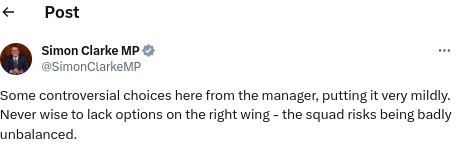
His old boss Simon Clarke used unsubtle sporting metaphors on Monday to make his position clear:

Source

Owl’s view is that Leopards don’t change their spots: be on the lookout for Simon trying  to “reinvent” himself as a lefty LibDemish wet.

“Care in the community” – Does the Minister know much of it is unsustainable?

In answer to Richard Foord’s debate on the closure of the Seaton Hospital wing,  the Minister for Social Care, Helen Whately, extolled the virtue of virtual care and care in the community in place of hospital beds, saying:

“Across the country, we have achieved a lot as part of our commitment to move more care out into the community.”

However, as described in the article below, much Social Care is contracted out to public charities on an unsustainable basis, for example:

The Stroke Association, which is contracted by the NHS and local authorities to deliver stroke recovery services for tens of thousands of patients once they have been discharged from hospital, said last year it was paid just under £11m for services costing nearly £17m, with the £6m gap met through public fundraising.

What happens when this “outsourcing” dries up? – Owl

English charities ‘near insolvency’ after subsidising public sector contracts

Patrick Butler www.theguardian.com 

Charities in England are on the brink of insolvency after subsidising heavily underfunded local authority and NHS contracts to the tune of hundreds of millions of pounds donated to them by the public, voluntary sector leaders have warned.

Donations, will legacies and charity shop profits are being used to prop up thousands of state-funded services in danger of closure, including care homes, homeless shelters, addiction projects and physical rehabilitation support schemes.

One charity told the Guardian it used £6m a year raised from the public and other donors to subsidise clinical and care services it provided under contract to the NHS and local authorities, a sum it described as “unsustainable”.

The refusal of local authorities, the NHS and government departments to fund the real cost of local service contracts – and the built-in assumption that voluntary sector will deliver “on the cheap” – was threatening the existence of vital local services, the National Council for Voluntary Organisations (NCVO) said.

“It’s potentially catastrophic for communities if these services stop,” said Sarah Vibert, the chief executive of NCVO. “Many services, like homelessness interventions and support for victims of domestic violence or sexual abuse, wouldn’t currently exist without charities.”

She added: “For too long, the goodwill of charities has been taken for granted. [Public sector contract managers] know charities will do everything possible, including subsidising public services with charitable funds, to prevent closing their door to someone. But this can’t continue.”

Although charities have been embedded in delivery of public services for years, the scale of the funding gap has pushed many charities to the edge as inflation and demand has soared, and councils and NHS bodies, many in financial crisis themselves, slash grants and refuse to uplift the value of contracts.

The Stroke Association, which is contracted by the NHS and local authorities to deliver stroke recovery services for tens of thousands of patients once they have been discharged from hospital, said last year it was paid just under £11m for services costing nearly £17m, with the £6m gap met through public fundraising.

It said the funding gap was unsustainable, meaning it would have to cut the volume and quality of services or walk away from contracts. “This will have an impact on people’s recovery from their stroke, emotionally and physically,” said Jen Garner, the Stroke Associations’s associate director in north-west England.

Charities fear more will follow in the footsteps of Leonard Cheshire, the social care charity that has been forced to shut care homes and evict vulnerable residents as a result of a financial crisis caused when its multimillion pound subsidy of hundreds of underfunded council contracts became unsustainable.

A detailed NCVO survey of its members reveals bitterness and frustration among charities who feel their focus on the needs of vulnerable beneficiaries is exploited by public bodies which routinely expect charities not to charge for the full cost of the service or to deliver it for “next to nothing”.

One respondent said: “[The local authority] see contract payments as ‘handouts to do-gooders’ instead of recognising that they are paying us to work for them because we able to do it better, cheaper, faster and with a more human and empathic approach.”

The survey of more than 330 charities found:

  • The vast majority were subsidising the cost of providing public services. Nearly half had not received an uplift in the value of the contract in the past two years, despite increasing demand and rising wage and energy costs.
  • Contracts were often only viable by freezing or cutting staff pay and conditions. One charity made a senior member of staff redundant, then took them back on as a volunteer to do their old job to keep vital services afloat.
  • A social care charity started a public fundraising campaign, and sold a building it owned, to raise the cash to maintain a service the council would only part fund. “[We are] not sure we can carry on unless something changes,” it said.

Although there is sympathy for councils and NHS bodies which are themselves in dire financial straits there is anger at public sector “double standards” that accept private contractors must make a profit while routinely expecting charities to run services at a loss, with donors picking up the tab.

A government spokesperson said: “We are backing the NHS with record funding. The NHS resource budget in England will be £165.9bn in 2024-25 – and that doesn’t include the additional £8.1bn for adult social care and discharge over two years.

“Local authorities have seen an increase in core spending power of up to £5.1bn or 9.4% in cash terms on 2022-23, with almost £60bn available for local government in England.”

“Local people helping local people” is how Nick Ralph describes the Good Neighbours network, a loose federation of 123 neighbourhood groups providing low-level informal care to vulnerable people across Hampshire in south-east England.

Its 4,000 volunteers drive isolated older citizens to hospital appointments, help them with shopping, dog walking or DIY tasks, and organise lunch clubs and other social events. It is classic preventive charity work, knitting communities together and reducing pressure on overstretched hospital and care services.

“It keeps vulnerable people independent and in their homes for longer, and out of expensive hospital beds. It’s the oil that keeps community wheels turning,” says Ralph, the executive director of the Council for Social Responsibility, a charity that supports the scheme on behalf of the Church of England diocese of Portsmouth.

The scheme costs £150,000 a year to run, but is under threat. Hampshire county council – itself facing financial “meltdown” – scrapped its grant in March and local NHS commissioners say their own £50,000 a year grant is at risk.

The charity, whose four staff ensure the countywide army of volunteers are trained, insured and security checked, will use its own funds to keep the service running until April. After that, it is unclear how many local groups will be able to continue.

Ralph understands the council’s predicament – its budget has been squeezed by government cuts – but believes the savings are shortsighted. “There will a loss of community support and as a result much more cost will be thrown on to the state,” he said.

Alarm raised over water firm job of new environment secretary’s wife

The new State for the Environment is surely going to have to “recuse” himself from any decision regarding pollution our rivers and seas or have we not moved on one iota from recent Tory sleaze? – Owl 

Sandra Laville www.theguardian.com 

Campaigners have raised concerns over a potential conflict of interest for the new UK environment secretary, Steve Barclay, whose wife is a senior executive at Anglian Water.

Barclay took on the environment role in Rishi Sunak’s cabinet reshuffle this week. His wife, Karen Barclay, holds a senior position at the water company, as head of major infrastructure (DCO) planning and stakeholder engagement.

As secretary of state, Barclay is responsible for overseeing the regulation of water companies. He is responsible for ensuring the water firms make improvements regarding sewage pollution via the government’s storm overflow reduction plan.

Anglian Water is one of six companies under investigation by the regulator Ofwat for potential illegal dumping of raw sewage. The Environment Agency is separately in the middle of a huge criminal investigation into illegal sewage dumping by water companies involving more than 2000 water treatment works.

Water companies are pressing government and the regulator Ofwat to approve £96bn investment in infrastructure improvements to fix leaks, stop sewage discharges and build more capacity at treatment plants, which they want customers to pay for via bill rises. Many critics say the public has already paid once for the investment, and should not be made to pay again for fixing problems which put the companies in breach of their legal duties.

Tim Farron, the rural spokesperson for the Liberal Democrats, said: “Ministers’ spouses do of course have the right to their own careers, but I do worry about the possible conflict of interest here for the man charged with forcing the water companies to clean up their act.

“We need to make sure the secretary of state is fully committed to doing everything in his power to stop the sewage scandal.”

This summer, Anglian Water pleaded guilty to allowing millions of litres of untreated sewage to overflow from a water recycling centre in Essex. It was fined £2.65m, the largest penalty imposed for environmental offences in the east of England region.

Ashley Smith, of Windrush Against Sewage Pollution, said there was a possible conflict of interest for the new secretary of state.

“It’s not just that the new environment secretary’s wife holds a senior post at Anglian Water, it is the fact that the water industry routinely operates outside the law, has misappropriated billions of bill payers’ money and now holds the country to ransom to hike bills to fix the mess it made and cannot be trusted to not make off with another windfall gifted by government,” said Smith.

A government spokesperson said: “All Defra ministers declare their interests in line with the ministerial code.

“There is an established regime in place for the declaration and management of interests held by ministers. This ensures that steps are taken to avoid or mitigate any potential or perceived conflicts of interest.”

Craig Bennett, the chief executive of the Wildlife Trusts, who chairs Anglian Water’s independent challenge board, said: “It would prudent for him to make sure this has been declared publicly and that it is all out in the open. Then it is something that can be managed.”

Karen Barclay has been approached for a comment. Anglian Water did not comment.

Concerns over new Health Secretary Victoria Atkins’ ‘conflict of interest’ in war on obesity as it’s revealed 47-year-old’s husband is sugar tycoon 

Conflict of interest concerns were today raised over the appointment of Victoria Atkins as Health Secretary.

This government will have integrity, professionalism and accountability at every level. – Owl

www.dailymail.co.uk  (Extract)

Just hours after being handed a prominent role in Rishi Sunak’s cabinet reshuffle, details of Ms Atkins’ husband role as chief executive of a world-leading sugar firm circled online.

Department of Health chiefs said Ms Atkins ‘will recuse herself’ from decisions that may be impacted by ‘outside interests’ because of Paul Kenward’s role at ABF Sugar, which supplies supermarkets and food manufacturers……..

7 hidden side effects of sugar | HCF

7 hidden side effects of sugar

  • Sugar makes your organs fat. …
  • It can lead to heart disease. …
  • It plays havoc with cholesterol levels. …
  • It’s linked with Alzheimer’s disease. …
  • It turns you into an addict. …
  • It disables your appetite control. …
  • It can make you depressed.

“Carry On with Traditional Values”

What a crowd. The new health secretary’s husband runs British Sugar, the new environment minister’s wife is an executive at water polluting Anglian Water, the PM’s wife was a non dom when he was Chancellor, and that is all we know so far ……

South West Water scolded for its ‘bland’ views on Devon

South West Water is being asked to justify its “bland” responses on planning applications, given the rise in sewage spills in Devon’s river and coastal waters. Torridge District Council wants the company to be removed from the list of consultees and an independent organisation to oversee new developments.

Alison Stephenson www.devonlive.com

And it plans to ask other councils in Devon to support its request to government. In his motion to the council, Cllr Peter Christie (Green, Bideford North) said he is fed up with SWW’s response of “has no objection” when it is asked to give a view on new plans.

“Over the last decade, this is the answer we get, with very few exceptions. Clearly, given the current state of our rivers and coastal waters there is a major problem – and it appears to be overlooked that SWW have a vested interest in more development as it means more customers locked into paying them, as water and sewage services are a monopoly service.”

He told the council that according to SWW’s website, in Bideford last year there were 24 sewage spills, 31 in Buckleigh, 144 in Abbotsham, 117 at Weare Giffard and 25 in Torrington.

“South West Water will take the money for every new house but are not doing what they should be doing in tackling the infrastructure.”

He said in the late 1970s and 80s a ‘sewage embargo’ was placed on Bideford and house building stopped for several years because the town’s infrastructure couldn’t cope.

“Nothing has really changed, they cannot cope with the sewage capacity and water availability is also an issue when we have a drought.”

Cllr Annie Brenton (Lab, Bideford West) said there is a large new development under construction in Bideford beyond Atlantic Village and the council needs to be “really careful and scrupulous” about planning details for drains and sewerage.

“The welfare of our people and our rivers and our sea is just as important as making money,” Cllr Brenton said.

Cllr Simon Newcombe (Con, Winkleigh) said independent was “all very good” but if it was not legally enforceable it was not worth the money spent on it.

Cllr David Brenton (Lab, Bideford South) said: “We should be getting Ofwat here. They are supposed to be the ones that are regulating and monitoring this, but they don’t.

“They have the teeth, but they don’t use them. It’s a quango of course, we know how loaded they are, but we need to get them here and ask them ‘what are you doing about the spills in our rivers and seas’.”

South West Water responded to DevonLive saying: “South West Water is not a statutory consultee to planning but we are an interested party as a statutory undertaker. We have a duty to support growth and make sure there is adequate capacity in the network.

“Even though we are not a statutory consultee, South West Water does review 30,000 planning applications each year and where we believe it is appropriate, we will add relevant comments on planning applications for consideration by the Planning Authority.

“It is a requirement under building regulations to ensure full separation of foul and surface water for any new property that is built and this would fall to the Local Authority to respond to.

“To support the ongoing conversation between South West Water, North Devon District Council and Torridge Council, an initial workshop between officers was held in October to explore how we can work better together to ensure well informed decision making and add further value to the planning process. It was agreed at this meeting that in the interests of sharing information and knowledge, this group will continue to meet regularly.

“We continuously review our approach to ensure we provide robust responses to planning applications and we will be contacting Councillor Christie to discuss his concerns.”

Enough is enough

Tories start to tear themselves apart (again).

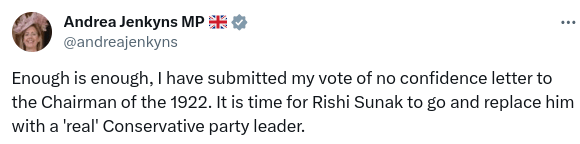
Enough is enough, I have submitted my vote of no confidence letter to the Chairman of the 1922. It is time for Rishi Sunak to go and replace him with a ‘real’ Conservative party leader. – Andrea Jenkyns MP

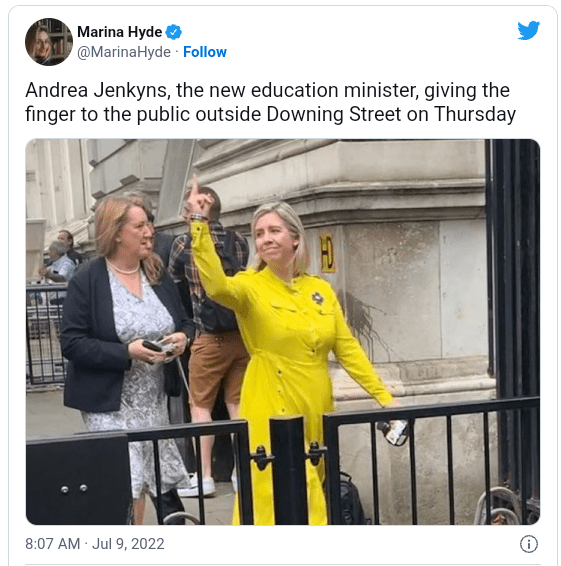
Some readers are already ahead of Owl by recalling how she “gestured” to the crowd when appointed Education Minister showing what she thought of “the little people”.

Seaton Community Hospital adjournment debate Monday 13 November in full 

The debate lasted about half an hour, Richard Foord received a lot of support while the Minister wriggled.

From Hansard

Richard Foord (Tiverton and Honiton) (LD)

I would like to welcome the new Secretary of State for Health and Social Care, the hon. Member for Louth and Horncastle (Victoria Atkins), to her place.

I rise to raise the pressing situation facing the community hospital at Seaton in the part of east Devon that I represent. I am very grateful for the opportunity to outline why plans to strip away a whole wing of the hospital pose a serious risk to the long-term viability of the hospital, and how small actions by the Government can unlock this space and provide huge benefits for the local communities.

Seaton Hospital is one of 12 community hospitals that provide vital services in my corner of Devon which were given over to NHS Property Services in 2016. Seaton Hospital provides a range of services and clinics that enable people to be cared for closer to home in their own community. I would like to take a moment to give hon. and right hon. Members an idea of the range of services that the hospital currently provides. They include a dedicated Chime audiology service, aneurysm screening, bladder and bowel treatments, and child and adolescent mental health services—we heard a lot about that in today’s health debate—as well as access to a dietician, ear, nose and throat specialists, general medicine, orthoptists, support for those with Parkinson’s, physiotherapy, podiatry, retinal screening, speech and language therapy, and stoma treatments. I could go on.

The hospital also acts as a hub for the growing number of so-called at-home care services. We appreciate that community hospitals have been increasingly moving over to services provided in the community at home. That includes provision for those who are frail and need regular care, or are reaching the end of their life. Indeed, the Seaton & District Hospital League of Friends supports the hospice at home professionals, who provide care to people and their families in those most difficult times of a person’s life or in a family’s life.

Jim Shannon (Strangford) (DUP)

I commend the hon. Gentleman for securing this debate. When someone evaluates what a community hospital does, they find that it is about much more than finance and making sure that the books balance. It is about all the things the hon. Gentleman has referred to. The community hospital in my constituency is where my three children were born some 30-plus years ago. It is where I took my youngest son when he broke his arm. It is where I took my other boy when he put his hand through a glass window and had to go to hospital for surgery. That is what a community hospital is about, and that feeling is replicated by every one of my constituents. When the hon. Gentleman speaks about his local community hospital, I am quite sure that he has the same passion, belief and commitment to that hospital, because it is part of the community, and that is how it is measured, not by finance.

Richard Foord 

I am grateful to the hon. Gentleman for his intervention. His anecdotes about what that hospital has done for his family and community are absolutely the same sort of thing as I hear from constituents every time I speak to them.

Seaton Hospital was built in 1988 to provide better local access to medical care and treatment for people across the Axe valley. It serves people not only in Seaton but in Colyton, Colyford, Beer, Axmouth and other villages dotted around the east Devon countryside. Originally, the plan was that people would not have to travel so far for their treatment. Given that the Royal Devon and Exeter Hospital is perhaps 30 miles away—20 miles at least—people felt that acute provision was on their doorsteps, which is what they wanted.

Simon Jupp (East Devon) (Con)

The hon. Member is making a stand for a community hospital used by people in both our constituencies, and I congratulate him on having secured the debate. I live less than 10 miles from Seaton Hospital. So many residents raised funds to build the wing, which first opened back in 1991. Does the hon. Member agree that it would be so wrong for local residents to have to pay twice for a building that they helped to fundraise for and build?

Richard Foord 

The hon. Member makes an excellent point. It is exactly right that Seaton Community Hospital was built by local people. Let me expand on that important point, because a lot of people have talked to me about this and I want to relay to the House the feelings they have spoken to me about at recent local community meetings.

The hospital was built over two storeys and updated in 1990 with an acute wing, which was funded not just 50% by the local community but 100% by local donations. The important thing to note is that the construction would not have been possible at all were it not for the contributions by local individuals. For example, the Seaton & District Hospital League of Friends had a scheme called “Be a brick: donate to Seaton Hospital”. People could make a small contribution—whatever they could afford—and get a little brick as a memento to demonstrate that they had contributed to Seaton Community Hospital. The charity is still a vocal champion of the hospital to this day. The project would not have happened had it not been for the generosity of the local people. What comes with that is a sense of ownership that I cannot really stress enough. There is a really strong feeling that the hospital does not belong to some amorphous NHS: it is their hospital. They paid for it, they were treated in it and it belongs to them.

Several weeks ago, I was contacted by the League of Friends charity after it learned from the Devon NHS that the plan is to hand over the two-storey wing from the Devon NHS to NHS Property Services. The charity was concerned that this could lead, eventually, to the selling off of the hospital wing, and even to its demolition. As soon as I heard that, alarm bells were set ringing for me. It is clear that Devon’s integrated care board is keen to wash its hands of the facility as quickly as it can. In essence, the facility is in special measures, and in a financially dire place. The wing is costing the Devon NHS about £300,000 a year, billed by NHS Property Services.

I was not all that familiar with NHS Property Services a year ago. I had heard of it, but I was under the impression that it was just another division of the NHS. I looked into it a bit further, and I found that it is responsible for the maintenance and support of most local NHS facilities. I was surprised to find that it is a Government-owned company, legally owned by one shareholder. The single shareholder for NHS Property Services is the Secretary of State for Health and Social Care. As of today, the hon. Member for Louth and Horncastle can congratulate herself on taking on NHS Property Services as her new holding. How can it be the case that a hospital built with the generous support of local people is now owned directly by NHS Property Services, rather than those local people?

In 2016, the Government transferred that facility over to NHS Property Services and implemented a consolidated charging policy to levy charges for rent, maintenance and service charges. Some of those charges are extortionate. We are talking about £300,000 a year, which is £247 a square metre. On paper, it might seem prudent to organise the NHS with some commercial expertise in charge of some of these facilities. However, we have to bear it in mind that the people running NHS Property Services are not necessarily thinking about it through the lens of health and social care; they are thinking about how they can maximise the utility of space and make savings to put money back into budgets.

That is worrying, because what I am hearing is that the offer being made to NHS Devon is, “If you wash your hands of this facility, you will receive 50% of the proceeds of the sale”—that will be to the NHS Devon integrated care board—“and 50% of the proceeds will go back into central coffers, back to Whitehall and back into the very large pot that is the NHS.” The House can imagine what that is like for an individual constituent in my part of east Devon, who has contributed perhaps tens or hundreds of pounds—as much as they could afford—in decades gone by, perhaps through a direct debit or regular payment, to maintain the facility. To hear that those decades of investment will be put back into a big pool in London, a long way away, is pretty sickening.

There has been an understandable backlash from people right across my corner of Devon. I have been to a couple of public meetings in recent weeks since the news broke. At Colyford Memorial Hall a couple of weeks ago, there were more than 200 people. It is a cliché to say there was standing room only, but there was no standing room—there was a long queue of people outside in the rain wanting to get into the meeting. People had one overriding feeling that they wanted to convey to me, and that they wanted me to convey to the Minister and to others gathered here this evening: they created this hospital and they are deeply offended by the idea that it might be taken away. What put salt into those wounds was the idea that that should happen with zero public consultation.

Wendy Chamberlain (North East Fife) (LD)

My hon. Friend is making a passionate speech on behalf of his community. What strikes me is that when the community came forward and made those contributions or bought those bricks, they did not do so to save the hospital at that point. I am pretty sure, like the hon. Member for Strangford (Jim Shannon), that they made that contribution to maintain the hospital for future generations. I am not surprised that it feels like a betrayal to my hon. Friend’s constituents.

Richard Foord 

I very much thank my hon. Friend for her contribution. She is exactly right. I point to two specific conversations I have had with constituents recently. 

The first was with someone who lives in Seaton, who was close enough to the hospital that she could walk there. Her husband died in the hospital and she was able to go and see him in his final days. She welled up—more than that, tears rolled down her cheeks—as she told me about her husband, who she was able to see in his final days.

Now we have moved to a situation in which patients are cared for at home. Of course, that means that some of the staff previously based out of the community hospital are driving to people’s driveways and providing that care in their homes. That works for some individuals, but the other day I had a lady in my surgery who was almost shaking with nervousness because her husband, whom she loved dearly, had just been discharged from the acute hospital in Exeter and she was charged with looking after him but did not feel able to look after his needs, as he was overcoming his operation towards the end of his life. We are putting some of our constituents in a really difficult situation that they do not feel equipped for.

The reason for the beds being removed from the hospital in 2017 related to so-called workforce issues. There was a substantial consultation of local people in 2017 when beds were removed from local hospitals, but I fear that following that consultation, which showed the outrage and indignation of local people, the NHS does not want to get involved such a consultation exercise again, hence the desire for the ICB to get shot of the building as soon as possible.

The ICB was talking about getting shot of it by the end of this calendar year, although that has gone to Devon County Council’s health scrutiny committee, so it may be pushed into next year. What we need tonight is an intervention from the Minister in relation to NHS Property Services, which is charging a clinical rate for a space that has not been used for acute medicine—it has not had clinical beds in it—since 2017. Organisations are coming forward with a desire to use it not for clinical use but as a care hub to provide other services.

I want to make hon. Members aware of how those clinical beds got removed in the first place. In 2017, there was deep concern that the removal of the beds was an arbitrary decision made following a last-minute intervention by the then right hon. Member for East Devon, Hugo, now Lord Swire. In fact, it is revealed in a book by his wife, Sasha, that Seaton Hospital was to be kept open, with its beds maintained, but, because of that last-minute intervention by Hugo Swire, the bed closures moved to Seaton and the Sidmouth Hospital beds remained.

As a result of that decision, there was no additional funding to set up extra services at Seaton. Instead, the ICB began charging this exceedingly high rent for an empty space. What we really need to do is reduce that rental fee from its clinical rate to one that acknowledges that there are community alternatives. The palliative care nursing team can operate out of this space, and organisations such as Restore and hospice at home carers can work out of it, too. The friends of Seaton and District Hospital are coming up with a strong business plan, but they do need more time to develop it and a concessionary rate—not the clinical rate—to operate from it. If no solution is found, the ward is most likely to be either sold off or demolished. Again—I cannot stress this enough—we need to do this for the people who feel that they paid for the hospital.

There is a precedent for it, and I am grateful to the hon. Member for St Ives (Derek Thomas) for letting me know that the hospital in Cornwall was saved from the jaws of NHS Property Services. However, there is a big difference between what I am proposing for Seaton and what happened at St Ives. St Ives hospital was paid for by a single philanthropist. As we have heard, Seaton Hospital was paid for with contributions—or subscriptions —from thousands of people.

Jim Shannon 

The widow’s mite.

Richard Foord 

Exactly.

Finally, when it comes to healthcare infrastructure in rural areas such as mine, it is so much harder to rebuild something once it has been removed than to maintain it. We saw in coastal and rural communities such as mine the damage that the closure of cottage hospitals caused, and the impact of removing beds from community hospitals. We must put a stop to that, before our rural healthcare centres are left empty skeletal shells of their former selves, where they were once hubs of love and care. I am looking forward to the Minister’s response and hope that she will agree to work constructively with me, as Seaton’s MP, to ensure a fair deal for local people and to protect our hospital for the people who bought and contributed to it.

The Minister for Social Care (Helen Whately)

I congratulate the hon. Member for Tiverton and Honiton (Richard Foord) on securing this debate. I appreciate his interest and concern about the future of Seaton community hospital. As he said, it was built only as a result of a huge fundraising campaign in the local community, which was matched pound for pound by the NHS. It therefore holds a lot of importance for the hon. Member’s constituents. I fully understand his interest in making best use of the facilities. I know that my hon. Friend the Member for East Devon (Simon Jupp) also wants to see this situation resolved, and I met him earlier to talk about it. I remind the hon. Member for Tiverton and Honiton that decisions about the use of NHS property such as this community hospital are taken at a local level—as they should be—and not by a Minister in Whitehall.

It may be helpful to recap some of the history, as the hon. Member covered in his speech. Between 2015 and 2017, the then NHS clinical commissioning group—CCG—undertook a recommissioning of community services in Devon. That was about introducing a new model of care—more integrated and more community based, with more people receiving care at home. I heard him raise concerns about that model and the shift to getting care closer to the community. My ministerial brief includes supporting the discharge of people from acute hospitals to try to care for more people in their own homes. Some patients spend longer in hospital than is good for their recovery, so for many people it is much better that, when they are declared fit for discharge, they recover and receive care at home.

Returning to the situation of this particular community hospital, as part of the commissioning change there was a change of lead NHS trust as the provider of services in local community hospitals. That meant that ownership of 12 community hospitals, including Seaton, was transferred from the former NHS provider trust to NHS Property Services, as the hon. Member spoke about. NHS Property Services’ model of charging a market rent for properties is to build an incentive to make good long-term decisions about the use of buildings. NHS Property Services then invests that income into those properties and the services that they provide.

At the point of transfer, many community hospitals in Devon had a large amount of empty space. The transfer happened on the basis that the NHS commissioning body—now the ICB—would be responsible for the full cost of that space. The costs include the recovery of the market rent and service charges, such as energy, rates, cleaning and maintenance. Over the past seven years, progress has been made to identify sustainable, alternative healthcare uses for vacant spaces in other community hospitals in Devon, such as in Axminster and Ottery St Mary’s. However, I understand that Seaton and some others still have significant amounts of vacant space. In addition, the ICB and NHS Property Services have worked closely with the voluntary sector, and have supported local initiatives in some properties, such as the Waffle café at Seaton Hospital. However, it is for the local commissioners—not NHS Property Services—to determine the best use of the healthcare spaces that they are responsible for.

Despite sincere efforts from the ICB, I understand that no sustainable healthcare use has been identified for the former ward space at Seaton, which adds up to about half the hospital space. I know the hon. Member’s constituents are frustrated by this situation. Local community groups have expressed an interest in taking on some of the empty ward space, but they see the level of charges as an insurmountable barrier. The ICB has explored a range of potential healthcare uses with NHS providers, but the proposals have not yet come to fruition, so I know the situation is not satisfactory for them either.

The costs to the system of the vacant space are a pressure on the health budget. Clearly, having unused space is not a good use of resources and, ultimately, taxpayers’ money.

Helen Whately 

It is important to note that NHSPS operates on a cost recovery basis. That means any reduction in its charges counts as a loss to the health budget if it is not directly offset by actual cost reductions in the facilities. As the hon. Member mentioned, the annual charges for the vacant space in this facility are approximately £300,000, of which £140,000 is the rental charge. The rest is spent on a share of the utilities, business rates, maintenance and cleaning costs for the property.

Richard Foord 

I am grateful to the Minister for explaining the charge-back system. Could she explain why the NHS is charging the NHS and hence the NHS cannot have this space, and why it cannot be used for health purposes? Could she explain the charging mechanism a little bit more please?

Helen Whately 

The hon. Gentleman says it cannot be used for health purposes. What I understand is that what is being looked at is what healthcare it can be used for, albeit recognising the shift of more care into the community and the changing model of care. On the way the system works, in essence the philosophy behind NHSPS is to ensure that best possible use is made of property. If there are no charges associated with the use of buildings, we could get lots of buildings sitting empty and there is not the same incentive to ensure the best possible use of facilities and resources. That is the philosophy behind having this kind of system. I think he mentioned in his speech bringing specific expertise together as part of the organisation that is NHSPS. I hope that addresses his query.

Helen Morgan (North Shropshire) (LD)

Will the Minister give way?

Helen Whately 

I will make a bit of progress, if that is all right.

As I outlined, the ICB is required to pay for the costs and it is not sustainable for the ward space to remain empty for a further lengthy period of time. When an ICB decides there is no long-term healthcare use for an asset, it will usually be sold to allow the funds to be reinvested elsewhere. I have been told that that is not the plan in the case of Seaton community hospital, not least because half the building is an operational health facility and the ICB is fully committed to keeping those services open. I also appreciate that a huge fundraising effort was put in by the local community to build the wing at the hospital in the first place, a point that my hon. Friend the Member for East Devon (Simon Jupp) made when he intervened earlier, and so selling the facility would not be what the community wants.

We know that providing high-quality care and support in the community benefits patients, and their carers and families, helping people to stay well and independent for longer. Across the country, we have achieved a lot as part of our commitment to move more care out into the community. For example, urgent community response services are doing a great job of helping to keep people out of hospital when they are at risk of a crisis. Virtual wards or hospital-at-home services are providing hospital-level care in people’s own homes, helping to avoid admissions to hospital and allowing earlier discharge, and ensuring extra support is there if somebody is concerned about being discharged home, or, as I heard the hon. Member mention, is concerned about a family member being discharged home.

Richard Foord 

I am grateful to the Minister for raising the concept of the virtual ward in this context. It reminds me a little of conversations that I have had with constituents in recent months about the virtual shopping experience, the virtual rail ticket purchasing experience, and the difficulty that they are having in dealing with humans. I think that the last thing people want when it comes to health and social care is “virtual”. They want the human touch.

Helen Whately 

I can only encourage the hon. Gentleman to visit a team that supports a virtual ward, and speak to some patients who have been cared for through hospital at home or virtual wards. I have done both, and the feedback from patients is phenomenally positive. If someone is concerned about being discharged and supported in this way, it does not happen, but many people would much rather recover in their own homes with that support than be in a hospital where it is hard to get a good night’s sleep because there so much going on around them. Moreover, while people recover in their own homes, beds are freed up for people who really need acute hospital care on site.

A third model that is doing very well in helping people to receive care close to home is the proactive care model delivered by multidisciplinary neighbourhood teams. These are real game-changers, helping people to live independently and stay out of hospital. The teams consist of—among others—doctors, nurses, care workers, allied healthcare professionals, all coming together to ensure that people have the care that they need in order not to be going in and out of hospital, as sometimes happens when people become unwell.

While I fully understand the hon. Gentleman’s frustration, I have been assured that the integrated care board, local providers and NHS Property Services are working together to resolve the situation at Seaton Hospital to ensure that facilities—and, indeed, funds—are put to good use for patients.

TWO PEOPLE: THREE MONTHS. A NEW BOOK BY PHILIP ALGAR

Another idea for Christmas! Owl

Philip, a local author and campaigner who fought to save the hospital and library, has published his final book. “Sadly, thousands of people end their working lives, frustrated and tired mentally and physically. Many will reflect on how different their careers might have been and ponder earlier incidents, major or trivial, in which they might have reacted differently. Some, lacking interests, will sink into a frustrating retirement. I wanted to explore this in my new book.

“Michael Johnson, retired and living in Torquay, has lost interest in virtually everything and suffers from boredom and a sense of futility. His sense of humour has vanished. His wife, Ann, desperate for a change and failing to jolt him into returning to be the man she married, visits Aberdeen to see friends. Michael, confronted by powerful dreams, is persuaded by one to visit London whilst Ann is away. Determined to right a few wrongs, suffered when young, he creates some situations in which his dormant sense of imaginative humour returns. The couple’s experiences, when apart, have challenging repercussions especially when Michael is visited by someone whom he met in London. Weeks later, one sinister dream has a dramatic impact on the family.”

“I hope that the book reveals a sensitive and sympathetic understanding of the problems many face but that it is balanced by an imaginative humour aimed at the way we live today”.

The book is available from The Curious Otter Bookshop in Ottery St. Mary and Amazon. It can also be ordered via all good bookshops.

Fables for Our Times – Mike Temple

An idea for a Christmas Present.

Owl understands that they are available at several bookshops in Sidmouth, Ottery and Tiverton.

I originally wrote them in 12 separate “books”, each with about 30 pieces, many of them topical/satirical pieces often about Bojo, but decided when publishing to discard about 70 pieces that soon seemed dated in their detail.

The following twelve “books” of verse were written over a period of three years from early 2020, during a turbulent time for this country.

Prompted by La Fontaine, I have aimed for variety. To him and, of course, Aesop I am deeply indebted.

I make no excuses, however, for the fact that some of these pieces are not fables in the strict sense of the word.

The cover, by local artist, Mike Baldwin, is based on the following fable: The Ass in the Lion’s Skin

Mike Temple

Here is another called: The Developers’ Charter

[These poems are reproduced as images because Owl has had difficulty in loading them onto an EDW page whilst retaining the original verse structure. – The trials and tribulations of Word Press “updates” and “improvements”]

Misery for the elderly as study suggests one in six GP practices now only take bookings online

  • Campaigners warn Britons  missing out on vital care as NHS is ‘erecting barriers’

Shaun Wooller www.dailymail.co.uk (Extract)

The NHS is discriminating against elderly patients with one in six GP practices now taking bookings online only, a study suggests.

Campaigners warn Britons are missing out on vital care as the NHS is ‘erecting barriers’ that limit opportunities to see a family doctor face-to-face.

This is forcing people into private healthcare or overcrowded A&E departments and hits those without internet access hardest, over-60s group Silver Voices said.

Its poll of 1,200 members reveals 76 per cent have experienced difficulties in obtaining a face-to-face GP appointment.

Eighty per cent have been forced to accept a telephone consultation and 71 per cent begrudgingly saw another member of practice staff…..

Keir Starmer set for election landslide bigger than Blair in 1997, poll suggests

Sir Keir Starmer is on course for a landslide general election victory bigger than 1997, despite party tensions over the IsraelHamas conflict.

Archie Mitchell www.independent.co.uk

The Labour leader would become prime minister with a 212-seat majority if an election were held tomorrow, according to a Survation poll on behalf of the UK Spirits Alliance.

The survey, based on new constituency boundaries taking effect at the next election, is the first of its kind since Hamas launched a wave of terror attacks on Israel on 7 October.

In the month since, Sir Keir’s party has been plagued by infighting over whether to call for a ceasefire as the civilian death toll grows in Gaza.

The Labour leader has defied pressure to call for an end to Israel’s assault, warning that to do so would solely benefit Hamas.

He has instead called for “humanitarian pauses” to allow aid into the besieged Strip, in line with the UK and US governments.

But several frontbenchers have rejected the principle of “collective responsibility”, breaking the party line and backing a ceasefire. Last week Imran Hussain, the MP for Bradford East, announced he was quitting his role as shadow minister for the new deal for working people, to be able to “strongly advocate” for a ceasefire.

Almost 50 Labour councillors have quit and hundreds of local representatives oppose the leadership’s stance.

Despite the weeks of infighting dominating media coverage of Labour, the new poll suggests the party could secure 431 seats, compared to the Conservatives on 156.

In his 1997 victory, Sir Tony Blair won 418 seats, compared with Sir John Major’s Tories on 165, securing a 179-seat majority.

The Survation poll, reported by The Sunday Times, suggests nine cabinet ministers would lose their seats, including former leadership contender Penny Mordaunt, seen by many as a major contender to replace Rishi Sunak.

Other major scalps that are expected include defence secretary Grant Shapps, transport secretary Mark Harper, work and pensions secretary Mel Stride and justice secretary Alex Chalk.

A separate Opinium poll this weekend revealed Labour’s lead over the Conservatives has increased to 17 points, up from 15 a fortnight ago.

Labour now has 43 per cent of the vote share, while the Conservatives are on 26 per cent.

Opinium said Labour and Sir Keir have taken some “big hits” in terms of public perception over the conflict in Gaza, but the Conservatives have “let them off the hook”.

James Crouch, Opinium’s head of policy and public affairs, said: “The government seems to have let Labour off the hook on what could have been a very difficult week for the opposition.

“Labour’s response to the conflict in the Middle East has made the party look less united, and Starmer look much weaker than before. However, by the end of the week the news had moved on to Conservative divisions and indecision, leaving the door open to a 17-point Labour lead in the polls.”

Onshore wind projects in England stall as no new applications are received

“Unfortunately, the government has been sending mixed messages to industry about the net zero transition – which could mean we lose out on the cheaper [energy] bills and good jobs that will come from building the industries of the future here in Britain.” Sam Richards, a former climate and energy adviser in No 10.

Toby Helm www.theguardian.com 

The government has received no new applications for onshore wind farms in England since cabinet ministers eased planning rules earlier this year – in a further sign that Rishi Sunak’s anti-green policy shift is driving investment abroad.

So far this year, only one new project, with a single turbine, has become fully operational in England, with many more being built in the EU – and in Scotland and Wales, where planning rules are less burdensome. This is despite renewables being seen as the cleanest and safest form of power, and having wide public support.

Since early September, when the communities secretary, Michael Gove, and energy secretary, Claire Coutinho, introduced changes to planning rules, claiming these would boost onshore wind investment, there have been no applications to local authorities, according to the industry’s representative body, RenewableUK, which has studied data held by the Department for Energy Security and Net Zero.

The fall-off in onshore wind projects in England contrasts with rapid increases in investment in Germany, France and Sweden.

The collapse will add to growing unease in Whitehall after no one bid for licences in the latest auction for offshore wind projects because the price companies could charge for the energy was set at too low a rate.

The Observer understands that, with panic setting in behind the scenes, ministers will announce a new framework of pricing within days to try to attract more investment into the sector before it is too late. There is also dismay among civil servants and government advisers, past and present, over the effect that recent government pronouncements on the green agenda have had on companies’ investment thinking.

In last week’s king’s speech, the government announced an energy bill with plans for a new annual system of oil and gas licences, despite the UK’s commitment to net zero targets, prompting outrage from the green lobby. Coutinho said more oil and gas “wouldn’t necessarily bring bills down”.

Sam Richards, a former climate and energy adviser in No 10, who now runs Britain Remade, a campaign group promoting economic growth, said recent anti-green rhetoric from the government risked lasting damage to the UK’s bid to be in the vanguard of a green industrial revolution.

“Unfortunately, the government has been sending mixed messages to industry about the net zero transition – which could mean we lose out on the cheaper [energy] bills and good jobs that will come from building the industries of the future here in Britain,” he said.

James Robottom, head of policy at RenewableUK, the body representing about 500 companies in the sector, said other countries were doing far more to maximise opportunities. “Unprecedented financial incentives are being offered to renewable energy developers by the US and the EU,” he said. “International competition to secure private investment in clean energy projects is intense as other countries seek to lure developers away from the UK to work elsewhere”.

He added: “The government’s very slight changes to the planning system aren’t going to bring about a significant increase in the number of new onshore wind farms in England. There are still restrictions to onshore wind that aren’t faced by any other infrastructure – despite widespread cross-party support to end the de facto ban – which is dampening the confidence of investors who would otherwise be interested. Local communities that support onshore wind are being denied the chance to benefit from cheap clean power.”

In 2015, before the government changed planning rules to make it easier for local people to block onshore wind farms in their areas, there were 158 new onshore projects in England, involving the construction of 228 new turbines. By last year, only two projects, involving four new turbines, were built in England.

Ed Miliband, Labour spokesperson for energy security and net zero, said: “The British people are paying the price of this government’s dogmatic, ideological and self-defeating opposition to home-grown clean power – in higher bills, energy insecurity and failure on climate.

“The Conservatives presented an energy bill that won’t bring bills down. Their supposed lifting of the onshore wind ban doesn’t do anything of the kind and it is costing families £180 every year on their bills.”

The government said that across the whole of the UK – not just England – substantial progress was being made. “The last Contracts for Difference round saw a record number of successful projects across renewables, including onshore wind projects.

“The streamlined National Planning Policy Framework aims to make it easier and quicker for onshore wind projects to come forward where there is local support.”

Rishi Sunak sacks Suella Braverman as home secretary

Bang goes the Lib Dem’s best recruiting officer! – Owl

Suella Braverman has been sacked as home secretary, after she defied No 10 over an article accusing the Met Police of bias in the policing of protests.

By Sam Francis www.bbc.co.uk

Mrs Braverman was accused of stoking tension in the article ahead of pro-Palestinian protests in London over the weekend.

Her replacement has not been announced.

The sacking kickstarts what is expected to be a major Cabinet reshuffle by Mr Sunak as he reshapes his top team ahead of next week’s Autumn Statement.

Foreign Secretary James Cleverly was seen entering Downing Street on Monday morning and there was speculation he would replace Mrs Braverman as home secretary.

Another arrival at Number 10 was former prime minister David Cameron, prompting suggestions he would be returning to government as foreign secretary.

Mr Cameron, who has been out of Parliament since he stood down as a prime minister in 2016, could be given a seat in the House of Lords to take up his new position.

Mrs Braverman was sacked following days of a political firestorm sparked when she wrote an article for The Times newspaper, in which she accused the police of bias.

The article was not cleared by No10 and it later emerged Mrs Braverman had defied a Downing Street request to tone the article down.

Mrs Braverman was accused of stoking tensions surrounding a pro-Palestinian march on Armistice Day.

Sunak’s waiting list pledge ‘downgraded’ as NHS is told to control costs

The “bottom line for the NHS” this winter is “the financial bottom line”. 

Rishi Sunak’s pledge to slash NHS waiting lists has effectively been downgraded, the Observer has been told, amid an increase in the number of patients in England waiting longer than 18 months for treatment.

Michael Savage www.theguardian.com 

Hospital leaders are warning that morale is low, staff absences are high, and funds for new equipment and repairs are having to be raided ahead of winter. They have now been told to prioritise controlling costs in favour of some of the extra work being done towards the prime minister’s pledge to bring down waits.

The news comes as the latest data reveals that one key waiting time target is heading in the wrong direction. The number of people waiting more than 18 months for treatment climbed back above 10,000 in September – a similar level to that recorded in March, and up from 8,998 in August.

With trusts already frustrated that they will not be fully compensated for costs created by NHS strikes, hospital leaders and analysts said that a memo sent last week effectively signalled the downgrading of No 10’s battle against waiting lists.

The memo said that to show “how you will deliver financial balance”, trusts needed a treatment plan “identifying the insourcing/outsourcing and waiting list initiatives you still consider necessary within a balanced financial plan”. One NHS finance chief said they believed it was the first time in a decade that they had been told the “bottom line for the NHS” this winter was “the financial bottom line”.

Sally Gainsbury, senior policy analyst at the Nuffield Trust, said the NHS was in a “precarious” position going into winter. “The NHS has now been asked to scale back the additional efforts and expenditure it was incurring in order to work through the record-high elective backlog – waiting lists – and focus instead on emergency and urgent cases,” she said. “The message is that further expenditure to reduce the waiting list – such as extra weekend clinics and theatres – just isn’t affordable within the budget constraints, so it is serious, especially for patients who may already have been on a list for months.

“Twelve-hour trolley waits are at the point they were this time last year. Staff sickness absence rate is extremely high ahead of winter. And then there is the issue of ongoing strikes. The small amount of extra cash from the Treasury this week isn’t going to solve the financial problems.” She said that the budget for buildings and equipment was “being raided” to cope.

Wes Streeting, the shadow health secretary, said the government had effectively abandoned its ambitions. “This is the government waving the white flag on Sunak’s pledge to cut waiting lists,” he said. “The PM would rather blame NHS staff than take responsibility and fix the problem himself. No wonder waiting lists have trebled since 2010. The longer we give the Conservatives, the longer patients wait.”

Tim Gardner, assistant director of policy at the Health Foundation, said that if the government was saving extra NHS funding for the forthcoming autumn statement, it would be “far too late to shift the dial on what’s likely to be a challenging winter for emergency departments”.

“There does seem to have been a distinct shift in priorities,” he said. “Financial control seems to be coming through more strongly, along with an increased focus on urgent and emergency care and patient safety, possibly in anticipation of what could be a difficult winter. As a consequence, progress on elective waiting lists appears to be a lower priority than it was.”

With the service struggling, NHS bosses are desperate for further strike action to be avoided. Junior doctors and consultants continue to demand the reopening of the pay deal offered by the government. Radiographers also walked out last month.

The CEO of NHS Providers, Sir Julian Hartley, urged ministers to resolve the disputes once and for all. “We haven’t even hit the worst of winter yet the pressure is being felt right across hospitals and mental health and community services, as demand for care continues to outstrip capacity,” he said. “This hiatus in strike action while talks continue between the government and doctors’ unions couldn’t have come soon enough. The last thing the NHS needs as we head into another challenging winter is more industrial action.”

Dr Adrian Boyle, the president of the Royal College of Emergency Medicine, said he anticipated that the months ahead would be “as difficult as last winter”. “There’s nearly 150,000 people in one month who spent more than 12 hours in emergency departments,” he said. “That’s a bad indicator of us going into a difficult winter, so we’re worried.”

A Department of Health and Social Care spokesperson said: “Cutting waiting lists is one of our top five priorities, and despite disruption from strikes, 18-month waits are down more than 90% from their peak in September 2021. We’re backing the NHS with billions of investment to improve performance, with an additional £800m allocated this winter to support emergency care and tackle the longest waits.”

Prof Sir Chris Whitty says UK faces rural and coastal ageing crisis

So let’s demolish the Seaton Hospital Wing! – Owl

The UK faces an ageing crisis and healthcare must step in, England’s chief medical officer, Prof Sir Chris Whitty, warns in his annual report.

By Michelle Roberts www.bbc.co.uk

People are living longer but some spend many of their later years in bad health – and that has to change, he said.

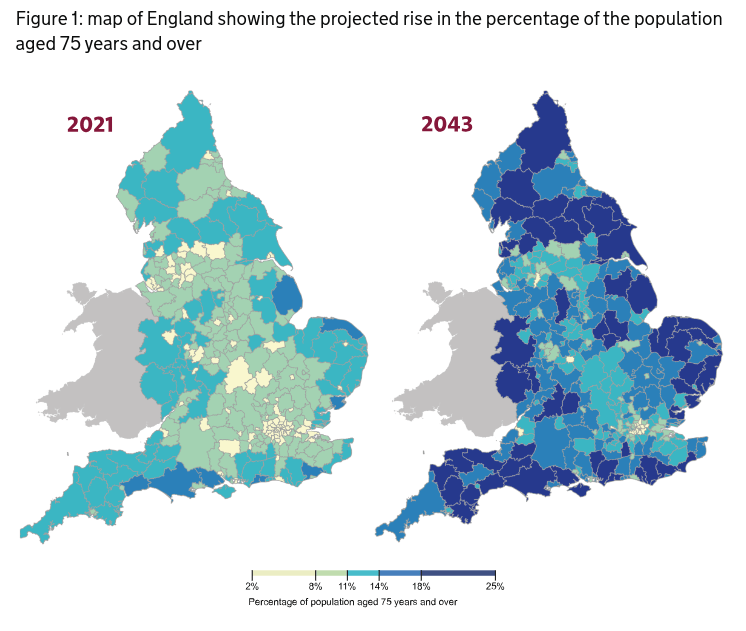
Based on projections, the elderly boom will be in rural, largely coastal, areas and these places are often poor cousins when it comes to provision.

In deprived regions, age-related issues emerge 10 years earlier, on average.

While young people flock to wealthy cities, areas such as Scarborough, North Norfolk or the south coast of England are going to age “rapidly and predictably”, says the report – Sir Chris’s fourth in the role.

He told me: “We’ve really got to get serious about the areas of the country where ageing is happening very fast, and we’ve got to do it now.

“It’s possible to compress the period of time that people spend in ill health…because otherwise we will end up with large numbers of people leading much more dependent lives.”

Providing services and environments suitable for older adults in these areas is an absolute priority, the report says.

Much of the NHS’s work is already caring for an ageing population, and that is set to increase.

The fact that people are living longer compared to a century ago is “a triumph of medicine and public health”.

But the emphasis needs to be on quality, not quantity, says the report.

It says major action in two areas could help turn things around:

  • Policies to reduce disease and disability and help people to exercise, eat well and stay fit
  • Making housing, transport and other parts of the environment more elderly friendly, so people can live out their lives as independently as possible

Sir Chris explained: “Houses are built for young families…and if you project forward to the middle of the century, a quarter of the population will be over 65, yet we still have a housing stock not designed for that age group.”

He said people should adopt “old-fashioned” methods to stay healthy.

“Having lots of exercise, having mental stimulation and a social network, eating a reasonably balanced diet… these are things which are old-fashioned, but they still work.”

People should also make choices about what care they do and don’t want, and doctors should refrain from over-treating.

Improving quality of life in older age sometimes means less medicine, not more, says the report.

Sir Chris said: “That might be, ‘I want to go to hospital but I don’t want to go to intensive care’. It might be, ‘I want to have treatment but I don’t want to have an operation’. Or it might be ‘I don’t want any more treatment at all’. The conversation needs to be had.”

Prof Dame Carol Black, from the Centre for Ageing Better, said: “Many people are facing enormous challenges and hardship in their later years, as this report makes clear.  

“We don’t all have an equal opportunity to age well. Wealth, work, housing, discrimination; all play a significant role in the huge gap in healthy life expectancy between the richest and poorest areas of the country.”

Paul Farmer, chief executive at Age UK, called for a cross-government ageing strategy, and a minister for older people to help drive forward change.

“We can already see how the failure to invest in delivering the right services and support is leading to worse outcomes for older people and entirely avoidable problems,” he said.

“Older people are isolated at home if the design of our communities means they can’t safely go out. People end up falling, and in the back of an ambulance if our built environment is full of trip hazards.

“Our hospitals are over capacity at least in part, due to the failure to provide adequate social care and community services to enable people to stay safe and well at home. None of this is inevitable. Getting it right would have immeasurable benefits.”