It was the brilliant application of science that produced the first ever vaccines against coronaviruses to be fully developed, approved and deployed. (And Johnson can be credited with choosing Dame Kate Bingham to lead the roll out programme).
The Key Question for Boris Johnson to answer (and “Dr Death” who is credited with fuelling the second wave), however, is: what would have happened had science failed, as so easily could have been the case?
How would we have fared under their “Plan B”?
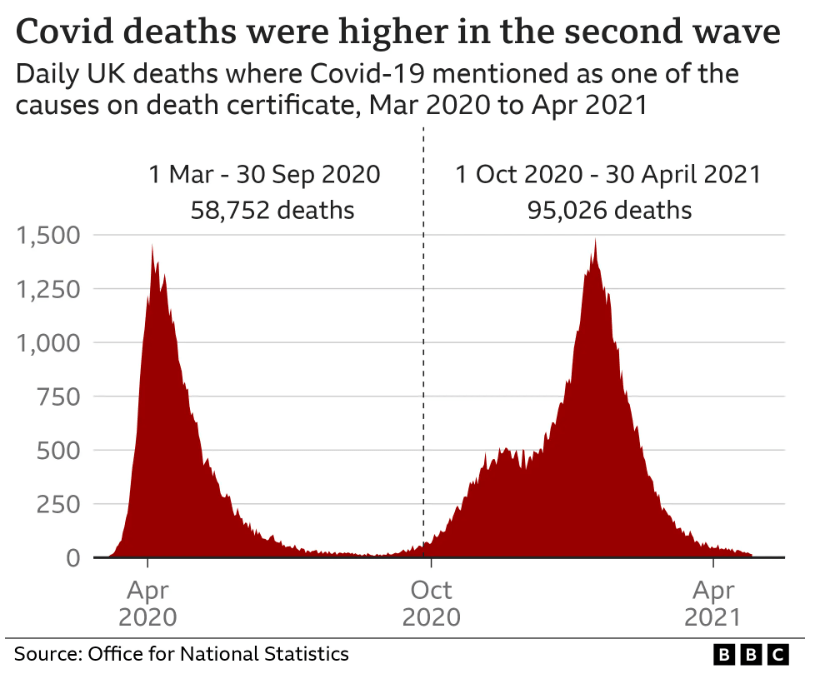
The graph above plots daily deaths in both the first and second waves.
We can now see that although the peak daily death rate is broadly the same, the second wave lasted longer and killed 60% more individuals than the first.
Vaccine roll out began in early Dec 2020 and the top four priority groups received a first dose by mid Feb 2021, that is care home residents and carers, frontline health and social care workers, those aged 75 years and over, and those clinically extremely vulnerable aged 70 and over.
By April 2021 most of those aged 55 and over had also been given their first dose.
Bearing in mind the lag between vaccination and individuals gaining significant immunity, the main effect of the vaccination programme was to lower the impact of subsequent waves.
Political decisions had already “baked in” second wave fatalities.
Owl concludes that the government’s handling of the second wave was worse than the first.
Covid inquiry: Eight uncomfortable questions facing Boris Johnson
Boris Johnson appears before the Covid inquiry next week, and his government’s response during the first year of the pandemic will be in the spotlight.
By Nick Triggle www.bbc.co.uk
A range of experts, scientists and ministers have already given evidence, and some of them have cast doubt on Mr Johnson’s decision-making. Mr Johnson is expected to apologise but also argue his government got many of the big calls right.
So what challenging questions might the former prime minister face?
Did he take Covid seriously enough early on?
There was a lack of urgency as Covid started to spread in the early months of 2020, scientists have told the inquiry.
Both Prof Neil Ferguson and Prof Graham Medley, who sat on the government’s scientific advisory group, Sage, have told the inquiry that by February 2020 they were worried the NHS was going to be overwhelmed.
Despite this, it was not until 2 March that Mr Johnson chaired his first meeting of the Cobra emergency committee on Covid.
WhatsApp messages released by the inquiry show Dominic Cummings, who at the time was chief of staff to the PM, wrote a day after the meeting that he still didn’t think Mr Johnson was convinced of the severity of the situation. He “doesn’t think it’s a big deal”, he wrote.
This week the then Health Secretary Matt Hancock said that, in hindsight, lockdown should have happened three weeks earlier. But he said the data – how fast Covid was spreading the UK – was not available until mid-March.
Mr Johnson will surely be asked about his response in those early days. Should he have acted sooner?
Could a full lockdown have been avoided?
New data from scientists led to a frantic set of meetings on the weekend of the 14 and 15 March. Government scientists were worried the NHS was at “imminent” risk of being overwhelmed.
On the Monday, a set of voluntary measures were introduced, including asking the public to stay at home for 14 days if they – or anyone in their household – had Covid symptoms. They were also advised to stop non-essential contact, and all unnecessary travel.
Some at the inquiry have wondered whether those earlier, less restrictive measures were enough. It was thought reducing social interactions by 75% would be needed to stop the epidemic growing.
Sir Chris Whitty, England’s chief medical officer, told the inquiry last month that it initially looked like the public were firmly adhering to the measures. But with only a few days of data to study, the scientists were uncertain whether it would be enough, Sir Chris said in his testimony.
After what appears to be widespread agreement inside government that tougher measures were needed, the full lockdown was announced on 23 March.
But that lack of absolute certainty in the lead-up has come up repeatedly during the inquiry. We will never know for sure what would have happened if we had relied on the voluntary measures, as Sweden did. The former PM will no doubt be asked about it.
Did dysfunction in government cost lives?
WhatsApp messages and extracts from the diaries of Sir Patrick Vallance, who was the chief scientific adviser during the pandemic, have made it clear that there were bitter divisions within government during 2020. In an entry in the autumn he accused No 10 of being at war with itself.
And in one of the most memorable exchanges of the inquiry so far, Mr Cummings was read WhatsApp messages he sent, saying he wanted to “personally handcuff” senior government official Helen MacNamara “and escort her from the building”.
“We cannot keep dealing with this horrific meltdown of the British state while dodging stilettos from that [expletive],” Mr Cumming wrote in one message from August 2020.
In her evidence, Ms MacNamara said the “toxic” environment in government affected decision-making during the crisis.
In particular, she said the “macho, confident” nature of people in and around Mr Johnson’s No 10 team meant the government was “unbelievably bullish” early on, with people “laughing at the Italians” when they started to impose restrictions.
Did he undermine the scientists?
The Eat Out to Help Out scheme has attracted a lot of attention in the inquiry. It was designed by the Treasury to help boost the hospitality industry after the first lockdown, by giving diners discounted meals in August 2020.
And while its role in that autumn’s second wave can sometimes be overplayed, key government scientists have told the inquiry they were not consulted about the scheme.
Prof Jonathan Van-Tam, who was deputy chief medical officer in the pandemic, told the inquiry he only learnt about Eat Out to Help Out from a TV report, adding it “didn’t feel very sensible to me”.
Sir Patrick said it was “obvious it would cause an increase in transmission risk” and that ministers would have known that.
The architect of the scheme was Rishi Sunak, who was then Chancellor. He will face plenty of questions about this when he appears the week after Mr Johnson.
But as prime minister at the time, Mr Johnson will have to explain what happened. His witness statement – which has already been handed to the inquiry – suggests the scheme was run past the scientists.
Why was there no ‘circuit breaker’ lockdown?
By September 2020, government scientists were setting out the merits of a circuit breaker – a short lockdown to disrupt the spread of the virus when it was starting to spread more quickly.
On 20 September, Mr Johnson called a Zoom meeting of scientists to discuss the government’s response to sharply rising Covid infections.
Present were key government scientists, including Sir Chris and Sir Patrick, as well as Dr Anders Tegnell, who spearheaded Sweden’s pandemic response – with no lockdowns, school closures or mask mandates.
The Downing Street meeting had also involved scientists who were critics of several lockdown-related measures.
It is not entirely clear what advice was given. Dame Angela McLean, who is the current chief scientific adviser, told the inquiry that a single, one-off circuit breaker would not have been enough.
No circuit breaker was introduced. Restrictions were tightened in the coming weeks, including the sliding-scale system of regional restrictions – tiers, as they were known – which the former Cabinet Secretary Michael Gove described as “inherently flawed” in his testimony.
On 31 October, Mr Johnson announced another lockdown for England during November, but with schools allowed to stay fully open this time. He told the public it was needed to allow people to have as normal a Christmas as possible.
Was it a mistake to try to save Christmas?
Regardless of what happened in the autumn, the situation changed completely in December with the identification of the new, more transmissible Alpha variant. With England out of November’s lockdown and back in tiers, Covid began spreading rapidly.
Promising to save Christmas, Mr Johnson resisted calls to go back into lockdown until the new year.
This was despite the Covid vaccination programme having started, meaning the most vulnerable would soon have some protection against the worst effects of the virus.
It presented, some argue, the strongest case for a lockdown out of any of them, as it would have bought time for those people to get their vaccinations and build up immunity – and therefore would have had a tangible impact on the harm the virus could wreak.
In his testimony, Michael Gove, who was cabinet secretary during the pandemic and part of the core group of decision-making ministers, accepted that this lockdown happened too late.
More people are recorded as dying in this winter wave than were in the first wave. Did Mr Johnson’s desire to give people a festive period with limited restrictions cost lives?
Was decision-making ‘colour blind’?
Ethnic minority groups were disproportionately affected by both the virus and restrictions, said Prof James Nazroo, a sociologist at the University of Manchester, but Mr Johnson’s government was not tuned into this.
It took, he told the inquiry, a “colour-blind approach” and “disregarded existing economic, social and health vulnerabilities experienced by ethnic minority groups”.
One of the key problems was that, in the early months of the pandemic, there was no equality impact assessment, which governments use to consider the costs and benefits of policy for different groups.
Equalities Minister Kemi Badenoch agreed that Mr Johnson’s government was slow to fully grasp the problems it was facing, saying too often ethnic minorities were lumped together under the BAME grouping, an acronym standing for black, Asian and minority ethnic.
“Using the term BAME masked what was actually happening within different ethnicities. From a health perspective, or even just from any sort of analysis perspective, that’s not particularly helpful,” she told the inquiry.
Did he forget about children?
Mr Johnson’s government made a “terrible mistake” over schools, said Anne Longfield, who was children’s commissioner for England during Covid.
She told the inquiry that while the closure of schools for most children was probably necessary at the start of Covid, decision-making “lacked coherence”. Pubs and hairdressers, for example, were able to open after the first lockdown before schools, she said.
This was something that was repeated in Scotland later in the pandemic.
She said schools should be the “last to close and first to reopen”, and accused ministers of being indifferent to the policy decisions affecting children.
The most vulnerable children will be struggling with the impact of the pandemic for the next 10 or 20 years, she said.
Mr Gove conceded mistakes were made over children, saying there was not enough focus on the impact on them. Mr Johnson will be asked about them too.
Boris Johnson appears at the Covid inquiry from Wednesday at 10:00 GMT.

 East Devon Watch