
- Repair of existing rear balcony to include replacement of rotten timbers and metal railings with glazing.
 31 Hamilton Lane Exmouth EX8 2JTRef. No: 23/2592/FUL | Validated: Fri 01 Dec 2023 | Status: Awaiting decision
 - Prior approval (Class Q) for a change of use of agricultural building to 1no. dwellinghouse (Use Class C3) Dunsmore Sanctuary Lane Woodbury Devon EX5 1EXRef. No: 23/2601/PDQ | Validated: Fri 01 Dec 2023 | Status: Awaiting decision
- Discharge of condition for 23/1095/LBC: Condition 2 (lime render) Town Dairy Cottage Church Road Lympstone Exmouth EX8 5JURef. No: 23/2602/DOC | Validated: Fri 01 Dec 2023 | Status: Awaiting decision
- Proposed agricultural building for the storage of machinery and fodder Farm Yard And Buildings To The North Of Green Lane RousdonRef. No: 23/2586/AGR | Validated: Fri 01 Dec 2023 | Status: Awaiting decision
- Proposed vertical extension to existing dwelling to provide additional accommodation at first floor Braestones Gully Shoot Colyford EX24 6HFRef. No: 23/2573/FUL | Validated: Thu 30 Nov 2023 | Status: Awaiting decision
- Reinstatement of window Livermore Farm Aylesbeare Exeter EX5 2DHRef. No: 23/2572/FUL | Validated: Thu 30 Nov 2023 | Status: Awaiting decision
- Erection of roof over existing manure storeHoemoor Farm Upottery EX14 9PBRef. No: 23/2581/FUL | Validated: Thu 30 Nov 2023 | Status: Awaiting decision
- x2 Yew : reduction in height and width by 50%. Brookfield House South Square Colyton Devon EX24 6NHRef. No: 23/2580/TCA | Validated: Thu 30 Nov 2023 | Status: Awaiting decision
- T1, Ash: fell. 5 Kingsholme Colyford Devon EX24 6RJRef. No: 23/2574/TRE | Validated: Thu 30 Nov 2023 | Status: Awaiting decision
- Erection of roofing over existing silage pit. Highley Farm Upottery Honiton EX14 9PDRef. No: 23/2584/FUL | Validated: Thu 30 Nov 2023 | Status: Awaiting decision
- Lawful Development Certificate for garage conversion and single storey side extension43 Withycombe Park Drive Exmouth Devon EX8 4ELRef. No: 23/2576/CPL | Validated: Thu 30 Nov 2023 | Status: Approved
- Proposed agricultural building Field West Of Whitford Road WhitfordRef. No: 23/2577/FUL | Validated: Thu 30 Nov 2023 | Status: Awaiting decision
- Raising of roof and conversion of roof space to habitable space, including front and rear dormers and balcony 29 Poplar Tree Drive Seaton EX12 2TWRef. No: 23/2575/FUL | Validated: Thu 30 Nov 2023 | Status: Awaiting decision
- Proposed demolition of existing dwelling and attached building and replacement with 1 no. dwellinghouse, and alteration of adjacent outbuilding Blackley Down Farway Devon EX24 6DJRef. No: 23/2563/FUL | Validated: Wed 29 Nov 2023 | Status: Awaiting decision
- Discharge of conditions of 23/1147/FUL : Conditions 8 (Tree Protection Plan (TPP) and an Arboricultural Method Statement(AMS) and Condition 11 (Construction Management Plan) Land North Of Railway (Little Monitor Cottage) Whimple EX5 2GFRef. No: 23/2559/DOC | Validated: Wed 29 Nov 2023 | Status: Awaiting decision
- Single storey rear / side extension, alterations to roof on south end and changes to fenestration and materials Summerhill Higher Metcombe Ottery St Mary EX11 1SJRef. No: 23/2570/FUL | Validated: Wed 29 Nov 2023 | Status: Awaiting decision
- T1. Oak (English) : Removal. T2, Oak (English) : Removal. 1. The tree works are proposed to stop the influence of the tree(s) on the soil below building foundation level and provide long term stability to 51 Evergreen Close, Exmouth, EX8 4RR 2. Estimated costs of repair to the building are a minimum of £70.000.00 if the influence of the tree(s) remain and 3,900.00 if the proposed tree works are allowed to proceed. Granting permission will limit these costs. In the event of a refusal we, or our clients, will seek to secure compensation for the additional costs incurred through Section 202(e). 3. Should the tree/s remain the total cost of repairs will be the Superstructural repairs + Alternative method of repairs (Minimum) = £73,900.00 4. It is the expert opinion of both the case engineer and arboriculturalist that on the balance of probabilities the supporting information demonstrates the influence of the tree(s). 5. Note: Further monitoring results may be submitted if these become available during the course of this application. 47 Evergreen Close Exmouth Devon EX8 4RRRef. No: 23/2568/TRE | Validated: Wed 29 Nov 2023 | Status: Awaiting decision
- G002, Common Ash : Fell. Plant 1x replacement tree for each removed tree of the group – suggested species include small leaved lime, sycamore and ‘new horizon’ elm. 50 Tigers Way Axminster Devon EX13 5TGRef. No: 23/2566/TRE | Validated: Wed 29 Nov 2023 | Status: Awaiting decision
- Discharge of conditions for 22/0977/FUL : Condition 3 (Equipment Screen) and Condition 4 (Outbuilding) Ley Farm Yarcombe Devon EX14 9LWRef. No: 23/2565/DOC | Validated: Wed 29 Nov 2023 | Status: Awaiting decision
- Proposal to demolish existing public toilets, and replace with a new public toilet building. Toilets West Walk Castle Hill Seaton EX12 2QWRef. No: 23/2561/FUL | Validated: Wed 29 Nov 2023 | Status: Awaiting decision
- Proposed general purpose agricultural building Higher Seavington Farm Stockland Devon EX14 9DERef. No: 23/2552/FUL | Validated: Tue 28 Nov 2023 | Status: Awaiting decision
- T1: Cherry – fell and replace with another tree (variety to be agreed with planning). 1A Arden Close Budleigh Salterton Devon EX9 6JGRef. No: 23/2553/TRE | Validated: Tue 28 Nov 2023 | Status: Awaiting decision
- Discharge of conditions for 23/1308/FUL : Condition 3 (tree, hedge and shrub protection scheme) and Condition 6 (scheme of landscaping) Land South East Of Higher Lodge OffwellRef. No: 23/2554/DOC | Validated: Tue 28 Nov 2023 | Status: Awaiting decision
- Construction of garden workshop. 20 Springfield Road Exmouth EX8 3JXRef. No: 23/2555/FUL | Validated: Tue 28 Nov 2023 | Status: Awaiting decision
- Removal of garage to be replaced with a two storey side extension and single storey rear extension. 3 Millwey Avenue Axminster Devon EX13 5EHRef. No: 23/2556/FUL | Validated: Tue 28 Nov 2023 | Status: Awaiting decision
- Replacement porch to the front of the property. Replacement garden room to the rear of the property. Alterations and recladding to the existing elevations and associated external works. Mill House Bendarroch Road West Hill Devon EX11 1TSRef. No: 23/2558/FUL | Validated: Tue 28 Nov 2023 | Status: Awaiting decision
- Change of use of existing annexe accommodation to enable dual use as either annexe and/or holiday accommodation Ivy Green Farm Chardstock EX13 7BYRef. No: 23/2548/COU | Validated: Tue 28 Nov 2023 | Status: Awaiting decision
- Discharge of condition for 23/0111/AGR : Condition 3 Landscaping. Castlewood Farm Musbury Axminster EX13 8SSRef. No: 23/2530/DOC | Validated: Mon 27 Nov 2023 | Status: Awaiting decision
- Erection of a new public toilet building. Sidmouth Swimming Pool Ham Lane Sidmouth EX10 8XRRef. No: 23/2537/FUL | Validated: Mon 27 Nov 2023 | Status: Awaiting decision
- Demolition of garage to be replaced with 2-storey front extension and raised terrace and installation of 16 solar panels on the front elevation (resubmission of withdrawn application 23/0621/FUL). Shepherds Park Bungalow Woodbury Exeter EX5 1LARef. No: 23/2546/FUL | Validated: Mon 27 Nov 2023 | Status: Awaiting decision
- Discharge of conditions for 22/2651/LBC : Condition 4 : window and door details (joinery) Berkeley Cottage Exeter Road Newton Poppleford Devon EX10 0BJRef. No: 23/2545/DOC | Validated: Mon 27 Nov 2023 | Status: Awaiting decision
- Monopole on concrete foundation with associated 1 equipment cabinet, 2 ERS racks and green mesh fencing Devon Cliffs Holiday Centre Sandy Bay Exmouth EX8 5BTRef. No: 23/2541/TEL | Validated: Mon 27 Nov 2023 | Status: Awaiting decision
- Replace existing conservatory with new rear ground floor extension and external seating area 4 The Chase Honiton Devon EX14 1QBRef. No: 23/2539/FUL | Validated: Wed 29 Nov 2023 | Status: Awaiting decision
- Permission in principle for the demolition of an existing greenhouse and the construction of two dwellings Land Adjacent Elsdon House Elsdon Lane West HillRef. No: 23/2535/PIP | Validated: Tue 28 Nov 2023 | Status: Awaiting decision
- T1 – Copper Beech: fell. Replant with one replacement Copper Beech – 8-10cm girth. Bradlegh End East Longdogs Lane Ottery St Mary EX11 1HXRef. No: 23/2528/TRE | Validated: Mon 27 Nov 2023 | Status: Awaiting decision
- Agricultural storage building and workshop Great Trill Farm Musbury Axminster EX13 8TURef. No: 23/2526/AGR | Validated: Fri 01 Dec 2023 | Status: Awaiting decision
- Proposed single storey rear extension. 44 Richmond Road Exmouth Devon EX8 2NARef. No: 23/2516/FUL | Validated: Mon 27 Nov 2023 | Status: Awaiting decision
- Construction of timber framed car port Site Of Woodside Higher Metcombe Ottery St MaryRef. No: 23/2512/FUL | Validated: Wed 29 Nov 2023 | Status: Awaiting decision
- Variation of condition no. 2 (approved plans) of planning permission 21/1574/FUL – Creation of a dwelling and associated works as a replacement for the dwelling approved under Class Q previously. Includes changes in landscaping and fenestration, addition of a chimney, and some external rendering Barn Adjacent To Barley Way Ebford Lane Ebford Exeter EX3 0QXRef. No: 23/2496/VAR | Validated: Tue 28 Nov 2023 | Status: Awaiting decision
- Installation of new plant to the rear, with timber acoustic barrier fence [Retrospective] 2-4 Yonder Street Ottery St Mary Devon EX11 1HDRef. No: 23/2490/FUL | Validated: Tue 28 Nov 2023 | Status: Awaiting decision
- Remove 3no. antennas at 16.3m and replace with 3no. upgraded antennas at 16.3m, with associated works Telecommunications Mast Shire Lane Lyme RegisRef. No: 23/2493/TEL | Validated: Thu 30 Nov 2023 | Status: Awaiting decision
- Proposed roof over existing open feed yard. Courtbrook Farm Clyst St George Exeter EX3 0NTRef. No: 23/2495/FUL | Validated: Tue 28 Nov 2023 | Status: Awaiting decision
- Demolition of x2no. outbuildings to be replaced with 2 bed detached chalet bungalow 34 Raleigh Road Ottery St Mary Devon EX11 1TGRef. No: 23/2485/FUL | Validated: Wed 29 Nov 2023 | Status: Awaiting decision
- Installation of galvanised steel steps, access gate and x2no. concrete posts either side of gate from road to West bank. New Site Of Gauging Station Latchmoor Green ThorvertonRef. No: 23/2475/LBC | Validated: Mon 27 Nov 2023 | Status: Awaiting decision
- Demolition of existing dilapidated timber structure and replacement with 7no. timber clad shipping containers for storage purposes only, with associated works Unit 12 The Old Sawmills Hawkerland Road Colaton Raleigh EX10 0HPRef. No: 23/2470/COU | Validated: Wed 29 Nov 2023 | Status: Awaiting decision
- Installation of galvanised steel steps, access gate and x2no. concrete posts either side of gate from road to West bank. New Site Of Gauging Station Latchmoor Green ThorvertonRef. No: 23/2474/FUL | Validated: Mon 27 Nov 2023 | Status: Awaiting decision
- Demolition of existing sanitary block and construction of replacement sanitary and amenity block Salcombe Regis Camping And Caravan Park Salcombe Regis Devon EX10 0JHRef. No: 23/2451/FUL | Validated: Thu 30 Nov 2023 | Status: Awaiting decision
- Removal of 2no. trees and leylandii hedge on boundary, replacing with matching stone wall and timber fence and construction of wooden bike store on concrete base in garden. 1 Richmond Road Exmouth EX8 2NBRef. No: 23/2442/FUL | Validated: Mon 27 Nov 2023 | Status: Awaiting decision
- Certificate of existing lawfulness for the use of the annexe as ancillary accommodation Frogwell Farm Smallridge Devon EX13 7JLRef. No: 23/2440/CPE | Validated: Tue 28 Nov 2023 | Status: Awaiting decision
- Siting of defibrillator on exterior wall on front elevation New Inn The Hill Kilmington Devon EX13 7SFRef. No: 23/2435/LBC | Validated: Fri 01 Dec 2023 | Status: Awaiting decision
- Prior notification for the erection of a storage shed to be used for agricultural machinery and fodder Field At Higher Bussels Huxham EX5 4EWRef. No: 23/2420/AGR | Validated: Tue 28 Nov 2023 | Status: Awaiting decision
- Erection of highly sustainable self-build dwelling with associated landscaping and biodiversity enhancements Land To Rear Of Great Halls Aylesbeare EX5 2FDRef. No: 23/2422/FUL | Validated: Wed 29 Nov 2023 | Status: Awaiting decision
- Construction of new workshop and office building with associated underground parking and expansion of existing vehicle access Land Opposite Devonshire Court Devonshire Road Heathpark Industrial Estate HonitonRef. No: 23/2411/MFUL | Validated: Tue 28 Nov 2023 | Status: Awaiting decision
- Replacement of existing detached double garage with new detached double garage and games room with ancillary annex accommodation over. Castle Hill House Greenhead Sidbury EX10 0QDRef. No: 23/2360/FUL | Validated: Thu 30 Nov 2023 | Status: Awaiting decision
- Proposed conversion of redundant agricultural buildings to form 3 no. dwellinghouses, provision of associated parking and associated works and demolish/dismantle existing barn and slurry tank Cadhayne Farm House Colyton Devon EX24 6DTRef. No: 23/2339/FUL | Validated: Thu 30 Nov 2023 | Status: Awaiting decision
- Demolition of the existing residential bungalow, and the new build of a 2-storey, pitched roof, residential dwelling on the same footprint as the existing, with a small extension to the east accommodating extra living space and a garage. Fieldhead Luppitt Devon EX14 4RXRef. No: 23/2229/FUL | Validated: Tue 28 Nov 2023 | Status: Awaiting decision
- Erection of a single-storey rear extension and external doors Long Orchard Old Ebford Lane Ebford Devon EX3 0QPRef. No: 23/2227/FUL | Validated: Mon 27 Nov 2023 | Status: Awaiting decision
- Proposed new highway access Huntsland Cottage Church Hill Pinhoe EX4 9JJRef. No: 23/2091/FUL | Validated: Mon 27 Nov 2023 | Status: Awaiting decision
- Reduce height of 1no. chimney on rear elevation an 1no. central chimney to roof level 17 North Street Exmouth EX8 1LFRef. No: 23/1993/LBC | Validated: Thu 30 Nov 2023 | Status: Awaiting decision
Daily Archives: 11 Dec 2023
‘Open season’ for developers in East Devon
It is “open season” for housing developers in East Devon as the council can’t show the government it has at least five years’ worth of land for new homes.
Will Goddard, local democracy reporter www.radioexe.co.uk
That’s the view of local councillor Jess Bailey (Independent, West Hill and Aylesbeare), who spoke of her frustration this week.
Because it can’t prove it has identified land for new housing for five years means the council’s policies for locating new developments are deemed out-of-date for deciding whether to grant planning permission.
[See also this article on the Tory Poison Chalice to put the Conservative Government policy in the context of the local Conservative pro-development legacy – Owl]
Cllr Bailey said: “I am concerned that effectively East Devon is declaring an open season for developers [who think] ‘don’t worry about planning policies because we haven’t got a five-year land supply.’
“The responsibility for this state of affairs must lie with the Conservative government and its flawed algorithm, which is putting so much pressure on East Devon.
“What I really want to focus on is what East Devon District Council can do to put in maximum effort to resist speculative development when faced with this government’s algorithm.
“I’m certainly not saying that we start refusing everything, but what I am saying is that we draw on everything that we can to ensure that we’re in the best position to refuse applications that are not in accordance with our planning policies, regardless of the five-year land supply.”
Most councillors at the meeting agreed with Cllr Bailey and voted to ask all Devon district councils and the Local Government Association to agree to a legal challenge to “robustly” resist speculative development and uphold councils’ policies for where new houses should be built.
Cllr Vicky Johns (Independent, Ottery St Mary) said: “Three-quarters of our area is covered by AONB [an area of outstanding natural beauty], and yet that is not taken into account at all in any way, shape or form when we’re allocated the housing that we’re supposed to put in.
“We’ve already built all we’re supposed to have built and yet we’re still being told we need to build more, and build more, and build more.
“I do agree that all the councils in the area should club together… and ask the government why they’re stating we have to do this when we don’t have the capacity to do it. It’s ridiculous.”
Cllr Olly Davey (Green, Exmouth Town) added: “It’s understood as of January 2023, nearly 40 per cent of English local authorities could not demonstrate a five-year housing land supply, so the position EDDC finds itself in is by no means uncommon.”
Tories facing general election wipeout with just 130 seats, says polling guru
[But help is at hand for Simon. Under a proposed “career transition” scheme he could receive free advice with tasks such as writing a CV from a designated career coach. bbc.co.uk]
Rishi Sunak’s Conservatives are facing their worst ever result at the general election and could be left with just 130 seats, according to Professor Sir John Curtice.
Adam Forrest www.independent.co.uk
The country’s top polling guru warned of the bleak situation faced by the Tories as they head into winter with the news dominated by infighting over the prime minister’s Rwanda deportation plan.
Prof Curtice said Mr Sunak’s party would be “lucky to win [many] more than 200 seats” and could see an even worse result if its dire poll ratings continued.
“If these patterns were to be replicated in a general election, the outcome for the Conservatives could be bleak indeed – maybe as few as 130 seats, the worst outcome in the party’s history,” he wrote for The Sunday Telegraph.
The outcome would be even worse than the 165 seats the Tories were left with in 1997, when the party, then led by John Major, was thumped by Tony Blair’s Labour – which won a landslide 179-seat majority.
With Labour enjoying a consistent polling lead of close to 20 points, Prof Curtice said voters appear to have “stopped listening” to the Tories on the big issues.
He warned Mr Sunak that his recent anti-immigration push had “not gone well”. The elections expert said it looked like the Rwanda bill “could divide the party just as [Theresa] May’s ill-fated Brexit deal did in 2019”.
On the major split currently looming in response to Mr Sunak’s plans, Prof Curtice wrote: “Divided parties rarely prosper at the polls. In pursuing their disagreements with Mr Sunak over immigration, Tory MPs should realise they are potentially playing with fire.”
He added: “Even though the polls have repeatedly indicated that the government’s Rwanda policy is relatively popular – at least among those who voted Conservative in 2019 – the first polls since this week’s developments suggest they also are unlikely to move the electoral dial.”
He continued: “We should not be surprised. Although many 2019 Conservative voters are unhappy about the level of legal and ‘illegal’ immigration, those who feel that immigration has gone up a lot are not especially likely to say they will not vote Conservative again.”
There is speculation at Westminster that Mr Sunak may be forced into a snap election in the early part of 2024 if he struggles to get his Rwanda bill through parliament.
But cabinet minister Michael Gove insisted that Mr Sunak’s government is “not contemplating” holding an early general election if the Rwanda bill is voted down. Asked if it was an option, the senior Sunak ally told Sky News: “No, we’re not contemplating that.”
A group of unnamed Tory MPs have told The Mail on Sunday that they would like to get rid of Mr Sunak – with some even keen to bring back Boris Johnson as leader.
Dubbed the “pasta plotters”, a small group of anti-Sunak MPs and strategists were said to have met at an Italian restaurant to plan “an Advent calendar of s***” for the current Tory leader over the Rwanda issue this December.
“Whatever you feel about him, one thing no one can question is [Mr Johnson]’s effectiveness as a campaigner,” one red-wall MP told the newspaper. But with Mr Johnson out of parliament, the so-called pasta plotters are said to be uncertain who could realistically replace Mr Sunak.
Damian Green – chair of the One Nation wing – offered a warning to any right-wing rebels pouncing on the Rwanda issue as a way to get rid of Mr Sunak.
“Anyone who thinks that what the Conservative Party or the country needs is a change of prime minister is either mad, or malicious, or both,” he told the BBC’s Sunday with Laura Kuenssberg.
Mr Green added: “It is a very, very small number doing that [plotting to oust Mr Sunak].”
PPE bought via ‘VIP lane’ was on average 80% more expensive, documents reveal
“The British public are sick of being ripped off under the Conservatives. Billions of pounds of taxpayers’ money have been squandered … when it could have been spent in our schools, hospitals and police.” – Rachel Reeves, the shadow chancellor.
Rowena Mason www.theguardian.com
PPE was on average 80% more expensive when the government bought it from firms referred through a special “VIP lane” by Conservative ministers, MPs and officials, new information has revealed.
The Good Law Project, which has long been investigating PPE deals during the Covid pandemic, said internal government documents showed that the unit price paid for items under VIP lane contracts was up to four times higher than average.
The organisation highlighted one example as being the cost of PPE delivered by Meller Designs, a fashion company at the time co-owned by the Tory donor David Meller, which was referred through the VIP lane by Michael Gove’s office. Meller Designs was awarded six PPE supply contracts worth £164m during the coronavirus pandemic.
In three of these contracts with Meller Designs, the government paid between 1.2 and 2.2 times the average unit price. The average price for medical gowns was £5.87 but the gowns bought from Meller Designs cost £12.64. About £8.46m worth of the equipment supplied by Meller Designs was later found to be not used in an NHS setting.
A spokesperson for Meller Designs said: “Meller Designs approached the government in March 2020 and offered to supply PPE for the NHS and other essential public services.
“We are extremely proud of the role we played at the height of the Covid-19 crisis and managed to secure more than 100m items of PPE – including masks, sanitiser, coveralls and gloves direct from the manufacturers – at a time when they were most needed. This PPE was used in hospitals and by emergency services throughout the country.
“In responding to the national emergency, we were able to rely on our many years’ experience of sourcing, testing and quality control of a wide range of products.
“As a company Meller Designs has been in business for more than 100 years but we can honestly say this was one of the most difficult and important contracts we have ever been asked to respond to and we would like to thank all our colleagues who worked so hard to make it happen.”
Responding to the PPE figures, Rachel Reeves, the shadow chancellor, said: “The British public are sick of being ripped off under the Conservatives. Billions of pounds of taxpayers’ money have been squandered … when it could have been spent in our schools, hospitals and police.
“That is why Labour will appoint a [commissioner] to go through pandemic contracts line by line and whenever they have failed to deliver, we will clawback every pound we can for the public.”
A Department of Health and Social Care spokesperson said its priority throughout the pandemic “was to save lives and we acted swiftly to procure PPE at the height of the pandemic, competing in an overheated global market where demand massively outstripped supply”.
“Due diligence was carried out on all companies and every company was subjected to the same checks,” the spokesperson said.
Separately, the Conservative peer Michelle Mone said she was wrong to publicly deny involvement in a PPE firm now under investigation by the National Crime Agency (NCA).
Lady Mone released a YouTube documentary in which she and her husband, Douglas Barrowman, launched a fightback “because we have done nothing wrong”.
Mone had lobbied ministers, including the communities secretary, Michael Gove, and officials for PPE Medpro to win contracts and it went on to obtain £200m in deals to supply masks and medical gowns. Her lawyers subsequently denied to the Guardian repeatedly that she was involved in the firm.
The DHSC is suing PPE Medpro for the full return of the £122m it paid for the surgical gowns but never used, claiming they were unsafe for use in the NHS. The company is defending the claim.
The NCA has been conducting an investigation into PPE Medpro since May 2021, which is continuing.
Gove said he could not comment on matters under NCA investigation but insisted it was wrong for anyone to suggest that ministers were doing favours for their contacts.
He told the BBC’s Laura Kuenssberg on Sunday: “Ministers did not take individual decisions about who should receive contracts … teams of civil servants assessed the worthiness of any contracts put forward.
“The suggestion that somehow ministers were seeking to deliberately do favours for or line the pockets of other individuals is totally unjustified because the decisions were only taken after a proper coherent and fair procurement process.”
Housing crisis poses threat to survival of rural communities – CPRE Report
An affordable, healthy home is the foundation for a decent life. But our new report shows that rural communities in England are facing an existential threat from an acute and overlooked shortage of genuinely affordable housing.
The report, entitled ‘Unraveling a crisis: the state of rural affordable housing in England’, launched today and lays bare the impact of this crisis on real people, along with what is needed to fix it.
‘Chronic shortage’ of affordable housing
A chronic shortage of genuinely affordable housing is creating huge social housing waiting lists and forcing people out of the communities they know and love. This worrying crisis is being fed by record house prices, stagnating wages and an increasing number of second homes and short term lets.
The countryside, where levels of homelessness have leapt 40% in just five years, is being drained of skills, economic activity and vital public services.
There is an extreme disparity between rural house prices, which are higher than those in other parts of the country, and rural wages, which are much lower. House prices in the countryside increased at close to twice the rate of those in urban areas in the five years to 2022. While the average cost of a home jumped 29% and is now £419,000, rural earnings increased by just 19% to a total of £25,600.
89-year waiting lists
More than 300,000 people are on waiting lists for social rented housing in rural England, an increase of over 10% since 2018. At the current rate of construction, it would take 89 years to offer a home to everyone on the waiting list. Current planning policies allow for the building of new ‘affordable’ housing costing anything up to 80% of market value. This means that in many rural areas the ‘affordable homes’ being provided are often anything but.
Local authorities have not replaced social housing at the rate properties have been sold under the Right to Buy policy, leading to a chronic shortage of housing for people who need it most.
Damaging short-term lets and second homes
In Cornwall, where more than 15,000 families are on social housing waiting lists, the number of properties for short-term let, (at much higher prices than social rents), grew by 661% in the five years to 2021. Half of the families on social housing waiting lists in South Lakeland could be accommodated in local properties available exclusively as holiday rentals. Devon has seen 4,000 homes taken off the private rental market and 11,000 new short-term listings since 2016.
The government has legal powers to protect council housing purchased under the Right to Buy scheme from being sold off at market rates or as second homes. Our research is the first published study to look at the overall coverage of these so-called ‘Section 157’ powers.
We found that these powers only apply to half of all rural parishes in England. They exclude whole counties such as Bedfordshire and Cambridgeshire, and also large towns. There are several large towns, particularly in south west England, where there is a particular lack of affordable housing.
‘Decades of inaction’
CPRE’s Chief Executive Roger Mortlock said:
‘Decades of inaction have led to an affordable housing crisis that is ripping the soul from our rural communities. Solutions do exist and the next government must set and deliver ambitious targets for new, genuinely affordable and social rented rural housing, curbing the boom of second homes and short-term lets.
‘Record house prices and huge waiting lists for social housing are driving people out of rural communities, contributing to soaring levels of often hidden rural homelessness. We need urgent change to ensure we don’t end up with rural communities that are pricing out the very people needed to keep them vibrant.’
Urgent recommendations
The report contains a list of recommendations that CPRE believes will help to solve the severe housing crisis in the countryside. It includes calls for the government to:
- Redefine ‘affordable housing’ to directly link to average local incomes
- Increase the minimum amount of genuinely affordable housing required by national planning policy and implement ambitious targets for the construction of social rented homes.
- Support local communities to deliver small-scale developments of genuinely affordable housing and make it easier for councils to purchase land at reasonable prices, enabling the construction of social housing and vital infrastructure.
- Introduce a register of second homes and short-term lets, with new powers for local authorities to levy additional council tax on second homes.
- Extend restrictions on the resale of ‘affordable housing’ to all parishes with fewer than 3,000 inhabitants to ensure local workers can continue to use properties, rather then allowing them to become second homes or holiday lets.
Read the full report
Read our 2023 affordable housing report here. We’ve also created a jargon-busting explainer, to help readers interpret the report and understand some of the key policy mechanisms.
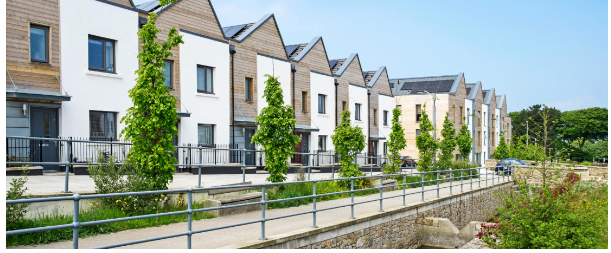
An affordable housing scheme in Cornwall Kevin Britland / Alamy Stock Photo
 East Devon Watch