Derriford Hospital long ambulance waits revealed

The Tories have forgotten, and taken for granted, Devon and Cornwall for too long.

All they seem to be interested in is closing beds. – Owl

Long ambulance waits and “hours lost” mark a worrying situation for Derriford Hospital chiefs in a new report.

David Dubas-Fisher www.plymouthherald.co.uk 

The latest Integrated Performance Report by the University Hospitals Plymouth NHS Trust board, held on December 1, noted a series of performance indicators which showed worrisome figures relating to some waiting times – but also a plan for new development and enlargement of the hospital after it secured funding.

In April PlymouthLive reported that according to the NHS’s own figures, Derriford Hospital had some of the longest accident and emergency waiting times in the country, with more than 24 percent of people arriving at the hospital having to wait more than 12 hours before being admitted, discharged or transferred.

But the latest set of performance indicators in the 574-page long report, suggests that while in April the “ambulance handover lost hours” sat at 3,350, it has risen steadily to 5,108 in August, 6,359 in September and 8,906 hours in October. With a “national target” of 76 percent, Derriford is languishing with its latest figures at 54.1 percent.

The report also notes that the number of patients who wait 12 hours or more in A&E has increased from 1,491 in April to 1,774 in October.

In it’s ‘responsive’ metrics for Urgent and Emergency Care, it noted how ambulance handover delays had increased to alarming levels. In April this year it stated that 3,350 hours had been lost against a ‘trajectory’ of 2,393. By September this year that had risen to 6,359 hours lost, against a trajectory of 3,039. However, the figures had sky-rocketed during October when 8,906 hours had been lost, against a trajectory of 3,554.

The report went on to state that the trajectory had been “assigned to us by our regulators and represents the improvement required to allow SWAST to achieve their Categrory-2 response time target. It broadly represents a 60 percent improvement at UHP (University Hospitals Plymouth) on previous volumes of lost hours due to handover delays. This is currently off trajectory and review of improvements actions is in progress.”

According to weekly figures recently released by the NHS on Monday, November 27, the average handover time at University Hospitals Plymouth NHS Trust was four and a half hours. That was the longest average wait at any trust in the country last week.

Things improved slightly at the trust on Tuesday when handover delays were four hours six minutes. On Wednesday it was four hours, on Thursday three hours 44 minutes, on Friday four hours six minutes, on Saturday ‘just’ two hours 12 minutes, and on Sunday three hours two minutes.

That compares with Great Western Hospitals NHS Foundation Trust where the average was two hours 34 minutes, and at University Hospitals of North Midlands NHS Trust it was two hours 30 minutes, both also on the Monday.

University Hospitals Plymouth NHS Trust also had the worst record for making patients wait for over an hour in ambulances. A total of 377 arrivals by ambulance had a handover delay of over an hour. That works out as 63 percent of arrivals. That’s up from 57 percent the previous week.

A Department of Health and Social Care spokesperson said: “We have prepared for winter earlier than ever before and we are making good progress in cutting both A&E waits and ambulance response times.

“Compared to the same time last year, ambulance handover delays have fallen by 28 percent, thousands more 111 calls are being answered within 60 seconds, and there were nearly 1,500 more hospital beds available.

“We know there is more to do and that’s why we’re working to get 800 new ambulances on the road and create 5,000 extra permanent hospital beds, on top of 10,000 hospital at home beds already rolled out, to free up hospital capacity and cut waiting times.”

A spokesperson for University Hospitals Plymouth NHS Trust said: “As the Major Trauma Centre for the southwest peninsula, we receive some of the most acutely unwell patients by air and road ambulance and continue to face pressure across the health system. It’s important to note that the data reflects seasonal changes and we expect to see higher demand for our services as we head into the winter months, which we have been preparing for.

“We understand patients and their families will be concerned about long waits and we have a relentless focus on getting patients to the right place at the right time to reduce ambulance waits.

“In addition to our clinical management of patients, we have introduced a number of measures which to help alleviate the pressure on the Emergency Department including; investing in more staff, expanding our Same Day Emergency Care service until 2am, (with plans to extend to 24 hour opening), and creating additional beds in both the hospital and community.

“Finally, we would always ask the public to choose well this winter and there are some things you can do to help ease the pressure on the Emergency Department:

  1. If your relative is in hospital and ready to go home, please collect them as soon as you can to get them safely home.
  2. Please use your local pharmacy, GP, and Urgent Treatment Centre if appropriate.
  3. Think 111 – If you think you, or someone you care for, needs to attend an emergency Department (ED), call 111 or visit www.111.nhs.uk, first. “

Labour’s prospective parliamentary candidate for Plymouth Moor View Fred Thomas has rounded on the Government after Derriford Hospital revealed its long waiting times for ambulance handovers.

He said: “After 13 years of Tory neglect, the NHS desperately needs a Labour Government to resuscitate it. The last Labour Government reduced waiting times by using the private sector, increasing staff numbers and spreading good practice. We did this before. We will do it again.

“We will train more GPs and bring back ‘family doctors’ for those with ongoing needs, Labour will double the number of district nurses and train 5,000 more health visitors. This will allow far more patients to be seen in the comfort of their home and provide a route to catching problems early and setting healthy habits. We must fix these problems in primary care that are driving avoidable footfall to the A&E.

“There can be no doubt the staff at our hospital continue to work in incredibly challenging conditions doing their best for us but without the staffing and bed resources they need to care for our people the way they would want to, or in a way patients deserve. We don’t clap NHS workers on a Thursday night anymore, but we probably should.”

Last month, Plymouth Moor View MP Johnny Mercer, in his opinion piece for PlymouthLive, said he understood locals “continued frustrations with your health services in Plymouth” saying each week he heard from “distressed constituents who are filed onto waiting lists”.

His concerns were highlighted when in May 2022 he revealed he had been admitted to Derriford Hospital and was left sitting on a chair in a hospital corridor for 21 hours in excruciating pain thanks to a herniated disc in his neck. He praised health staff and hospital chief Ann James, but claimed that not enough was being done to meet demand.

At the time he stated: “I have promised a new hospital by 2027, and that is my defining objective as the member of Parliament for Derriford. I also accept that the government has spent £20 million on the emergency department that is being developed as we speak.

“But whatever is being done is not being done fast enough, or at enough scale to meet the demand, and so I intend to meet with both local and national healthcare leaders to express these views and make it clear that the situation must improve in the near-term.”
Ofgem plans £16 household charge to help energy firms recover £3bn in bad debts

The energy watchdog has set out plans that would result in households paying an extra £16 on top of their energy bills to help suppliers recover almost £3bn in bad debts from customers struggling to pay bills.

Mark Sweney www.theguardian.com 

Ofgem said the one-off extra charge, which would be levied at £1.33 a month on bills paid between April next year and March 2025, was to “protect the market and consumers” after figures showed energy debt had hit a record £3bn.

The level of bad debt, which refers to the amount of money owed by customers that is unlikely to realistically be repaid, has soared because of increases in wholesale energy prices and the wider cost of living crisis putting pressure on household finances.

“We know that cost of living pressure is hitting people hard and this is evident in the increase in energy debt reaching record levels,” said Tim Jarvis, the director general for markets at Ofgem.

“The record level of debt in the system means we must take action to make sure suppliers can recover their reasonable costs, so the market remains resilient, and suppliers are offering consumers support in managing their debts.”

Ofgem, the energy regulator for Great Britain, said this one-off move would be less costly to consumers than if suppliers were forced out of business.

When wholesale energy prices began to rise in 2021, and soared dramatically after Russia’s invasion of Ukraine last year, about 30 energy companies went out of business.

Ofgem said this led to every UK energy customer being charged an extra £82 to cover the costs of making sure that households were not cut off.

The regulator said the consultation on the proposal would include the energy industry, consumer groups and the public.

“The proposals set out today are not something we take lightly,” Jarvis said. “However, we feel that they are necessary to address this issue. This approach will ensure the costs are recovered fairly, without penalising a particular group of customers.”

The proposed plan does not include passing extra costs on to customers who use prepayment meters. This is because they operate on a top-up system so PPM customers do not build the same debt level as credit customers.

Ofgem said that other industry sectors already “commonly make provisions” within their prices for bad debt costs and that the energy sector could do so within the price cap mechanism to “ensure these costs are recovered as fairly and efficiently as possible”.

Since the beginning of the year the energy price cap, the regulated cost of the average annual dual-fuel bill in Britain, has fallen from £2,500 to £1,928 from January 2024.

“The price cap has helped to protect consumers from a volatile gas market,” Jarvis said. “However, it remains a blunt instrument in a changing energy sector, and the way it works may need to change in the future, so customers continue to be protected.”

Government warned over recruitment of care workers from ‘red list’ countries

The government is potentially draining countries of vital medical staff, despite committing not to do so – and has been warned it should come up with a plan to change direction and help the countries in question.

Tim Baker news.sky.com 

The independent Migration Advisory Committee (MAC) has released its annual report on the state of the UK’s immigration system.

It comes at a particularly prescient time, as the government struggles with the issue following the revelation that net migration is at its highest ever level.

Sky News Monday to Thursday at 7pm. Watch live on Sky channel 501, Freeview 233, Virgin 602, the Sky News website and app or YouTube.

One of the highlighted areas in the report is the health and social care sector.

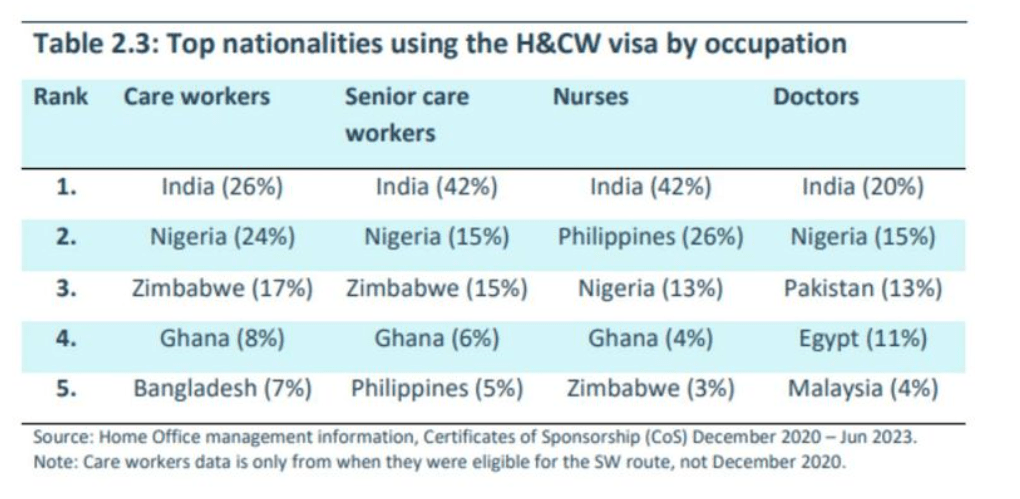
The MAC report describes how roughly 35% of doctors and 20% of nurses recruited to the UK are from “red list” countries, as described by the World Health Organization (WHO).

Under WHO rules, employers and recruitment agencies must not actively recruit health and social care personnel from “red” countries.

The list is also part of the government’s own code of practice for recruiting in the sector.

Countries on the “red list” include the likes of Bangladesh, Pakistan, Nigeria, Zimbabwe, and Ghana.

Health workers leaving these regions are reportedly “having a negative impact” in their domestic sectors.

The report says it is possible that “social media algorithms” are resulting in UK recruitment adverts being seen by those in red list countries – and it recommends the government “consider careful planning within the UK to reduce reliance and consequent negative effects on red list countries”.

The MAC report also highlights how low-paid foreign care workers are propping up the UK sector – seemingly without a government plan to deal with it.

Current high-levels of foreign recruitment have been precipitated by the addition of the care workers and home workers on the Shortage Occupations List – meaning people entering from abroad can be paid less.

Image: The number of people applying for a health and care worker visa by country. Pic: MAC

In 2021, 31,800 people applied for a health and care worker visa to work in the UK. From October 2022 to September 2023, this number was 144,000.

The report says the committee previously recommended this “to potentially alleviate some of the difficulties in the short-term whilst funding issues were addressed”.

But none of the other 19 steps they recommended to help address the underlying causes of workforce difficulties have been adopted.

The report also highlighted another issue – that people entering the UK on health and social care visas had been able to bring in dependents with them, such as children.

In 2021, 31,500 dependent visas were applied for on this route – this rose to 173,900 from October 2022 to September 2023.

However, the government has now said that it will be closing this dependent route off.

The MAC report says that, when calculating the benefit to the economy of hiring cheap labour from abroad, the cost of schooling migrant children and other impacts on the state’s purse are “generally ignored” – and cheap foreign labour is not necessarily “almost costless” when compared to “addressing the underlying pay issue”.

The government said this month that it will be reforming the Shortage Occupations List.

Spreaker This content is provided by Spreaker, which may be using cookies and other technologies. To show you this content, we need your permission to use cookies. You can use the buttons below to amend your preferences to enable Spreaker cookies or to allow those cookies just once. You can change your settings at any time via the Privacy Options. Unfortunately we have been unable to verify if you have consented to Spreaker cookies. To view this content you can use the button below to allow Spreaker cookies for this session only.

Another sector with low pay is migrant nurses – who get 18% lower wages than domestic counterparts when accounting for factors like age.

This is possibly down to those arriving in the UK having to start on the lowest pay band – a factor which may contribute to the NHS “reliance” on immigration.

Sky News has contacted the Home Office for a response.

Cheshire East council says it faces bankruptcy due to HS2 link cancellation

A council in one of the wealthiest parts of the UK has warned it faces potential bankruptcy due to the “devastating” impact of cancelling the northern leg of HS2.

Josh Halliday www.theguardian.com 

Leaders of Cheshire East council in north-west England said the authority had spent £11m preparing for the high-speed rail link, and this would now have to be written off. Most of this money – £8.6m – had been funded by borrowing and would now have to be funded from the council’s already stretched revenue budget.

As a result, the council, which is a unitary authority covering Crewe and Macclesfield, could be forced to trigger a section 114 notice, in effect declaring bankruptcy, according to a report by council officers.

Nearly one in five council leaders in England have said they are likely to declare effective bankruptcy within the next year due to a lack of government funding. One in four councils in Scotland said they faced the same prospect.

Labour-run Nottingham city council last month became the fourth authority in the past year – and the eighth in six years – to declare effective insolvency.

Cheshire East council said it faced “direct and devastating impacts” from Rishi Sunak’s decision to abandon HS2 north of Birmingham. It said these impacts were not mitigated by the government’s “network north” proposals which were released to quell widespread anger from political and business leaders over the axing of HS2.

The report submitted to a full meeting of Cheshire East council on Wednesday said it was seeking a “fair and equitable deal to compensate for the losses to the council and the opportunity cost to the borough” of Sunak’s decision.

The council, which reported a forecast £18.7m shortfall in its budget earlier this year, has already introduced a number of cost-saving measures, including charges for green bins, cuts to library opening hours and closing its headquarters.

The council’s Labour leader, Sam Corcoran, has met the rail minister, Huw Merriman, who “agreed that a dialogue between the council and government would continue”, the meeting was told.

The Conservative group leader, Janet Clowes, added that there was “very much a cross-party Cheshire East remonstration with government”.

She said: “I accept that it’s my government, if you like to put it that way, but we have a really good case to bring forward and we have a right to expect more in terms of the response that we can get as how those monies are now going to be allocated. Because Crewe deserves it, as does the rest of Cheshire East that was set to benefit indirectly from being the gateway to the north.”

The mayor of Cheshire East, the Liberal Democrat Rod Fletcher, said he wanted to take the “unusual step” of speaking on the issue as he was a retired railway operating manager. “I was personally devastated,” he said of the cancellation.

A Department for Transport spokesperson said: “Cheshire East is set to receive significant additional support from a new £4.7bn fund to transform local transport across the North and Midlands, as well as a £110m uplift of over 11 years for local road maintenance.

“This is on top of a funding boost of more than £2.2m for bus services in the area as well as the extension of the £2 bus fare cap to the end of 2024 – all part of our Network North plans using redirected HS2 funding to benefit more people in more places, more quickly.”