Tory donor’s firm paid for Sunak’s £16,000 one-way helicopter trip to Leeds

Why take a train when someone will pay for a helicopter? – Owl

Rishi Sunak took a £16,000 one-way trip to Leeds on a helicopter courtesy of a firm owned by Frank Hester, the Tory megadonor, taking the total for the prime minister’s donor-funded air travel to more than £100,000 this year.

Rowena Mason www.theguardian.com 

The prime minister once again showed his fondness for short-haul air travel as he took a helicopter from Battersea to Leeds Bradford airport last month – a journey of about 90 minutes. The quickest train from London to Leeds takes about 2 hours and 13 minutes, and costs in the region of £60 off-peak.

Sunak registered the trip as paid for by The Phoenix Partnership (TPP), which as a group has won more than £135m of NHS and government contracts to supply IT since April 2020.

Labour said it was the fourth helicopter ride taken by Sunak that was funded by wealthy Conservative party donors who have been paying tens of thousands of pounds to allow the prime minister to avoid public transport or long car journeys. His regular private air travel has also raised questions about the prime minister’s commitment to tackling the climate crisis.

Hester, who is sole owner of the company, made a £5m donation to the Conservatives earlier this year – the joint biggest gift by a living donor. TPP has previously said it was “unequivocally apolitical”.

Jo Maugham, the director of the Good Law Project, said: “None of us can look into Mr Hester’s mind to see what motivates him to make these generous donations to Mr Sunak and his government of vast sums of money and a helicopter ride. What is beyond doubt is that he has made an enormous fortune from contracts given to him by the government.”

Sunak has long been criticised for taking flights and helicopters for short trips, including an RAF chopper from London to Dover, despite the trip being just over an hour by train.

Emily Thornberry, the shadow attorney general, said: “Yet again we have the prime minister asking a Tory donor to pay thousands of pounds for a luxury helicopter just so he doesn’t have to spend two hours on a train with the general public.

“If it seems like it happens every month, that’s because it usually does. Four different donors this year for four different helicopters, to go with the two he normally uses at taxpayers’ expense. If he spent half as much time thinking about the country’s cost of living as he does about his own options for flying, we would all be a damn sight better off.”

During the visit, which was in the same constituency as TPP’s main office, Sunak visited a jewellery maker and was later mocked on social media for having used a hammer sideways – even though he was told to do so by the instructor.

TPP supplies software to about 2,700 GP surgeries in England as well as support services to allow them to hold medical records for patients electronically.

Downing Street and TPP have been approached for comment.
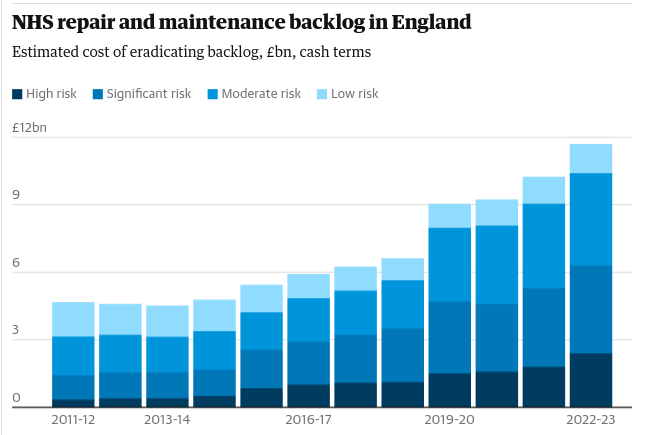
Hospitals ‘falling to bits’ as NHS in England faces record £12bn repair bill

The NHS in England has a record repair bill of almost £12bn, new figures show, with ministers needing to find more than £2bn for urgent maintenance to prevent catastrophic failure.

Michael Goodier www.theguardian.com 

The annual report on the condition of the health service’s estate said on Thursday that the cost of improving rundown buildings and decrepit equipment was two and a half times larger than in 2011-2012, when it stood at £4.7bn.

The cost of the “high-risk” backlog – situations where the need to repair or replace facilities and equipment must be urgently addressed to prevent serious failure, significant injury or major disruption to clinical services – rose by almost a third to a record £2.4bn. This was £0.3bn in 2011-2012.

However, investment to reduce the backlog fell in the last year from £1.41bn to £1.38bn, a fraction of what is needed to restore the NHS estate back to acceptable levels of risk. The stark figures cover a time prior to the health service becoming embroiled in the crumbling concrete crisis which initially hit school buildings.

Sir Julian Hartley, the chief executive of NHS Providers, said that “too many NHS buildings are quite simply falling to bits”, and that we need “a step change in the government’s approach to planning and funding essential capital investment in the NHS”.

He said: “The eye-watering cost of trying to patch up creaking infrastructure and out-of-date facilities is mounting at an alarming rate.

“Mental health, hospital, community and ambulance services are crying out for much-needed funding for critical projects to overhaul ageing estates and to give patients and staff the safe, reliable conditions they need.

“We should be planning for how to transform the NHS estate as well as addressing urgent maintenance challenges.”

The costs of the “high-risk” backlog have risen by 31% in 2022-2023, while the overall repair bill has risen by 13.6% in the same period. The level of investment only covered 11% of the cost.

The hospital with the largest high-risk backlog was Airedale general, where it would take £335.2m to fix all of the serious safety and maintenance issues. Airedale is part of the NHS programme to remove reinforced autoclaved aerated concrete (Raac) from its buildings. Raac is a lightweight construction material that is susceptible to structural failure.

There were 42 hospital sites confirmed to contain Raac as of October, 18 of which had joined the national Raac programme since May, meaning the cost of any repairs needed was excluded from the latest figures.

However, the maintenance crisis is broader than one single issue. Charing Cross hospital in London had the second-largest high-risk backlog, with £173.7m worth of repair work needed.

But it did not appear on the government’s list of hospitals with Raac. Neither did St Mary’s hospital in London, Croydon university hospital or Wycombe hospital, which had the third, fourth and fifth largest high-risk backlogs respectively.

The Health Service Journal recently reported that Doncaster Royal Infirmary, some of which dates back to the 1930s, had been testing contingency plans for a “full or partial site closure” because of the problems it faces with parts of its infrastructure.

In 2021, a leak from a water pipe got into the electricity supply for the women and children’s hospital. This knocked out power cables for an entire wing of the hospital, started several fires and forced staff to evacuate premature babies and mothers who were in labour.

Siva Anandaciva, the chief analyst at the King’s Fund, said the government’s failure to build the “40 new hospitals” Boris Johnson promised in 2019 “has left parts of the NHS estate in such a poor condition they pose serious risks to staff and patients”.

In September Julian Kelly, NHS England’s deputy chief executive, told MPs on the Commons public accounts committee that the NHS had “examples all the time where hospitals are having to shut units, decant patients into other spaces, where we are losing [operating] theatres … which limits our capacity to treat patients”.

Rory Deighton, the director of the NHS Confederation’s acute network, said: “The growing cost of the high-risk maintenance needed to prevent catastrophic failures or major disruption to clinical services is particularly worrying.”

NHS trust bosses regarded the “urgent” need for more capital investment as the NHS’s top funding priority, he added.

Separate figures show the NHS was badly hit by the rise in the cost of energy due to Russia’s invasion of Ukraine. The service spent £1.2bn on energy costs in 2022-23, up by 53% on the year before, despite using less energy overall (down by 1.7%).

A Department of Health and Social Care spokesperson said: “We have invested significant sums to upgrade and modernise NHS buildings so staff have the facilities needed to provide world-class care for patients, including £4.2bn this financial year.

“Trusts are responsible for prioritising this funding to maintain and refurbish their premises, including the renewal and replacement of equipment.

“This is on top of the £3.7bn made available for the first four years of the new hospital programme and a further £1.7bn for over 70 hospital upgrades across England alongside a range of nationally funded infrastructure improvements in mental health, urgent and emergency care and diagnostic capacity.”

Christmas is coming, and the GESP is getting fat.

Extract from CPRE December newsletter:

As we head into the festive season, a spectre has risen Jacob Marley-like, clanking its chains. The Greater Exeter Strategic Plan, whose obituary was published as recently as 30 October, seems to have leapt straight back out of its grave.

GESP was an ambitious plan for the zone around Exeter including East Devon, Mid Devon and Teignbridge, which was declared technically dead when East Devon pulled out. But now we hear news of three new ‘towns’: 8,000 houses just east of Exeter (East Devon), another 1,000 in Alphington/Marsh Barton (Teignbridge) and 1,100 in East Cullompton as part of the planned 5,000 intended for the Culm Garden Village (Mid Devon).

We look forward to the plans to expand the networks of schools, post offices, police stations, reservoirs, GPs, dentists, pharmacists and the RD&E.

And how many of these homes will be priced for genuine local need? An important CPRE study shows that fewer than 10,000 social homes and fewer than 18,000 ‘affordables’ were built in Devon – in the last 30 years! More on this in the next Newsletter.

Devon and they potholes

The Daily Mail carries a report that drivers in Devon have submitted claims amounting to more than £1million for vehicle damage caused by potholes in just eight months, but the council has paid out less than five per cent of the claims.

A total of 966 vehicle damage claims have been submitted to Devon County Council since April this year with the value totalling £1.1million.

The figures were obtained by Councillor Frank Letch (Lib Dem, Crediton), who was seeking information on the number of potholes the county is dealing with.

Cllr Letch said the figures showed that 28,801 reports of potholes have been made by members of the public in this financial year alone, and that the council had identified 1,505 potholes for repair.

Devon County reports:

We’re receiving an extra £6.663 million for highway maintenance this financial year.

The money is a share of the Government’s £8.3 billion investment in roads over the next 11 years using funds redirected from the cancelled HS2 rail line extension to Manchester.

The initial schemes prioritised to start in the coming weeks are mostly minor routes and residential roads across the county.

The funding will also accelerate patching and pothole repairs across Devon’s 8,000 mile road network – the biggest of any authority in the country. The aim is for the repair schemes to be completed this financial year……