MP’s Dickensian rant against Mid Devon but ministers see no cause for concern

The Tory candidate for Tiverton & Minehead, and sitting MP, Ian Liddell-Grainger, has launched a scathing attack on Mid Devon District Council (MDDC) in a 25-minute tirade in Westminster.

Lewis Clarke www.devonlive.com

Ian Liddell-Grainger’s comments have been described as ‘bald faced lies, sexist and sexually inappropriate’ by Mid Devon’s leader, Luke Taylor.

His main focus of attack was alleging that MDDC’s development arm, 3 Rivers Development’s Ltd, which has ceased trading following losses of up to £21 million was a ‘loss-making white elephant’.

The company was founded in 2017 while the authority was under Conservative leadership, before independent councillors were leading the authority between 2019 and 2023 when in May the Liberal Democrats had a landslide victory.

Mr Liddell-Grainger, MP for Bridgwater and West Somerset, made a scathing speech in Westminster Hall on Tuesday, December 19, in which he called the council’s investment venture a “modern morality tale in the manner of Charles Dickens”.

He said that the council’s senior officers, led by chief executive Stephen Walford and deputy chief executive Andrew Jarrett, were “chronically naive” and “out of touch” with the way commerce works, and that they had gambled with taxpayers’ money on risky projects that failed to deliver.

He said: “When Walford and Jarrett moved into their jobs as top officers, I think they probably wanted to make their mark. But neither of them had any experience at all in any other trade or profession; I do not think either of them had ever actually even done a paper round.

“There should have been alarm bells ringing at every level, but Mr Walford and his number-crunching colleague were a convincing double act like Laurel and Hardy—and many others I can think of.”

He also criticised the council’s current leader, Liberal Democrat Luke Taylor, whom he mockingly referred to as “Mr Thingamabob”, for refusing to shut down the company, which he said had cost the council £21.3 million in loans.

He said: “The Liberal Democrats, who are now refusing to shut down this loss-making white elephant, never objected to its creation in the first place. If they did, they did it so quietly that nobody noticed. Mr Thingamabob may well have been won over by his smooth-talking chief exec; after all, it would be perfectly normal for him to trust his officers.

“Elected members never get paid enough to justify full-time work on council business. They are dedicated amateurs, no matter the party. They are obliged to listen to their officers—especially the most senior, who is the chief executive.”

He claimed that the council had been “incredibly coy” about revealing any details about the company, and that the scrutiny committee had produced a “cack-handed and useless” report that did not hold anyone accountable.

He said that the council had become “toxic” and that there was a “poor relationship” between the company and the elected members, who had lost trust in the officers.

He also alleged that the council had withheld information from the public, and that the chairman of the council, Councillor Frank Letch, had “brutally suppressed” any debate.

He concluded: “This is a saga of wasted opportunity, of council officials wielding enormous influence over councillors, letting them down, then falling out with the whole council. It is a disgrace. Those are all distressing situations, but there have been well-sourced stories in the press recently of real anger from members of the public who tried to obtain simple information about 3 Rivers Developments but were rebuffed.

“People complained that MDDC thinks that the whole business is far too complicated for ordinary people to understand, so information is deliberately withheld.

“When complaints are made at full council meetings, the chairman of the council brutally suppresses any debate. The chairman’s name, incidentally, is Councillor Frank Letch—a man with a short fuse. Perhaps it is a struggle—the naming of a person like Letch. Mainly, the posh dwellings designed for some spare land next to the council buildings are being converted for the use of over-60s, even though the location is completely unsuitable.

“I could, but will not, go on and on. This is a saga of cockups and blunder, and it is very expensive indeed. I would rather risk public money with Ebenezer Scrooge than with those responsible in Mid Devon, and especially the chairman of scrutiny, who is quite ridiculously incompetent.”

The Parliamentary Under-Secretary of State for Levelling Up, Housing and Communities, Simon Hoare responded in the debate saying: “Mid Devon District Council is not on my departmental radar as a council causing concern in terms of its finances. Financial management is a different thing. In terms of its basic finances, it is not on the radar.

“I do not know the gentleman to whom he refers with regard to the senior officers, and I can only speak from experience of my exposure and interaction with local government officers over very many years. My experience is that they are women and men of integrity who, day in and day out, devote themselves to the public service of their communities and always strive to do their best.

“Sometimes the best is not good enough, and sometimes the wrong decisions are taken. I think that the motivations of people in public service are usually strong and beyond challenge. I say gently to my hon. Friend that he may not like some of the things that the council has done, and he may have done things differently, but I repeat that the council is not currently on our radar.”

He concluded: “It is particularly important when any party has a very large majority, as the Liberal Democrats do in Mid Devon at the moment. One almost needs to double up and double down on scrutiny in order to prove beyond peradventure that that job is being done. I am about to run out of time. I am grateful to my hon. Friend for raising this issue. As I say, I am happy to continue our conversation in order to ensure that the good folk of Mid Devon receive the service and services to which are they entitled and deserve.”

Mid Devon Liberal Democrats have welcomed remarks from the Local Government Minister, after they expressed confidence in the financial position of Mid Devon District Council.

Councillor Luke Taylor, Liberal Democrat Leader of Mid Devon District Council, said: “Unlike Mr. Liddell-Grainger, Liberal Democrats are focused on ensuring that the residents of Mid Devon receive the quality service and services that they deserve.

“Despite inappropriate language and wild claims by the MP for Bridgwater, it’s telling that even his own Government acknowledges that Mid Devon District Council has no case to answer when it comes to financial management.

“I am sure that Bridgwater residents would rather their MP be focused on tackling the issues they face, instead of these desperate attempts to be relevant here in Mid Devon.

“On behalf of the Mid Devon Liberal Democrats, I want to thank the government for acknowledging the council’s financial prudence. We will remain focused on doing all we can to support everyone living across our towns and villages.”

He added: “Despite the unfounded allegations, bald faced lies, sexist and sexually inappropriate language used by the Conservative MP for Bridgwater, cowering behind Parliamentary Privilege, this Government has recognised that MDDC has no case to answer. We can only hope that this will bring an end to the sordid campaign run by this most un Parliamentary of MPs.”
Exmouth & Exeter East Tory candidate outlines priorities and credentials

In a long press article the Tory candidate for the new Exmouth & Exeter East seat, David Reed, outlined his priorities and credentials in somewhat disjointed terms.

The three key issues he will address if elected are: reducing sewage spills; improving social care access; and promoting apprenticeships. 

Many would say that the first two of these issues are the direct result of right wing conservative policies intended to reduce taxes by shrinking the state and cutting investment in services and infrastructure.

Water companies (and Railways, which he doesn’t mention) are examples of how privatisation has broken Britain.  

In a speech to a Conservative Forum in April 2009, for example, David Cameron declared that “the age of irresponsibility is giving way to the age of austerity”, and committed to end years of what he characterised as excessive government spending. He became PM in 2010 with George Osbourne as Chancellor and we can now see the result of what he meant by “austerity”.

In the article David Reed described himself as ‘centre-right’ which doesn’t seem to be a good starting point to stop leaks in sewage or improving access to social care.

On promoting apprenticeship schemes he says they allow:

“…companies, the private sector, to invest in their people, and it creates a much better connection so that people can actually learn on their job, but also have the opportunity once they’re qualified to save a lot more and then buy into things like housing, have a family, which I think the Labour [education] policy has eroded. “

Maybe news to him: the Tories have been tinkering around the edges of the policy on apprenticeship schemes for the past 13 years with the latest funding package published last October.

In Owl’s view apprenticeships suffer from the short term nature of so many investment decisions taken in Britain by both government and the private sector. We need a complete reset on investment but that can only come with a government demonstrating confidence in managing the economy, not conducting mad cap experiments with the likes of Liz Truss.

Asked about his relative political inexperience, he said: “I would like to think that I’ve actually packed a lot into my life so far.  

“I’ve been very close to central government policy for a long time, and I’ve been on the sharp end of delivering that policy, either through the military [as a former Royal Marine] or in other jobs that I’ve done, or in the defence industry [defence contractor BAE Systems with whom the MoD currently spends £4.0bn annually 2021/22].  

“I’m coming in knowing how the state works, understanding how to bid for central government money, how to write an effective bid, which is very, very important, and then how to actually work with relevant authorities to actually get on the job and actually deliver those things. 

“It takes a long time to see how that puzzle fits together, but I come good to go.” 

(Is that a promise? – Owl)

Read the full article here 

As yet, inexperienced David Reed who has only tenuous local connections doesn’t know who he might be facing in the General Election. They could trump him both on experience and local connection.

Exmouth & Exeter East is a seat that Labour has said is not, for them, a “battleground seat”.

Could this be another two horse race?

There are nearly 26,000 Claire Wright votes to play for between the Exmouth & Exeter East constituency and the Honiton & Sidmouth constituency. Owl can’t see many of these going to either of the Tory candidates.

Why we should not blame councils for housing crisis 

 Letter www.theguardian.com

The latest attack on our planning system is misguided (Michael Gove threatens action against English councils over housing plans, 19 December). Michael Gove misses the real reason why the UK lags so far behind other parts of Europe. For decades, governments have relied on housebuilders, who want to make money quickly. At the same time, it has cut the capacity of local authorities to be more than regulators.

Even in popular areas with agreed plans, such as Northstowe in Cambridge, Southall in west London, or around Gloucester, building is grinding to a halt as confidence dissolves. The results are congestion, pollution and stress for local communities.

The government needs to rebuild capacity to deliver from the bottom up. New towns provide inspiration, but development must be joined up with existing infrastructure capacity, especially local rail. Our Wolfson prize-winning plan for Uxcester Garden City showed how mid-sized cities such as Oxford or York could be doubled in size through a visionary spatial plan. Yet the proposal was blocked by a previous housing minister, apparently because it would extend a tightly bounded city into Tory strongholds.

Good strategic planning requires the use of compulsory purchase powers to assemble land in the right locations at existing use values with long-term loans from pension funds and insurance companies for the foundations. Delivery should be through small builders, including cooperatives (as in the Netherlands or Germany) to create neighbourhoods where people on a range of incomes want to live.

The government needs to resource strategic planning properly rather than continually attacking councils for what is not their fault.
Dr Nicholas Falk
Executive director, the Urbed Trust

House prices in some parts of Cornwall fall by a quarter

A map has revealed the average price of houses in every Cornish postcode and how they have changed over the past year. Data shows the places where prices have dropped the most significantly, including on the pretty Lizard peninsula.

Lisa Letcher www.cornwalllive.com

The data covers houses sold from October 2022 to October 2023 and comes from the Land Registry, where all property sales are recorded. Some postcodes however have seen less than 20 sales and the lower the number of houses sold, the less realistic the average price overall.

It revealed that house prices in TR12 which covers the Lizard peninsula, below Helston, have fallen by more than a quarter with 76 total sales. In October 2022 the average cost of a house was £537,768 but now it’s £116,995 less – a 26.5 per cent decrease.

That’s the largest drop of any postcode district in Cornwall to have had at least 20 sales over the last 12 months. Homes in PL10 – covering Cawsand, Cremyll, Fort Picklecombe, Freathy, Kingsand and Millbrook – saw the next largest drop for an area with over 20 sales.

The average property there cost £336,700 in the year to October. That’s down by 16.1 per cent compared to a year earlier when the average was £400,434.

In TR2 – Truro, Gerrans – prices fell by 13.1 per cent to £455,012, in TR5 – St Agnes – by 13.1 per cent to £506,175, and by 12.1 per cent in PL28 – Padstow, Crugmeer, Porthcothan, St Merryn, Trevone, Treyarnon – to £678,757.

You can see how prices have changed in your local area by using our interactive map as house prices fell by an average of £3,000 across the UK in the year to October. We’ve also listed the top ten places with the largest fall in average house prices.

The average house UK-wide cost £288,000 in 12 months to October 2023, new data from the Land Registry has revealed. That’s 1.2 per cent lower than in the year to October 2022. Average house prices decreased by 1.4 per cent to £306,000 in England and by 3.0 per cent to £214,000 in Wales, but increased by 0.2 per cent in Scotland to £191,000.

Cornwall postcodes with the largest average house price drop

PostcodePlacesAverage price in October 2023Total sales this yearAverage price in October 2022Sales last yearPercentage change yearChange
PL29Port Isaac, Port Gaverne, Port Quin, St Endellion, Trelights£539,37516£776,86818-30.9%-£237,493
TR12Lizard peninsula£420,77376£537,76898-26.5%-£116,995
TR17Marazion£336,6676£413,53627-24.7%-£76,869
PL10Cawsand, Cremyll, Fort Picklecombe, Freathy, Kingsand, Millbrook£336,70039£400,43457-16.1%-£63,734
PL34Tintagel, Bossiney, Trewarmett£332,54617£403,05431-14.9%-£70,508
TR2Truro, Gerrans£455,012103£499,452146-13.1%-£44,440
TR5St Agnes, Mithian£506,17532£580,41465-13.1%-£74,239
PL28Padstow, Crugmeer, Porthcothan, St Merryn, Trevone, Treyarnon£678,75738£732,34567-12.1%-£53,589
TR20Penzance£361,01975£396,385126-9.9%-£35,367
TR6Perranporth, Bolingey, Perrancoombe£434,10845£446,25364-6.6%-£12,145

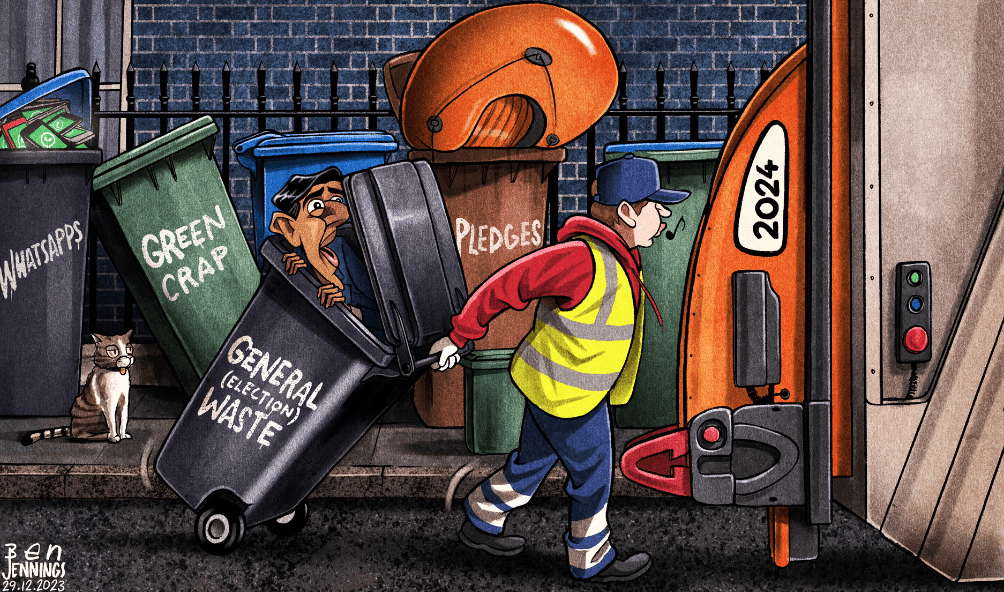
Rishi Sunak’s prospects for 2024 

In September Rishi Sunak scrapped “Heavy Handed” plans to make everyone sort their rubbish into seven bins as he rowed back on green pledges.

Looks like he only needs four! – Owl