Good luck with letting the train take the strain

Due to planned engineering works, no trains will be servicing the line between London Paddington and Reading on either Christmas Eve – Sunday, December 24 – or Wednesday, December 27.

www.southwalesargus.co.uk

Network Rail is set to begin work on the new HS2 station at Old Oak Common.

Services are not scheduled to operate on Christmas Day or Boxing Day. 

Tickets for trains travelling towards Devon and Cornwall on Friday, December 22 and Saturday, December 23 are already almost sold out. 

The following changes are being made to the London Paddington services while the work is ongoing:

  • Most GWR services start or terminate at Reading instead of London Paddington;
  • Limited GWR and Elizabeth line train services will run between Reading and Ealing Broadway;
  • Connecting Underground services will run from Ealing Broadway into central London;
  • Customers travelling to or from central London can do so using London Underground’s District or Central line services at Ealing Broadway, as the Elizabeth line will not be in operation between Ealing Broadway and London Paddington;
  • South Western Railway will accept GWR tickets on these days between Reading and London Waterloo, as will Chiltern Railways between Oxford and London Marylebone. 

Passengers are also advised that no Heathrow Express services will run during this time. Customers travelling to Heathrow Airport from central London should use the Piccadilly line instead. 

Operators have said anyone who needs to travel on Sunday, December 24, or Wednesday, December 27, should allow plenty of time to reach their destination as journey times will be significantly longer than normal.

Great Western Railway say services will also finish earlier than usual on Sunday December, 24 and all journeys will need to be completed by approximately 10.30pm. 

People who do need to travel on these dates are advised to travel before 9.30am. 

For the latest information, please click here

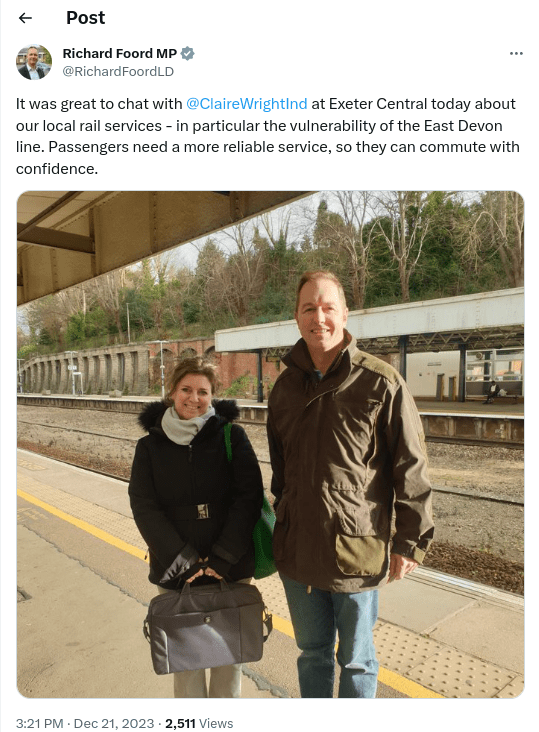
Local MP has a chat with Claire Wright

“It was great to chat with @ClaireWrightInd at Exeter Central today about our local rail services – in particular the vulnerability of the East Devon line. Passengers need a more reliable service, so they can commute with confidence.”

Richard Foord of course, not Simon Jupp. Simon is becoming increasingly isolated.

MP calling for improvements on Exeter-Waterloo railway line

Adam Manning www.midweekherald.co.uk

Liberal Democrat MP Richard Foord has called for urgent work to be undertaken to improve the Exeter-Waterloo railway line in the wake of flash flooding, which saw services between Exeter and Yeovil junction cancelled for ten days. 

Speaking in Parliament this week, Tiverton & Honiton MP Richard Foord raised the issue with Rail Minister, Huw Merriman, and asked for the line to be dualled between Chard Junction and Axminster, and a passing loop at Whimple would allow trains to pass. 

In response to Mr Foord’s calls, the Minister committed to reviewing the proposed project and said he would take extra steps to reduce disruption for people living in East and Mid Devon.

Bad weather saw huge levels of rainfall, which triggered a landslide near Crewkerne. This caused train services to be cancelled for more than a week, as there is only a single track on this section of the route.   

This was not the first time this route has been blocked following heavy rain. In November 2022, the service between Exeter-Waterloo had to terminate at Axminster for several days due to a landslip near Honiton. 

Mr Foord said: “Everyone living in our corner of Devon knows just how well-used our rail services are. They offer a vital commuter link to Exeter and London, as well as being a gateway to the wider West Country for tourists and visitors. 

“However, we’ve seen multiple issues in recent years that have caused many trains to be cancelled or delayed. In particular, the fact that there is only a single track between Chard and Axminster throttles capacity, meaning that one minor issue can derail services for everyone. 

“Solutions could include dualling the line, or adding a passing loop, so that services can move back and forth more easily. We also need to see greater investment in flood defences along our railways, to avoid more damaging landslips that can block the line. 

“I am glad that the Minister agreed to look into these proposals, which would benefit our communities and everyone who regularly uses rail services. I will continue to push for the signal to go green, so that this much-needed work can begin.” 

Richard Foord calls for Govt to tackle Devon’s broadband ‘not-spots’

Liberal Democrat MP Richard Foord is calling for more to be done to tackle so-called broadband ‘not-spots’ in East Devon.

Adam Manning www.midweekherald.co.uk

Speaking in Parliament, Richard Foord MP highlighted the case of two communities who have been left lagging behind on broadband – Northleigh and All Saints residents say they struggle to get even a basic internet connection. 

The Honiton MP said that it was rural areas in East Devon where speeds were the slowest, clocking in at almost half the UK average. 

Communities such as Sidmouth, Axminster, and Seaton rank in the worst 10% of the whole country for broadband. Even places like Honiton, where speeds are notionally better, the average connectivity is still in the worst 30% in the country. 

Highlighting the impact this patchy connectivity has on people’s ability to access things like online banking, to work from home, and stay in touch with loved ones, Richard Foord is now calling for the Government to step-up efforts.  In Parliament, Richard called on the Minister to get people online with speeds that bring people into the 2020s. 

Richard Foord MP said: “It’s a scandal that rural towns and villages like ours are being left struggling to get even basic broadband access, all while urban areas surge ahead. 

“In recent years we’ve seen so many banks close branches on our high streets, forcing people to rely upon online banking to manage their finances. There’s also been a rise in online bookings for travel, particularly when it comes to our railways.  

“But all of this isn’t possible if you cannot get a reliable connection. For far too long, people in our part of the world have been neglected by this Government, which seems out-of-touch with some of the challenges we face on a daily basis.  

“Devon is tired of being left at the back of the queue. That’s why we need to see real action to fix this situation and to help our communities get online, ensuring that the South West – and East Devon in particular – catches up with the rest of the country.” 

Council blunder sees payments taken before Christmas

East Devon District Council has apologised after the premature withdrawal of some council tax payments this month. The authority has blamed a ‘technical glitch’ which meant a payment was taken on Friday rather than on December 27.

Daniel Clark www.devonlive.com 

The council has said that they understand the financial impact this may have on households, especially at this time of year. They said: “We sincerely apologise for any inconvenience caused.”

For residents who do not have enough money in their account to cover the payment. EDDC, suggests they contact their bank and ask them to stop and/or reverse the transaction. If the banks do this the funds should appear back in their account on the same day, and they should avoid any fees.

A statement issued on Friday said: “ East Devon District Council deeply regrets the inconvenience caused to our residents due to an unforeseen error which has resulted in the premature withdrawal of some council tax payments this month.

“On Friday, December 22, a technical glitch occurred in our payment processing system, causing some residents to experience an early debit of their council tax payment. The normal date for payments (the 25th of the month) should have meant the 27th December was the date banks would have taken payment. We understand the financial impact this may have on households, especially at this time of year and we sincerely apologise for any inconvenience caused.

“Where the payment has been made by a resident’s bank and the loss of funds causes hardship, residents should contact their bank and ask for the payment to be reversed under the direct debit indemnity, EDDC will then make contact with residents in the new year to arrange for payment of the instalment.

“For residents who do not have enough money in their account to cover the payment. EDDC, suggests they contact their bank and ask them to stop and/or reverse the transaction. If the banks do this the funds should appear back in their account on the same day, and they should avoid any fees.

“If it is too late to contact the bank and fees are incurred due to this error, residents are asked to provide evidence of the fees incurred and email these to counciltax@eastdevon.gov.uk and the council tax team will look to recompense the fees incurred.

“For those who experience financial difficulties from this error, our financial resilience team will be dealing with emergency requests on the mornings of the 27 and 29 December. To submit a request for financial support, please click on the council website.

“The council wants to assure residents that steps are being taken to prevent the recurrence of such incidents and East Devon District Council remains committed to helping anyone affected by this error.”

NHS given warning about infection control as Covid cases rise

The most recent figures showed one in 24 people in England and Scotland had Covid on 13 December, up from one in 55 two weeks before.

Matthew Weaver www.theguardian.com

The Royal College of Nursing has warned of an increase risk of Covid among hospital staff and patients due to the NHS’s failure to follow World Health Organization advice about infection control during a current spike in cases.

The most recent figures showed one in 24 people in England and Scotland had Covid on 13 December, up from one in 55 two weeks before.

On Tuesday, the WHO expressed concern about a new subvariant of Omicron, labelled JN.1, after its rapid spread in the Americas, western Pacific and European regions. To tackle the increase, the WHO advised that all health facilities “implement universal masking” and give health workers “respirators and other PPE”.

Now the RCN has written to the four chief nursing officers in England, Wales, Scotland and Northern Ireland asking why this guidance has not been introduced across the NHS.

The letter, seen by the Guardian, points out that existing guidance in the national infection prevention and control manual (NIPCM) does not mandate hospital staff to use masks. It also leaves decisions about respirators to local risk assessors.

The RCN says this guidance to UK hospitals is “inconsistent” with WHO advice.

The letter by Patricia Marquis, the RCN’s director for England, calls for urgent revision to the NIPCM guidance to ensure the “universal implementation” of masks and respirators for health workers.

Marquis wrote: “I am mindful of the current unsustainable pressures on the health service, with … a rise in cases and hospitalisations with Covid-19, alongside other respiratory viruses in general circulation. I am concerned that without proper protections ill-health and sickness will continue to rise in nursing staff and impact on their ability to deliver safe and effective patient care.”

She added: “We are also concerned about the increased risks to patients from hospital-acquired respiratory infections.”

Marquis also raised the issue of ventilation in hospitals. She said: “We also have concerns about the adequacy of ventilation in general ward and outpatient areas within hospital buildings and believe that action must be taken to assess and improve this.”

In Tuesday’s update, the WHO said the global health risk posed by JN.1 was “low” based on the available evidence. But it added: “Despite this, with the onset of winter in the northern hemisphere, JN.1 could increase the burden of respiratory infections in many countries.”

It also pointed out that Covid “is not the only respiratory disease circulating. Influenza, RSV and common childhood pneumonia are on the rise”.

The UK Health Security Agency, which is responsible for the guidance, has been approached for comment.

Christina Pagel, a professor of operational research at University College London, suggested JN.1 was likely to cause a wave of infections second only to that recorded in England in March 2022, which was driven by the Omicron variant.

“After a quieter 2023, it’s a sign that we can’t just assume that Covid has gone away or can’t cause us significant issues any more,” she said, adding as many people had not been eligible for recent booster programmes, they had not had a Covid vaccination for two years.

“This will likely mean they feel sicker [if they do catch Covid] and also [have an] increased risk of long Covid too,” Pagel said. “Given we’ve got millions of leftover vaccines from the autumn booster campaign, why not try to put them in people’s arms instead of the bin and open them out to the general population?”

‘Christmas stink’: UK’s traditional festive swims face rising tide of sewage

Long-established Christmas seaside swimming locations have been flooded with sewage over the last year, prompting concern that swimmers could fall ill.

Aletha Adu www.theguardian.com 

They would not be able to claim compensation, as Tory MPs earlier this month blocked a Lib Dem amendment that would have allowed anyone who got sick as a result of illegal sewage dumping to claim from water companies.

During the festive season, swimmers traditionally wear cheery fancy dress as they plunge into the sea at beaches from Eastbourne, Sussex, to St Ives, Cornwall.

Statistics analysed by the Lib Dems have found that this year, festive swimmers will be using beachfronts where 4,574 hours of sewage has been spilled. Between the 32 event locations analysed by the party, almost 1,000 sewage spills were found to have occurred this year.

The former party leader Tim Farron said there needed to be a ban on sewage dumping in swimming areas.

In Sale, Greater Manchester, swimmers attending a Boxing Day charity event will be exposed to waters that have had 94 sewage discharges nearby. On the same day, an event in Cirencester, Gloucestershire, will expose swimmers to waters in which there have been 67 sewage discharges lasting a total of 405 hours over the last year.

A New Year’s Day swim location in Saunderfoot, Wales, has had 1,244 hours worth of sewage pumped into nearby waters this year.

At Brighton, which holds a festive swimming event, Southern Water fails to even monitor sewage, leaving revellers oblivious to the water quality.

Two years ago, outdoor swimmers in Oxfordshire were forced to cancel their Boxing Day swim after Thames Water announced a sewage dump on Christmas Day.

Farron, now the Lib Dem’s environment spokesperson, criticised the “Christmas stink” left by Conservative ministers. He expressed fears swimmers who could be made ill by the sewage, with no compensation from water companies after Conservatives blocked a proposed new law in parliament earlier this month.

MPs rejected the amendment, tabled by Farron, to the victims and prisoners bill by 267 to 27, a majority of 240, with the Lib Dem MP calling the result an “absolute disgrace”. He said Conservative MPs had “yet again voted to let water companies off the hook.

“This is a real Christmas stink for so many hoping to enjoy their traditional festive swim. The freezing cold water should be the only thing swimmers worry about, not sewage floating by them,” Farron said.

“It’s disgusting that our coastlines and lakes have been polluted by this foul habit. There needs to be a ban on sewage discharges in swimming areas. When will Conservative ministers finally clamp down on profiteering water firms who are destroying our environment?

“It was shocking to see Conservative MPs block plans to compensate swimmers made sick by sewage. Not only are they letting them pump sewage into waterways, but they are also content for swimmers to get sick.”

A report from the marine conservation charity Surfers Against Sewage found 1,924 cases of people getting sick because of suspected sewage pollution over the last year, nearly triple the number of cases reported in the previous year.

The shadow environment secretary, Steve Reed, accused the government of turning a “blind eye to corruption and cover-ups” in the water industry.

He was referencing a BBC Panorama report that examined sewage releases into waterways by companies deemed to have good environmental ratings. It found United Utilities, a water company in the north-west of England, wrongfully downgraded 60 incidents to the lowest possible category, meaning they officially caused no environmental harm.

The environment secretary, Steve Barclay, insisted the government was taking a tougher approach to monitoring and penalties, and said spills from storm overflows were worse in Labour-led Wales.

A spokesperson for the Department for the Environment, Food and Rural Affairs said: “This year 96% of our bathing waters met minimum standards with 90% now ranked as ‘good’ or ‘excellent’ – up from just 28% in the 1990s.

“Our Plan for Water is delivering more investment, stronger regulation, and tougher enforcement to clean up our waterways and bathing waters, including £1.7bn of this being used to tackle storm overflows to cut over 10,000 discharges by 2025.”

Simon Jupp seems to be losing it

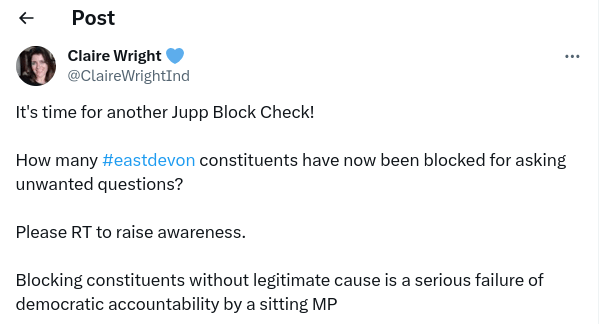
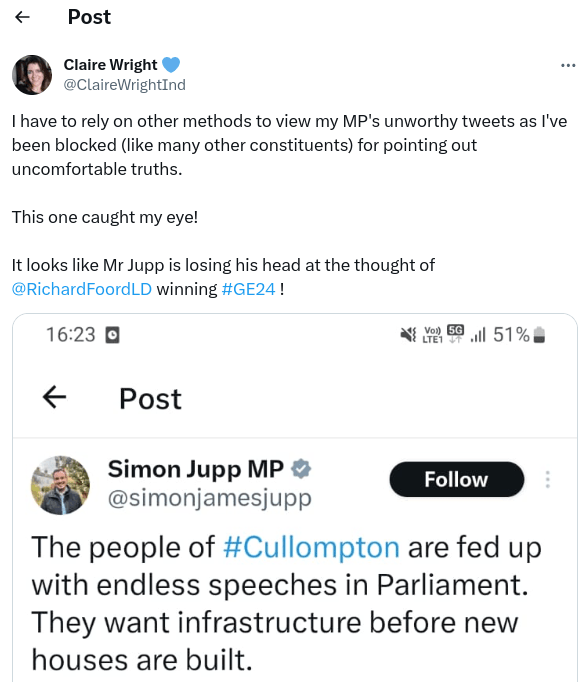
Claire Wright calls out Simon Jupp for blocking his constituents from his twitter account for any uncomfortable questioning of what he says.

Claire Wright:

“I have to rely on other methods to view my MP’s unworthy tweets as I’ve been blocked (like many other constituents) for pointing out uncomfortable truths……It looks like Mr Jupp is losing his head at the thought of @RichardFoordLD winning #GE24 !”  

“Blocking constituents without legitimate cause is a serious failure of democratic accountability by a sitting MP”

The following three councillors have also been blocked: Paul Hayward, Dan Wilson and Joe Whibley. 

Owl has received complaints about blocking from various correspondents as well.

Plymouth, Torquay, now Colaton Raleigh suffers dawn chainsaw massacre 

Unnamed land owner secretly and successfully applied to the Forestry Commission  to fell ancient trees in Colaton Raleigh.

Not yet reported in local press only in the national press! – Owl

‘Horrified’: Devon village in shock at felling of 100 ancient beech trees

Rachel Hall www.theguardian.com

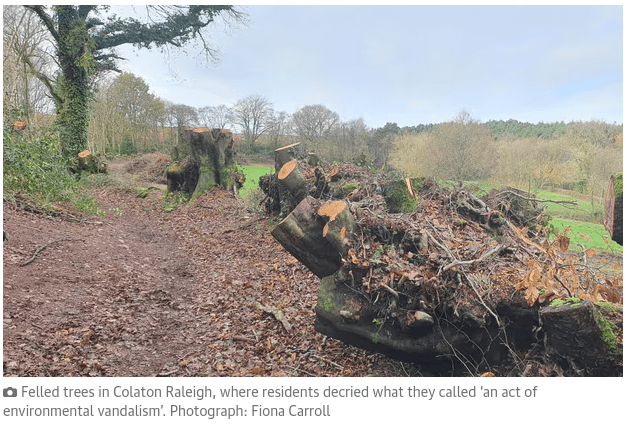
Not much happens in the sleepy village of Colaton Raleigh, where almost half of the residents are retired. So local walkers were horrified when they woke up one morning to an act of “environmental vandalism” that left behind the maimed stumps of 100 ancient beech trees.

Residents in the east Devon community are grieving the loss of the beloved trees, which were located in a special conservation area and site of special scientific interest, home to lots of local plants and animals, after they were felled by a government agency without consulting the community or council.

An application was made by a local landowner to the Forestry Commission, a branch of the Department for Environment, Food and Rural Affairs. It would not comment on individual cases, but said all decisions were taken in line with its standards.

Alan Pearce, a tree warden from the area, said: “It certainly ought to be a fairly wide consultation because it’s part of our heritage, grown-out hedges that go back hundreds of years. Once they’re gone you’re talking about 200 years to regrow. The stumps look nearly all of them perfectly sound and solid. I can’t see they can say they were diseased or dying. We’re meant to be planting trees, not felling them.”

He said people were “absolutely horrified”, with one walker in tears over the decision, which he suggested may have been taken in order to improve grazing land in the adjacent field.

Fiona Carroll, another resident, said: “Many people walk in this area as it is part of a large expanse of heathland and they are at a loss as to why this has been allowed to happen. These were, in my view, valuable landscape and wildlife trees situated along an extensive ancient Devon bank. The roots had grown into large supporting structures giving many a distinctive look. My current impression is that this destruction is nothing short of an act of environmental vandalism.”

Ewan Macdonald, who researches how people engage with the environment at the University of Oxford, said he was not surprised the felling had provoked such an emotional reaction because of the way people connected with trees.

“It highlights how intrinsically bound up things like trees, the environment and conservation are with our culture,” he said. “The value of trees gathers importance with age, so I can see why removing them is upsetting. It’s a natural thing that people form an attachment to things they can personify or build a relationship with.”

He added: “I do think it is always important to engage the local community with any decision that is made about conservation. That’s not to say that the Forestry Commission didn’t have good reasons for removing the trees, but communicating those reasons to people and making sure the community feels engaged and brought into that is an important thing. It shows it’s hard for anyone to own nature wholeheartedly.”

The beech felling is not the first to provoke ire. Most recently, the felling of 40 palm trees in Torquay in Devon that appeared in 1970s sitcom Fawlty Towers prompted accusations the council had wrought “total destruction” on the seafront.

This followed a similar controversy when 110 trees were removed under cover of darkness in March 2023 in Plymouth as part of the relandscaping of the city’s Armada Way, ultimately leading to the resignation of the council’s Conservative leader.

And in 2016, five people were arrested in a bitter dispute with the council over tree felling in an affluent Sheffield suburb. Nick Clegg, then the constituency’s MP, described the incident as “something you’d expect to see in Putin’s Russia, rather than a Sheffield suburb”.

HS2 money rerouted to repair roads in London

Another dollop of catch-up ketchup misses the target. – Owl

An official social media post boasting that money earmarked for transport improvements in the north would be spent on road repairs in London has been criticised by MPs and local leaders.

Ben Clatworthy, Aubrey Allegretti www.thetimes.co.uk

The Department for Transport (DfT) posted a graphic celebrating the new Network North project, which will pump £235 million into improving roads in the capital.

The poster also claims the money has become available because of Rishi Sunak’s decision to cancel HS2’s northern leg from Birmingham to Manchester.

The prime minister insisted the £36 billion saved by not finishing the project would go towards the Network North plans, which include more than 100 regional transport projects.

However, the money earmarked would only be spent between 2029 and 2040, during the period it would have been used to build HS2’s route from the West Midlands to Crewe and from Crewe to Manchester.

Louise Haigh, the shadow transport secretary, said: “When Rishi Sunak went to Manchester to cancel the northern leg of HS2 he claimed he would ‘join up our great towns and cities in the north and the Midlands’. Now he is promising to repair roads in London as part of a ‘Network North’, showing just how ludicrously out of touch he is.”

The DfT faced a backlash on social media while MPs and local leaders in the north were left bemused.

Andy Burnham, the mayor of Greater Manchester, said: “Network North seems to include everywhere — except the north.”

Steve Rotheram, the mayor of the Liverpool City Region, said: “Unless Network North is shorthand for Network North Circular, I really fail to see how fixing roads in London will help to improve journey times between Liverpool and Manchester, get more freight onto rail, or make a jot of difference to a single person in the north.

“It’s more smoke and mirrors from the government. A PR stunt from a photo-op prime minister who is more interested in shiny graphics for social media than tackling the issues facing real people.”

Ben Bradley, the Conservative MP for Mansfield and leader of Nottinghamshire county council, told colleagues in a private WhatsApp group that sending a message that “we scrapped £9 billion of investment in the Midlands and north to invest in London roads” was “not helpful”.

Sarah Dines, a former minister and Tory MP for Derbyshire Dales, also complained that the news was “good for London but my constituents are revolting”. She posted a picture of a pothole with the caption: “Virtually everywhere in Derbyshire”.

Dines added: “We have had extra money in Derbyshire for potholes, but this is peanuts compared to London. I have had a flood of emails today. What do I say?”

Andy Carter, the Tory MP for Warrington South, Cheshire, and aide to Mark Harper, the transport secretary, was on the receiving end of the backlash after he announced news of the funding to the “Transport Support Group” of Tory MPs.

“Positive news for London colleagues — fixing potholes in the capital,” he said.

Carter told Dines he believed that Derbyshire had had a 30 per cent increase in road repair funding.

Critics of the decision to scrap HS2 questioned the claim that the London funding — £7.5 million made available between now and March, followed by a further £7.5 million in 2024-25, with the remainder extending until 2034 — was made possible by axing the scheme.

Henri Murison, the chief executive of the Northern Powerhouse Partnership, said: “Having cancelled the northern section of HS2, it is important to be straight with the public about where the money is really going.

“I do not critique previously promised essential road maintenance in London and short-term bus fare incentives across England. However, as Phase 2 of HS2 had already been delayed so much so little money can be saved to cover the immediate revenue and capital commitments included here that it seems implausible.”

Sunak has previously been forced to defend pumping money from HS2 into projects in the south of England.

He told the BBC: “I’m not apologising for the fact that Bristol and the West Country or the south of England is going to get more money as a result of this decision. It’s not a criticism that these things are not in the north.”

The government published plans for Network North, including a full list of projects, immediately following Sunak’s announcement that the northern leg of HS2 was cancelled at the Tory party conference in October.

However, some pages were quickly deleted including some where the government pledged to “revolutionise mass transit in Bristol”. A page about reopening Transport North East’s Leamside Line was also removed.

Harper said that “every penny of the £19.8 billion committed to the northern leg of HS2 will be reinvested in the north”.

He added: “Every penny of the £9.6 billion committed to the Midlands leg will be reinvested in the Midlands. The full £6.5 billion saved through our re-scoped approach at Euston will be spread across every other region in the country.”

Exeter Vaccination Centre at Greendale Business Park to be demolished

Watch this “space”! – Owl

Will Goddard www.exmouthjournal.co.uk 

A temporary building at Greendale Business Park used as a vaccination centre during the Covid pandemic must be demolished by New Year’s Day after an application to keep it was refused. 

The 72-metre-long structure was originally built under emergency regulations in 2021, and East Devon District Council later agreed it could stay in use by the NHS until the end of 2022, but that it had to be removed by December 31, 2023.  

Paul James of FWS Carter & Sons, which owns and operates Greendale Business Park, had applied to keep the building permanently for a range of purposes including commercial, residential and medical uses, but also said it could just be used by the NHS. 

Planning officers recommended that councillors refuse the application, as the building goes against its ‘local plan’, a guide for new development in the district, which does not permit the outward expansion of the business park.

They also had other concerns such as its visual impact on the landscape. 

The NHS said it needed a “surge vaccination centre”, in the event of another pandemic, but officers felt they had not seen enough information to be sure there was no other suitable site.

Some councillors agreed with the officers, but others thought it should be allowed to stay.  

Cllr Geoff Jung (Lib Dem, Woodbury and Lympstone) said: “A large regional centre made strategic sense but obviously it is not required now.  

“Existing local surgeries and pharmacies are now more than willing and able to provide the flu and Covid jabs and they welcome the beneficial income that this provides. 

“Is this site suitable for commercial use? It’s not supported by our agreed local plan, it’s not agreed by our adopted villages plan… because this large business park is considered to be an unsustainable location and increasing it would be detrimental to the local landscape.”

Cllr Ben Ingham (Conservative, Woodbury and Lympstone) said: “The NHS are the body best placed to advise on medical need and they say they need it.  

“The Covid inquiry stresses the importance of preparing for future pandemics and learning from the mistakes of 2020 when we could not respond to Covid-19 at short notice.  

“Our communities need it to safeguard our public health. It really is that simple.” 

Cllr Mike Howe (Independent, Clyst Valley) said: “There is no policy support for this at all.  

“If you want to barge a horse and cart through our local plan as it stands today, carry on ahead. We haven’t got the proof from the NHS.” 

Cllr Ian Barlow (Independent, Sidmouth Town) said: “I speak to the people I represent, and whenever you say to them, they want to remove the vaccination centre… they can’t believe it.  

“The whole point of planning is to plan for the future. What difference does it make what it’s for?

“If the NHS has quite rightly said they’d like to save some money. If they can do a deal, surely that’s the sort of thing we want to encourage. They’ve done a deal that this building is for the NHS, on short notice it can be cleared if it is required.  

“We didn’t know about the first pandemic. We will not know about the second pandemic.” 

Woodbury Parish Council also supported the application to keep the building. But, after a vote, permission was refused.

Just How Much Has MPs’ Pay Changed Since 2008 Compared To Junior Doctors?

MPs may be getting a pay rise in April – and junior doctors in England have started another wave of walkouts over their salary, meaning people are inevitably drawing parallels.

Kate Nicholson www.huffingtonpost.co.uk 

The union British Medication Association (BMA) claims junior doctors have had a real terms pay cut of 26.1% since 2008-9. How have MPs’ salaries’ fared in the same time frame?

Both roles are subject to extra cash boosts depending on their seniority. For junior doctors, the number of hours worked and where they work can cause further fluctuations in their overall pay.

So, HuffPost UK has just compared the base-level each role could earn every year at a minimum, based on the gov.uk website and the BMA’s website.

Comparing MPs and junior doctors’ basic pay:

2008: MPs – £61,820, first year junior doctors – £28,274

2009: MPs – £64,766, first year junior doctors – £28,274

2010: MPs – £65,738, first year junior doctors – £28,274

2011: MPs – £65,738, first year junior doctors – £28,274

2012: MPs – £65,738, first year junior doctors – £28,274

2013: MPs – £66,396, first year junior doctors – £28,274

2014: MPs – £67,060, first year junior doctors – £28,274

2015: MPs – £74,000, first year junior doctors – £28,274

2016: MPs – £74,962, first year junior doctors – £32,398

2017: MPs – £76,011, first year junior doctors – £32,398

2018: MPs – £77,379, first year junior doctors – £32,398

2019: MPs – £79,468, first year junior doctors – £32,398

2020: MPs – £81,932, first year junior doctors – £32,398

2021: MPs – £81,932, first year junior doctors – £32,398

2022: MPs – £84,144, first year junior doctors – £32,398

2023: MPs – £86,584, first year junior doctors – £32,398

The base-level pay for MPs over the last 15 years has gone from £61,820 in 2008 to £86,584 in 2023.

The base level pay for junior doctors in their first year (in the same time period) has gone from £28,274 to £32,398.

However, as they gain experience, junior doctors can earn more.

Between 2008 and 2016, they could earn up to £57,570.

Between 2016 and 2023, they could earn up to £63,152.

What has happened to MPs’ pay?

MPs are expected to all get a 7.1% pay rise in April, taking them from £86,584 to £92,731 for their basic salary level.

Frontbenchers then get an extra boost, depending on how senior they are – but these rates have been frozen since 2014.

Since 2015, it has used the average increase in public-sector earnings for the three months leading up to October to work out the yearly raise.

By the time April rolls around, inflation is expected to have fallen to around 2%.

But, the IPSA can also block the expected increase to MPs’ salaries, as it did in 2020 when a £3,000 rise was seen as inappropriate at the height of the Covid pandemic.

The Westminster watchdog will make a final decision in the New Year on how much to hike increases for 2024.

What has happened to junior doctors’ pay?

Junior doctors went on their 26th day of strikes on Monday, in a walkout expected to last three days. Another six-day walkout is planned at the start of January.

It comes after the BMA’s talks with the government broke down in December.

Nearly half of NHS doctors are junior doctors, as the term encompasses both those who are just out of university and some who have more than a decade of experience.

Two-thirds of junior doctors are part of BMA, which is asking for an extra 35% to their salaries to make up for below-inflation pay rises since 2008.

That’s much higher than what the government has already offered.

Sunak said in July that a 6% rise and £1,250 added to their salaries would be the government’s “final” offer, and there would be no more negotiation.

More recently, the government offered an additional 3% rise – but the union rejected it, noting it was “unevenly spread across doctors’ grades”.

The union said: “The approach from [health secretary Victoria] Atkins and the team has been productive but ultimately that alone is not sufficient to make up for 15 years of declining pay.

“A year after our dispute started, we are still too far from turning the tide on plummeting pay, morale, and retention of doctors.”

‘Catastrophic failure’ of council housing company unpicked – 3 Rivers Mid Devon

Critics have spoken out in frustration about a report aimed at drawing a line under the 3 Rivers housing firm debacle in Mid Devon that they say leaves questions unanswered.

Bradley Gerrard, local democracy reporter www.radioexe.co.uk 

A working group of four Mid Devon councillors and one council officer presented a ‘lessons learned’ report to the scrutiny committee this week aimed at assessing what contributed to the failure of the soon-to-close housing firm, and what should be done differently if a similar entity is launched again.

The report highlights mistakes around the company’s set-up in 2017 and its subsequent operation. Its 10 recommendations lay bare various shortcomings.

The topic dominated public questions at the meeting, with concerns about the working group’s short timeframe to conduct its work, worries about its remit, the transparency of the evidence the report relied on, and claims of factual errors.

The report noted that the council and the company had different attitudes to risk, meaning that a development company was “not the most appropriate form of commercial enterprise for the council to initiate to supplement its income.”

It continued: “With hindsight, the challenge in bringing two organisations with fundamentally different cultures together required greater thought and consideration, and that challenge ultimately proved too difficult to achieve in this instance.”

It paints a picture of an authority trying to mitigate the risks associated with 3 Rivers, but not fully aware that these actions curtailed the firm’s flexibility and its ability to make quick decisions.

The separation between 3 Rivers, a commercial entity, and the council, a political body and lender, was “never wide enough to enable the board of 3 Rivers to take timely, independent, operational decisions.”

It outlines an instance where Mid Devon’s planning committee refused a 3 Rivers application, which the company successfully appealed, and was awarded costs.

It added that the decision to take on the “difficult site at St George’s Court” was “influenced by political considerations regardless of the fact that anticipated returns, though positive, were low”, and that “no advice” was sought from an independent commercial or banking lender as to the structure or viability of the business plan.

Specialised commercial property development skills at inception “would have significantly strengthened the board”, it said.

Councillor Gordon Czapiewski (Liberal Democrat, Tiverton Lowman), who chaired the working group, said it looked at council minutes, external reports, written submissions and letters from the public.

He outlined the 10 recommendations, which included that if a similar company was set up again, at least two board members should be unrelated to the council, that there should be “necessary distance” by the council from commercial decisions, and that an exit strategy should be in place from the beginning.

Cllr Czapiewski acknowledged it had not been possible to interview everyone who had experience of the company since its launch in 2017, or to scrutinise every single document, but that the relevant material was made available to the working group, including documents from confidential sections of council meetings when the press and public are excluded, known as Part 2.

Barry Warren, who chairs Willand Parish Council but was speaking in a personal capacity, asked who had set the timeframe for the working group to operate in and who had decided which materials were made available for it.

He also questioned whether audio recordings had been listened to, and whether the working group would make a comment on the “loss of millions of pounds.”

Cllr Czapiewski said council leader Luke Taylor (Liberal Democrat, Bradninch) had set the timeframe in agreement with scrutiny committee chair Councillor Rachel Gilmour (Liberal Democrat, Clare & Shuttern), and that the working group had access to all the material it required.

He acknowledged that audio recordings were not listened to, primarily because much of the previous debate on 3 Rivers had been in Part 2 proceedings, and so weren’t recorded.

Speaking after the meeting, Mr Warren said he had not been interviewed by the working group, in spite of being leader of Mid Devon when the authority decided to limit 3 Rivers to completing its two remaining projects in Tiverton and Bampton.

Another resident, Paul Elstone, asked why former council leaders were not interviewed in person, especially when the working group was “made aware of threats against them,” adding that evidence was available that conflicted with some statements in the report, and that the working group hadn’t stated who should have prevented the failings and how.

“Why was the root cause not addressed in the report, as that is something that is a serious omission,” he said.

He claimed he had seen an email that “can only be described as explosive” in terms of identifying a possible reason for the firm’s failure, and queried whether the working group had seen this.

Andrew Jarratt, deputy chief executive at Mid Devon, said a “six-figure sum” had been spent by the authority on external reports into 3 Rivers, including on one by its external auditors Grant Thornton investigating allegations of fraud and malpractice.

Cllr Gilmour, echoing the ‘lessons learned’ report, said these allegations had proved to be “unsubstantiated.”

Nick Quinn, another resident, also queried what he called some “factual errors” – including a suggestion that there were four directors of the company at launch when Companies House shows three – and questioned why the working group had not been given longer to complete its work, as well as whether the report would be debated by full council.

He was told that the working group “do not accept any statements are incorrect” and that it had “not been shown evidence to suggest that,” while also being informed it was “too late for further evidence” and that the report would not be debated by other council committees.

Councillor Rhys Roberts (Conservative, Cadbury), a member of the working group, acknowledged he would have “preferred more time” for the report as it would have “given us an opportunity to talk to more people who were involved and had knowledge of the company and were part of the decision-making process.

“But, given the timescale, I’m comfortable with the fact that we spoke to key stakeholders and decisionmakers, and were able to question them freely, with those people having no prior knowledge of the questions we wanted to ask.”

He added that nobody declined to speak to the working group and that information it requested from interviewees was freely given.

“This report comes on the back of numerous independent reports that have already been published about the company and its failures,” he said.

“It’s a catastrophic failure, a financial failure for the council, and that’s why we are spending so much time looking at the implications for the future so it doesn’t happen again.”

Another member of the public, Kate Clayton-White, said constituents wanted accountability, and so the fact former councillors were able to give statements to the working group anonymously was “preposterous.”

“I’m yet to hear anyone praise the way the council is handling this matter,” she said, adding: “This committee needs to scrutinise properly and make all its findings available with nothing hidden behind Part 2 confidentiality.”

Cllr Gilmour said some interviewees had requested anonymity, and so the working group had decided to grant it to all those who contributed to the report’s findings.

“Had we not done so, it is likely the statements would have been superficial and not helpful,” she said.

Last month, Mid Devon said it estimated that £3.7 million would need to be written off in the current financial year in relation to 3 Rivers, and that the value of confirmed impairments had reached £5.3 million as at March this year.

Labour confirms East Devon seats are NOT part of its election ‘battleground’

seatonmatters.org

Labour has published a full list of its 211 ‘non-battleground’ seats, i.e. the seats they don’t aim to try to win. They include the Honiton & Sidmouth seat (which includes Seaton and Axminster), and also Exmouth and East Exeter.

In these seats, voters who want to get rid of the Tories should back the Liberal Democrats. Voting Labour (or Green) will only split the anti-Tory vote and potentially let the Tory in. Remember that Simon Jupp has jumped ship from Exmouth to stand in our area – he thinks he can win. Let’s make sure he doesn’t – support Richard Foord, our excellent Lib Dem MP!

Read details here

[We now await the selection of the Lib Dem candidate for Exmouth and East Exeter and, crucially, whether the chosen candidate is someone Claire Wright will endorse as she has with Richard Foord for Honiton & Sidmouth. – Owl]

Don’t be misled by what “Spreadsheet” Sunak says about figures

Sunak challenged by watchdog over claim to have cut public debt

The head of the UK’s official statistics watchdog has challenged Rishi Sunak over his claim to have reduced public debt, saying the prime minister’s definition of this was so specific and limited that it risked being misleading for voters.

Peter Walker www.theguardian.com 

Sir Robert Chote, the chair of the UK Statistics Authority (UKSA), said Sunak’s claims last month “may have undermined trust in the government’s use of statistics and quantitative analysis in this area”.

Writing to Sarah Olney, the Liberal Democrats’ Treasury spokesperson, Chote said the Office for Statistics Regulation, the UKSA’s regulatory arm, would “work with the prime minister’s office to ensure further statements on debt levels adhere to our guidance on intelligent transparency”.

Olney raised the issue with Chote’s office after Sunak said “debt is falling” in a No 10 social media video posted on 7 November, the day of the king’s speech, and then said “we have indeed reduced debt” during prime minister’s questions on 22 November, the day of the autumn statement.

Downing Street told the UKSA that both claims referenced forecasts by the Office for Budget Responsibility that net debt would be falling as a proportion of GDP during the final year of the five-year forecast, in the context of the autumn statement meaning 2027-28.

In both cases this was mainly happening due to changes to the OBR’s fiscal projections, with government decisions on tax and spending actually making debt higher.

Chote’s letter noted that while it was fair to use debt as a proportion of GDP rather than absolute numbers, the “average person in the street” would most likely have taken Sunak’s statement to mean that debt was already dropping and that government decisions had helped do this – “neither of which is the case”.

“This has clearly been a source of confusion and may have undermined trust in the government’s use of statistics and quantitative analysis in this area,” he wrote.

“Members of the public cannot be expected to understand the minutiae of public finance statistics and the precise combination of definitional choices that might need to be made for a particular claim to be true.”

Olney said Sunak had “reached for the Boris Johnson playbook and is undermining trust in politics”.

She said: “Rishi Sunak knows he has no good story to tell on the UK economy so he has resorted to making one up. This is desperate stuff from a desperate prime minister and it is right that he has been called out on it.”

A government source said: “The OBR is crystal clear – thanks to the long-term decisions we have taken, we are on track to get debt falling.”

Transport infrastructure in Cullompton – Richard Foord 

Richard Foord makes a reasoned case for action on investment in an integrated transport system for Cullompton. 

Simon Jupp (wannabe MP for Cullompton) throws his toys out of the pram. 

The Transport Minister lists government transport achievements for 12 minutes, but says nothing relevant to the people of Cullompton.

Below is the Hansard record. Here is a summary:

Richard Foord starts to make the case, Simon Jupp jumps in to tell members how busy he has been distributing Tory “surveys” in Cullompton and claims credit for securing funding for a new station.

Richard Foord pointedly thanks his neighbouring MP, calling him “the MP for Exmouth”, for saying residents are calling for infrastructure. He says they are fed up with surveys. They want action. He then details the case for funding for a relief road, improvements to J28 on the M5 , supporting rail improvements and the creation of walking and cycling routes to create an integrated transport system for the rapidly increasing commuter traffic to and from Exeter.

Simon Jupp, on a point of order, seeks an apology for being called the “MP for Exmouth”. He doesn’t get it!

Guy Opperman, The Parliamentary Under-Secretary of State for Transport, then drones on listing government achievements on transport for twelve minutes, but never really says anything useful or relevant to the people of Cullompton. He ends by saying:

“I reassure the House that the Government are continuing to provide record levels of investment for road, rail, buses and active travel projects. It is our mission to level up transport infrastructure and to unlock further growth for all corners of the UK, and I thank him for bringing this matter to the House.”

Transport Infrastructure: Cullompton (Hansard)

Richard Foord (Tiverton and Honiton) (LD)

It is a pleasure to have secured the final debate of 2023. I understand that I have until about half past seven, but given that I am the only thing standing between the Minister and sherry, mince pies and wrapping gifts by the fire, I probably will not take the full two hours and 20 minutes.

I have a request of the Minister this afternoon. I am asking this Government to deliver the people of Cullompton a gift that everyone there has been asking for for years: the Cullompton relief road and the railway station. Cullompton is a rural market town nestled in the Culm valley. There has been a town there since Roman times—if you go out and knock on doors in the area, people will tell you that they have been waiting that long for the relief road and the railway station. The layout of the town would be familiar to anyone who has visited a small west country town: it has one major road, straddled by shops and houses. The town centre is very much the beating heart of the community. It has a regular farmers market that takes place once a month, every second Saturday. The economy of the town is built on a past involving wool, cloth and leather working, but in recent years it is very much a commuter community, with people making journeys to Exeter in particular.

Simon Jupp (East Devon) (Con)

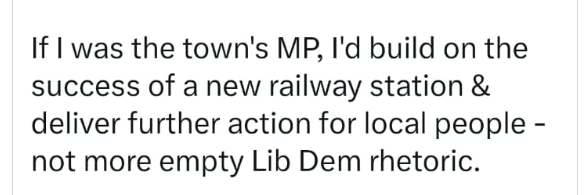
Earlier this year, I distributed a survey across Cullompton to ask residents about their transport priorities. The responses made it crystal clear that a railway station was much needed, alongside a relief road and M5 junction upgrades. Residents tell me on the doorstep that new housing must come with infrastructure first, and they are right. While in the Department for Transport, I worked with the community and Conservative county councillor John Berry to secure a new railway station, after meetings with the Chancellor, the Transport Secretary and the Rail Minister. Local residents in Cullompton have waited long enough. It is time for decisive action, not just warm words. Does the hon. Member need a hand to get a relief road, too?

Richard Foord 

My neighbour, the hon. Member for Exmouth, is quite right that people in Cullompton are calling for this, but they have had enough of surveys. They have been consulted until their pens have no ink left in them.

In 2018, Devon County Council ran a survey on the Cullompton town centre relief road. Another survey, organised by Cullompton Community Association fields, revealed that people were torn but would give up their community fields for the sake of a relief road to stop the awful congestion in the centre of the town. Now there is to be a further consultation, on both the relief road and junction 28, on which progress also needs to be made; I will expand on that shortly. People in Cullompton are sick of being consulted. They want to see action, and in particular they do not want to see surveys that are simply a means of harvesting voter intention data.

Huge volumes of traffic pass through Cullompton every day. The town is home to roughly 9,000 people, but it is reckoned that 37,000 a day commute into and out of Exeter, and many of them are from Cullompton. Traffic often becomes backed up and gridlocked, especially at busy times—early in the morning, or when children are picked up from school. I experienced that at first hand recently when driving to one of my advice surgeries in Cullompton. So bad was the congestion that I had to turn the engine off to stop it idling and releasing pollution.

Planning permission for the relief road was granted by Mid Devon District Council in January 2021, not without cost to local amenities. I have played football with my children at the CCA fields, and I know that members of the cricket and bowling clubs would love to have better pitches or greens, but above all else they want certainty: they want to know what the future of the town will look like. What they do not want is an enormous amount of housing with no supporting infrastructure. The Minister and other Members will have heard about the appeals that have taken place, but I should point out that Cullompton is a special case. There are plans for a north-west urban extension, and also for a garden village.

As Members will know, garden villages were an initiative thought up in 2017, and the Culm garden village is set to add 5,000 new houses to the town. If that were accompanied by promises of a new GP centre, new community sports facilities, new schools, new bus links and new cricket pitches, those might offer some amelioration, but all that people in Cullompton are seeing is more houses. We cannot keep building houses without the appropriate infrastructure to support them. Our roads cannot cope with the volume of traffic that we are seeing.

Then there is question of the motorway. The M5 goes past Cullompton, and junction 28 is one of the more congested motorway junctions. In fact, it is dangerously congested. National Highways said recently that it was

“unable to support development which introduces an unacceptable risk to highway safety, which includes queuing extending onto the M5”.

“Development” is actually a euphemism for housing. What National Highways is really saying is that we cannot afford more housing in this town, because it will simply cause queues on the motorway—but the queues are not just on the motorway; they are also through the town itself. All the motorists who get snarled up in the town, idling in traffic, know that they should be looking to Westminster and Whitehall for the solutions. Cullompton Town Council itself has said that it will “actively oppose” any residential development at east Cullompton until the town centre relief road is delivered and the capacity of junction 28 is increased. That will need to include safe pedestrian crossings over the M5, the railway and the river.

It is about time that Westminster and Whitehall took a look at that, because it is something that MPs and candidates through the ages have called for. Certainly, in the Tiverton and Honiton by-election last year, the Conservative candidate and I both called for it. As Cullompton’s MP, I have raised the issue in Parliament on multiple occasions and urged Ministers to consider how the lack of a relief road is affecting people in Cullompton. In the local elections earlier this year, Cullompton went Liberal Democrat. I dare say that that was a sign of people’s protests, and an indication that they are not prepared to put up with being overlooked on this issue by the Conservative Government here in Westminster.

We saw the welcome Network North announcements this autumn, but the opportunity to fund the relief road was passed over in rounds 1 and 2 of the levelling-up fund and, although we did not know it at the time, in round 3 as well, when Devon did not get any levelling-up funding at all. With all the furore, anyone would think that the relief road was going to be enormously expensive, but in the context of the sorts of figures that the Department for Transport is dealing with, I suggest that £35 million is not enormous, particularly as £10 million of that has already been secured by Homes England. To get best value out of that, the Government will want to match-fund against that £10 million from the housing infrastructure fund, for which there is a deadline.

It is thought that the upgrade to junction 28 would cost a further £34 million. That is a much more expensive proposition, but a lot of work has gone into it, costing £800,000 so far. That has resulted in a robust and financially sound business case. The junction 28 proposal contained 25 options, such was the diligent work that went into it, and they have been whittled down to just three. The proposal has now gone out to public consultation, with a deadline of 5 February. Members will forgive the people of Cullompton for being tired of being consulted on these matters; they just want to see action.

The case for the relief road and junction 28 is also health-related, as it relates to traffic and congestion. This is why we also need a railway station at Cullompton. There was a recent announcement of funding to reopen Cullompton station. Again, Network North was something of a re-announcement, but we were certainly glad to be part of the restoring your railway announcement in 2020. A strategic outline business case was developed last year and it will go to a full business case in 2024, with the potential opening of Cullompton railway station in 2025. I work alongside my co-chair, the hon. Member for Taunton Deane (Rebecca Pow), as part of the metro board looking at every stage of the development and at how Network Rail and Great Western Railway are doing, perhaps giving them a little bit of a nudge when necessary but absolutely supporting their excellent work.

A railway station at Cullompton, along with the improvements to junction 28 and a relief road, will help with air pollution. The air quality management area in Cullompton has good monitoring, but I am afraid it reveals very poor outcomes for people’s health. It is estimated that the building of the relief road and the improvements to junction 28 would result in a reduction in the levels of nitrogen dioxide in the air of between 69% and 79%. That would clearly improve people’s health locally.

There are also plans afoot for walking and cycling. I have had people working with me on cycle routes in the area. Sustrans is considering linking Tiverton and Exeter through Cullompton, and there is a local cycling and walking infrastructure plan for connecting Willand and Uffculme. Together, all these initiatives—the relief road, the railway station and the walking, cycling and wheeling routes—will make a very friendly part of Devon into an environmentally friendly one.

In closing, I give credit to Neil Parish, my predecessor, who worked on this during his time as an MP, and to local Liberal Democrat campaigners who have been working with me on the operational details. I hope that we can think of today’s debate in the context of Christmas present. The word “present” in that context is usually associated with a gift, but I would like the Government to think of it in the context of the present tense—that is to say, I hope that we might see some action on Cullompton railway station, the relief road and junction 28 in the present and not at some unspecified point in the future. Those would be gifts for which I know that people in mid-Devon would be very grateful.

Simon Jupp 

On a point of order, Mr Deputy Speaker. I seek an apology, as the hon. Member for Tiverton and Honiton (Richard Foord) did not name my constituency correctly in response to my intervention. He referred to me as the MP for Exmouth, but my constituency also includes Sidmouth and I should be referred to as the MP for East Devon. He has done this politically in local newspapers and leaflets. I wish also to clarify that Devon was successful, to the tune of nearly £40 million, in the most recent round of levelling-up funding, just to correct the researcher or whoever wrote the hon. Gentleman’s speech. I seek an apology for my constituency being named incorrectly, and a promise from the hon. Gentleman that he will not do so again.

Mr Deputy Speaker (Mr Nigel Evans)

The hon. Member for Tiverton and Honiton (Richard Foord) is not indicating that he wishes to say anything further to that point of order, in which case it stands on the record.

The Parliamentary Under-Secretary of State for Transport (Guy Opperman)

I thank both the hon. Member for Tiverton and Honiton (Richard Foord) and my hon. Friend the Member for East Devon (Simon Jupp) for their contributions to this debate on transport infrastructure in Cullompton. It is an honour and a privilege to address this issue on behalf of the Department for Transport. I have a sense of déjà vu all over again, as I responded to yesterday’s Adjournment debate—and I will be responding to the first Adjournment debate in the new year on Monday 8 January.

As the hon. Member for Tiverton and Honiton eloquently said, it is important to stress that transport infrastructure matters to everybody. I assure the House that I will not be using my full two hours and three minutes either, but, much as you did, Mr Deputy Speaker, I start by wishing everybody in the Chamber, all parliamentary staff, the Department for Transport team, those working in transport over the holiday period and my private office team of Juliette, Tessa, Aleena, Beth, Laura, Jack and Tom a happy Christmas.

As the last Minister to address the House in 2023, I want to say that democracy requires work and sacrifice. Our thanks, in particular, go to His Majesty’s constabulary, who keep us safe. We wish them a happy Christmas. We remember, sadly, the loss of PC Keith Palmer, who was killed in March 2017, and we understand very clearly that these men and women keep us and democracy safe. That should not be forgotten in any way.

As a Transport Minister, it is not for me to comment on the quality of councils’ bids to the levelling-up fund and the Department for Levelling Up, Housing and Communities, but I will attempt to address the points that relate to this debate. I will try my hardest to address the widespread gentle criticism that there has not been investment in the south-west, and in Devon in particular. I will address Cullompton, but it would be remiss of me not to highlight the important work the Government are doing to improve journeys right across the south-west, and particularly in Devon.

Clearly, we remain committed to a long-term, multi-road programme of investment to improve road links to the region. By 2025, we will have completed a 3-mile upgrade between Sparkford and Ilchester. A combination of Government and local funding has enabled the delivery of £5.7 million of support for the Tiverton eastern urban extension, providing access to a site of more than 1,500 dwellings and associated employment. Additional transport infrastructure has been delivered at junction 27 of the M5 and at the A30 Honiton junction. The A361 north Devon link road scheme, which passes through the hon. Gentleman’s constituency, will also provide benefits to the area by improving connectivity to northern Devon.

The £60 million provided by the Government will see full delivery of the scheme in 2024. Obviously, those projects will deliver significant benefits for the travelling public, but they will also boost the wider economy and support wider plans for growth.

The hon. Gentleman raised the issue of rail. Clearly, we have unlocked further prosperity for the region. That includes more than £50 million for the Dartmoor line, which has provided hourly services between Okehampton and Exeter since reopening in 2021. It is the first restoring your railway scheme to be delivered, and local people have enjoyed rail access to employment, education and leisure opportunities for the first time in almost 50 years.

The Secretary of State opened the new accessible station at Marsh Barton in Devon earlier this year, which came about with the help of £3.5 million of new stations funding. That is another great example of a locally led but nationally supported rail project, and one that clearly gives an economic boost to not only Devon, but the wider region. The Government have also invested more than £150 million to make the vital coastal rail link through Dawlish more resilient, helping to deliver the reliable service that communities deserve.

As part of Network North, we have made funding available for the final phase of the south-west rail resilience programme. The hon. Gentleman mentioned Network North, and Devon will receive more than £208 million through the roads resurfacing fund over the next 11 years, including an additional £6.66 million for the next two years, to combat potholes, which cause misery for drivers. For context, in this year alone that equates to a 16.6% uplift to the county council’s 2023 pothole budget.

I could go on about that in more detail, but I will move on to buses. Clearly, the £2 bus fare that the Government have rolled out across the country is exceptionally popular, and the bus fare cap has been extended until the end of December 2024. The national bus strategy asked that all English local transport authorities outside London publish a bus service improvement plan, setting out local visions for the future of bus services, driven by what passengers and would-be passengers want. That is backed by more than £1 billion of funding and the investment can be used to support and protect existing bus services that would otherwise be at risk. To support Devon County Council, we have allocated £17.4 million to deliver its BSIP, which will support service improvements such as increased frequency between Cullompton and Tiverton Parkway, a new service from Cullompton to Honiton railway station, and improvements to services 4 and 380.

In addition, we have provided support for active travel, with investment for drivers and public transport users being assisted by local cycling and walking infrastructure plans—LCWIPs. They allow local authorities to take a long-term approach when developing cycling and walking networks, helping to identify improvements that can be made over a 10-year period. Devon County Council is developing its Cullompton and Tiverton LCWIP. Obviously, we await the plan for consideration. That joint project with Mid Devon District Council focuses on a core area of Cullompton and considers strategic links south to Killerton and north-west to Willand, Tiverton Parkway and Tiverton. As I understand it, a consultation will be held shortly to seek the community’s views on the proposed plans. Identifying improvements through an LCWIP will support Devon County Council to include Cullompton within its pipeline of schemes for future funding rounds and to build on the £7 million-worth of funding the council has been awarded in recent years to both develop active travel and promote its use.

On multi-modal projects, for transport infrastructure to make a real difference to people who choose to live, work and do business in the south-west, we cannot operate in silos. We therefore take a holistic approach to connectivity. Clearly, my hon. Friend the Member for East Devon will be aware of the £15.7 million Destination Exmouth levelling-up scheme that delivers benefits for drivers, cyclists, pedestrians and public transport users alike. The West Devon transport hub has also received funding from a levelling-up fund scheme.

The hon. Gentleman raised specific matters relating to Cullompton. I accept entirely that the town has grown. I know the area well, as I represented individuals in a case at Taunton Crown court back in the distant dark ages before the turn of the century and spent some time there. I accept entirely that it has grown considerably and that there are plans to grow it more. It has developed into a commuter town, particularly to Exeter, and with its close proximity to the M5, I accept that there is high dependency on travel by car. However, it is also connected to Exeter by a bus service every 20 minutes, the frequency of which, I understand, will be increased to every 15 minutes in 2024.

The Government have a history of investing in the area. When the hon. Gentleman’s predecessor, who he rightly lauded as a strong constituency MP, was championing Tiverton and Honiton, a £1.8 million funding package between 2013 and 2016 delivered improvements to junction 28 of the M5, which included widening and signal upgrading. I am also aware that a project is being undertaken by Devon County Council to enhance the look and feel of the heritage town centre, including some minor transport-related improvements, which is on track to be completed in 2024.

The hon. Gentleman raised the issue of the Cullompton relief road. With respect, it is not for the Government to do the job of the local council in the making of such an application. The Government are not the local planning authority in respect of any particular garden village. The council needs to make the case and plan the infrastructure. I cannot comment on the nature of the levelling-up bid or its ongoing progress, but clearly there is work being done on junction 28. Some £900,000 has been secured from Homes England to support the development of a strategic outline business case.

Although I am not the Rail Minister, I will address the issue of rail, which the hon. Gentleman raised. As I understand it, the railway station closed in 1964 and the town will be potentially seven times the size it was then in the next couple of decades. Through Network North—the Government’s decision to cancel parts of the HS2 project and redistribute funds across the country—I was delighted that £5 million was secured to reopen the station. Fast trains to London and Exeter will unlock great opportunities for the community, and I look forward to seeing the station in operation as early as 2025.

The hon. Gentleman made many other points. With respect, I cannot answer for the Department for Levelling Up, Housing and Communities, but he seeks support for various other matters. I would only make the point that it is for him and his local council to make the case for the infrastructure that he seeks and to put that in an appropriate form, so that any funding can follow. I am not aware that he sought any specific meetings with my predecessor, but I am happy to take away the points he raised today.

It is right and proper that the hon. Gentleman raises issues that matter to his local community on its behalf. I reassure the House that the Government are continuing to provide record levels of investment for road, rail, buses and active travel projects. It is our mission to level up transport infrastructure and to unlock further growth for all corners of the UK, and I thank him for bringing this matter to the House.

Leader Paul Arnott gives an unequivocal  account of governance in EDDC

Paul Arnott under the title ‘A personal view from East Devon Leader Paul Arnott’ in all local papers this week:

I hoped this week to end the year with a seasonal reflection on the work of East Devon and a few civic hopes for the new year. That will need to keep till January though.

Last week our Audit & Governance committee considered an interim statement from EDDC’s external auditors, Grant Thornton. Usually, these reports concentrate on how a council is running its finances, from external contracts and procurement to monitoring of key performance indicators.

This is vital and legally obligatory work, and the joke amongst auditors goes that if a council ends this process wreathed in smiles then they aren’t doing their job properly. If they did not identify room for improvement, there would be no point having an auditor.

This year, Grant Thornton made the decision to look at the subject of the council’s governance. In particular they were as concerned as I have been for many years about anonymous allegations of bullying.

For legal reasons I can’t go into my personal experiences of this, but from the public record I can identify the start for me as the attempts in the lead up to May 2020 – when I was elected Leader – to prevent there being any meeting to elect a new Chair of council. This came near the start of the pandemic, and I had to battle to ensure we even had an Annual meeting. The Conservatives, who then held the Chair wanted to keep it, to hold no Annual meeting, and run the council under the blanket authority of our now former chief executive. This was profoundly undemocratic.

However, with the help of a brave and much maligned young councillor I was able to repeatedly quote our own constitution back at the Conservatives and our officers. The Annual meeting went ahead, I was elected Leader, and have been elected as such every May since then. The ensuing cross-party administrations have got on with the job, though clearly we had displeased many for whom East Devon had been a comfortable one party state for the previous five decades.

Since then, I have been aware of the word “bullying” being raised. Hence no jolly Christmas missive, I am afraid because I have to use this space to be unequivocal.

First, East Devon as a council has an incredibly strict Standards process. Second, if any allegations of bullying by a councillor are made, they are independently assessed by a legal team and passed for external investigation. This is rightly a confidential process – presumption of innocence being the bedrock of British justice – so I have no more knowledge about the number of allegations than anyone else.

However, the third, hard and indisputable fact is that there has been no finding of bullying against a single councillor in the entire time covered by the Grant Thornton report, also by the way the time I have been Leader.

To be frank, the most awful part of this year has been the doubts raised through an independent report concerning how back in 2016 the council reacted when it became aware that then Cllr John Humphreys had been arrested for what was later proved as sex crimes against underage males in Exmouth. A Safeguarding process should have been instantly triggered, but was not. Humphreys is now serving 21 years. It would be a good start to the new year if his allies and those who enjoyed his hospitality came clean about all that at last. It is highly likely that this will be raised in Grant Thornton’s report for the current year in due course.

Planning applications validated by EDDC for week beginning 4 December

How much of your water bill is swallowed up by company debt?

Find out which English water companies have the most debt, who is proposing the biggest bill increases, and which ones have paid the most to shareholders

Anna Leach, Carmen Aguilar García, Rich Cousins, Ellen Wishart and Sandra Laville www.theguardian.com 

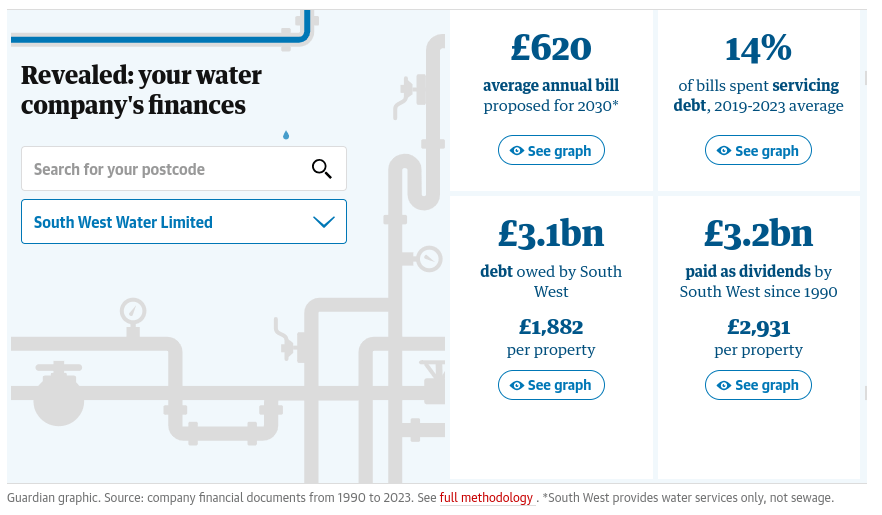
Water bills in England could be a quarter more expensive by 2030. But customers may not realise that almost 20p of every pound they pay goes to servicing company debts, rising to more than 25p for customers in some parts of the country.

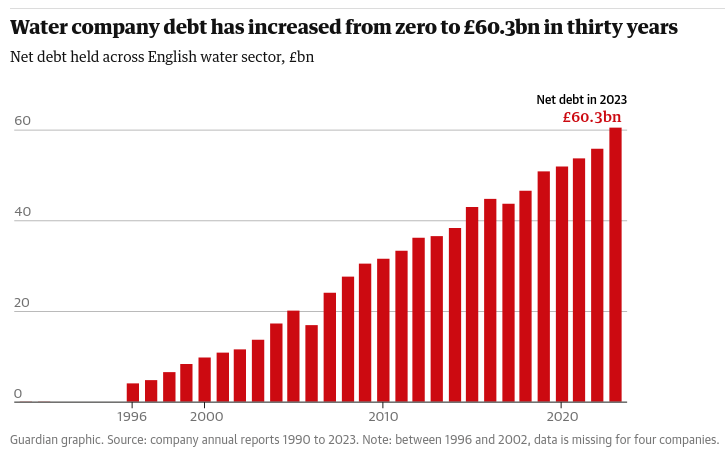
England’s privatised water companies have a huge £60.3bn debt pile, which they say was taken on to fund essential infrastructure. The last 33 years of company accounts tell a different story about where the money from those loans has gone.

Between 1990 and 2023, English water companies have paid out a total of £53bn in dividends, meaning that they have given almost the same amount to shareholders as they currently have in debt.

Find out how much your bill could rise, how much your local water company spends servicing debt and which companies have been giving out the most money to their shareholders, by using our interactive tool. [Accessible through this link to original article] 

In contrast to the English system, at publicly owned Scottish Water, Guardian analysis found that 10% of revenue was spent paying costs associated with debt. As it is a public company with no shareholders, no dividends have been paid out, while its debts amounted to £4.1bn as of March 2023, equivalent to £1,493 per property provided with water.

Since Margaret Thatcher’s government privatised England’s water companies in 1989, debts have been piling up almost every year, going from no debt in 1989 to a combined £60.3bn between them in 2023.

While companies argue that debt has been used for investment, experts say that the debt has not been taken to finance investment but to pay “huge returns for shareholders”. Over the three decades, water companies have paid close to £53.1bn as shareholder dividends – more than £83.7bn in today’s prices.

The water companies’ five-year business plans with the proposed increase in bills will still need to be approved by the industry regulator, Ofwat, which will announce its decision in December.

Methodology

The Guardian analysed net debt and dividends from all England’s water companies using every year’s annual reports. Dividends include special and interim dividends and cover all payments out of the licensed utility under the category “dividends”. Definition of net debt and accounting periods might vary across companies.

Certain companies have changed name or merged with other companies over the 33-year period; we have analysed the documents submitted to Companies House for each of the current Ofwat water-supply licence holders.

Full explanation on how the cost of debt has been calculated can be found here, along with responses by companies to the figures uncovered by this Guardian analysis.

We collected data about the proposed increase in water bills from each of the companies’ business plans for 2025-2030.

The number of total connections per water company, provided by the Consumer Council for Water, includes household and not-household premises with a water and/or sewage connection. This has been used to normalise figures to be able to compare companies of different sizes.

Honiton and Sidmouth: Richard Foord anticipates close battle

At the next election, local people face a clear choice – a strong Liberal Democrat champion fighting hard for our communities, or another silent Conservative who will always vote in his Party’s interest. It’s all to play for and every vote will matter. – Richard Foord

[Today Richard Foord moves the adjournment debate on Transport infrastructure in Cullompton] 

Will Goddard www.midweekherald.co.uk

It’s “all to play for” in the newly formed Honiton and Sidmouth seat at the next general election, according to Liberal Democrat candidate Richard Foord. 

The current MP for Tiverton and Honiton believes people are fed up with the current Conservative government and he has a real prospect of winning. 

A former British Army major, the 45-year-old was voted in during a by-election in 2022 following the resignation of former Tory MP Neil Parish after he watched pornography in the House of Commons. 

Mr Foord, who is married with three children and lives in Uffculme, will go head-to-head with East Devon Tory MP Simon Jupp in the contest for the new constituency. 

Large parts of the new seat are formed from the current East Devon and Tiverton and Honiton constituencies, which up until last year’s by-election win by Mr Foord for the Lib Dems, have always been Conservative. His majority is 6,144.

Mr Foord will go head-to-head with East Devon MP Simon Jupp for the seat. (Image: Gareth Williams)

Simon Jupp’s margin in the general election in 2019 was only marginally higher at 6,708.

The runner-up with over 40 per cent of the vote was independent Claire Wright, who is backing Mr Foord

Richard Foord MP said: “I think the fact that she came very close when the Conservatives nationally did so well in the 2019 general election… indicates that this part of the constituency (Sidmouth, Ottery and West Hill) should not be taken for granted by the Conservatives. 

“The feedback that I’ve been getting on the doorstep is very much that even long-term Conservative voters are at this time, in these circumstances, frustrated with this Conservative government and looking for an alternative.” 

Asked whether he thought he only won by a protest vote, as is often the case with by-elections, he said: “If we’re presenting it that by-elections are somehow different, I would say these are not usual times and the government’s polling has not improved since the by-election in June last year. 

“The popularity of Rishi Sunak as prime minister has hit lows that Boris Johnson didn’t quite reach. 

“I would definitely say it’s very much all to play for and it will come down to potentially every last vote. 

“I grew up here in the West Country. I came of political age at a time when the Liberal Democrats controlled most constituencies here.  

“When I was first able to vote in 1997, and at the subsequent election in 2001, you could walk from Truro to Bristol on Lib Dem-held territory.” 

Claire Wright, who stood as an independent candidate in 2019. (Image: Claire Wright)

If elected, Mr Foord says he will tackle healthcare problems, seek to boost the local economy, and put pressure on water companies to reduce sewage spills. 

He said: “I do feel that if we begin to lose community hospitals like the one in Seaton, it could be the thin end of the wedge for community hospitals more broadly.  

“Sidmouth has a community hospital, Ottery has a community hospital.

“I think we really need to protect these things because what I’m hearing on doorsteps is people want to be able to have access to healthcare close to home.  

“Linked to that, we have NHS dental services that are collapsing.

“NHS dentistry is something I care very deeply about. I also know that it’s something my constituents care very deeply about. 

“We need to have a local economy that enables businesses to thrive. This is where local politics meets national politics, because businesses cannot thrive if there isn’t a stable business environment for them to work in.  

“I’m hearing myself from businesses, large and small, that they want to get back to a time when politics was predictable. 

“They don’t like the uncertainty that our politics has brought us in recent years. And that… has had the effect of places closing up, shops shutting up, pubs shutting up. Hospitality is big business in this part of the world. 

“We know that sewage dumping is rife here on the Jurassic Coast and on the broader East Devon coast. 

“I think we need to take the responsibility for water quality monitoring away from the water companies, because it has been found that some of them have not been revealing all of the data that they should to the regulator, the Environment Agency.  

“The Liberal Democrats have been very strong in this area. We want to see water companies run as public benefit companies.  

“We want to see people with environmental concerns… community representatives with environmental concerns on the board of these companies, so that they’re not run purely to extract profit.” 

A general election is expected to be called next year, and must be held by the end of January 2025. 

‘They all knew’: Michelle Mone hits out at Rishi Sunak over PPE deals

“I was honest with the Cabinet Office, the government and the NHS in my dealings with them. They all knew about my involvement from the very beginning.”

When it was put to her that she had admitted lying to the press, Mone replied: “That’s not a crime.”

But wasn’t she threatening legal action? – Owl

Peter Walker www.theguardian.com 

Michelle Mone has condemned Rishi Sunak after he expressed concern at her admission she lied about involvement in a company that won lucrative deals during Covid, saying the government “knew about my involvement from the very beginning”.

After the former Conservative peer admitted in a BBC interview on Sunday that she had been untruthful in denying a connection to PPE Medpro, which made millions of pounds in profits over a contract to provide personal protective equipment, Sunak said No 10 was taking the case “incredibly seriously”.

In a furious response to the prime minister’s comments, Mone tweeted: “What is Rishi Sunak talking about? I was honest with the Cabinet Office, the government and the NHS in my dealings with them. They all knew about my involvement from the very beginning.”

Her comments place even greater pressure on ministers to explain what they knew about the affair, particularly Michael Gove, the levelling up secretary. The Labour leader, Keir Starmer, has already called for Gove to make a statement on Mone and PPE Medpro,

In the interview on Sunday, Mone said she had not told the truth about her involvement in the firm to protect her family from media attention. When it was put to her that she had admitted lying to the press, Mone replied: “That’s not a crime.”

Asked during a trip to Scotland about Mone’s admission, Sunak said: “The government takes these things incredibly seriously, which is why we’re pursuing legal action against the company concerned in these matters. That’s how seriously I take it and the government takes it.

“But it is also subject to an ongoing criminal investigation, and because of that, there’s not much further that I can add.”

Mone was made a Conservative peer by David Cameron in 2015, but has been on a leave of absence from the Lords since last year and is no longer in the party.

Speaking earlier on Monday, Lord Callanan, the energy efficiency minister, told BBC Radio 4’s Today programme that he hoped Mone would not return to the upper house.

Asked whether as a self-confessed liar she should come back, Callanan said: “I would hope that she would see sense.” Pressed on what he meant, he added: “I would hope that she would not be coming back to the House of Lords.”

Guardian investigations found Mone and her husband, Doug Barrowman, were involved with PPE Medpro, which was awarded contracts worth £203m in May and June 2020 after she approached ministers, including Gove, with an offer to supply PPE equipment.

Asked about the case during a visit to Leeds, Starmer called it “a shocking disgrace from top to bottom”, adding: “There are now serious questions that I think Michael Gove, the government, needs to answer. Who made the original contact? What was the nature of that discussion that led to the situation that we now learn developed?

“I think they should make a statement in the House of Commons today about this so that the public can hear first-hand what actually happened here.”

The Labour leader added: “I don’t think she should be in the Lords. I think the government should be held to account for this.”

Speaking to BBC One’s Sunday with Laura Kuenssberg, Mone admitted that she and Barrowman, through their lawyers, repeatedly falsely denied they had any connection to PPE Medpro.

She said she regretted having done so: “We’ve done a lot of good but if we were to say anything that we have done that we are sorry for, and that’s … we should have told the press straight up, straight away, nothing to hide … I was just protecting my family. And again, I’m sorry for that, but I wasn’t trying to pull the wool over anyone’s eyes. No one.”