
- T1: Willow – crown reduce by 2-3 metres, maximum diameter of cuts 60mm. T2: Ash, fell to ground level. T3: Ash, fell to ground level. G4: Elder & Sycamore, fell to ground level. T7: Ash, dismantle to ground level. T8: Ash, dismantle to ground level. G9: Sycamore & Ash, fell or dismantle to ground level. G10: Ash 2 no. of, dismantle to ground level. T11: Ash (multi-stemmed), coppice at 2-3m above ground level, finished height to be confirmed.
 Furness Orchard Greenway Woodbury Exeter EX5 1LWRef. No: 24/0130/TCA | Validated: Fri 19 Jan 2024 | Status: Awaiting decision
 - T376, Lime : crown raise to 3m over public footpath to comply with the Highways Act 1980, maximum diameter of cuts (MDC) 50mm. T377, Rowan : remove epicormic growth from base, MDC 25mm. G1001, Limes (group of 4) : repollard, MDC 75mm. Brinkburn Court Manor Road Sidmouth EX10 8SBRef. No: 24/0127/TRE | Validated: Fri 19 Jan 2024 | Status: Awaiting decision
- Demolish existing conservatory and replace with new single storey extension, convert the existing garage to form usable space. 3 Upper Churston Rise Seaton EX12 2HDRef. No: 24/0122/FUL | Validated: Thu 18 Jan 2024 | Status: Awaiting decision
- Certificate of lawful development for single storey rear extensionLower Wessiters Lodge 19 Marlpit Lane Seaton Devon EX12 2HHRef. No: 24/0121/CPL | Validated: Thu 18 Jan 2024 | Status: Refused
- Certificate of Proposed Lawful Development to replace summer house and pump room to existing outdoor swimming pool with new building.Sowden Lodge Courtlands Lane Exmouth EX8 5ABRef. No: 24/0119/CPL | Validated: Thu 18 Jan 2024 | Status: Approved
- Discharge of condition for 23/1201/FUL : Condition 3 (arboriculture/tree protection/parking and storage). Southernhay Lower Broad Oak Road West Hill Ottery St Mary EX11 1XHRef. No: 24/0111/DOC | Validated: Wed 17 Jan 2024 | Status: Awaiting decision
- T1: Sycamore – crown lift to approximately 3m from ground level to remove the lower two limb/s encroaching into the garden toward the property. Crown reduction of up to 3m, reducing and shaping leaving appropriate growth points. 2 The Bothy Rousdon DT7 3YDRef. No: 24/0117/TCA | Validated: Thu 18 Jan 2024 | Status: Awaiting decision
- Discharge of conditions for 23/1908/FUL : Condition 4 (external materials) Coomb Bank Farm Cooks Lane Axminster Devon EX13 5SJRef. No: 24/0116/DOC | Validated: Wed 17 Jan 2024 | Status: Unknown
- Erection of illuminated and non-illuminated signs to the exterior of the building. The Three Tuns 133 High Street Honiton EX14 1HRRef. No: 24/0104/ADV | Validated: Tue 16 Jan 2024 | Status: Awaiting decision
- Discharge of conditions for 21/0651/FUL : Condition 3 (materials), Condition 4 (landscaping scheme) Rutton Rull Lane Whimple Devon EX5 2NXRef. No: 24/0107/DOC | Validated: Tue 16 Jan 2024 | Status: Awaiting decision
- G1- Mixed species, mostly Beech and Willow- Crown lift to up to 5m to clear from lawn and garage. T1- Redwood – crown lift to approximatley 2.5m above roof. Birch House 4 Birch Grove West Hill EX11 1XPRef. No: 24/0109/TRE | Validated: Tue 16 Jan 2024 | Status: Awaiting decision
- Larch: fell and remove stump. Cherry Tree House Church Hill Musbury Axminster EX13 8BARef. No: 24/0094/TCA | Validated: Tue 16 Jan 2024 | Status: Awaiting decision
- T1, Holly Tree : fell T2, Silver Birch : fell T3, Silver Birch : fell Abergrange Long Hill Beer Devon EX12 3HURef. No: 24/0092/TCA | Validated: Mon 15 Jan 2024 | Status: Awaiting decision
- Replacement PVCu windows and new entrance door. 3 Beacon Cottages Talaton EX5 2SARef. No: 24/0091/FUL | Validated: Mon 15 Jan 2024 | Status: Awaiting decision
- T1, poplar – reduce by approximately 10m and re-shape to leave a natural form. 17 Highbury Park Exmouth EX8 3EJRef. No: 24/0086/TRE | Validated: Mon 15 Jan 2024 | Status: Awaiting decision
- Construction of rear extension, loft conversion with new roof and timber cladding on South East and North West elevations 11 Harcombe Lane Sidford Devon EX10 9QNRef. No: 24/0075/FUL | Validated: Thu 18 Jan 2024 | Status: Awaiting decision
- Variation of Condition Number 2 [Approved Plans] on planning permission 22/2083/FUL (Single storey side/rear extension with raised decking, enclosure to front porch, installation of 29 x solar panels to roof and erection of a single storey home office with 12 x solar panels installed to roof.) Proposal for change in roof covering for home office from roof slates to zinc style standing seam roofing. 2 Seaward Close Branscombe Seaton EX12 3AWRef. No: 24/0082/VAR | Validated: Thu 18 Jan 2024 | Status: Awaiting decision
- Demolish existing garage. Construction of a two-storey rear extension, single story [garage] extension on south/west elevation, and raising existing roof with a change in materials Old Orchard Whalley Lane Uplyme DT7 3UPRef. No: 24/0068/FUL | Validated: Wed 17 Jan 2024 | Status: Awaiting decision
- Conversion of former antiques shop to new dwelling. Antiques Centre Old Station Yard Station Road Colyton EX24 6HARef. No: 24/0065/PDMA | Validated: Tue 16 Jan 2024 | Status: Awaiting decision
- Raising of roof to match adjoining neighbours and construction of rear dormer extension. 38A Rolle Street Exmouth Devon EX8 2SHRef. No: 24/0062/FUL | Validated: Wed 17 Jan 2024 | Status: Awaiting decision
- Proposed loft extension comprising hip to gable roof extension to south-west (rear) elevation and extension to north-east (front) elevation with hipped roof to match existing and proposed side porch extension on south-east elevation. 18 Willow Avenue Exmouth Devon EX8 4QSRef. No: 24/0064/FUL | Validated: Thu 18 Jan 2024 | Status: Awaiting decision
- Works to car park including the installation of four electric vehicle charging bays with their own dedicated charging unit and associated lighting and electrical equipment Marks And Spencer Foodhall Royal Avenue Exmouth EX8 1ENRef. No: 24/0063/FUL | Validated: Wed 17 Jan 2024 | Status: Awaiting decision
- T1, Oak approx 14 metres high and 14 metres wide at all points; to pollard back to previous pollard position when work last carried out in 2016.8 Campion Way Honiton EX14 2YRRef. No: 24/0055/TRE | Validated: Tue 16 Jan 2024 | Status: Withdrawn
- Change of use of land from agricultural use to storage (within Use Class B8) for the siting of self-storage containers with gravel hardstanding and erection of security fencing and gate (part-retrospective] Burrow Farm Broadclyst EX5 3JARef. No: 24/0045/FUL | Validated: Tue 16 Jan 2024 | Status: Awaiting decision
- Prior approval for the conversion of existing barn to two dwellings Lower Pilehayes Farm Woodbury Salterton EX5 1QERef. No: 24/0018/PDQ | Validated: Wed 17 Jan 2024 | Status: Awaiting decision
- Proposed installation of gully drains and a central stone drain adjacent to driveway and another gully drain across the driveway. The Old Pump House Holyford Lane Colyford EX24 6HWRef. No: 24/0022/FUL | Validated: Wed 17 Jan 2024 | Status: Awaiting decision
- Construction of single storey annexe on side/North elevation. 5 Springfield Membury Devon EX13 7ABRef. No: 24/0031/FUL | Validated: Wed 17 Jan 2024 | Status: Awaiting decision
- Flat roofed dormer to the north/east (side) elevation, to replace the existing dormer 65 Scott Drive Exmouth Devon EX8 3LFRef. No: 23/2763/FUL | Validated: Tue 16 Jan 2024 | Status: Awaiting decision
- Certificate of lawfulness of existing use for the continued use of land as mixed use farm park and caravan and camping site, and land used for purposes ancillary to that mixed use Farway Countryside Park Farway Colyton EX24 6JLRef. No: 23/2752/CPE | Validated: Tue 16 Jan 2024 | Status: Awaiting decision
- Proposed swimming pool with summerhouse/plant room Wild Orchids Harcombe Road Axminster Devon EX13 5TBRef. No: 23/2637/FUL | Validated: Thu 18 Jan 2024 | Status: Awaiting decision
- Variation of conditions 2 (materials) and 3 (approved plans) of planning permission 05/1078/FUL, (First floor and single storey extensions with alterations), to amend the materials and design Mill Stream Bungalow Colyton EX24 6EURef. No: 23/2605/VAR | Validated: Fri 19 Jan 2024 | Status: Awaiting decision
- Installation of solar array with associated infrastructure, access and landscaping Winslade Park Clyst St MaryRef. No: 23/2506/MFUL | Validated: Wed 17 Jan 2024 | Status: Awaiting decision
- Loft conversion with front dormer and rear rooflights and alterations to external materials and replacement of existing windows and doors. 3 Sea View Common Lane Beer Devon EX12 3EURef. No: 23/2400/FUL | Validated: Mon 15 Jan 2024 | Status: Awaiting decision
Daily Archives: 29 Jan 2024
Angela Rayner: Tories’ council fund is cynical pre-election sticking plaster
Angela Rayner has accused the Conservatives of cynically applying a “sticking plaster” to council finances to get through the next election, as local authority leaders warn that more will go bust next year.
Rowena Mason www.theguardian.com
The shadow communities secretary said Labour was “under no illusions” about the financial mess it would inherit in local councils if it gained power, after the Tories “took a sledgehammer” to budgets for more than a decade.
The prime minister, Rishi Sunak, was forced to bail out councils in England last week with a £600m funding pot to prevent a rebellion of Tory MPs who fear losing their seats. But figures shared by the Institute for Government show it would take more than £7bn in extra cash to get local government funding up to the same levels as 2010.
Analysis by the Guardian of 13 years of council spending data lays bare the scale of cuts to services. Between 2010-11 and 2022-23, real terms spending per head on cultural services was cut by 43%, on roads and transport by 40%, on housing by 35% and on planning and development by a third, with more cuts pencilled in for this year.
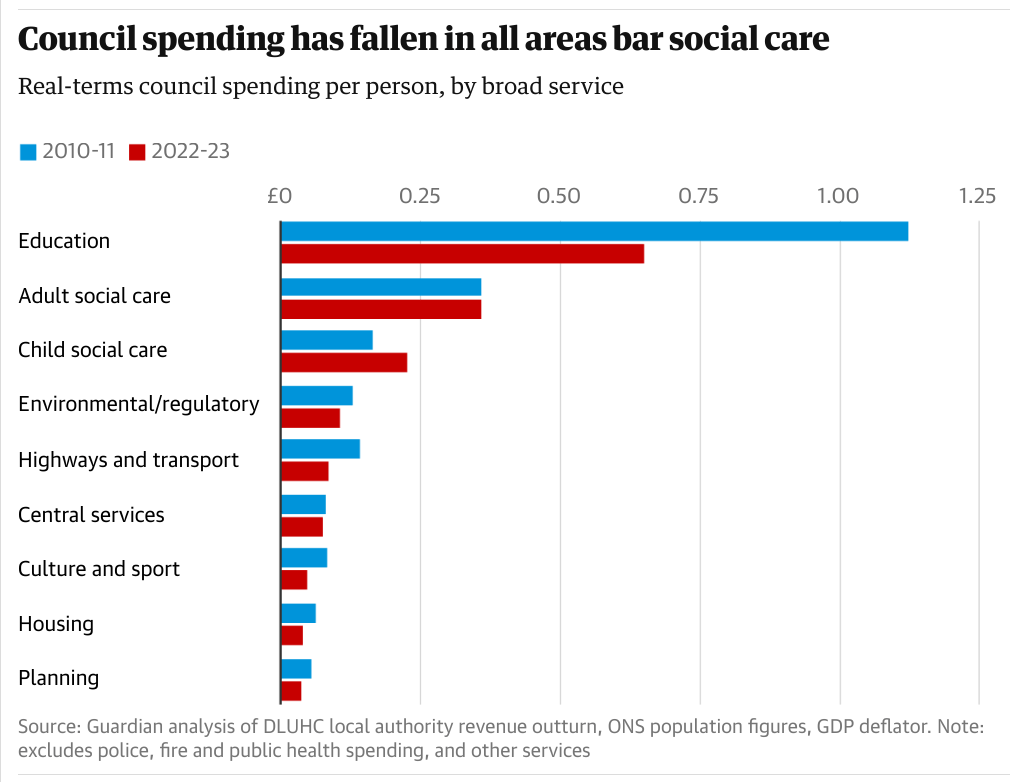
Council leaders from across the political divide told the Guardian the extra money announced this week was welcome but would not be enough to prevent further cuts in the coming years.
It is understood the government is exploring options for a fresh austerity drive in councils for after the next general election, after Michael Gove said his Department for Levelling Up, Housing and Communities would force councils to develop “productivity plans”.
The warnings from the levelling up secretary will add to Labour’s fears that the Conservatives are pursuing a scorched earth policy of underfunding public services in order to spend its spare cash on tax cuts to boost Sunak’s electoral prospects.
“It’s hard to see where productivity is coming from without it being a mask for further privatisation or reductions in services,” said James Lewis, the Labour leader of Leeds city council. “It feels like austerity is going further yet again.”
In an interview, Rayner said libraries, sports centres and youth provision were “not a garnish” and rejected calls from some Conservatives to reduce the types of services that councils had to offer.
“What’s very clear to me is that we are going to inherit a very difficult situation because the Tories have brought [councils] to the brink, offering them a very small amount of money now which cynically to me is about them trying to just get them over the line for a general election,” she said.
“But it’s not going to do anything about the long-term problems that we would inherit and we’re under no illusions about the scale of those problems.”
She said Labour would have to look at the overall state of public finances if it were to take power in the next year, but it would want to move to multi-year funding settlements to help councils plan better and make sure money was directed to the areas that needed it the most.
Asked about the risk of more council bankruptcies in the next few years, Rayner said: “Yes I’m absolutely worried about that. And I think councils up and down the country are worried about that. They’ve seen these added costs … temporary accommodation, children’s services and the pressures of the cost of living crisis that’s been created by the Tories – this real perfect storm for local authorities.”
Four local authorities fell into effective bankruptcy in 2023 – Birmingham, Nottingham, Woking in Surrey and Thurrock in Essex.
Roger Gough, the Conservative leader of Kent county council, said he had warned Sunak 15 months ago the government was “sleepwalking into financial disaster” amid dramatically escalating pressure on local authorities.
He said: “The fundamental situation is unchanged. The extra funding is welcome, and it’s important for us to not be too dog in the manger about this. But the fundamental pressures are still there. We are experiencing these as are other authorities across the country.
“We all know the cavalry is not going to be coming over the hill in terms of government funding, and that will be true frankly if there is a change of government. We all have to work within the world we’re living in.”
Stephen Houghton, the Labour leader of Barnsley council, who also chairs a group of 48 urban councils in the north of England, Midlands and south, said there was likely to be a “surge ofsection 114s next year” if more money was not provided – referring to the mechanism councils use to declare effective bankruptcy.
He said it “would be churlish” not to welcome the extra £600m but it would not be enough to match inflation and demand-led pressures on local authorities. “It won’t solve the problem. It will get us through to next year but what happens the year after that? Unless something substantial happens, we’re looking at a lot more councils struggling.”
In Birmingham, where the council has been placed in special measures by the government after its effective bankruptcy in September, officials plan to shrink the authority by 15% over the next two years. Others planning deep cuts include Bradford, Kent, Hampshire, Stoke-on-Trent and Somerset.
Tim Oliver, the Conservative leader of Surrey county council and chair of the County Councils Network, said he thanked the government for last week’s “highly unusual, if not unique” bailout package. “But I might say post general election we’ll be back.”
“The sector has been reasonably clear. With increased demand, there’s a funding gap of £2-3bn over the coming years.”
The former Conservative communities secretary Eric Pickles said local council funding should be overhauled altogether, including a review of business rates, revaluation of council tax at the point of property sales and an end to the government “topslicing” the central pool for council budgets.
“Whoever is the next government, if you did it the first year, you would begin to see some benefits from it by the fifth year,” he said. Pickles also backed three-year funding settlements for councils as “something I always wanted to do”.
Many Conservative MPs say privately that the £600m bailout is only a temporary solution. One senior Conservative MP said it was “a step in the right direction but the budget will need more to prevent council cuts due to the cost of energy and cost of living”.
Ben Bradley, the Conservative MP and leader of Nottinghamshire county council, said the cash increase was a “victory”, but that there were structural pressures authorities were facing. “There’s no political benefit of going into an election saying we’re shutting down your library and your youth centre. It’s not going to work. We do need to support and protect local services.”
A government spokesperson said: “We have recently announced an additional £600m support package for councils across England, increasing their overall proposed funding for next year to £64.7bn – a 7.5% increase in cash terms.”
£30m spending cut target for Devon social care
More on the impact of austerity with more to come as the PM considers tax cuts. – Owl
More money is needed to help Devon develop innovative ways of reshaping its adult social care services as the department targets £30 million of spending cuts.
Bradley Gerrard, local democracy reporter www.radioexe.co.uk
Devon’s adult social care lead, Councillor James McInnes (Conservative, Hatherleigh & Chagford) said he had told a Westminster cabinet member this week that “things need to change” if councils are to be given the time and resources to develop adult social care services to respond to increased and changing demand.
The budget, health and adult care scrutiny committee heard this week that Devon relies too much on expensive and resource-intensive bed-based and residential care, and that it is trying to help people achieve greater autonomy through in-home care and technology.
Council officers acknowledged they had been behind in terms of reviewing the services that individuals receive, noting that care packages are often set up at a time of crisis, but that assistance could be reduced if patient recovery is monitored more regularly.
Some speakers suggested the council might be offering too many services to too many people, and that better case-by-case reviews could help it distribute its resources better.
Cllr McInnes was speaking as the proposed budget for the 2024/25 financial year, which begins in April, showed the authority expects to spend more than £360 million on integrated adult social care.
Increased demand and rises in the national living wage have pushed the department’s costs up by £50 million.
About £30 million in potential savings, cuts and additional income have been identified to mitigate that. However, this still means that adult social care is costing the county £20 million more than it did this financial year.
Cllr McInnes urged central government to reconsider its approach to social care funding to help nurture innovation.
“I don’t think there’s enough money,” he said.
“Money isn’t the only answer, and it needs to be a dual approach as we need to innovate and change how we deliver services, but one thing I would plea for – and which I discussed with a national cabinet minister last week – is that for things to change and be innovated. We need the space, and the financial space, to do that.”
He said councils are battling year in, year out to balance budgets, and extra funding would provide allow councils to improve how they offer adult social care.
Council officers said an aging population, a rising number of people seeking help, also commonly with more complex requirements, and a rise in working age adults with mental health problems, were the key factors putting pressure on the service.
Devon’s rural geography adds a further challenge, they said.
Councillor Caroline Leaver (Liberal Democrat, Barnstaple South) felt the word ‘savings’ actually means real-terms cuts.
“I think it means there will be fewer services for the most vulnerable people, and I’m struck by the number of different savings specified,” she said.
“The question for me is what the savings or cuts mean in practice, and who the affected people will be and how many?”
Councillor Carol Whitton (Labour, St David’s & Haven Banks) didn’t have a problem with the department looking at ways to do things differently if it achieves better value for money and meets residents’ demands.
She told councillors: “Last year at this scrutiny meeting, we missed some of the lines that were in the budget about how individual users and groups were being impacted, and I think as a committee we should be given that information.”
She added there had been a “great deal of public concern” about changes in adult social care provision, and that this could have been mitigated before steps were taken.
Councillor Richard Scott (Conservative, Exmouth) said it is important to remember where the money comes from that pays for services.
“We never consider the person paying for it, we don’t look at council tax and how regressive it is as it generally impacts on people that have less,” he said.
“We are providing too much and not reviewing it quickly enough, and we need to understand why.”
Devon’s finance lead Angie Sinclair said spending on adult and children’s services represents almost 80 per cent of the council’s budget, but that moves had been made to curb the rise in spending in these departments.
“The increase 12 months ago in adult social care was nine per cent, and 18 per cent for children’s services, but we are working hard to pull that back and this year the rises are six per cent and 10 per cent, respectively, which is a significant improvement on last year,” she said.
“We are doing the best as a team to get the best value in terms of affordability and better outcomes as doing the right thing should cost us less.”
Devon’s chief executive Donna Manson added that better collaborative working with the NHS, as well as district councils, is playing a positive role in ensuring money is better spent.
More than 100,000 trees to be planted in Devon to boost Celtic rainforest
More than 100,000 trees are being planted in north Devon as part of efforts to boost temperate or Celtic rainforests, some of the UK’s most magical but endangered environments.
Steven Morris www.theguardian.com
The trees are being planted close to surviving pockets of rainforest at two spots close to the coast and one inland.
Among the trees that will be planted is the almost-extinct Devon whitebeam, which is only found in the English West Country and in Ireland. It can reproduce without fertilisation, creating seeds that are genetic copies of itself. Its edible fruit used to be sold at Devon markets as “sorb apples” – celebrated in the DH Lawrence poem Medlars and Sorb-Apples (“I love you, rotten,/Delicious rottenness.”)
Helped by volunteers, schoolchildren and community groups, the National Trust is hoping to establish 50 hectares (123 acres) of new rainforest across three sites. About 38,000 trees will be planted near the sea on Exmoor, 20,000 at Woolacombe and Hartland, and 50,000 inland at Arlington Court, near Barnstaple.
Temperate rainforests, also known as Atlantic rainforests, are characterised by their damp conditions, making them the perfect home for a unique variety of rare ferns, mosses, liverworts, lichens and wildlife including pine martens, pied flycatchers and stoats.
Over the centuries, the temperate rainforest, which used to run the length of the western seaboard of the UK, has deteriorated largely due to air pollution, invasive species, diseases such as ash dieback and general lack of care.
John Deakin, the head of trees and woodlands at the National Trust, said: “All that’s left are fragments, covering only 1% of Britain and limited to small patches in Devon, Cornwall, north and west Wales, Cumbria, the west of Scotland and parts of Northern Ireland.
“As a result, the rare specialist plants that depend on this habitat desperately cling to the remaining fragments for survival, with some of the woodlands we care for in north Devon containing nearly the entire global population of some of these species, such as the Devon whitebeam. Without urgent action, these unique plants could soon be facing extinction.
“We are working on expansion, rather than just preservation. This is important because the conditions many of these rare plants thrive in are not necessarily conducive to disturbance, which makes regeneration tricky. But, by planting on the edges of these existing woodlands, we can ease the pressure caused to the existing delicate vegetation and instead help the woodlands evolve outward.”
Bryony Wilde, project manager at Arlington Court, said: “Through this tree planting, we’re helping to create a living landscape where both nature and people can thrive. These trees will not only provide a habitat for wildlife but also fix carbon into the soil, purify air and water, and provide a place for people to enjoy.”
Devon is a good place to experience a temperate rainforest, with places like Wistman’s Wood on Dartmoor, an upland oakwood, cherished for its flora and enchanting feel.
Last year, Devon Wildlife Trust announced t it was planting a temperate rainforest in the south of the county, on the slopes above the River Dart.
The plight of the temperate rainforest has been highlighted by the writer and environmentalist Guy Shrubsole, who has been leading a project to map the surviving fragments.
Hair today, gone tomorrow – will Simon Jupp follow advice and snip his beard off?
According to the Sun and Daily Mail, Tory MPs are shaving their beards off because they have have been told it is a turn off to voters.
Sources have provided an image of what a Simon shorn might look like – and, no, it’s not deep fake AI!
Dear Reader, judge for yourself; but it doesn’t work for Owl.
With or without a beard he still looks like a well-fed Tory.

Will he do it?
Watch this face!
 East Devon Watch