
- Agricultural livestock building phase 2
 Drakes Farm Seaton Road Musbury Devon EX13 8AJRef. No: 24/0342/FUL | Validated: Fri 16 Feb 2024 | Status: Awaiting decision
 - Agricultural livestock building Drakes Farm Seaton Road Musbury Devon EX13 8AJRef. No: 24/0341/FUL | Validated: Fri 16 Feb 2024 | Status: Awaiting decision
- 24/0333/VARVariation of condition no. 2 (approved plans) of planning permission 21/1574/FUL – Creation of a dwelling and associated works as a replacement for the dwelling approved under Class Q previously. Includes changes in landscaping and fenestration, addition of a chimney, and some external rendering Barn Adjacent To Barley Way Ebford Lane Ebford Exeter EX3 0QXRef. No: 24/0333/VAR | Validated: Thu 15 Feb 2024 | Status: Awaiting decision
- Proposed single storey extension to north/front elevation (resubmission of 23/0478/FUL) Pine Hollow Hulham Road Exmouth Devon EX8 5DXRef. No: 24/0335/FUL | Validated: Thu 15 Feb 2024 | Status: Awaiting decision
- Construction of first floor extension. 11B Stoneborough Lane Budleigh Salterton EX9 6HLRef. No: 24/0327/FUL | Validated: Wed 14 Feb 2024 | Status: Awaiting decision
- Discharge of conditions for 17/0532/MOUT : Condition 26 (noise impact) Exeter Logistics Park Werstan Road Clyst Honiton EX5 2GBRef. No: 24/0323/DOC | Validated: Wed 14 Feb 2024 | Status: Awaiting decision
- Proposed Change of Use from residential Annexe (for ancillary accommodation) to a Holiday Let Uphills Greenway Lane Sidmouth EX10 0LZRef. No: 24/0311/FUL | Validated: Fri 16 Feb 2024 | Status: Awaiting decision
- Single storey rear extension & new front porch Green Lane Farm Green Lane Chardstock EX13 7BLRef. No: 24/0317/FUL | Validated: Tue 13 Feb 2024 | Status: Awaiting decision
- Proposed Change of Use from Shop (Class E, a) to Cafe (Class E, b), two side extensions and internal alterations. The Octagon Esplanade Exmouth Devon EX8 2AZRef. No: 24/0313/FUL | Validated: Tue 13 Feb 2024 | Status: Awaiting decision
- Certificate of existing lawful development for the installation of movable, ground mounted solar panels, reasonably necessary for the purposes of agriculture. Broadhayes Farm Stockland Devon EX14 9ELRef. No: 24/0312/CPE | Validated: Tue 13 Feb 2024 | Status: Awaiting decision
- Discharge of conditions for 23/2147/FUL: Condition 3 (Materials) Condition 4 (Landscaping) 21 Clinton Terrace Budleigh Salterton EX9 6RYRef. No: 24/0304/DOC | Validated: Mon 12 Feb 2024 | Status: Awaiting decision
- T1, Apple: fell to near ground level. T2, Laurel: fell to near ground level. T4, Field Maple: dismantle to near ground level. 2 Thorns Cottages Greenway Woodbury Devon EX5 1LRRef. No: 24/0302/TCA | Validated: Mon 12 Feb 2024 | Status: Awaiting decision
- Discharge of condition for 21/1527/LBC: Condition 2 (Materials) Salston Manor Hotel Ottery St Mary EX11 1RQRef. No: 24/0307/DOC | Validated: Mon 12 Feb 2024 | Status: Awaiting decision
- Discharge of condition for 23/1967/FUL: Condition 3 (Landscaping) Devonia South Street Colyton EX24 6PSRef. No: 24/0308/DOC | Validated: Mon 12 Feb 2024 | Status: Awaiting decision
- T1: Bay, reduce height by 2.5m and prune sides to shape; T2: Ash, reduce tips of branches by up to 1m; T3: Plum, reduce tips of branches by approximately 1-1.5m; T4: Pittosporum, prune away from property to achieve a minimum of a 1m clearance, thin canopy by up to 15%. 5 Thorns Cottages Greenway Woodbury EX5 1LRRef. No: 24/0306/TCA | Validated: Tue 13 Feb 2024 | Status: Awaiting decision
- Retrospective application for the proposal for 2no. barber shop illuminated signs with clear lights, and 2no illuminated projecting barber shop signs that rotate with clear lights both at each end of the shop front sign 76 High Street Honiton EX14 1PDRef. No: 24/0297/LBC | Validated: Mon 12 Feb 2024 | Status: Awaiting decision
- The erection of an Agricultural building with Solar Panels Orchard View Payhembury Devon EX14 3JARef. No: 24/0305/FUL | Validated: Thu 15 Feb 2024 | Status: Awaiting decision
- Front pitched roof dormer forming roof space conversion over a garage and replacement garage door. 6 Parkhayes Woodbury Salterton EX5 1QSRef. No: 24/0294/FUL | Validated: Mon 12 Feb 2024 | Status: Awaiting decision
- Construction of 1.8m x 2.4m shed near entrance to property. Land East Of Lower Marlpits Farm Honiton EX14 9TBRef. No: 24/0284/FUL | Validated: Tue 13 Feb 2024 | Status: Awaiting decision
- Proposal to install an electric vehicle charging unit Broadclyst House Broadclyst Exeter EX5 3EWRef. No: 24/0280/FUL | Validated: Wed 14 Feb 2024 | Status: Awaiting decision
- The installation of modular battery units with ancillary equipment, including power conversion units, 11kV transformer compound, switchroom, DNO substation and site office to provide standby, emergency electricity to support and facilitate renewable and low carbon energy projects. Land West Of Wareham Road HawkchurchRef. No: 24/0276/FUL | Validated: Fri 16 Feb 2024 | Status: Awaiting decision
- Retrospective agricultural livestock building. Lane End Farm Broadhembury Honiton EX14 3LURef. No: 24/0264/FUL | Validated: Tue 13 Feb 2024 | Status: Awaiting decision
- Creation of 2 No. off street parking spaces. 11 Newlands Park Seaton EX12 2SFRef. No: 24/0258/FUL | Validated: Mon 12 Feb 2024 | Status: Awaiting decision
- Roads and infrastructure details complete with access road realignment of approved scheme to serve 9 houses Waterleat High Street Newton Poppleford EX10 0DURef. No: 24/0255/FUL | Validated: Fri 16 Feb 2024 | Status: Awaiting decision
- Proposed dwelling 2 Halsdon Avenue Exmouth EX8 3DLRef. No: 24/0241/FUL | Validated: Mon 12 Feb 2024 | Status: Awaiting decision
- Construction of single storey side extension, replacement garage and rear 1st and 2nd floor dormer extensions. 245 Exeter Road Exmouth EX8 3NGRef. No: 24/0240/FUL | Validated: Fri 16 Feb 2024 | Status: Awaiting decision
- Variation of Condition 2, (approved plans), and removal of condition 3, (external materials), on application 23/1376/FUL, (Erection of rural workers dwelling). Spurtham Farm New Road Upottery Honiton EX14 9QDRef. No: 24/0218/VAR | Validated: Fri 16 Feb 2024 | Status: Awaiting decision
- Replacement conservatory 5 Brand Close Honiton Devon EX14 2FERef. No: 24/0197/FUL | Validated: Tue 13 Feb 2024 | Status: Awaiting decision
- Permission in principle for construction of a minimum of 1 dwelling to a maximum of 9 dwellings Land Between Shercroft Close And Spenco Station Road Broadclyst Station BroadclystRef. No: 24/0181/PIP | Validated: Fri 16 Feb 2024 | Status: Awaiting decision
- Technical details consent for 1no. new dwelling (following approval of 22/2407/PIP) 4 The Green Exmouth Devon EX8 2QRRef. No: 24/0178/TEC | Validated: Tue 13 Feb 2024 | Status: Awaiting decision
- Insertion of new window in gable (side) elevation May House Musbury Axminster EX13 8ARRef. No: 24/0159/LBC | Validated: Thu 15 Feb 2024 | Status: Awaiting decision
- Proposal to install an electric vehicle charging unit Broadclyst House Broadclyst EX5 3EWRef. No: 24/0141/LBC | Validated: Wed 14 Feb 2024 | Status: Awaiting decision
- T2, T3 Beech: crown reduce both trees by up to 3ms, maximum diameter of cuts 50mm. Wyndhams Higher Broad Oak Road West Hill Devon EX11 1XFRef. No: 24/0131/TRE | Validated: Fri 16 Feb 2024 | Status: Awaiting decision
- Replace 3no. windows on ground floor south elevation with 12mm heritage double glazing; insert 4no. sills on first floor south elevation, remove existing cement render to external walls on the west and south elevations and re-render in lime Halls Farm Higher Metcombe Ottery St Mary EX11 1SSRef. No: 24/0112/LBC | Validated: Thu 15 Feb 2024 | Status: Awaiting decision
- Certificate of Lawfulness for the proposed occupation of the dwelling by persons, none of whom would be employed or last employed in agriculture.The Haven Curscombe Feniton EX14 3EURef. No: 24/0115/CPL | Validated: Thu 15 Feb 2024 | Status: Awaiting decision
- Retrospective application for the proposal for 2no. barber shop illuminated signs with clear lights, and 2no illuminated projecting barber shop signs that rotate with clear lights both at each end of the shop front sign 76 High Street Honiton Devon EX14 1PDRef. No: 24/0102/ADV | Validated: Mon 12 Feb 2024 | Status: Awaiting decision
- Demolish existing bungalow, 1 no. replacement dwelling Oak Tree House Old Ebford Lane Ebford Devon EX3 0QRRef. No: 24/0108/FUL | Validated: Wed 14 Feb 2024 | Status: Awaiting decision
- Block up and reposition 1no. door on side south elevation at ground floor; block up 1no. window and reposition 1no. window on side south elevation at ground floor; remove a windows on the side south elevation at ground floor, remove internal partition wall between kitchen and dining room and removal of cupboard wall at ground floor 24 Temple Street Sidmouth EX10 9AYRef. No: 23/2721/LBC | Validated: Mon 12 Feb 2024 | Status: Awaiting decision
- Replace 1no. existing window with fire escape window at second floor north elevation; smoke curtain at top of internal staircase on second floor; install metal handrail to external metal staircase at 2 Corn Mill on west elevation Corn Mill Otter Mill Ottery St Mary Devon EX11 1AFRef. No: 23/2658/LBC | Validated: Thu 15 Feb 2024 | Status: Awaiting decision
- Replace 4no. windows with fire escape windows at first floor south elevation; replace 1no. window with fire escape window at first floor west elevation; replace 1no. window with fires escape window at second floor west elevation; create 1no. new fire door/wall in apartment 5 on first floor; create 4no. new fire door/wall in apartments 7, 8, 9 & 10 on second floor; create 4no. fire door/wall in apartments 12, 13, 14 & 15 on third floor; create 4no. fire door/wall in apartments 18, 19, 20 & 21 on fourth floor; create 1no. new fire door/wall in apartment 17 and create 1no. fire door in apartment 17 on fourth floor Town Mill Otter Mill Ottery St Mary Devon EX11 1GTRef. No: 23/2654/LBC | Validated: Thu 15 Feb 2024 | Status: Awaiting decision
- Proposed Internal Alterations, Side Extension, Loft Conversion/Extension (lifted roof), Front and Rear Dormers and New Front Porch. Morningside Vicarage Road East Budleigh Devon EX9 7EFRef. No: 23/2613/FUL | Validated: Fri 16 Feb 2024 | Status: Awaiting decision
- Discharge of conditions for 23/1556/FUL : Condition 3 (External Materials), Condition 4 (Landscaping) Egremont Barn Payhembury Honiton EX14 3JARef. No: 23/2593/DOC | Validated: Mon 12 Feb 2024 | Status: Awaiting decision
Daily Archives: 26 Feb 2024
Devon hospital trust’s massive repair bill revealed
Ageing buildings at the Royal Devon & Exeter Foundation Trust mean its repair bill rose by one of the largest amounts last year across England.
Bradley Gerrard www.devonlive.com
New figures provided by the BBC show the RD&E’s repairs backlog more than doubled from more than £68 million in the 2021-22 financial year to £146 million in 2022-23.
This means that it experienced the sixth biggest percentage rise last year out of England’s NHS trusts. However, it still does not put the trust in the top 10 for the highest overall repairs backlog, which ranges from £193 million at tenth-placed University Hospitals Birmingham NHS Foundation Trust through to £734 million at first-placed Imperial College Healthcare NHS Trust.
In total, the estimated bill to complete so-called high-risk repairs needed at England’s NHS acute hospitals has swollen to £2 billion – up more than a third compared to the previous year.
The RD&E Hospital (Wonford) in Exeter was built between 1992 and 1996, and the trust said large parts “tipped over into ‘not good condition’ as defined by the Department of Health and Social Care because it is in the 30-35 year old age bracket”.
The trust’s current form began in April 2022, when it brought together the assets from the RD&E NHS Foundation Trust and the Northern Devon Healthcare NHS Trust.
“This increase in the total number of assets has also added to the rise,” a spokesperson for the RD&E said.
“There is a medium-term plan in place to address the repair backlog at the RD&E, whereas North Devon District Hospital is one of the 40 new hospitals, which when rebuilt will address the issue.”
The NHS describes North Devon District Hospital as “the most remote acute hospital in mainland England,” adding that many of its building are over 50 years old “which can result in challenges delivering care.”
The government had pledged to build the new hospital by 2030, but earlier this month Shona Dunn, second permanent secretary at the Department of Health & Social Care, said it is “now expected to complete after 2030”.
The RD&E spokesperson said the trust is exploring whether a phased-build programme for the North Devon District Hospital could be implemented to help it “mitigate some of our infrastructure risks sooner.”
The spokesperson added that the level of repair backlog is “measured continuously” with “higher-risk areas then addressed in the short term where capital funds are made available.”
However, its core capital funding – cash that would be used for repairs – is “currently overcommitted”, the spokesperson added, meaning that the highest priority jobs had to be dealt with first.
Fortunately, RAAC, or reinforced autoclaved aerated concrete, which is blighting a host of hospitals and schools across the country, is not an issue for the RD&E Trust.
“There is one non-clinical, non-structural area in the North Devon District Hospital which is affected by RAAC, however this area has been surveyed and confirmed as low risk and fit for purpose,” the spokesperson said.
A total of 86 trusts provided a response to the BBC Shared Data Unit, revealing at least 1,385 reports of infrastructure problems, impacting the care of at least 1,055 patients.
After another weekend of sewage discharges onto our bathing beaches – how informative is SWW Waterfit Live?
When SWW faced EDDC’s scrutiny committee recently, Waterfit Live was claimed to be the answer to most councillors’ questions.
This section of this morning’s South West Water’s Waterfit Live map shows three active discharges in Exmouth, Sandy Bay and Budleigh. Locals know there are more potential sites than these.
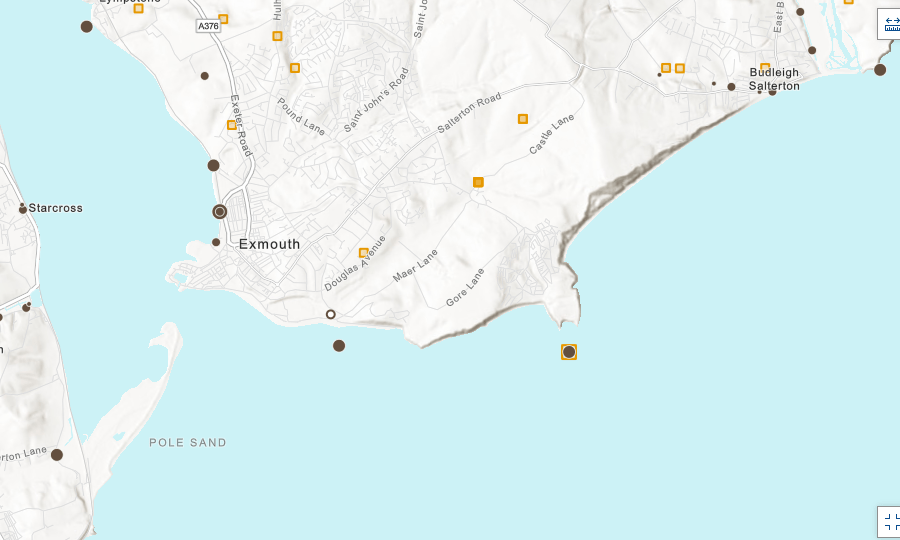
Below, for comparison, is the Rivers Trust map showing the actual locations of combined sewage overflows (brown spots) at similar scale but in much greater detail.
Surely we need to know from SWW exactly which outfall has spilled, not a generalised “blob”?
WaterFit Live

Rivers Trust map of existing outfalls
Only faux leather sandal wearing Liberals drink skimmed milk – Jacob Rees-Mogg
Only liberals drink skimmed milk to go with their faux leather sandals. Full fat, creamy milk will nourish your inner Tory.
Listen to Sir Jacob Rees-Mogg MP for North Somerset and 19th Century here

40 projects to benefit from £25 million funding for natural flood management
The Environment Agency’s Climate Resilient Otter Catchment (CROC) scheme has been handed £1,184,800. The initiative involves eight projects around the River Otter with a focus on land and soil management, as well as local farming practices. Sidbury Manor Estate’s River Sid catchment scheme has been given £240,000.
Welcome funding in what is now regarded as a marginal constituency. – Owl
Department for Environment, Food & Rural Affairs www.gov.uk
Forty projects which will use natural processes such as planting trees and creating wetlands to reduce the risk of flooding are set to benefit from a £25 million government programme, Floods Minister Robbie Moore announced today (Friday 23 February).
Part of the government’s plan to increase the nation’s flood resilience, natural flood management processes protect, restore, and mimic the natural functions of catchments, floodplains and the coast to slow and store water.
Community, charity and council projects set to benefit from the £25 million Natural Flood Management programme include:
Severn Rivers Trust will carry out a mixture of natural flood management measures in the headwaters of Illey Brook, near Halesowen in the West Midlands. Many of these works will focus on soil and land management – slowing and storing surface water runoff, while also reducing soil erosion and supporting agriculture. New woodland areas and hedgerows will support wetland complexes and the creation of new habitats.
The Ribble Rivers Trust has proposed a number of projects focusing on slowing river flows across the Ribble catchment, in Darwen, Clitheroe and Lea Green. Swales, ponds and leaky barriers across watercourses will slow and store floodwater in the upper reaches of the River Darwen catchment, whilst vegetation management and new woodland will intercept the flow of water as it runs downhill, reducing runoff and enabling water to be stored in the soil.
The announcement comes after a wide range of applications were submitted to the Environment Agency by community groups, environmental charities and councils for grants, following the launch of the largest-ever investment in natural flood management schemes in September last year. The Environment Agency led a review of these applications, with input from Defra and Natural England.
Environment Agency chair Alan Lovell said:
It’s exciting to see such appetite for Natural Flood Management, recognising its value in providing not only benefits against flood risk but also wider support for nature recovery.
I’m proud of the role the Environment Agency is playing in leading this pioneering programme. We look forward to working with partners to help natural techniques become a mainstream option for flood protection and help create more climate resilient places.
Floods Minister Robbie Moore said:
It’s vital we use nature as an ally in our work to become ready for climate change, helping to restore the natural environment and protecting homes and businesses. That’s why we’re funding the biggest-ever investment in natural flood management – and it’s great to see the huge demand.
These schemes will complement traditional bricks-and-mortar defences, all funded by our £5.2 billion flood programme. This programme is one more part of our plan to bolster flood resilience and shield communities – all whilst boosting biodiversity, restoring habitats and protecting the environment for future generations.
Mark Lloyd, chief executive of The Rivers Trust, said:
We warmly welcome this significant fund which will not only protect people and businesses from flooding, but will also make more space for nature, purify pollutants, recharge groundwater aquifers, lock up organic carbon and create amenity value for communities.
The new funding builds on the £15m natural flood management pilot programme which ran until 2021, creating the equivalent of 1.6 million cubic metres of water storage and reducing flood risk to 15,000 homes.
The Environment Agency is managing the new £25 million programme with work taking place from now until March 2027.
The programme will help meet the goals of the National Flood and Coastal Erosion Risk Management Strategy for England, which provides a longer-term vision of how we will better protect and prepare homes and businesses from flooding and coastal change and create climate resilient places.
It also supports the Government Policy Statement on Flood and Coastal Erosion Management, which highlights the importance of harnessing the power of nature, and the Environmental Improvement Plan, which recognises the need to mitigate and adapt to climate change with the use of nature-based solutions. Investing in natural flood management will support the government’s plan to better protect communities while tackling climate change and benefitting nature.
To find out more about the Natural Flood Management Programme and for a full list of successful projects refer to our Gov.uk pages and below.
Successful applicants and schemes:
- City of Doncaster Council, Bentley NFM Opportunities
- Northumberland County Council, Alnmouth Coastal scheme
- National Trust, Common Farm Hydrological Restoration
- National Trust, Resilient Coledale
- Community Forest Trust, Whitewell Brook NFM
- Ribble Rivers Trust, Ribble Revival: Darwen Community Catchment
- Ribble Rivers Trust, Ribble Revival: Clitheroe Community Catchment
- Ribble Rivers Trust, Ribble Revival: Wrea Green Community Catchment
- Wyre River Trust, Wyre Catchment Resilience Programme
- Brampton 2 Zero CiC, Brampton Natural Flood Management Project
- National Trust, Poynton and Micker (Norbury) Catchment Plan (Headwaters)
- Cheshire Wildlife Trust, Meols Natural Flood Management Scheme
- Mersey Rivers Trust, Alt Catchment NFM
- Woodland Trust, Smithills Estate NFM 2024
- City of Trees Trust, Cromton Moor Slow the Flow Leaky Dams
- Severn Rivers Trust, Illey Brook NFM
- Leicester City Council, Leicester Urban NFM – Willow Brook Catchment
- Nottinghamshire Wildlife Trust, Saving Worksop and Shireoaks through NFM
- Nottinghamshire County Council, Cropwell Butler Natural Flood Management
- Lincolnshire County Council, Barrow Beck Chalk Stream Restoration
- East Mercia Rivers Trust, Field Beck NFM – Holdingham, Sleaford
- Lincolnshire County Council, Building Flood Resilience in the River Rase Catchment
- National Trust, Northey Island Causeway Saltmarsh Management
- River Waveney Trust, Diss Natural Flood Management
- Essex County Council, Hockley Woods Leaky Dams
- RSPB, Beneficial Use of Dredged Sediment (BUDS) in the Blackwater Estuary
- Norfolk County Council, North Attleborough Flood Alleviation Scheme
- London Borough of Hillingdon, Pinn Meadows Natural Flood Management
- South Oxfordshire District Council, The Goggs, Watlington NFM Scheme
- Surrey County Council, Ash Ranges NFM
- High Weald AONB Partnership (East Sussex County Council), High Weald AONB NFM Project (Alder Stream)
- RSPCA, Marsham Valley Natural Flood Management Partnership
- The Friends of Cannizaro Park, Cannizaro Park NFM Programme
- Royal Borough of Greenwich Council, Marsh Dykes and Thamesmead Flood Alleviation Network
- High Weald AONB Partnership (East Sussex County Council), High Weald AONB NFM Project (Crawley – Stanford Brook)
- National Trust, Swan Brook Wetlands
- Dorset AONB Partnership, hosted by Dorset Council, West Dorset Rivers & Coastal Streams Natural Flood Management Programme
- Sidbury Manor Estate, Sidbury Manor Estate & The River Sid Catchment
- Environment Agency, Climate Resilient Otter Catchment (CROC)
- Westcountry Rivers Trust, Climate Resilient Mevagissey
 East Devon Watch