

Monthly Archives: February 2024
Breaking: Richard Foord MP NHS Property Services (Seaton) adjournment debate yesterday – Is the pressure working?
Richard Foord gets Health Minister Andrew Stephenson to say “No plans for demolition” and to say:
“I fully recognise that the local community has invested in the building of the hospital in the first place, and therefore is a key stakeholder in its future. The ICB and NHS Property Services continue in ongoing dialogue with a range of community groups about potential future uses, and the community has been invited by the ICB to develop a business case for the future use of the property by the end of June 2024. Any future decisions on the future of Seaton Hospital will be taken following evaluation of that business case. I sincerely hope that a financially sustainable solution can be found locally and in the best interests of the people of Devon.” Andrew Stephenson
From Hansard transcript
Richard Foord Liberal Democrat Spokesperson (Defence)
My aim during this Adjournment debate is to get a plain answer to one simple question: to whom does NHS Property Services answer? That is a crucial question, because the organisation is in possession of an estate of more than 2,700 properties with a value of more than £3 billion. The company is responsible for roughly 10% of all NHS facilities, yet there is a need for clarity on how it is overseen. I aim to unpack some of the key questions that need answering and outline some ways in which we can improve the situation we find ourselves in, specifically in relation to Seaton Community Hospital in my constituency.
What exactly is NHS Property Services? I had to answer this question myself several months ago, when I learned of plans by NHS Devon to hand back part of Seaton Community Hospital to NHS Property Services, from which NHS Devon had been renting the building. I had little idea why NHS Property Services was the nominal owner of a full wing at Seaton Hospital. That is in spite of the fact that the wing was funded entirely through donations raised by the local community before the hospital was built and opened in 1988.
NHS Property Services is a Government-owned company with one single shareholder, the Secretary of State for Health and Social Care. To me, that implies that Ministers are ultimately responsible for the oversight of that company, even though I accept that the day-to-day running of the organisation is delegated. Yet ask a Minister about this, as I have, and Members might hear a rather different story. Each Minister who I have asked questions of has simply said that they cannot get involved in the decision-making processes in NHS Property Services in any meaningful way. I can understand Ministers not wanting to tinker in operational decisions, but there are some principles at stake in relation to Seaton Hospital that means it is not just an operational matter. Surely a company should be accountable to its shareholders—how otherwise can the company and its board be held accountable for their actions?
That is the paradox: we have a company worth billions that is solely owned by the Government, yet Ministers protest that they can have almost nothing to do with it. Far from being entirely detached from Government, the framework within which NHS Property Services operates is set by the Department of Health and Social Care. When I talk to regional representatives from NHS Property Services, as I have several times, they make it plain to me—in what they say and what they do not—that they are bound by policies emanating from Whitehall. That affects everything from how the organisation was established to its current operating framework, including how much NHS Property Services charges as rent for spaces that it lets to local NHS organisations such as integrated care boards.
That is a key barrier in the fight to save Seaton Hospital as one single entity. The current £140 per square metre market rent puts the embattled wing far out of the price range of any local, community-based organisation that wants to take over the space and use it for the improvement of health and wellbeing in the Axe valley. That is a crazy price: it is well over double what one would have to pay for office space here in Westminster—and, trust me, real estate prices in Seaton should not be comparable with those in Westminster.
My concern is that, on the one hand, the rent is extortionate because it is based on a clinical rate, and yet, on the other hand, the property directors—the people charged with running NHS Property Services—have a background in infrastructure and estates and want to get the maximum income they can from the estate they are running, so they pay little heed to the health context.
I will talk a little about the health context to bring this Seaton Hospital case study to life. The chief medical officer, Sir Chris Whitty, in his annual report last October called “Health in an Ageing Society”, wrote specifically about the tendency of older people to retire and move to rural areas, and specifically to coastal areas such as Seaton. He said:
“We’ve really got to get serious about the areas of the country where ageing is happening very fast, and we’ve got to do it now. It’s possible to compress the period of time that people spend in ill health…because otherwise we will end up with large numbers of people leading much more dependent lives.”
The report recommends:
“Providing services and environments suitable for older adults in these areas” as an “absolute priority”. Sir Chris Whitty says that, specifically, we need policies to reduce disease, to reduce disability and to help people to exercise, eat well and stay fit.
That was the chief medical officer, and I will also refer to a report written just a couple of weeks ago by Beccy Baird from The King’s Fund. It calls for a radical refocusing of health and care, with primary care and community services at its core. The report says that
“progress has been hampered by an incorrect belief that moving care into the community will result in short-term cash savings. Other factors include a lack of data about primary and community services leading to a ‘cycle of invisibility’”, with
“urgent challenges such as A&E waiting times and planned care backlogs becoming the priority for politicians tempted by quick fixes instead of fundamental improvement.”
Sir Chris Whitty and Beccy Baird are up against some in the public sector who are tempted to treat all estate management matters as the same. The head of the National Audit Office, Gareth Davies, talked in Parliament in January about asset management being one of the
“main areas of financial opportunity” for the Government. I would caution the National Audit Office and NHS Property Services to read the Whitty and Baird reports, rather than simply seeking to divest all property in the NHS for as much as Property Services can get.
Seaton Hospital was transferred to NHS Property Services in 2017. The purpose of Property Services at that time was to centralise the holdings of various strategic health authorities and primary care trusts under one umbrella organisation. The aim was to remove the burden from local NHS organisations, and offer greater financial security by holding all those properties centrally. It was intended to provide better management of these important spaces, so as to ensure value for money and quality facilities, using economies of scale and of scope.
Fast forward to 2024, and it is clear that the model is broken. Rather than ensuring that our local health services get the space they need, we seem to be making perverse, false economies. The Government give money to integrated care boards only to have Government-owned NHS Property Services recoup a large portion of that money in rental fees for the buildings that ICBs use, at a rent set and advised by market rent auditors. This offers very little flexibility or security for our local NHS services, which, as in the case of Seaton Community Hospital, are left in a scenario in which the ICB is forced to cut services while still being lumbered with a bill for the space those services used to occupy. We lost the clinical beds we had at Seaton Hospital in 2017, and the space has since remained vacant. The only way to remove this item from the budget line is to turn over the space to NHS Property Services, which becomes liable for the amount charged in rent.
As hon. Members can see, this system is not only complex but incredibly backwards. The Government are effectively renting these buildings from themselves, despite the fact that many were previously directly owned by local health bodies. They are not even rented out at a fair price, despite the stated commitment to achieving fair market rates. These facilities are rented out as clinical spaces, even when they are not used for clinical purposes. This is based on an evaluation that must have been completely off the scale when it was made in 2016. Seaton Hospital was evaluated by the assessor Montagu Evans, and I do not know who it could possibly have talked to if it thinks that Seaton Hospital is worth £300,000 rent a year.
Why, we might ask, is the rent not adjusted to reflect the building’s current status? So far as I can gather, it is because the Government’s rental framework does not allow it. It places a huge roadblock in the way of community groups and hospital friends organisations that seek to convert such spaces into new settings aimed at providing non-clinical services of the sort to which Sir Chris Whitty and Beccy Baird were referring. Instead, the system seems analogous to a self-licking lollipop, or a dog blindly chasing its evasive tail without ever stopping to think why it cannot catch it.
During my many conversations with NHS Property Services in recent months, individual employees have sought to be helpful. However, they find themselves handcuffed by Government policy. They are unable to deviate from the Government’s framework, which, through the consolidated charging policy, first introduced in 2016, sets the rate that ICBs and, now, community organisations need to pay. The rate was introduced when Jeremy Hunt, who is now Chancellor of the Exchequer, was Health Secretary.
In effect, the Government own all NHS facilities and have the power to direct the arrangements under which they are rented out, including the wing of Seaton Community Hospital that was funded, in whole, by local villagers, townspeople and the Seaton and District Hospital League of Friends charity. What on paper might seem like a prudent way to manage NHS facilities, and to make sure that they are properly maintained, means in reality that, in places like Seaton, the community no longer has a stake or a say in how its local hospital is used.
That begs the question: who is in charge? The answer should be the Secretary of State and Ministers reporting to her, but given her Department’s attempts to point the finger at this operational body and to divest itself of responsibility, it seems that nobody is in charge. People are pointing in several directions, and I cannot identify exactly who is setting the market rate. Simply put, the Government have let go of the wheel, and are content to let the car spin out of control so that they do not have to take responsibility. That is not good enough.
Our NHS is the envy of the world and one of our country’s greatest achievements. When the great Liberal thinker William Beveridge conceived of a service that was free at the point of use all those years ago, it was revolutionary and re-shaped the way in which modern democracies have approach public health. We cannot allow it to be eroded because of the unwillingness of the Government to face up to the challenge. The mark of leadership is honesty and accountability. I would like to see that from Ministers. Rather than the Government saying, “This is an operational matter for NHS Property Services, not me,” I would much rather someone from this Conservative Government admitted that they know what the so-called market rent is, why it is charged at that rate, and why the community must pay if it wants to use that space. Better still, that community should be given a concessionary rate, in recognition that clinical activity is not going on in that wing of the building at this stage. The community ought to be able to hire the space for a much more affordable rent.
I have three questions for the Minister. First, is the Department for Health and Social Care responsible for setting the amount that NHS Property Services charges local NHS services such as ICBs to rent the space? Secondly, could the consolidated charging policy, which I understand sets out those prices, be changed by the Secretary of State or Ministers? Thirdly, if the answer to those questions is yes, why have I been told repeatedly that Ministers cannot, so they say, get involved in operational matters relating to NHS Property Services?
Many ICBs are struggling to balance the books—NHS Devon is no different in that respect—and are seeking to downsize the space that they rent to make ends meet. This situation is not specific to Seaton, although I think it is a good case study because of the way in which local people bought a brick and built the hospital themselves with many small donations. The situation facing our local community hospital strikes me as an illustration of why change is needed. I have been campaigning with the Seaton and District Hospital League of Friends charity, which supports Seaton Hospital, to change the charging policy, so that NHS Property Services can have flexibility on rental fees. I want the company to enable underused space in NHS facilities to be rented out to local community groups that want to invest in preventive health and community wellbeing, and that want to fulfil some of the vision that Sir Chris wrote about in his annual report last October.
Ultimately, I would like an affordable concessionary rate to be offered to Seaton and District Hospital League of Friends and the working group that works with them. That would be of benefit to rural and coastal communities such as Seaton. We need to know how to ensure accountability for the current arrangements, and I hope that there can be concessions for local communities, such as the one that I represent in the Axe valley. I look forward to the Minister’s responses to my questions, and I hope that he is willing to engage with me to enact meaningful change that will benefit communities and constituents, such as those in my Tiverton and Honiton constituency.
Andrew Stephenson Assistant Whip, Minister of State (Department of Health and Social Care)
I congratulate Richard Foord on securing the debate. I am grateful for the opportunity to set out the role of NHS Property Services. This subject is understandably of great interest to right hon. and hon. Members across the House.
The hon. Gentleman raised the issue of the future of Seaton community hospital. I will come to that in the latter part of my speech, but let me say for the record that I completely understand his desire to protect a much-loved community health facility. As the Member of Parliament for Pendle, I successfully fought to keep open Pendle Community Hospital in Nelson, and in the neighbouring constituency of Ribble Valley, the new £7.8 million Clitheroe Community Hospital opened in May 2014, so I recognise the importance of community hospitals, not just in offering in-patient care, but in acting as a hub for other healthcare services. It will be most useful for me to first set out to the House why and how NHS Property Services came into being.
Under the Health and Social Care Act 2012, the coalition Government abolished primary care trusts and transferred their commissioning responsibilities to clinical commissioning groups. Their property interests transferred to either NHS trusts or NHS Property Services, which was established in 2013 for this purpose. That decision was made because it allowed commissioners to focus on providing care for patients, rather than managing property. NHS Property Services took ownership of nearly 3,500 local facilities, such as community hospitals, health centres, GP surgeries and care homes. In the past 10 years, NHS Property Services has reduced the size of that estate by a fifth, saving over half a billion pounds of taxpayers’ money, every penny of which has been reinvested into the NHS.
I understand the Minister’s point about reinvesting the proceeds from selling what might have been regarded as excess NHS property, but my concern relates to where that money goes. My understanding is that, following a sale, half the money might go back to the integrated care board, which would be Devon in this case. The problem with that situation is that it does not take account of the fact that local communities donated the money to build the infrastructure in the first place. That is certainly the case in the Axe valley with Seaton Community Hospital.
Andrew Stephenson
I appreciate the hon. Gentleman’s concern. I hope to provide reassurance in the latter part of my speech that the sale of Seaton Community Hospital is certainly not on the cards and is exceptionally unlikely. However, I appreciate that when property is sold, there is always tension between how much of that money will be reinvested in local communities—many of which have a stake in having created the facilities in the first place—and how much goes into the general NHS pot. The important point for me to land today is that all the money remains within the health services and none returns to the Treasury, so any sales of property from this portfolio are not a way for the Government to generate income, but simply a way of ensuring that the property estate is managed in the most effective fashion.
NHS Property Services was established as a limited company and is led by a board of executive and non-executive directors who are appointed for their property and healthcare expertise, including a departmental shareholder representative. The board’s directors all have the usual responsibilities relating to the proper governance of a limited company, with certain shareholder matters reserved, such as share issue or senior appointments. The board must work within the wider frameworks across Government, such as the Treasury’s guidance on managing public money, which rightly sets out the strict rules for delivering value for taxpayers’ money. The company therefore works with the Department to agree fiscal targets to work within, and is rightly held accountable for its use of public money. However, it is important to emphasise that my Department is not responsible for operational decisions, which are taken by the board and its executive management team.
One reason for the creation of NHS Property Services was to ensure that decisions could be taken without political interference. Although I appreciate that the hon. Member and others across the House may be of the view that my noble Friend Lord Markham, who has ministerial responsibility for NHS Property Services, can intervene to reduce the rents for unoccupied space at Seaton Community Hospital or similar facilities across the country, it would simply not be appropriate for him or any other Minister to intervene in any individual case.
The coalition Government established NHS Property Services through the cost recovery principle, which is the broad framework that the organisation works under. This means that it is funded through charging its costs to the occupiers of its buildings and the recipients of its services. As such, every pound it spends and does not recover is a pound that cannot be spent on delivering frontline care.
The Devon properties were transferred to NHS Property Services on the basis that their ongoing running costs would be funded through rents at market rate and service charges. This approach was taken to give real incentives to local commissioners to take the tough decisions on which properties were most suitable for delivering their clinical strategy, looking at areas as a whole and moving away from a situation whereby subsided property costs could lead to a less effective approach. I accept that that can sometimes lead to tensions about how reasonable charges are set, but the aim is that NHS bodies, and other voluntary and charitable organisations that wish to occupy NHS premises, must factor in the full cost of occupying and maintaining specialist facilities in their decision making.
I will now turn to the future of community hospitals in Devon, including Seaton Community Hospital. As the hon. Gentleman set out in his Adjournment debate in November, Seaton Hospital was part of a group of community hospitals that transferred to NHS Property Services in 2017, when large parts of Seaton Hospital and others in Devon were already vacant. The clinical commissioning group carried out a consultation on the model of community care and a new model of care was introduced, making it more integrated and more community based, with more people receiving care at home. That resulted in a significant reduction in the number of community hospital beds required across Devon. Since then, progress has been made to identify sustainable alternative healthcare uses for vacant spaces in community hospitals in Devon, such as Ottery St Mary and Axminster. In addition, NHS Property Services and Devon ICB have worked with the voluntary sector to support local initiatives in some properties, such as, as the hon. Gentleman will know, the Waffle café at Seaton Hospital.
I understand that Seaton Hospital and some other hospitals still have significant amounts of vacant space. Despite their best efforts, NHS Property Services’ commissioners have been unable to identify relevant services that could fill this gap. NHS Property Services has continued to manage the property, with the costs of the vacant space being charged to the ICB to ensure the costs attributed to the property are fully recovered, but recently the financial challenges facing Devon ICB have called the sustainability of that position into question and it has explored options for alleviating those costs. However, as I explained, simply seeking to pass those costs back to NHS Property Services would not result in the Department having any more money to spend on local healthcare services in Devon.
As I am sure the hon. Gentleman will appreciate, the responsibility for decisions about where to locate clinical services in Devon is a matter for the ICB. It is not a matter for Ministers. However, NHS Property Services is working closely with local leaders to identify options that would help to mitigate the cost pressures arising due to Seaton Community Hospital not operating at full capacity. If, and only if, the ICB determines the property is wholly surplus to its requirements, NHS Property Services would have the responsibility for selling the asset, following Treasury guidelines, but it is important to stress that the site remains an operational site and NHS Property Services therefore has no plans to sell it.
As has been mentioned in the local media, the idea of partial demolition of the hospital has been floated. Again, there are no plans for that course of action, which would very much be a last resort in any event. I believe the site has now been listed as an asset of community value, which means that such a drastic step is exceedingly unlikely to be supported by the local planning authority or other local stakeholders.
It is true that the property has been registered as an asset of community value. To my mind that gives it a stay of execution, rather than that it is inevitable that it will be preserved intact. NHS Property Services talked through the very many options—I think 28 options—on the table for the vacant space at Seaton Hospital. One of that long list of options is indeed selling off the redundant ward, which could be demolished and used for houses. Did the Minister not know that?
Andrew Stephenson
I know the idea of demolition has been floated in a meeting, but I have been assured that there are certainly no plans for demolition. As the hon. Gentleman will know, an asset of community value nomination was accepted by the local authority, and as an ACV nomination remains live for five years, it will expire in January 2029, although I am pretty sure that local community groups and others would campaign for that to be extended. It is certainly much more than a stay of execution. I hope that has provided suitable reassurance to the local community that the threat of demolition is exceedingly remote, because the local planning authority and other local stakeholders simply would not agree to the demolition of this much-valued community asset.
I fully recognise that the local community has invested in the building of the hospital in the first place, and therefore is a key stakeholder in its future. The ICB and NHS Property Services continue in ongoing dialogue with a range of community groups about potential future uses, and the community has been invited by the ICB to develop a business case for the future use of the property by the end of June 2024. Any future decisions on the future of Seaton Hospital will be taken following evaluation of that business case. I sincerely hope that a financially sustainable solution can be found locally and in the best interests of the people of Devon.
Question put and agreed to.
House adjourned.
UK lender trials ban on new holiday let mortgages for tourist hotspots
A leading building society is trialling a ban on new holiday-let mortgages in some popular tourist destinations.
Rupert Jones www.theguardian.com
Campaigners say the move by Leeds building society could improve the situation for local residents currently struggling to buy or rent in parts of Norfolk and Yorkshire that have seen a surge in the number of properties turned into holiday rentals.
The announcement comes days after the government unveiled new rules for short-term holiday lets in England that aim to rein in a sector that has been described by some as “out of control”.
In recent years there has been growing concern about the number of properties being let out on a short-term basis, leading to local people being priced out of their communities. Platforms such as Airbnb have made it easy to do this as a potentially lucrative side hustle, while the tax treatment is more favourable than it is for buy to let. On top of that, the coronavirus pandemic and cost of living crisis have increased demand for domestic holidays and short breaks.
On Monday the government said it had listened to campaigners and announced two proposals applying to England. Planning permission will be required for future short-term lets (this will not apply to existing ones), while a mandatory national register will be set up to provide local authorities with information on short-term lets in their area.
Now, Leeds building society says it believes it is the first holiday let mortgage lender to restrict new lending. It has worked with North Norfolk District Council and North Yorkshire Council to set up a 12-month trial from the end of March, during which it will stop new loans for holiday homes in certain areas.
Everywhere in North Norfolk will be included, including the seaside towns of Cromer, Wells-next-the-Sea and Sheringham. The areas in North Yorkshire affected are Scarborough, Whitby, Filey, Saltburn, Leyburn and Richmond.
The relevant postcodes will be added to the building society’s systems to prevent any holiday let mortgage applications received in those areas from being approved. Existing holiday let borrowers are unaffected.
The Leeds estimates it is in the top 10 of the 40 or so lenders offering this type of mortgage. However, some lenders include them with with buy-to-let home loans. Holiday let mortgages are typically used to buy properties that will be let out for short periods (no longer than 31 days) rather than used for long-term lettings, which is where buy-to-let mortgages usually come in.
Ben Twomey, the chief executive of Generation Rent, says it is pleased that Leeds building society is “prioritising the necessity of homes over the luxury of holidays”.
Water firms allowed to dump sewage into rivers using permits from the 1950s
Hundreds of permits that allow water companies to dump sewage into Britain’s rivers have not been updated by Government officials for decades with some remaining unchanged since the 1950s, i can reveal.
Lucie Heath inews.co.uk
An i analysis of permits obtained under Environment Information Requests (EIRs) found that some are lacking basic details such as how much sewage a treatment centre can handle before spilling into England’s waterways.
Others do not include limits on pollutants, such as phosphorus, which in high quantities can have a devasting impact on rivers.
i‘s investigation has identified almost 100 permits for active sites that have not been updated since 1989, when water companies in England were first privatised. Two permits date back to the 1950s during the era of rationing and the Suez crisis, while 24 are from the 1960s. Hundreds more have not been updated in at least a decade.
Campaigners have accused the Environment Agency (EA) watchdog, which is responsible for the permits, of “being asleep at the wheel” and have called for them to be urgently updated to include tougher restrictions for water firms.
The EA issues water companies in England with these documents setting out conditions on how they must treat wastewater before it is discharged into the environment.
The permits also outline when water companies can dump untreated sewage into bodies of water, something firms are allowed to do during periods of exceptional rainfall to prevent it from backing up into people’s homes.
They apply to the management of wastewater treatment plants, pumping stations and the pipes in their network through which they are allowed to spill sewage, known as combined sewer overflows (CSOs).
The EA said it regularly reviews the documents and will add new restrictions if deemed necessary, but experts have raised concerns over whether the oldest ones have been updated to reflect factors including population growth and climate change.
The watchdog has a duty to regularly scrutinise the permits issued to companies and to update them if needed.
Dr Ben Surridge, senior lecturer in environmental science at the University of Lancaster, said the documents are an essential tool for regulating water companies and their impact on the environment.
“Firstly it means that the water company has to invest in order to meet that permit and secondly it means you can monitor the effluent for compliance and ultimately there’s a legal route that you can go down with the water company if you’re monitoring suggests they’re not meeting that permit,” he said.
Modern permits can be over 30 pages long and include detailed information on things such as the volume of wastewater an asset, such as a pumping station, should be able to deal with before spilling sewage.
Permits for treatment plants can also include limits on the level of pollutants, such as phosphorus or ammoniacal nitrogen, that can be discharged into the environment. These pollutants can prove deadly to aquatic life if found in high quantities.
i‘s analysis found that some of the oldest are only one page long, have been typed on a typewriter, and contain very little in terms of restrictions.
Some of these old permits were for sites that have been responsible for a high number of sewage spills in recent years, raising questions over why they have not been updated with tougher restrictions.
One example includes Severn Trent’s permit for a CSO located in the village of Cromford, which lies on the edge of the Peak District in Derbyshire.
Severn Trent spilled sewage from that point 70 times – more than once a week on average – during 2022, but the permit for the site has not been updated since 1963 and contains no information around how much sewage is allowed to pass through the site before a spill occurs.
Geoff Tomb, a researcher from the campaign group Windrush Against Sewage Pollution, described the permit as “no more than an acknowledgement that spilling takes place at the site but without any permit restrictions”.

The permit issued for a storm overflow pipe in the village of Cromford, which hasn’t been updated since 1963
There is also concern that restrictions on discharging treated sewage are not stringent enough in Britain’s most protected areas, such as the Lake District.
One example includes the permit for the Troutbeck Wastewater Treatment Plant, that sits within the Lake Windermere catchment area, which hasn’t been updated since 1996.
The permit contains no limits on the level of pollutants, such as ammonia and phosphates, that can be discharged into the water from the treatment plant, meaning the local water company, United Utilities, is not required to test for these nutrients.
Matt Staniek, a conservationist and founder of the Save Windermere campaign, said the permit “is yet another example of the EA being asleep behind the wheel”.
“The absence of limits on the amount of nutrients coming from wastewater treatment works is, in today’s age with readily available technology, unacceptable and outdated,” he said.
Dr Surridge said there are many examples of wastewater treatment work permits that do not include limits on these pollutants.
He said the EA is only required to include these requirements on larger treatment works that are discharging treated effluent into sensitive bodies of water. Permits should be altered if the surrounding population increases or the water quality deteriorates, he said.
Dr Surridge said it was possible that the oldest permits were “still relevant”, but also that conditions had “changed significantly” over time.
He said there were questions over whether the EA was able to “review those permits regularly and ensure that they are appropriate, given the changes in our rivers and lakes, in our catchments, and the climate”.
The EA told i it regularly reviews permits and will update them “when they need to reflect more modern standards or in response to compliance issues”.
It said 12,000 storm overflow permits had been updated with stricter conditions since 2015. That would leave almost 2,500 storm overflow permits that haven’t been updated in the last nine years or for longer.
Mr Tomb said: “There are many old ones that aren’t fit for purpose. One of the reasons is the Environment Agency is drastically under-resourced and underfunded and as a result is not really fit for purpose. One of the things that goes on the back burner is automatic upgrading of older permits.”
The EA recently admitted it has not been able to check sewage permits “as frequently as we should” due to resourcing pressures. The omission came in a consultation on changes to charges for water quality permits and was first reported by ENDS Report.
“Not only are there too many sewer overflows with out of date permits, they are weak and rarely checked for compliance,” said Theo Thomas, Chief Executive of London Waterkeeper, which has voiced concerns over the permits issued to Thames Water.
Mr Thomas would like to see permits updated to include a limit on the number of sewage spills they can be responsible for per year, above which an asset would be branded “unsatisfactory” and improvement work be required.
An Environment Agency spokesperson said: “The fact a permit has not been updated does not necessarily mean it has been left unchecked. We regularly review our permit stock, but they are updated when they need to reflect more modern standards or in response to compliance issues.
“We are strengthening the way we regulate the water industry with 100% of storm overflows in England now monitored and more than 12,000 storm overflow permits updated with stricter conditions since 2015. Our ongoing work to modernise our permit stock will also ensure that all permits are fit for purpose.”
Second District Councillor to run for parliament
Green Party selects Cllr Ollie Davey parliamentary candidate

Ollie Davey is the new parliamentary candidate for the Green Party in the Exmouth and Exeter East constituency (Image: Mike Rosser)
Adam Manning www.exmouthjournal.co.uk
The Green Party has elected Olly Davey as their prospective parliamentary candidate for the new constituency of Exmouth and Exeter East.
The new constituency includes Exmouth, Budleigh Salterton, Woodbury, Topsham and East Exeter including and stretching north of the Countess Weir estate. Mr Davey has been a member of Exmouth Town Council and East Devon Council since May 2019.
Mr Davey was elected as the first Green mayor of Exmouth in May last year.
He is currently serving as the mayor of Exmouth and chair of East Devon District Council’s Strategic planning committee. Olly is also a musician, performing locally in a number of bands.
Olly stated: “I have agreed to stand for parliament because I want to ensure that there is a Green voice in the forthcoming election.
“Too often the environment and climate crisis are left out of the debate or given a token mention.
“I intend to make sure that they are right at the forefront of our thinking and influence everything that we aim to do.”
The other confirmed candidates for the Exmouth and Exeter East seat are David Reed (Conservative) and Paul Arnott (Liberal Democrats).
How holiday homeowners are avoiding paying double council tax
There has been a tenfold increase in holiday lets registered for business rates in England in the past five years, putting them beyond the reach of government plans to double council tax on the properties, according to an analysis of government data.
Emanuele Midolo www.thetimes.co.uk
The number of holiday lets skyrocketed from about 8,800 in 2017 to more than 89,000 in 2023 and now account for about 10 per cent of all second homes in England. According to the latest housing survey, there are more than 809,000 second homes in the country. Cornwall had the largest spike, from 1,000 registered holiday lets in 2017 to 10,397 in 2023. Devon also experienced a tenfold increase, from 757 in 2017 to 7,044 last year. Other hotspots are North Yorkshire, Norfolk and Cumbria.
Owners of such properties can register them as small businesses and pay business rates rather than council tax if they let them for a minimum of 70 days a year having made them available for 140 days. Many are eligible for business rates relief, which means they will pay neither council tax nor business rates.
The revelation comes as the government announced new rules this week to curb short-term holiday lets.

Meanwhile Leeds Building Society declared today that it is to begin a 12-month trial with North Norfolk district council and North Yorkshire council, two of the top-four locations for holiday lets in the country, to ban new loans for holiday let homes in those areas (existing mortgages won’t be affected). In 2022 the building society became the first national mortgage lender to stop funding purchases of second residential homes.
Wendy Fredericks, the councillor in charge of housing for North Norfolk district council, says: “In North Norfolk we have a really severe shortage of homes that people on local wages can afford. Increasing numbers of holiday lets reduce the number of rental homes available for year-round use by local people.”
The government already has plans for councils in England to charge double council tax on holiday homes from April 2025, with many local authorities in holiday hotspots announcing their intention to hike prices. Some fear, though, that the long lead-up to implementation has given owners the chance to evade this by switching to pay business rates.
This week Michael Gove, the housing secretary, went a step further by adding that he wants homeowners planning to rent out their properties through Airbnb and other short-term rental websites to apply for planning permission and sign up to a government registration scheme.
“Short-term lets play an important role in the UK’s thriving tourism sector, but in some areas too many local families and young people feel they are being shut out of the housing market and denied the opportunity to rent or buy in their own community,” a government source said of the measures.
The new rules reportedly do not apply to existing holiday lets, which the government said “will automatically be reclassified into the new use class and will not require a planning application”.
Laws in Scotland already require short-term lets to be licensed and from April local authorities there will be able to charge double council tax for second homes, including those used as holiday lets. In Wales local authorities can charge up to 300 per cent more council tax on second homes and holiday lets.
“Many people know about the council tax benefits, but there are also reliefs for capital gains tax, mortgage interest and pension contributions that can make running a holiday let more appealing from a tax point of view,” says Sean McCann, a chartered financial planner at the insurer NFU Mutual.
Many of these tax benefits are accessible to owners who make their UK properties available to let for at least 210 days a year and actually let them out for a minimum of 105 days.
“You can’t count days where it is occupied by the owner or their friends and relatives for no or a reduced rent,” McCann explains. “Similarly, you can’t include periods where it is rented out to the same person for more than 31 days.”
Owners of holiday let properties are also eligible to offset their mortgage interest against tax in full — unlike buy-to-let landlords, who can only claim 20 per cent tax relief.
They also qualify for rollover relief on capital gains tax, meaning that if the owner sells the property and makes a gain they can roll it over into the purchase of a new holiday let property.
Furthermore, profits are treated as earned income, so can be used to make pension contributions, which also attract tax relief.
However, lenders are increasingly reluctant to grant mortgages to owners of properties used as holiday lets. Aside from Leeds Building Society, Barclays has said it will not grant mortgages on properties used as holiday lets.
While the idea of a registration scheme for holiday lets has been well received, some have criticised planning requirements that could discourage owners from letting their properties altogether, resulting in leaving them empty or selling them off.
“We understand what the government is trying to achieve, identifying what properties are available and having a better control over the quality of those properties, of course we welcome that,” says Tanya Hasking, head of lettings at the estate agency John D Wood & Co. “But some of these proposals could spook landlords out of the market, ultimately damaging the very local communities the government is trying to protect.”
Ben Edgar-Spier, head of regulation and policy at the holiday let company Sykes Holiday Cottages, adds that there are 1.5 million empty properties in England, almost twice as many as second homes and short-term let properties combined.
“A report we commissioned from Oxford Economics shows that in 2021 short-term let linked activity contributed £27.7 billion to the UK economy, supporting 496,000 jobs, many in rural communities,” Edgar-Spier says. “The report also showed short-term lets have a negligible impact on house prices. And yet the sector is continually scapegoated for housing supply shortages.”
Breaking BBC News: East Devon council files vote of no confidence in South West Water
A council has passed a vote of no confidence in South West Water (SWW) after a series of pipe failures and sewage overflows in the area.
By Alex Green www.bbc.co.uk
East Devon District Council (EDDC) voted unanimously to pass the motion at a full council meeting on Wednesday.
The council said its leader Paul Arnott would now write to SWW, and would be asking local MPs to lobby government.
SWW said it would continue to do everything it could to deliver improvements and address concerns.
A spokesperson for the water company said: “We are disappointed to hear about the motion passed by East Devon District Council.
“We will continue to do everything we can to deliver ongoing improvements and to address the concerns of our customers in light of the recent bursts in the area.”
It previously said it was investing £38m to reduce spills at Exmouth and took its responsibilities “very seriously”.
There were a number of pipe failures in Exmouth in December, including at the Phear Park Pumping Station emergency overflow outfall, where SWW said sewage had been released into the estuary because of a burst of one of its critical rising mains.
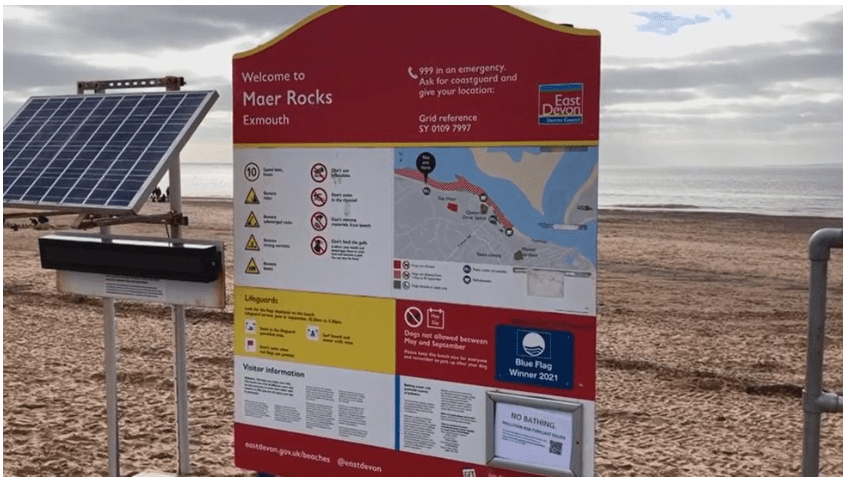
The Environment Agency has previously issued precautionary advice against bathing in Exmouth
EDDC said it was “alarmed” SWW had failed to notify the council of sewage overflows in Exmouth, leading to reports of people and pets falling ill from exposure to untreated human waste during sea swimming.
During the meeting, EDDC agreed Mr Arnott should write publicly to SWW’s chief executive to request a commitment from the water company to involve town and parish councils in discussions regarding ongoing and upcoming works.
The council also wants a joint partnership between SWW, EDDC officers, and cabinet members on ongoing developments and issues.
It also said it wanted SWW to work with EDDC planning officers to help manage pressures caused by new developments, respond to community concerns and proactively advise the public of overflows.
At the council meeting, it was also agreed the leader would write to local MPs to encourage them to support efforts to engage SWW.
The letter will also ask MPs to lobby the government to revisit “weak legislation”, and to resist a request by the water company to raise bills by more than 20% by 2030 – until demonstrable action on sewage spills had been taken.
‘Lost control’
Mr Arnott said: “We truly do not have any confidence in the operational side of South West Water, particularly to protect key communities all the way across East Devon.
“Particularly at the moment, you can see it in Exmouth, where there is sewage coming up through the streets, it’s coming up through failed pumping stations, and it’s going into the sea.”
The council leader said “despite repeated assurances”, the local authority believed SWW had “now lost control”.
“It’s evidenced in plain sight…hundreds, thousands probably of tanker journeys going around with sewage that essentially is going straight into the sea,” he added.
“The infrastructure is broken, and the reason for the no confidence is they should have known 10, 12 years ago the infrastructure would break, and they didn’t fix the roof…when the sun was shining.”
East Devon ‘green lungs’ could be lost forever: District council challenges national plans to slash green spaces near Ottery, Exmouth, Lympstone and Exeter
Acres of ‘green lungs’ and wildlife areas in East Devon are at risk of being lost forever unless the district council wins its challenge to protect land from being earmarked for development.
Local Democracy Reporter eastdevonnews.co.uk
Plans to slash East Devon’s ‘green wedges’ have been sent back to the drawing board, writes local democracy reporter Will Goddard.
Green wedges are designed to protect the character of towns and villages and stop them blending together.
But they do not prevent housing development completely and are not part of national planning policy. Other protections also exist to safeguard landscapes and the environment.
The proposed cuts and changes to how the wedges are defined were brought forward at an East Devon District Council meeting, amid concerns they could be challenged in the future without clear evidence to justify them.

Green wedge proposed between Exmouth and Lympstone. Image: EDDC.
More than 70 per cent of the currently designated green wedges would have been lost under the plans, according to Cllr Geoff Jung (Lib Dem, Woodbury and Lympstone).
He said: “I appreciate that a green wedge is not a countryside protection tool, but a development and planners’ device to help protect the unchecked development of our conurbations, as well as helping to try and stop any correlating of settlements.
“But many of our residents see them as far more important, as the green lungs, wildlife areas and helping to reduce flooding, etc.
“Reducing them by this magnitude without any replacement policy sends the wrong signal that we as a council don’t care about environmental protection. Our countryside is our number one asset.”

Proposed green wedge between Ottery and West Hill. Image: EDDC.
Cllr Ben Ingham added: “The NPPF [National Planning Policy Framework] does not identify green wedges as such. That is not a green light to get rid of them, rather an opportunity for us to protect our green credentials.
“Green wedges came into form for this authority during the 1990s. Over the last 30 years, residents and Councillors have taken these to represent a part of our collective values and aspirations. To attack these collectively is to reject our current cultural values that embrace the East Devon vision.
“They come into play when different planning major applications come forward within a green wedge and can be the last resort of our protection for our planning policies and values.”

Proposed green wedge, East of Exeter and south of the A30. Image: EDDC.
Councillors voted unanimously to send the plans back for revision and more councillor input, and also for officers to look into whether areas of East Devon could be designated as ‘green belt’ land, a more established classification nationally.
Simon Jupp one of the shy Tory candidates who seem reluctant to tell voters they’re Conservative
[Featuring image first seen on East Devon Watch]
Unwitting constituents might be forgiven for thinking that the green leaflet that just slipped through their letterbox adorned with the face of a smiling politician was put there by their local Green Party.
Eleanor Langford, Hugo Gye inews.co.uk
In fact, if they get as far as unfolding the pamphlet, they will see a small logo in one corner that reveals it is actually a leaflet for their local Conservative MP or prospective Parliamentary candidate, paid for and designed by the party’s central office.
The colours of the UK’s political parties are fairly well established – blue for the Tories, red for Labour, orange or yellow for the Lib Dems and, as the name suggests, green for the Green Party.
However, the Conservatives seem to be ignoring this distinction with the design of some of their recent flyers, leaving potential voters in many areas of the country confused.
Has the image of the party become so damaged by the turmoil of its latest spell in government that its MPs have become systematically shy about revealing that they are actually Tories?
It’s not just leaflets where they appear to be playing down or almost obscuring their party affiliation. Data compiled by Campaign Lab shows that, as of November 2023, 51 per cent of Conservative MPs did not mention the party in their bio on X, formerly known as Twitter, compared to just 10 per cent of Labour MPs and zero Lib Dems.
Philip Cowley, professor of politics at Queen Mary University, says there’s “no great mystery” why some Tories are going down this path.
“The national party is unpopular,” he says. “The local candidate is hoping that he or she can establish themselves as a local champion, while still relying on the core Conservative vote.
“The green works to make them look like the sort of person who will defend their patch against nasty house builders. The focus is all on local stuff, rather than national policy.”
The green leaflet isn’t the only design put out by the Conservative Party that has led to some confusion. A second, used by multiple MPs, uses pink and purple colours and a magazine-style layout with the heading “You & Your Family” – though it does include the sub-heading “how Rishi Sunak’s plan is strengthening our economy”.

A leaflet distributed by Simon Jupp MP (Image taken from eastdevonwatch.org/2024/02/08/)
Multiple voters from various constituencies have taken to social media to highlight the lack of any clear Conservative branding on both leaflets, with many questioning why the party’s name is left so small.
One Tory MP contacted by i insisted that, according to rules set by the Independent Parliamentary Standards Authority (IPSA), any material paid for using parliamentary expenses can’t be political.
But that does not appear to be the case with these designs. Multiple MPs told i that both green and magazine-style layouts are templates provided and paid for by Conservative Campaign Headquarters (CCHQ), so political content and branding shouldn’t be a problem.
They also insisted that, while the front cover was green, there were frequent mentions of the Conservative Party throughout the inside of the leaflet.
One version of the leaflet, seen by i, did include a small Conservative logo on an inside page, the details of the local association that paid for it and listed Prime Minister Rishi Sunak’s five priorities on the back cover, but the copy included no mention of the words ‘Conservative Party’.
A veteran Tory strategist i spoke to had mixed feelings about the issue. They said the use of the green colour scheme was a “longstanding thing”, and insisted it wasn’t about “distancing from the party”.
“You get better engagement as it looks less tribalistic,” they said. “It’s taken a long time to convince MPs of this given they are so used to nailing their colours to the mast.

Some local Green Party associations have criticised the leaflets for being similar to their branding (Image: twitter.com/WokingGreens)
“As for not putting Conservative on it – that I have less sympathy for, it feels more like individuals doing whatever they can to win.”
According to one current Tory activist, MPs can choose which designs they want, and the contents have to be approved by CCHQ before they are printed.
“It really depends on the MP [or] candidate which one is chosen. I think the worry is that some people might throw away our leaflet based on the colours, without actually reading what we can do for them.”
“It’s pretty normal practice – I’ve been doing this 10 years and have seen lots of leaflets like this.”
And some Tories say they can’t see what the fuss is about. “I don’t think it’s particularly unusual having a green front cover,” a Tory MP, who had used the green leaflet told i.
“Before I became an MP I was chairman of the local Conservatives and we quite often did the green front cover.
“It’s for the green Commons benches. I don’t think there’s anything odd there.”
But other parties beg to differ and fear voters could get confused. In a statement on Facebook, the Luton and Bedfordshire Green Party accused the Conservatives of trying to “hide behind our branding that they clearly feel has more credibility than their own”, and even suggested that similarities were too close to be a coincidence.
“They have chosen two shades of green that very closely match shades that have been used by the Green Party in combination in exactly the way this leaflet does,” they said.
“In addition, this leaflet uses for its main headline the typeface ‘Bebas Neue’ that is exactly the same one chosen by the Green Party.
“This simply cannot be [a] coincidence. The design has been intended to replicate (to some extent) the appearance of a Green Party leaflet.”
It’s not the first time that politicians have been accused of trying to distance themselves from their own party’s national leadership.
Ahead of the 2019 general election, an investigation by the Daily Mail found that more than 100 leaflets distributed by Labour candidates did not mention the party’s then-leader Jeremy Corbyn. A separate analysis by The Telegraph also found that nine out of 10 of his shadow cabinet did not mention him.
But if the green leaflets are a deliberate Tory strategy for the next election some within the party fear it will backfire.
“The public are smart enough to see through a silly ploy like this,” a second Conservative source told i. “It’s so self-defeating to not work to repair the brand that will be next to your name in the ballot box.
“MPs tend to massively overestimate their own personal votes in their patch, so the best thing they can do is tie their efforts to the party or sink completely.”
The Conservative Party was contacted for comment.
Dotty & May Saving Seaton Hospital
Seaton filmmaker Chrissy Evans’ new 3-minute film has had 3,500 Facebook views in two days. Showing two women discussing – in no uncertain terms – the proposed disposal of the hospital wing that was paid for 100 per cent by local people, the film has captured the continuing mood of defiance in our East Devon community. You can play video here

Chrissy is the writer and director, and the film features local actors Mary Bowles and Val Christmas. Their group, Bus Pass Productions, has made several lighthearted-but-serious films aimed at older people, including, last year, one on dementia. ‘Old age is no place for the weak, but laughter is a strong weapon’, says Chrissy. To contact her: Chrispleck51@hotmail.co.uk or 07814 323988.
Meanwhile, in Parliament …
Richard Foord MP has had the reply (see text below) from the Government to the 9,000-strong petition that he presented recently. Unfortunately, it ignores the elephant in the room: that the ‘market rents’ that NHS Property Services charges are inappropriate for a community hospital paid for by local people. This makes the parliamentary debate on NHS Property Services, which Richard has obtained for tomorrow [today] (23rd), all the more pertinent.
Progress towards use of the wing for community health and wellbeing activities
The Seaton Hospital Steering Committee is preparing its plan for using the wing and has recently held a constructive meeting with Devon NHS ICB and NHS Property Services. Regular meetings will take place until the summer.
Contact: Professor Martin Shaw, Secretary, Seaton Hospital Steering Committee
07972 760254
Text of government reply to petition
[Out of one pocket and into another – net change zero – very clever these Whitehall Mandarins – Owl]
The Government is aware that the NHS Devon Integrated Care Board (ICB) is seeking to review its future requirements for Community Hospitals. We understand that the building of Seaton Hospital in 1988 was only possible with significant public fund-raising and that the continued availability of healthcare services delivered in community hospitals are strongly valued by the communities they serve. However, they also need to be able to adapt to changing clinical needs.
Between 2015 and 2017, NHS Devon Clinical Commissioning Group (now the ICB) undertook a review of community services which resulted in the transfer of ownership of the North Devon community hospitals estate, including Seaton Hospital, to NHS Property Services. At the same time the service delivery model was changed, resulting in a reduced requirement for community hospital beds and leading to some properties such as Seaton being significantly underutilised.
The ICB is responsible for meeting the costs of continuing to run this operational property and in seeking to address its significant financial challenges is now considering how best to rationalise its property needs.
Ultimately, whilst the long-term healthcare commissioning requirements for Seaton Hospital is for the ICB to determine, the operational costs of running the property have to be paid for and therefore a long-term sustainable use must be established. The ICB is currently working closely in partnership with NHS Property Services to identify and evaluate suitable options to achieve this objective. Whilst the property remains an operational healthcare facility, it is not surplus to commissioning requirements and there are no current plans to sell the facility.
The Government believes that ICBs are best placed to make decisions on commissioning services for their communities, working with local authorities, stakeholders and local populations to meet people’s needs.
“Working through the challenges” a new euphemism?
For achieving nothing on rural broadband in Devon! – Owl
 Richard Foord Liberal Democrat Spokesperson (Defence)
Devon County Council is spending its broadband clawback money on anything but broadband. That £7.8 million was intended for improving broadband in rural areas, including in villages such as Northleigh. Residents have encountered numerous pledges on poles, but they still do not have full fibre. Does the Minister think the clawback funding for broadband should have been ringfenced by Devon County Council?
 Julia Lopez Parliamentary Secretary (Cabinet Office), The Minister of State, Department for Culture, Media and Sport, Minister of State (Department for Science, Innovation and Technology)
These issues have been highlighted many times by Conservative Members from Devon. We thought we had worked through some of those challenges. The clawback challenge that the hon. Gentleman highlights has not previously been raised with me, and I will happily look into it for him.
National news: Exmouth overrun by sewage trucks as pipe burst sparks second major spill this year
One of Devon’s most popular beaches is again being subjected to untreated sewage being pumped into the sea just a month after the last major spill.
David Parsley inews.co.uk
South West Water (SWW) has told local residents that it has re-launched the use of tankers to transport sewage each day from a burst pipe to pumping stations along the Exmouth coast.
The move has, once again, resulted in pollution warnings at the East Devon tourist hotspot on several occasions in the past week. The water firm has apologised for the disruption.
Campaigners claim that the pollution warnings began on 8 February, but SWW did not directly write to customers alerting them to another burst pipe until last Wednesday.
In an email dated 13 February, the water company, which was fined £2.15m for illegally dumping sewage into rivers and the sea in Devon and Cornwall last year, told residents: “We’re working hard to repair another burst in the Exmouth area. We need to temporarily use tankers again to allow our team to safely work on the damaged pipe.”
Three days later the company wrote to locals again, apologising for the issues, which were ongoing as of Wednesday afternoon, 13 days after the tankering of millions of litres of sewage through the town began.
In January, i revealed SWW had been accused of dumping millions of litres of raw sewage into the sea at Exmouth after sending 240 tankers a day to an overflowing pumping station.
Local sea swimmer Jo Bateman, who is taking SWW to court over the sewage spills that regularly prevent her from taking her daily dip, said: “We’re just getting the usual guff from SWW. They say they care and are doing everything that can to fix the problems but they keep happening.
“There were all the issues from mid-December that went on well into January, and this latest burst pipe is leading to yet more pollution with warnings about the dangers of swimming at our beach being made since 8 February.
“The issue is that SWW just react to problems as they occur rather than proactively trying to prevent them from happening in the first place. Meanwhile, the executives and shareholders continue to profit from bonuses and dividend payments.”
Since the transporting of sewage from the site of the latest pipe burst to pumping stations and treatment works around Exmouth, the Environment Agency (EA) advised against swimming in the sea due to raw sewage being pumped into the water.
This warning from the EA, which was issued on 15 February remained in place on Wednesday evening. It reads: “Bathing is not advised, due to pollution from sewage.”
During a community meeting held by SWW in Exmouth on Tuesday night locals staged a protest against what they say is the company’s continued failure to protect the local environment.
East Devon District Council leader Paul Arnott, who attended the protest, said SWW had brought five security guards to the meeting for protection, but there were no reports of any trouble.
Twenty-six of the 30 district council wards in East Devon have experienced an untreated sewage spill since 2022, meaning more than 82 per cent of the local population lived in a ward affected by the pollution.
A spokesman for SWW said: “We want to reassure our customers that we are working hard in Exmouth to fix the burst on one of our critical rising mains.
“We have now completed the extension of the temporary overland pipe which we hope to bring online later today.
“This will mean we can then stand down the tankers. We are also working on a permanent replacement of the entire rising main which we expect to complete by the end of March.
“We are very sorry for the disruption caused, and we will continue to keep everyone updated.”
EDDC passes sewage motion
(Excuse the pun)
Last night EDDC overwhelmingly passed the motion in a recorded vote with 46 councillors voting for and two abstentions. It incorporated six actions (details here).
The two councillors who abstained were the leading Tories: Cllr Colin Brown, Dunkeswell and Otterhead, and Cllr Mike Goodman (chair of scrutiny), Sidmouth Sidford.
Cllr Sophie Richards, Sidmouth Town, attended part of the meeting but had left the chamber before the vote. What could have been more important than sewage spewing into the sea for Sidmouth?
Given its importance, the chair had brought the motion to the top the agenda.
Two attempts to derail it by amendment were defeated.
One from Cllr Ian Barlow, Sidmouth Town, who continued the “non-confrontational” line he pursued at the SWW Scrutiny Meeting on February 1, trying to water it down. He wants a line drawn under the past and a new start made with SWW. (Despite this he voted for what he described as a “pointless” motion.)
The second from Cllr Mike Goodman to take it back into scrutiny.
Many councillors wanted to speak of their ward members experience with SWW.
One councillor mentioned that he had learned at the end of Wednesday’s SWW “Road Show” in Exmouth that the sewer repairs would take a year to repair.
Cllr Jess Bailey, West Hill and Aylesbeare, proposed strengthening the EDDC action to ask EDDC’s chief executive, Susan Davey, to forgo any bonus until substantive (to be defined) progress is made to improve matters locally, and to ask SWW to follow other water companies in actively monitoring sewage discharges into rivers before the government deadline of 2025. SWW is only doing the minimum. It was agreed that these sentiments would be added to the actions placed on the Leader.
Opening remarks
To finish, here is an extract of the remarks made by Cllr Todd Olive, Whimple and Rockbeare, when he proposed the motion.
There are two things that I want to really pick out. First is the sheer scale of South West Water’s failure, and the environmental vandalism that has resulted. Sewage overflows in East Devon spilled raw, untreated effluent for over twenty thousand hours in 2022. That’s the equivalent of one pipe spewing poo into our rivers and onto our beaches for over two years and three months. In the few weeks since this motion was submitted, we have seen the third burst of a sewage main in the Maer valley in Exmouth in the space of barely two months, with the overflow at Phear Park operating twenty-four hours a day every day since February 13. The worst performing CSO in East Devon in 2022 spilled on more than two in every three days that year: it seems to me that South West Water is inadvertently heading for a new record. Only today I understand colleagues have been dealing with another burst pipe, this time in Colyton. Chair, briefly at this point, I should like to extend thanks to Geoff Crawford and Andrew Tyerman of Exmouth’s ESCAPE group for their tireless efforts in keeping track of what’s going in Exmouth.
Our residents are angry. They are angry at the desecration of our rivers and our coast; at the disruption caused by weeks of noisy, obnoxious tanker movements from works in Exmouth and Budleigh to try and keep a lid on this mess; angry at the literal eruptions of sewage from manholes that we are seeing in the West End, in Clyst St Mary, where raw sewage has more than once been flowing down our streets. Angry at a faceless, unaccountable corporation that sends PR chiefs to meetings of our Scrutiny committee with promises of answers in the future, and of a new sewage works in the West End that won’t be built until at least thirty years after South West Water themselves identified the need for it, found a site for it, ringfenced the funding for it, and obtained permission to build it. Angry with a government that has, belatedly, only this morning got its act together and provided only a partial restoration of the funding and capacity that was deliberately stripped from the regulator that’s supposed to keep an eye on water quality.
Government suddenly announces partial reversal of Environment Agency cuts
Between 2013 and 2018 the Environment Agency shed 20% of its staff particularly during Liz Truss’ efficiency drive in 2015, (2,500 staff and £80m).
Now the government announces greater resources and manpower for the EA (by 2026) of 500 staff and £55m per year.
Environment Secretary Steve Barclay says:
We are clear that we need to get much tougher with unannounced inspections to bring an end to the routine lawbreaking we have seen from water companies, which is what this announcement will deliver.
Panicking? – Owl
Inspection surge to crack down on water sector pollution
- Fourfold increase in water company inspections to hold companies to account.
- Includes up to 500 additional staff for inspections, enforcement and stronger regulation over the next three years, with recruitment already underway.
- Part of a tougher regime fully funded by government and water company permits.
Water company inspections will more than quadruple as the Government cracks down on poor performing companies, under plans announced today (20 February). In recent months, robust steps have been made under the Plan for Water with all 15,000 storm overflows now monitored and the cap on civil penalties for pollution removed. Last week, Defra went further in announcing that water bosses are set to be banned from receiving bonuses if a company has committed serious criminal breaches.
The Environment Agency (EA) is already ramping up inspections on water company assets, with over 930 completed this financial year. Today’s announcement goes further as water company inspections carried out by the EA will rise to 4000 a year by the end of March 2025, and then to 10,000 from April 2026. This will include an increase in unannounced inspections – strengthening oversight of water companies and reducing the reliance on water company self-monitoring, which was established in 2009.
Increased inspections and enforcement will be backed by around £55 million each year. This will be fully funded through increased grant-in-aid from Defra to the Environment Agency and additional funding from water quality permit charges levied on water companies, subject to a public consultation closing in March 2024.
Environment Secretary Steve Barclay said:
We are clear that we need to get much tougher with unannounced inspections to bring an end to the routine lawbreaking we have seen from water companies, which is what this announcement will deliver.
We are going further to quadruple the Environment Agency’s regulatory capacity – allowing them to carry out 4,000 water company inspections by the end of the next financial year.
Environment Agency Chair Alan Lovell said:
Last year we set out measures to transform the way we regulate the water industry to uncover non-compliance and drive better performance. Today’s announcement builds on that. Campaign groups and the public want to see the Environment Agency better resourced to do what it does best, regulate for a better environment.
Proposals to get extra boots on the ground to increase inspection visits will help further strengthen our regulation of the industry.”
With 100% of storm overflows now monitored, data-driven analytics will also help the Environment Agency map discharges against rainfall more effectively so they can quickly direct new specialist officers to any sites at risk, identify any non-compliance and take action.
The EA is already conducting the largest ever criminal investigation into potential widespread non-compliance by water and sewerage companies at thousands of sewage treatment works. Since 2015, the EA has concluded 59 prosecutions against water and sewerage companies securing fines of over £150 million.
Today’s announcement builds on the recent improvements the government has delivered to the water environment, including:
- 100% of storm overflows in England are now monitored – providing a complete picture of when and where sewage spills happen.
- Removing the cap on civil penalties for water companies and broadening their scope so swifter action can be taken against those who pollute our waterways.
- Increased protections for coastal and estuarine waters by expanding the Storm Overflow Discharge Reduction Plan, prioritising bathing waters, sites of special scientific interest and shellfish waters.
- Requiring the largest infrastructure programme in water company history – £60 billion over 25 years – to revamp aging assets and reduce the number of sewage spills by hundreds of thousands every year.
- Providing £10 million in support for farmers to store more water on their land through the Water Management Grants to support food production and improve water security.
- Speeding up the process of building key water supply infrastructure, including more reservoirs and water transfer schemes.
Exmouth: Hundreds protest against sewage pollution. Councillors give their support.
Paul Arnott posted a video on Facebook and this statement:
Today, I’ve been speaking to Exmouth residents protesting against South West Water, who held a behind-closed-doors Q&A at Exmouth Town Hall this afternoon – with no less than five private security guards. SWW’s failure to properly invest in our infrastructure, and their haphazard and disruptive approach to managing the effective collapse of the sewage network in Exmouth, has been as shocking to me as to any other resident – and I’m determined to see them held to account.
I’d strongly encourage anyone able to come along to Wednesday evening’s Full Council at East Devon’s offices in Honiton, starting at 6pm, to do so – we’ll be considering a strongly-worded motion calling out South West Water’s appalling track record, and trying to get us on the road to fixing things. You can also follow along via the Council’s YouTube channel.

Image from ESCAPE Facebook
Exmouth Journal Staff www.exmouthjournal.co.uk
Hundreds of residents turned up outside Exmouth Town Hall this afternoon to protest about sewage pollution.
Organiser Jo Bee rallied the troops, which included swimmers, environmental groups, Exmouth Quakers and councillors.
Lots of people drove past the protest and tooted their horns in support of the group’s cause.
The protest started at 1.30pm. Around 200 protesters turned up and Exmouth Quakers turned up and started singing sea shanties.
Councillors came out to see what the commotion was; Geoff Jung and Paul Miller were seen outside as well as Paul Arnott, who was supporting the protests.
The aim of today’s protest ‘to make it very clear to SWW that we simply don’t accept the damage they are doing to us, to our environment, and to our tourism. Enough is enough’.
A Facebook group called ESCAPE (End Sewage Convoys And Poollution Exmouth) is open for members of the public to join and find out the latest on sewage pollution in Exmouth and Budleigh.
Paul Arnott told the Journal: “I fully support these protests. I have been told that EDDC have laid on seven security guards inside the town hall as they heard news of the protests.”
Jo Bee added: “We are here today to show to South West Water that enough is enough. This is just the start, with my court case as well standing up to South West Water.”
SWW are hosting a series of coastal community roadshows across the region to share the latest business plan with customers. Today they were in Exmouth and residents decided to gate crash the meeting with a protest outside.
They are explaining to residents how the water and wastewater systems work and explaining more about the plans we have for Exmouth and the surrounding areas.
The meeting is being held from 2pm to 6pm and is fully booked, with a limited supply of tickets.
A motion is being carried through East Devon District Council on Wednesday (February 21) declaring ‘no confidence’ in the company’s sewage management systems.
The motion states that there is ‘widespread concern’ among East Devon residents, and notes ‘with alarm’ that specific measures to improve the capacity of the sewage system, identified in 2010, ‘have not been actioned’
In response to this, South West Water said: “The opinions of our customers matter to us greatly. We are listening and know we have more to do. The purpose of events like our Community Roadshow in Exmouth tomorrow is to hear directly from customers and have the opportunity to discuss any concerns they may have.
“We are investing to help deliver improvements in our environmental performance, and will continue to do all we can to protect our region’s seas and rivers.”
Oh the irony of it! Simon – look behind you!
What was lurking just a few metres away from the hospitality tent on Friday when Simon Jupp, Rebecca Pow, Minister for Nature, and assembled dignitaries were toasting the new “King’s nature Reserve”?
Are they going to continue to “look the other way”?
Read the full story in Simon Jupp’s facebook post and subsequent comments. – Owl

Simon Jupp on facebook wrote:
How lucky are we to live here? East Devon is a beautiful part of the world, and we should do all we can to protect our natural environment.
It was great to welcome the Minister for Nature, Rebecca Pow MP, to Budleigh Salterton last Friday for a fantastic celebration of Pebblebed Heaths National Nature Reserve being extended into wetlands created by the Lower Ottery Restoration Project (LORP).
The multi-million-pound investment into our local environment through the LORP is already paying dividends, with greater protections for biodiversity and a more resilient ecosystem.
To top it off, the expanded nature reserve is part of the “King’s Series” celebrating the coronation of His Majesty King Charles III. He has good taste!
Thank you to Natural England and Clinton Devon Estates for a great celebration, and for their important work in helping to take care of East Devon’s precious environment.
This post received these comments:
Karen Powers
Truly a fantastic achievement. Please Don’t let SWW ruin this nature reserve with their secret raw sewage dumping via the unreported Emergency Overflow (EO) back door. Graphic photos and videos have been released to EA but SWW are already trying to clean away the evidence. Escape have been reporting the Lime Kiln EDM as potentially faulty since November 2023. There is never a spill more than 1-2 minutes. SWW deny any faults and say it’s working as expected. I predict that now the back door (EO) will hopefully be closed the spills will start to be reported via the Lime Kiln EDM? Perhaps SWW wanted to hold back any publicity about poollution at this site before the opening?
Geoff Crawford
Hi Simon, pity SWW were reported to EA this morning for potentially illegally dumping sewage and all sorts of stuff there via an un reporting EO. Exactly why ESCAPE – End Sewage Convoys And Poollution Exmouth are asking you to lobby government to make SWW report on ALL overflows. It’s great that You and Rebecca POW want to protect this environment and nature reserve. Let’s see that action, report on ALL overflows, EOs and CSOs and prove your words by actions. Don’t let it look like you looked the other way.
Fran Swan
Geoff Crawford
Absolutely!
And please Simon Jupp MP, open transparency and let this comment remain!
Planning applications validated by EDDC for week beginning 5 February
- Single storey rear extension
 9 Yallop Way Honiton Devon EX14 2GNRef. No: 24/0286/FUL | Validated: Fri 09 Feb 2024 | Status: Awaiting decision
 - Discharge of conditions for 21/1228/LBC : Condition 3 (building condition), Condition 4 (materials/rain water goods/windows/doors/vents) Hillside Farm Harcombe Devon DT7 3RNRef. No: 24/0287/DOC | Validated: Fri 09 Feb 2024 | Status: Awaiting decision
- Timber Orangery Wessington Farm Awliscombe EX14 3NURef. No: 24/0290/FUL | Validated: Fri 09 Feb 2024 | Status: Awaiting decision
- Discharge of Condition for application 22/0744/LBC: Condition 4 (Details) Springfield Kilmington Devon EX13 7SBRef. No: 24/0291/DOC | Validated: Fri 09 Feb 2024 | Status: Awaiting decision
- Polytunnel Stockers Farm Wick Devon EX14 4TYRef. No: 24/0283/AGR | Validated: Fri 09 Feb 2024 | Status: Awaiting decision
- Certificate of lawfulness for construction of single storey extension to western elevation (previously submitted under 15/0113/CPL)Mountfield Coreway Sidford Sidmouth Devon EX10 9SDRef. No: 24/0292/CPL | Validated: Fri 09 Feb 2024 | Status: Awaiting decision
- Discharge of condition for 23/2432/FUL: Condition 3 (Materials) Laneside Drakes Avenue Sidford Devon EX10 9QYRef. No: 24/0275/DOC | Validated: Thu 08 Feb 2024 | Status: Unknown
- T1, Lime: re-pollard to previous reduction points. Sherwood Salcombe Hill Road Sidmouth Devon EX10 8JSRef. No: 24/0277/TRE | Validated: Thu 08 Feb 2024 | Status: Awaiting decision
- Discharge of condition for 23/1207/LBC: Condition 4 (Details) The Lodge Gittisham Devon EX14 3ADRef. No: 24/0278/DOC | Validated: Thu 08 Feb 2024 | Status: Awaiting decision
- Agricultural building for hay, straw and storage of machinery Chineway Farm Putts Corner Sidbury Sidmouth EX10 0QQRef. No: 24/0281/AGR | Validated: Thu 08 Feb 2024 | Status: Awaiting decision
- To include Rentplus affordable housing provisions within Section 106 dated 29 April 2014 (Phase 3A) and Section 106 dated 27 February 2023 (Phase 3B) Land At Pinn Court Farm Pinncourt Lane Exeter EX1 3TGRef. No: 24/0274/V106 | Validated: Thu 08 Feb 2024 | Status: Awaiting decision
- T1, hawthorn – fell. Reason – dead buds and suspected root death due to honey fungus. 20 Fore Street Budleigh Salterton Devon EX9 6NGRef. No: 24/0270/TCA | Validated: Wed 07 Feb 2024 | Status: Awaiting decision
- Devon County Council consultation: Demolition of the Devon Lady, single storey classroom at Kilmington Primary School and construction of a modern equivalent of the same dimensions.Kilmington Primary School Whitford Road Kilmington Axminster EX13 7RGRef. No: 24/0273/CM | Validated: Wed 07 Feb 2024 | Status: Awaiting decision
- T1, coastal redwood – shorten back low branches, to a suitable pruning position, away from wire by approximately 1m and balance as necessary. T2, weeping beech – shorten back from roof by 2m to a suitable side branch. Row of approximately 22 Lawson cypress on boundary – fell to as near ground level as possible. Heronsbridge Little Knowle Budleigh Salterton Devon EX9 6QSRef. No: 24/0269/TRE | Validated: Wed 07 Feb 2024 | Status: Awaiting decision
- G1, Western Red Cedar: crown raise lower foliage over graveyard in order to give approx. 1.5-2.0 metres clearance over headstones. St Andrews Church ChardstockRef. No: 24/0267/TCA | Validated: Wed 07 Feb 2024 | Status: Awaiting decision
- Installation of a main entrance sign to the access of a new Cats Adoption Centre (previously approved under application 19/2365/MFUL) Axhayes Cattery Clyst Honiton Exeter EX5 2HSRef. No: 24/0265/ADV | Validated: Wed 07 Feb 2024 | Status: Awaiting decision
- Redevelopment of site to provide: (a) Care home building (Class C2) with associated parking, landscaping, staff and resident facilities and associated works (b) Extra care apartment building (53 units) with associated communal lounge, wellbeing suite, restaurant and care provision (class C2) (c) Retirement living apartment building (33 units) with associated communal lounge (Sheltered housing) and (d) Erection of 4 houses and 3 townhouses (Class C3) along with accesses, internal car parking, roads, paths, retaining walls, refuse and landscaping associated with development; retention/refurbishment of building B, erection of habitat building and sub-stations. (Demolition of buildings other than building B) (Variation to previous application (23/0571/MFUL) showing removal of balconies and elevational changes to west elevation of Retirement Living block) Former Council Offices Knowle Sidmouth Devon EX10 8HLRef. No: 24/0263/MFUL | Validated: Wed 07 Feb 2024 | Status: Awaiting decision
- Conversion of garage to ancillary annexe for friends, family and for holiday accommodation Cranbrook The Glen Uplyme DT7 3TRRef. No: 24/0272/FUL | Validated: Wed 07 Feb 2024 | Status: Awaiting decision
- Proposal for side extension (resubmission based on 23/1107/FUL) The Oaks Shute Road Kilmington EX13 7STRef. No: 24/0261/FUL | Validated: Tue 06 Feb 2024 | Status: Awaiting decision
- Proposed ground floor rear extension and introduction of weatherboard cladding to rear elevation 10A Portland Avenue Exmouth Devon EX8 2BSRef. No: 24/0253/FUL | Validated: Thu 08 Feb 2024 | Status: Awaiting decision
- Certificate of lawful development for rear dormer loft conversion to the main roof.147 Egremont Road Exmouth Devon EX8 1SDRef. No: 24/0252/CPL | Validated: Mon 05 Feb 2024 | Status: Awaiting decision
- T1, Willow: Crown reduction to 15m high (from 18m) and to 9m wide (from 18m). 14 Sowton Village Sowton Exeter EX5 2ADRef. No: 24/0247/TCA | Validated: Mon 05 Feb 2024 | Status: Awaiting decision
- T001, Weeping Willow : Crown Reduction by 0.5m-2m in spread and 1m-2.5m in height dependent on available pruning points. Tuckers Lodge Dalwood Devon EX13 7EGRef. No: 24/0239/TRE | Validated: Wed 07 Feb 2024 | Status: Awaiting decision
- T7 – Cherry: reduce crown height by up to 4m and lateral spread by up to 3m, ensuring a minimum clearance of 2m from property. Maximum Diameter of Cuts 50mm. Crown lift to 2.5m above ground level, MDC 25mm. Rationale: This Cherry tree is now quite large and is dominating the garden, the works are suggested as part of the reasonable and responsible management of this tree and is appropriate arboricultural management. The works are to be planned for summer 2024. 5A Northview Road Budleigh Salterton Devon EX9 6BYRef. No: 24/0237/TRE | Validated: Mon 05 Feb 2024 | Status: Awaiting decision
- Demolition of lean-to structure, proposed part conversion to 1no. residential dwelling with garden and associated works, and the rebuild, repair and conservation of the existing barns. Town Tenement Farm Clyst Hydon Cullompton EX15 2NBRef. No: 24/0226/FUL | Validated: Fri 09 Feb 2024 | Status: Awaiting decision
- Demolition of lean-to structure, proposed part conversion to 1no. residential dwelling with garden and associated works, and the rebuild, repair and conservation of the existing barns. Town Tenement Farm Clyst Hydon Cullompton EX15 2NBRef. No: 24/0227/LBC | Validated: Fri 09 Feb 2024 | Status: Awaiting decision
- Retrospective application for a mud ventures building Greendale Farm Shop Farringdon Devon EX5 2JURef. No: 24/0225/FUL | Validated: Tue 06 Feb 2024 | Status: Awaiting decision
- Single storey rear extension and fencing. 27 Haydons Park Honiton EX14 2TARef. No: 24/0229/FUL | Validated: Thu 08 Feb 2024 | Status: Awaiting decision
- Erection of a bungalow Bramley Ridgeway Sidbury EX10 0SFRef. No: 24/0222/FUL | Validated: Thu 08 Feb 2024 | Status: Awaiting decision
- Construction of earth lined slurry lagoon with security perimeter fence New Park Farm Awliscombe EX14 3QARef. No: 24/0220/FUL | Validated: Tue 06 Feb 2024 | Status: Awaiting decision
- Discharge of conditions for 16/0175/FUL : Condition 3 (materials and finishes) – in part Long Range Whimple Exeter EX5 2QTRef. No: 24/0212/DOC | Validated: Fri 09 Feb 2024 | Status: Awaiting decision
- Discharge of conditions for 21/3308/RES: Condition 3 (cycle storage), Condition 4 (air source heat pumps) Waterleat High Street Newton Poppleford Sidmouth EX10 0DURef. No: 24/0206/DOC | Validated: Mon 05 Feb 2024 | Status: Awaiting decision
- Loft dormer with rear facing window (retrospective). 99 Byron Way Exmouth EX8 5SERef. No: 24/0201/FUL | Validated: Tue 06 Feb 2024 | Status: Awaiting decision
- Single-storey rear extension. 2 Canada Cottages Broadway Woodbury Devon EX5 1NXRef. No: 24/0196/FUL | Validated: Tue 06 Feb 2024 | Status: Awaiting decision
- Demolition of existing garage and storage shed; construction of new garage; alterations to existing driveway and retrospective approval for existing garden office Bundels Ridgeway Sidbury Devon EX10 0SFRef. No: 24/0185/LBC | Validated: Fri 09 Feb 2024 | Status: Awaiting decision
- Demolition of existing garage and storage shed; construction of new garage; alterations to existing driveway and retrospective approval for existing garden office Bundels Ridgeway Sidbury Devon EX10 0SFRef. No: 24/0184/FUL | Validated: Fri 09 Feb 2024 | Status: Awaiting decision
- Discharge of Condition for 21/3067/AGR: Condition 3 (external roof finish materials). Land To South East Of Gore Lane KilmingtonRef. No: 24/0172/DOC | Validated: Tue 06 Feb 2024 | Status: Unknown
- Request for continuation of permission 20/0965/FUL to use Royston Farm as a not-for-profit therapeutic school and to use first floor areas as well as the ground floor, and increase placements from 5 to 10. Royston Farm Talewater Talaton EX5 2RRRef. No: 24/0158/FUL | Validated: Mon 05 Feb 2024 | Status: Awaiting decision
- Alterations and minor extension to the existing commercial building and formation of customer parking area. Oliver Joseph Fitness & Land To The West And South Lyme Street Axminster EX13 5AURef. No: 24/0157/FUL | Validated: Wed 07 Feb 2024 | Status: Awaiting decision
- The proposal relates to the demolition and replacement of the existing dwelling. Kenwood Woodhouse Hill Uplyme DT7 3SLRef. No: 24/0139/FUL | Validated: Mon 05 Feb 2024 | Status: Awaiting decision
- Proposed 30 no. EV charging points and battery farm (enclosed within a building – part retrospective) with associated parking spaces, internal road network/hardstanding and access and egress onto the Greendale Business Park Private Road Network. Land Adjacent Greendale Business Park Greendale Business Park Woodbury Salterton EX5 1EWRef. No: 24/0099/FUL | Validated: Fri 09 Feb 2024 | Status: Awaiting decision
- Proposal for driveway and access enlargement with alterations to boundary wall and embankment Forge Cottage Cowley Devon EX5 5ELRef. No: 23/2761/FUL | Validated: Mon 05 Feb 2024 | Status: Awaiting decision
- Proposed 12 no. EV charging points and associated layby, site access and egress with new public footpath and cycle path Four Oaks Clyst St Mary Exeter EX5 1ATRef. No: 23/2640/FUL | Validated: Mon 05 Feb 2024 | Status: Awaiting decision
- Replace lintel on south east ground floor window plus additional lintels if identified during course of work; replace all ceilings at first floor; remove and re-render east and west elevations; south elevation left exposed masonry; remove southern bolt on chimney; replaster internal walls at ground floor and repairs to purlins on projecting from southern gable wall plus addition roof work identified during course of work. 1 Rose Cottages Church Road Whimple Devon EX5 2SYRef. No: 23/2248/LBC | Validated: Thu 08 Feb 2024 | Status: Awaiting decision
Exmouth residents plan protest at South West Water roadshow
South West Water will be hosting a ‘roadshow’ at Exmouth Town Hall (Tuesday) and members of the public are planning a protest outside.
Adam Manning www.exmouthjournal.co.uk
They are holding a demonstration outside the Town Hall at 1.30pm, which the group behind it say is ‘to make it very clear to SWW that we simply don’t accept the damage they are doing to us, to our environment, and to our tourism. Enough is enough’.
A Facebook group called ESCAPE (End Sewage Convoys And Poollution Exmouth) is open for members of the public to join and find out the latest on sewage pollution in Exmouth and Budleigh.
A spokesman for the protest said: “Please come and demonstrate with us. SWW needs to be held to account, and they need to see just how unhappy we are with their actions (or, more accurately, their INactions).”
In response to this, South West Water said: “The opinions of our customers matter to us greatly. We are listening and know we have more to do. The purpose of events like our Community Roadshow in Exmouth tomorrow is to hear directly from customers and have the opportunity to discuss any concerns they may have.
“We are investing to help deliver improvements in our environmental performance, and will continue to do all we can to protect our region’s seas and rivers.”
SWW are hosting a series of coastal community roadshows across the region to share latest business plan with customers and to demonstrate how we’re investing record amounts in making improvements right across the South West.
In Exmouth, they will be explaining to residents how the water and wastewater systems work and explaining more about the plans we have for Exmouth and the surrounding areas.
The event is fully booked, representatives of the water company will be at Exmouth Town Hall, St Andrews Road, EX8 1AW from 2pm-6pm.
Everything you wish you never needed to know about sewage fungus
The smelly, nasty bacteria that spells bad news for rivers is flourishing in the UK. Here is how to spot it and what it means.

Leana Hosea www.theguardian.com
What is sewage fungus?
It is slimy, murky brown, smells bad, and fills river enthusiasts and anglers with gloom.
But it is probably useful to know that sewage fungus, so called because of its fungal-shaped mass of filaments, is not fungus at all, but is primarily made up of several species of bacteria, most commonly Sphaerotilus natans, Beggiatoa alba, Carchesium polypinum, and Flexibacter species. By the time you see its characteristic slimy, floating fronds, it will contain some fungi and algae, too, and it always spells bad news for the river in which it is spotted and for any unfortunate wildlife living there.
Where do you find it and where does it come from?
Sewage fungus flourishes in waterways polluted with high levels of nutrients and organic matter.
Sewage discharges are a common source of this kind of pollution, but these microorganisms can also be carried into waterways from animal slurry and even from effluent from paper mills. Last month, a Devon farmer was fined £6,000 for polluting a stream with slurry, with thick sewage fungus visible for more than a mile downstream, the Environment Agency reported. A study by Oxford University found that sewage pollution, whether treated or untreated, was the primary reason for increased sewage fungus in rivers.
Is it dangerous?
Sewage fungus can reduce oxygen levels in water, suffocating aquatic life. So it can, for example, smother fish eggs and prevent them from hatching. In severe cases, a river may not be able to support invertebrates as a result. Mass fish deaths have taken place in watercourses plagued by the fungus, which can then affect the whole food web. Even when sewage fungus is removed it can have a long-term effect on river health and it can take time for life in the river to recover.

Underwater view of sewage fungus growing in a stream polluted from slurry and dung from a dairy farm.
Does it pose a significant danger to human health? Dr Anne Jungblut, a microbiome expert from the Natural History Museum, says it is a mould, and so could contain human pathogens. “It’s the level of danger of the junk in the kitchen plughole, which wouldn’t be good to eat. If there’s a lot of it in the river you wouldn’t want to swim there, as it’s an indicator there’s likely to be sewage, which could have E coli in it and that is dangerous,” he said.
Some of the UK’s most prized landscapes are blighted with sewage fungus. It has taken hold in Lake Windermere and has been spotted on the picturesque River Wye, as well as on a public footpath in Surrey after sewage overflowed from a Thames Water treatment works.
Is it getting worse?
The more sewage releases there are, the greater the probability of an increasing growth of sewage fungus. In 2022, 389,165 sewage spills were reported in the UK, discharging for a staggering 2.4m hours.
“It is very hard to tell if the situation is getting worse, as there is so little research in this area,” says Dr Michelle Jackson, whose study for the University of Oxford found that sewage pollution was worse than agricultural runoff for rivers. “Although water companies have to report outbreaks downstream of treatment works, they only use a simple visual inspection.”
A citizen science survey project by the Rivers Trust reported 322 instances of sewage fungus in rivers across the UK and Ireland, which represents 9% of the surveys taken. The Environment Agency says river health has been improving since the Industrial Revolution, but that is a low bar and new and emerging pollutants are replacing those from older industries. Add to that increased pressure on the wastewater system from a growing population, underinvestment in outdated infrastructure, and stresses from climate breakdown, and it is clear that changes need to be made if rivers and the wildlife they support are to be restored to health.
How can sewage fungus be tackled?
Outbreaks will increase unless water quality improves. To better monitor sewage fungus, Oxford University has developed an AI model to detect where the bacteria are growing, even before they become visible. The method uses imaging techniques and machine learning to identify sewage particles and sewage fungus in water samples. The researchers say this could act as an early detection system for spotting harmful outbreaks, acting as “a canary in the coalmine” to limit pollution buildup and halt species decline.
Dr Dania Albini, a co-author of the research, wants to see improvements to wastewater plants, along with more regulations. “These efforts are crucial in safeguarding the integrity and safety of our rivers – fundamental elements of both ecosystems and human wellbeing,” she said when the report was published late last year.
But until there is action to target the sewage discharge problem, people may have to get used to the sight of the insidious fungus and its slimy fronds in the UK’s waterways.
Sewage spills are a stinker for Tories in marginal seats
Battleground seats held by the Conservatives have the highest number of sewage spills of any marginal constituencies, The Times has found.
George Willoughby, Adam Vaughan www.thetimes.co.uk
The figures show how exposed Tory MPs are to attacks over the party’s record on water pollution. Seats won in the 2019 general election by a margin of less than 10 per cent will be crucial when people next vote.
The Times can reveal that of the 79,467 sewage spills in marginal constituencies in 2022, over 39,000 were in Conservative seats, more than those held by any other party. Labour marginal seats were second at little more than 26,000.
The Liberal Democrats have made sewage one of their top campaign issues, with Sir Ed Davey, the party leader, saying Tory voters were “very, very angry” over spills.
Since being appointed last September, Steve Reed, the shadow environment secretary, has also concentrated on water quality, saying the “sewage scandal” was a result of “Conservative failure”.
Polling of 6,000 adults by Survation found that 56 per cent of people would consider raw sewage discharges when they voted in the next general election. The number for those who voted Tory in 2019 is 51 per cent, whereas for Labour voters it is 66 per cent.
The high number of spills in Tory-held marginal seats appears to be a result of the party’s gains in “red wall” areas in 2019. About 25,000 spills in 2022 were in marginal constituencies the party gained from Labour. About 14,000 sewage discharges were in marginal seats the Tories held in 2019.
The Welsh constituency of Carmarthen East & Dinefwr, held by Jonathan Edwards, the former Plaid Cymru MP who is now an independent, had the most sewage spills of all marginal seats, with 7,103 dumps. Edwards holds a 4 per cent majority.
The Arfon constituency, held by Plaid Cymru, had the second most spills for a marginal seat, followed by three Tory consituencies: Ynys Môn, North West Durham and Aberconwy.
The drier weather last year is believed to have led to a slight fall in the number of sewage spills.
Discharges happen mostly during heavy rain when sewer capacity is overwhelmed. Sewage releases are often a result of geography and water company infrastructure. Having a high number of spills in their constituency can leave MPs vulnerable to criticism, however.
The Lib Dems attribute their victory in the 2021 Chesham & Amersham by-election to their concentration on polluted local chalk streams. One of the marginal seats in the party’s sights is Cheltenham, held by Alex Chalk, the justice secretary, with a majority of 981.
Tim Farron, the Lib Dem environment spokesman, said the Tories’ failure to tackle the sewage crisis would cost them seats at the next election. “Lifelong Conservative voters are planning to vote Liberal Democrat for the first time because of this,” he added.
Labour is yet fully to set out its stall on how it would tackle water pollution. The Tories recently pinched one of the party’s headline ideas: ending self-monitoring of water companies.
Rebecca Pow, an environment minister and MP for Taunton Deane, said: “We have a plan and it’s already in place. The water companies have to be taken into account.”
Reed said: “This Conservative government has meekly sat back … while toxic sewage pollutes our waterways.”
 East Devon Watch