A quick take on last night’s Westminster Hall debate on South West Water

A correspondent has provided this quick take:

Mr Jupp read from a script and used it to criticise EDDC about housing. I did not hear him congratulate EDDC for having a vote of no confidence. [Owl can confirm that he did not].

Mr Jupp was very proud when people praised him for being a fellow Janner [dialect term for those coming from Plymouth]. Luke Pollard – Labour and Kevin Foster – Conservative MP for Torbay. who left Plymouth at 18 to go to Warwickshire University and lived Coventry until his return to Torbay to become the MP. Mr Jupp beamed every time someone congratulated him in terms of putting the debate. 

When Mr Jupp spoke I didn’t hear him mention Jo Bateman, the Exmouth swimmer. [Confirmed, he did not]. However, Richard did refer to her. Jo Bateman went to the House of Commons on Monday. She didn’t even see her MP, Mr Jupp. Wouldn’t it be etiquette for him to welcome a constituent? 

Mr Jupp asked Richard about the Libdems policy concerning the Libdems position concerning the Environment Agency and Ofwat.  Richard clarified that the Libdems wanting to replace Ofwat. If Mr Jupp was that concerned about the Libdems policy why does not look like on their website? It quite clearly states: “

  • Strengthening the Office for Environmental Protection and providing more funding to the Environment Agency and Natural England to help protect our environment.
  • Ending sewage discharges by transforming water companies into public benefit companies, banning bonuses for water bosses until discharges and leaks end, and replacing Ofwat with a tough new regulator with new powers to prevent sewage dumps.

It seems to me that neither Mr Jupp or Robbie Moore [The Parliamentary Under-Secretary of State for Environment, Food and Rural Affairs] had a grasp of what the Libdems policies are and were keen to focus on the Lib dems wanting to abolish Ofwat with no understanding that the Libdems wanting to replace it with a tough new regulator. 

Mr Jupp at the end was keen to state that the Libdem policies were as clear as mud. [Indeed “clear as mud” were his last words in the debate]. Unfortunately for Mr Jupp, the electorate has no idea what the Conservative Party stand for with all their different groups – One Nation, New Conservatives, National Conservatism etc and then he wonders why the Conservative Party are underperforming in the polls.  

As far as the debate was concerned there was no real outcome. When Richard Foord asked Mr Moore why he didn’t turn up there was no reply. 

[Owl will pick over the entrails in due course]

 A couple of hours ago I learned that the sewer pipe in Budleigh Salterton burst last night.

South West Water were using tankers to transport flows from Budleigh to Maer Lane sewage treatment works. I understand from South West Water, with whom I remain in touch about.

Simon Jupp at last night’s debate – more on the debate later

Shrinking the State: NHS funding faces biggest real-terms cuts since 1970s, warns IFS

The context behind today’s expected budget announcement of tax cuts. – Owl

NHS funding faces the biggest cuts in real terms since the 1970s, an influential analysis shows, amid growing pressure on Jeremy Hunt to prioritise public service funding over tax cuts in the budget.

Denis Campbell www.theguardian.com 

It comes as the Guardian has learned that the chancellor is planning to clamp down on the NHS’s annual £4.6bn bill for agency workers who cover for doctor and nurse shortages at the frontline.

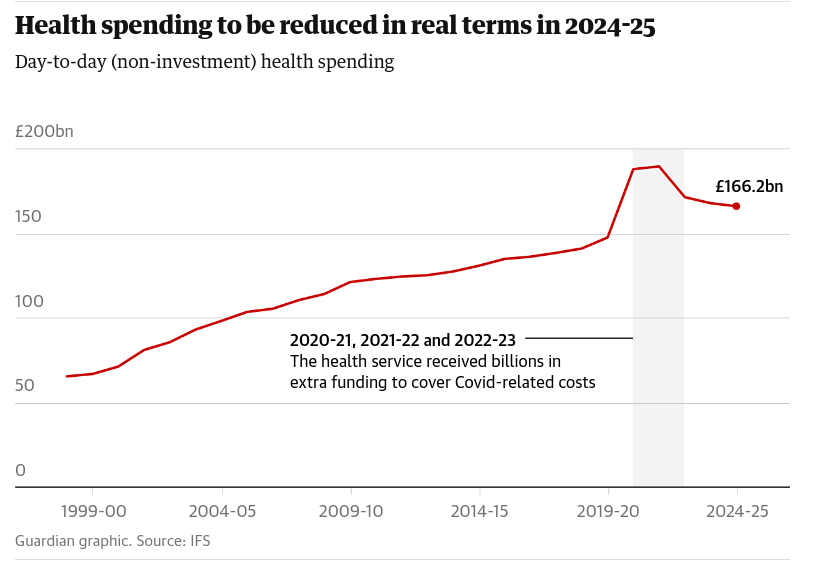
Health spending in England is due to suffer a 1.2% cut – worth £2bn – in the new financial year starting next month, despite the NHS facing extra costs from continuing pay strikes and the expansion of its workforce, according to an analysis by the Institute for Fiscal Studies (IfS).

The health budget, almost all of which the NHS gets, is to go from £168.2bn in 2023-24 to £166.2bn in 2024-25, after adjustment for inflation, in 2022-23 prices.

Without a government rethink the reduction in funding will force the NHS to cut staffing numbers, staff pay, the services it provides to patients or all three, the thinktank warned.

Its intervention comes as Hunt is considering cutting billions more from his public spending plans to pay for further reductions in either income tax or national insurance in this week’s budget.

Economists have calculated that such a move would mean taking as much as a fifth out of budgets for certain “unprotected” departments across the five-year parliament covering areas such as justice, home affairs and local government.

There were also reports on Monday night that the chancellor was looking to give motorists a £5bn boost by extending the “temporary” 5p-a-litre cut in fuel duty by another year.

The level of public sector spending pencilled in for the next parliament could mean cuts equivalent to those undertaken by David Cameron’s government during the years of austerity from 2010 to 2015. That has prompted warnings that the next government would not be able to implement them, and would be forced either to raise taxes or borrow more to fund emergency spending.

The Liberal Democrats said the plan to cut the NHS budget was “scandalous”. Doctors’ leaders warned it would harm patients. And hospital bosses said they would struggle if it went ahead because the estimated £2bn cost of 15 months of strikes have left their finances in a perilous state.

Sarah Olney, the Lib Dem’s Treasury spokesperson, said: “What this Conservative government is doing to our NHS is nothing short of scandalous. They have left health services shockingly underfunded and it is patients who are bearing the brunt of their neglect.”

She urged Hunt to cancel the planned cut in the budget he will present to MPs on Wednesday.

Meanwhile, hospital doctors voiced alarm that, with the NHS already in “an eternal crisis” in which it cannot meet the growing demand for care, pressing ahead with the planned cut could be “terminal” and would harm patients.

Dr Tim Cooksley, the immediate past president of the Society for Acute Medicine, said: “On this background, rumours of a funding cut could be the final straw for many colleagues and would undoubtedly cause severe harm to large numbers of patients.

“There is consensus that the situation in the NHS has never been so challenging. Funding is only part of the solution but a crucial one. A reduction at this stage could be a terminal event.”

David Phillips, an associate director at the IFS who carried out the analysis, said: “Existing [government spending] plans entail real-terms cuts of around 1.2% in [NHS] day-to-day spending [in 2024/25] – the largest reduction since the 1970s following the 1976 IMF crisis, except for the last two years as temporary funding related to the Covid-19 pandemic expired.

“A real-terms reduction in health spending would require some combination of reductions in staffing, pay and service provision.”

Phillips also disclosed that the government had to give the Department of Health and Social Care an emergency injection of £4.4bn of extra Treasury funding during the course of the current financial year to ensure that it – and the NHS – did not bust their budgets. The DSHC had not publicised that.

The NHS is thought to have received about £4bn of the £4.4bn, which was to cover staff pay rises, the costs of industrial action, schemes to help the service cope with winter and also its share of the health surcharge that migrants, or their employers, pay to cover the cost of their NHS care.

The DHSC’s budget for 2023-24 was originally due to be £164.2bn. However, it rose to £168.2bn as a result of ministers giving it what health economists call an “in-year bung” of about £4bn, to avoid a shortfall.

The department was and remains due to be handed a budget of £166.2bn for 2024-25. However, the £4.4bn top-up received this year meant that, as a result, next year’s budget was on course to be £2bn less than this one, prompting the IfS’s intervention, Phillips explained.

Julian Hartley, the chief executive of NHS Providers, which represents health service trusts, said: “These figures will ring alarm bells for trust leaders who are already struggling to provide patient care in a hugely challenging financial environment.

“Fifteen months of strike action have landed the NHS with an eye-watering bill due to income lost from delayed operations, scans and procedures and providing cover for striking staff.

“With worries that industrial action looks set to continue into the next financial year, trust leaders are rightly worried that these costs could continue to mount. Given the extra pressure industrial action is putting on NHS budgets, it’s vital the Treasury funds trusts’ strike costs in full.”

Hunt also plans to announce a clampdown on the money the NHS gives to employment agencies – £4.6bn across the UK and £3.5bn in England alone – as a result of a Treasury review of productivity across the public sector. He is set to cap the amount the service as a whole can hand them.

Wes Streeting, the shadow health secretary, labelled the chancellor “hypocrite Hunt” because the DHSC last year raised the annual cap for such spending by £450m. Streeting also pointed out that in 2015, when Hunt was the health secretary, he announced a similar crackdown on agencies which charged “extortionate hourly rates which cost billions of pounds a year”.

Streeting said: “Taxpayers are paying a heavy price for 14 years of Conservative failure.

“The Conservatives refused to train the doctors and nurses our NHS needs, leaving the health service to rely on rip-off recruitment agencies. Then they forced doctors and nurses out on the worst strike in the history of the NHS, leaving patients waiting longer and taxpayers picking up the bill.

“Expecting hypocrite Hunt to fix the mess he’s made is like expecting the arsonist to put out the fire they’ve started – it’s not going to happen.”

The DHSC was approached for its response.

Tory MP doesn’t want beavers in Dorset 

“There is no sense in reintroducing beavers into small chalk streams, or any other form of stream in Dorset. Beavers dam rivers.”

(In fact he doesn’t want them anywhere!).

Can you ever really trust a Tory on environmental issues? – 

Richard Drax MP Conservative, South Dorset during the debate on farming in the House of Commons at 4:21 pm on 4 March 2024.

From Hansard:

My next topic is slightly off farming, but it relates to it, and that is the reintroduction of beavers. There has been a report of a beaver being released illegally in the constituency of my hon. Friend the Member for West Dorset. That is causing concern. I believe that reintroduction has been experimented with in Scotland to a large degree. If we are to re-wild, I suppose there is some sense in putting beavers in large rivers, but there is no sense in reintroducing beavers into small chalk streams, or any other form of stream in Dorset. Beavers dam rivers. They would be protected, no doubt, by every organisation that would want to protect them. Farmland would then flood. As has been proven in Scotland, beavers do not hang around and say, “This is my home.” They breed and move elsewhere and do the same in other rivers. As I understand it, they had to be culled in Scotland, because they broke out of the area given to them. Can the Government please look not only at the illegal releasing of beavers into rivers, if that is happening—it has not been proven yet—but the legal release? There is an emphasis on re-wilding. While we all want to see wild animals, there is a proper place and location for each species.

John Halsall: ‘We are sorry for the issues in Exmouth’

John Halsall is the man who led the South West Water’s team responding to questions raised by councillors at the EDDC scrutiny meeting on 1st February.

He is SWW’s Chief Operating Officer, in effect second in command to the CEO with the day to day running of the business “at his fingertips” so to speak. He is also on the Board. He should, therefore, have been in a position to answer pretty well any question councillors threw at him, especially the twelve they had given him in advance. By the same token, he knows all about any “inconvenient facts” SWW would rather we didn’t know about.

Owl described SWW’s approach to the committee at the time as “evasive” and is not surprised that subsequently the full council passed a vote of “no confidence in SWW”.

John Halsall has now written to apologise to the people of Exmouth for the disruption caused by sewer mains bursting. But questions around SWW’s strategic failure to invest remain.

As with the Post Office “Horizon” scandal, when confidence in an organisation has been lost, an apology is a start but not a sufficient response to regain that confidence.

SWW, and indeed all water companies, have a long way to go.

Exmouth is not the only place suffering in East Devon.

What is “the long-term solution for Exmouth”, see “Does SWW have a cunning plan?” We need full transparency. – Owl

Adam Manning www.exmouthjournal.co.uk

South West Water says it is ‘sincerely sorry’ for the current issues surrounding the burst sewer pipe in Phear Park.

In December last year, a series of bursts were found on the pipe between the Plumb Park housing estate and Maer Lane Sewage Treatment Works. 

The burst occurred due to the condition of the pipe, which was unexpected because it was not known to have deteriorated and had only burst once in the previous 20 years.

Due to the condition the pipe was found to be in, South West Water decided to replace the entire section. This is roughly 500-metres long and is due to be completed by the end of this month.

To address the initial burst, a temporary overland pipe to bypass the damaged section. After this, three further bursts on other parts of this section of pipe were spotted on February 13.

While repairing or putting in sections of overland pipe to bypass the burst, tankers were bought in to take flows from Phear Park Pumping Station to Maer Lane Sewage Treatment Works. That work is now complete and the overland pipe runs from Plumb Park to Maer Lane. The tankers have now been stood down, but a small number in the area as a precaution.

The 500-metre section of pipe which runs from Plumb Park housing estate to Maer Lane Sewage Treatment Works is now being repaired. Since 2008, replacement and relining work has been carried out to the other section of this main, which runs from the housing estate to Phear Park Pumping Station. This means that the entire main from Phear Park to Maer Lane Sewage Treatment Works will have been upgraded when the repair is completed.

They say that they are now ‘working on a long-term solution for Exmouth’.

John Halsall, chief operating officer of South West Water said: “I’d like to take the opportunity to sincerely apologise to anyone who has been affected and to explain what issues we have faced and what steps we are taking to ensure this doesn’t happen again. There has been some misunderstanding about the work at times.

“We really appreciate that the tankering caused disruption for customers in the area and we are sincerely sorry for that. This was the least worst option available to us but we understand it was far from ideal.

“We have been in regular contact with the Environment Agency throughout the duration of the works and we have been keeping them updated on our progress. We have also been providing updates to the council, the local MP, local media and customers. We know how much it means to everyone to get the information they want, when they want it. Different people are interested in different aspects of this repair and so it is very difficult to update everyone, all the time, but we are working as hard as we can to keep everyone informed and we know we can do better.

“Once again, I would like to reiterate how sorry I am personally to local residents for the ongoing issues in Exmouth and I really appreciate their continued patience. I would also like to thank all of our operational teams who have worked hard in an extremely challenging situation, and who continue to work hard on the long-term solution for Exmouth.”