Investigation into Plymouth £72 million investment

An independent investigation is to take place into Plymouth City Council’s £72 million pension transaction deal.

Alison Stephenson, local democracy reporter www.radioexe.co.uk

The council used government money to invest in a consultancy firm to reduce a pension deficit in 2019. It says it has saved more than £9 million because of the decision.

But auditors raised concerns over the move which they said was unusual and is now the subject of a  investigation by the Department of Levelling Up, Housing and Communities (DLUHC).

Council Leader Tudor Evans (Lab, Ham) and head of finance David Northey have welcomed the scrutiny.

“We are happy to work with an independent team to review the whole process and ensure everyone can learn from this, ” said Cllr Evans.

David Northey added that he would be “open and transparent”.

Questions will be asked of audit and governance committee members from 2019 and officers and financial management and practices looked into.

The Labour party was in control of the council at that time.

“I hope that everyone will take the opportunity to tell them exactly what they know and didn’t know and any issues that arise will be in their recommendations I’m sure,” said Mr Northey.

He added that he had asked the levelling up department to conduct its investigation sooner rather than later so the council could draw a line under it, and that things had moved on.

The controversial decision has held up accounts from 2019/20 being approved, but the council confirmed this week that auditors Grant Thornton were now content with the accounts and were “in the process” of signing them off.

The auditors have made recommendations about the way such matters are handled and these had been implemented.

A spokesperson from Plymouth City Council added: “We have always been transparent about the transaction and it has been discussed at various council meetings, including the audit and governance committee.

“We knew that the transaction was novel in local government, but we were doing our best to think outside the box to ensure we didn’t need to make cuts to local services as our funding [from central government] continues to reduce. ”

Former council leader Cllr Richard Bingley (Con, Southway) said a formal independent investigation was needed to “get to grips” with what had happened.
 

England’s ludicrous experiment in privatised water is coming to a messy end 

Since privatisation in 1989, water bills across Britain have increased 360%, more than twice the rate of inflation (in Scotland, water is government-owned, and bills are lower). At these rates, you would think that our water system would be state of the art.

Adam Almeida Adam, a senior data analyst at the thinktank Common Wealth www.theguardian.com

The question mark over the future of Britain’s largest water supplier, Thames Water, has put its 16 million customers across London and south-east England – myself included – in an uncertain position. While water will still keep coming out of our taps, the price of these financial woes will probably be borne by customers and taxpayers. Meanwhile, Thames Water’s shareholders have spent the last three decades benefiting from the company’s massive financial gains. If ever we needed an example of the risks of selling essential infrastructure to investment firms, this is it.

Auditors warned in late 2023 that the debt-laden company could run out of money by April if shareholders did not inject it with much-needed cash. Now investors are saying they won’t provide Thames Water with £500m of emergency funding, leading to speculation that the company will be temporarily renationalised.

Since privatisation in 1989, water bills across Britain have increased 360%, more than twice the rate of inflation (in Scotland, water is government-owned, and bills are lower). At these rates, you would think that our water system would be state of the art. Instead, news broke this week that Thames Water was responsible for almost 17,000 occasions of dumping raw sewage in 2023 because of poor overflow systems that have had insufficient infrastructural investment.

In Margaret Thatcher’s imagination, selling off this public asset was meant to bring about shareholder democracy, but it has instead resulted in a major wealth transfer to Thames Water’s nine shareholders – institutional investors that are mostly based overseas in places such as Abu Dhabi, Beijing and Brisbane. The result is a company buckling under the weight of unserviceable debt, which over the years had not had sufficient investment, and had value extracted in the form of dividends. For their part, the shareholders released a statement criticising the water regulator, Ofwat, for the current crisis, saying it had “not been prepared to provide the necessary regulatory support for a business plan which ultimately addresses the issues that Thames Water faces”.

The largest shareholder – owning 31% – is the Ontario Municipal Employees Retirement System (Omers), a Canada-based public pension fund. Funnily enough, Omers happens to be the pension plan covering my grandmother, who collects a widow’s pension left behind by my grandfather, José. As a construction worker employed by the city of Toronto, José contributed to his pension using wages earned by paving the city’s roads in the summer and clearing the snow in the winter.

This is a bizarre arrangement, in which I (and millions of others) pay escalating prices for drinking water so that my grandmother in Canada and thousands of other pensioners can live out their golden years. Yet this model of ownership is becoming increasingly common as Britain’s essential infrastructure is bought by institutional investors with portfolios worth hundreds of billions of dollars. These firms typically manage money on behalf of their clients, which include pension funds, university endowments and insurance companies.

As a result of this system, public infrastructure changes hands in quick succession as investors turn a profit and leave companies in worsening financial states with each exchange. This has had grim consequences for people who rely on these essential services in their daily lives. During the pandemic, for instance, care homes loaded with high levels of debt (a staple business practice of institutional investors) saw death rates twice as high, according to one study that linked the rates to cost-cutting practices such as reduced staffing and limited supplies of personal protective equipment. The morbid effects of institutional investor ownership are also experienced by workers, as seen recently with the Body Shop’s employees facing probable layoffs while under the management of a private equity firm. Water systems, care homes and chain stores are all transformed into assets to be squeezed of their value.

Even the supposed beneficiaries of this system, such as my grandmother, enjoy quite muted gains from this ownership arrangement. The average Omers pensioner receives 28,040 Canadian dollars (£16,348) a year, not nearly enough to afford the cost of a bed in a long-term care home – another asset increasingly acquired by investment funds. Care for my grandmother’s complex health needs, resulting from a lifelong physical disability, would require her to pay $96,000 (£55,970) a year in a private facility. This means that my mother has become her full-time carer while she waits up to two and a half years for a bed to become available in a public nursing home.

By far the largest winners in this whole arrangement are the executives at the helm of investment firms that reap massive profits from these business practices. In 2022, the Omers CEO, Blake Hutcheson, made the equivalent of £3m. Hutcheson’s earnings pale in comparison to those of the CEO of Macquarie, an Australian asset manager that sold its share in Thames Water to Omers. The chief executive took home a whopping 30m Australian dollars (£15.5m) last year alone. These extraordinary figures are a severe indictment of a truly ludicrous system.

The solution, rather than tinkering with the ownership structure or again trying to regulate a privatised industry, is to ultimately end the exploitation of our public goods. England must follow the lead of the rest of the world – and bring water back into public ownership. Water systems act as a natural monopoly, meaning there is little to be gained in terms of “competitive innovation” through privatisation. Returning Thames Water to public ownership would mean that profits would no longer seep out through shareholder payouts, but would instead be reinvested back into the system by lowering water bills, upgrading crumbling infrastructure or funding future research and development. Public ownership of water companies could plug the leaks in the system, physical and financial.

Exmouth Sideshore expansion approved after planning appeal

A new building and five pay-to-use loos can be built at the Sideshore water sports and retail development on Exmouth seafront after a successful appeal.

Will Goddard www.exmouthjournal.co.uk

The approved plans are for a single-storey flexible office and community hub on a wedge of grass to the west, and five public toilets to the rear of Sideshore in an extension to the bin store. The new loos would open from dawn until dusk and use contactless payments.

East Devon District Council’s planning committee initially refused to give permission to a company called Queen’s Drive CIC for the project in February last year, but the Planning Inspectorate has overturned the decision.

The committee thought the proposed building would detract from the “character and appearance of the wider area” and would have been “detrimental to the openness and special landscape qualities of Exmouth seafront”.

But the inspectorate overruled the council.

An artist’s impression of the new building. (Image: Hilton Barnfield Architects)

It said the proposed structure would not be out of keeping with the character and appearance of this part of the seafront because of the nearby buildings, it would not interrupt views and it would occupy “a relatively small part of a grassed area and therefore would not compromise the openness of the site and its surroundings”.

The new building will have desk space for the Sideshore venue manager and “flexible meeting space” for the company and other community groups.

Planning documents say it will also “assist in facilitating events held on the adjacent Sideshore open space” and feature bird boxes, insect hotels, window plant boxes and trellises.

South West Water more than tripled the number of Budleigh sewage discharges in 2023

South West Water are holding a roadshow in Budleigh on Tuesday 2nd April. 

Book now, and let them know what you think!

[The Community Roadshow will take place from 12:30pm-16:30pm at the Venture Hall, Moor Lane, Budleigh Salterton, EX9 6QE, on Tuesday 2 April. Anyone looking to attend the event can pre-register here: Our roadshows | Get involved | South West Water]

In figures released today, South West Water more than tripled the number of Budleigh sewage discharges in 2023 vs 2022, dumping 546 hours of sewage into our brooks and beach area

Petercrwilliams fightingpoolution.com 

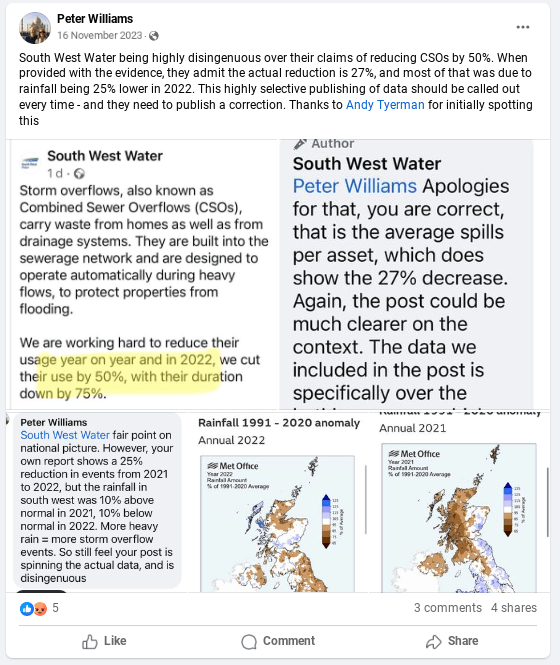
This time last year, South West Water trumpeted their ‘success’ in “reducing overflows by 50% and their duration by 75%”. We pointed out at that time that this statement was highly disingenuous, as any apparent ‘success’ was almost certainly caused by 2022 having 25% lower rainfall than average – and that they would need to take real action in order to bring sewage discharges down.

Well today, the results of that underinvestment were made clear.

Five of Budleigh’s eight sewage overflows were in full flow in 2023, with 187 incidents discharging 546 hours of sewage into our town streams and beach area. This represents a more than tripling of the number of events, and almost doubling of the discharge time, compared to 2022.

It sometimes seems that SWW focus more on spinning the news than tackling the underlying issues, so it will be interesting to see how they approach today’s shocking figures.

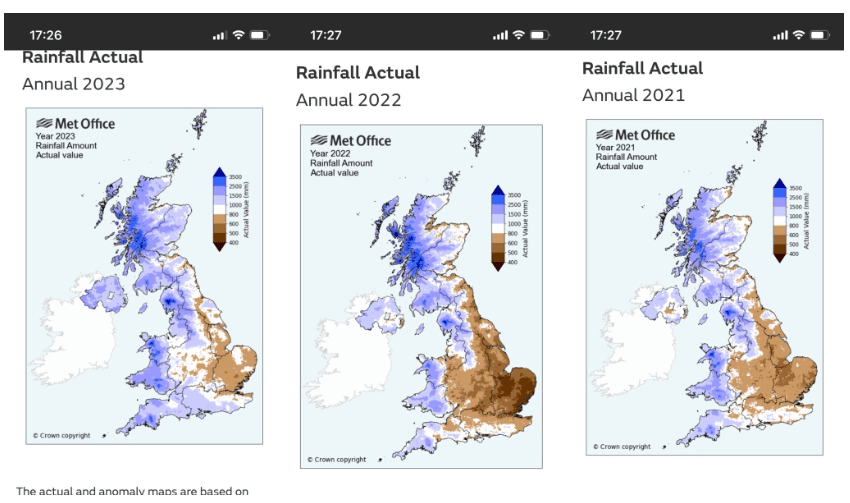
One item they’ve already trailed as a reason for the poor performance is the rainfall in 2023. They are talking about ‘exceptional’ rainfall, ‘which clearly they couldn’t plan for’ …. except that’s really not the case. The south west area rainfall in 2023 was not significantly different to the 2015-2022 pattern, and it was 2022 which was the outlier (approx 25% less rainfall compared to average years). As can be seen from the Met Office rainfall charts below, the South West had about 1,200mm rain in 2023, slightly less in 2021, and about 900mm in 2021.

So yes, 2023 was wetter than the previously very dry year, but that should not trigger a doubling of sewage into our local environment. It’s also worth noting that rainfall variation does not change the water companies legal obligations to achieve the Government-set discharge targets.

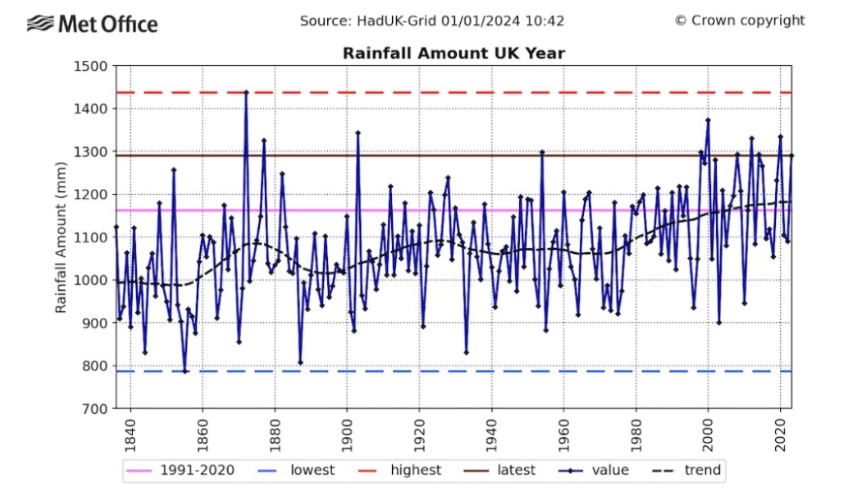
South West Water, and the Environment Agency, like to quote rainfall comparisons to the 30-year ‘Long Term Average’, and on that basis 2023 was a wetter year. The problem with that argument is that the UK is going through a sustained period of increasing rainfall. So justifying poor discharge performance on the basis of outdated averages just won’t cut it in future.

The largest single polluter remains the Lime Kiln Pumping Station, where 116 discharges dumped sewage for a total of 466 hours. That’s a discharge every three days on average. If South West Water want to make a major improvement in Budleigh’s water quality, they really must address the critical issues at Lime Kiln pumping station. As it’s built on a large car park, there can be no excuse for not having the space to significantly increase sewage holding capacity (so called storm tanks).

Lime Kiln actually has two sewage outlets. One goes out to Otter ledge, but the Emergency Overflow (which we know they did use in 2023) dumps raw sewage straight into the Kersbrook and from there directly into the sea. As both outfalls are covered by a single data point, we don’t know how much of that was dumped onto the shoreline, and how much was slightly further offshore. This lack of clarity really needs to change.

SWW’s pollution performance in Budleigh is fairly typical of their dire performance across the region. 2023 saw a shocking 1/2 million hours of sewage being discharged from SWW’s overflows, an increase of 88% on 2022.

Looking across the broader River Otter catchment area (which all flows out alongside Budleigh beach), there were more than a thousand pollution events in 2023, discharging over seven thousand hours of sewage into the river. Again, this was around 40% higher than in 2022.

This data highlights why we need SWW to take real action now, particularly to sort out the Lime Kiln sewage problems. No ‘spinning’, no excuses.

Water firm that drove truckloads of sewage to the sea in Exmouth may have broken law

“Many of the overflow lasted days, according to the water company’s own data, while two were non-stop for a full week.”

South West Water is facing investigations into more than 100 sewage spills in a popular Devon tourist town following major failures in the system since last December.

David Parsley inews.co.uk 

The Environment Agency (EA) has told i that every spill and subsequent transportation of thousands of truckloads of sewage through the seaside town of Exmouth is being investigated.

After a pipe burst in the East Devon town on 11 December, local residents had to endure up to 240 trucks a day moving sewage to pumping stations, one of which was broken and allowed sewage to flow directly into the sea.

Since the first pipe burst, two more pipes have failed, leading to further sewage spills.

While preliminary data for the level of sewage spills is yet to be confirmed, initial figures suggest that South West Water has pumped sewage into the sea and the River Exe estuary for 1,600 hours since the first pipe burst occurred.

Internal South West Water data obtained by i shows that at the pumping stations in Exmouth and nearby Sandy Bay there have been 106 sewage overflows so far this calendar year. These figures do not include the overflows between the 11 and 31 December.

Many of the overflow lasted days, according to the water company’s own data, while two were non-stop for a full week.

Water companies are only permitted to discharge sewage into rivers or the sea if adverse weather conditions cause storm overflows. To do so in normal weather conditions is against the law.

A spokeswoman for the EA told i: “We take all pollution incidents seriously and at Exmouth we are investigating all discharges linked to the burst pipe and the subsequent tankering operation.”

Andy Tyermen, one of the founders of End Sewage Convoys And Poollution Exmouth (ESCAPE), said: “The EA has confirmed they are investigating spills associated with the four pipe bursts on the rising main that started 11 December last year.

“Escape understands this will include the use of tankers to transfer sewage to Maer Road pumping station, which was already overflowing spilling sewage into the sea.

“As SWW does not provide a history of spills we estimate in Exmouth there have been 1,600 hours of overflows since the problems began.”

In January, South West Water transported millions of litres of sewage to what the EA called a “failed pumping station” just 200 metres from Exmouth’s sandy beach. The move was described by a local campaign group as “wilful pollution” by the company.

In February, the Government announced a ban on water company bosses receiving bonuses if a company has committed serious criminal breaches.

The ban will apply to all executive board members and chief executives and is set to come into effect later this year.

In 2023 the boss of Pennon Group, which owns South West Water, gave up £440,000 in bonuses in the wake of record water quality fines for the company.

Chief executive Susan Davy waived a £157,000 bonus and £283,000 in long-term incentives after the firm was fined £2.15m last April for illegally dumping sewage into rivers and the sea in Devon and Cornwall.

Despite giving up her bonuses, Ms Davy, who was paid more £1.6m the previous year, still took home her annual base salary of £460,000, while the firm’s shareholders benefited from a dividend payout of £122m, despite the company making a loss of £8.5m in the financial year to the end of March 2022.

The EA also has new powers to impose uncapped civil penalties and next year (2024-25) it is expected to quadruple inspections of water company assets to 4,000 a year, and then to more than 10,000 from April 2025.

This will include an increase in unannounced inspections, strengthening oversight of water companies and providing greater assurance alongside operator self-monitoring.

The EA spokeswoman added: “We continue to hold polluters to account and since 2015, we have secured over £150m in fines through prosecutions.”

A spokeswoman for South West Water declined to confirm the number of sewage spills since mid-December, adding that the company does not “comment on live regulatory investigations”.