Paul Arnott ‘East Devon District Council has Exmouth’s back’

Paul Arnott 

Many readers may have seen last weekend The Times Newspaper listing Exmouth as “One of The Best Places to Live 2024”.

The article included a superb quote from the Sideshore’s Ella Slade who said she thinks the town is “going places”.

“I love being by the sea,” Ella said, “and Exmouth is a great place with a great community. It feels really young. It’s got character and personality and everybody puts their oar in to make the businesses work and the community the best it can be.”

The bit of Ella’s quote I loved was that “everybody puts their oar in”, which is true but also can be read in two ways. In my experience of doing all I can for Exmouth as District Leader for four years that is spot on.

There are people breaking their backs to make the town blossom, and there are commentators on the sidelines (you find everywhere to be fair) for whom nothing is ever right. That’s democracy, and long may the two ways of putting your oar in live.

As the district council we get a regular kicking from some locals, which is expected of course. (Before I was a councillor I’d considered the daft plans for a seafront hotel at sea level quite potty too, and said so.) But taking that on the chin without complaining does justify a right to reply. Many will remember the superb Monty Python routine from Life of Brian called “What have the Romans ever done for us?”

So, I scribbled a few notes of new actions East Devon District Council has taken in Exmouth this year alone. Let’s start with a lovely one. With the leadership of a wonderful team of volunteers aged 3-96, our Parks and Gardens Team at EDDC been involved with the lovely Exmouth Tiny Forest Group planting 185 broadleaf trees creating three small copses to surround the new Tiny Forest at the Carter Avenue Green Space. In the same week, we opened 28 new parking spaces for bikes on the front by the RNLI Lifeboat Station and in Phear Park.

We also concluded a very long consultation process which has been going on for two years about Placemaking in Exmouth. Now, the sideline commentators always say “they won’t listen”, “it’s all rubber stamped already” and astonishingly, “it’s all been done behind closed doors”. In fact, since I put my own oar in four years ago, we set up an open Placemaking Group with representation from all sorts of interest groups in Exmouth, including the Town Council which – unlike the old days under the Conservatives – meets in public.

Indeed, those meetings are all there on YouTube to watch if you wish, and the agenda and minutes are on our website. I’d like to thank the nearly 700 hundred contributors who either attended public sessions at the Ocean or filled in the consultation document in recent weeks.

Of course, the biggest recent intervention is the £1.5 million funding to urgently rebuild the sea wall at Sideshore. We could have crossed our fingers and hoped it would hold up, but my Cabinet decided that the works must be done instantly. Thanks to all Exmouthians for your patience as the path in front of Sideshore becomes a bit of a building site for the next few weeks. Better than the seafront being swept into the sea I’d hazard.

What then have the Romans/EDDC done for us? Loads. Can we do better? Yes, everyone can always do better. But as long as I have a say, East Devon District Council has Exmouth’s back.

‘Too many’ MPs not playing by rules as Bill moved to improve behaviour in public

An MP has said that “too many” of their colleagues in Parliament are not playing by the rules, as a Bill was presented to make codes of conduct more binding.

Claudia Savage www.independent.co.uk

Labour MP Debbie Abrahams (Oldham East and Saddleworth) presented the Bill to the House of Commons on Wednesday, using a 10-minute rule motion, that would put rules about MPs’ behaviour on the statute books.

She told the Commons: “Too many people across our great country and nation states feel that the UK parliament, the MPs and ministers that sit in this place, that make new laws on behalf of them no longer represents them.

People across the country feel that while they play by the rules, too often, too many of us do not.

“They’re engaged every five years or so at a general election but rarely in between and while they are struggling to make ends meet, public money is treated by some as a personal fiefdom to bestow on their chums and benefactors.”

She added: “When people lose faith in democracy they seek political extremes.

“Polling from the Institute for Government recently showed two thirds of our constituents said that they do not think the current Government behaves to high ethical standards.

“Likewise polling from the UK anti-corruption coalition found two thirds of voters believe UK politics is becoming more corrupt.”

The Standards in Public Life (Codes of Conduct) Bill would seek to provide a statutory code of conduct for Members of the House of Commons and Members of the House of Lords, as well as local councillors.

The Seven Principles of Public Life, known as the Nolan Principles, state that those holding public office should exhibit selflessness, integrity, objectivity, accountability, openness, honesty and leadership.

Ms Abrahams said: “It’s absolutely right that under this the Nolan principles, currently guiding principles, also become codified.”

Ms Abrahams clarified that her Bill is “not party political”.

She said: “The reality is that when one party is seen as behaving in a way that lacks integrity, this does not affect just them, it affects the reputation of politicians on all sides.”

The member for Oldham East and Saddleworth concluded that by urging MPs from both sides of the House to support the Bill to “strengthen our standards in public life and to restore the public’s trust” in MPs.

The Bill is scheduled for further scrutiny by MPs on April 26 but is unlikely to make further progress in its current form due to a lack of parliamentary time to debate Bills tabled by backbench MPs.

A revolution in the way Britain does politics has begun in Devon. Tory MPs should be afraid 

[Worth mentioning that a “South Devon Watch” (now facebook based) had its origins at around the same time as “East Devon Watch”. Both aimed at driving revolutionary ideas forward and providing a critique of local Conservatism. (Use Georgina Allen in the EDW search to find relevant posts from around 2016 onwards.) 

The founders of the East Devon Alliance would also claim to have been part of this revolution by creating a mutual support group for like minded independents, pledging to follow the Nolan principles and seeking to become District Councillors. Within three electoral cycles the Tory stranglehold on East Devon District Council has been broken and the council is now run by a “rainbow” coalition.

The full history and evolution of change, including the pivotal role played by Claire Wright, was chronicled by “Old Owl” in three posts celebrating, in 2021, the first million hits on EDW. (Part 1, Part 2 and Part 3). 

So revolutionary ideas of how to do politics have already taken root in other parts of Devon and are flowering. – Owl]

A revolution in the way Britain does politics has begun in Devon. Tory MPs should be afraid

George Monbiot www.theguardian.com

This is what democracy looks like: hundreds of people queueing in the rain, seeking to take back control of a political system that treats voters like an afterthought. Last weekend, a remarkable democratic experiment reached its first conclusion. A process that began here in South Devon and is now spreading to other constituencies has allowed voters to reclaim the initiative from centralised and self-interested political parties. It directly confronts our unfair electoral system.

Ours is one of many constituencies in the UK known as “progressive tragedies”: places in which most people vote for parties to the left of the Tories but which, thanks to our iniquitous first-past-the-post system, end up with Tory representatives. The Conservatives have ruled here since 1924, often without majority support.

The Labour and Conservative leaderships conspire to sustain this system, in the hope of absolute majorities. But it works, like other such truncations of democracy (think of our political funding arrangements) much better for the Conservatives than it does for Labour. As Neal Lawson of the democracy campaign Compass argues, of the 11 general elections since 1979, “eight were won by the Conservative party and only three by Labour. But cooperation among progressive parties could have averted all eight Conservative majority governments bar 2015.”

Both within the Labour party and in the country at large, there’s an urgent desire for a fairer system. Unfortunately, this desire is thwarted by the Labour leadership. The result? As Lawson points out, of the 15 wealthy nations surveyed by the ParlGov project, voters in the UK are the most left-leaning, yet suffer the most rightwing governments. Sometimes it seems that Labour strategists would rather possess control than power.

This is not going to change in the near future. All pleas to work for the greater good, even when Jeremy Corbyn was leader, have been met with stony refusal. As someone well-placed in the party told me, our undemocratic system, and the prospect it offers of gaining an absolute majority, “is like the ring in Lord of the Rings. You know it harms you, but once it’s within your grasp, you can’t give it up.”

The simple and brilliant idea of a group of people in the South Devon constituency was to take these decisions out of the hands of the parties and return them to the people. The UK’s first “people’s primary” involved seven meetings held around the constituency. Candidates for progressive or vaguely progressive parties were invited to explain to voters why they would be best placed to evict the Conservative. After each meeting, constituents voted by secret ballot to choose their champion. When the aggregate result was announced, everyone in the constituency could see who other people believed was the most promising challenger.

Without this help, we have to guess other people’s voting intentions, and we often guess wrong. The people’s primary overcomes the prisoner’s dilemma, ensuring we are less likely to waste our vote. The decision the constituents make doesn’t prevent the other parties from standing. But, by selecting a common champion, it reduces the chances of letting the Tory back in.

Labour, thrown into chaos by the leadership’s attempt to control their choice of candidates, has yet to field a contender, so was unable to participate. The party leadership would have blocked its involvement anyway. Their loss. The Liberal Democrat and Green candidates battled gamely across two weeks of meetings. The Lib Dem, Caroline Voaden, won decisively. So now we know that our best chance of helping to eject the dismal Tory MP is to vote for her.

I chaired the first of these meetings. Tickets sold out two days after they were issued. The questions were searching and pertinent. Whatever the results at the general election, this is already a victory of sorts: bringing people back into the political process, showing how democracy could become a living proposition, rather than a dry and curling parchment locked behind a portcullis with chains.

Now the process has begun in five other constituencies, including those represented by Kemi Badenoch and Danny Kruger. The South Devon pioneers have identified 57 progressive tragedies in which the Conservatives are still predicted to win and there is some uncertainty about who the most effective challenger is likely to be. They’ve offered to share their model with these constituencies, but not with those where one progressive contender is clearly ahead of the others. In those cases they recommend a different system: stopthetories.vote.

All the big political parties hate these primaries. The Tory response is understandable: they know they can’t survive a fair democratic process in a progressive constituency. Most shocking and self-destructive has been the reaction of Liberal Democrat party managers. After the South Devon process had begun, a letter to candidates from the Lib Dem chair in England instructed them: “Under no circumstances are you to take part … any candidate who ignores this instruction, and participates in a primary, risks having their approved status rescinded and the withdrawal of party support and resources.”

The letter revealed an almost comical misunderstanding of what the primary process is and how it is conducted. It claimed that the primary could put candidates in breach of election law on both process and expenses. In reality, the process has been closely scrutinised by the Electoral Commission, and applies a long list of safeguarding rules. The spending (which is very small, as the primaries are created and run by volunteers) takes place before the champion is chosen, so, as the Electoral Commission has confirmed, doesn’t eat into the candidates’ capped election budgets. Perhaps we shouldn’t be surprised by such reactions: any process involving a transfer of control, however beneficial, will be fiercely opposed by those who are losing it.

Out of adversity comes better tactics. The Isle of Wight East constituency, after the refusal of both Labour and the Lib Dems to play, is designing a new process that doesn’t rely on their involvement.

The primaries won’t deliver a perfect system. We’ll still be stuck with a centralised and coercive politics, unmatched to the needs of the complex system we call society, based on the illegitimate concepts of presumed consent and remote decision-making. We will properly reclaim that power only when our representative politics are accompanied by participatory and deliberative decision-making.

But it’s a start: a small, slow revolution in a country whose people have long been deprived of their democratic rights. Enough of command and control. Enough of tricks and truncations. Enough of lies and evasions. While they dissemble, we assemble.

Asylum chaos as RAF sites and Bibby Stockholm barge to cost £48m more than hotels

The spiralling costs of Rishi Sunak’s controversial plans to house asylum seekers on RAF sites and in a “prison-like” barge have been laid bare in a damning report that found that the scheme will be significantly more expensive than paying for hotels – despite the sites housing far fewer migrants than planned.

Archie Mitchell www.independent.co.uk

The Home Office initially said that developing the four sites – including the Bibby Stockholm barge, two RAF sites, and former student accommodation in Huddersfield – would save taxpayers £94m.

But Whitehall’s official watchdog says the prime minister’s plan is expected to cost £46m more than the current system – which sees migrants put up in hotels while their claims are being processed – and £1.2bn overall over the next decade.

The National Audit Office (NAO) said the Home Office will have spent at least £230m developing the four major projects by the end of March – despite just two of the sites being open and providing accommodation for only 900 people.

The damning report, published on Wednesday, follows a warning last week from former home secretary Dame Priti Patel that the government’s asylum accommodation system is in need of reform and that there are “serious questions” to be asked of her former department.

The review said the government had spent more money unnecessarily and increased risk by pushing the projects forward too quickly, adding that the Home Office had pursued the policy despite “repeated” assessments that it “could not be delivered as planned”.

Labour said the NAO’s findings were “staggering”, accusing the prime minister of “taking the Tories’ chaos and failure in the asylum system to a new level”.

Shadow home secretary Yvette Cooper added: “On top of the £8m a day on hotel rooms, the government is now paying tens of millions of pounds in set-up costs for new sites in Wethersfield and Scampton, which are still not in use, and millions more for sites that will never be used.”

Charities said the report exposed “bad policies being implemented badly at huge financial cost”, and claimed that the accommodation sites were creating additional “fear and trauma” for asylum seekers.

NAO boss Gareth Davies said: “The pace at which the government pursued its plans led to increased risks, and it now expects large sites to cost more than using hotel accommodation.”

According to the findings, the Home Office originally estimated that the set-up costs at the former RAF bases would be £5m each, but they increased to £49m for Wethersfield and £27m for Scampton.

So far only Wethersfield – which has a capacity of 1,700 – and the Bibby Stockholm, which has space for around 500 men, are housing asylum seekers.

But the two sites were housing just under half the number of migrants the Home Office expected them to accommodate at the end of January, with 576 living at Wethersfield and 321 on the Bibby Stockholm at that point.

The government is currently facing legal action over the conditions at Wethersfield, which has been condemned as a de facto detention centre and not suitable for long-term accommodation.

The Independent has previously revealed that nearly 100 asylum seekers, including suspected victims of torture and human trafficking, were moved out of the RAF base after the Home Office admitted the accommodation was unsuitable for them.

According to the NAO report, the Home Office is “now considering reducing the maximum number of people it accommodates” at Wethersfield, but has not confirmed the new number.

The department expects Scampton to start housing asylum seekers from April, with Huddersfield following in May, it added.

The NAO also found that:

  • The Home Office rated its own performance as “red” as it recognised the challenges of the work, repeatedly revising accommodation targets “downwards”
  • The department “prioritised awarding contracts quickly, and modifying existing contracts over fully competitive tenders”, with “overly ambitious accommodation timetables” leading to “increased procurement risks”
  • Emergency planning rules were used so that sites could be found, and so that work could begin quickly before speaking to affected communities about the plans, in order to “reduce the risk of local opposition affecting negotiations”. In January, the Home Office was “still working with providers to develop specific measures assessing residents’ safety at large sites”
  • The Home Office is “resetting” its programme and developing a “longer-term accommodation strategy”, which will see it reduce the number of spaces it intends to provide at such sites amid proposals to “identify smaller sites accommodating between 200-700 people”
  • There are “uncertainties” about how the Illegal Migration Act is being implemented, making it harder for the Home Office to assess what asylum accommodation it needs. The report said the law changes will make it “more difficult to assess how much and what type of accommodation the Home Office will need” as it does not know how effective the deterrent will be or how it will affect the amount and type of accommodation required

The costs for Wethersfield, the Bibby Stockholm and Scampton are £777.2m for 2023-2027. Costs for a new site at Huddersfield are £358.4m for the period until 2033 – taking the total costs in the next decade up to £1.2bn.

On Monday, it emerged that Home Office minister Tom Pursglove had confirmed in a letter to Gainsborough Conservative MP Sir Edward Leigh that the “regular occupancy” at RAF Scampton would be a maximum of 800 asylum seekers instead of the original 2,000 men destined for the site, which has been beset by legal challenges.

Ms Cooper said: “This report is staggering. The British taxpayer is already paying out eye-watering sums on asylum hotels, and now it turns out the sites they promised would save money are costing the taxpayer even more. Rishi Sunak has taken the Tories’ chaos and failure in the asylum system to a new level.”

Refugee Council chief executive Enver Solomon said: “There would be no need to spend exorbitant sums of money on housing people in barges, military bases or hotels if cases were dealt with in a timely manner.”

A Home Office spokesperson said that the use of asylum hotels is “unacceptable”, adding that the department had acted to “reduce the impact on local communities by moving asylum seekers onto barges and former military sites”.

They added: “The cost of hotels will fall – and we are now closing dozens of asylum hotels every month to return them to communities … While the NAO’s figures include set-up costs, it is currently better value for money for the taxpayer to continue with these sites than to use hotels.”

Brexit is ‘the elephant in the room of British politics’, Ed Davey says

Brexit is “the elephant in the room of British politics”, Sir Ed Davey has claimed as he seeks to boost support for the Liberal Democrats.

Hugo Gye inews.co.uk

The leader of the UK’s third party claimed in his speech to its spring conference that both the Conservatives and Labour were seeking to disguise the impact that leaving the EU has had on the economy.

But he again fell short of calling for the country to rejoin the EU, calling instead for closer relations which will “rip up red tape” for businesses.

Speaking in York at the Lib Dems’ first in-person conference since 2019, Sir Ed also warned the Tories that they could lose dozens of seats if they do not pledge to tackle water pollution, and pledged to prioritise political reform including a change to the voting system.

Addressing Brexit in his speech, the leader said: “I call it the elephant in the room of British politics. An elephant we always point to, even though other parties daren’t even whisper its name. So let me shout it, yet again: if you want to boost our economy, you have to repair our broken relationship with Europe.

He added: “You don’t need me to tell you what a disaster the Conservatives’ botched deal with Europe has been for our country. You see it every day in your communities: the businesses strangled by red tape; the farmers, fishers and factories, unable to sell to their customers on the continent; the empty shelves in local supermarkets.”

Lib Dem policy on the EU is to revisit Britain’s relations with the bloc in the coming years, but without a firm commitment to rejoin either the EU itself or its single market or customs union.

Ahead of May’s local elections, Sir Ed warned Conservative MPs that voters angry about discharges of sewage into Britain’s rivers would turn on them. He said: “People want a clean, healthy natural environment. They want an end to the Conservatives letting water companies get away with pumping filthy sewage straight into our rivers – the biggest environmental crime in our country today, and a crime that will cost the Conservatives dozens of seats if they don’t act.”

And he pledged to redouble the party’s commitment to changing the voting system – saying: “While the other parties still cling to the discredited ‘first past the post’ electoral system, our zeal for proportional representation remains undimmed.”

Sir Ed called the Conservatives “a bunch of mutinous pirates, only interested in who got to wear the captain’s hat”, joking: “We needed Hornblower. They gave us Pugwash.” But he also hit out at Labour, claiming that “their only goal seems to be ‘not as bad as the Conservatives’ – talk about a low bar!”

Listen to the Prime Minister’s policy ideas, please!

 “Too late” .. “march towards the sound of the guns” …“get on with it”. – Ben Wallace.

Yet still the pretenders manoeuvre. – Owl

Government has brought adult social care in England ‘to its knees’, MPs say

The government has brought adult social care in England “to its knees” with years of uneven funding and a “woefully insufficient plan” to fill thousands of staff vacancies, MPs have said in a damning report on a system that provides long-term care for 835,000 people.

Robert Booth www.theguardian.com 

The public accounts committee said “chronic underfunding, rising waiting lists and patchwork funding” has placed sustained pressure on local authorities, and the government is falling short on Boris Johnson’s promise in 2019 to “fix the crisis in social care once and for all”.

The Department of Health and Social Care “is not providing the leadership needed to deliver a social care sector that is sufficient to meet the country’s needs”, the cross-party committee concluded.

Meg Hillier, its Labour chair, said: “Years of fragmented funding and the absence of a clear roadmap has brought the adult social care sector to its knees. Waiting lists are rising, the sector is short tens of thousands of essential staff, and local authority finances are being placed under an unsustainable amount of pressure.”

The report comes with almost half a million people on waiting lists for care in residential settings or at home and an ageing population causing rising demand. There is also growing concern that some private providers are enjoying increasing profit margins because the government may not have a grip on value for money in a system that costs councils nearly £24bn a year.

The PAC wants assurances that £2.7bn in additional funding allocated in 2022 to speed up discharges from hospitals into social care and to increase the rates councils can pay for care, “is not simply going into provider profits”.

The committee also said that the government has given little assurance that changes to introduce a £86,000 per person cap on care costs, already delayed to October 2025, can be delivered on schedule. Meanwhile, more than 150,000 care posts are vacant and “the DHSC has still not produced a convincing plan to address the chronic shortages”, the committee said.

Nadra Ahmed, chair of the National Care Association, which represents independent care providers, said: “The intent has been there but the implementation has been quite woeful. The sector continues to become ever more fragile despite the government having published a plan.”

Helen Wildbore, director of Care Rights UK, which represents users of social care and their relatives, said: “It is older and disabled people paying the price – their safety, dignity and rights at risk as services get stretched to breaking point. We hear from people facing uphill battles to get access to care, to get their basic needs met or to have serious concerns with care resolved.”

A spokesperson for DHSC said: “We are committed to reforming adult social care and have invested up to an additional £8.6bn over two years to meet the pressures facing the sector, grow the workforce and improve hospital discharge. The report rightly acknowledges progress to boost care workers’ career progression and training to improve retention, including through a new accredited qualification. To drive forward our vision for reform, we are also investing up to £700m on a major transformation of the adult social care system, which includes investing in technology and adapting people’s homes to allow them to live independently.”

The findings coincided with the first preliminary session on the care sector at the Covid-19 public inquiry, after there were 50,000 deaths related to the virus in UK care homes.

Sam Jacobs, representing the Trades Union Congress, told the inquiry the pandemic hit “a chronically underfunded and fragmented social care sector delivered by many thousands of local authority and private care providers with little central strategic direction … served by an understaffed, underpaid and undervalued workforce.”

Jane Townson, chief executive of the Homecare Association, said a “glaring absence of social care expertise” in the government’s scientific advisory group meant it failed to “adequately consider the unique challenges and needs of the sector in the scientific advice informing policy decisions”.

“Decision makers frequently disregarded and undervalued the dedicated professionals working in social care, who put their own health and wellbeing on the line to continue providing care and support in the most challenging of circumstances,” she said.

Tory party fined £10,750 by Electoral Commission for not accurately reporting non-cash donations

The Conservative party has been fined £10,750 by the Electoral Commission for failing to accurately report non-cash donations worth more than £200,000.

Peanuts for a party with questionable attitudes to donations. – Owl

www.theguardian.com

The donations related to an employee who had been seconded to the party by a donor. The commission said:

“The party under-reported non-cash donations, in the form of an employee seconded to the party by a donor between April 2020 to December 2023. The non-cash donations were under reported by more than £200,000, when the seconded employee went from part-time to full-time work at the party.

The party also reported late a single non-cash donation relating to the same seconded employee, in December 2023.”

Louise Edwards, director of regulation and digital transformation at the commission, said:

“Our investigation into the Conservative and Unionist Party found a number of donations inaccurately reported or reported late. The political finance laws we enforce are there to ensure transparency in how parties are funded and to increase public confidence in our system, so it’s important donations are fully and clearly reported.

Where we find offences, we carefully consider the circumstances before deciding whether to impose a sanction. We take into account a range of factors before making our final decision, including proportionality.”

Potholes: Roads in England and Wales at ‘breaking point’

John Hart last month: “They’ve given us an extra £6.6m this year but that is a drop in the ocean,”

“Last year they gave us £9.5m and, I hate to say it, but £7m of that went in inflation.

“We’ve got a backlog that’s getting bigger because we cannot cope with what we’ve got.”

Roads in England and Wales are at “breaking point” due to potholes, with repairs at an eight-year high, according to a new report.

https://www.bbc.co.uk › news › uk-england-68598875

The Asphalt Industry Alliance (AIA) said councils were expected to fix two million potholes in the current financial year.

That is up 43% on the previous year and the highest annual total since 2015-16.

Ministers highlighted their pledge to provide £8.3bn of extra funding over 11 years for road improvements in England.

The AIA’s annual report found that 47% of local road miles were rated as being in a good condition, with 36% adequate and 17% poor.

The survey also found that average highway maintenance budgets increased by 2.3% in the 2023-24 financial year compared with the previous 12 months.

But the impact of rising costs due to inflation meant local authorities “effectively experienced a real-terms cut”.

Meanwhile, the amount needed to fix the backlog of local road repairs has reached a record £16.3bn, up 16% from £14bn a year ago.

AIA chairman Rick Green said: “Local authorities have a bit more money to spend this year but the impact of rising costs due to inflation means they have actually been able to do less with it.

“Couple this with the effects of the extreme weather we are increasingly facing, and the result is that the rate at which local roads are suffering is accelerating towards breaking point.”

Depending on their size, potholes can cause significant damage to vehicles and pose a danger motorists, cyclists and pedestrians.

Although small potholes rarely cause major accidents, if a vehicle hits a lot of them over time, it can lead to damage to the tyres, suspension and steering system.

In Daventry, Northamptonshire, signs have appeared from an apparently fed-up driver welcoming people to “Pot Hole City” and “Pot Holy Island”.

While on the Isle of Man, a woman has planted daffodils in potholes, hoping the “guerrilla gardening” will hammer home the problem.

In October 2023, the government announced it would provide the £8.3bn of extra funding for local road improvements.

This was part of the Network North strategy to use money saved by scrapping the planned extension of HS2 north of Birmingham.

Mr Green said: “There’s still a mountain to climb when it comes to fixing our local roads.

“While it’s great that English local authorities should be getting more money from the government through its Network North funding, it’s clearly not going to be enough to halt the decline.”

AA president Edmund King added: “Our breakdown data shows that 2023 was the worst year for potholes for five years.

“Arguably the road network is a local council’s biggest asset, but not enough planned investment and repairs are being made to make streets safer and smoother for drivers and those on two wheels.”

A Department for Transport spokesperson said the £8.3bn spending pledge was evidence the government was “taking decisive action to resurface roads and fix potholes”.

They added: “In addition, we have made £150m available for local authorities right now meaning funding for most authorities has increased by almost a third compared to last year, with a further £150m to follow in the coming financial year.” 

Exmouth developers in stalemate with Cornwall Council over affordables

New homes boarded up in Cornish village in planning row

Completed new homes in a Cornwall village have been boarded up and left empty after a planning stalemate, according to developers.

By Rebecca Ricks www.bbc.co.uk

Michael Wight and Adele Fulner the directors of Bridge View described the situation as ‘soul destroying’

[The company and its directors are registered at an address in Exmouth]

Bridge View claimed council delays and abnormal costs have left it unable to deliver 33 homes in Calstock, including affordable housing.

Parish councillor, Dorothy Kirk, said it was “a tragic situation where everybody loses”.

Cornwall Council said it was working with stakeholders to find a solution.

‘Expensive and difficult’

A document published by the council in January 2024, stated there were 160 households on the waiting list for homes in the parish.

Ms Kirk, said: “I hope somehow we can rescue it.

“We have to find a solution, end of. I don’t want Calstock to be deprived of homes, I don’t want to see the developer lose everything.

“It’s been a long, expensive and difficult journey. We have to have houses for local people.”

The new homes at Bridge View were granted planning permission in 2018.

Bridge View in Calstock was originally given permission to build 33 homes, 15 of which were set to be affordable housing

One of the directors, Michael Wight, said his firm had allocated £2.8m, for 15 affordable homes but claimed council delays then cost the firm £1.2m in interest.

He accused the council of “weaponising” legal planning agreements and “strangling the business cash flow” by blocking the sale of completed homes.

The council said issues with the development had been “ongoing for several years” and that it had “done all in its power to work with the company”.

Mr Wight said the abnormal costs included the need to build a second road, a more complicated drainage system and a large retaining wall, the wall understood to have cost about £750,000.

Coupled with the interest from the delays, he said their affordable homes budget was “eroded”.

He told the BBC that in November 2023 the affordable housing operators backed out, after delays, and realising the “magnitude” of possible maintenance to the large wall.

The firm showed the BBC evidence that no new affordable housing operator wanted the homes and as a result they could not fulfil planning conditions.

They received one offer from RentPlus, a rent with the option to buy model, but the firm was not within the council’s approved list as it was considered an intermediate operator.

The developers appealed against one of Cornwall Council’s refusals with the inspector ruling in favour of the council but said the costs associated with the site were abnormal.

The developers said the latest submission for amendments was submitted to the council in April 2023, but the planning department did not provide a response until January 2024, longer than the expected 13 weeks.

They said that delay alone cost the firm £880,000.

The funding for the site expired in October 2023 and by March, in a stalemate with the council, the site was mothballed.

Adele Fulner, another director of the firm, said it was a “complex situation”.

“I’m sorry it hasn’t worked out the way we wanted it to,” she said.

“I feel like we could have fought harder to make it happen and for that I apologise.”

A family-run business, the firm said this was their biggest build to date and they felt the outcome had been “soul destroying”.

Workers at the site have now boarded up the windows as the site is expected to be returned to the lender

Cornwall Council said it was: “Committed to working with developers that have been granted planning permission to ensure that a housing development, and the agreed number of affordable housing homes, are delivered in line with the planning permission.”

It said it “must adhere” to planning policies, including neighbourhood plans” and was actively working to secure the delivery of the development and affordable housing.

Lib Dem wins ‘primary’ over Greens in South Devon with 78% of the votes

Labour didn’t take part but got 2%.

Organisers of a campaign to unite voters from across the political spectrum against the Conservatives in South Devon have hailed it as a success, calling it “democracy in action”.

Bradley Gerrard, local democracy reporter www.radioexe.co.uk 

What they are caling the ‘South Devon Primary’ aimed to encourage voters of various political parties – except the Tories – to back a single candidate at the next general election following town hall meetings and hustings’ events.

Liberal Democrat Caroline Voaden emerged as the clear winner from the process, securing 78 per cent of 1,072 votes cast.

‘South Devon’ will be a new constituency at the general election, comprising Conservative MP Anthony Mangnell’s current Totnes patch with some other areas. It will be the first time a constituency has been called South Devon since  1885 and had only ever been held by Conservatives and Whigs.

For this primary, Green candidate Robert Bagnall won 20 per cent of the vote, while Labour, which didn’t put a candidate forward in the event, achieved two per cent.

The result suggests that Lib Dem and Green activists in the new South Devon seat are willing to back Ms Voaden.

Anthea Simmonds, one of the South Devon Primary organisers, said there had been “universal” support for the process by those who attended.

“The feedback from people has been amazing, and they felt it was a very grown-up and professional debate,” she said.

“Caroline was very professional, and on top of relevant facts and figures, and there was lots of enthusiasm, including from people who wouldn’t ordinarily vote Lib Dem.”

Ms Simmonds said people had told her they thought the process would mean that “their vote was going to count for once”.

She continued: “At the end of the meetings, I go round and ask people for their thoughts and it was universal – people thought it was fantastic to see democracy in action and said they would definitely be getting behind the candidate that emerged as the winner from the primary.”

The Totnes constituency has been Conservative for a century. The last MP for the area not to be a Tory was Henry Vivian, for the Liberals, in 1923, although the boundaries were slightly different to the existing Totnes seat and forthcoming South Devon one.

Sitting MP Anthony Mangnall was not invited to take part in the South Devon Primary. At the general election in 2019, Mr Mangnall secured 53 per cent of the vote.

Ms Simmonds said South Devon Primary was funded by its founders without official political party affiliation.

“This wasn’t organised by people who belong to political parties, but done to meet a need which relates to frustration and despair with the electoral system, and it caught people’s imagination,” she said.

“People were coming out on a rainy Saturday afternoon to sit and talk about politics with people like them.”

Planning applications validated by EDDC for week beginning 4 March

Tory minister refuses to say if party has received new £5m donation from Frank Hester

A Cabinet minister has refused to confirm whether the Conservatives have taken another £5 million donation from Frank Hester, the businessman accused of making racist remarks about MP Diane Abbott.

www.independent.co.uk 

Mark Harper also declined to comment on “hypotheticals” when pressed repeatedly on whether the party will accept more cash from the top donor.

Reports emerged this week that Mr Hester may have offered £5 million more, which has not yet been published by the Electoral Commission.

Sky News presenter Trevor Phillips asked Mr Harper today (17 March): “Has the Conservative Party received another £5m from Frank Hester?

The transport secretary replied: “I’m not involved in donations.”

What are the rules on accepting donations? Owl asks Sir Humphrey:

Under the PPRA rules political parties must declare all donations over £500.

Under these rules anything less than £500 is not a donation for the purpose of declaration.

So Sir Humphrey, what constitutes a “donation”?

A donation is money, goods or services given to a party without charge or on non-commercial terms, with a value of over £500.

Sir Humphrey, are there any restrictions on receiving donations?

Donations have to be permissible donations and from an identifiable source, impermissible donations must be returned within 30 days.

Sir Humphrey, what is a permissible source? Can any old rogue or business make a donation?

A permissible source includes:

  • an individual registered on a UK electoral register, including overseas electors and those leaving bequests
  • a UK-registered company which is incorporated in the UK and carries on business in the UK

And PPRA?

Don’t ask.

Sir Humphrey, will it keep us squeaky clean if we say: “All our donations are declared in the proper way”?

Undoubtedly!

Ed Davey: ‘We need a cross-party agreement on social care’

Rishi Sunak and Keir Starmer have been challenged to sign up to cross-party talks finally resolving the impasse over social care, as part of a Liberal Democrat plea to “grasp the nettle” after years of failure.

Michael Savage www.theguardian.com

Ed Davey, the Lib Dem leader, said that his party would include in its forthcoming manifesto a promise to attend cross-party talks on social care after the election. He called on both the Tories and Labour to do the same in a bid to agree a financial package that helps the NHS and deals with the high costs some face.

“We’ve got lots of ideas to bring to the table,” Davey told the Observer. “But we’re only going to ultimately solve this if we have a cross-party consensus. It’s just been knocked out for far too long. We need to do it right this time. We cannot wait.

“Come to the table. Put in your manifestos – everybody – that you will take part in cross-party talks after the election for a cross-party agreement on social care. We can therefore come up with something that will stand the test of time. This is a long-term policy with a massive impact on the NHS. There are issues on how it’s financed and we’d have to all agree on that, too. I don’t think there’s any other way of doing it. I just hope Sunak and Starmer will respond positively. Let’s grasp the nettle. Let’s crack it.”

Several pledges to deal with the huge social care costs faced by many families have been made in recent years, with both Boris Johnson and Theresa May promising solutions that were never implemented. Private cross-party talks before the 2010 election also broke down.

It comes after the main parties were recently told to “grow up” by Sir Andrew Dilnot, whose government-backed commission proposed a cap on social care costs more than a decade ago. He said there had been “no serious addressing” of the state of the care system by Labour or the Conservatives heading into the election campaign.

Davey said he had been disappointed by suggestions that Labour wanted to “park” the issue until well after the election. He said that some of the ideas he would bring to the talks would be a special national minimum wage for care workers and more help for family carers. “They actually save the taxpayer huge amounts of money,” he said. “They want to do it. If you gave them a bit of extra support, such as a bit of respite care, it’d be more sustainable. More would do it and they’d be able to do it for longer.”

Davey was speaking ahead of this weekend’s Lib Dem spring conference. He said that there was now the real chance of a “once in a generation” election that saw a complete Tory collapse.

He said that his party’s hopes were growing that both the chancellor Jeremy Hunt and levelling up secretary Michael Gove could be unseated. Both cabinet ministers have seats in Surrey, part of the “blue wall” of previously safe Tory heartlands that the Lib Dems have been focusing on under Davey.

The Lib Dems have been stagnant in the polls at around 10% for some time, with some criticising the party for being overtaken by Reform UK, the successor to the Brexit party. However, Davey said Reform was only a threat to the Tories and byelection victories showed his targeted campaign was working. He said he felt a “moral responsibility to make sure we beat lots of Conservative MPs”

“I’ve noticed over my time that if leaders focus on vote share across the whole country and ignore seats, they perform badly at the election,” he said. “I am not going to do that. If you have a strategy that is focused on the seats where you can win, and you don’t allow yourself to be taken off by criticism, frankly, I think we will do what we need to do. We’re going to play an absolutely central role in removing the Conservatives.”

He denied the criticism he had received over the Horizon scandal had hampered his leadership. He was criticised after it emerged he had initially refused to meet Alan Bates, the former postmaster and campaigner fighting for justice, when he was Post Office minister during the coalition government.

“Liberal Democrat leader in election year gets attacked by the Conservative press shocker,” he said. “It’s a huge miscarriage of justice and we need to play our part in getting justice for the postmasters. They need exoneration, they need compensation. The inquiry needs to learn the lessons and we need to change things big time.”

We Need a Constitution 

moneyversusdemocracy.

We Should Learn From Ireland

This post is meant for those who agree that we need a proper entrenched constitution, not just a muddle in which the government can avoid addressing the challenges we face, and shut down dissent in order to retain the trappings of power.

Creating a constitution from scratch is a huge task, but it seems to be required in our case. We can learn from the Irish experience. When the Irish Free State was formed in 1922, it was still tied somewhat to Britain. It formed its own constitution which drew heavily from the Westminster system. By 1934 Éamon de Valera decided it was time to review the constitution. He had two objects in mind, to finally cut the ties with Britain, and crucially providing that any future amendment would be done in a controlled manor. Any change can only be agreed by a national referendum. This constitution came into effect in 1937 following a plebiscite. It has lasted 86 years without coming into difficulties. There have been 32 amendments reflecting great changes in the economy and society, many of which de Valera did not foresee.

The wording of the constitution is particularly clear and the office of the parliament( Oireachtas) issues loads of citizen information.

What I am suggesting is that we examine each article of the Irish constitution and see whether and how far it could be included in the British constitution. Having done that we should compare that with the Cabinet Manual which is the government’s view of what the constitution is, and how things should be done.

I have set out my ideas in a bit more detail in a document (59Kb) which I can email you on request. Please email me on davidsmith658howard@gmail.com.

I am currently working on my own. I am 82 and am in not very good health. I need support. I welcome any constructive comment on errors of fact, on the process etc. Any wholly unhelpful comment will simply be ignored at this stage.

  • Do you want your comments to remain anonymous?
  • Can you assist with any aspect of the drafting? If so would this be as part of a small group?
  • Should we attempt to inform mainstream media at this stage? If so can you help?
  • Do we need a better website? Could you help with this?

David Smith

Sunak has ‘given up’, says Davey as he urges Lib Dems to ‘smash blue wall’

[Also reported in Simon Jupp’s and David Reed’s essential on-line reading: “The Mail Online”:

Sir Ed Davey sets his sights on Tory seats in southern heartland: Lib Dem leader will today urge members to knock on five million doors and ‘bring the Blue Wall tumbling’]

“Smash the blue wall”

Sophie Wingate www.independent.co.uk

Sir Ed Davey has told the Liberal Democrats spring conference that the Prime Minister “sounds like he’s already given up” and that setting the general election date is “pretty much the only thing left that Rishi Sunak controls any more”.

The Lib Dem leader said the Tories “no longer represent British values of decency, tolerance and the rule of law”, as he challenged members to “smash the blue wall” at the national vote.

The Lib Dems are using the gathering in York to prepare for a further push into traditional Conservative strongholds, particularly seeking to win over voters in the south and south-west of England.

Sir Ed rallied members to “make this a once-in-a-generation election” as he argued that his party was the only one to offer “transformational change”, while the Tories and Labour were just “tinkering around the edges”.

Mr Sunak this week ruled out holding an election on May 2, indicating that he would send the country to the polls in the latter half of 2024.

The party that brought us Boris Johnson, Suella Braverman and Lee Anderson, proudly funded by a man who made the most appalling racist and sexist comments – the Conservatives no longer represent British values of decency, tolerance and the rule of law

In his speech on Sunday, Sir Ed said the election date was “pretty much the only thing left that Rishi Sunak controls any more”.

“He certainly doesn’t control his party. Certainly not his Cabinet. Certainly not the healthcare crisis or the economy,” he said.

“In fact, the Prime Minister sounds like he’s given up.”

Sir Ed accused the Prime Minister of “outrageously running down the clock” and “squatting” in Downing Street “while the crises facing our country just get worse and worse”.

The Tories were overseeing “political, economic and financial instability” because they had “been consumed by the most damaging, never-ending soap opera in British political history”, the Kingston and Surbiton MP said.

“And Tory MPs have given us another episode this weekend, with plots for yet another prime minister – a fourth in less than two years,” he added.

It comes as Mr Sunak faces reports that some Conservative MPs are plotting to replace him before the election, and criticism over his handling of the emergence of alleged racist remarks about an MP by major Tory donor Frank Hester.

Addressing the racism row, Sir Ed said: “If this week’s news has shown anything, it’s that we must also cap donations to political parties.

“So that even the wealthiest racists cannot buy power and influence over the Conservative Party.

“The party that brought us Boris Johnson, Suella Braverman and Lee Anderson, proudly funded by a man who made the most appalling racist and sexist comments – the Conservatives no longer represent British values of decency, tolerance and the rule of law.”

Sir Ed urged Mr Sunak to call a national vote immediately, saying the Lib Dems were “up for the fight” and “the country can’t wait a moment longer to see the back of this terrible Conservative Government”.

“We can make this a once-in-a-generation election,” he said.

“In so many parts of the country, only we can beat the Conservatives. And we must.”

He argued the case for having more Lib Dem MPs in Parliament, saying: “The mess our country is in demands not a plan to tweak things, but a plan to transform everything.

“Tinkering around the edges won’t come close to solving anything, and yet that’s what both the Conservatives and Labour are offering. They’re both trying to cloak themselves in the costume of change, but they’re both really saying ‘keep things the same’.

“The Liberal Democrat approach is so different, because we don’t just want to change things on the surface – paper over the cracks but leave the foundations to crumble underneath – we want real change”.

He said that would only happen “if we change our political system”, as he called for proportional representation to replace the first-past-the-post set-up.

Repealing the Fixed Term Parliaments Act was “a shameless act of Conservatives rigging the system in their favour”, he added.

Sir Ed also made the crisis in the NHS and social care central to his conference address, setting out “big, bold reforms” to ensure people could see a GP, NHS dentist or pharmacist when they needed to.

“Investing wisely in community services, to save lives and save money in the long-run, instead of just throwing cash at crisis after crisis with nothing to show for it,” he said.

He called on all parties “to include in their manifestos a cast-iron commitment to finally hold cross-party talks on social care to finally forge the agreement that has been kicked down the road for far too long”.

The Lib Dems won 11 seats at the 2019 general election, but have since gained formerly Conservative constituencies across southern England in a series of by-elections.

These have included Chesham and Amersham in Buckinghamshire, Frome in Somerset and Tiverton and Honiton in Devon.

But some polls suggest the far-right Reform UK party has overtaken the Lib Dems in popularity across the UK.

Tory Party chairman Richard Holden said: “Sir Ed Davey’s vacuous ramblings told the country nothing about what the Lib Dems stand for. Just like Sir Keir Starmer’s Labour Party, they can’t say what they would do, because they don’t have a plan.

“A vote for the Liberal Democrats would mean going back to square one under a Sir Keir Starmer-led Labour Government – and that will inevitably mean more borrowing and more taxes on working people.”

National Grid’s net-zero vision: £60bn and an ‘electrical spine’

Britain’s power network will need £60 billion investment in new offshore wind farms if it is to hit the government’s target to decarbonise the electricity system by 2035.

Are we having a good experience with privatised utilities delivering timely investment in infrastructure? – Owl

Caroline Wheeler www.thetimes.co.uk

National Grid, the FTSE 100 company which is responsible for keeping the lights on, will unveil its plans on Tuesday.

It intends to connect up to 86 gigawatts (GW) of offshore wind by 2035, which on a windy day is enough to meet peak demand. It says 20,000 jobs will be created annually, of which 90 per cent will be outside the southeast of England.

The plans will, however, raise fears of hundreds of new pylons spoiling the countryside.

National Grid receives about £20 a year from each household bill as part of a transmission charge. These payments will finance the network upgrade.

Demand for electricity is set to rise by nearly two thirds over the next decade as people’s everyday lives, from increased smartphone usage to running an electric car, place more demand on the network.

To meet the government’s net-zero target, thousands of miles of new cabling will be required to move electricity from the sea and on to homes and businesses.

National Grid’s ESO division (electricity system operator) has recommended the creation of an “electrical spine”: onshore cables that will move a huge volume of power between Peterhead in Aberdeenshire and Merseyside.

Although the route is yet to be determined, the cable is expected to run down the east coast then through the central belt of Scotland to the northwest of England.

In addition three offshore links connecting windfarms in Scotland to those on the east coast of England will be recommended to “innovatively connect up the turbines offshore”.

Fintan Slye, the ESO executive director, said: “Great Britain’s electricity system is the backbone of our economy and society and must be fit for the future”. He said the company had to take “swift, co-ordinated and lasting action” to meet the net- zero target.

Up until now offshore wind farm developers have built individual connections to the shore. This approach was both criticised by affected communities and created bottlenecks, resulting in wind farms being paid to turn off turbines.

The ESO said this was now untenable as ministers pursued a near fourfold increase in offshore wind capacity to 50GW by the end of this decade. At present 14GW comes from wind although offshore capacity, from 130 projects at all stages of development, stands at 100GW.

Its aim is to reduce construction costs and minimise disruption after opposition from communities, notably Conservative constituencies in Suffolk.

Campaigners there argue that plans for onshore substations, as well as new connections between Suffolk and Kent, and an interconnector to the Netherlands, could cause long-term damage to ecology and tourism.

This year Ralph Fiennes, the actor, who was born in Ipswich, called for a halt to plans for “acres of steel and concrete in areas of profound natural beauty”.

Under National Grid’s plans, which seek to answer some of the concerns from residents, three times more undersea cabling could be laid than pylons. This will include 900km of upgrades to the existing network, a new 3,800km offshore network and a new 1,600km onshore network which could be overhead or underground.

Last year gas accounted for 32 per cent of Britain’s electricity generation, ahead of 29 per cent from wind and 14 per cent from nuclear. The last coal-burning plant, at Ratcliffe-on-Soar in Nottinghamshire, is due to close in September. Britain is set to have the second-largest offshore wind fleet by 2035, with 20 per cent of global capacity.

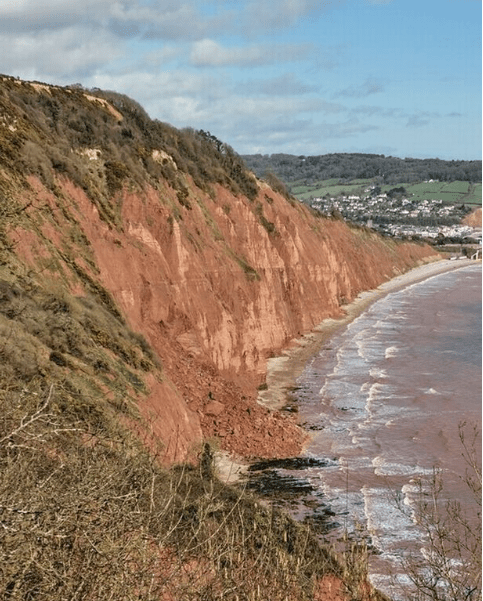
Rocks the size of cars collapse in huge Sidmouth cliff fall

A famous East Devon cliff has collapsed – again. Another huge cliff fall took place in Sidmouth today with visitors and local residents describing rocks the size of cars coming down onto the beach below.

Olivier Vergnault www.devonlive.com

Exmouth coastal scientist Vicky Walkley was sitting on a bench enjoying the view of the coast when she heard a loud rumbling noise. She looked at the famous red cliff below and saw it collapse onto the beach. She said the cliff fall happened today (Sunday March 17) at around 2pm.

The latest collapse has happened at the Jacob’s Ladder end of the beach. The incident was caught on video, which can be viewed at the top of the article.

Vicky said: “The rocks and debris entirely covered the full width of the beach in seconds, which really highlights how dangerous it is to walk next to unstable cliffs like these.

“Even after the main cliff fall had stopped, debris kept on falling. About 10 minutes after the dust settled, a huge rock the size of a car then came crashing down the cliff and rolled along the beach. Luckily there was no one on this part of the beach at the time but if there had been, it could have been tragic.”

The latest cliff fall in Sidmouth (Image: Vicky Walkley)

As a coastal expert with more than a decade’s experience Vicky is familiar with what can trigger cliff falls – even though such incidents remain very difficult to predict.

She explained: “As a coastal scientist for 11 years, I have been working on projects to help the government and local councils assess and predict coastal erosion. Cliff falls are very difficult to predict, they can happen at any time – not just in stormy weather with big waves, but also on calm sunny days like today.”

She added: “All the heavy rainfall we’ve had this winter acts to lubricate the joints in the rock and increase the likelihood of cliff falls. Warm sunshine can also heat the rock, causing it to expand – this can trigger cliff falls too.

“The effects of climate change, including rising sea levels and wetter winters, are likely to accelerate the rates of cliff erosion in future, so it’s important that everyone is aware of these risks when visiting the coast.”

Sidmouth’s cliffs are notorious for crumbling with cliff falls previously taking place at both East Beach and Jacob’s Ladder. In September at the East Beach end of the town, footage captured a “waterfall of earth” coming tumbling down. In October there was another incident at the other end past Jacob’s Ladder.

Trees legal battle in the High Court next week

The outcome will be known in three to six weeks

A judicial review to decide whether Plymouth City Council acted legally when it chopped down more than 100 trees on Armada Way in a late-night operation last March will be heard in the High Court in London next [this] week.

Alison Stephenson, local democracy reporter www.radioexe.co.uk

The case, set for Tuesday and Wednesday, has been brought by protester group Save the Trees of Armada Way (Straw).

It will argue that the council, at the time under Conservative control, used an emergency order to fell the trees as part of a redevelopment plan without full scrutiny.

It will also claim the authority failed to get proper advice to carry out an environmental impact assessment, did not take account of nesting birds and that a report on the consultation was biased.

The hearing was delayed after the now Labour run council tried and failed twice to get the case thrown out. It said the original decision is now “academic” as  there are new plans for Armada Way. The court, though, said the applications were “misconceived”.

Costs to the taxpayer so far from the clean-up operation after the trees were remove, together with subsequent legal costs, are understood to be close to £300,000.

London-based Goodenough Ring Solicitors, acting on behalf of STRAW, are holding more than £28,000 pledged by the public to fight the case through a Crowdjustice campaign.

The firm said that the results of the judicial review would not be known for three-to-six weeks.

It said a further legal action by its client is being considered, alleging a consultation on new plans for Armada Way last October and November failed to provide enough details on the cost.

It was revealed in January that scheme is now likely to cost £37 million, compared with original redevelopment plans of around £13 million.

A spokesperson for Goodenough Ring said a letter before that stage of legal action began had been sent to the council, but a decision had not been taken yet on whether to proceed as it depends on the outcome of next week’s hearing.

In a statement, Straw said: “It’s disappointing that not only are Plymouth City Council still defending what they did last March, but that this hearing did not happen months ago, as it should have.

“Plymouth City Council have been wasting time and taxpayers money, kicking the can down the road, but we are pleased that the hearing is finally happening. I think the people of Plymouth deserve to know if their council has acted unlawfully or not.

“Obviously we hope to win and we hope that this action will send a strong message to all councils that the unnecessary destruction of our trees and green spaces is simply not on.”

A spokesperson for Plymouth City Council said: “The judicial review is based on a decision made by the previous council administration. Following the election last May, the new council leader withdrew that decision when he first took office. Therefore, the original decision, which is subject to the judicial review, was not implemented any further.

 “While we remain hopeful that the judge will agree, it is important to remember that the legal hearing does not impact the current plans to regenerate Armada Way.

“Our city deserves to have a better city centre – a city centre that rivals others across the country and one where people want to live, work, visit, shop and do business in.”

The plan includes more than 200 trees, which is more than previously on Armada Way.

‘Do not swim’ warnings in place at 28 beaches hit with sewage – Saturday

A recently updated sewage map by Surfers Against Sewage (SAS) has revealed that nearly 30 beaches across the South West currently have pollution or sewage warnings in place. Beauty spots such as Exmouth, Sidmouth and Budleigh Salterton as well as Portreath, and Ilfracombe are just a few of the areas where warnings are in place as swimmers are urged to avoid entering the water.

Carl Eve  16/03/2024 www.devonlive.com

The majority of the incidents have been laid at the door of “storm sewage” which has plagued beaches across the South West in recent weeks due to heavy downpours.

The main contributing factor to polluted beaches is urban runoff, which sees fertilizers, pesticides, oil, and untreated human and animal waste entering waterways, such as rivers. They then eventually end up at our beaches.

Swallowing water that could be contaminated with faecal matter could lead to gastroenteritis, hepatitis, giardiasis, skin rashes, amoebic dysentery, nose, ear, and throat problems, pink eye, and other respiratory illnesses. Symptoms to look out for include nausea, vomiting, diarrhoea, cramps, inflamed stomach and intestines.

Beaches currently marked as pollution risks

Sidmouth Town

Pollution Alert: Storm sewage has been discharged from a sewer overflow in this location within the past 48 hours. Rock pools to the west, overhanging cliffs to the east, Sidmouth Town beach compromises 900m of legally protected pebbles broken up by rock groynes and backed by a promenade and the town. Two sewer overflows are located at Sidmouth, one discharges through a long sea outfall some 600m out to sea while the other discharges into the River Sid, just under 400m to the east.

Budleigh Salterton
Pollution Alert: Storm sewage has been discharged from a sewer overflow in this location within the past 48 hours.
Part of the Ancient World Heritage Coastline, Budleigh Salterton is a 2km stretch of resort beach with red cliffs at the western end and the River Otter Estuary at the eastern end backed by a promenade and town. There are three sewer overflows in the area, one discharges directly onto the beach, another 400m east and another that discharges 1.3km away into the sea.

Dawlish Town
Pollution Alert: Storm sewage has been discharged from a sewer overflow in this location within the past 48 hours.
Dawlish Town is on the south coast of Devon. It is a sandy beach resort approximately 650m wide and close to the town and cliffs. There are five sewer overflows covered by the Safer Seas Service here within 650m off the beach which can operate in heavy rainfall.

Teignmouth Holcombe
Pollution Alert: Storm sewage has been discharged from a sewer overflow in this location within the past 48 hours.
A small sand and rock beach located at the base of tall red cliffs, Holcombe is an isolated beach backed by cliffs and a railway line. A sewer overflow discharges into the Holcombe Stream 40m upstream of the beach.

Meadfoot
Pollution Alert: Storm sewage has been discharged from a sewer overflow in this location within the past 48 hours.

Slapton Sands Torcross
Pollution Alert: Storm sewage has been discharged from a sewer overflow in this location within the past 48 hours.
Slapton Sands Torcross is on the south coast of Devon. It is a remote shingle beach, approximately one kilometre wide, backed by Slapton Ley Nature Reserve.

Mill Bay
Pollution Alert: Storm sewage has been discharged from a sewer overflow in this location within the past 48 hours.
Mill Bay Beach is a privately owned beach on the East Portlemouth side of the Salcombe Estuary. The beach can be reached by the local ferry or by car. It is a sheltered beach and is popular with families.

Hope Cove
Pollution Alert: Storm sewage has been discharged from a sewer overflow in this location within the past 48 hours.
Hope Cove is on the South coast of Devon. It is a remote sand and rock beach, approximately 370 metres wide, surrounded by cliffs. There are two sewer overflows which discharge into the sea here which can lead to a temporary drop in bathing water quality especially after heavy rainfall.

Mothecombe
Pollution Alert: Storm sewage has been discharged from a sewer overflow in this location within the past 48 hours.
A traditional family beach, Mothecombe is a remote, sandy beach backed by cliffs and sand dunes. The beach is split into 2 parts with one being private with limited access and the other being free. There are no sewer overflows directly on the beach at Mothecombe however a number of urban areas (Ermington, Ivybridge etc.) can discharge into the River Erme whose estuary Mothecombe is located in.

Plymouth Hoe East
Pollution Alert: Storm sewage has been discharged from a sewer overflow in this location within the past 48 hours.
A small shingle and rock city beach, Plymouth Hoe East is a narrow strip below a promenade and Plymouth Hoe. There is a sewer overflow that discharges SW of the beach and a number more in the surrounding area that support the city of Plymouth. .

Kingsand
Pollution Alert: Storm sewage has been discharged from a sewer overflow in this location within the past 48 hours.
Kingsand is on the south coast of Cornwall. It is a sand and shingle beach resort, approximately 200 metres wide, close to the village of Kingsand. The Environment Agency carried out additional monitoring in the Kingsand Stream between 2010 – 2015, and made recommendations for further improvements to protect and improve the bathing water quality.

Seaton (Cornwall)
Pollution Alert: Storm sewage has been discharged from a sewer overflow in this location within the past 48 hours.
A mixture of grey pebbles and coarse sand forms this remote beach surrounded by gently sloping cliffs. It is located at the entrance to the Seaton Valley Country Park and is one of the few beaches in the area to offer great surfing conditions. There are a few sewage overflows from local sewage treatment works discharging upstream into the River Seaton which meanders across the beach.

Millendreath
Pollution Alert: Storm sewage has been discharged from a sewer overflow in this location within the past 48 hours.
Millendreath is a small, sandy beach backed by cliffs and hills with a stream flowing across it. A sewer overflow from the Plaidy pumping station discharges off the rocks to the West of the beach and another from the urban area can discharge through the stream.

East Looe
Pollution Alert: Storm sewage has been discharged from a sewer overflow in this location within the past 48 hours.
A small sand and rock beach resort located at the mouth of the River Looe, East Looe is close to the town of Looe and so gets very busy. No sewer overflows discharge directly onto the beach here, however several discharge into the River Looe Estuary and catchment upstream.

Readymoney Cove
Pollution Alert: Storm sewage has been discharged from a sewer overflow in this location within the past 48 hours.
Readymoney is a small, sandy, remote beach located at the mouth of the River Fowey. It is in a cove sheltered by tall cliffs between St Catherines Castle and the medieval part of Fowey. A sewer overflow discharges 100m from Readymoney beach and others discharge into the Fowey Estuary.

Pentewan
Pollution Alert: Storm sewage has been discharged from a sewer overflow in this location within the past 48 hours.
Pentewan, located on the south coast of Cornwall, is a privately owned sandy beach resort, approximately 1.1km wide. There is an emergency sewer overflow from the Pentewan pumping station that discharges to the St Austell River 250m from the beach. Within the Pentewan bathing water catchment there are four emergency sewer overflows that discharge into the St Austell River at least one and a half kilometres upstream of the bathing water.

Porthluney
Bathing not advised due to poor annual classification.
A sheltered and sandy beach popular with swimmers, it is backed by the grounds of Caerhays Castle. There is a ban on motorised watercraft here to maintain the peace and quiet.

Swanpool
Pollution Alert: Storm sewage has been discharged from a sewer overflow in this location within the past 48 hours.
Swanpool is a pebble and sandy beach resort approximately 140m wide and backed by the Swanpool Nature Reserve. There is an emergency sewer overflow from the Queen Mary Gardens pumping station that discharges to the sea approximately 420m east of the bathing water.

Perranuthnoe
Pollution Alert: Storm sewage has been discharged from a sewer overflow in this location within the past 48 hours.
A small, rural, sandy beach with some rock and shingle areas. Cliffs and a quaint village back the beach. There are no sewer overflows discharging directly at Perranuthnoe, however, there are a number in the nearby Mounts Bay that may affect bathing water quality here. We receive sewage discharge alerts here from the Perranuthnoe pumping station overflow.

Long Rock
Pollution Alert: Storm sewage has been discharged from a sewer overflow in this location within the past 48 hours.
The second of four beaches enclosed in Mounts Bay, Long Rock beach is a one kilometre stretch of sand backed by sea defences. Within the catchment area of Heliport beach there is a sewer overflow that discharges into the Ponsdale Brook, 130m upstream of the beach, three that discharge into Trevaylor Stream and four more sewer overflows that discharge into the sea east and west of the beach.

Portreath
Pollution Alert: Storm sewage has been discharged from a sewer overflow in this location within the past 48 hours.
Portreath is large beach with soft fine sand, with shingle below the shoreline and is popular with families. The harbour wall is popular with experienced surfers for its vortex surf break. On the left-hand side, the beach has a small stream running down to the sea. A few hundred metres off the coast is the huge Gull Rock, which as the name suggests is something of a haven for seabirds of all kinds. Portreath is a popular family beach which, like many beaches on the north Cornish coast, is attracts surfers and in particular bodyboarders. The beach backs onto the small town offering most facilities including several shops, toilets and cafes. The sewage from Redruth is pumped to a sewage treatment works (STW) at Kieve Mill to the northwest of Camborne. The treated sewage is then discharged to the sea at North Cliffs approximately three and a half kilometres to the southwest of Portreath.

Instow
Bathing not advised due to Poor annual classification.
Instow has been classified as Poor for five consecutive years, meaning it has been de-designated and permanent advice against bathing is in place. Instow is a pretty and sandy beach that tends to get very busy during the summer. Calm waters, protected from swell by sandbanks at the mouth of the Taw estuary, make this a good choice for families. There are also shops and cafes in the village, which is directly behind the beach.

Ilfracombe Hele
Pollution Alert: Storm sewage has been discharged from a sewer overflow in this location within the past 48 hours.
Hele beach is a small, sand and shingle cove just to the east of Ilfracombe. It is located in an Area of Outstanding Natural Beauty and is sheltered from the prevailing winds. A sewer overflow discharges to the sea some 280m to the east of the beach. Other overflows from Ilfracombe urban area may also affect water quality here.

Dunster North West
Bathing not advised due to Poor annual classification.
A large pebble and sand resort beach backed by Chalets, Dunster North West faces into the Bristol Channel and is just east of the popular seaside resort of Minehead.

Burnham Jetty North
Bathing not advised due to Poor annual classification.
Just to the north of the rivers Brue and Parnett estuaries, Burnham Jetty North is a large, sand and mud, gently sloping beach resort backed by sea defences with a large tidal range. Although there are no sewer overflows discharging directly onto the beach, there are several within the catchment area that discharge into the rivers. More overflows from the surrounding urban area may also affect bathing water quality here.

Weston-super-Mare Uphill Slipway
Bathing not advised due to Poor annual classification.
Uphill Slipway is a sandy beach resort next to the mouth of the River Axe. It has a large tidal range and areas of mud are exposed at low tide. It is just south of the popular seaside resort of Weston-super-Mare. A sewer overflow discharges into the sea at the southern end of the beach while sewer overflows from the surrounding urban area discharging into the River Axe and may affect water quality especially after heavy rainfall.

Weston Main
Bathing not advised due to Poor annual classification.
Located close to the popular seaside town of Weston-super-Mare, Main beach is a large stretch of sand with a pier. Two sewer overflows discharge directly into the sea here – one at the northern extent of the beach and one 2km to the south. The bathing water quality may also be affected by discharges from the surrounding urban catchment area.

Weston-super-Mare Sand Bay
Bathing not advised due to Poor annual classification.
A sand and shingle beach resort, approximately 5km wide and backed by sand dunes. There is a saltmarsh at the northern end, and Sand Point Headland is a Site of Special Scientific Interest (SSSI). The outfall from Weston-super-Mare STW discharges to the sea at Black Rock 5km south of Sand Bay.