Watchdog has no idea how much sewage is spilling into protected Lake District site

The EA requires water companies to provide data on storm overflow usage but not for emergency overflows (EO). Thanks to Peter Williams we know about the EO at Budleigh’s Lime Kiln pumping station. There must be more. Where are they? – Owl

Lucie Heath inews.co.uk

The watchdog responsible for preserving the environment has no idea how much sewage is being spilt into a protected body of water in the Lake District, i has learnt.

Although the lake is showing signs of environmental damage, the Environment Agency (EA) is not collecting any data on the amount of sewage being dumped into it from an “emergency overflow” pipe.

Esthwaite Water is a 280-acre (1.13 km2) lake connected to England’s largest lake, Windermere. It is known as being the favourite spot of children’s author and former Lake District resident Beatrix Potter, but it now frequently contains algal blooms that can be deadly for the lake’s aquatic life.

While the EA monitors other sewage overflows in the Windermere catchment for spills, the one in Esthwaite remains a blind spot. This is because the watchdog does not track every situation in which water companies dump raw sewage.

Campaigners accused the EA of “failing in its role as regulator”, and called on the watchdog to do more to investigate the sources of pollution in the region to protect the once pristine lake from sewage spills.

It is “absolutely absurd that untreated sewage is being allowed to discharge into a site of special scientific interest – let alone that it’s going unmonitored,” said Matt Staniek, a conservationist and founder of the Save Windermere campaign.

Esthwaite Water has been designated a site of special scientific interest, the name given to areas in the UK that are afforded special protections – for example from development or agriculture – due to their environmental importance.

The lake is also one of the UK’s 141 Ramsar sites, the name given to wetlands deemed to be of international importance, for example due to the wildlife they support.

But several sites in the Lake District, including Esthwaite Water, have shown signs of deterioration over a period of decades, partly due to sewage pollution.

Frequent algal blooms have been observed at Esthwaite Water, a sign of high nutrient levels as a result of sewage and agricultural pollution.

Algal blooms are harmful to freshwater ecosystems as they restrict oxygen levels and in more serious cases can cause mass fish deaths. These blooms can also produce toxins that make humans sick.

The local water company, United Utilities (UU), is allowed to release sewage into the lakes and rivers within the Windermere catchment from various sites.

Usually this sewage is treated at a wastewater treatment plant before being released into the environment, but UU is also permitted to discharge untreated waste during periods of heavy rainfall if its infrastructure is becoming overwhelmed. It does this through pipes called ‘storm overflows’.

The EA requires water companies to provide data on storm overflow usage but not for emergency overflows, such as the pipe releasing sewage into Esthwaite Water.

Concerns have been raised over how often water companies are utilising overflows both within the Lake District and across the wider country.

Latest official figures show water companies in England and Wales spilled from storm overflows more than 380,000 times in 2022, adding up to over two million hours, including 5,904 hours in the Windermere catchment.

But, as i recently revealed, these figures do not show the whole picture because the EA is not currently monitoring water companies’ use of emergency overflows. These can be used to dump untreated sewage during emergencies such as an electrical or mechanical failure.

The watchdog currently only requires water companies to monitor these overflows if they discharge sewage in designated shellfish water, meaning just 10 per cent of England’s almost 7,000 emergency overflows are monitored.

While these overflows are only supposed to be used in rare circumstances, the data available shows some are being used frequently, including those operated by UU.

This includes another emergency overflow in the Lake District, on the banks of Lake Ullswater, that spilled 34 times in 2022, amounting to a total 660 hours.

One of the unmonitored emergency overflows is attached to a pumping station that sits on the western banks of Esthwaite Water.

The only publicly available data on Esthwaite pumping station is patchy, covering a series of months between 2013 and 2017.

It shows the site spilled intermittently during this period, including 17 times during October 2015.

“It’s potentially a big spiller but where is the data? If there was data previously why is there not data now?” asked Mr Staniek.

The conservationist has tried to obtain data about the site, including how often it is has experienced technical failures, through submitting Environmental Information Requests to both the EA and UU.

However, the EA said it did not hold the data he asked for, while UU refused to provide the information.

Mr Staniek said: “Esthwaite holds international ecological significance, yet the Agency is not fully holding United Utilities accountable for the damage being inflicted upon it.”

He called for a public inquiry into the EA, which he said was “failing in its role as regulator”.

‘Transparency is fundamental’

Earlier this year research published by the charity WildFish in collaboration with Save Windermere sampled every river in the Windermere catchment and found a decline in insects in areas near where sewage is discharged.

The groups raised concerns about the impact on wider ecosystems in the area, describing the invertebrates as a “key component of a river’s food web”.

WildFish chief executive Nick Measham said the EA “should be carrying out more monitoring” at Esthwaite, as the lake is “clearly suffering from the impact of too much phosphate or nutrients going into it”.

“In general we would call for all water company discharges to be monitored and for water companies and the Environment Agency to make all of that data available to independent scrutineers. Transparency is fundamental to accountability. At the moment we have water companies that are not transparent and patently not accountable,” he said.

The Environment Agency said: “We are requiring companies to monitor all emergency overflows from 2025, including at Hawkshead and Esthwaite Lodge pumping stations. This is in addition to the 100 per cent of storm overflows in England, which are already monitored. Emergency overflows are different and must only operate in urgent circumstances like electrical powers failures or mains bursts.

“Water companies must already report any discharges of sewage in emergency overflows. We investigate any instances where permits are not being followed and take enforcement action if necessary.”

United Utilities was approached for comment but did not respond.
After 13 years, Tories now need your help to stop pollution

The’re flush out of ideas!

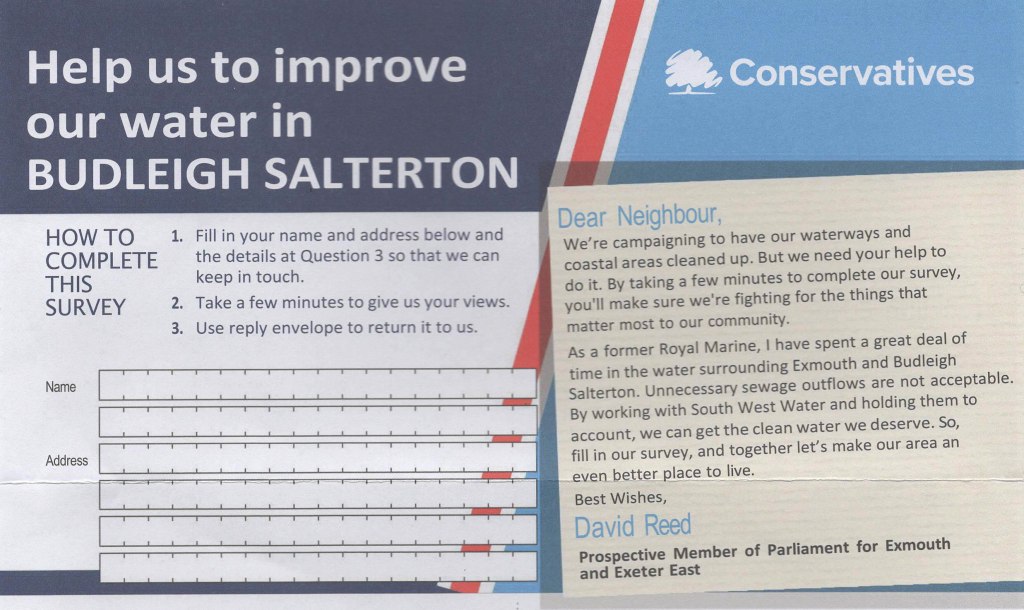
One of Owl’s old feathered friends was puzzled to receive this plea from a “neighbour”:

“Help us improve our water in Budleigh Salterton.”

This “neighbour” turned out to be David Reed, the prospective Tory candidate for the redrawn constituency of Exmouth and Exeter East who doesn’t live in the “neighbourhood”.

Owl’s friend thought that the Conservatives had sorted the problem “once and for all” with the publication of their “Storm Overflows Reduction Plan”.

The policy David Reed is stuck with is one of gradual improvements over the next 26 years.

Left to Conservatives “values” our young candidate will be an old man nearing his 60s before overflows are a thing of the past.

The current MP for Budleigh is the itinerant Simon Jupp. He explained, in the first Westminster Hall debate he proudly led last March why conservatives won’t move any faster:

“……Of course, in a perfect world, we would stop sewage spills completely and immediately. Sadly, that is virtually impossible in the short term; because of the pressure on our water infrastructure, we would risk the collapse of the entire water network, and the eye-watering costs involved mean we would need not just a magic money tree, but a whole forest.

The same point was also made by Thérèse Coffey in her introduction to the policy paper.

Storm Overflows Discharge Reduction Plan Updated: 25 September 2023

In this Plan, we are setting new targets which will revolutionise our sewer system and generate the most significant investment and delivery programme ever undertaken by water companies to protect people and the environment:

• By 2035, water companies will have: improved all storm overflows discharging near every designated bathing water; and improved 75% of storm overflows discharging into or near ‘high priority sites’ (as defined in Annex 1). 

• By 2045, water companies will have improved all remaining storm overflows discharging into or near ‘high priority sites’.

• By 2050, no storm overflows will be permitted to operate outside of unusually heavy rainfall or to cause any adverse ecological harm.

The die is cast with the Tories and Owl’s friend thinks the best way to make progress on improving water is to follow a different path:

Sewage bursts through manhole covers into rare chalk stream for 10 weeks

Raw sewage has been flowing from manholes into a rare chalk stream in Berkshire for more than two months as Thames Water’s infrastructure has struggled to cope with continuing wet weather.

Lucie Heath inews.co.uk 

The village of Lambourn, that sits within the North Wessex Downs Area of Outstanding Natural Beauty, has been littered with toilet paper, tampons and “lumps of faeces”.

Samples of the River Lambourn by the local river’s trust found phosphate – which damages rivers and aquatic life – in quantities more than 100 times the recommended level for the protected watercourse.

Thames Water said the problem was a result of the area experiencing one of its wettest winters on record, which has resulted in groundwater levels reaching a 30-year high.

i has reported on multiple incidents of raw sewage flowing through villages, gardens and into rivers this winter as water companies across the UK have struggled to cope with heavy rainfall.

Months of wet weather has resulted in rising levels of groundwater, which is water found underground in the space between soil and rocks. This groundwater can infiltrate through cracks into sewage infrastructure, causing pipes to overflow.

In Lambourn, this contaminated water has been flowing out of three manhole covers down the streets and into the river.

Thames Water has set up a filter that separates solids before this water enters the river, however the water is not being treated for pollutants. Local campaigners claim some solids are still making their way into the river.

Pictures from the village show the streets littered with toilet paper and human waste.

Contaminated water flowing into the River Lambourn (Photo: Action for the River Kennet)

Anna Forbes, the senior project officer at Action for the River Kennet (ARK), the local river’s trust for the area, said the problem is not new for the village. However, the situation has been particularly bad this year, with sewage flowing out of the manholes for the past 10 weeks, she claimed.

“It’s just horrible that you’ve got this beautiful little village and yet people are walking through untreated sewage.

“It absolutely stinks. You feel like you’re breathing it in… there are places where you can’t avoid walking through it.”

On Saturday ARK carried out testing directly where the sewage is entering the river and found phosphate levels at 4.42mg/litre, which is 110 times higher than Natural England’s recommendation for a body of water with the same protections as the Lambourn (0.04mg/litre).

Thames Water said it regularly monitors water quality of the River Lambourn and said this testing shows “a minimal impact on the environment because the flows are heavily diluted by the groundwater and surface water run-off”.

High levels of phosphates are damaging to rivers as it causes algal blooms, which can starve aquatic life for oxygen.

Nutrient pollution is a particular concern for chalk streams, such as the Lambourn, because they are a globally rare habitat.

Ms Forbes said: “There are only 260 of them [chalk streams] in the world and 224 of them – so over 85 per cent – of them are here in England.

“And when they’re healthy, because of their unique qualities, it’s a really fragile ecosystem that sustains a wealth of wildlife. So things like mayfly, brown trout, water voles, otters, kingfishers, all these wonderful native species we’ve got, but many of them rely on the river being healthy, with good water quality being key.”

Thames Water said: “We’re sorry that customers have been affected as our sewers have become overloaded by floodwaters in the River Lambourn area. The excessively heavy rain that the region has experienced means the groundwater and river levels remain very high in this area and the ground is saturated. A significant amount of this water is entering the local sewer system and causing flooding from manholes.

“We are working hard to keep our sewers flowing and to prevent further flooding. We’re carrying out daily clean-ups where the manholes have been overflowing in Lambourn and we’re using tankers at our sewage pumping station in Upper Lambourn 24 hours a day to help manage excess flows in the sewers. We also have a filter unit in place near Lambourn fire station, which uses a pump to take the excess water out of our foul sewer, so it can be screened and then safely returned to the river.

“We’re continuing to work closely with the Lambourn Valley Flood Forum and we continue to investigate where groundwater and surface water is getting into the sewer system. We’ve previously installed 10.1km of leak-tight liners in our sewers, and have sealed 122 manholes in the local sewer network.”

Covid hits a three-year low but it will be back, scientists warn

Covid infections in the UK are at their lowest level in nearly three years, tumbling to just a fifth of the level they were before Christmas, according to the latest figures.

Tom Bawden inews.co.uk 

Official data shows that 0.9 per cent of the population in England and Scotland – less than 1 in 100 – had Covid in mid-February, compared to 4.6 per cent in late December.

This is the lowest level since July 2021 decline was helped as immunity from boosters and previous infections built up and the weather warmed up.

The figures were reported in the latest UK Health Security Agency and ONS infection survey.

However, while scientists welcomed the drop in infections, they cautioned that the virus is not going anywhere.

They warn that it will be around for years to come – probably at lower levels and with fewer spikes, but still present and with the possibility of a resurgence if a nasty new variant develops.

They say a new wave is likely in the autumn with smaller spikes also a possibility later in the spring or in the summer – depending on whether dangerous new variants develop, how well immunity holds up and how many people get a booster in the spring.

“Covid infections are here for ever. They will never go away,” said Professor Paul Hunter, of University of East Anglia.

(Source: UKHSA. The gap in the graph relates to a period in which the government stopped surveillance.

He predicts “a series of waves”, driven by the weather – with more cases in the winter – and contagious new strains, known as escape variants.

“I know we will see another wave in the autumn and we can say pretty definitely that infections will peak each year around December and January for the rest of our lives – although the burden of disease from Covid will continue to decline over coming years,” he said.

“Whether we see significant spring summer peaks is uncertain. Unless a new escape variant appears any spring or summer peak will probably not be that great.”

Professor Steve Griffin, of Leeds University, thinks it more likely we will see a resurgence in the next few months.

“I would be surprised if we don’t see another wave before the summer given the rate at which the virus is evolving and the absence of effective vaccination since autumn.

“The total lack of public health mitigations continues to be detrimental, causing absence, loss of work and profound health issues. Just because this isn’t winter 2020/21, it doesn’t mean we can ignore it. To live with something, we must understand and adapt, not pretend it isn’t there.”

Professor Lawrence Young, a virologist at Warwick University, agreed that “there is no room for complacency” despite the fall in Covid cases.

“Covid is here to stay. It is still circulating and, more worryingly, changing. We are likely to be confronted with new virus variants that could be more infectious and more able to dodge the immune protection from vaccination,” he said.

“There is also the worrying issue of the long term consequences of infection and increasing evidence that this virus can lurk in our bodies for many months after initial infection.”

Professor Young says there was a risk of a new round in the coming weeks and months as people start to mix more, although he expects any peak to be well below previous records.

“We need to keep an eye on infection levels over the next few months as people start to mix – particularly at various big events, such as the Cheltenham Gold Cup next week – and start travelling abroad on holidays over Easter.

“It is very unlikely that we see levels of infection that we experienced in previous years but the behaviour of this virus is unpredictable. So much will depend on whether new virus variants emerge and the levels of immunity in the population.”

He added: “The big question is what will happen with boosters over the Spring. The current advice is that only adults aged over 75 years, residents in care homes, and anyone aged six months or over who is immunosuppressed, will be eligible for free Covid vaccines.

“There will also be private access to them from April at £45 and appointments are now bookable. How many people will decide to have a booster jab and what this will mean for levels of population immunity is another uncertainty.”

Professor Rowland Kao, of Edinburgh University, is hopeful that things are improving but says we “are not totally out of the woods yet”.

However, “the longer we go without another major variant of concern that leads to massive rises in severe cases, then the more optimistic we can be.

“I would like to see what happens this summer. If we go through the summer without further major spikes – remember we had smaller surges in May and September last year – I would be more confident that Covid is settling down into more of a seasonal and predictable pattern.

“This would still be important because of the illness it does cause, but means it is more likely to be predictable the way seasonal flu, RSV and others are. And predictability matters a great deal.”

New plan for council’s former Knowle HQ

It’s not much different to one previously rejected.

Plans to knock down the former council offices at the Knowle in Sidmouth for a care and retirement development have been submitted for approval again after being refused in January. 

Will Goddard, local democracy reporter www.radioexe.co.uk 

But the only change is the removal of a handful of balconies from one side of a block of retirement flats. 

East Devon District Council (EDDC)’s former HQ, which was also once a hotel, was severely damaged by fire in a suspected case of arson last March. 

Retirement homes specialist McCarthy and Stone wants to demolish it and build a 70-bed care home, 53 assisted living apartments for over-70s and 33 apartments for over-60s, as well as non-age-restricted properties in the form of four semi-detached homes and a terrace of three townhouses. 

A former caretaker’s building would have been kept, and another purpose-built structure erected, for bat habitats. 

EDDC’s planning committee refused the application two months ago on grounds the design of the two southerly blocks would not have reflected “local distinctiveness”, and the block of flats for over-60s with its “large windows and balconies” would have been too overbearing on properties in Knowle Drive to the west. 

The fresh plans ask permission for the same as before with only a minor change: removing the second-floor balconies on the western side of the over-60s block. 

This will “provide a lessening of impact… upon the residential and visual amenities of the occupiers of neighbouring [properties] in Knowle Drive”, according to planning documents. 

They also hope the revised plans will allow “more detailed discussions” with EDDC to address the reasons for refusal, which could lead to further changes and “potentially avoid the need to take the scheme to an appeal”, planning documents say. 

So far, members of the public seem largely unimpressed by the new proposals, with 23 objections and two comments in support. 

David and Naomi Hogg, objecting, describe the removal of the balconies as a “minimal attempt to address the issue of overlooking and overbearing”.  

They said: “It fails to recognise the significant overbearing effect caused simply by the fact that this three-storey block would be built on substantially higher ground than that of the neighbouring properties on Knowle Drive.” 

But Norma Pearce writes in support: “As an elderly resident of Sidmouth and an intended future occupant of this comprehensive development… The current amended proposal re: removal of balconies is an appropriate price to pay, to preserve the privacy of nearby residents.” 

Conservatives lose control of last borough council in Surrey

Oops! – Owl

Surrey’s last district and borough council with a Conservative majority has gone to no overall control.

BBC news South East

Reigate & Banstead Borough Council, one of 11 lower tier councils in Surrey, had a Conservative majority of one after 2023’s local elections.

But with Councillor Zelanie Cooper, who represents Lower Kingswood, Tadworth and Walton, stepping away from the Conservatives, the council is left without a majority party.

The Surrey Conservatives have been contacted for comment.

Ms Cooper said she had left the party over concerns about candidate selection, meaning the Conservatives now have 22 of 45 councillors.

She said: “With the support of a significant number of local residents, who believe that local councillors should represent them in local elections, I have chosen to step away from the Conservative Party.”

She will stand as an independent councillor at the next local election on 2 May, when one third of councillors will be up for election.

Surrey County Council still has a Conservative majority and all 11 Members of Parliament for Surrey represent the Conservative Party.

They include Chancellor Jeremy Hunt in South West Surrey and Michael Gove in Surrey Heath, the Secretary of State for levelling up, housing and communities.

Surrey’s two tier system means the responsibilities for different services lie with either the county or the district and borough councils.

A Reigate & Banstead Borough Council spokesperson said any decision needed regarding political balance of the council would be taken at the next full council meeting on 28 March.

Elsewhere in Surrey, at May 2023’s elections the Liberal Democrats took control of Guildford and Surrey Heath and increased the majorities they already had at Woking and Mole Valley.

Other councils are run by residents’ parties or as coalitions between parties, while Runnymede Borough Council is led by a Conservative, who have 19 of the 41 seats.

Analysis

By Jack Fiehn, BBC Radio Surrey political reporter

The political control at Reigate & Banstead could change soon, either following a council meeting at the end of March or the local elections at the beginning of May.

For example, at the elections, the Conservatives could make the gains they need to retake overall control. Or they could lose seats, altering the calculation again.

But it is worth taking a moment to mark the contrast in the Tories’ fortunes.

As recently as 2015, the party had majorities on and ran 10 out of 11 of the borough or district councils in Surrey (Epsom & Ewell being the exception).

Now it is only Reigate & Banstead and Runnymede where they are still the main force.

Jeremy Hunt’s Budget failed to address ‘the real challenges’ facing UK, IFS warns

Jeremy Hunt’s Budget failed to address the “real challenges” facing Britain, the boss of Britain’s most influential economic think tank has warned.

Archie Mitchell www.independent.co.uk 

Paul Johnson, director of the Institute for Fiscal Studies (IFS), laid bare the chaos facing the NHS, local authorities, social care and the justice system, and said the chancellor had not been “transparent” about the scale of the problems.

And, in a damning assessment of the Conservative government and Labour, he said both are engaged in a “conspiracy of silence” about just how bleak the outlook for the country is.

In his widely-watched post-Budget analysis, Mr Johnson said: “This was not a budget which addressed the real challenges we are facing because it was not transparent about what those challenges are.

“Government and opposition are joining in a conspiracy of silence in not acknowledging the scale of the choices and trade-offs that will face us after the election. They, and we, could be in for a rude awakening when those choices become unavoidable.”

As the impacts of the chancellor’s Budget became clear:

  • The IFS said Jeremy Hunt had failed to address the “real challenges” facing the country
  • Its director accused Labour and the Conservatives of engaging in a “conspiracy of silence” about those challenges
  • The Resolution Foundation said living standards would fall this parliament for the first time on record 
  • Rishi Sunak doubled down on Jeremy Hunt’s suggestion that the Tories would seek to scrap national insurance, a move branded “reckless” by Labour 
  • Mr Hunt claimed he was bringing down the tax burden “in a way that is responsible and protects our public services”
  • Shadow chancellor Rachel Reeves said the government had “given with one hand and taken much more with the other”

Mr Johnson said Mr Hunt’s Budget “did not change anything very significantly… which is a shame”.

The economist said the national debt is at its highest in 70 years and “showing no signs of falling”, while interest payments soar. And he highlighted a “worrying increases in the number of individuals moving onto health and disability related benefits”, which brings its own “huge challenges” to the public purse.

And, after Mr Hunt offered voters a pre-election bung in the form of a 2p national insurance cut, Mr Johnson said the Budget came with “big implicit cuts in public investment spending overall and cuts to many areas of day-to-day spending on public services despite very obvious signs of strain in many areas”.

Rachel Reeves accused the chancellor of giving with one hand and taking ‘much more’ back with the other

“One only has to look at the scale of NHS waiting lists, the number of local authorities at or near bankruptcy, the backlogs in the justice system, the long-term cuts to university funding, the struggles of the social care system, to wonder where these cuts will really, credibly come from,” he added. Mr Johnson warned that cuts to day-to-day spending on a range of public services outside of health, defence and education, will have to fall by around £20 billion.

The damning verdict came as the Resolution Foundation warned that Rishi Sunak and Mr Hunt will oversee the first ever fall in living standards between elections despite Wednesday’s tax-cutting Budget, the Resolution Foundation has warned.

In its own withering assesment of the state of the economy, the think tank said this has been a parliament of “flatlining growth” and falling living standards.

And, even accounting for the chancellor’s national insurance giveaway, the Resolution Foundation said that by the next election, households’ disposable income will have fallen by 0.9 per cent – the first parliament in modern history to see a fall in living standards.

Chief executive Torsten Bell said: “Budgets are always a big day for Westminster, but the big picture for Britain has not changed at all. This remains a country where taxes are heading up not down, and one where incomes are stagnating.”

And he told BBC Radio 4’s Today programme: “If you look over the course of the last 15 years, what we see is that our wages today are back where they were in 2008.

“In fact, the Office of Budget Responsibility (OBR) says we won’t get back to 2008 wage levels until 2026.

“That’s 18 last years of wage growth.”

The think tank also pointed to the “implausible” post-election spending cuts pencilled in by Mr Hunt to give him room for the tax handouts without breaching his so-called “fiscal rules”.

Mr Bell added: “Big tax cuts may or may not affect the outcome of that election, but the task for whoever wins is huge.

“They will need to both wrestle with implausible spending cuts, and also restart sustained economic growth – the only route to end Britain’s stagnation.”

It comes after Mr Hunt used Wednesday’s Budget, likely the last before an autumn general election, to cut 2p from national insurance, saving a person on an average £35,000 salary around £450 a year. Combined with a cut last autumn, the chancellor said average earners would now be £900 better off.

But despite the handout, which Mr Hunt and the PM had hoped would boost the Tories’ dire poll ratings, experts warned the savings for voters had been eclipsed by the amount taken back through so-called stealth taxes.

The highly respected Institute for Fiscal Studies (IFS) said for every £1 handed back to voters by the chancellor, the decision to freeze tax thresholds would claim £1.30 as taxpayers are dragged into higher brackets.

Defending his Budget on Thursday, Mr Hunt said he was bringing down the tax burden “in a way that is responsible and protects our public services”.

“That’s what I have done in the autumn statement and the spring Budget, if you want to see that continue then it is only the Conservative Party that wants to bring down the tax burden,” he told Sky News.

Mr Hunt also doubled down on the suggestion he wants to phase out national insurance as a tax altogether, describing it as an “unfair” levy. He admitted it will not happen “any time soon”, but suggested one option would be to merge income tax and national insurance.

Pressed on whether Wednesday’s Budget set the stage for a May 2 election, Mr Hunt insisted it was a decision for Mr Sunak, whose current plan is to go to the country this autumn.

It came as shadow chancellor Rachel Reeves savaged the Budget, highlighting Labour analysis of OBR figures which show average families will be left £870 per year worse off by Mr Hunt’s measures.

“The government have given with one hand and taken much more with the other,” she told Today.

Potential unexploded bombs delay Exmouth sea wall repairs

EDDC’s scrutiny committee to look into how the authority allowed businesses and infrastructure at Sideshore to be built next to the part of the sea wall that has failed.

Was “due diligence” carried out on our behalf by the “Build,build,build” Tories? -Owl

Will Goddard, local democracy reporter www.radioexe.co.uk 

Delays were also caused by a change in design

Emergency repairs to Exmouth’s crumbling sea wall are set to begin this month after being delayed because of a change to the design and checking for unexploded bombs.

But costs have skyrocketed, and part of the project is to be pushed back until autumn. 

Cracks appeared in the structure in front of the Sideshore watersports and retail development last August.  

A subsequent storm weakened the wall further and put it at risk of collapse, but temporary repairs of concrete blocks and sand have since held it together. 

This section, which is believed to be around 100 years old, does not have foundations. This, together with low beach levels, has allowed waves to wash out sand from underneath. 

East Devon District Council (EDDC) had wanted to start installing a 255-metre barrier of steel sheet piles at the wall in January for £1.1 million. Cladding the steel piles later was projected to come to just over £2 million. 

But now the work will be split into two smaller phases, and costs have soared because of poor ground conditions. 

The first phase will begin in the next two weeks and replace 90 metres of failed wall near Sideshore. It should be complete by the end of May and will cost £1.5 million. Work will not take place over the four-day Easter bank holiday weekend. 

The second phase will tackle 115 metres of ‘at-risk but still-intact’ wall towards Coastwatch House, minus the slipway. Work on this section has been pushed back to September at the earliest and will come to an estimated £1.8 million. 

Cladding the steel piles should cost just shy of £1 million, bringing the total amount up to £4.3 million.  

EDDC hopes it will be able to get a grant of £1.1 million from the Environment Agency to help. 

Cllr Geoff Jung (Lib Dem, Woodbury and Lympstone) said: “There is no choice, we have to do it.  

“We want it to be just as good as before, if not better aesthetically, and provide protection from increased risk from climate change.  

“We will endeavour to find funding from elsewhere, but we need to be prepared to dip into our reserves on this one, and probably put back some other projects that are less urgent.” 

Delays to the project are down to having to change the design because of poor-quality ground, figuring out how to work around businesses and a risk of unexploded bombs in the area requiring more surveys. 

The second phase has been deferred amid concerns piling could damage businesses along the wall towards Coastwatch House. 

There are suggestions one or two of the buildings could be moved next to the western-most building to make the repairs simpler and cheaper. But this would be “extremely risky” for the council to undertake without following proper planning procedure, which would need more time. 

The steel sheet piles will initially be installed without cladding. They will last for around 100 years once clad.  

The 90 metres of wall in the first phase will be replaced with a vertical wall, while the second phase could keep its current sloped revetments.

Councillors also agreed for EDDC’s scrutiny committee to look into how the authority allowed businesses and infrastructure at Sideshore to be built next to the part of the sea wall that has failed. 

Tories and Labour in conspiracy of silence about post-election cuts – IFS chief

Both the Conservatives and Labour are engaged in a “conspiracy of silence” about public spending after the election, the head of the Institute for Fiscal Studies has said.

Christopher McKeon www.independent.co.uk

Paul Johnson, director of the respected think tank, said Wednesday’s Budget had not been transparent about the challenges facing the UK, pencilling in significant cuts to public spending for after the election without setting out what that would involve.

The prospective cuts are required to ensure the Government meets its fiscal rule to have debt falling in five years’ time, and involve cutting spending on unprotected departments – including courts, prisons and local councils – by around £20 billion, and cutting public investment by £18 billion a year in real terms.

Government and opposition are joining in a conspiracy of silence in not acknowledging the scale of the choices and trade-offs that will face us after the election.

They also assume that the “temporary” freeze on fuel duty will end, something that has not happened in the last 15 years.

Mr Johnson said: “Maybe that is possible, but keeping to these plans would require some staggeringly hard choices which the Government has not been willing to lay out.

“Indeed, we heard yesterday that the next spending review, in which these choices will have to be announced, will rather conveniently not happen until after the election.

“One only has to look at the scale of NHS waiting lists, the number of local authorities at or near bankruptcy, the backlogs in the justice system, the long-term cuts to university funding, the struggles of the social care system, to wonder where these cuts will really, credibly come from.”

While he was doubtful that the Conservatives would deliver their current spending plans, Mr Johnson also expressed scepticism that Labour would oversee significant cuts to public spending if it won the election.

He said: “Government and opposition are joining in a conspiracy of silence in not acknowledging the scale of the choices and trade-offs that will face us after the election.

“They, and we, could be in for a rude awakening when those choices become unavoidable.”

He went on to dismiss the Chancellor’s stated ambitions to abolish employees’ national insurance contributions and increase defence spending to 2.5% of GDP without further detail on how they would be funded as “unlikely”.

He said: “Remarkably, Mr Hunt stuck with the claim that he wants defence spending to rise to 2.5% of national income ‘as soon as economic conditions allow’.

“Well, economic conditions allowed a £10 billion cut in NICs this year. So they could have allowed a £10 billion increase in defence spending instead.

“That would have just about met the target. Actions speak louder than words.”

On national insurance, he added: “This pledge to cut taxes by more than £40 billion goes in the same bucket as pledges to increase defence spending – not worth the paper it’s written on unless accompanied by some sense of how it will be afforded.”

Speaking to broadcasters on Thursday, Rishi Sunak declined to explain how he would fund an abolition of national insurance, saying people “trust me on these things” and that he would only cut taxes “responsibly”.

Westminster Hall debate on South West Water 5 March led by Simon Jupp

Introduction

“The costs of cleaning up coastal waters, a national resource, have not fallen fairly across the country. Thirty percent of the cost has fallen on Devon and Cornwall, which have just 3 percent of the nation’s population.” Written in a policy paper in 1996 that still chimes today.(Richard Foord).

What was Simon Jupp’s aim in calling this third parliamentary debate so late in the electoral cycle when there is insufficient time for any meaningful government action?

Perhaps all that Tories can do at this stage is to come out fighting.

Simon Jupp sets the scene

Thanks to this Conservative Government, we finally have the tools to hold South West Water to account. It is the biggest crackdown on sewage spills in history: the Government have introduced unlimited fines, accelerated investment plans, legal targets to reduce discharges from every single storm overflow and eliminate all ecological harm, as well as compulsory storm overflow monitors, and they have forced live spill data to be made public. I voted for all that…”

After a bit of finger wagging at South West Water (SWW) he turned his fire on EDDC:

“Councillors on East Devon District Council very much jumped the gun to sign off a further new town of 8,000 homes in our district—just weeks before the new national planning policy framework was announced, which provides the tools to challenge such housing targets, especially in these circumstances. That was spectacularly short-sighted and risks further challenges for the district’s water infrastructure.”

Steady on Simon, EDDC Leader Cllr Paul Arnott has already gone on record as questioning whether development can continue until SWW  has increased its treatment capacity.

But turning off the tap is not as easy as that. The 2013 Tory administration set East Devon an eighteen year target to build a minimum of 950 houses/year (17,100 in total by 2031).

Simon did not mention the fact that, uniquely amongst Devon councils, EDDC has just passed a vote of “no confidence” in SWW nor that one of his constituents, Jo Bateman, is suing SWW for loss of amenity. 

He then hinted at goodies to come by saying: The Government are looking to consult on whether to make water companies statutory consultees on major planning applications. I wholeheartedly support such a move, and I urge the Minister to press ahead with that as quickly as possible.

He also urged the Minister to get water companies to install monitors on all emergency overflows. [No commitment from the minister to do this was given].

That then set the scene – trumpet government action, hint at further action and blame everyone else.

Main Debate

There was a short discussion on water supply raised by Anne Marie Morris (Newton Abbot) (Con). She disclosed that in an email Environment Agency said that South West Water “were not honest, open and transparent with regulators about their drought projections”.

Had there been any direct representation by a Cornish MP this subject might have had greater prominence. 

Luke Pollard (Plymouth) (Lab) highlighted that since 2010, Environment Agency funding has been cut by over 50%

Richard Foord got to speak about half an hour in.

He started by saying that Since 1990, South West Water has paid out in dividends an amount equivalent to £2,931 per property. That is more than any of the other 13 English water companies.

He continued by remarking that: South West Water is a poorly performing water company, but we have to look at the environment in which it is working. The water companies are working to the incentives that their shareholders set for them, rather than for the public benefit and good.

“There were 146 recorded dry spills over a 12-month period last year. To recap, those are illegal spills made by water companies when there is no heavy rainfall. Just yesterday evening, I was talking to Jo Bateman from the East Devon constituency, who attended the End Sewage Pollution coalition meeting that I brought together. She explained to me that she is suing South West Water for those illegal dry spills. I am not at all persuaded that water companies will simply do the right thing without Government intervention. We know the Environment Agency has been denuded of resources in recent years. The agency had £235 million cut from its budget when the right hon. Member for South West Norfolk (Elizabeth Truss) was the Secretary of State for Environment, Food and Rural Affairs.”

He pointed out that the government has only acted because of the level of public outrage and pressure from opposition parties such as the Lib Dems.

His main focus was on laying out the changes Lib Dems propose. Abolish Ofwat as it stands and bolster the Environment Agency so that we have a regulator with teeth and transform water companies into public benefit companies. Fantastic campaigners such as those he hosted the previous day need a voice at the board level of these companies, otherwise we will face the catastrophe of our tourist hotspots being struck with the affliction that is water pollution. According to Blue Flag, four of the 10 beaches most affected by pollution last year were in Devon, including Sidmouth, which endured over 600 hours of sewage spills.

“We need to see the end of operator self-monitoring, which is where water companies get to gather their data themselves before passing it to the regulator. It means that they can potentially vary the data they are collecting. Water companies are essentially marking their own homework. This is having a devastating effect on some tourist areas such as the ones in Honiton.”

Unfortunately a succession of conservative interruptions disrupted the flow of his arguments. What the Tories jumped on was the proposal to abolish Ofwat, when Lib Dem policy is to replace it with a tough new regulator with new powers to prevent sewage dumps.

They returned to this three times, but it’s not the Lib Dems who are in the dock.

Selaine Saxby drops a bombshell – Campaign group misrepresent the data!

At this point Selaine Saxby (North Devon) (Con), a surfer herself, dropped a bit of a bombshell claiming:

“A campaign group [clarified later as Surfer Against Sewage] has chosen to misrepresent the data it has, issuing sewage alerts when the combined storm overflows run and scaring people from entering our beautiful waters.”

She needs to do her research on the Environment Agency’s questionable testing methods and the fact that SWW data cannot yet be trusted. The “rules of thumb” adopted by Surfers Against Sewage are a much safer bet. (See “Is it safe to swim in Budleigh?”)

Labour’s View.

Mr Toby Perkins (Lab) shadow minister for rural affairs said, amongst other things:

“Yesterday, along with the hon. Member for Tiverton and Honiton, I spoke at the launch of the election manifesto for the Surfers Against Sewage campaign. It was a shame that the Government were not able to send the Minister, although he was intending to go. It is an important coalition, because the issue is of huge importance to our constituents, particularly to the economy of the south-west. As the hon. Member for Tiverton and Honiton reflected, we heard from Jo Bateman about the powerful campaign that she is fighting for the ability to swim in clean waterways, recognised as an amenity that should be available to us all.

In preparing for this debate, I was pleased to hear about the work of Jayne Kirkham and Perran Moon, Labour’s parliamentary candidates for Truro and Falmouth and for Camborne and Redruth, respectively. They have supported protests and started petitions that add to the community fight to preserve Cornwall’s waterways. Jayne stressed that the discharges into Cornwall’s rivers was impacting on tourism and costing millions alongside the environmental damage.

Many people are concerned that Ofwat’s new growth duty will further reduce its ability to be a force for environmental good. When the Minister responds, I hope that he can set out how he sees that duty working alongside Ofwat’s responsibilities to improve environmental outcomes. Does the Minister agree that the perception that our waterways are not fit to swim in is damaging to growth as it depletes tourist revenue? If so, will he confirm whether he has instructed Ofwat that its new growth duty must mean that no sewage discharge is liable to reduce tourist growth?”

Ministerial response

From: The Parliamentary Under-Secretary of State for Environment, Food and Rural Affairs (Robbie Moore).

Moore recognised that SWW remains one of the worst performing companies particularly on pollution incidents and storm overflow discharges. “That is completely unacceptable. South West Water should be under no illusion: it must take urgent steps to reduce its pollution incidents significantly, as well as addressing other performance concerns, such as increasing resilience of the water supply.”

He mentioned the old news of the 2050 target for overflow reduction. And that we supposedly have 100% monitoring of storm overflows. Though in an interjection, Mr Perkins raised the big problem of “self-monitoring”.

Moore then mentioned SWW latest business plans of £2.8 bn investment to turn things around [but we have heard plenty of promises in the past – haven’t we?]

Last words from Simon Jupp

As ever, Lib Dem policy is as clear as mud.

So was this a debate about South West Water and pollution or a grandstand for electioneering? – Owl

Question put and agreed to.

Resolved,

That this House has considered the performance of South West Water.

Westminster Hall debates are strictly timed. 

This one lasted an hour and involved the following speakers:

One Lib Dem, Richard Foord,

Two Labour MP’s, Luke Pollard (Plymouth) & Toby Perkins (Chesterfield) shadow minister for rural affairs; and 

Five Conservatives Simon Jupp (East Devon), who led the debate, Anne Marie Morris (Newton Abbot), Selaine Saxby (North Devon), Kevin Foster (Torbay) & Anthony Mangnall (Totnes). 

The Parliamentary Under-Secretary of State for Environment, Food and Rural Affairs (Robbie Moore) replied. 

Note there was no MP from Cornwall. 

Follow link to the Hansard transcript of the debate 

Jo Bateman’s account of the launch of the “End Sewage Pollution Manifesto” in Westminster

Jo met Thérèse Coffey who didn’t know that Liz Truss, who was in charge at the Department for Environment, Food and Rural Affairs (Defra) between 2014 and 2016, oversaw “efficiency” plans set out in the 2015 spending review to reduce Environment Agency funding by £235m.  [Coffey was Deputy Prime Minister from September to October 2022 under, guess who? – Liz Truss!] – Owl

From ESCAPE facebook page

Short(ish) update on Monday evening’s House of Commons event, Surfers Against Sewage launching the End Sewage Pollution manifesto. You can read it here: https://www.sas.org.uk/…/the-end-sewage-pollution…/.

I gave a short talk, emphasising the impact sewage pollution has on me personally, and also the much wider  impact on the environment and also the tourism industry.

The event was well attended, although fewer MPs came than were expected due to an important debate going on at the same time in the main chamber. Surprisingly Therese Coffey  turned up, and tried to tell me that the EA did not have their funding cut by Liz Truss… I was able to correct her 😊. I was told at one point that Simon Jupp MP  had arrived; I didn’t see him, and when I went to talk to him he’d gone. So perhaps he wasn’t there at all, or if he was he avoided me!
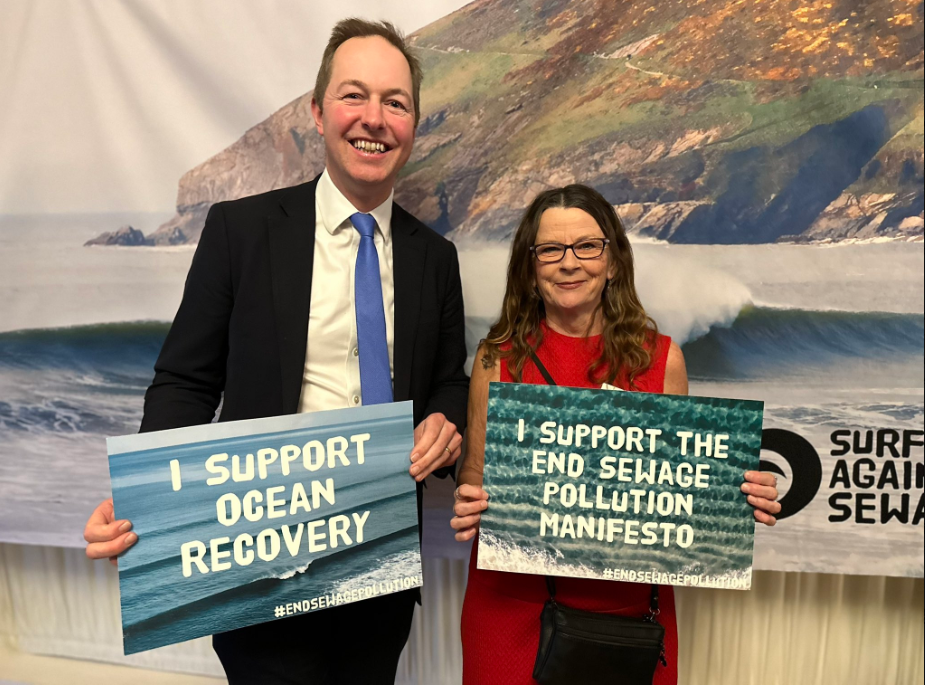
The event was hosted by Richard Foord MP, Lib Dem for Honiton & Tiverton. He said the Lib Dems fully support the manifesto and are committed to implementing it in full. (I’m not  reporting this as a Lib Dem fan, it’s just what he said. If I could vote anyone in, it would be Surfers Against Sewage.)

Overall it was an excellent event that gave a very strong message to Government that enough is enough, we need commitment to change, followed through with actions. I was honoured to be a part of it.

We commit to investment and improvement, says South West Water boss

Billed as an advertising feature from South West Water:

‘We can only rebuild trust by having one conversation at a time, and that’s on us’

Paul Atkins www.devonlive.com 

Here in the UK, we’re famed for talking about the weather – but recently we’ve been talking about it more than usual, writes Susan Davy, Chief Executive Officer of South West Water.

You won’t have failed to notice we’ve just had the wettest February ever. Across the South West, we’ve had more than twice the average rainfall.

Climate change is unfolding before our eyes: it’s a sobering statistic that five of the 10 warmest Februarys have been within the last five years.

The new climate reality presents challenges to us as a business, which we are meeting head-on – managing investments while looking to keep our customer bills as low as we can.

Our responsibility goes far beyond pipes, treatment works and reservoirs: it’s looking after 860 miles of coastline and committing to make our waters the benchmark for quality.

It’s not a simple job: besides the climate, we’re navigating population shifts, and the footprint of agriculture and tourism.

We’re halfway through a two-year £850 million accelerated investment programme to adapt our assets to take account of those changes and challenges.

Water resilience

Let’s take the first of those challenges – water resilience.

In 2022, the South West experienced one of the driest years on record. Reservoirs hit their lowest-ever levels as we fought to protect both river health and supply clean drinking water to customers and the millions of tourists who flocked here.

We moved quickly by adapting former quarries and mines to store water across Devon and Cornwall and investing in schemes to refill reservoirs more quickly.

We are also investing major sums to make more of the water we have. As well as investing in desalination, we plan to create 2,000 new jobs as part of a wider £2.8 billion investment plan across the Greater South West – a doubling of investment from the first half of this decade.

This includes upgrading half of our water treatment works, cutting leakage from our networks to less than 10% and creating a water grid to connect all our strategic reservoirs.

We’re also investing in large reservoirs, starting with Cheddar 2 in Bristol.

We’re looking forward to these plans after a 2023 which was among the wettest years in the past two centuries.

The 10 named storms and 12 yellow weather warnings we’ve had since September have been good for water resources, but triggered more use of storm overflows than any of us would like to see, even though they will have protected thousands of our homes and businesses from internal sewer flooding.

Water quality

That brings us to the second challenge of water quality.

Although there is no quick fix, our monitoring sets us apart from the rest of the world.

We’re also taking a nature-first approach to take flows out of the systems naturally by using reed beds, smart ponds and smart water butts, helping the planet and reducing the use of electricity.

Over time, more and more water will run off from roads, highways and fields, as more houses are built to cope with population growth.

That’s why we’re rethinking how our operations can help to stop these runoffs from entering our systems.

We also must remember the huge strides we’ve taken in recent decades.

In 1990, around 90% of the sewage in Devon and Cornwall was discharged untreated to the environment, most to coastal waters.

Thanks to Clean Sweep, the largest marine improvement programme in Europe, and £13 billion of investment, we created a legacy of excellence in our region’s designated bathing waters.

Just one example of Clean Sweep’s benefits was Exmouth – one of the most popular beaches in our region, where we have seen significant (around 96%) falls in harmful bacteria in the Agency’s water samples since the 1990s.

The result is that we now have some of the best bathing water quality in the country.

While ‘excellent’ between May and September, our monitoring tells us we need to ensure ‘excellent’ water quality all year round.

Release from overflows can result in diluted raw sewage going into our rivers and seas, and it is not acceptable. It is wrong, and it must stop.

We have a plan to deliver transformative change to dramatically reduce the use of storm overflows and ahead of Government targets.

Customers and communities are rightly concerned and disappointed. We are too – but we will fix this as quickly as we can, with the help of our investors.

Funding from shareholders has directly supported new investments to break the drought cycle and accelerate improvements to fix storm overflows while helping us keep bills as low as possible.

Without their support, it wouldn’t have been possible, and we will need that support in the future.

In contrast to other UK water companies, many of our investors are customers through WaterShare+, a unique scheme that gives customers both a stake and a say in how their water company is run, and in holding us to account.

At the same time, we are working hard to keep costs as low as they can be. Bills for households in Devon and Cornwall are lower today than they were 10 years ago.

From Stop the Drop to Save Every Drop we are helping customers to save water and save money.

Our Smart Saver tariff is designed to help customers think and change the way they use water.

In the space of two years, we have given away around 300,000 water-saving devices including water butts, ensuring smarter and healthier homes across the region.

Rebuilding trust

I’m very clear we can only rebuild trust by having one conversation at a time, and that’s on us.

That’s why we are doing more than ever to get into our local communities and talk face-to-face.

Our planned Community Roadshow programme will allow everyone to see local plans and ask any questions they have.

We have already kicked this off and the feedback from everyone has been resoundingly positive, while rightly challenging.

This work doesn’t end here; it’s an ongoing journey of progress, commitment, and collaboration.

My team and I work in water because it’s too important not to, and we’re doing this for a future we can all be proud of.

A quick take on last night’s Westminster Hall debate on South West Water

A correspondent has provided this quick take:

Mr Jupp read from a script and used it to criticise EDDC about housing. I did not hear him congratulate EDDC for having a vote of no confidence. [Owl can confirm that he did not].

Mr Jupp was very proud when people praised him for being a fellow Janner [dialect term for those coming from Plymouth]. Luke Pollard – Labour and Kevin Foster – Conservative MP for Torbay. who left Plymouth at 18 to go to Warwickshire University and lived Coventry until his return to Torbay to become the MP. Mr Jupp beamed every time someone congratulated him in terms of putting the debate. 

When Mr Jupp spoke I didn’t hear him mention Jo Bateman, the Exmouth swimmer. [Confirmed, he did not]. However, Richard did refer to her. Jo Bateman went to the House of Commons on Monday. She didn’t even see her MP, Mr Jupp. Wouldn’t it be etiquette for him to welcome a constituent? 

Mr Jupp asked Richard about the Libdems policy concerning the Libdems position concerning the Environment Agency and Ofwat.  Richard clarified that the Libdems wanting to replace Ofwat. If Mr Jupp was that concerned about the Libdems policy why does not look like on their website? It quite clearly states: “

  • Strengthening the Office for Environmental Protection and providing more funding to the Environment Agency and Natural England to help protect our environment.
  • Ending sewage discharges by transforming water companies into public benefit companies, banning bonuses for water bosses until discharges and leaks end, and replacing Ofwat with a tough new regulator with new powers to prevent sewage dumps.

It seems to me that neither Mr Jupp or Robbie Moore [The Parliamentary Under-Secretary of State for Environment, Food and Rural Affairs] had a grasp of what the Libdems policies are and were keen to focus on the Lib dems wanting to abolish Ofwat with no understanding that the Libdems wanting to replace it with a tough new regulator. 

Mr Jupp at the end was keen to state that the Libdem policies were as clear as mud. [Indeed “clear as mud” were his last words in the debate]. Unfortunately for Mr Jupp, the electorate has no idea what the Conservative Party stand for with all their different groups – One Nation, New Conservatives, National Conservatism etc and then he wonders why the Conservative Party are underperforming in the polls.  

As far as the debate was concerned there was no real outcome. When Richard Foord asked Mr Moore why he didn’t turn up there was no reply. 

[Owl will pick over the entrails in due course]

 A couple of hours ago I learned that the sewer pipe in Budleigh Salterton burst last night.

South West Water were using tankers to transport flows from Budleigh to Maer Lane sewage treatment works. I understand from South West Water, with whom I remain in touch about.

Simon Jupp at last night’s debate – more on the debate later

Shrinking the State: NHS funding faces biggest real-terms cuts since 1970s, warns IFS

The context behind today’s expected budget announcement of tax cuts. – Owl

NHS funding faces the biggest cuts in real terms since the 1970s, an influential analysis shows, amid growing pressure on Jeremy Hunt to prioritise public service funding over tax cuts in the budget.

Denis Campbell www.theguardian.com 

It comes as the Guardian has learned that the chancellor is planning to clamp down on the NHS’s annual £4.6bn bill for agency workers who cover for doctor and nurse shortages at the frontline.

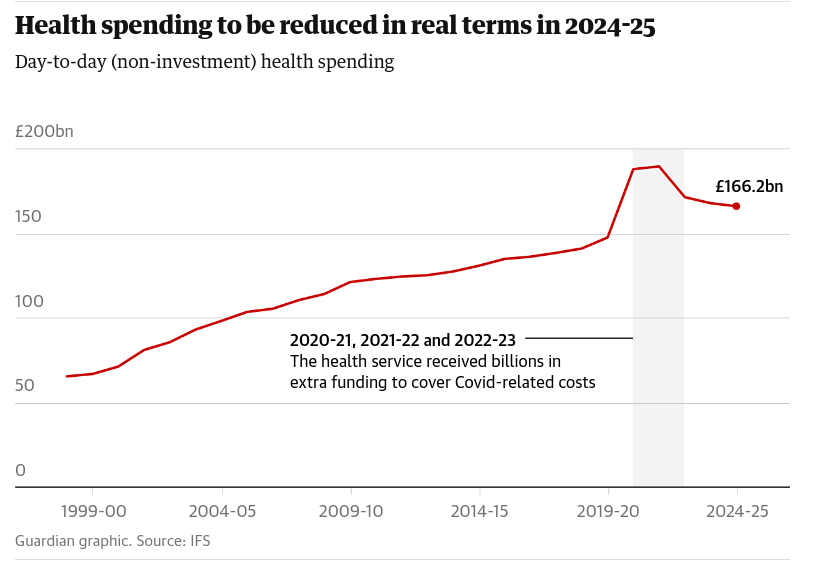
Health spending in England is due to suffer a 1.2% cut – worth £2bn – in the new financial year starting next month, despite the NHS facing extra costs from continuing pay strikes and the expansion of its workforce, according to an analysis by the Institute for Fiscal Studies (IfS).

The health budget, almost all of which the NHS gets, is to go from £168.2bn in 2023-24 to £166.2bn in 2024-25, after adjustment for inflation, in 2022-23 prices.

Without a government rethink the reduction in funding will force the NHS to cut staffing numbers, staff pay, the services it provides to patients or all three, the thinktank warned.

Its intervention comes as Hunt is considering cutting billions more from his public spending plans to pay for further reductions in either income tax or national insurance in this week’s budget.

Economists have calculated that such a move would mean taking as much as a fifth out of budgets for certain “unprotected” departments across the five-year parliament covering areas such as justice, home affairs and local government.

There were also reports on Monday night that the chancellor was looking to give motorists a £5bn boost by extending the “temporary” 5p-a-litre cut in fuel duty by another year.

The level of public sector spending pencilled in for the next parliament could mean cuts equivalent to those undertaken by David Cameron’s government during the years of austerity from 2010 to 2015. That has prompted warnings that the next government would not be able to implement them, and would be forced either to raise taxes or borrow more to fund emergency spending.

The Liberal Democrats said the plan to cut the NHS budget was “scandalous”. Doctors’ leaders warned it would harm patients. And hospital bosses said they would struggle if it went ahead because the estimated £2bn cost of 15 months of strikes have left their finances in a perilous state.

Sarah Olney, the Lib Dem’s Treasury spokesperson, said: “What this Conservative government is doing to our NHS is nothing short of scandalous. They have left health services shockingly underfunded and it is patients who are bearing the brunt of their neglect.”

She urged Hunt to cancel the planned cut in the budget he will present to MPs on Wednesday.

Meanwhile, hospital doctors voiced alarm that, with the NHS already in “an eternal crisis” in which it cannot meet the growing demand for care, pressing ahead with the planned cut could be “terminal” and would harm patients.

Dr Tim Cooksley, the immediate past president of the Society for Acute Medicine, said: “On this background, rumours of a funding cut could be the final straw for many colleagues and would undoubtedly cause severe harm to large numbers of patients.

“There is consensus that the situation in the NHS has never been so challenging. Funding is only part of the solution but a crucial one. A reduction at this stage could be a terminal event.”

David Phillips, an associate director at the IFS who carried out the analysis, said: “Existing [government spending] plans entail real-terms cuts of around 1.2% in [NHS] day-to-day spending [in 2024/25] – the largest reduction since the 1970s following the 1976 IMF crisis, except for the last two years as temporary funding related to the Covid-19 pandemic expired.

“A real-terms reduction in health spending would require some combination of reductions in staffing, pay and service provision.”

Phillips also disclosed that the government had to give the Department of Health and Social Care an emergency injection of £4.4bn of extra Treasury funding during the course of the current financial year to ensure that it – and the NHS – did not bust their budgets. The DSHC had not publicised that.

The NHS is thought to have received about £4bn of the £4.4bn, which was to cover staff pay rises, the costs of industrial action, schemes to help the service cope with winter and also its share of the health surcharge that migrants, or their employers, pay to cover the cost of their NHS care.

The DHSC’s budget for 2023-24 was originally due to be £164.2bn. However, it rose to £168.2bn as a result of ministers giving it what health economists call an “in-year bung” of about £4bn, to avoid a shortfall.

The department was and remains due to be handed a budget of £166.2bn for 2024-25. However, the £4.4bn top-up received this year meant that, as a result, next year’s budget was on course to be £2bn less than this one, prompting the IfS’s intervention, Phillips explained.

Julian Hartley, the chief executive of NHS Providers, which represents health service trusts, said: “These figures will ring alarm bells for trust leaders who are already struggling to provide patient care in a hugely challenging financial environment.

“Fifteen months of strike action have landed the NHS with an eye-watering bill due to income lost from delayed operations, scans and procedures and providing cover for striking staff.

“With worries that industrial action looks set to continue into the next financial year, trust leaders are rightly worried that these costs could continue to mount. Given the extra pressure industrial action is putting on NHS budgets, it’s vital the Treasury funds trusts’ strike costs in full.”

Hunt also plans to announce a clampdown on the money the NHS gives to employment agencies – £4.6bn across the UK and £3.5bn in England alone – as a result of a Treasury review of productivity across the public sector. He is set to cap the amount the service as a whole can hand them.

Wes Streeting, the shadow health secretary, labelled the chancellor “hypocrite Hunt” because the DHSC last year raised the annual cap for such spending by £450m. Streeting also pointed out that in 2015, when Hunt was the health secretary, he announced a similar crackdown on agencies which charged “extortionate hourly rates which cost billions of pounds a year”.

Streeting said: “Taxpayers are paying a heavy price for 14 years of Conservative failure.

“The Conservatives refused to train the doctors and nurses our NHS needs, leaving the health service to rely on rip-off recruitment agencies. Then they forced doctors and nurses out on the worst strike in the history of the NHS, leaving patients waiting longer and taxpayers picking up the bill.

“Expecting hypocrite Hunt to fix the mess he’s made is like expecting the arsonist to put out the fire they’ve started – it’s not going to happen.”

The DHSC was approached for its response.

Tory MP doesn’t want beavers in Dorset 

“There is no sense in reintroducing beavers into small chalk streams, or any other form of stream in Dorset. Beavers dam rivers.”

(In fact he doesn’t want them anywhere!).

Can you ever really trust a Tory on environmental issues? – 

Richard Drax MP Conservative, South Dorset during the debate on farming in the House of Commons at 4:21 pm on 4 March 2024.

From Hansard:

My next topic is slightly off farming, but it relates to it, and that is the reintroduction of beavers. There has been a report of a beaver being released illegally in the constituency of my hon. Friend the Member for West Dorset. That is causing concern. I believe that reintroduction has been experimented with in Scotland to a large degree. If we are to re-wild, I suppose there is some sense in putting beavers in large rivers, but there is no sense in reintroducing beavers into small chalk streams, or any other form of stream in Dorset. Beavers dam rivers. They would be protected, no doubt, by every organisation that would want to protect them. Farmland would then flood. As has been proven in Scotland, beavers do not hang around and say, “This is my home.” They breed and move elsewhere and do the same in other rivers. As I understand it, they had to be culled in Scotland, because they broke out of the area given to them. Can the Government please look not only at the illegal releasing of beavers into rivers, if that is happening—it has not been proven yet—but the legal release? There is an emphasis on re-wilding. While we all want to see wild animals, there is a proper place and location for each species.

John Halsall: ‘We are sorry for the issues in Exmouth’

John Halsall is the man who led the South West Water’s team responding to questions raised by councillors at the EDDC scrutiny meeting on 1st February.

He is SWW’s Chief Operating Officer, in effect second in command to the CEO with the day to day running of the business “at his fingertips” so to speak. He is also on the Board. He should, therefore, have been in a position to answer pretty well any question councillors threw at him, especially the twelve they had given him in advance. By the same token, he knows all about any “inconvenient facts” SWW would rather we didn’t know about.

Owl described SWW’s approach to the committee at the time as “evasive” and is not surprised that subsequently the full council passed a vote of “no confidence in SWW”.

John Halsall has now written to apologise to the people of Exmouth for the disruption caused by sewer mains bursting. But questions around SWW’s strategic failure to invest remain.

As with the Post Office “Horizon” scandal, when confidence in an organisation has been lost, an apology is a start but not a sufficient response to regain that confidence.

SWW, and indeed all water companies, have a long way to go.

Exmouth is not the only place suffering in East Devon.

What is “the long-term solution for Exmouth”, see “Does SWW have a cunning plan?” We need full transparency. – Owl

Adam Manning www.exmouthjournal.co.uk

South West Water says it is ‘sincerely sorry’ for the current issues surrounding the burst sewer pipe in Phear Park.

In December last year, a series of bursts were found on the pipe between the Plumb Park housing estate and Maer Lane Sewage Treatment Works. 

The burst occurred due to the condition of the pipe, which was unexpected because it was not known to have deteriorated and had only burst once in the previous 20 years.

Due to the condition the pipe was found to be in, South West Water decided to replace the entire section. This is roughly 500-metres long and is due to be completed by the end of this month.

To address the initial burst, a temporary overland pipe to bypass the damaged section. After this, three further bursts on other parts of this section of pipe were spotted on February 13.

While repairing or putting in sections of overland pipe to bypass the burst, tankers were bought in to take flows from Phear Park Pumping Station to Maer Lane Sewage Treatment Works. That work is now complete and the overland pipe runs from Plumb Park to Maer Lane. The tankers have now been stood down, but a small number in the area as a precaution.

The 500-metre section of pipe which runs from Plumb Park housing estate to Maer Lane Sewage Treatment Works is now being repaired. Since 2008, replacement and relining work has been carried out to the other section of this main, which runs from the housing estate to Phear Park Pumping Station. This means that the entire main from Phear Park to Maer Lane Sewage Treatment Works will have been upgraded when the repair is completed.

They say that they are now ‘working on a long-term solution for Exmouth’.

John Halsall, chief operating officer of South West Water said: “I’d like to take the opportunity to sincerely apologise to anyone who has been affected and to explain what issues we have faced and what steps we are taking to ensure this doesn’t happen again. There has been some misunderstanding about the work at times.

“We really appreciate that the tankering caused disruption for customers in the area and we are sincerely sorry for that. This was the least worst option available to us but we understand it was far from ideal.

“We have been in regular contact with the Environment Agency throughout the duration of the works and we have been keeping them updated on our progress. We have also been providing updates to the council, the local MP, local media and customers. We know how much it means to everyone to get the information they want, when they want it. Different people are interested in different aspects of this repair and so it is very difficult to update everyone, all the time, but we are working as hard as we can to keep everyone informed and we know we can do better.

“Once again, I would like to reiterate how sorry I am personally to local residents for the ongoing issues in Exmouth and I really appreciate their continued patience. I would also like to thank all of our operational teams who have worked hard in an extremely challenging situation, and who continue to work hard on the long-term solution for Exmouth.”

Breaking: ‘What tax cuts can we expect in the Chancellor’s budget?’ Richard Foord has a few better ideas

Richard Foord, MP for Tiverton & Honiton

By the time you read this, it’s possible you might have heard the Chancellor of the Exchequer Jeremy Hunt present the Government’s budget for the year ahead. Writing as I am before he gets to his feet, there is talk of what tax cuts he will make.

Tax cuts anticipate a General Election like a blackbird’s song predicts daybreak. Neither lasts very long afterwards! What is lacking though is a sense of just how bad things are right now for those who continue to depend on public services.

Local health services are being pushed to the brink. Community Hospitals like the one in Seaton are threatened with being divided and even disposed of. NHS dentistry is decaying before our very eyes. To my mind, there are several things the Government could do right now to help the economy and society in Devon and beyond.

The Chancellor could permanently cut the rate of VAT for tourism and hospitality businesses. This would boost vital businesses in tourist hotspots like ours – allowing them to stay afloat and generate taxes to support other vital services.

A low VAT rate levied on a pub that continues to trade is better for the Treasury than a high VAT rate levied on a landlord who is driven out of business. The permanent VAT cut I propose contrasts with the temporary cut that has been proposed by some Tory MPs. They seem not to have spotted that the VAT rate on hospitality businesses has leapt up and down like a yo-yo at the hands of this Conservative Government.

Secondly, the Chancellor ought to cancel the planned real-terms cut to the NHS. Failing to increase the NHS budget in line with inflation would remove around £1.3bn from services that are already struggling. We need to invest in people’s health: recruit more GPs, boost the number of dental appointments, and cut the long waits for urgent cancer care. People who are well can work, contribute to society and pay taxes.

Finally, Government must stop handing out tax breaks to big banks. It must stop allowing energy firms to rake in bumper profits off the back of rising energy costs too. This would generate billions extra to invest in our communities.

People are tired of the chaos and mismanagement this Conservative Government has presided over. People tell me they are ready for a change, and here in Honiton & Sidmouth, the way to get that is to vote Liberal Democrat, so we can send this obstreperous Government off the pitch and enjoy the dawn of a new day.

Richard Foord hosted pollution campaigners in Westminster. Minister invited but shunned the event.

Jo Bateman attended as part of the Surfers Against Sewage campaign.

4 March Richard Foord:

Tonight, I hosted @WaterWaysProtct and @sascampaigns in Parliament. No Minister was present, though he was invited.

We need the Govt to take this issue seriously – with more powers and resources, as well as duties, so the regulator can enforce the law.

What Richard Foord will have done is collect first hand information for Today’s “Westminster Hall” debate that Simon Jupp is kicking off at 4.30pm.

Do the Tories really care about pollution? – Owl

Water firms are gaming the monitoring system, says regulator

Regulators have accused water companies of “genuinely shocking” behaviour, gaming a self-monitoring system and demonstrating a “culture of complacency”.

Adam Vaughan www.thetimes.co.uk

The comments from the heads of the Environment Agency and Ofwat mark an escalation of rhetoric from the water sector’s regulators.

Philip Duffy, chief executive of the Environment Agency, singled out sewage pollution incidents by Southern Water and Severn Trent, which were recently fined £330,000 and £2 million, respectively.

He said they were “genuinely shocking, shocking cases of pollution of our rivers, that shouldn’t be happening in a well-regulated industry”.

In Southern Water’s case, more than 2,000 fish were killed after a pump failed and sewage was released into a stream that feeds into the River Hamble in Hampshire. Severn Trent, meanwhile, was responsible for a “reckless failure” in allowing 260 million litres of sewage to be spilled illegally into the River Trent, a judge concluded.

Duffy said that “time and time again” promises made by water firms to the Environment Agency and Ofwat hadn’t been kept. “Infrastructure that should have been maintained to a certain level hasn’t been maintained to that level,” he said.

Under Duffy’s leadership, the Environment Agency is preparing to increase the number of inspections of water companies from less than 1,000 in the current financial year to 4,000 next year and more than 10,000 the year after. He said the measures were needed because the system of companies monitoring themselves, introduced in 2009, “had been gamed a bit”.

“The times of day the samples were taken, the way the samples were taken, gave a misleading positive impression,” he said. Duffy also said he was “really worried” about chemical pollution in rivers, specifically the “forever chemicals” PFAS and PFOS which have been linked to serious health harms including increased risk of cancer.

David Black, the chief executive of Ofwat, said that water companies needed to restore public trust by implementing improvements and showing greater transparency.

“We need to see a change of culture,” he told a conference held by the Water Report on February 29. “I think the water sector has demonstrated a culture of complacency in the face of significant challenges, such as climate change, resource scarcity and population growth, and this has led to stagnating performance.”

However, Black said he was pleased the water industry was beginning to “respond in a meaningful way to the challenges it faces”. He cited the £96 billion water firms have proposed spending between 2025 and 2030. Ofwat has to decide this summer whether to approve the spending, despite it requiring a 31 per cent increase in household water bills over the period.

The Times’s Clean it Up campaign has been calling for stronger governance of the water sector and more resources for regulators to do their job.

In recent weeks the government has vowed to ban bonuses for bosses of water companies that commit criminal acts of pollution. Chief executives have received £26 million since 2019 and, while some voluntarily waived their bonuses last year amid public anger, five still took them.

However, it has emerged that the government has rowed back on a plan by the environment secretary, Steve Barclay, to block dividends at water firms with a poor environmental record. “The government has no plans to block water company dividends over illegal pollution events,” Gareth Davies, exchequer secretary to the Treasury, wrote in a message to industry last week. Labour is understood to have no appetite for such a dividend ban.

David Henderson, chief executive of Water UK, the industry body, said a dividend ban would have been disastrous. “If you want to break the system, and get terrible environmental performance, that’s the way to do it,” he said when asked if a ban would harm investment in the sector.

Henderson said there “still a lot to do” in improving the state of rivers but he was hopeful the sector would tackle the problem. “Performance has not been where it should have been,” he admitted. “We have failed, in some parts quite acutely, to keep up with public perceptions of what is needed.”