Tory candidate for Exmouth & Exeter East, David Reed, as negative and misinformed as Simon Jupp

Cllr. Joe Whibley writes in the Exmouth Journal:

In response to Mr Reed, prospective parliamentary candidate for Exmouth and Exeter East, and his missive regarding working with South West Water I have a couple of points of note.

I welcome his intention to try and work with South West Water, but suggest that he is clearer in his knowledge of the workings of local government. To suggest that East Devon’s planning department is somehow culpable is to completely misunderstand or misrepresent planning law EDDC cannot legally turn down a planning application on the grounds of sewage infrastructure. If South West Water say they can accommodate any new development, East Devon are forced by law to accept that even if we know there is some doubt.

As an example, if Mr Reed were to look at the planning officers recommendations for the redevelopment of the Devoncourt Hotel, he will see an example of this. I am saddened that they have suggested the committee may wish to grant permission for this, but any representations about this will need to be on things other than South West Water’s position_

Might I suggest that if Mr Reed wishes to be a successful local candidate and ultimately MP, he moves away from the behaviour of his predecessor Mr Jupp. His constant criticism of the district council, despite the best efforts of people to work collaboratively has proved incredibly obstructive and in the interests of nobody.

Cllr Joe Whibley

East Devon District Council

Businessman says he could bring “creativity” to PCC role

A businessman and accountant who has watched politics from afar is hoping to become the next police and crime commissioner for Devon and Cornwall.

Alison Stephenson, local democracy reporter www.radioexe.co.uk

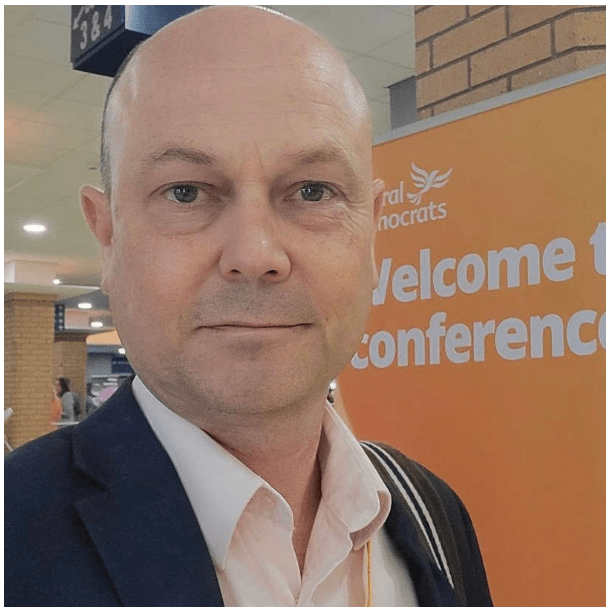
PCC candidate for the Liberal Democrats Steve Lodge. (Image courtesy: Liberal Democrats)

Steve Lodge, 53, from Tiverton thought about standing as a MP, but says his financial background and governance experience – he has been vice chair of the Federation of Small Businesses in Mid Devon – together with his knowledge of business, are suited to the commissioner role.

And the fact that he has no background in policing, he believes, is a good thing, enabling him to bring “creativity, innovation and acumen to the job, without any baggage”.

Mr Lodge, who is standing as the Liberal Democrat candidate in the election, runs a marketing and communications agency and has been in business for 25 years. Before that he was an accountant at IBM and Marconi.

“I watched politics from afar. I am a life long Lib Dem voter, but never really considered myself going into that area and I was concentrating on my business,” he said. “I now have the opportunity to step back a bit and it feels like time for a change.”

Bumping into Lib Dem Richard Foord, MP for Tiverton and Honiton and Lib Dem leader Sir Ed Davey during a PR job at Tiverton High School sealed the deal.

“I was inspired by them to make the world a fairer place, and thought that’s something I would like to do.”

Mr Lodge is one of three candidates, along with incumbent commissioner Alison Hernandez, and former diplomat and civil servant Daniel Steel.

The job of the PCC is to hold the police service to account and to scrutinise their performance. It pays more than £88,000 a year, with elections taking place every four years.

Mr Lodge wants to see “a proper return to community policing” with more bobbies on the beat, and to bridge the gap between the police and the public as he says “trust has been eroded”.

He wants what he called ‘fairer funding’ and ‘smarter spending’ so police have the resources to fight crime, and to support rehabilitation and restorative justice.

He said national police funding levels were the same last year as in 2011. “You have to question how the police can work properly with this amount of underfunding,” he said.

Mr Lodge believed he could “add value” to the new police and crime plan in 2025 and wants more of a multi-agency approach.

He said many people, charities and local authorities, who do “fantastic work” on crime prevention and in areas like mental health, who are unsung heroes.

He feels the police needed “to be more joined up”. All the force could do is to respond to crime and teach rookie officers the basics, he said.

The biggest issue right now “hands down,” is anti-social behaviour, he believes.

“It’s something I am hearing when I knock on every door. In Truro, shopkeepers are subject to verbal abuse. People think they can just walk in and steal what they like.”

He continued: “If we can provide common sense to politics and to being the police and crime commissioner, we will resolve a lot of the problems we have currently.”

Looking through documents from 2012, when the police and crime commissioner’s office was set up, he saw something on youth crime which made a lot of sense but hadn’t been implemented.

“It was created by the Conservatives and it said for every pound you spend on youth crime you save the country £2.50. If I could walk into bank with £1 and come out with £2.50 I would be a happy man, but what happened? Investment in youth crime was slashed. Investment in the police was slashed.

“If we invest properly in our public services, we will deal with the issues we have, but for some reason politicians just don’t see it.”
 

Former diplomat says ‘community policing will be top priority’ if he’s elected

A Plymouth born-and-bred former diplomat is hoping his resilience and experience of working in some of the most challenging areas of the world will make him a good fit for the role of Devon and Cornwall police and crime commissioner.

Alison Stephenson, local democracy reporter www.radioexe.co.uk

Daniel Steel (image courtesy: Plymouth Labour)

Daniel Steel is one of three candidates standing for election on Thursday 2 May. He is the Labour and Co-operative Party representative.

The others are Conservative Alison Hernandez, who has been police and crime commissioner (PCC) for the last eight years, and Tiverton businessman Steve Lodge, for the Liberal Democrats.

The job of the PCC is to hold the police force to account and to scrutinise their performance. It comes with a salary of more than £88,000 and elections take place every four years.

Mr Steel, 31, says he has public service running through his veins. His father was in the Royal Navy and he has always wanted “to do his bit.”

“My values come from my dad, it has what has motivated me my whole life. I want to put back more than I take out.”

He has served in countries such as Afghanistan, where he says his resilience and leadership were forged.  He also dealt with challenging issues around refugee displacement, human trafficking and modern slavery whilst working at the Foreign Commonwealth and Development Office.

“I spent a lot of my career so far working in difficult and dangerous places,” he said.  “It allowed me to see what it looks like when the rule of law breaks down.  I fundamentally believe that the rule of law is the bedrock of our society and democracy.

“When you look at the alternatives of violence and chaos you see in lots of other places, we are really lucky that in the UK we have strong government systems and governance in our country.”

Mr Steel, who has had to give up his job as a civil servant because he is standing for office,  hopes that Labour will form the government following the next general election but he says in the meantime the police and crime commissioner role is a chance to implement the party’s mission.

“One of Labour’s key aims is to take back the streets, with 13,000 more officers and police community support officers (PCSOs). I was shocked that in Devon, Cornwall and the Isles of Scilly we only have 177 PCSOs. That’s one per 10,000 residents. It’s why we don’t have the community policing we expect and deserve as the public.”

Devon and Cornwall had almost double the number of PCSOs (346) in March 2015, a year before Ms Hernandez took over as commissioner. Many subsequently became police officers.

“If I am elected, my number one priority on day one is to re-establish community policing.  Too many police officers unfortunately are having to work behind desks because the force does not have the right mix of staff.

“Alongside the acting chief constable and the senior team, I would be looking how we can increase police staff to free up officers so they can be working on the streets, not on spreadsheets.”

Mr Steel, who lives in Plymouth, said members of the public he had talked to linked problems of anti-social behaviour and burglaries directly with a lack of visible police presence.

And a business organisation in St Austell was paying a private security firm in the town centre to keep crime down, he said.

“It’s not the fault of police. It’s a result of all political decision making by the Conservative government and police and crime commissioners. Policing was cut to the bone and the force has lost years of valuable experience from those officers who went during the cuts.”

Mr Steel has also pledged to tackle violence against women and girls, prevent youth crime and reduce reoffending, boost crime prevention and victim support, and back a crackdown on illegal sewage dumping.

A few years ago, he was the victim of a knife crime and said the traumatic experience had stayed with him. He says it has given him the ability to empathise with victims of serious crime.

“I see the role as being a representative for victims, the accused and members of the public to try and bring a public prospective into the police.”

He said he had made a career out of bringing people together.

And he added that his work as a diplomat was similar to being a politician: “I have represented the UK and spoken on its behalf with ministers and other diplomats around the  world to make sure I was delivering for the UK’s people.

“The PCC is a challenging role but an important one. It which covers an enormous region. We are diverse in terms of population, rural, urban, different politics and I will be acting in a fair and even handed way and do my best to serve the residents across the region, however they vote.

“I can reassure the public that I will be making the tough calls and asking the tough questions. The cost of policing is becoming more and more of a burden on the taxpayer, for me it’s about how we use those resources efficiently to make sure they are working.”