Flogging off the family silver but County will have to repeat the exercise 30 times just to fix the potholes!

Selling off council-owned properties in Exmouth, Axminster, Exeter, and other areas of Devon, are hoped to earn the county around £7million, it has been revealed.

Local Democracy Reporter eastdevonnews.co.uk 

Property disposals have earned Devon just over £7 million and the hopes are the same amount could be secured this year, writes local democracy reporter Bradley Gerrard.

The biggest ticket item sold by Devon County Council in the year to March 31 was land at Aldens Farm in Alphington, for £4 million, where a large housing application of more than 180 homes has been approved.
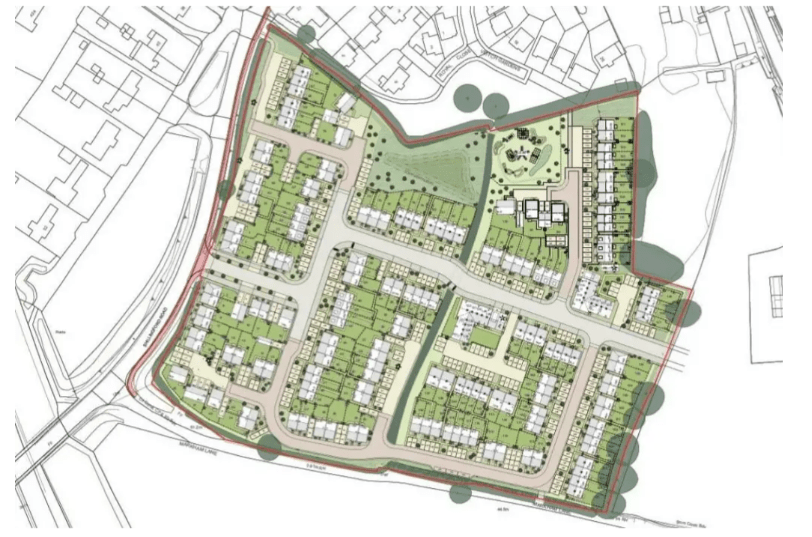
Aldens Farm planning documents, for Alphington, Exeter.

Exeter’s Compass House earned the council £900,000, the second biggest sale amount from the 12 sites or buildings it sold.

Councillors at the authority’s cabinet meeting heard this week (Wednesday, May 8) that the council expected to earn a similar amount – around £7 million- in the current financial year.

The authority has slated four sites for possible sale or repurposing, as well as three freeholds on Sowton Industrial Estate in Exeter.

It believes 2-4 Meeting Street in Exmouth, East Devon, which is being vacated by public health nursing and a local ceramics group, both of whom are relocating to another Devon County Council-owned building, the Kennaway Centre, could be marketed for residential or commercial use – pending a change of use application – over the summer.

An East Devon youth centre is also relocating to the Kennaway Centre from The Hive in Exmouth, meaning the latter is surplus to requirements too.

Lea Combe, in Axminster, in East Devon, has also been identified as suitable for residential development of around four to six houses. It was previously being safeguarded for a highways development scheme, but that is no longer required.

The council also wants to repurpose Rosalind House in Tiverton into so-called ‘staying close’ provision; essentially accommodation within the county that could house looked-after children.

However, it noted that the property’s garden “which is considerably bigger than required for staying close” could be marketed as a potential residential site for one or two houses.

And three freeholds in Sowton, which are jointly owned with Exeter City Council, could also be sold if the values achieved for them would be greater than prospective proceeds from ground rent.

Councillor Carol Whitton (Labour, St David’s & Haven Banks) asked what the timescale was for a decision on whether to sell the Matford Offices which are on the County Hall site in Exeter.

These had previously been earmarked for disposal, but are subject to a public consultation given strong opposition in the community to turn them into housing.

At the time their potential disposal was discussed in October, alongside other properties and land totalling an estimated value of £10 million, Julian Brazil (LIberal Democrat, Kingsbridge) called the move a “fire sale”.

Devon county officers suggested potential options for Matford could be put before Councillors in the autumn.

Outgoing leader John Hart (Conservative, Wembury and Bickleigh) said that in the past 12 years, the authority had “raised a considerable amount of money and reduced our property holdings, money which has been put into the capital expenditure pot, by and large”.

‘The stakes could not be higher’: world is on edge of climate abyss, UN warns

The world is on the verge of a climate abyss, the UN has warned, in response to a Guardian survey that found that hundreds of the world’s foremost climate experts expect global heating to soar past the international target of 1.5C.

Damian Carrington www.theguardian.com

A series of leading climate figures have reacted to the findings, saying the deep despair voiced by the scientists must be a renewed wake-up call for urgent and radical action to stop burning fossil fuels and save millions of lives and livelihoods. Some said the 1.5C target was hanging by a thread, but it was not yet inevitable that it would be passed, if an extraordinary change in the pace of climate action could be achieved.

The Guardian got the views of almost 400 senior authors of reports by the authoritative Intergovernmental Panel on Climate Change. Almost 80% expected a rise of at least 2.5C above preindustrial levels, a catastrophic level of heating, while only 6% thought it would stay within the 1.5C limit. Many expressed their personal anguish at the lack of climate action.

“The goal of limiting global warming to 1.5C is hanging by a thread,” said the official spokesperson for António Guterres, the UN secretary general. “The battle to keep 1.5C alive will be won or lost in the 2020s – under the watch of political and industry leaders today. They need to realise we are on the verge of the abyss. The science is clear and so are the world’s scientists: the stakes for all humanity could not be higher.”

Alok Sharma, the president of the Cop26 climate summit in 2021, said: “The results of the Guardian’s survey should be another wake-up call for governments to stop prevaricating and inject much more urgency into delivering on the climate commitments they have already made.” He said world leaders needed to get on and deliver on the pledge they made to transition away from fossil fuels at Cop28 in December.

Christiana Figueres, the UN climate chief who oversaw the landmark 2015 Paris climate deal where the 1.5C goal was adopted, said: “These climate scientists are doing their job. They are telling us where we are, but now it’s up to the rest of us to decide what this moment requires of us and [to] turn the seemingly impossible into the new normal.”

She said the world was on the edge of positive societal tipping points away from fossil fuels. “It doesn’t mean a utopian future – we know too much climate change is already baked into the system – but enormous positive change is coming. A world in which we pass 1.5C is not set in stone.”

The 1.5C target was initially proposed by the Alliance of Small Island States (Aosis). Fatumanava Pa’olelei Luteru, the chair of Aosis, said: “Our islands are quite literally sinking as the temperatures rise. The lack of ambition on climate change from bigger countries is consigning our states to a reality of devastating loss. The [Guardian] report must be a wake-up call to the world.”

Mohamed Adow, from Power Shift Africa, said: “It’s good to see the experts who follow climate most closely sharing their horror at the lack of action from governments. Those of us living in countries facing the worst effects of the climate crisis feel this too. My country of Kenya has faced its worst drought in 40 years and then last week saw hundreds killed in devastating floods. We wish leaders had the same sense of urgency as the climate scientists.”

Youth climate activists from around the world also shared the climate experts’ fears. “Crashing through the guardrail of 1.5C would be a death sentence for millions of people in the global south,” said Vanessa Nakate, at Rise Up Movement Uganda. “Unless we see immediate action no one will be safe.”

Disha Ravi, at Fridays For Future India, cited the dire impacts of India’s recent heatwaves: “The complacency of leaders is killing people. Temperature rises beyond 2.5C are not inevitable, but averting it requires genuine commitment and action from those in power.”

Policy experts, economists and business leaders responded to the Guardian findings with both frustration and calls for urgent change. Rachel Kyte, a professor of practice in climate policy at the University of Oxford, said: “It is desperately frustrating that our political, economic and social systems don’t know what to do with the science. We need … innovations in our democracy to give scientists the politics they deserve.”

Nicholas Stern, an eminent climate economist, said: “The Guardian’s results are a message from scientists that they lack confidence in our world leaders to take the necessary action to avert climate catastrophe. It’s not too late for political leaders to act but the scale and pace of change must be large and rapid.”

Helen Clarkson, the chief executive of the Climate Group, which runs a network of 500 multinational businesses, said: “The Guardian survey is a stark reminder of the gap between climate targets and action.”

The respondents to the Guardian survey identified lack of political will as the single biggest barrier to climate action. Harjeet Singh, at the Fossil Fuel Non-Proliferation Treaty Initiative, said: “For decades, governments, especially in rich countries, have consistently prioritised the fossil fuel industry’s interests over the wellbeing of their people. We have a narrow window to avert the worst outcomes, but it requires urgent, transformative policies that prioritise the wellbeing of people and the planet over profit.”

Some politicians backed the call for urgent action. Caroline Lucas, a UK Green party MP, said: “The world’s leading scientists are running out of words to describe the gravity of the climate emergency we face. Politicians need to wake up and treat this catastrophic threat with the seriousness and urgency it requires.”

Ed Miliband, the shadow climate change minister in the UK, said: “Every fraction of a degree matters to the survival of our planet for future generations. That’s why we need governments around the world to maximise climate action, rather than rowing back.”

In the US, Representative Chrissy Houlahan said: “[The Guardian report] should give all of us in Congress even more urgency to act swiftly and bipartisanly.” Bas Eickhout, a Green member of the European parliament, said: “I recognise the feelings of despair of the scientists very well. However, we simply do not have the option of giving up.”

Additional reporting by Nina Lakhani, Helena Horton, Oliver Milman and Lisa O’Carroll.