Holiday homes could close primary school – Kingswear

The closure of a Devon village school that eventually had no pupils attending has been blamed on the large number of holiday homes.

Bradley Gerrard, local democracy reporter www.radioexe.co.uk 

Kingswear Primary School is now facing closure due to the substantial drop in pupil numbers, and a key reason behind this has been laid at the door of the significant number of holiday lets and second homes in the community.

The school had 66 pupils on roll in 2017, and discussions were taking place around that time to try to find space for an extra classroom.

However, in the 2022/23 academic year, there were just 13 children on roll, five of whom were in their final year of primary school and set to move to secondary school.

By last September, there were no children on roll, the council said, and no preferences for admission to reception for this September had been made.

Councillor Jonathan Hawkins (Conservative, Dartmouth & Marldon) said it was a “very sad day for my community”.

“This closure is due, I believe, to the village being a very beautiful place to live, an expensive place to live, and as such we have a lot of second homes and holiday lets, and I believe that is why this school is closing,” he said.

“We have terraces of houses, as does Dartmouth across the river, where only one or two residents live in them full time.

“This is a problem for all towns and villages, communities like ours, and hopefully we can find a way to prevent holiday lets and second homes for small communities, as we need families to live in our village.”

Cllr Hawkins added that Kingswear was particularly constrained in terms of sites which could be developed for housing and therefore boost the population.

The biggest development at Noss on Dart Marina will accommodate 126 homes, but is over 1.5 miles from the village and the application does not propose any affordable housing.

Cllr Hawkins said he felt he and the community had “done all we possibly can” to keep the school open, but there was simply not the attendance to keep it going.

Councillor Andrew Leadbetter (Conservative, Wearside and Topsham), the cabinet member for children’s services and schools, said it was “always sad when you have to discuss closing a school”.

“But there is no point in keeping it open if there are no children there,” he said.

“We have worked hard, ably assisted by Cllr Hawkins, to find a workable solution, but we are left in the unenviable position with a school with no children, and parents seeking not to send their children there due to a lack of numbers.”

Because the school is overseen by Education South West multi-academy trust, the decision to close the school actually lies with the Secretary of State for Education.

Devon County Council, as the education authority, is consulted as part of the process, but does not have the power to prevent its closure because ity does not oversee the school. It has been asked in this instance to agree the closure, though, as Kingswear is classified as a rural academy school, prior to the Secretary of State making a final decision.

However, in Kingswear’s case Devon would probably have been unlikely to lobby to keep it open given that a rebound in pupil numbers does not look likely any time soon.

A report prepared for councillors revealed that “very few children” live in Kingswear itself, and that local health data showed “low future cohorts of pre-school aged children” living in the village too.

Just five children would be due for admission in September (albeit no applications had been made to attend), while four children would be expected to join in September next year, just three in 2026 and five in September 2027.

The report noted that there had been objections to the closure from members of the community, though, with uncertainty over the school’s future and communications from the trust “leading to parents withdrawing their children from school” cited as issues.

It added that objectors felt the academy’s decision to close the pre-school also affected pupil numbers, and that local parents had now started a playgroup with good attendance.

As part of the consultation, the trust said it had “invested heavily in marketing efforts beyond the Kingswear catchment area”, but with little success.

Devon said it would provide primary-age children living in the Kingswear Primary School area with free school transport to Dartmouth Academy, which involves a ferry crossing across the River Dart. It estimated this could cost “in the region” of £250 per day for a 16-seater minibus to cross the river.

The minister and churchwardens of Kingswear are understood to hold the freehold for the school site, meaning Devon County Council does not have a say in its future use.
Council funding is a numbers game in which everybody is losing

The problem for local democracy is that there is now little relationship between the council tax rates in a local area and what the relevant authorities are able to deliver. That’s because the way in which the central grants are allocated has become essentially arbitrary.

Paul Johnson www.thetimes.co.uk

Less than two weeks ago, some us in England went to the polls for this year’s local elections. Reflecting the absurdly centralised and Westminster-focused nature of our political system, most of the commentary since then has obsessed about what these elections mean for the standing of the parties nationally and whether we have gleaned anything more about the likely shape of the next parliament.

The short answer to that question is no. Broadly speaking, the election results were in line with what we should have expected, given the opinion polls, which makes it even more depressing that we have heard so much about that subject and so little about local democracy and the challenges facing the councils themselves.

One reason is likely to be the utterly baffling complexity and illogicality of English local government. If you think you’re clear about what your local district/shire/unitary/borough council or metro mayor is responsible for, then you are in a small minority. Or more likely wrong. Our hodge-podge of different structures almost defies description, let alone rational explanation. Anand Menon, professor of European politics and director of UK in a Changing Europe at Kings College London, put this point rather nicely in the weekly Expert Factor podcast that he and I host along with Hannah White, of the Institute for Government. “It’s hard to avoid the impression that our arrangements for local government were written, while slightly inebriated, on the back of an envelope.”

You could say the same for the way in which we fund our local government. We are all familiar with council tax. I have written here before about its many absurdities. It is out of date and regressive. The tax payable on Buckingham Palace is similar to that on the average band C property across the country. It now funds about half of what local authorities spend, although that fraction varies a lot in different places. The rest is allocated to councils from a combination of local business rates and central government grants. The problem for local democracy is that there is now little relationship between the council tax rates in a local area and what the relevant authorities are able to deliver. That’s because the way in which the central grants are allocated has become essentially arbitrary.

Once upon a time, long, long ago, central government made a real effort to calculate what it thought each council would need, such that each could deliver broadly the same array and quality of services. A complex formula would take account of local tax-raising powers. Homes in Wokingham and Westminster are worth a lot more on average than those in Wolverhampton and Walsall, so the former two could raise more council tax per head of population than the latter two and hence should need less subsidy. The formula also would take account of numbers of people, numbers in poverty, the age structure of the population, the length of roads for which the council was responsible and so on. Not perfect, but a proper attempt at a rational system.

This system became increasingly, and deliberately, opaque under the last Labour government and has pretty much broken down entirely over the past 15 years. Cuts to local government funding in the 2010s effectively took no account of differing needs and hence fell more heavily on poorer and metropolitan areas. Moreover, the basis for allocating funding hasn’t been updated in years. Even the population figures used are more than a decade out of date and much of the data on which the allocations are based are considerably older than that. Hence what your council receives is probably more closely related to its needs 20 years ago than its present situation. The allocations are, in other words, increasingly random.

The government promised to put a new, up-to-date “fair” funding formula in place by 2019. That, though, has been kicked beyond the next election. Since there is no money to smooth any transition, I wouldn’t hold my breath. With each passing year, a return to rationality becomes ever harder. If you are reallocating within a fixed budget, you make some worse off. A return to rationality might require a return to spending growth.

Under those circumstances, it is hard for voters to have a real sense of how effective their local council is. Add to that the fact that getting on for two thirds of council spending goes on services that most of us, most of the time, don’t even see and the problem for local democracy gets bigger. This is close to the fraction of their budgets that many councils now find themselves spending on a combination of adult social care and children’s social services, a number that has been rising sharply. These are statutory responsibilities and are so necessary for the most vulnerable. Demand and costs have been going up fast.

At first blush, after the funding cuts of the 2010s it looks as though councils have done rather well recently. Core funding of English local councils will be about 11 per cent higher in real terms this year than it was three years ago. The trouble is it looks like their costs have grown faster still.

A little help may be at hand. In a completely unprecedented move, the government felt obliged to respond with a £600 million top-up earlier in 2024. A new and unheralded Office for Local Government has been set up with a remit to support councils and to share data and best practice.

One thing is for sure. All those new councillors elected a fortnight ago, from whichever party or none, will need all the help they can get. They have my gratitude for volunteering to serve and my very best wishes for success in the face of a tremendous shared challenge.

Paul Johnson is director of the Institute of Fiscal Studies. Follow him on @PJTheEconomist

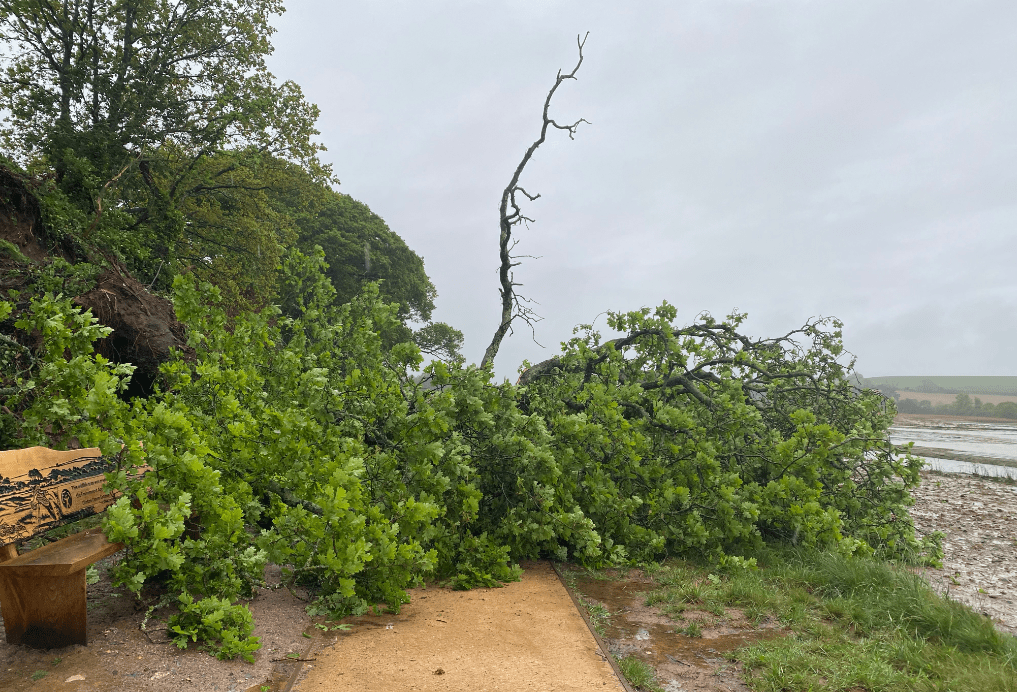
Budleigh, Massive Oak tree falls from cliff onto LORP path, no reported injuries

(Just missing the newly erected Clinton Estate and Environment Agency seat marking the opening of this wildlife site)

From a correspondent:

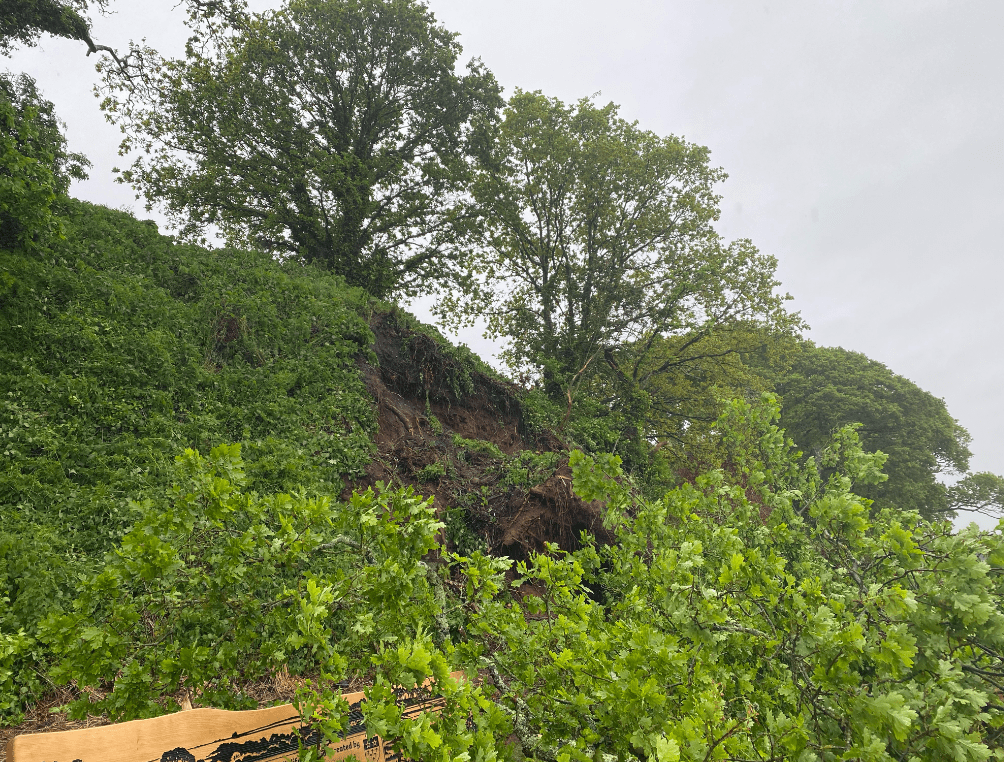
Today we lost a magnificent oak tree which sat on the cliff  at the end of a granary lane garden,  on the western LORP path.

It is only pure luck that no one was killed…(if it had gone yesterday when the path was crowded it would have been a different story) as you will see from the photos it has taken a huge chunk out of the bank and has fallen over  the  path and a fair  way into the estuary.

The granary lane residents  in nearby properties  have on numerous recent occasions   asked Clinton Devon Estates to check the safety of the trees . Concerns have been raised regarding recent slippages and tree movement ,  however  not  on this scale.

The bottom of the cliff where this tree has fallen has been saturated with vile stagnant water for months …it doesn’t  drain  away and concerns were raised  with LORP about damage  to the cliff. The original planning permission  was to raise the path by a metre to protect the cliff, but this was amended  without consultation with  local residents and the path remained the same level.   Hence the sea just rolls in and gets trapped.  Has this affected the trees?   Who knows but it certainly won’t have helped.

Is the path safe to walk?  I would say not…the trees are precariously hanging on, some almost horizontal…anything  which was beneath them has been cleared for LORP and personally I think the path should be closed until CDE has carried out a full inspection of all the trees and published the findings, and deemed the path safe.

Those trees have received little or no maintenance for many years…most probably in the  too difficult or too expensive box for Clinton to deal with…but a proper survey should always have been carried out before opening a busy footpath!