Brixham ‘open for business’ despite parasite outbreak – boil water in 2,500 properties remains

Traders in a Devon town impacted by a water parasite outbreak have urged tourists to visit the area during half term.

George Thorpe, Kirk England www.bbc.co.uk

South West Water (SWW) has been asking people in Brixham to boil tap water after cryptosporidium was found in its network on 14 May.

The water company said 2,500 properties in the Hillhead remained under boil water notices while work to flush the parasite out of the system was completed.

Business owners in Brixham said they had seen a drop in footfall during the outbreak and wanted SWW to help restore confidence in the water locally.

According to the UK Health Security Agency on Friday, there have been 77 confirmed cases of cryptosporidiosis in Brixham.

SWW said work to flush the parasite out of the water network has continued and apologised for the disruption.

‘Heartbreaking situation’

Sean Twomey, owner of the Golden Hind museum ship in Brixham Harbour, said the outbreak had affected all the town’s businesses.

He said it could have been a “bigger disaster” if the outbreak happened during the school holidays, but there had been a “huge drop” in visitor numbers in the past two weeks.

“The town is notably quieter than it normally would be,” he said.

Mr Twomey said he wants SWW to give more reassurance the water is safe to help get visitors back.

“Brixham’s an amazing place to stay and to visit for day trips and stuff like that,” he said.

“It’s heartbreaking to hear of all the Air B&Bs, guest houses and hotels having cancellations and stuff like that.”

Richard Gledhill, from the Torbay Communities charity, said it looked like people were cancelling their visits.

“I’m sorry to say that the word on the street is that people are cancelling,” he said.

“They’re making their own choices without doubt and some of the guys that I know who run restaurants, pubs or wine bars in the town are saying people are just not coming.”

Market traders in Brixham said business had “gone dead” in the town since the outbreak.

Alanis Oliver, who runs the Emalini Art stall, said there was a strange feel around the town.

“I’ve heard of some places who have had cancellations all the way through to August and it’s a bit disheartening really,” she said.

“But I think there will still be some people who come down for the half term and for the holiday.”

Carolina Vottero, who runs the Oyster Cove stall, said she was worried some people would not come back to Brixham.

But she said traders and the town were ready and “buzzing” for the summer season.

Ms Vottero said: “It has been quiet, I’m not going to lie, but we have the bank holiday weekend ahead and hopefully we’ll have everybody coming in.”

Some traders in Kingswear have also expressed their concerns as the village has been impacted by the outbreak as it has the same water supply as Brixham.

Sian Thomas and Jess Povey, who run the Ebb and Flow cafe, said the outbreak has had a “huge impact on trade” and they have felt “forgotten”.

Ms Thomas said: “Obviously it’s been really busy with the bank holidays and Dart Music Festival and I think we would have expected more people than we’ve actually have had.”

Ms Povey added: “It’s pretty sad really. At this time of year it should be exceptionally busy and we’re just not seeing the same numbers we did last year for example.”

Devon ‘open’

Visit Devon director Sally Everton said there had been a downturn in trade since the outbreak happened and the organisation wanted to tell tourists it was safe to visit the county.

“I have had a few challenging times just assuring potential visitors coming to Devon for half term and the Whitsun bank holiday that we’re open for business and it is safe to come here,” she said.

“It’s absolutely 100% safe and we’re open as normal.”

Ms Everton said tourists heading to other parts of Devon can be assured they will not be affected by the parasite.

She said: “Action was taken immediately to limit any impact that it would have on the businesses and visitors that came to Devon.”

One tourist who has not been put off by the outbreak was Ian Pye from Manchester, who is spending two weeks camping near Berry Head.

He said people should “come on down” to Brixham and not to worry about the water.

“It’s got to be taken seriously, but I’m sure South West Water will fix it in no time,” Mr Pye said.

Additional reporting by Hattie McCann

He called a surprise election but Rishi Sunak is making up policy on the hoof

Tories in complete disarray as they launch election without manifesto

What a difference three days make in politics!

23 May Bringing back National Service “could damage morale, recruitment and retention and would consume professional military and naval resources”.

National Service: National Security Ministry of Defence written question – answered on 23 May 2024.

Photo of Andrew MurrisonAndrew Murrison The Parliamentary Under-Secretary of State for Defence

The Government has no current plans to reintroduce National Service. Since 1963, when the last national servicemen were discharged, it has been the policy of successive Governments that the best way of providing for the defence of our country is by maintaining professional Armed Forces staffed by volunteers. The demanding, increasingly technical, nature of defence today is such that we require highly trained, professional men and women in our Regular and Reserve Armed Forces, fully committed to giving their best in defending our country and its allies.

If potentially unwilling National Service recruits were to be obliged to serve alongside the professional men and women of our Armed Forces, it could damage morale, recruitment and retention and would consume professional military and naval resources. If, on the other hand, National Service recruits were kept in separate units, it would be difficult to find a proper and meaningful role for them, potentially harming motivation and discipline. For all these reasons, there are no current plans for the restoration of any form of National Service.

Three days later

26 May Rishi Sunak has vowed to bring back national service for 18-year-olds to create a “renewed sense of pride in our country” if he wins the general election.

Under the mandatory scheme, teenagers would be given a choice between a full-time placement in the armed forces for 12 months or spending one weekend a month for a year volunteering in their community.

What next?

Public finances and the 2024 general election – Institute for Fiscal Studies

ifs.org.uk

There are few certainties in a general election campaign. This time is no different, though there are two things of which we can be reasonably confident.

First, the UK’s parlous fiscal position will hang over the campaign like a dark cloud. Both Labour and the Conservatives are committed to precisely the same debt target. That target is currently on track to be met by the finest of margins. Promises of fiscal largesse, whether tax cuts or spending increases, would mean breaching it. If the parties are serious about their fiscal rules, they’ll have to keep a lid on those promises.

Second, the parties will do everything possible to avoid revealing how they’d approach the difficult economic and fiscal trade-offs awaiting the next government in the autumn.

Here, we discuss each of these points in turn before reflecting on what they mean for the campaign.

Why it’s so hard to get debt falling

Jeremy Hunt and Rachel Reeves, and their respective parties, have both committed to have debt as a share of national income (the debt-to-GDP ratio) falling by the fifth and final year of the forecast. Both have other fiscal targets, but it is this debt rule that is currently acting as the binding constraint. The problem is, for a Chancellor with a goal of reducing debt as a fraction of national income, things have arguably never been so bad.

Government debt is measured relative to the cash size of the economy – what fiscal nerds refer to as nominal GDP. This is the denominator in the debt-to-GDP ratio. When the cash size of the economy is growing quickly – due to either high inflation or rapid ‘real’ economic growth – it is, all else equal, easier to get debt falling. It’s also easier to get debt falling when interest rates are low, and indeed when debt is low, because the government doesn’t need to spend as much on servicing its debt. When one or both of those conditions are satisfied, the government can run looser fiscal policy – it can borrow more – without pushing debt onto a rising path.

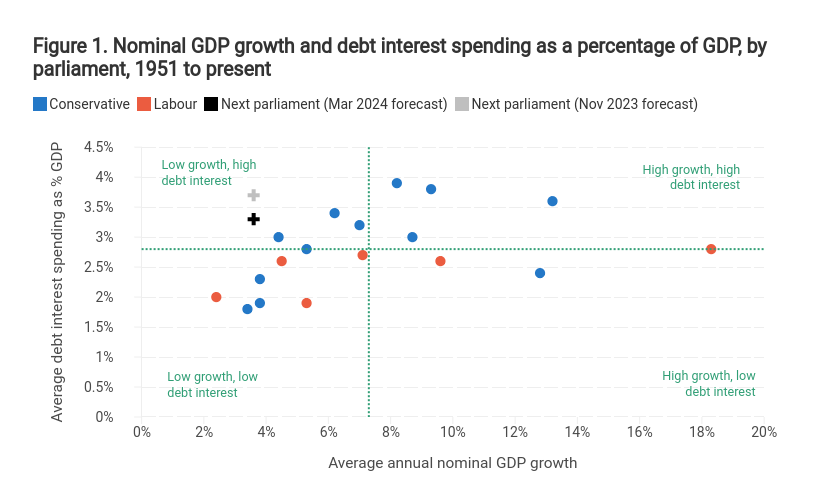
The trouble is, neither of these conditions – high growth or low debt interest payments – are expected to be satisfied in the next parliament. In fact, the latest official forecasts that the next government will face lower than average nominal GDP growth (3.6% per year) and higher than average debt interest spending (3.3% of GDP): the worst of both worlds. This is summarised in Figure 1 and explained in more detail in this previous election briefing.

This picture improved slightly between November 2023 and March 2024 (as shown by the difference between the black and grey markers in Figure 1) as forecasts for debt interest payments came down slightly. These forecasts are subject to considerable uncertainty and it is entirely possible that things will improve further. Growth could pick up, or debt interest payments could fall. The combination of weak growth and high interest rates would certainly be unfortunate and unusual historically, and we may get lucky. 

But we might not. Just because thousands of English and Scottish football fans are crossing their fingers and hoping for the best this summer doesn’t mean that the next Cabinet should do the same. The fiscal outlook might even have deteriorated since the spring, as central banks have indicated that they intend to keep interest rates higher for longer, and the scale of the bill for various compensation schemes (most notably to victims of the infected blood scandal) has become apparent. Indeed, some reports suggest that one reason we’re having a summer election is that the government didn’t expect to be able to cut taxes in an autumn statement without breaching its promise to get debt falling. This debt target leaves a lot to be desired in terms of its design, but that is almost beside the point. Whoever presides over the post-election fiscal event is likely to have very limited fiscal room for manoeuvre. 

Inevitable post-election trade-offs 

This limited room for manoeuvre – limited “headroom” in the oft-used but rather unhelpful parlance – will be despite a considerable package of tax rises and spending cuts built into the baseline. Taxes as a share of national income are forecast to grow from 36.5% of national income in 2024–25 to 37.1% in 2028–29, not least due to an ongoing freeze to the cash value of income tax thresholds (a freeze which has another three years to run). Spending on everything other than debt interest is set to fall from 40.8% to 39.0% of national income. The fact that this is only just enough to stabilise debt in five years’ time speaks to the difficulty of the economic and fiscal inheritance awaiting the next government. 

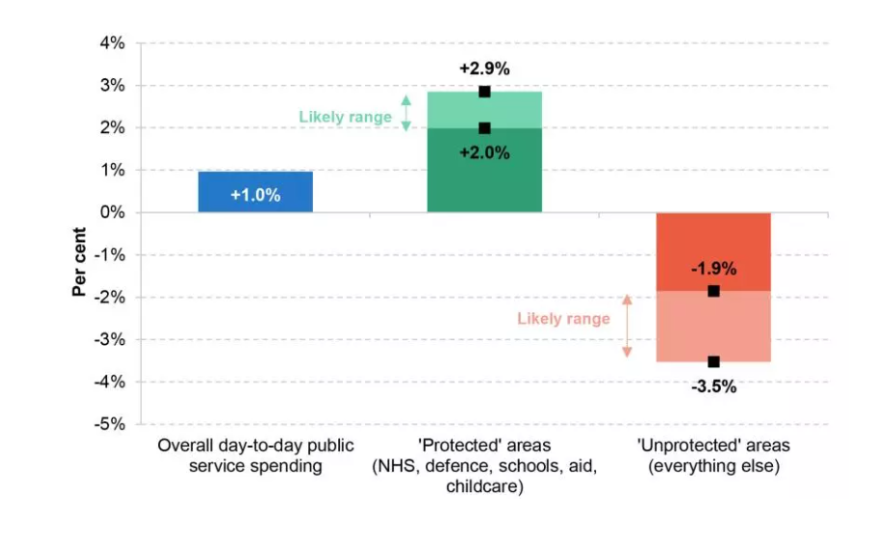
On the spending side, one major and fairly immediate challenge for the next government will be the Spending Review due by the end of the calendar year. Departments do not have detailed budget allocations beyond this year (2024–25). The high-level spending plans published alongside the March Budget, which will act as the baseline for the parties’ election promises and be the starting point for the next government, imply cuts to some ‘unprotected’ budgets. Precisely how big those cuts are depends on what happens to the ‘protected’ areas (like health and defence), among other things. The whole point is, there are no published plans beyond this year, meaning that we don’t know. A reasonable estimate is that unprotected budgets face cuts of between 1.9% and 3.5% per year (or between £10 and £20 billion by 2028–29) – see Figure 2. Notably, this is before accounting for recent announced increases in defence spending. The precise figures are less important than the fact that there are cuts on the way with absolutely zero sense from the main parties about where those might fall.

Figure 2. Estimated change in day-to-day departmental budgets (average annual real-terms growth) under existing spending plans, 2024–25 to 2028–29

Investment budgets, too, are facing cuts. Government investment is set to fall sharply as a share of national income even with Labour’s promise of an additional £23.7 billion of green investment over the parliament. 

It’s not that spending cuts would be impossible to deliver. It’s that they would be impossible to deliver while maintaining the existing contours of the welfare state (even before the planned expansion of childcare subsidies and introduction of a lifetime cap on social care costs), and while maintaining the current range and quality of public services. We could, as a country, decide to charge for services that are currently free, or to means-test things that are currently provided universally, or for the state to stop doing things that it currently does. Yet such discussions seem unlikely to feature in the debate. We wouldn’t allow parties to tell us they will raise taxes without specifying where from, yet we allow them to promise spending cuts without any detail as to where the axe will fall. 

The winners of the election won’t be able to dodge this question for long. The next government may choose to hold a one-year Spending Review (covering just 2025–26) to give itself more time to plan its strategy and come up with a coherent plan for the rest of the parliament. This would delay, but not fundamentally alter, the trade-offs required. 

Readers can explore these trade-offs for themselves using our interactive ‘Be the Chancellor’ tool, produced in partnership with Nesta.

What this means for the campaign 

If we look at the big fiscal picture, the next government effectively has three options. It can implement the spending cuts baked into existing plans – cuts that will inevitably be painful. It can implement tax rises – over and above those already in the books. Or it can borrow more – something that is highly unlikely to be consistent with a promise to stabilise debt as a share of national income. The parties might well be reluctant to tell us which of these they would opt for upon taking office. That doesn’t mean that we should refrain from asking them. 

It is perfectly possible to make a principled case for each of these options. It is perfectly reasonable to hope for more economic growth, and highly desirable for parties to present plans for how they’d aim to deliver it.  But there is no escaping the tough fiscal realities facing the UK. For a party to enter office and then declare that things are ‘worse than expected’ would be fundamentally dishonest. The next government doesn’t need to enter office to ‘open the books’; those books are transparently published and available for all to inspect. We should use them as the basis for an open and robust discussion during the election campaign. 

[See original article for explanation of figure data sources, assumptions and caveats]

Pothole compensation bills costing taxpayers 57% more than a year ago

Taxpayers’ bill from compensation cases related to unrepaired potholes in roads has shot up by 57 per cent in a single year, new data analysis shared with i reveals.

Alexa Phillips inews.co.uk

Authorities in England and Wales spent £25.6m on the pothole payouts to drivers, and associated costs, in 2023/24, compared with £16.3m the previous year. They covered both injuries and damages to vehicles and made up the large majority of the £28.8m spent on all road user compensation claims (see graph below).

The average number of road user compensation claims received per local authority has also rocketed to 421, compared with 234 the previous year. And of those claims 89 per cent related to potholes in 2023/24, compared with 72 per cent the year before, according to the data from a survey of local authorities by the Asphalt Industry Alliance.

Simon Williams, head of policy at the RAC motoring group, warned that the amount local authorities were currently paying in compensation “will pale in comparison to the eventual bill if our pothole plague is allowed to continue”.

The money used for the payouts could have filled more than 350,000 potholes, i analysis has found. The average cost of fixing a pothole is £72.26 but payouts average around £405 per claim.

Councils in England and Wales did spend an estimated £143.5m fixing potholes in 2023-24 – a rise from £93.7m in 2022-23.

But Jack Cousens, head of road policy at the AA motoring group, said he was “worried about budget cuts to road maintenance”.

He told i: “It’s not just fixing potholes. It’s other things such as painting worn outlines, cutting back, overgrown hedges that covering signs cutting back sight lines, where the grass has got long on roundabouts and key junctions, all of those sorts of things form part of their transport budget.”

Potholes have also been responsible for a series of deaths in recent years, prompting coroners to urge councils to repair them.

i has found seven occasions when coroners in England and Wales have sent councils or National Highways official warnings over the risk of further deaths because of potholes.

They come in future deaths reports, which are sent after inquests when a coroner thinks action is needed to protect lives.

The most recent was in October when Lancashire County Council was accused of failing to fix a large crack in the road that led to the death of a cyclist.

Harry Colledge, 84, was flung from his bike in Winmarleigh after it hit the pothole.

He suffered a fatal head injury and died in January 2023.

Kate Bisset, the coroner, wrote that the council had been notified of the crack in September 2022 but failed to identify it in inspections. “There is a risk of future deaths to road users if the surfacing of this road is not adequately maintained,” she warned.

In April 2023 a coroner wrote to National Highways, urging them to repair a Northamptonshire A road on which a collision occurred in 2021, which killed Benjamin James Teague, 26.

Mr Teague’s death was not blamed on the pothole – he drove on the wrong side of the road when overtaking a vehicle and crashed into an oncoming car – but evidence was given during his inquest that the road on which the collision occurred is “in a very poor state with potholes”.

Coroner Anne Pember said the scene of the crash – the A5 between Pottersbury and Paulesbury – was repaired shortly after the crash but had since deteriorated.

There were more warnings in 2022 from coroners about the risk of further deaths from potholes after cyclists were killed.

Mr Williams said the reports were a “stark reminder of the true consequence of Britain’s crumbling roads”.

“Pothole-related injuries are entirely preventable if the roads were looked after better,” he added. “So the fact councils are shelling out such large sums of money in compensation for sub-standard road surfaces is both ridiculous and totally unsustainable.”

The Government has put £8.3bn in funds from the cancelled parts of HS2 towards resurfacing roads, but the RAC said this would cover just 3 per cent of all council-managed roads in England.

The RAC said a proportion of the money raised from fuel duty should be ringfenced for road maintenance.

Councils partly pay for pothole repairs out of their main budgets, which leaves road maintenance vulnerable to cuts to help pay for other services.

National Highways regional director Victoria Lazenby said: “We regard every single death on our roads as one too many. The safety of everyone on our road network matters, it is an imperative for our business in what we set out to achieve and a core value of our organisation in how we go about it.

“Therefore, we take very seriously any comments or concerns raised by coroners in relation to our roads and take action where possible to further improve the way we work and help prevent any more people coming to harm.”

Lancashire Council did not respond to a request for comment.

A Department for Transport spokesperson said: “While the UK’s roads are some of the safest in the world, every death on them is a tragedy, and we are investing £8.3bn of reallocated HS2 funding – enough to resurface the equivalent of over 5,000 miles of roads – so local authorities can maintain their roads making them safer.

“The first £150m of this increase was released within weeks of it being announced in October, with the next £150m coming later this year.”

Thames Water tests for vomiting bug contamination as families fall sick

Thames Water has sent samples of water for lab testing after dozens of people reported becoming unwell with stomach cramps, vomiting and diarrhoea in south-east London.

Helena Horton www.theguardian.com

Earlier this month, unsafe drinking water led to more than 100 cases of a waterborne disease in Devon, with people asked to boil their water because of contamination fears.

After cryptosporidium, a disease that can cause symptoms such as diarrhoea and vomiting, was detected in the water supply in the Brixham area of Devon 10 days ago, 17,000 households and businesses were told by South West Water not to use their tap water for drinking without boiling and cooling it first.

Now residents in Beckenham have reported being struck by a stomach bug which is causing days of vomiting and diarrhoea. They include a four-year-old boy suffering days of vomiting, and an adult woman who was so unwell she went to hospital with stomach pain, vomiting and dehydration.

Katie Cox, a TV producer who lives in the area, said: “I was unwell two weeks ago with what I thought was a stomach bug.

It was a good week before I was able to eat again properly. Since then, the South West Water contamination has come to light and I became concerned that maybe there is something in our water.”

Whole families have reported becoming unwell, and fear it may be caused by a bug in the water. After reporting the issue to Thames Water, people who have been unwell said technicians came to take samples of their tap water. Thames Water confirmed its technicians collected samples, which have been sent for laboratory analysis.

A spokesperson said: “We take the quality of our water extremely seriously – it is the highest quality drinking water in the world – and since 2010 more than 99.95% of tests taken from customers’ taps met the standard required by UK and European legislation. Every year, we carry out more than 500,000 tests, taking samples from source to tap. Customers can find information about their water supply by inputting their postcode on our website.”

Thames Water has not carried out specific testing on any treatment works nearby, but a source at the company said it carries out general monitoring from the wider water supply zone as part of a statutory monitoring programme, and there are no recent failures from the Central Sydenham water zone.

Labour’s shadow environment secretary, Steve Reed, said: “Our water industry is broken. Just days ago, a parasite outbreak was making people sick in Devon, now [Beckenham’s] drinking water may not be safe to drink.

In Devon, South West Water said on 14 May that the water was safe to drink before reversing this advice a day later. The business said data from tests showed treated water leaving its treatment works was not contaminated, but further tests overnight found small traces of cryptosporidium.

In Brixham, 2,500 properties remain under boil tap water notices as the system continues to be flushed, and there has been no date given to those properties for when the water will be safe to drink again.

David Harris, South West Water’s drought and resilience director, said: “We will not lift that boil water notice until it is safe to do so.”

Britain not ready for ‘inevitable’ next pandemic, warns ex-chief scientific adviser Sir Patrick Vallance

Sir Patrick Vallance, the government’s chief scientific adviser during the Covid pandemic, has warned that Britain is not prepared for another pandemic.

Speaking more generally about chaos in No 10, Sir Patrick said: “We have seen, I think, a really extraordinary situation over the past few years with multiple prime ministers, no real accountability for what’s going on and an extremely chaotic system that needs to be revised. That’s why it’s really important that there is an election now. It’s time that we have a change.”

Ellie Harrison www.independent.co.uk

The scientist called for future pandemics to be treated like potential wars, with as much focus going into planning for them as goes into the armed forces.

Speaking at the Hay Festival, during a panel chaired by The Independent’s editor in chief Geordie Greig, Sir Patrick said: “Are we ready for another pandemic? The answer is no.”

He identified several key areas for improvement. “We need better surveillance to be able to pick these things up,” he said. “We need to be much faster, much more aligned. And there are ways to do this – getting rapid diagnostic tests, rapid vaccines, rapid treatments – so that you don’t have to go into the extreme measures that took place last time.”

Vallance said that future pandemics, which he called “absolutely inevitable” need “continual government focus and attention”, and yet “by 2023 the G7 had sort of forgotten about it.”

He continued: “You can’t forget about it in two years.”

Sir Patrick was the UK government’s chief scientific adviser from 2018 until last year, helping to shape key coronavirus policy including lockdowns, as well as becoming a familiar face to millions on the televised Covid briefings alongside then PM Boris Johnson.

Painting a picture of Johnson’s incompetence during the pandemic, he said that when he was asked to present at the G7, on Zoom, the PM interrupted him to tell him he was on mute. Sir Patrick said he told the PM he was certain that he wasn’t on mute, and then watched as “somebody came across and whispered into Johnson’s ear and he said, ‘Ah, sorry, I haven’t got my headphones in.’”

Sir Patrick added: “What is absolutely inevitable is there will be another pandemic. And we’re not ready yet. I don’t think we’re treating it in the way that we treat, for example, the armed forces. We know we have to have an army, not because there’s going to be a war this year, but because it’s an important part of what we need as a nation. We need to treat this preparedness [for a pandemic] in the same way, and not to view it as an easy thing to keep cutting back when there’s no sign of one.”

He also said, however, that he was feeling optimistic about the Pandemic Preparedness Treaty that the World Heath Organisation is attempting to push through. The main goal of the treaty would be to foster an all-of-government and all-of-society approach, strengthening national, regional and global capacities and resilience against future pandemics.

“I’m optimistic for this so-called ‘100 Day Mission’ to get diagnostics, therapeutics and vaccines,” he said. “But it needs political will to drive that forward, and I’m concerned that that’s going to get lost quite quickly.”

Speaking more generally about chaos in No 10, Sir Patrick said: “We have seen, I think, a really extraordinary situation over the past few years with multiple prime ministers, no real accountability for what’s going on and an extremely chaotic system that needs to be revised. That’s why it’s really important that there is an election now. It’s time that we have a change.”

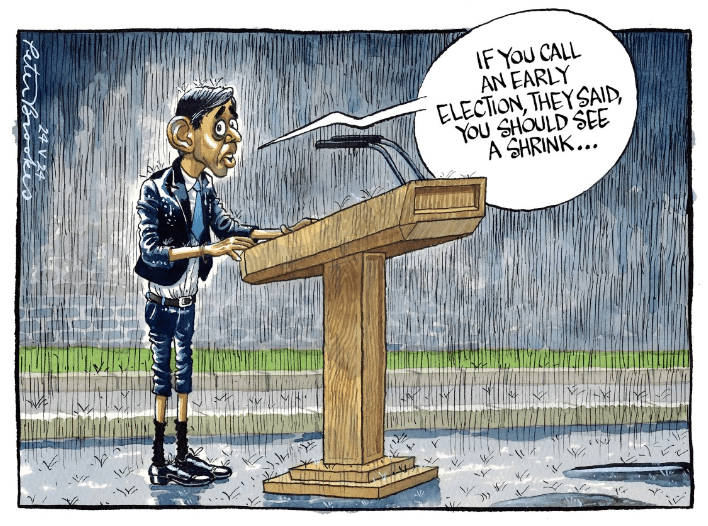
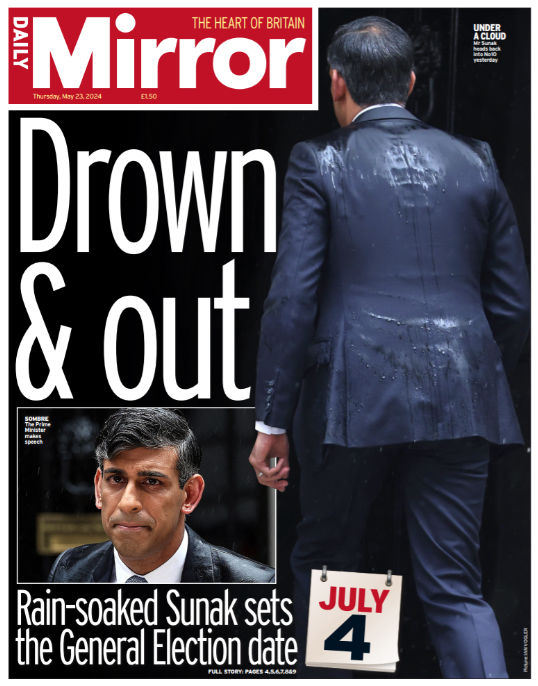
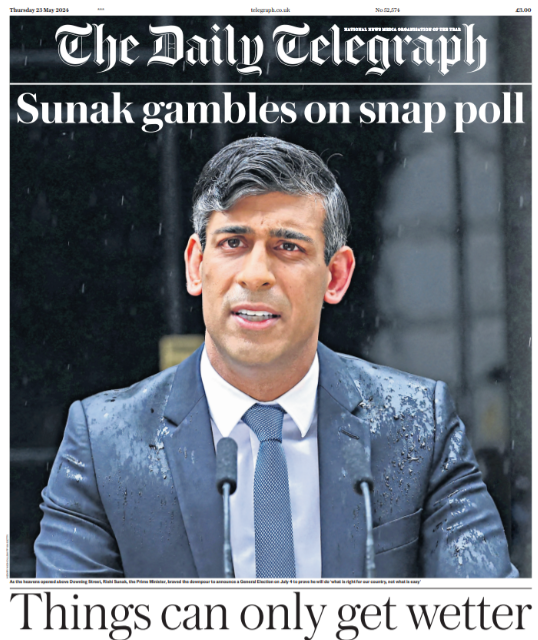
He said the sight of prime minister Rishi Sunak, standing out in the pouring rain this week, as he announced there would be a general election on 4 July, was “emblematic” of the “chaos” within the Conservative Party.

Are consumers any better off after 14 years of Conservative government?

It is a simple question – and it will be at the heart of the general election campaign. After 14 years of Conservative government, people are asking: am I any better off?

Hilary Osborne www.theguardian.com 

Incomes

The answer for most people is – no, you are not better off. Pay has fallen in real terms – that is when inflation, including housing costs, has been taken into account. From 2010-2019, pay across the UK fell by 0.1% a year. Things have improved since the start of the pandemic, but workers are earning thousands of pounds less than they would have been if earnings had risen with inflation.

The living wage – previously the minimum wage – has gone from £5.93 an hour for over-21s to £11.44. However, the Resolution Foundation said cuts to working-age benefits have offset the gains for many. It said, over the past 10 years, low-paid families with children in receipt of benefits had experienced next to no, or even negative, income growth.

The personal tax allowance – the bit that you can earn tax free each year – increased rapidly in the years of the Coalition, letting 3.4 million people on low incomes keep all of their earnings. But since 2021 the threshold has been frozen. That means people receiving pay rises have not felt as much benefit as they would have otherwise.

Despite cuts to national insurance this year, some people will still be worse off than if the thresholds had risen with inflation. When the chancellor announced the latest cut, the Resolution Foundation said anyone earning up to £19,000 would still be worse off. The biggest gainers, it said, were those earning £50,000.

Housing

Though some homeowners have seen huge gains in the value of their properties, it is harder than ever to get on the housing ladder.

In May 2010, the average price of a UK home was £169,162, according to the Nationwide Building Society. In April this year, it was £261,962.

Although the market was sluggish in many parts of the country for several years after the 2008 banking crisis, in London, low interest rates pushed up values. Prices had started rising everywhere before the pandemic and, after a brief period where the housing market was closed, the race for space and a stamp duty holiday added fuel to the fire.

Low interest rates helped many pay off their mortgages and, in the last English Housing Survey, covering 2022-23, 35% of households were outright owners while 29% had mortgages. In 2010, more people had mortgages than owned outright.

However, the cost of a mortgage has gone from record lows – some borrowers were able to lock in for two years at below 1% – to rates not seen since before 2008.

Those not already on the housing ladder face a huge struggle to buy a home. According to Nationwide’s chief economist, Robert Gardner, a typical first-time buyer home now costs 5.2 times a buyer’s earnings, up from 4.6 in 2010. Monthly repayments are now 39% of homeowners’ take-home pay – “that’s quite a bit above the long-run average”, he says. For most of the past 14 years, it was running at 29.30%, but rising interest rates have changed that.

The target of building 300,000 homes a year has not been met.

Children and young people

The past 14 years have been bleak. Within weeks of getting into power, the Conservatives scrapped child trust funds – Gordon Brown’s scheme to help families build up savings for their children. Children had been given payments of at least £250 to be saved until they turned 18. The Institute for Fiscal Studies has found that the accounts made a big difference to the wealth of 18-year-olds, though with average savings of £650, it said this was unlikely to have affected whether they could afford higher education or a deposit for a home.

In January 2013, the government changed the child benefit system so higher income families no longer got the payments.

In England, tuition fees were capped at £3,290. In December 2010, the coalition government tripled the cap to £9,000, which students started paying in September 2012. Since 2017, it has been £9,250.

Childcare costs have gone up faster than inflation: according to the charity Coram, across Great Britain, the average price of 50 hours of childcare for a child under two was £285 a week in 2023, more than 30% higher than a decade ago.

Childcare vouchers were replaced by tax-free childcare in 2017, but many parents are missing out, said Laura Suter, director of personal finance at advice firm AJ Bell. Government spending has been less than half expected. She says many people are put off by the name of the scheme.

Older people

Older people, particularly women, have seen their incomes increase thanks to the new state pension and the “triple lock”, which was introduced by the coalition government to ensure state pensions keep up with inflation and earnings.

However, Helen Morrissey, head of retirement analysis at the financial firm Hargreaves Lansdown, said data shows that after housing costs, and with inflation taken into account, pensioners received £387 a week in 2022/23, compared with £371 a week in 2010. “This is not an enormous increase over the time period,” she said.

Older people are the most likely to have accrued savings, and for many years they did not earn much interest on them. According to Moneyfacts, in 2010, the average easy access savings rate on £10,000 was 0.78%. Interest rate rises mean that’s now at 3.11%. Those saving will feel better off because of recent rate rises, but borrowers will not.

Bills

Council tax bills have gone up, but central government funding cuts mean many bill payers are getting less for their money. In 2010-11, the average bill for a band D property in England was £1,439. This year, it is £2,171.

However, between 2010-11 and 2019-20, the amount local authorities spent on all services fell by 10.4%. The miles covered by bus routes fell by 14% and a third of England’s libraries closed.

Food prices went down for several years as discounters opened more shops in the UK and forced existing supermarkets to embark on cost-cutting. Official figures show prices dropped in 2014, 2015 and 2016. There were also drops during the pandemic. That trend has reversed – in spring last year, prices peaked at more than 19%.

Electricity bills had been fairly stable until the last couple of years. The average spend on electricity was £451 a year in 2010, and £1,274 last year, while gas went up from £520 to £1,304.

Rapid increases in prices in 2021 led to many suppliers collapsing and the disappearance of most of the cheapest tariffs.

Research by the Centre for Economic Performance at LSE suggests that Brexit has contributed to other cost pressures. In a report published last May, it said the cost of Brexit to each household was £250 when only considering the impact on food since December 2019.

A House of Commons Library report shows that, over the past three years, headline inflation has been higher in the UK than in France.

Revealed: Water firms dump sewage at ‘world-class’ Blue Flag beaches

Raw sewage was discharged at nearly half of England’s 72 Blue Flag beaches last year, i analysis reveals.

[Including Exmouth, Sidmouth and Seaton]

Tom Bawden inews.co.uk

Blue Flag status indicates, among other things, that “no industrial, waste-water or sewage-related discharges should affect the beach area”.

But in total, water companies released waste into the sea around Blue Flag areas on at least 2,101 occasions over a total period of 14,834 hours in 2023.

Water companies are allowed to release sewage through “storm overflows” during periods of heavy rain, but campaigners have criticised the dumping of waste at sites designated as safe for swimming.

Meadfoot Beach near Torquay had the longest period of sewage discharge, totaling 2,003 hours through 140 dumps, according to the Top of the Poops sewage monitoring site, based on data from the water companies.

Exmouth Beach, which has been awarded Blue Flag status six years in a row, came next, with 214 sewage dumps over 1,983 hours, followed by Torre Abbey Sands in Torquay, with 190 dumps over 1,682 hours.

Environmental activist Feargal Sharkey said i‘s analysis was “yet another illustration of the utter devastation and contempt water companies are showing towards their customers and society”.

“Blue Flags are awarded on the basis that here’s a guide that you can take your family over the bank holiday weekend and safe in the knowledge that your kids will be safe,” Mr Sharkey said.

“But hidden behind the presentation of a Blue Flag beach, your children are potentially actually paddling and swimming in their own waste. And it’s only because of the recent ruckus and all of this being dragged out into the public scrutiny that people are now becoming aware of it.”

He added: “Kier Starmer’s very insightful reference to the state of our rivers and sea yesterday was greeted with applause and enthusiasm.

“Now we need to ensure that any new government will carry out an immediate root and branch review – not only of the ownership, funding and structure of the water industry, but the operation, structure and funding of its regulatory oversight system because both have failed both the environment and the consumer.”

Asked if that includes blue flag beaches, he said: “You better believe it – all of it should be up for grabs and it all needs to be reviewed in the first 100 days and a matter of some urgency.”

Water companies are allowed to use “storm overflows” to discharge waste during periods of heavy rain to stop their systems from getting overwhelmed and sewage backing up into people’s homes.

But people are becoming increasingly angry about the number of times sewage is being dumped into the sea and want to see the sewage system upgraded.

A total of 20 of the 33 Blue Flag sites where sewage was released had 30 discharges or more last year. Nine Blue Flag beaches had more than 100 sewage discharges.

Jo Bateman – a keen swimmer – is so frustrated by the pollution around Exmouth beach that she is taking South West Water to court.

A retired physiotherapist, the 62-year-old is claiming compensation, saying she was unable to swim at Exmouth Beach for ten days in 2023 because of raw sewage being discharged into the sea.

“When I first started swimming in Exmouth in 2018, I was completely ignorant of the water pollution problem caused by South West Water’s sewage discharges into the Exe estuary and off the beach,” she said.

“As time has gone by, I’ve learned more and more about what’s happening. It’s unacceptable. I’m [taking SWW) to court this because I feel they need to be held to account and made to take full responsibility for the harm they’re causing – not just to me but to all water users, to the environment, and to the tourism industry.

“I hope to set a legal precedent that will open the floodgates for the many people like me who have been affected by the unacceptable actions of the water companies. It would be amazing to see them rise up and take action,” she said.

John Halsall, Chief Operating Officer at South West Water, said: “Like all our customers, including Ms Bateman, we care deeply about the quality of our region’s bathing waters… Exmouth beach has maintained an ‘excellent’ bathing water quality status since 2016.”

The Blue Flag scheme is an international quality mark which is run in England by Keep Britain Tidy and tests the quality of bathing water at least every 30 days.

A spokesperson for Keep Britain Tidy said they are awarded on the basis of water quality testing that is carried out, independently, by the Environment Agency at all designated bathing beaches during the bathing season – which runs between May and September.

“The Environment Agency advises us which beaches have met the international Blue Flag standard for bathing water quality, based on the EU Bathing Water Directive, at the beach,” it said.

Other English beaches that are most affected include Avon Beach, in the coastal town of Mudeford, to the east of Bournemouth, which had 165 sewage dumps last year over 1,657 hours and Beachlands Central on Hayling Island in Hampshire, with 163 dumps over 1,286 hours.

In the North of England, Whitley Bay had 52 dumps lasting 148 hours and Seaburn Beach near Sunderland had 43 discharges over 136 hours.

Analysis of raw data for Blue Flag beaches in Scotland and Wales is less comprehensive and up-to-date than for England.

Scotland does not have a Blue Flag scheme but it does operate its own award, known as the Scottish Beach awards.

An analysis by the Scottish Liberal Democrats, based on data for 2022, found that sewage was dumped onto those beaches at least 411 times that year.

Peterhead Lido, which is situated on the east coast, north of Aberdeen, saw the most releases, with 337 discharges over 483 hours in 2022. And last year, sewage was dumped on 205 occasions, the longest of which lasted 28 hours, according to Scottish Water.

In Wales, a pumping station about a mile downstream of Poppit Sands beach in northern Pembrokeshire – as the River Teifi enters the sea – discharged sewage 130 times over 2,592 hours in 2023, according to data from Welsh Water.

A Water UK spokesperson said: “The quality of our bathing waters has been transformed in recent years. There are nearly seven times as many beaches classed as ‘excellent’ since 1990 and 90 per cent of bathing waters are now rated as ‘good’ or ‘excellent’.

“We recognise however that the current levels of sewage spills are still unacceptable. Companies want to invest £11 billion – a tripling on current levels – to reduce spills in bathing waters by nearly two-thirds by 2030.”

Blue Flag beach criteria

The Keep Britain Tidy website lists a series of criteria for a Blue Flag beach, saying the award shows “locals and visitors they have arrived at a clean, safe and beautiful beach”.

The criteria includes:

  • No industrial, waste-water or sewage-related discharges should affect the beach area
  • The beach must achieve ‘excellent’ water quality as set out in the Bathing Water Directive
  • If appropriate, an adequate number of lifeguards and/or lifesaving equipment must be available at the beach
  • First aid equipment must be available on the beach
  • A supply of drinking water should be available at the beach
  • Wheelchair access and accessibility features must be in place for at least one Blue Flag beach in each municipality
  • Bins must be available at the beach and they must be regularly emptied
  • Facilities for the separation of recyclable waste materials should be available at the beach
  • Toilet facilities must be provided
  • The toilet or restroom facilities must be kept clean
  • There should be no unauthorised camping, driving or dumping of waste on the beach
  • During the bathing season dogs must be excluded from the award area of the beach

An Environment Agency spokesperson said 96 per cent of bathing sites meet minimum water quality standards – up from just 76 per cent in 2010.

“We are also strengthening our regulation and working with the water sector, farmers, industry, and others to improve our bathing waters for all.”

Sian Williams, head of operations Natural Resources Wales said: “We remain absolutely committed to improving water quality in our rivers and coastal waters for both people and nature.

“We understand the concern of many across Wales that overflows are still operating too frequently, and we continue to push water companies to improve their performance and reduce spill numbers.”

Lest you forget the dysfunctional response to Covid including the part played by Rishi Sunak

5 revelations you missed at the Simon Case Covid grilling

Britain’s supremely powerful Cabinet secretary — that’s the country’s top civil servant — faced a grilling Thursday from the U.K.’s official inquiry into the deadly coronavirus pandemic.

Andrew McDonald www.politico.eu

But his interrogation came, helpfully, the day after Prime Minister Rishi Sunak called a snap election, diverting attention from what should have been a big moment.

POLITICO nevertheless did its patriotic duty — turning up in person for the grueling six-and-a-half-hour session to hear Case pressed on the role he played at the center of the U.K. government in Boris Johnson’s chaotic pandemic response.

Here’s what you missed.

1) Sorry about those awkward texts

The inquiry started — where else? — with an examination of Case’s very frank WhatsApp messages, which have stolen the headlines as the process unfolded, offering scathing takes on Johnson, his advisers and even the British public.

“They are very raw, in-the-moment, human expressions,” Case said — after inquisitor Hugo Keith deadpanned: “It is understood that you were a prolific user of WhatsApp.”

Case admitted he owed a few apologies for the way he had expressed himself — and said he “deeply regretted” the messages.

Some new text messages from Case in 2020 were also disclosed during Thursday’s grilling, showing that the top official once told Boris Johnson to get off WhatsApp.

2) Mistakes were made

Case got emotional as questions moved to the fall of 2020, when Covid-19 cases soared before the British government finally implemented a second national lockdown.

“We tried, at every stage, to act through the best of intentions to find the right balance to avoid these harms, but we didn’t come up with the right answer,” Case said of the day Britain entered lockdown again. “It was a very dark day.”

In Case’s written witness statement he described failings under Johnson’s government as the “worst governing ever seen.” He said he feels that responsibility for the many lives lost lies with all, including himself, who served in that period.

3) Toxic pygmies in Whitehall

Case — in newly-published WhatsApps and in his oral evidence — took aim at a toxic culture in Whitehall and its key departments.

In one freshly-revealed text to another senior official, Case summarized the situation in the critical Cabinet Office department as “Crisis + pygmies = toxic behaviors.” He said this was likely a comment on the ability of people in the Cabinet Office and in No. 10 Downing Street.

Case said he was deeply frustrated by the culture in government — in which “good people were just being smashed to pieces.”

“I felt that decision-taking was inefficient and sort of more difficult than it had to be,” Case said.

He agreed, too, with the inquiry’s line of questioning that there had been a “culture of fear” around Johnson’s then-top aide, Dominic Cummings, though he later added that Cummings’ “reputation was worse than the reality.”

4) BoJo reflections

Case — who described Boris Johnson in WhatsApps at the time as “Trump-Bolsonaro levels of mad and dangerous” and “basically feral” — had a go at smoothing over his criticism of his old boss.

In a lyrical interlude, Case said Johnson’s “style is very much wanting the debate to play out in front of him, competition for ideas and views I think is really how he made decisions.”

But Case added that he hadn’t understood at the time how the former PM was opposed to lockdown “at quite a deep ideological level,” which led to struggles as he considered whether to plunge a Britain once again ravaged by Covid-19 back into lockdown in the fall of 2020.

In far more diplomatic language than he used in his WhatsApps, Case said he found Johnson’s habit of making U-turns “incredibly frustrating.”

“That was really difficult [for me] as a sort of technocrat, as the gearbox trying to connect the prime minister’s system,” he added.

5) What about Sunak?

The inquiry also revealed that Case had privately told Johnson in summer 2020 to stop always agreeing with his chancellor, Rishi Sunak — now Britain’s prime minister.

As Britain’s top finance minister, Sunak tended to back quicker exits from lockdown than the medical experts who had the PM’s ear.

According to the inquiry’s lawyers, Case sent Johnson a message amid discussions of meetings between Sunak and Johnson that read: “It can’t always be you agreeing with Rishi.”

Inquiry lawyer Hugo Keith put it to Case that he was concerned Johnson kept being bounced into a change of policy by meetings with Sunak.

Case insisted he was simply telling the PM to do the balancing-act job of a prime minister, while Sunak carried out his role in promoting the economy.

Boil water notice – Alston and the Hillhead area of Brixham

Still in place for 2,500 households

23/05/2024 www.southwestwater.co.uk 

“We’re working around the clock to resolve the situation for the 2,500 households impacted across the Hillhead supply area.

“Our number one priority is the health and safety of our customers. Yesterday (22 May) over 40 South West Water crews began delivering bottled water to properties across the boil water notice area.  

“Bottled water stations in Broadsands, Freshwater Quarry and Churston remain open between 7am and 9pm every day. On Tuesday (21 May), a drop-in centre opened in Brixham, which is open to customers with questions regarding compensation and support available to affected households.

“Our community van is back in Kingswear today from 12-5:30pm, you can find us parked up on Brixham road off the B3205. The team will be able to help with any queries or concerns you have following the boil water notice.

“Our operations teams are working tirelessly to eliminate any traces of cryptosporidium, and we are continuing to flush and clean the system. We will not lift the boil water notice for those affected until we and our public health partners are absolutely satisfied it is safe to do so.

“Separately, investigations into the damaged air valve installation on private land, which we believe to be the cause, are ongoing.

“We are hugely grateful to our customers for their kind support to our teams that are out trying to fix the issue and support our customers in the local area as quickly as possible.”

Inspector allows ‘unwanted’ Exeter student flats

A government inspector has given the go-ahead for a new development of student flats in the heart of Exeter which city councillors said the community did not want or need.

Guy Henderson, local democracy reporter www.radioexe.co.uk

Developers trying to build four three-storey units on the site of the former Maximum Motors workshop in Howell Road have won their appeal against the city council’s decision last September to say no.

There will be bedrooms for 26 students in the purpose-built blocks.

Councillors said when they made their decision that the city did not want more purpose-built student accommodation, and desperately needed homes for local families instead.

They said the increase in student housing to cope with the growth and popularity of Exeter University had led to an ‘imbalance of population’ and went against local planning policies.

But the inspector decided that it would not create an over-concentration of student flats which would change the character of the neighbourhood.

There are already more than 300 beds in four other purpose-built blocks within 250 metres of the Howell Road site.

At the time it was first considered, one objector pleaded with councillors: “If you have any regard at all for residents living in the centre of Exeter, you will turn down this application.”

Another wrote: “I cannot object strongly enough to this suggestion and this constant focus on purpose-built student accommodation rather than social and general needs.”

The inspector decided the new blocks could be properly integrated into the urban area.

An application by the developer for costs against the city council was refused.

Rishi Sunak Takes Staged Election Questions from Conservative Councillors Posing as Ordinary Voters

The Prime Minister thanked the hi-vis jacket-wearing men for their “important” questions without declaring that they were local Conservative Councillors Ross Hills and Ben Hall-Evans

Adam Bienkov bylinetimes.com 

Rishi Sunak has been accused of faking support for the Conservative party, after taking two questions from supposedly ordinary members of the public, who turned out to be Conservative Councillors.

Broadcasters on Thursday morning carried footage of an individual wearing a hi-vis jacket, asking the Prime Minister a question about his Rwanda scheme, during an event at a warehouse in Derbyshire.

The man told Sunak that “the biggest issue is going to be immigration over this election campaign” before asking him whether “your Rwanda plan is going to see results and stop the small boats coming.”

The Prime Minister thanked the man for his “important question.”

However, neither Sunak, nor broadcasters informed viewers that the man asking the question was actually Conservative Leicestershire County Councillor Ross Hills.

Hills confirmed to Byline Times that he had been the individual asking the question.

“That was me yes,” he told this paper, before confirming that he had been asked to appear at the event.

Asked whether the Conservative party had asked him to ask Sunak the specific question about Rwanda, he insisted that he had to get to work and ended the call.

Hills lists his job online as being a “part time dentist” alongside his job as a councillor.

This paper later identified a second hi-vis jacket-wearing individual asking Sunak a question at the event about the economy as local Erewash Conservative Councillor Ben Hall-Evans.

Hall-Evans, who lists his profession online as a ‘Functional Consultant’, told Sunak that “You’ve talked a lot about the economy, specific to everybody, the cost of living crisis… What’s been done and what sets you apart for the future to benefit that pound in the pocket.”

Sunak replied that this was a “good place to start” without revealing to viewers who the man was.

A Labour spokesperson said it showed that Rishi Sunak was “running scared” of the electorate.

“Rishi Sunak spent months dodging the verdict of voters and even now, he’s still running scared.

“The reality is that 14 years of Tory chaos have cost the country dearly and have left working people worse off.”

The Conservative party was contacted for comment.

The row comes after Byline Times revealed that the Conservative party had staged a fake “protest” against Labour’s Deputy Leader Angela Rayner.

This paper identified one of the protesters as local Conservative Councillor for Yarm, John Coulson.

Coulson admitted to this paper to taking part in the protest, alongside other local Conservative councillors.

Demolition plans for Devoncourt hotel rejected

A hotel once regarded as the finest in Exmouth has been saved from demolition but its long-term fate is still hanging in the balance. East Devon planners have rejected contentious plans to demolish Devoncourt Hotel and replace it with a combination of apartments and a hotel.

Anita Merritt www.devonlive.com 

The latest planning application for the site in Douglas Avenue sought to build 66 homes and a new smaller 65 bed hotel. Fierce opposition saw around 180 objections submitted and just three in favour of the proposals.

The revised application, submitted by Azim Lalani, had been recommended for approval. However, during an at-times tense debate yesterday, May 21, when planners met to discuss the plans, it was eventually rejected as it was considered to be an overdevelopment of the site and was unsympathetic to its surroundings.

Worries were also raised about parking. Seven councillors on the district council’s planning committee voted to reject the scheme – a motion proposed by vice chair Cllr Matt Hall (Liberal Democrat, Exmouth Withycombe Raleigh) – with four in favour of approving it.

Chair Olly Davey (Green Party, Exmouth Town) didn’t vote to reject the proposal but acknowledged it had been a ‘contentious application’.

After the meeting he said: “There were concerns about the ability of the design to blend in with its surroundings, the scale of the development and also there was a great deal of discussion about the availability of parking for the proposal.

“We had several of the original objectors there, and they outlined similar concerns, including the amount of traffic that would be using the site.”

Cllr Davey said a redesign meant the proposed development would now take up less of the site than initial plans, but the scheme still didn’t fit the design statement for the Avenues area, which states only a quarter of any given plot should be developed.

The plans involved demolishing the existing hotel and replace it with a 65-bed alternative at the southern most part of the land with access via Maer Road car park and its own car park. Vehicular access for the proposed apartments was to remain off Douglas Avenue.

The location of the apartments was on the north and south side of the site. One of the blocks would have been for 15 affordable properties, with some being rented or for shared ownership.

The application was initially debated by East Devon’s planning committee in April. Following a marathon two-and-a-half hour debate, councillors agreed to visit the site to investigate concerns about parking as the new hotel would rely on the nearby council-owned Maer Road car park for its guests.

The council’s car parks manager told councillors that data suggested there would be enough capacity for the hotel guests, given that daily use is generally fewer than 100 transactions per day. However, the car park is currently closed at night as it was previously used by ‘boy and girl racers’, although it was suggested it could be opened all night if demand from the hotel and other users existed.

Some councillors raised concerns about sewerage capacity. However, South West Water stated that storm overflow at the pumping station and the local sewer flooding downstream from the proposed development “is being investigated so the issues should hopefully be resolved before any new connection takes place”.

While the council’s landscape architect and urban designer retained their recommendations to refuse the scheme, officers said “the benefits of the proposal are considered to demonstrably outweigh the harm” with conditions put in place to mitigate certain impacts.

Cllr Davey said the committee would now have to wait to see whether the applicant would submit a revised scheme or try to appeal. Malcolm Gigg, the agent for the applicant, was contacted for comment but was unavailable.

At the April meeting, he said the scheme would benefit the area by providing ‘much-needed accommodation’ from both the residential and hotel perspective. He said the extent of the work needed to retain the existing building was ‘unachievable’.

The Devoncourt was generally considered to be Exmouth’s finest hotel before it began offering 25-year timeshare rooms in the 1980s.

Among the local residents against the plans, one said in his submitted objection to the council: “I object to the thoughts that planning take no notice of what is going on with all of said people who object to a monstrosity that no one wants, when we already have a hotel that everyone loves to visit on a daily basis.

“Who in their right mind planned a carbuncle of this magnitude only to destroy a hotel that has great views of Exmouth and good facilities for all to enjoy, two swimming pools and beautifully kept gardens?

“What a waste, so please wake up as to what you are destroying here now. Throw these plans in the bin where they belong.

“The residents who live all around the area object to these plans and also all who use the hotel for the facilities don’t want what you want, so as I said get your heads out of the sand and scrap the idea completely as it’s not needed.”

Water firms seek bills hike to up to £915 over next five years

Water firms in England and Wales have reportedly declared they want to increase bills by between 24 per cent and 91 per cent over the next five years, according to a consumer watchdog.

Brendan McFadden inews.co.uk

Southern Water is asking for the biggest increase of 91 per cent, which would mean its customers’ bills would rise from the current level of £479 to £915 per year, according to the Consumer Council for Water (CCW).

South Staffordshire and Cambridge Water are requesting the lowest rise – of 24 per cent – which equates to a £43 rise in their bills.

Firms have defended their request by saying higher bills will fund £100bn of spending over the next five years.

They claim the cash will fund replacing ageing, leaking pipes as well as stemming sewage discharges into rivers and seas.

The firms’ request comes in advance of a meeting by water industry regulator Ofwat this week, where it will set out what companies can charge their customers from next year up until 2030.

The regulator is understood to agree bill rises of at least half the amount that the companies have requested.

In some cases it is believed that Ofwat will request rises of more than half that has been requested.

Mike Keil, chief executive of the CCW, said bill rises were “going to come as a massive surprise to people”.

“People do want to see improvements, they do understand that takes investment, but I think the scale of what’s being proposed here is going to come as a real shock and this is why water companies have double down on their efforts to explain what people are getting for their money,” Mr Keil said.

Increases which have been proposed include forecasted inflation rate of 2 per cent.

The data take in changes the companies, Ofwat and other bodies such as the Environment Agency (EA) have made to their proposal for the future since their five-year plans for the period 2025-2030 were submitted in October.

Proposed increases include a forecast inflation rate of 2 per cent, in line with the Bank of England’s target.

Katy Taylor, Southern Water’s chief customer officer, said the company shared “everyone’s concerns about rising payments”, adding: “the water needs of our water-stressed region pose a unique set of challenges which require significant investment”.

Ms Taylor added cash from higher bills would be used to “reduce the use of storm overflows, safeguard water supplies for a rapidly growing population, and protect the environment”.

Water UK, which represents suppliers, said bill rises were “never welcome”, adding water companies were “massively increasing the level of financial support they offer to customers who struggle to pay their bills”.

The request for bill increases comes after a study published this year found water bosses have pocketed more than £25m in bonuses, benefits and other incentives since the general election in 2019.

Data compiled by Labour found the chief executives of nine water companies in England have pocketed millions on top of their basic pay over the past four years.

Since the election water chiefs received more than £10m in bonuses, nearly £15m in incentives and £621,580 in benefits, the analysis found.

The cash includes £1.4m in bonuses last year, down from £3.1m paid in 2022.

The release of the figures comes amid widespread outrage at the amount of sewage water companies are pumping into the nation’s rivers and lakes.

According to analysis from i published last week, water companies discharged sewage for more than 56,000 hours between them in rivers just down the road from their own headquarters last year.

Ofwat and the EA have come under fire for failing to do enough to protect consumers and take proper action against water companies for pumping sewage into the UK’s waterways.

Latest official data show water companies across England spilled sewage 464,056 times in 2023.

In one incident revealed by the BBC, United Utilities illegally pumped around 10 million litres of sewage into Lake Windermere in February.

The company blamed a telecoms fault in the area – but critics claim it failed to address the problem and let the EA know about it for nearly 10 hours.

A spokesperson for the company told the BBC: “As soon as we discovered this fault was affecting the Glebe Road pumping station, our engineers took urgent steps to resolve the situation.”

More than one in six customers considered water bill rises affordable, according to a recent survey by Ofwat.

How much do companies want to hike bills by?

  • Southern Water: an increase of 91 per cent to £915
  • Thames Water: an increase of 59 per cent to £749
  • Hafren Dyfredwy: an increase of 56 per cent to £676
  • Severn Trent: an increase of 50 per cent to £657
  • Wessex Water: an increase of 50 per cent to £822
  • Yorkshire Water: an increase of 46 per cent to £682
  • Dŵr Cymru: an increase of 43 per cent to £702
  • United Utilities: an increase of 38 per cent to £666
  • South East Water: an increase of 35 per cent £330
  • Pennon: an increase of 33 per cent to £644
  • Portsmouth Water: a increase of 31 per cent to £157
  • SES: an increase of 30 per cent to £315
  • Anglian Water: an increase of 29 per cent to £682
  • Northumbrian Water and Essex & Suffolk Water: an increase of 26 per cent to £530
  • Affinity Water: an increase of 25 per cent to £294
  • South Staffs & Cambridge Water: an increase of 24 per cent to £221

SWW escape Brixham scrutiny due to Torbay council ‘paralysis’

“It is ironic that all the councillors from Brixham and the affected areas are Conservatives. Their actions have now resulted in us not being able to hold SWW to account on behalf of the community.” Opposition leader Steve Darling (Lib Dem).

Guy Henderson – Local Democracy Reporter www.radioexe.co.uk

‘It would have been a very opportune moment to hold them to account’

Torbay Council has been left in a state of ‘paralysis’ in the aftermath of a stormy mayor-making meeting which resulted in opposition councillors walking out.

Liberal Democrats, independents and the lone representative of Prosper Torbay got up and left the chamber in protest as the meeting at the Riviera Centre ended in chaos.

Now a string of meetings – including a showdown with South West Water – has been called off because the make-up of the council’s committees will not be decided until after a crucial by-election in Torbay next month.

The Riviera Centre meeting saw the council’s Conservatives – the largest single party group – vote against the appointment of Liberal Democrat mayor-elect Swithin Long, despite having previously given him their unanimous backing.

The position of mayor – normally ceremonial – is more delicate this year because the council is split 18-17 in favour of the non-Tory opposition. The mayor has a casting vote in the event of a tied council decision, making the position crucial in the coming 12 months.

The by-election takes place on Thursday 6 June in Wellswood, which is traditional Tory territory.

The opposition walkout came later in the meeting when council leader David Thomas (Con, Preston) moved a successful motion to adjourn selecting committee memberships and chairs until Thursday 20 June, saying: “It would make sense to deal with it after the by-election.”

The motion, he said, would go straight to the vote with no debate, in line with the council’s own standing orders. This sparked the opposition’s angry walkout.

Now a number of key meetings scheduled for the next month have had to be called off because the committees have no chairs or members.

A meeting focusing on adult social care has been axed, along with one on caring for children and young people. The council’s audit committee will skip its scheduled meeting, as will the overview and scrutiny board and committees overseeing Oldway Mansion and Torbay’s harbours.

Opposition leader Steve Darling (Lib Dem, Barton with Watcombe) said: “The council is effectively paralysed.”

Representatives from South West Water (SWW) and the Environment Agency had been due to face councillors at the overview and scrutiny board on Wednesday 5 June, but that meeting is on the ‘cancelled or postponed’ list.

“With the current cryptosporidium outbreak in Brixham, it would have been a very opportune moment to hold them to account,” said Cllr Darling.

“It is ironic that all the councillors from Brixham and the affected areas are Conservatives. Their actions have now resulted in us not being able to hold SWW to account on behalf of the community.”

Paul Arnott: ‘Enjoy the beaches this summer, but keep protesting too’

Paul Arnott

Many moons ago, I was living in reduced circumstances paying my way through a Psychology degree at Exeter Uni with a tiny grant and no other support except working every vacation to save to survive another term. I was very lucky, however, to be offered a couple of affordable places to live as I progressed and then graduated, one in Bonhay Road near St David’s station and the other on The Strand in Topsham.

One of the subjects we studied was known as “cognitive dissonance”, a term that has to an extent now passed into the wider language. When used today, it essentially means how we feel when confronted with two entirely incompatible aspects or facts. Last weekend, that happened on a huge scale, when many of the residents of our seaside towns heard via East Devon District Council that Beer, Exmouth, Seaton and Sidmouth Town beaches had been awarded Blue Flag Status from Keep Britain Tidy on behalf of the Foundation for Environmental Education.

It would be an understatement to say that residents were gobsmacked, having spent winter witnessing repeated sewage spills with the seawater not fit to enter. Let me just say that, as an example, the Exmouth Facebook pages were boiling over with cognitive dissonance. Or WTF to coin one particular acronym. Understandably so.

Too make it odder, within days of the Blue Flag Awards being announced, there was a superb protest by the Friends of the River Exe with Surfers Against Sewage for a Paddle Out at Exmouth beach. More surreal, along Lyme Bay at Brixham thousands of residents were told to boil their tap water by South West Water, and dozens succumbed to diarrhoea, after cryptosporidium entered the fresh water supply.

EDDC got a bit of a leathering, a classic example of shooting the messenger, for announcing the Blue Flag prizes. I want to assure readers that as far as South West Water and the government are concerned, we are still wholly and actively on the front foot having, as many may recall, voted formally that we have no confidence in SWW a few months back. Much is happening which will be made known as events unfold.

However, and this is the dissonant bit, the Blue Flag awards are actually good news for the communities concerned, all of them needing tourism as a key part of their economies. Crucially, the measurements taken to win this status were between 15th May and 30th September last year, the summer season. It seems highly likely that if these measurements had been taken over the winter, a Brown Flag may have been more apt.

It’s worth pointing out that water quality is not the only criterion. We have provided track matting at Seaton and Beer, soon at Sidmouth and Budleigh, to assist disability access. Facilities such as taps, refill points and benches are adjudged very good. In Exmouth through our concessions around five thousand children per year are introduced to water sports. And much more.

All the above means that for the crucial summer season the work of East Devon District Council and the many local businesses and volunteers is something we can all be proud of. In the rare event of a summer pollution incident, we will raise red flags, and information boards with QR codes will give up to date information.

I hope this helps. Please enjoy the beaches this summer, but if you’re fed up with how the government has lost control of SWW, keep protesting too. I will continue to do both.

South West Water to pay £127m dividend despite pollution anger

The owner of South West Water has announced plans to hand back more than £120 million to shareholders despite facing fresh controversy over water pollution and racking up £9 million in losses.

Emma Powell, Adam Vaughan www.thetimes.co.uk

Less than a week ago, residents of Brixham in Devon were told to boil their drinking water after cases of a diarrhoea-type illness were confirmed and samples of cryptosporidium, a harmful waterborne parasite, were discovered.

Susan Davy, chief executive of Pennon, said that the company was “working tirelessly around the clock” to resolve the problems. Normal service has yet to resume for 15 per cent of affected customers. Households have been offered compensation of a payment or bill credit of £215, which will cost Pennon £3.5 million.

According to the UK Health Security Agency the latest number of reported cases of cryptosporidium infection in the area is 57. Brixham has a population of about 17,000.

The FTSE 100 group declared a final dividend of £86.7 million, which, in addition to the £40.2 million already paid out to shareholders, will take the total dividend for the year to £126.9 million, a move that has prompted criticism.

Anthony Mangnall, the Conservative MP for Totnes, said Pennon should suspend the dividend payments or the chief executive should step aside. “I’m not against dividend payments in general. I’m just saying that at this point in time, where the public have been so badly let down, that we really consider how these dividends are paid,” he told the Press Association.

A government source said it was “completely unacceptable” for the company to be paying a dividend “given its appalling record”, including millions of pounds in fines last year for pollution offences and poor performance.

“The announcement of a £127 million payout only adds to the concerns about the way this company is managed. Steve Barclay [the environment secretary] is clear there is simply no justification for profit from pollution.”

The company said it had adjusted the payout by £2.4 million to account for the fine levied on South West Water last year for dumping waste into rivers in Cornwall and Devon, the largest such penalty imposed for environmental offences in the region.

Davy said the company had “carefully considered” new guidance on dividends from Ofwat, the water industry regulator, in deciding how much cash to return to investors. After the £2 million deduction, the dividend was in line with a policy to increase the payout each year in line with HCPI inflation — the consumer prices index with added housing costs — plus 2 per cent, “signalling we are listening, clearing the way for long-term shareholder value”, Davy said.

She added: “At a time when media, public and regulatory scrutiny is high, it is important we do what is right for all.”

The group underperformed on its outcome delivery incentives, which reward the company for performing against operational targets from leaks and supply interruptions, suffering a net penalty impact of £35 million. Pennon incurred a pre-tax loss of £9.1 million, worsening from £8.5 million the previous year.

The shares closed down 37p, or 5.1 per cent, at 679½p.

Thames directors jump ship

A wave of directors quit Thames Water yesterday ahead of Ofwat’s assessment of the utility’s five-year business plan, due on June 12 (Tom Saunders writes). Six resigned from Kemble Water Holdings, the ultimate parent of Thames, as well as from other entities in the utility’s complex corporate structure, prompting prices for some of the riskiest bonds attached to Kemble to trade as low as 5.8p on the pound, reported Bloomberg, down from 12p a week earlier.

The directors included representatives from Thames Water shareholders such as Omers, USS, QIC, British Columbia Investment Management and Fiera Capital.