Exmouth’s part time Post Office at W H Smith

From correspondent Kate Wilcox:

Since Exmouth Post Office was franchised to W. H. Smith in 2019,  there have been a number of occasions when the Post Office has been closed without notice.  This happened again on Wednesday 15 May and staff shortages were cited as the reason.  A number of elderly people had travelled into town to carry out business with the Post Office only to be told it would be open for the morning of May 16th.  When local bus services are sporadic and unreliable, after making the effort to get into Exmouth town centre, it is frustrating and annoying to find that the Post Office is closed.  Other local post offices are not within easy walking distance.

The franchising of Post Offices to WH Smith in 2016 was met with fierce opposition from the CWU and members of the public. The All Party Parliamentary Group expressed its concern that WH Smith’s marketing director Roger Gale was unable to outline the organisation’s contingency plan in the event of WH Smith collapsing. MP and APPG chair Gill Furniss told RN: “I was left disappointed by the answers from Post Office officials. Despite the Post Office’s protestation that there will be a consultation on the closures, it was revealed that in fact the decision to close the Crown Post Office is final and not up for consultation.”

I wrote to Sir Hugo Swire, the local Conservative MP in 2019 at the time when the franchising was established, to voice my opposition and concerns for the future of a post office in the town centre should WH Smith close down.  These objections were brushed aside with no explanation of how the Post Office would deal with the eventuality.

There appears to be no enforceable regulation concerning the number of staff required to be available to run the post office or the hours of opening.  The WH Smith staff have no control over the opening or closing of the post office but they get abuse from angry customers who have had wasted journeys.

Yet again, the Conservative Government has allowed a public service body to be privatised with no regulation to protect members of the public from poor or non- existent service should the owners fail to meet their obligations.

Yours sincerely,

Kate Wilcox

Medical emergency at Budleigh beach

A person was rescued at a beach in Devon after a medical incident was reported. HM Coastguard and lifeguard crews rushed to he scene at Budleigh Beach, near Exmouth around 10am today (Thursday, May 16).

Shannon Brown www.devonlive.com

According to an eyewitness, an RNLI lifeboat launched from Exmouth before heading out on the water towards Sidmouth. They said: “Exmouth life boat launched this morning 10amish to recover a body from the waters towards Sidmouth.”

A HM Coastguard spokesperson said a medical incident had been reported and that one person was recovered. The RNLI said an unresponsive swimmer was being helped out of the sea at the beach. After being aided by members of the public, the swimmer was left in the hands of the South Western Ambulance Service.

A spokesperson for the Coastguard said: “HM Coastguard responded to reports of a medical incident at Budleigh Beach near Exmouth this morning, 16 May.

“Alerted at around 10am, Exmouth Coastguard Rescue Team and a lifeboat from Exmouth RNLI were sent to the scene. A casualty was taken into the care of the ambulance service.”

Exmouth RNLI said in a statement: “Exmouth RNLI lifeboat launched on service to reports of an unresponsive swimmer. At 09.55 this morning, H.M. Coastguard requested the launch of the RNLI Exmouth lifeboat following a report of an unresponsive sea swimmer being helped from the water at Budleigh Salterton.

“The ILB George Bearman II and three volunteer crew launched at 10.00 and set off at best speed to the location. Upon arriving at scene, the casualty had recovered sufficiently to be supported by members of the public and the Exmouth Coastguard Rescue team to a waiting ambulance. Our volunteer crew was therefore stood down and returned to station.”

Cheers as ‘precious’ Brixham beach car park protected

Standing room only in the council chamber

Torbay Council’s cabinet members were applauded by a standing-room-only audience as they passed a motion to protect Brixham’s Breakwater Beach area from over-development.

Guy Henderson – Local Democracy Reporter www.radioexe.co.uk 

Nearly 100 people travelled to the meeting in Torquay to hear the cabinet discuss making the council-owned Breakwater car park into an ‘asset of community value’.

That means an official endorsement that the car park exists mainly to ‘further the social wellbeing or social interests of the local community’, and it means that the local community would get first option to buy it if the council ever decided to sell.

The move also means that if the tenant of the Breakwater Bistro alongside the car park wants to redevelop the site, he will have to do so without encroaching on the car park or the beach beyond.

Last summer leaseholder Jack Turton announced plans to ‘transform’ the area, and hundreds of local people queued across the car park to examine the plans. Many were furious, and the brightly-coloured buildings in the proposal were described as ‘vile’ and ‘monstrous’.

Designers have since said they are going back to the drawing board to come up with something more acceptable, pointing out that the current bistro building has structural issues and needs to be replaced.

The original £25million hotel complex would have created a 44-bed hotel, spa and beachside bistro. But the multi-coloured design was compared to the fictional village setting in the children’s TV show Balamory.

The cabinet meeting followed an application by the Breakwater Beach Community Group to have the area listed, and council officers advised the cabinet to say yes.

Cllr Jackie Thomas (Con, Kings Ash) said: “I can see from today’s attendance that people are passionate and very keen to have this piece of land listed as a community asset, and I fully support them.”

And ward councillor Anna Tolchard (Con, St Peter’s with St Mary’s) told the meeting: “Breakwater beach is very precious to the residents of Brixham, and that is underlined by the number of people who have come along this evening to support the application.”

Cllr Adam Billings (Con, Churston with Galmpton) said the area was used for recreational purposes and had community value, and Cllr Chris Lewis (Con, Preston) said it was vital for any would-be developer to consult local residents and councillors.

“It is imperative that they take people with them,” he said. “We want to help Brixham, and we want to work together with everyone to provide a better Brixham.”

Cabinet members passed the proposal to protect the car park unanimously.

‘Somebody is going to die’ because of polluted rivers

Harmful bacteria in rivers due to sewage pollution is going to lead to someone dying, MPs have been warned.

Adam Vaughan www.thetimes.co.uk

Speaking as the illegal dumping of millions of litres of raw sewage into Windermere was revealed, the founder of a charity trying to prevent severe river pollution warned that lives were being put at risk.

“I’m not exaggerating, somebody is going to die because of this pathogen levels in our rivers”, said Charles Watson, the chief executive of River Action UK. The charity found dangerously high levels of harmful bacteria in the Thames before this year’s Oxford-Cambridge Boat Race.

In a three-hour hearing of the environmental audit committee in parliament, the water industry announced it would need to spend an extra £4 billion to meet environmental targets. The move is likely to lead to increases in household water bills of about a third.

Water companies said last year they would need to spend £96 billion between 2025 and 2030 on sewage treatment work upgrades, new reservoirs and other infrastructure.

However, Stuart Colville, deputy chief executive of the industry body Water UK, said that figure had been revised up to £100 billion after discussions with the government about meeting environmental goals. Thames Water alone accounts for about a fifth of the spending.

Separately, six water companies — Anglian Water, Northumbrian Water, Thames Water, Wessex Water, Yorkshire Water and South West Water — will imminently face the result of a major years-long investigation into widespread rule-breaking at sewage treatment works. David Black, chief executive of the economic regulator Ofwat, told MPs that a decision was coming this summer.

The minister for water, Robbie Moore, said “he would not hold back” on companies that pollute waterways. He warned United Utilities, which caused the discharge of untreated sewage in Windermere, that it would face fines or penalties if a new Environment Agency investigation found evidence of wrongdoing. The minister called the incident “unsatisfactory”.

A telecoms fault meant pumps to a United Utilities waste treatment works stopped in February, before a separate set of pumps sent raw sewage into the lake for hours. The Environment Agency investigated at the time, but considered the case to be a minor incident.

Matt Staniek, of the Save Windermere campaign, says the lake is a dumping ground for sewage

The illegal discharge into England’s largest lake, revealed by whistleblowers who spoke to the BBC, came as the company was ordered by the data watchdog to release information to The Times that could show further illegal pollution.

During the incident in February, the emergency pumps operated for six hours. Insiders estimated that it would have resulted in more than ten million litres of raw sewage being dumped into the middle of the lake.

The company disputed the figure, but has not given an alternative one. It also said it had not been notified of the unexpected fault on the telecommunications network. An engineer did not arrive at the pumps for ten hours.

Matt Staniek, of the Save Windermere campaign, claimed the company was the single biggest threat to the popular tourist spot. “I can tell you this is a continuous and repeated pattern of regulatory oversight and exploitation of England’s largest lake. It’s used as a dumping ground for sewage and the watchdog is fast asleep,” he said.

United Utilities, which serves the northwest including Liverpool, Manchester and the Lake District, caused more sewage spills from storm overflows than almost any other company in England last year. A spokesman said: “This incident was caused by an unexpected fault on the third-party telecoms cable network in the area, which United Utilities was not notified about and which affected both the primary system and United Utilities’ back-up.”

The Liberal Democrats tabled an amendment on Wednesday to the Criminal Justice Bill for a new criminal offence for bosses of water companies that fail to tackle sewages. However, the attempt to give a criminal record to individuals and companies is likely to fail as Labour is expected to abstain.

The Times is demanding faster action to improve the country’s waterways. Find out more about the Clean It Up campaign.

Daily Mail savages South West Water and Susan Davey

The £4m fat cat water boss giving you diarrhoea: As her customers fall ill, how South West Water CEO…

The £4m fat cat water boss giving you diarrhoea: As her customers fall ill, how South West Water CEO Susan Davy has pocketed millions while her firm pollutes beaches and rivers (but don’t worry, her Devon home isn’t affected by contaminated water)

www.dailymail.co.uk headlines

The need for a new regulatory model for our water

Correspondent Kate Willcox writes:

The latest scandals to hit the water company industry  – raw sewage being pumped into Lake Windermere and cryptosporidium found in the water supply of south Devon residents –  is yet more evidence that the privatised water companies are unfit to run this industry.

The Briefing Room on Radio 4 on Monday evening 13th May sets out clearly the reasons why the water companies are performing so badly.  Firstly, the water companies used their reliable income stream – water bills – to finance their activities and then borrowed heavily against the public assets that were handed over to them. The water companies had further cash from the tax payer to ensure that they could raise money for infrastructure investment. Shareholders’ money was not invested to maintain and improve the infrastructure; they just got dividends  of 77 million pounds to date for buying water company shares with no risk to their investments.  OFWAT failed to address this misuse of the assets which should have been used  to maintain and expand the water infrastructure.

The government ignored warnings at the time of privatisation that companies could fail to invest in the water industry and just reward shareholders and themselves, without strict regulation of the use of money raised against its assets, but these warnings were not acted upon.

The Government hobbled the regulatory bodies that are supposed to ensure that the companies run the industry effectively.  The Environment Agency had its funding cut to ensure that it could not carry out its duties effectively in regulating the water companies. The revolving doors between OFWAT and the water companies and the Government’s requirement that OFWAT do not prejudice the balance sheets of the water companies by enforcing their regulatory powers, has resulted in very gentle slaps on the wrists to the water companies. Now the water companies are coming back to the long suffering consumers demanding that water bills rise to pay for improvements to the water infrastructure that has already been paid for by consumers but spent on enriching shareholders and directors of the water companies.

Sir Dieter Helm Professor of Energy at the University of Oxford argues that the current extremely bad regulation of the water companies requires bringing in the special administrators to wind up Thames Water.   This approach could be used with all the privatised water companies to pass the water industry on to new and better organisations with a new regulatory model which will ensure that our water industry is run properly.  Wouldn’t it be great to look forward safe bathing in seas and rivers, safe drinking water and healthy rivers.

Yours sincerely,

Kate Wilcox

South West Water CEO Susan Davy issues statement to customers

Dear Customer,

I wanted to provide an update on what’s happening in Brixham, south Devon.

Your health and safety is our first and foremost priority. That’s why, on Wednesday 15 May, we advised those in the affected area to boil their drinking water before consuming it, following test results indicating the presence of cryptosporidium at Hillhead.

Recent tests showed that water leaving our treatment works was clear. However, in the early hours of Wednesday morning, we detected small traces of cryptosporidium in the Hillhead area of Brixham. Working with the UK Health Security Agency, we moved quickly to issue a boil water notice to affected customers and businesses.

Since then, our ground technicians have been working around the clock to identify the source of the contamination and rectify the situation so we can resume a normal water supply. While we urgently find and fix the problem, we have been delivering bottled water to vulnerable customers and to local businesses, including schools. We have also made bottled water available to residents in the local area.

I understand the significant impact the boil water notice has had on daily life. In recognition of this burden, our compensation payment will be increased to £115. This payment will be made automatically, where we have direct debit details, or applied as a credit to your next water bill, where we do not. You do not need to take any action.

To those in the affected area and our customers across the South West, I am truly sorry for the disruption and wider anxiety this has caused. While incidents like these are thankfully very rare, our customers expect a safe, clean, and reliable source of drinking water. I know on this occasion we have fallen significantly short of what you expect of us.

We will be providing updates, including on our website homepage and ‘In Your Area’ section, with additional information on Facebook. Our team is also available to answer your questions.

All of us at South West Water live and work in the region, just like you. It is our home and a place we love. I am sorry this has happened.

I promise you that we will not stop working until the situation has been resolved and drinking water returns to the quality level you expect.

Yours sincerely,

Susan Davy
Chief Executive Officer

Cryptosporidium – Brixham school shuts

A primary school in Brixham has been forced to close today (Thursday, May 16) after South West Water (SWW) confirmed a parasite has contaminated the drinking water. Eden Park Primary School in Brixham announced that it would not be opening to pupils today following the outbreak.

Molly Seaman www.devonlive.com 

SWW revealed that a ‘small trace’ of the parasite Cryptosporidium had been found in the water in Brixham yesterday afternoon despite previously telling residents its tests were clear. It advised people in the affected area to drink boiled and cooled tap water to avoid contracting the parasite.

Bottled water stations were set up yesterday to provide clean, safe water for residents to take home. However, Eden Park Primary wrote to parents yesterday evening to say they had not received any bottled water.

In a post to parents, Eden Park said it would be closing today as it could not safely open for students without clean drinking water. The full statement issued last night said: “Eden Park Primary School were only informed this afternoon (15/5/24) that the school was in an area where the tap water should be boiled.

“The school have taken swift action to put safety plans in place and contact the appropriate authorities about providing safe drinking water.

“At the time of writing this update (7.30pm), and despite repeated calls to South West Water about the urgency of the situation, the school has not received any bottled water or assurances of when water will be delivered. To enable parents and carers to make childcare plans for the morning, leaders have made the difficult decision to close the school tomorrow, Thursday 16th May.

“All Year 6 children should attend the school as usual, to complete their final SATs paper in the morning. They should bring their own full water bottle and be collected at 11:15am. The school will also provide bottled water for children and staff in school tomorrow. No other children should attend the school.

“A further update will be provided tomorrow afternoon, regarding the opening the school on Friday 17th May. Thank you for understanding with this rapidly changing situation.”

It is thought hundreds of residents are experiencing a range of symptoms including watery diarrhoea, stomach pains, nausea or vomiting, a mild fever, and loss of appetite.

Cryptosporidium is a parasite that can live in the intestines and faeces of infected humans and animals. It can spread through swimming in or consuming contaminated water, but can also be passed on in food.

A South West Water spokesperson said: “Customers in Alston and the Hillhead area of Brixham are advised to boil their drinking water before consuming following new test results for cryptosporidium. We are issuing this notice following small traces of the organism identified overnight and this morning.

“We are working with the UK Health Security Agency and other public health partners to urgently investigate and eliminate the source. We apologise for the inconvenience caused and will continue to keep customers and businesses updated. Bottled water stations will be set up in the affected areas as soon as possible.”

Martin Shaw announces progress in campaign to save Seaton Hospital

On behalf of the Seaton Hospital Steering Committee, I am pleased to issue the following press release:

The Seaton Hospital Steering Committee, comprising representatives of the local community elected at a public meeting, has been working hard to develop a business plan for a community hub which would take over the wing of the Hospital which Devon NHS no longer requires for its services. 

In developing our plan, we have met with a range of groups and organisations which are interested in using space in the building. The aim is to bring different sectors of the community together, so that the new space serves local people of all ages and offers facilities which local groups can use to improve their health and wellbeing.

Since early this year, monthly meetings have been held with the NHS’s Integrated Care Board and NHS Property Services, which owns the Hospital building, in order to clarify the terms on which community use would take place. The present aim is to present a plan to our partners by the end of June. 

Following the successful application to list Seaton Hospital as an Asset of Community Value, the Committee has also submitted a funding application to the government’s Community Ownership Fund, which accepted our initial expression of interest, and Richard Foord MP (a member of the Committee) has sought support in Parliament for the community to make full use of the empty wing at the hospital to assist with health and wellbeing issues.

Contacts:

General enquiries about the Committee’s work: Martin Shaw, saveseatonhospital@gmail.com 07972 760254

Enquiries about using space in the Hospital wing: Ben Tucker, ben@restoreseaton.co.uk

Cryptosporidium confirmed in water supply in two Brixham areas 

Yesterday SWW stated that all its current water supply tests had come back clear and that customers should continue to use their water as normal………….

Anita Merritt www.devonlive.com

South West Water (SWW) has confirmed that further testing has found the presence of cryptosporidium in two areas of Brixham. Yesterday, May 14, the UK Health Security Agency confirmed 16 cases of the infection and around 70 reported cases of diarrhoea and vomiting in Brixham, with more cases reported by victims on social media.

Yesterday SWW stated that all its current water supply tests had come back clear and that customers should continue to use their water as normal. Today, May 15, it has announced it has detected ‘small traces’ of the organism in Alston and the Hillhead area of Brixham.

Residents living in those areas are being advised to boil their drinking water before drinking it and bottled water stations have been set up for them. Cryptosporidium is a parasite which can cause sickness and diarrhoea if consumed. Drinking water can become contaminated for various reasons and SWW says it is fully investigating the cause.

It added that data from its tests over the last several weeks showed that the treated water leaving its treatment works was not contaminated. However, in the Hillhead section of its network, further tests taken overnight and working with the advice of UK Health Security Agency (UKHSA), it has found ‘small traces’ of cryptosporidium.

A South West Water spokesperson said: “Customers in Alston and the Hillhead area of Brixham are advised to boil their drinking water before consuming following new test results for cryptosporidium. We are issuing this notice following small traces of the organism identified overnight and this morning.

“We are working with the UK Health Security Agency and other public health partners to urgently investigate and eliminate the source. We apologise for the inconvenience caused and will continue to keep customers and businesses updated. Bottled water stations will be set up in the affected areas as soon as possible.”

Brixham: Cryptosporidium confirmed as illness sweeps town

The UK Health Security Agency has confirmed 16 cases of cryptosporidium and around 70 reported cases of diarrhoea and vomiting in Brixham – with more cases reported by victims on social media

Anita Merritt www.devonlive.com

The UK Health Security Agency (UKHSA) has confirmed there has been an outbreak of infection cryptosporidium in Brixham, but it has not yet been able to establish the cause of it. So far it says there have been 16 confirmed cases of the illness, with more expected, and around 70 reported cases of diarrhoea and vomiting in residents in the seaside town.

Earlier today, DevonLive reported it was believed hundreds of people in Brixham had become unwell according to comments on social media. Residents have shared how they have been poorly for days and the detrimental impact it is having on their lives.

Cryptosporidiosis is predominantly a waterborne disease and infections can be caused by drinking contaminated water or swallowing contaminated water in swimming pools or streams. It can also be acquired by animal and human contact.

South West Water (SWW) assured earlier today that the tests it has carried out on the quality of drinking water in Brixham have currently all come back clear. It has since stated it is advising residents to continue to use their water as normal and that it is continuing to review water supplies.

UKHSA says its investigation into the source is ongoing and those who have reported symptoms are being contacted for further information as part of investigations into a source. It has issued advice to help halt the spread of the infection.

Sarah Bird, consultant in health protection at UKHSA South West said: “We would like to reassure the public that we are working closely with partners to investigate the possible source of infection and put control measures in place. Further possible cases are under investigation and more cases are anticipated.

“At this stage, a source has not been identified, and more information will be shared as soon as it is available. For most people, cryptosporidium symptoms can be managed at home without medical advice.

“Symptoms include watery diarrhoea, stomach pains, dehydration, weight loss and fever, which can last for two to three weeks. Anyone can get cryptosporidiosis, but it is most common in young children aged between one and five years and most healthy people will recover fully.

“Anyone with a diarrhoeal illness should drink plenty of water to prevent dehydration and if they have severe symptoms like bloody diarrhoea, they should contact NHS 111 or their GP surgery. Please stay off school and work for 48 hours since the last episode of illness and away from swimming pools for 14 days after the last episode of illness.”

The UK Health Security Agency South West is working with Torbay Council, South West Water, NHS Devon and the Environment Agency to investigate the cause.

A South West Water spokesperson said: “We are working with UKHSA and other partners supporting their investigation into a number of cases of cryptosporidium in the Brixham area. As part of this, we have reviewed the operation of our water treatment works and the water quality data from those sites which show us there have been no issues with the treated water.

“As agreed today with public health partners, we are carrying out further monitoring of the local supply area and we’ll continue working closely with them on their investigation. We are advising customers to continue to use their water as normal. We will keep this under review.”

It is believed that many of the cases are affecting people who live in Higher Brixham. Tanya Matthews, who lives within that area in Ocean View, claims every home in her street has come down with the same symptoms.

Tanya, who has been suffering from stomach cramps and diarrhoea for the past nine days and is awaiting a cryptosporidium test, said: “I started having stomach cramps and explosive diarrhoea nine days ago and it has been the same every day since. I started to feel a little bit better yesterday then today [May 14] it hit me again.

“I rang SWW yesterday [May 13] and I was told there had been 15 confirmed cases of cryptosporidium and that UKHSA are looking into it as they don’t believe it’s to do with the water.

“They wouldn’t expect this many cases over a whole year for all of Devon and Cornwall so something is amiss. SWW asked if I had been in the sea or a river but I have not. I also think the water tastes funny and it has been leaving a horrid taste in my mouth.”

Yesterday, May 13, Tanya put a post on Brixham Fish Town Facebook to see how many other people had also been affected. It is had more than 1,000 comments with many reporting they are also unwell.

A resident who lives in Hillhead, Brixham and asked not to be named, has told how she has been bed-bound for over a week and has tested positive for cryptosporidium by her doctor.

She said: “I’ve been bed-bound for eight days with sickness and diarrhoea and have been signed off work for two weeks and lost over a stone in weight. It’s the worst illness I’ve ever experienced.”

Further health advice has been issued by Torbay Council. Dr Lincoln Sargeant, director of Public Health at Torbay Council said: “We are working with partners to investigate the source of this outbreak. We advise that people wash their hands thoroughly when handling food and after using the toilet to help prevent the spread of further infection.

“Please follow the advice to stay away from nursery, school and work for 48 hours since the last episode of illness and do not swim for two weeks after being unwell.”

Advice about cryptosporidium can be found by clicking here.

By the smallest of margins – Monday

The Commons defeated a government-led motion and voted to ban MPs from the parliamentary estate if they have been arrested on suspicion of violent or sexual offences.

Richard Foord voted on the side of the angels but no vote was recorded for Simon Jupp.  

LAST NIGHT [MONDAY] IN THE COMMONS www.politico.eu

ALL PART OF THE PLAN: After facing days of attacks from her new Labour colleagues, Natalie Elphicke may just have found a route to redemption. Elphicke’s vote (arguably) made all the difference on Monday night as the Commons defeated a government-led motion and voted to ban MPs from the parliamentary estate if they have been arrested on suspicion of violent or sexual offences. The free vote could not have been closer, finishing 170-169. Labour and Lib Dem MPs cheered it to the rafters.

What happened? The House of Commons Commission had — twice — recommended a panel should be set up to consider banning MPs from parliament if they had been arrested for a violent or sexual offence. Opposition MPs were deeply unhappy when the government instead proposed a much higher bar — the point an MP is actually charged with such an offence. But it was still assumed in SW1 that the motion, led by Commons Leader Penny Mordaunt, would sail through the Commons with the government’s tacit support, even though it was a free vote in parliament and there was no whipping operation in force.

Not so fast: But more than 150 Tory MPs took advantage of the non-whipped vote to simply not show up. And an amendment by Lib Dem MP Wendy Chamberlain and Labour MP Jess Phillips to bring in a ban from the point of arrest attracted the support of the vast majority of Labour, Lib Dem and SNP MPs, along with a group of eight Conservatives — including Theresa May. 

Sliding doors: You can make a strong argument that Elphicke’s vote won the day, given the knife-edge margin of victory. Even Conservative aides admitted on Monday night that Elphicke would have been very unlikely to vote for a Lib Dem-Labour tie-up on parliamentary standards a week ago, back when she was still a right-wing Tory. All this, of course, comes days after Elphicke faced allegations (which she denies) of trying to get the ex-attorney general to intervene in her ex-husband’s court case for sexual assault.

The big picture: Much more importantly, of course, the result is a big win for parliamentary campaigners who have long decried the lack of safeguards against accused sex offenders. In an impassioned speech during the debate, Phillips said that just prior to the vote she had met with two women who had been raped by MPs. “That’s a fairly standard day for me,” she said.

Successful collab: Chamberlain said the vote was “an important step towards making parliament a safe and modern place to work.” She added: “It is not about the guilt or innocence of any individual MP, but about safeguarding.” Phillips posted her shock on X after the vote, writing: “Shit! We won the vote by 1.”

Full list of MPs who voted:

Risked-based exclusion: amendment (o): Recent Votes www.theyworkforyou.com

Aye 169 No 168

Aye: A-Z by last name

Tellers

No: A-Z by last name

Tellers

‘The spectacle in the sky on Saturday and a new start for EDDC’

 Paul Arnott.

Did all you readers of the Herald and Journal publications enjoy the aurora borealis over East Devon? Yes, neither did I.

Like thousands of others on Saturday morning, I put the kettle on, and checked my phone only to see local Facebook pages bursting with images of the kind of night sky displays you’d normally have to cruise to Norway to see. The more I swiped up, the more I realised that my decision not to pass out on the sofa at the end of a busy week but to tuck up in bed at a respectable time instead, had caused me to miss a spectcle we may never see again this far south in my lifetime.

It’s a classic little boy called wolf story. How many dozens of times had we stayed up for a predicted solar eclipse or a meteor shower only to witness a cloudy night with nothing whatsoever to see? It was in this cynical spirit that I lay my head on my pillow last Friday, only to miss a spectacle which three thousand years ago would have had ancient peoples cartwheeling around Stonehenge.

Back then ancient folk might have ascribed immense meaning to the spectacle, optimists predicting the beginning of a new era, pessimists predicting some great doom yet to come. Modern science has denied us all these mumbo-jumbo interpretations but for me, having now absorbed glorious images of multiple church towers in East Devon set against a pallet of pinks and mauves, it will always help me remember a propitious week at work.

I was extremely honoured last week to be re-elected by the majority of councillors at East Devon District Council to be its Leader for a fifth year. In June, the council will celebrate 50 years since it was set up and until I became Leader in 2020, the role had always been filled by a Conservative.

I do realise that for many readers this will not be gripping current affairs news up there with a hard right Tory MP defecting to Labour, but it is worth noting. I have always believed in my more than a quarter century living in East Devon and Exeter that it is a moderate place, centrist, more liberal-minded than patronising metropolitan stereotypes portray. In district elections in 2019 and in 2023, that’s how the majority voted, and in 2022 in a national parliamentary election too when Richard Foord was elected.

To be frank, however, much more important than my taking on the leadership for year five, on the same evening we appointed a new Chief Executive, Tracy Hendren. The excellent Tracy had won the job against an impressive 20 applicants in an exhausting and rigorous process. This really is a moment to celebrate.

It is the first time this crucial role for the people of East Devon has changed hands in more than two decades. That was a time when the way senior officers dealt with looking into both a planning scandal eleven years ago, and an enquiry into a failure to safeguard in 2016 after ex-councillor John Humphreys had been arrested on sex crime charges against young persons, concerned thousands of local people, not least me!

Those officers no longer work at East Devon. We now have a fresh and reinvigorated new management, and we begin again. I fully expect some very challenging matters to emerge from hidden recesses, but we have the leadership at both councillor and officer level to deal with it. I may have missed the aurora borealis, but for me the sky over East Devon looks a look clearer now.

United Utilities ordered to publish secret sewage spill data

Five more refusenik water companies could also be forced to reveal details on the discharge of raw sewage after a ruling by the information watchdog including South West Water.

Adam Vaughan www.thetimes.co.uk

The data watchdog has ordered a water company to release secret figures that could reveal illegal sewage spills, paving the way for five other firms to be forced to do the same.

In a victory for The Times’s Clean it Up campaign, the Information Commissioner’s Office (ICO) ruled that United Utilities must share data showing the start and stop times of raw sewage discharges in 2022.

Cross-referenced with weather data, the information could reveal evidence of “dry spills”, the illegal practice of releasing raw sewage into rivers and seas when there has been no heavy rainfall.

Dry spilling is more environmentally damaging because there is no rain water to dilute the pollution and river levels might be lower on dry days. It could put swimmers at risk too, since they are more likely to go in on dry days, which are usually considered safer.

A lawyer at one of the six firms refusing to share the data — Anglian Water, Northumbrian Water, Severn Trent Water, South West Water, United Utilities and Yorkshire Water — had argued that it was so complex that “it is the regulators and not the press or the public” that should see it.

Several of the companies argued that their secrecy was justified because releasing the information would prejudice a joint investigation by the Environment Agency and Ofwat, the water industry regulator.

However, the ICO has ruled against United Utilities. Given that the times and locations of sewage spills was “purely factual information”, the data watchdog said it was “struggling” to see how its publication could obstruct the investigation.

David Black, the chief executive of Ofwat, had publicly said his investigation was not a reason to keep the figures secret, the ICO noted. Moreover, it said there was no evidence the water firm had asked the regulators if sharing the information would prejudice their investigation.

Another reason for ordering the data be made public was a recent appeal tribunal ruling in favour of Steve Lavelle, a campaigner who sought data from Northumbrian Water on sewage dumping in the sea at Whitburn, South Tyneside.

In light of that case and the failure of United Utilities to explain how the regulators’ investigation would be affected, the watchdog demanded it publish the data within 35 days. “It’s not in dispute that dry spillages have occurred,” the watchdog said. “The start and stop times won’t give any indication of how these dry spills will be considered by either regulator or what action might be taken as a result of the investigations.”

United Utilities, which serves the northwest of England including Liverpool, Manchester and the Lake District, claimed that releasing the data would amount to “inappropriate sharing of information”. It also warned it could lead to “misinterpretation” and was “disproportionate” to share the figures for its 2,000-plus sewage outfalls.

James Wallace, head of the charity River Action, said: “When someone deliberately withholds information, it is usually because they have something to hide. Bearing in mind the risk to rivers of ecological collapse and spread of infectious diseases to humans by the release of untreated sewage, the ICO ruling on water companies sharing raw sewage discharge data is essential.”

The data watchdog has issued a decision against only United Utilities, which twice refused to release the figures to The Times. However, because it dismantled the same argument used by the five other water companies, similar decisions are expected against them imminently, forcing them to release the data.

The companies could choose to appeal in a final attempt to keep the information secret.

A United Utilities spokeswoman said: “We note the ICO’s decision notice and we are considering our next steps.”

An Environment Agency spokesperson said: “As a regulator, we aim to be transparent and evidence-based; we expect the water industry to do the same.”

The Times is demanding faster action to improve the country’s waterways. Find out more about the Clean It Up campaign.

Holiday homes could close primary school – Kingswear

The closure of a Devon village school that eventually had no pupils attending has been blamed on the large number of holiday homes.

Bradley Gerrard, local democracy reporter www.radioexe.co.uk 

Kingswear Primary School is now facing closure due to the substantial drop in pupil numbers, and a key reason behind this has been laid at the door of the significant number of holiday lets and second homes in the community.

The school had 66 pupils on roll in 2017, and discussions were taking place around that time to try to find space for an extra classroom.

However, in the 2022/23 academic year, there were just 13 children on roll, five of whom were in their final year of primary school and set to move to secondary school.

By last September, there were no children on roll, the council said, and no preferences for admission to reception for this September had been made.

Councillor Jonathan Hawkins (Conservative, Dartmouth & Marldon) said it was a “very sad day for my community”.

“This closure is due, I believe, to the village being a very beautiful place to live, an expensive place to live, and as such we have a lot of second homes and holiday lets, and I believe that is why this school is closing,” he said.

“We have terraces of houses, as does Dartmouth across the river, where only one or two residents live in them full time.

“This is a problem for all towns and villages, communities like ours, and hopefully we can find a way to prevent holiday lets and second homes for small communities, as we need families to live in our village.”

Cllr Hawkins added that Kingswear was particularly constrained in terms of sites which could be developed for housing and therefore boost the population.

The biggest development at Noss on Dart Marina will accommodate 126 homes, but is over 1.5 miles from the village and the application does not propose any affordable housing.

Cllr Hawkins said he felt he and the community had “done all we possibly can” to keep the school open, but there was simply not the attendance to keep it going.

Councillor Andrew Leadbetter (Conservative, Wearside and Topsham), the cabinet member for children’s services and schools, said it was “always sad when you have to discuss closing a school”.

“But there is no point in keeping it open if there are no children there,” he said.

“We have worked hard, ably assisted by Cllr Hawkins, to find a workable solution, but we are left in the unenviable position with a school with no children, and parents seeking not to send their children there due to a lack of numbers.”

Because the school is overseen by Education South West multi-academy trust, the decision to close the school actually lies with the Secretary of State for Education.

Devon County Council, as the education authority, is consulted as part of the process, but does not have the power to prevent its closure because ity does not oversee the school. It has been asked in this instance to agree the closure, though, as Kingswear is classified as a rural academy school, prior to the Secretary of State making a final decision.

However, in Kingswear’s case Devon would probably have been unlikely to lobby to keep it open given that a rebound in pupil numbers does not look likely any time soon.

A report prepared for councillors revealed that “very few children” live in Kingswear itself, and that local health data showed “low future cohorts of pre-school aged children” living in the village too.

Just five children would be due for admission in September (albeit no applications had been made to attend), while four children would be expected to join in September next year, just three in 2026 and five in September 2027.

The report noted that there had been objections to the closure from members of the community, though, with uncertainty over the school’s future and communications from the trust “leading to parents withdrawing their children from school” cited as issues.

It added that objectors felt the academy’s decision to close the pre-school also affected pupil numbers, and that local parents had now started a playgroup with good attendance.

As part of the consultation, the trust said it had “invested heavily in marketing efforts beyond the Kingswear catchment area”, but with little success.

Devon said it would provide primary-age children living in the Kingswear Primary School area with free school transport to Dartmouth Academy, which involves a ferry crossing across the River Dart. It estimated this could cost “in the region” of £250 per day for a 16-seater minibus to cross the river.

The minister and churchwardens of Kingswear are understood to hold the freehold for the school site, meaning Devon County Council does not have a say in its future use.

Council funding is a numbers game in which everybody is losing

The problem for local democracy is that there is now little relationship between the council tax rates in a local area and what the relevant authorities are able to deliver. That’s because the way in which the central grants are allocated has become essentially arbitrary.

Paul Johnson www.thetimes.co.uk

Less than two weeks ago, some us in England went to the polls for this year’s local elections. Reflecting the absurdly centralised and Westminster-focused nature of our political system, most of the commentary since then has obsessed about what these elections mean for the standing of the parties nationally and whether we have gleaned anything more about the likely shape of the next parliament.

The short answer to that question is no. Broadly speaking, the election results were in line with what we should have expected, given the opinion polls, which makes it even more depressing that we have heard so much about that subject and so little about local democracy and the challenges facing the councils themselves.

One reason is likely to be the utterly baffling complexity and illogicality of English local government. If you think you’re clear about what your local district/shire/unitary/borough council or metro mayor is responsible for, then you are in a small minority. Or more likely wrong. Our hodge-podge of different structures almost defies description, let alone rational explanation. Anand Menon, professor of European politics and director of UK in a Changing Europe at Kings College London, put this point rather nicely in the weekly Expert Factor podcast that he and I host along with Hannah White, of the Institute for Government. “It’s hard to avoid the impression that our arrangements for local government were written, while slightly inebriated, on the back of an envelope.”

You could say the same for the way in which we fund our local government. We are all familiar with council tax. I have written here before about its many absurdities. It is out of date and regressive. The tax payable on Buckingham Palace is similar to that on the average band C property across the country. It now funds about half of what local authorities spend, although that fraction varies a lot in different places. The rest is allocated to councils from a combination of local business rates and central government grants. The problem for local democracy is that there is now little relationship between the council tax rates in a local area and what the relevant authorities are able to deliver. That’s because the way in which the central grants are allocated has become essentially arbitrary.

Once upon a time, long, long ago, central government made a real effort to calculate what it thought each council would need, such that each could deliver broadly the same array and quality of services. A complex formula would take account of local tax-raising powers. Homes in Wokingham and Westminster are worth a lot more on average than those in Wolverhampton and Walsall, so the former two could raise more council tax per head of population than the latter two and hence should need less subsidy. The formula also would take account of numbers of people, numbers in poverty, the age structure of the population, the length of roads for which the council was responsible and so on. Not perfect, but a proper attempt at a rational system.

This system became increasingly, and deliberately, opaque under the last Labour government and has pretty much broken down entirely over the past 15 years. Cuts to local government funding in the 2010s effectively took no account of differing needs and hence fell more heavily on poorer and metropolitan areas. Moreover, the basis for allocating funding hasn’t been updated in years. Even the population figures used are more than a decade out of date and much of the data on which the allocations are based are considerably older than that. Hence what your council receives is probably more closely related to its needs 20 years ago than its present situation. The allocations are, in other words, increasingly random.

The government promised to put a new, up-to-date “fair” funding formula in place by 2019. That, though, has been kicked beyond the next election. Since there is no money to smooth any transition, I wouldn’t hold my breath. With each passing year, a return to rationality becomes ever harder. If you are reallocating within a fixed budget, you make some worse off. A return to rationality might require a return to spending growth.

Under those circumstances, it is hard for voters to have a real sense of how effective their local council is. Add to that the fact that getting on for two thirds of council spending goes on services that most of us, most of the time, don’t even see and the problem for local democracy gets bigger. This is close to the fraction of their budgets that many councils now find themselves spending on a combination of adult social care and children’s social services, a number that has been rising sharply. These are statutory responsibilities and are so necessary for the most vulnerable. Demand and costs have been going up fast.

At first blush, after the funding cuts of the 2010s it looks as though councils have done rather well recently. Core funding of English local councils will be about 11 per cent higher in real terms this year than it was three years ago. The trouble is it looks like their costs have grown faster still.

A little help may be at hand. In a completely unprecedented move, the government felt obliged to respond with a £600 million top-up earlier in 2024. A new and unheralded Office for Local Government has been set up with a remit to support councils and to share data and best practice.

One thing is for sure. All those new councillors elected a fortnight ago, from whichever party or none, will need all the help they can get. They have my gratitude for volunteering to serve and my very best wishes for success in the face of a tremendous shared challenge.

Paul Johnson is director of the Institute of Fiscal Studies. Follow him on @PJTheEconomist

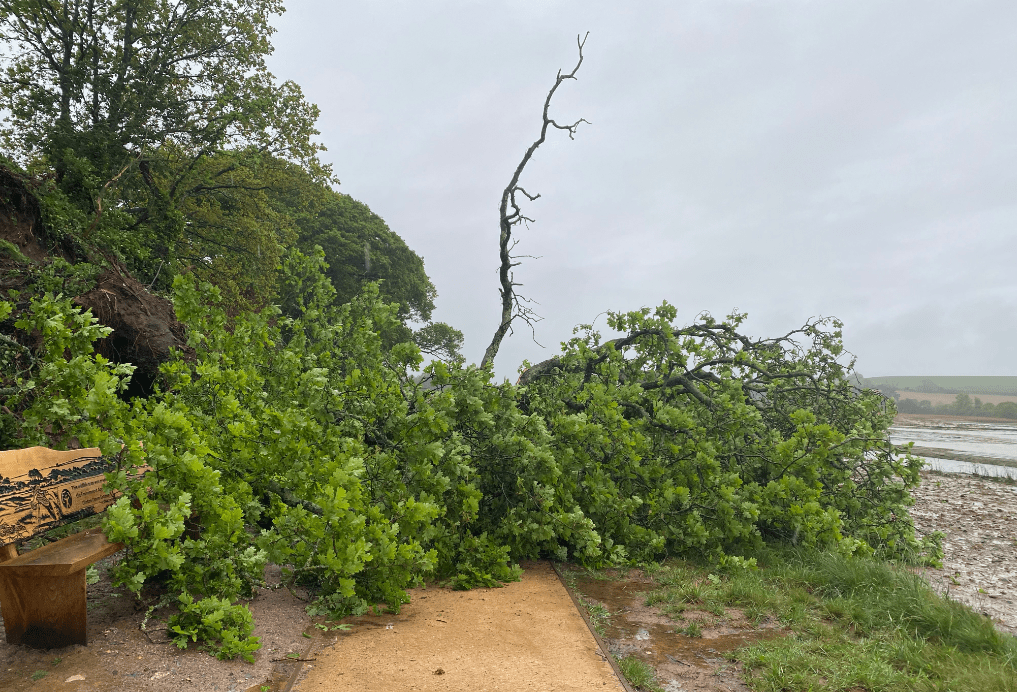
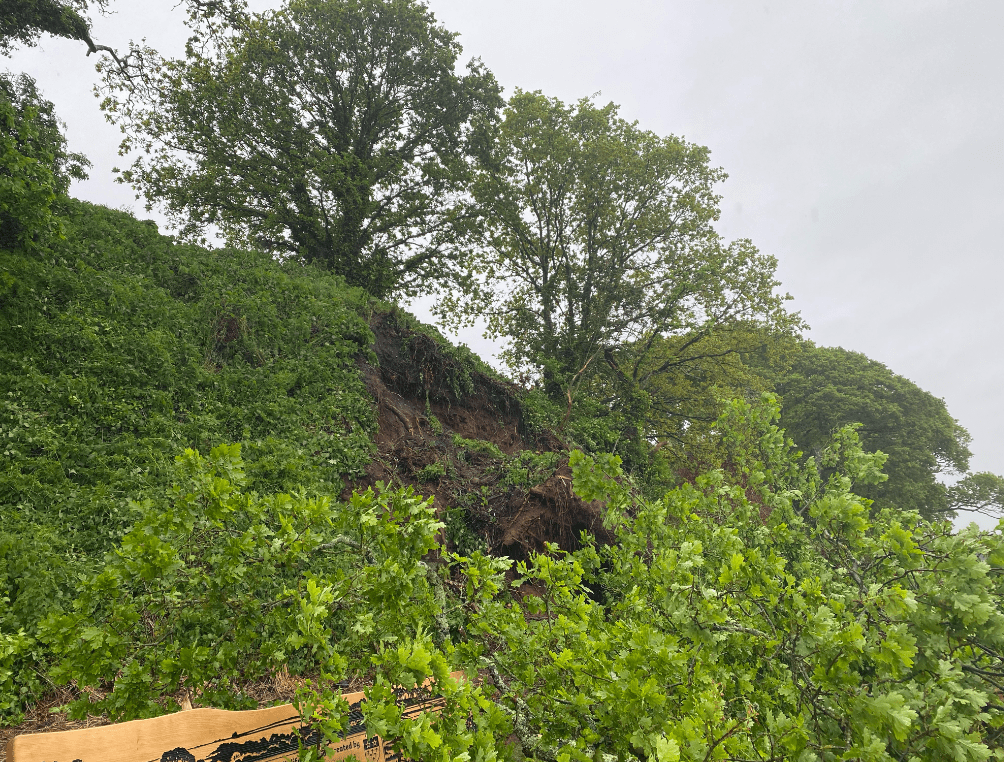
Budleigh, Massive Oak tree falls from cliff onto LORP path, no reported injuries

(Just missing the newly erected Clinton Estate and Environment Agency seat marking the opening of this wildlife site)

From a correspondent:

Today we lost a magnificent oak tree which sat on the cliff  at the end of a granary lane garden,  on the western LORP path.

It is only pure luck that no one was killed…(if it had gone yesterday when the path was crowded it would have been a different story) as you will see from the photos it has taken a huge chunk out of the bank and has fallen over  the  path and a fair  way into the estuary.

The granary lane residents  in nearby properties  have on numerous recent occasions   asked Clinton Devon Estates to check the safety of the trees . Concerns have been raised regarding recent slippages and tree movement ,  however  not  on this scale.

The bottom of the cliff where this tree has fallen has been saturated with vile stagnant water for months …it doesn’t  drain  away and concerns were raised  with LORP about damage  to the cliff. The original planning permission  was to raise the path by a metre to protect the cliff, but this was amended  without consultation with  local residents and the path remained the same level.   Hence the sea just rolls in and gets trapped.  Has this affected the trees?   Who knows but it certainly won’t have helped.

Is the path safe to walk?  I would say not…the trees are precariously hanging on, some almost horizontal…anything  which was beneath them has been cleared for LORP and personally I think the path should be closed until CDE has carried out a full inspection of all the trees and published the findings, and deemed the path safe.

Those trees have received little or no maintenance for many years…most probably in the  too difficult or too expensive box for Clinton to deal with…but a proper survey should always have been carried out before opening a busy footpath!

Planning applications validated by EDDC for week beginning 29 April

England gets 27 new bathing sites – but no guarantee they’ll be safe for swimming!

Twenty-seven new bathing sites will be designated in England ahead of this summer’s swimming season, the government has announced.

Helena Horton www.theguardian.com 

Giving waterways bathing status means the Environment Agency has to test them for pollution during the summer months, putting pressure on water companies to stop dumping sewage in them.

Twelve rivers are among the new sites. There are three river areas in England designated for swimming, far fewer than in many other European countries. In France, for example, there are more than 570 river bathing sites.

Bathing status is no guarantee the waters are safe to swim in, however. Last year, testing by the Environment Agency found that England’s three river swimming areas all had “poor” status due to pollution. This means people should not swim in them and risk getting sick if they do. Sewage spills and agricultural runoff mean swimming sites can carry E coli and intestinal enterococci, which could make swimmers ill.

The water campaigner and former Undertones singer Feargal Sharkey told the Guardian: “Every single stretch of river in England currently tested carries a ‘do not swim’ advisory. This lot will simply join that ignoble, floundering list of failure.

“It’s clearly not a strategy to deal with the decaying state of our rivers, it’s simply panic from a decaying government, it’s making excuses all before exiting stage left in the run-up to a general election.”

Water companies were criticised for record sewage discharges into England’s waterways last year. Recent data showed raw sewage was discharged into rivers and seas for more than 3.6 million hours, more than double that in the previous 12 months.

Bathing sites are only tested in the summer months but the government has promised a consultation later this year on proposals that would include extending monitoring outside the bathing season, as some people use the rivers recreationally all year.

The water minister, Robbie Moore, said: “The value our bathing waters bring to local communities is incredibly valuable – providing social, physical and positive health and wellbeing benefits to people around the country – and I am pleased to have approved a further 27 new bathing water sites for this year.

“These popular swimming spots will now undergo regular monitoring to ensure bathers have up-to-date information on the quality of the water and enable action to be taken if minimum standards aren’t being met.”

The chair of the Environment Agency, Alan Lovell, said: “The importance of England’s bathing waters for residents and visitors alike cannot be overstated, which is why the Environment Agency provides rigorous testing to ensure that bathers can make informed decisions before swimming in one of our 451 sites.

“Overall bathing water quality has improved massively over the last decade due to targeted and robust regulation from the Environment Agency, and the good work carried out by partners and local groups. Last year, 96% of sites met minimum standards, up from just 76% in 2010 – and despite stricter standards being introduced in 2015. We know that improvements can take time and investment from the water industry, farmers and local communities, but where the investment is made, standards can improve.”

The new bathing sites

  • Church Cliff beach, Lyme Regis, Dorset
  • Coastguards beach, River Erme, Devon
  • Coniston boating centre, Coniston Water, Cumbria
  • Coniston Brown Howe, Coniston Water, Cumbria
  • Derwent Water at Crow Park, Keswick, Cumbria
  • Goring beach, Worthing, West Sussex
  • Littlehaven beach, Tyne and Wear
  • Manningtree beach, Essex
  • Monk Coniston, Coniston Water, Cumbria
  • River Avon at Fordingbridge, Hampshire
  • River Cam at Sheep’s Green, Cambridge, Cambridgeshire
  • River Dart estuary at Dittisham, Devon
  • River Dart estuary at Steamer Quay, Totnes, Devon
  • River Dart estuary at Stoke Gabriel, Devon
  • River Dart estuary at Warfleet, Dartmouth, Devon
  • River Frome at Farleigh Hungerford, Somerset
  • River Nidd at the Lido leisure park in Knaresborough, North Yorkshire
  • River Ribble at Edisford Bridge, Lancashire
  • River Severn at Ironbridge, Shropshire
  • River Severn at Shrewsbury, Shropshire
  • River Stour at Sudbury, Suffolk
  • River Teme at Ludlow, Shropshire
  • River Tone in French Weir Park, Taunton, Somerset
  • River Wharfe at Wetherby Riverside, High St, Wetherby, West Yorkshire
  • Rottingdean beach, Rottingdean, East Sussex
  • Wallingford beach, River Thames, Berkshire
  • Worthing Beach House, Worthing, West Sussex

East Devon: District Council votes in Cllr Eileen Wragg as its new vice chair

Years of serving the community across East Devon and the county has propelled a former Exmouth mayor into the position of vice chair of the district council.

Local Democracy Reporter eastdevonnews.co.uk

Long-serving public servant Eileen Wragg, from Exmouth, has been voted in as vice chair of East Devon, writes local democracy reporter Bradley Gerrard.

Councillor Wragg (Liberal Democrat, Exmouth Town) has been a Councillor in some form for 28 years, and will now sit alongside Councillor Eleanor Rylance (Liberal Democrat, Broadclyst), who has been re-elected as chair for another term.

The Exmouth-born Councillor who was educated at Exmouth Grammar School, and later studied at the University of Plymouth, graduating with a BA Combined Honours degree in 1995, replaces Councillor Sam Hawkins (Independent, Cranbrook) as vice chair.

[Cllr Sam Hawkins now holds the finance portfolio – see below]

Cllr Wragg joined Exmouth Town Council in 1996, serving until 2015, during which time she held the role as mayor for two years between 2005-2007.

She was first elected to Devon County Council in 2005, losing her seat in the 2017 election, but is in her third term at East Devon, having been elected in 2015, 2019 and last year.

Cllr Wragg was nominated for the role by Councillor Sarah Chamberlain (Liberal Democrat, Broadclyst).

“Cllr Wragg has taught me a huge amount about being a councillor since I started in 2019, and she has been a councillor for many years and so has a wealth of experience and skills within all areas, and I think she would be perfectly suited to the role,” she said.

Exmouth peer Councillor Olly Davey (Green Party, Exmouth Town) seconded the nomination, commenting on Ms Wragg’s superb knowledge of local issues.

“Some of you will be aware that Cllr Wragg has had a few health problems recently, but having given her a lift here today, her mind is as sharp as ever, and she’s as feisty as ever, and I’m sure she’ll keep us all in our place if required,” he said.

Cllr Wragg thanked her colleagues for the nomination, quipping that she would “be back and fully operational as soon as the spare parts arrive that are being made now”.

EDDC cabinet members and portfolio holders, following annual meeting

Held byPosition at the council
Councillor Eleanor RylanceChair of the Council
Councillor Eileen WraggVice Chair of the Council

Cabinet members

Each member of the Cabinet takes responsibility for a Portfolio.

Cabinet membersRole / Portfolio
Councillor Paul ArnottLeader
Councillor Paul HaywardDeputy Leader and Portfolio Holder for Economy and Assets
Councillor Geoff JungPortfolio Holder Coast, Country and Environment
Councillor Marianne RixsonPortfolio Holder Climate Action
Councillor Sarah JacksonPortfolio Holder Communications and Democracy
Councillor John LoudounPortfolio Holder Council and Corporate Co-ordination
Councillor Nick HookwayPortfolio Holder Culture, Leisure, Sport and Tourism
Councillor Sam HawkinsPortfolio Holder Finance
Councillor Todd OlivePortfolio Holder Strategic Planning
Councillor Dan LedgerPortfolio Holder Sustainable Homes and Communities

Assistant Portfolio Holders

Post holderPortfolio
Councillor Paula FernleyCouncillor Charlotte FitzgeraldAssistant Portfolio Holders Coast, Country and Environment
Councillor Richard JefferiesAssistant Portfolio Holder Culture, Leisure, Sport and Tourism