Lib Dems gain most council seats in last five years, party’s data shows

The Lib Dems have added more council seats than any other party over the last parliament, gaining more than 750 in the last five years, largely in the south-west and south of England.

Rowena Mason www.theguardian.com 

As Ed Davey’s party won more seats than the Conservatives in the local elections last week, the Lib Dems said Tories would be “looking over their shoulder terrified” as the general election approached.

Data analysis by the party shows that the Lib Dems have gained 768 seats, Labour 545 and the Greens 480, while the Conservatives have lost 1,783.

The scale of the Conservative losses, with many councils falling to no overall control or Labour and Lib Dem coalitions since 2019, is likely to add to nerves among Tory MPs worried about keeping their seats at the general election.

The Lib Dems have taken control of councils in Devon, Dorset, Hampshire, Hertfordshire, Somerset and Surrey.

The party could be responsible for toppling some of the biggest Conservative names at the general election, such as the chancellor, Jeremy Hunt, and the housing secretary, Michael Gove, in Surrey, the justice secretary, Alex Chalk, in Cheltenham and Jacob Rees-Mogg in Somerset.

The Lib Dems have not improved their polling much nationally in recent months, remaining on about 10%, while the Reform party is on about 12%. Its national share of the vote in the local elections was about 17%, three percentage points down on 2023, but it appears to be building up support in pockets rather than across the country.

The party’s strong gains in local elections suggests its strategy of focusing on building up votes in key strongholds could help deliver seats at the election.

Visiting Dorset, where the Lib Dems took control of the council by taking 13 seats off the Tories, Davey said Conservative MPs in the region would be worried.

“This victory in Dorset is an historic and stunning result for the Liberal Democrats,” he said. “People here in Dorset and right across the country are fed up with this chaotic and out-of-touch Conservative government and they’re voting for change with the Liberal Democrats.

“From tackling issues with the NHS and the local environment to supporting people with the cost of living crisis, I know the new Liberal Democrat team on Dorset council will do everything they can to give people here a fair deal.

“After our victory in Somerset two years ago and our stunning successes in Devon last year, this win in Dorset confirms that the Liberal Democrats are back in the West Country and will be the main challengers to Conservative MPs here whenever the general election is called.”

The Green party also performed well at the local elections, adding about 74 seats, and becoming the largest party on Hastings borough council. It also became the largest party in Bristol, just short of an overall majority on the city council.

It also won its first seats on councils including Newcastle upon Tyne, Sefton in Merseyside, Redditch in Worcestershire and South Norfolk.

The party will also be targeting seats such as North Herefordshire and Waveney Valley in East Anglia at the general election.

Probe into Cranbrook’s maintenance and the upkeep of the district’s new towns is set to cost East Devon taxpayers £80,000

East Devon is aiming to avoid relying on controversial estate management firms that charge homeowners fees for providing and maintaining services, such as parks, writes local democracy reporter Bradley Gerrard. eastdevonnews.co.uk 

The firms have been flagged up in a national review of the housebuilding sector, with watchdog the Competition and Markets Authority (CMA) stating that around four in every five homes sold by the 11 biggest builders in 2021-2022 were subject to annual estate management charges (EMCs).

The average charge was £350, the CMA found, but it added that unplanned charges for significant repair work could cost thousands of pounds.

The charges are levied in addition to council tax, and critics say that residents are often not aware of the charges until shortly before they complete on their home purchase.

Cranbrook’s amenities were initially overseen by an estate management firm, but the town council took on its responsibilities in 2018, meaning residents were no longer subject to EMCs.

Now East Devon District Council wants to make sure it doesn’t fall into the same trap again, and has launched a strategic review into how it delivers services for residents, particularly those of its second new town which is being planned.

Andy Wood, assistant director for growth, development and prosperity at the council, said East Devon was in a “rare position” of delivering two new towns concurrently, and that he only knew of South Cambridgeshire taking on a similar challenge.

“But it isn’t just about building houses, but about how those communities thrive and the necessary infrastructure and services needed for that,” he told East Devon District Council’s cabinet meeting.

He added that the Planning Advisory Service, part of the Local Government Association (LGA), had been commissioned to ensure East Devon was in a strong position to expand Cranbrook and deliver the new town in the west of the district as well as various employment sites.

“One of the recommendations from the LGA is about this really key issue, looking at the role the council plays in the delivery of services and community assets,” he said.

“The CMA findings highlight the risk of what I would describe as part-privatised developments coming forward for housing estates that use estate management companies, which can be quite unaccountable and poor value for money and yet are becoming the default model.

“So, this is a real opportunity for the council to strategically review how we approach that.”

Mr Wood said the council was seeking permission from Councillors for an additional £80,000 to help it complete this review, as well as a review into the governance of Cranbrook – essentially looking at how the community is managed between the town, district and county councils.

Councillor Kim Bloxham (Independent, Cranbrook) welcomed the report, and hoped “lessons could be learned” from Cranbrook.

“The estate management company experience of Cranbrook was expensive and totally ineffective, and it left a legacy of poor maintenance and remediation once the town council assumed responsibility,” she said.

“The town council has been approached by other areas that want to move away from management companies but only one other has managed to do so, as it has proven to be hard.

“The best advice is to not go there in the first place and find a way to manage open spaces locally.”

Her ward colleague, Councillor Kevin Blakey (Independent, Cranbrook) said estate management companies had become a “national scandal” and feared things could only get worse.

“To say they do not offer value for money is an understatement, I would avoid them like the plague,” he said.

“Now we need to consider what can be done instead for large scale open spaces, and this authority will have to think carefully about how maintenance is managed and funded.”

He added that council tax had risen in Cranbrook due to the costs of managing a country park there, but that the outcome was still better than continuing to be involved with an estate management company.

Leader Paul Arnott (Liberal Democrat, Coly Valley) said that without the “persistent contributions” from the town Councillors, “we probably wouldn’t have got around to doing this”.

“As it turns out, it is something that has been extremely good in that we are rectifying a wrong that was done to the new community and we are now able to use that experience to hopefully get it right as the new community continues.”

The proposal to conduct the review provide the requested £80,000 was passed, but did include an amendment from Councillor Olly Davey (Green Party, Exmouth Town) that the authority’s incoming chief executive and other relevant planning and development staff and Councillors urgently review the report and propose any additional recommendations to cabinet.

Labour retains control of Exeter City Council

Despite losing a seat to the Greens and an independent

Labour have kept control of Exeter City Council with an increased majority, but it was an Independent win in Heavitree that shared the limelight as the city went to the polls.

www.radioexe.co.uk

Labour gained Topsham from the Conservatives and St Thomas and Pinhoe from Independents, but lost the Newtown and St Leonards seat to the Greens and Heavitree to independent Lucy Haigh.

She had campaigned against the city’s controversial Low Traffic Neighbourhood scheme, which has put Heavitree in the headlines in recent months.

She said she was delighted to have been elected and hoped to take the message of the protesters against the car ban to the council chamber.

Thirteen of the city council’s 39 seats were up for grabs.

The Liberal Democrats also had reason to be cheerful after snatching Duryard and St James from Labour. Council leader Phil Bialyk retained his seat in Exwick by a comfortable margin of nearly 700 votes.

He said it showed that the people of Exeter understood what Labour was trying to do on behalf of residents. “We are the political adults in the room,” he said. “We have to look towards Exeter’s future and we are not just about one issue.”

The first ballot boxes arrived at the Riverside Leisure Centre a few minutes after 10pm and a small army of counters got to work verifying the papers and then getting down to the business of counting them.

Party activists with coloured rosettes sat opposite the counters, watching the piles of papers mount.

Candidates paced the hall, taking stock of their progress. Young Green Party candidate Jack Vickers, standing for the Pennsylvania ward, cut an unmissable figure in his vivid green suit.

Yellow and green voting papers tumbled out of the big black ballot boxes as they were emptied – green for the police and crime commissioner election and yellow for the city council. They had to be carefully separated before counting could begin in earnest.

Early predictions were that it could be 1.30am before the first result was declared, but in fact it was 2.45am before returning officer Bindu Arjoon, the city council’s chief executive, declared that Cllr Bialyk had successfully defended his Exwick seat for Labour.

And there was an early success for the Greens, with the first batch of results also containing a win for the party in Newton and St Leonards, where Lynn Wetenhall convincingly took the seat from Labour.

Full results were:

Alphington – HARDING Rob, Labour Party 997; HARRELD Mark Jeffrey, Independent 125; HARRISON, Benn Elliott, The Green Party 289; HORNER Jamie Liam, Liberal Democrat 151; NEW Katherine Helen Judy, The Conservative Party Candidate 606. Turnout 34.24% LAB HOLD

Duryard and St. James – BADCOTT Tony, Labour and Co-operative Party 619; LEE Martha Sylvia, The Green Party 270; MORE O`FERRALL Rory Fouad, The Conservative Party Candidate 180; PALMER Tammy Catherine, Liberal Democrat 891.Turnout 27.2 % LIB DEM GAIN FROM LAB 

Exwick – BIALYK Philip Michael, Labour and Co-operative Party 1060; CURNOCK Charles Anthony, Liberal Democrat 130; HELIANTHUS Eric Sinclair, The Green Party 252; LUSCOMBE Kayleigh Michelle Suzanne, The Conservative Party Candidate 256; RUFOLO Frankie, Independent 371. Turnout 28.53% LAB HOLD

Heavitree – COLLACOTT Joan Marilyn, The Conservative Party Candidate 355; EADE Jack, The Green Party 948; HAIGH Lucy, Independent 1171; MUTTON Dave, Labour Party 705; RUFFLE Rod, Liberal Democrat 76. Turnout 48.8%  IND GAIN FROM LAB

Mincinglake and Whipton – BROWN Oscar Harold, The Conservative Party Candidate 290; HUTCHINGS Clive Alan, Independent 775; PAYNE Michael Geoffrey, Liberal Democrat 111; POLE Liz, Labour Party 842; STEPHAN Alex, The Green Party 169. Turnout 33.67%  LAB HOLD

Newtown and St. Leonard`s – BROCK Philip John, Liberal Democrat 96; CABRERA Julian Edward, Labour Party 941; SIMMONDS Paul, Independent 122; SPARKES Keith Andrew, The Conservative Party Candidate 211; WETENHALL Lynn Susan, The Green Party 1215. Turnout 39.1% GREEN GAIN FROM LAB 

Pennsylvania – HUGHES Zoë Jane, Labour Party 1106; HUNT Jack, The Conservative Party Candidate 390; JARMAN Victoria, Independent 297; VICKERS Jack David, The Green Party 878; WILLIAMS Nigel David, Liberal Democrat 177. Turnout 39.6% LAB HOLD

Pinhoe – CAMPION Christine Anne, Liberal Democrat 220; HUSSAIN Jakir, Labour and Co-operative Party 1019; JAGO Kate, The Green Party 300; SIMMONDS Susan, Independen 314t; THOMPSON David John, The Conservative Party Candidate 580. Turnout 32.37 LAB GAIN FROM IND

Priory – ABDULRAZAQ Tal, Independent 442; LUSCOMBE David, The Conservative Party Candidate 344; MULLETT Heather Ursula, The Green Party 233 THOMAS Philip Alexander, Liberal Democrat 209; WARDLE Tony, Labour Party 888 Turnout 32.34% LAB HOLD

St. David`s – BANYARD James John, The Green Party 1187; NEWBY Rob, The Conservative Party Candidate 248; STUART Ellen Miriam, Labour and Co-operative Party 785, WRIGHT Harry,Liberal Democrat 107. Turnout 33.3% GREEN HOLD

St. Loye`s – BONETTA Jake, Labour and Co-operative Party 914; BUTTERS Timothy Robert, Liberal Democrat 167; HANCOCK Deb, The Green Party 211; JOBSON Anne Margaret, The Conservative Party Candidate 1220. Turnout 36.69% CON HOLD

St. Thomas – BRAGG Andy, The Green Party 299; CARR Ashley, The Conservative Party  Candidate 167; DARLING Deborah Charlotte, Labour and Co-operative Party 1058; HANNAFORD Rob, Independent 464; NEWCOMBE Alexandra Vanessa, Liberal Democrat 771. Turnout 38.1% LAB GAIN FROM IND 

Topsham – FINCH Sarah Jane, The Green Party 322; ROLSTONE Gemma Lorraine, Labour Party 1339; THOMPSON Cynthia, The Conservative Party Candidate 1094; WILLIAMSON Alan, Liberal Democrat 217. Turnout 37.33% LAB GAIN FROM CON

Britain’s climate action plan unlawful, high court rules

The UK government’s climate action plan is unlawful, the high court has ruled, as there is not enough evidence that there are sufficient policies in place to reduce greenhouse gas emissions.

Helena Horton www.theguardian.com

The energy secretary, Claire Coutinho, will now be expected to draw up a revised plan within 12 months. This must ensure that the UK achieves its legally binding carbon budgets and its pledge to cut emissions by more than two-thirds by 2030, both of which the government is off track to meet.

The environmental charities Friends of the Earth and ClientEarth took joint legal action with the Good Law Project against the Department for Energy Security and Net Zero (DESNZ) over its decision to approve the carbon budget delivery plan (CBDP) in March 2023.

In a ruling on Friday, Mr Justice Sheldon upheld four of the five grounds of the groups’ legal challenge, stating that the decision by the former energy security and net zero secretary Grant Shapps was “simply not justified by the evidence”.

He said: “If, as I have found, the secretary of state did make his decision on the assumption that each of the proposals and policies would be delivered in full, then the secretary of state’s decision was taken on the basis of a mistaken understanding of the true factual position.”

The judge agreed with ClientEarth and Friends of the Earth that the secretary of state was given “incomplete” information about the likelihood that proposed policies would achieve their intended emissions cuts. This breached section 13 of the Climate Change Act, which requires the secretary of state to adopt plans and proposals that they consider will enable upcoming carbon budgets to be delivered.

Sheldon also agreed with the environment groups that the central assumption that all the department’s policies would achieve 100% of their intended emissions cuts was wrong. The judge said the secretary of state had acted irrationally, and on the basis of an incorrect understanding of the facts.

This comes after the Guardian revealed the government would be allowing oil and gas drilling under offshore wind turbines, a decision criticised by climate experts as “deeply irresponsible”.

The CBDP outlines how the UK will achieve targets set out in the sixth carbon budget, which runs until 2037, as part of wider efforts to reach net zero by 2050. Those emissions targets were set after a 2022 ruling that Britain had breached legislation designed to help reach the 2015 Paris agreement goal of containing temperatures within 1.5C (2.7F) of pre-industrial levels.

The Climate Change Committee’s assessment last year was that the government only had credible policies in place for less than 20% of the emissions cuts needed to meet the sixth carbon budget.

The lawyer for Friends of the Earth, Katie de Kauwe, said: “This is another embarrassing defeat for the government and its reckless and inadequate climate plans. We’ve all been badly let down by a government that’s failed, not once but twice, to deliver a climate plan that ensures both our legally binding national targets and our international commitment to cut emissions by more than two-thirds by 2030 are met.

“We urgently need a credible and lawful new action plan that puts our climate goals back on track and ensures we all benefit from a fair transition to a sustainable future. Meeting our domestic and international carbon reduction targets must be a top priority for whichever party wins the next general election.”

Ed Miliband, the shadow energy secretary, said: “This is a new low even for this clown show of a government that has totally failed on energy and climate for 14 years. Their plan has now been found unlawful twice – once might have been dismissed as carelessness, twice shows they are incapable of delivering for this country.

“The British people are paying the price for their failure in higher bills, exposed to the dictators like [Vladimir] Putin who control fossil fuel markets. Only Labour can tackle the climate crisis in a way that cuts bills for families, makes Britain energy independent, and tackles the climate crisis.”

Caroline Lucas, the Green party MP, said: “Once again the government’s climate plan has been ruled unlawful. When dealing with the climate emergency, simply ‘hoping for the best’ and putting your faith in unproven technologies and vague policies is not good enough – we need concrete plans and investments and there is no time to lose. The government must now go back to the drawing board and urgently pull together a credible plan to put the UK back on track to delivering our climate commitments.”

John Barrett, professor in energy and climate policy at the University of Leeds, said: “The UK government has failed to describe a credible pathway for the UK to achieve its legally binding climate commitments. This is despite overwhelming evidence from the Climate Change Committee and university researchers on the various options available to the government. Many of these options also deliver numerous co-benefits such as warmer homes, cheaper bills, more energy security, better air quality, more jobs and a healthier society. It is time for the UK government to take climate change seriously and tell us how they are going to achieve their own targets.”

A DESNZ spokesperson said: “The UK can be hugely proud of its record on climate change. Not only are we the first major economy to reach halfway to net zero, we have also set out more detail than any other G20 country on how we will reach our ambitious carbon budgets. The claims in this case were largely about process and the judgment contains no criticism of the detailed plans we have in place. We do not believe a court case about process represents the best way of driving progress towards our shared goal of reaching net zero.”

Big River Watch: public to monitor UK and Irish rivers for pollution

People in Britain and Ireland are being asked to monitor their local rivers for pollution so a leading water charity can measure the scale of the sewage crisis.

Helena Horton www.theguardian.com 

The Rivers Trust is this week launching the Big River Watch, asking people to record observations of their local rivers on a free app. The results will be made available through an interactive dashboard, and will help the organisation, as well as individuals and communities who can all access the data, to take action to improve rivers.

Volunteers will be asked to identify sewage pollution, sewage fungus, minewater and silt, along with other indicators of river health, so pollution hotspots can be identified and tackled. The Rivers Trust is hoping for it to be the UK and Ireland’s biggest ever mass participation survey of river health.

Tessa Wardley, director for communications and advocacy at the trust, said: “In September 2023, 60% of Big River Watch participants were new to citizen science, which shows just how important this tool is to help everyone get involved and showing they care about rivers. As well as learning where pollution and wildlife are spotted, we also want to know how spending time near rivers affects people’s wellbeing, so I’d encourage anyone and everyone to spend some time by their river and make their voice heard.”

UK and Irish rivers have been choked by sewage pollution, as the sewer system allows untreated human waste to mix with rainwater and domestic wastewater, meaning that the pipes become overwhelmed. This toxic cocktail of sewage and chemicals is then drained into waterways to prevent it backing up into homes.

Data first revealed by the Guardian found that 2023 was a record year for sewage spills. Raw sewage was discharged for more than 3.6m hours into rivers and seas in a 105% increase on the previous 12 months.

Water industry figures have admitted that this is due to a lack of investment in pipes and sewers, and as climate breakdown brings heavier rains and the population rises, the system is failing.

Emma Brisdion, marketing campaigns lead at the Rivers Trust, said: “Healthy rivers are essential for our wellbeing and for our wildlife. But rivers in the UK and Ireland have been allowed to get into a desperate state, and there are many people who care immensely about them and want to help.

“The Big River Watch invites communities to get involved. The simple survey is all about using that connection to rivers to record the good, the bad, and the ugly so we can understand our blue spaces better and make informed decisions about how to revive them.”

Surge in Covid cases prompt fears of a mini-wave

The proportion of people testing positive for Covid has jumped in the space of a week, latest figures have revealed.

Jane Merrick inews.co.uk

Positivity rates from the virus through the UK Health Security Agency’s (UKHSA) surveillance system were 7.1 per cent last week, compared to 4.6 per cent the previous week.

The figures relate to the proportion of people who take a Covid test, not the overall population. Positivity rates were highest in those aged over 65, at 10.4 per cent.

While people testing positive for Covid can be typically at 10 per cent or higher in the winter, the sudden jump from 4.6 per cent to 7.1 per cent in a week, in the middle of spring, is likely to prompt concerns of a mini-wave of the virus.

The UKHSA urged people eligible for a Covid vaccine to have their spring booster.

There were 297 positive samples for Covid out of 4,196 specimens reported by laboratories in the Respiratory DataMart System, which carries out ongoing surveillance for the virus.

Hospitalisations from Covid also increased slightly from 1.97 to 2.56 per 100,000 over the one-week period.

However, this rate is far lower than the peak of the pandemic, when admissions were at more than 30 per 100,000.

People eligible for a spring booster – those aged 75 years and over, care home residents and people who are immunosuppressed – have until 30 June to have the jab.

Dr Mary Ramsay, director of public health programmes at UKHSA, said: “Now is the time to get a Covid-19 spring booster if you’re eligible, as we’re starting to see a rise in Covid-19 cases and hospitalisations after a few weeks of low activity.

”The Covid-19 vaccine offers the best protection for those most at risk as the virus spreads. So, if you are aged 75 and over, a resident in a care home for older adults, or have a weakened immune system, book now. You don’t have to wait for the NHS to get in contact with you.

“If you have symptoms of flu or Covid-19 try to stay at home, as this helps protect others, especially those who are vulnerable. If you do need to go out when you are unwell especially if you [are] attending settings with vulnerable people, consider wearing a mask.”

Quote of the day: The choice is clear: we have a plan and it is working

“We are making progress across the board with a truly Conservative approach. Labour is nowhere to be seen.”

Rishi Sunak (comment in the Telegraph Friday 7:30 pm) 

Maybe you don’t get such a clear view from a helicopter – Owl

Lib Dems take Dorset Council, massive swing from Conservatives

The overall turn-out was 33.25%. The Liberal Democrats took the majority of the votes, with 42 elected councillors and now have control of Dorset Council.

What’s the make up of the new council?

YearConservativesLib DemsGreenIndependentLabour
20194329442
20243042442

There will be 82 councillors representing four political parties and in addition there are 4 independent councillors on Dorset Council. The numbers are as follows:

42 Liberal Democrats
30 Conservatives
2 Labour
4 Greens
4 Independent for Dorset/Independent other

Out of the 82 seats up for grabs, 28 are new councillors. 54 seats have been retained by members who have previously served as a councillor for Dorset Council.

www.dorsetecho.co.uk

Discredited Tory police commissioner hangs on because big anti-Tory majority splits its votes

Discredited Tory police commissioner hangs on because big anti-Tory majority splits its votes

Martin Shaw posts on Seaton & Colyton matters:

It’s a big disappointment that Alison Hernández, the Conservative Devon & Cornwall police commissioner, has been re-elected with 131,000 votes to 107,000 for Labour and 64,000 for the Lib Dems.

This is a clear lesson here for the General Election – there is a clear anti-Tory majority in our region (171,000 to 131,000 in this case) and we can remove most of their MPs. But if we split our votes between two or three opposition candidates in a constituency, the Tories will survive.

www.devonandcornwall-pcc.gov.uk/news-and-blog/multimedia-hub/alison-hernandez-has-been-returned-as-police-and-crime-commissioner-for-devon-and-cornwall-for-a-third-term-after-winning-a-majority-of-xxxx-votes/

Brixington By-election – split opposition lets Tories retain seat on 38% of the vote

See below for Owl’s analysis

East Devon District Council – By-election 2 May 2024

Declaration of results for East Devon District Council Exmouth Brixington Ward 2 May 2024

Exmouth Brixington

Name of CandidateDescription (if any)Number of votesElected?
BAILEY Aurora EConservative Party Candidate586elected
BENNETT, JulieThe Labour Party339 
CONDUIT, DianneLiberal Democrats513 
ROSSER, Michael JThe Green Party136 

Electorate: 6110
Ballot Papers Issued: 1593
Rejected Ballot Papers: 19
Turnout: 26%

Here is an analysis of Thurday’s result, compared to the full council elections held last year (see below).

Analysis: Similar turnout, but Thursday’s winner Aurora Bailey, in 2023, stood as an “Independent”. On Thursday she won with only  38% of the vote.

The 2023 election was for three councillors, electors had three votes. This Thursday’s election was for only one councillor and electors had one vote. The significant difference is the fall in the votes cast for the Green and Labour candidates. 

The conclusion Owl reaches is that if the “anything but Tory” majority really wants to do business in a straight fight under the first past the post system. Only the Lib Dems offer a viable alternative.

Council Exmouth Brixington Ward 4 May 2023

Name of CandidateDescription (if any)Number of votesElected?
BAILEY Aurora EIndependent518 
CAYGILL FredConservative Party Candidate673Yes
CHAPMAN MaddyConservative Party Candidate734Yes
COLMAN AndrewLiberal Democrats579 
KIRVAN Ian DIndependent471 
MARRETT G MalcolmGreen Party Candidate434 
NICHOLAS CherryConservative Party Candidate662Yes
WICKENDEN JamieLabour Party559 

Electorate: 6143
Ballot Papers Issued: 1743
Rejected Ballot Papers: 3
Turnout: 28.4%

Sunak to allow oil and gas exploration at sites intended for offshore wind

Tories in retreat continue their “Scorched-Earth” policy – Owl

Fossil fuel companies will be allowed to explore for oil and gas under offshore wind-power sites for the first time, the government will announce on Friday, in a move that campaigners said is further proof that ministers are abandoning the climate agenda.

Helena Horton www.theguardian.com 

The North Sea Transition Authority (NSTA), which regulates North Sea oil and gas production, will confirm that it is granting licences to about 30 companies to look for hydrocarbons on sites earmarked for future offshore windfarms.

The move has brought renewed criticism of Rishi Sunak from environmentalists, including from the prime minister’s own former net zero tsar, who worry that any future oil and gas production could hamper clean energy generation.

But it will also give the embattled prime minister a welcome piece of news to sell to his restive backbenchers – many of whom are keen to see more oil and gas production in the North Sea – the day after what are set to be a bruising set of local election results.

Chris Skidmore, the former Conservative MP who recently quit as Sunak’s net zero champion in protest at the government’s climate policies, said: “With a general election just months away, this is a deeply irresponsible and divisive move that goes against all advice from the International Energy Agency or the UN, and regrettably will further set back the UK’s climate reputation.

“Instead of wind powering new oil, the investment should instead be in more wind and renewables. More fossil fuels will only create stranded assets and stranded jobs at a time when demand for oil and gas is falling.”

He added: “This is a political and cynical stunt that will only backfire … We need to stop playing politics with climate and people’s future, and take a grownup position on seeking to find consensus for an end date to new oil and gas.”

A spokesperson for the NSTA said: “The NSTA have worked closely with other regulators to consider matters of co-location with offshore wind and other users.”

Sources say that the oil exploration itself will not involve any drilling, with companies largely using data to decide whether sites have the potential to be profitable for extraction.

Supporters of the scheme add that if any of the sites under windfarms prove suitable for production, oil and gas platforms will be able to use power from the wind turbines to lower their emissions. They will also have to strike an agreement with windfarm operators before they can begin drilling.

Experts say, however, that the emissions from burning any oil and gas produced will far outweigh whatever is saved in the drilling and extraction processes. They add that Friday’s announcement is likely to undermine investor confidence in Britain’s green energy sector as a whole.

The Guardian understands that investors in offshore wind have already expressed concern to the government about the decision, even threatening to pull out of the UK clean power sector altogether.

Doug Parr, policy director at Greenpeace UK, said: “It’s hard to think of a worse use of clean electricity from windfarms than powering the dirty industry that’s driving the climate crisis. It’s like using a nicotine patch to roll a cigarette.”

Sunak has made a series of announcements since becoming prime minister to roll back the government’s climate policies, including delaying the end of new sales of petrol and diesel cars and giving the green light for the huge new Rosebank oilfield off the coast of Shetland.

The prime minister has said the policies are part of a push to bring energy costs down and improve energy security. But his critics believe Sunak is using them as a dividing issue between the Conservatives and Labour going into this year’s general election.

Last month, Chris Stark, the outgoing head of the Climate Change Committee, accused the prime minister of abandoning Britain’s reputation as a world leader in the fight against the climate crisis.

Sunak, however, is also under pressure from Tory rebels, with the party more than 20 points behind in the polls and heading for heavy losses after Thursday’s local elections. A group of unhappy backbenchers is planning a move to unseat him altogether if the Tories lose the mayoralties in both the Tees Valley and the West Midlands this weekend.

No 10 has been working for weeks on a fightback plan to ward off any potential coup, and sources have told the Guardian the prime minister is likely to put his energy policies at the heart of any offer he makes to get his own MPs back on side.

Friday’s announcement marks the third phase in the 33rd round of North Sea oil and gas licensing. Earlier this year the government gave licences to 17 companies to look for hydrocarbons, including Shell, Equinor, BP, Total and Neo.

This phase differs from previous ones, however, because officials are opening up parts of the sea which have been leased to offshore wind operators for the first time. The government issues about 100 licences a year, only 2% of which go on to receive consent for production.

Dan McGrail, the chief executive of the trade body RenewableUK, said: “Prioritising offshore wind over oil and gas isn’t just the right choice for the planet, but given renewables are the lowest-cost means of generating power, we should be doing this for bill payers.”

Parr said: “Most of the planet-heating emissions from oil and gas rigs come from burning the polluting fuels, not extracting them.

“At best, this will make a small dent in the carbon footprint of a few oil companies’ operations. But more likely than not, it will end up greenwashing the fossil fuel industry’s image just as the government keeps trying to expand extraction against the advice of leading scientists and experts.”

A spokesperson for the energy department said: “To strengthen our energy security and grow the economy, we want to maximise the huge energy potential of the North Sea.

“We will continue to need oil and gas over the coming decades as we increase our share of renewables; that’s why we welcome the work by the NSTA and the Crown Estates to facilitate the co-location of wind and oil and gas projects as the offshore space gets busier.”

Clyst valley park could double in size

Proposals to double the amount of accessible space in Clyst Valley Regional Park will be put before residents.

Clyst Valley Regional Park (Image:East Devon District Council/LDRS)

Bradley Gerrard, local democracy reporter www.radioexe.co.uk

The park, effectively created by the Green Infrastructure Strategy in 2009, provides a buffer between Exeter and the countryside and, crucially, offers residents usable green space from nearby towns and villages in East Devon.

At present, 762 hectares is accessible but East Devon District Council has created plans to increase this by a further 740 hectares over 25 years – almost doubling the existing amount.

Under the proposals, a range of green spaces will be linked by greenways, or accessible routes through the countryside, for pedestrians and cyclists.

And less accessible areas will also be promoted in a bid to enhance the area’s biodiversity.

A large proportion of the regional park lies within the National Trust’s Killerton Estate, while 40 per cent of it is within a floodplain.

Members of the council’s strategic planning committee voted in favour of the plans going out to consultation, which should happen this month and last for six weeks.

Other key aspects of the proposals include the removal of some areas from the existing regional park boundary, including Cranbrook, Clyst St Mary and the Enterprise Zone where development has been implemented.

However, the proposals take into account the prospective new development south of Clyst Honiton and west of Aylesbeare.

The regional park expansion proposals say that the community between the A3052 and the A30 will include spaces and routes that will ultimately form part of the park, albeit these will be determined through a separate master plan.

A small number of sites within the current boundary are being promoted for development, and these are still being assessed.

Councillor Geoff Jung (Liberal Democrat, Woodbury and Lympstone), the portfolio holder for coast, country and environment, said he was a “great supporter” of the park and welcomed the expansion proposals.

“The park is designed to protect the countryside and improve access to it around the new towns,” he said.

“At the same time as we’re building new houses, we have to provide access to the countryside and this project does exactly that, so I hope councillors support it.”

The strategic planning committee chair, Olly Davey (Green Party, Exmouth Town), also praised the plan’s inclusion of the new community and its links to the park.

“Given what Mr Freeman was saying about the new community and routes through it that will form part of the regional park, maybe for once we are getting those allocated first before the new development of homes,” he said.

“It looks like for once we’re getting that right, and we’ll make sure we get the other bits of the new community right in the same way.

“This is something members have often called for, and it looks like that will happen, so these plans are to be welcomed.”

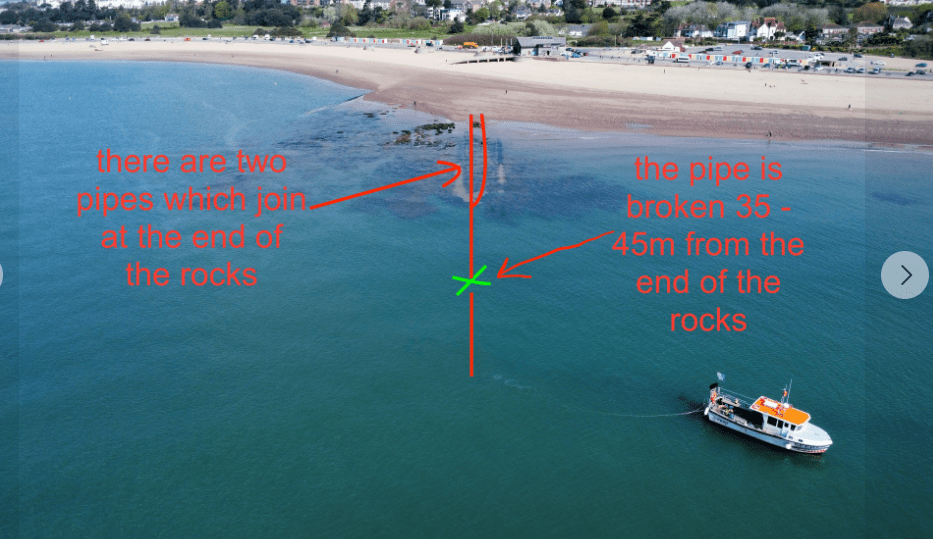
Broken Sewer Discharge pipe at Maer Rocks – what is happening next door in Budleigh? Multiple issues?

Kier is to start work in the Lime Kiln Car Park on behalf of South West Water for 5 days from 13/05/24.

For weeks tankers have been ferrying “Non Hazardous” liquids through the Town, destination unknown but assumed to be Exmouth.

Jodie McDonald reports on ESCAPE:

Budleigh Today, when I asked a member of EDDC what they were doing the response was “Sewage problems, lots of issues apparently” 🙄 they were there the whole time we were, leaving and coming back.

From Owl’s researches it would seem that the failure of sewage discharge pipes into the sea, most of which are of Victorian origin, is nothing new:

Budleigh Salterton Sewage Outfall, Local Government Board Inquiry 1903.

This records a 1903 inquiry into whether a storm broken sewer pipe should be extended prompting this letter to the press:

“As to the sewer outfall, after a public inquiry by a Government official, the Local Government. Board refused to sanction the scheme the local authority put before them, and advised the calling in of an engineer. This The Council have refused to do, and, although they know the danger is great, and increasing year by year, they will do nothing further until a zymotic plague enters the place, which is calculated to seriously injure the reputation of a health resort.”

Are the pipes at Maer Rocks 150 years old?

Robin Bush in “The Book of Exmouth” records that “The Board of Health” built new sewers in 1861 adding an outfall at Maer Rocks, completed in 1883, further schemes were required in 1899 and again in 1932. The Board of Health was replaced by the Exmouth Urban District Council in 1894.

How much of the current pipework dates from 1883?

“The pipe is where we expected it to be” (it’s just broken)

Latest reports on the Maer Rocks overflow pipes

Geoff Crawford

I cannot tell you everything I know as I do not want to compromise the Environment Agency ongoing investigation into SWW but I do want to provide an update following last weeks dye test by SWW.

I was fortunate to actually be there during the test on the first day.

SWW did not tell ESCAPE about the second day of tests so we missed that. An admin error they say but fortunately one of our members stopped by on his walk and witnessed most of it.

As I was actually physically present for several hours, spoke with the senior SWW engineer and the EA guy at length and was there when the dye came out of the broken pipe I know exactly what occurred, what was said and the views of both the senior SWW engineer and the EA representative.

You may have seen statements published by the Exmouth Journal and DevonLive last week issued by SWW to say that they had completed the promised dye test to locate the Maer Road Sewage Pumping Station emergency and storm overflow pipe location.

They stated things like the pipe was where they expected it to be and was operating as they expected and was located within the permitted area so all was well.

The Exmouth Journal and DevonLive (part of the same media group who regularly post paid for articles from SWW written as if they are real news articles) presumably published (both have now been removed) the SWW statements without crosschecking them or asking EA for their view on the situation.

Similar statements were sent by SWW to Exmouth Town Council, East Devon District Council and Simon Jupp MP. Fortunately those organisations are in contact with ESCAPE and EA and they chose to check the facts of the matter before simply promoting SWW point of view.

It is very interesting that SWW have not published these statements themselves but only offered them to others to publish on their behalf.

The Environmental Agency is undertaking an investigation of the Maer Road / Maer Rocks overflow pipe to determine in SWW breached its permit and so illegally overflowed sewage and caused pollution. They are investigating why SWW, though they knew that the pipe was broken, had not self reported this to EA and had not worked quicker to investigate it and repair it. EA are investigating if the end of the pipe or indeed the break in the pipe is at its permit stated location. If not it is potentially in breach of its permit and a new permit may be required.

EA are investigating if the several hundred tankers of sewage that were dumped into Maer Road SPS across December 23 and hence spilled out through this broken pipe whilst the SPS was already overflowing were hence “wilful pollution”.

EA are investigating if, as was stated by a SWW contractor to David Parsley of iNews, that a storm pump at Maer Road SPS had failed and had been failed for some time, making all overflows during that period illegal.

This pumping station and its location and cause of overflows is central to Jo Batemans legal claim for loss of amenity against SWW and the outcome of the EA investigation will surely have an impact on that claim.

So its no surprise that SWW are trying to get their story out, their narrative, their version of the truth and have that published by ETC, EDDC, Exmouth Journal, DevonLive, Simon Jupp MP. Its no surprise that SWW want you to believe that they broke no rules, all is well, all is within permit and they want to get that out before the Environment Agency have chance to properly review the facts, the results and to come to a proper considered conclusion.

It is the Environment Agency that issues the permits. It is the Environment Agency that will decide if the Maer Road SPS overflow pipe has breached those permit conditions and it is the Environment Agency that we should listen to and believe. The EA are the police acting to protect the public and holding criminals to account. Listen to the EA, publish their findings, not SWWs alternative truth.

I am pleased to say that many now understand that what SWW tell them is not necessarily the truth, the whole truth and nothing but the truth. Now people are asking questions, checking SWW statements, no longer blindly believing and repeating their propaganda. Hopefully the tide is turning and its not just the public that can see the subterfuge of SWW. Do not believe everything you read in the papers.

POSTCARD FROM LYME REGIS

London Playbook PM from Politico

SEWAGE FOR DAMAGES: Along the few kilometers the River Lim weaves between Uplyme village and the seaside town of Lyme Regis in Dorset, there are multiple points sewage can flow in. Human, animal and manufactured waste trickle in from numerous directions alongside the tributaries of fresh water. The sources include sewage works, home and agricultural slurries, and roads, to name a few.

Trolling the water: One of the culprits is a porthole tucked under a bridge right before the river meets the English channel. When an underground cathedral used for sewage storage fills faster than management firm South West Water can pump and treat it, the porthole belches the overflow out into the sea. Overflows are meant to be restricted to rain deluge events, which fill the infrastructure quicker. But the porthole — and others like it along the river — discharged for around 1,300 hours in 2023, up from around 1,200 in 2022.

Water warriors: The River Lim Action Group has been investigating pollution in the water and sounding the alarm about it. As a result, South West Water has upped its measurement and maintenance efforts, but more is needed to improve the current “moderate” cleanliness classification from official watchdogs. “We’ve been getting special treatment because we’ve made such a stink,” says Vicki Elcoate, a driving member of the group. “But we need a thorough, systematic solution to all these problems.”

Issue politics: The national political parties have picked up on concerns about similar sewage problems across Britain. The Liberal Democrats were the first to weaponize it against the governing Tories in target seats. Labour is now making noise too and the Tories are upping their game. Ministers handed Dorset council £4.63 million to tackle some of the land runoff issues affecting Poole Harbor, for example, and ministers have begun to talk tough about failing water bosses. No local Conservatives were available to talk to Playbook PM, however. 

Votes for water: Constituencies around Dorset are prime Lib Dem targets in the so-called “Blue Wall” of southern Conservative heartlands. Davey is hopeful of seizing Dorset council as a staging post during local elections this week and is using the sewage issue as a battering ram. Last month he visited West Bay beach just east of Lyme Regis alongside Giles Bristow, CEO of the Surfers Against Sewage campaign. The beach had a number of pollution alerts in 2023. 

A sodden shame: The pollution amounts to “hundreds of thousands of local tragedies in a national picture of shame,” Bristow tells me as we walk along the River Lim from Uplyme to the sea. Thatched cottages are dotted along a gravel path high above the river, the track bordered with bluebells and wild garlic flowers. The trail crosses the stream then opens out to a small meadow. Hidden in the trees is a South West Water treatment plant. I’m sure I detect a subtle smell of rot in the breeze.

Closed for sewage: The path becomes a single lane road flanking the river as we head towards the urban center of Lyme Regis. Bristow points out a pipe draining road surface water into the stream. There’s a sign on a bridge crossing an old fjord: “Reduced water quality is predicted. Swimming and paddling is not advised.” Children used to paddle in the area in summer, but now sewage fungus grows on the plants and rocks. 

The open seas: In the center of Lyme Regis the river flows through a mill then cuts deep between the  beautiful old buildings. There are a couple more bridges under the coastal road and footpath before the water hits the sea. The overflow gate sits low beneath the final bridge, its chin out of view under the water. Around the corner is Church Cliff Beach, which was stripped of its safe swimming designation because sewage was pooling at the shore. 

It’s not that bad, honest: “The River Lim has good water quality but that can sometimes be impacted by periods of heavy rainfall,” a spokesperson for South West Water said. Campaigners point out 10 of the overflow discharges occurred during the summer of 2022. The spokesperson added: “The most frequent and largest change to the water quality comes from agricultural runoff from fields, upstream of any of our infrastructure.”

Message discipline: Along the coast, the cliffs at Seatown rise up then fall towards the West Bay beach Davey visited to illustrate the sewage issue. But there’s a mismatch between national and local Lib Dem messages on sewage. Nick Ireland, Lib Dem group leader on Dorset Council who stands a good chance of becoming council leader this week in what would be a historic win in a Conservative stronghold, argues voters aren’t raising the sewage on the doorstep. 

Retail politics: “Across the South West it is a big thing and the politicians are jumping on the bandwagon,” Ireland tells me over lunch at the Posh Partridge cafe in Dorchester. But he insists voters are more focused on the cost of living crisis, ailing NHS services and demands for new housing. 

Nevertheless: It’s clear the national Lib Dems reckon polluted water is a vote-winner — and the Greens took the Lyme Regis council seat from the Tories at a 2022 by-election, which suggests it’s resonant, at least in affected wards. “It’s an issue that has captured the imagination of the whole country,” Bristow argues. Elcoate adds: “People will vote for the parties who support efforts to clean all this up.”

Views sought on Tipton St John Primary relocation

Residents of Tipton St John are being asked for their views on the proposed relocation of the village primary school to Ottery St Mary.

Philippa Davies www.sidmouthherald.co.uk

A consultation was launched on the school’s website, and on Devon County Council’s ‘Have Your Say’ website, on Wednesday, May 1.

It sets out the plan to rebuild the school at Thorne Farm in Ottery St Mary, and provides links to relevant documents. These include a report commissioned by the Department for Education on four possible sites for the new school, two of which are in Tipton St John: Carters Field and land south of Otter Close. The other two were Thorne Farm and the King’s School playing fields. The report considered the suitability, constraints and planning considerations of all four sites before recommending Thorne Farm as the best option.

The initial consultation will run until June 19. On June 24 the governors of the Otter Valley Federation, which runs Tipton Primary, will meet to decide whether to go ahead with the proposed relocation. If they do proceed, there will have to be a formal four-week consultation, ending on July 25, and the ultimate decision will be made by the Cabinet of Devon County Council in September.

As part of the initial consultation a drop-in session, open to all those interested in the proposal, will be held on Wednesday, May 22 in Tipton St John village hall from 4pm until 7pm. Governors from the Otter Valley Federation will be available to answer questions as well as officers from Devon County Council and representatives from the Diocese of Exeter.

While there has been a campaign for the rebuilding of Tipton St John Primary for many years, a large number of people feel strongly that it should be in the village. A petition has been launched on Change.org arguing that the primary school is the heart of the Tipton St John community, and pointing out that even if it relocates, measures will still be needed to tackle the flood risk in the village.

But there is also a view that Tipton Primary needs a new school building as soon as possible, and the relocation to Thorne Farm is the quickest way to achieve this.

Responses to the consultation can be sent to Tipton St John Primary School via email admin@tipton-stjohn.devon.sch.uk or by post. All responses will be shared with Devon County Council.

Why the new FLiRT group of variants is expected to bring a new wave of Covid

A new group of Covid variants is spreading fast, putting the UK at risk of a fresh wave of infections in the coming weeks, scientists warn.

Tom Bawden inews.co.uk

Cases involving the variants, nicknamed FLiRT, have soared this month to account for around a quarter of total UK Covid infections.

They are replacing JN.1, the dominant variant they are descended from, that until recently accounted for virtually every case of the virus in the UK.

At the moment, the new variants appear to be largely replacing JN.1 rather than driving up Covid cases overall – which remain at around three year lows.

But there are fears that its continued spread could start to push overall cases higher, given that it seems to be more contagious and that vaccines don’t work as well against it, scientists say.

At the same time, the immunity the British public has built up from vaccines and previous infections is likely to be waning after several months of very low levels of the virus.

“It is likely we are about to enter a new wave of infections due to the global increase of new subvariants of the current dominant variant JN.1,” said Professor Christina Pagel, of University College London.

“I expect prevalence to increase in the coming weeks as we see the arrival of new variants that seem to be replacing the JN.1 variant that caused the Christmas 2023 wave.”

“Essentially, JN.1 has mutated further and several of its children have found mutations that help them spread much faster than their parent,” Professor Pagel explained.

The FLiRT variants involve two key mutations from the JN.1 virus which mean it can spread more easily.

One sees a mutation, known as F, being replaced by another, known as L. The other involves mutation R being supplanted by mutation T – giving the main letters for the term FLiRT.

Although some scientists are expecting a new wave, they predict that it will be considerably smaller than that seen in the run-up to Christmas last year, when more than 2.5 million, or 4.6 per cent of the UK population had Covid.

That’s because the new subvariants are not as different from their “parents” than some previous subvariants were from theirs, while the two mutations have been around before, earlier in the pandemic, in some previous variants – but not since JN.1 became the dominant variant.

As such, the population may have some enduring immunity to those mutations but its hard to be sure, scientists say – as effect of any given mutation varies according to the variant it’s found in and is difficult to predict.

Professor Pagel said: “When the JN.1 wave hit around the world last December, it was significantly different to previous circulating variants and caused a substantial wave. Since these new FLiRT offshoots are more similar to JN.1, and we are heading into summer, hopefully any wave caused by these new subvariants will be smaller.”

Other scientists agree there is a risk that FLiRT could cause a spike in cases – although there is a good deal of uncertainty about whether this will happen and how big any outbreak may be, other than that is is likely to be smaller than the last wave.

Professor Lawrence Young, a virologist at Warwick University, said: “One FLiRT variant now accounts for 1 in 4 of all Covid infections in the US and so it is possible that these variants will cause a small wave of infection over the next few months.

“These mutations have been seen before in previous Covid variants but not in the context of JN.1. This makes it difficult to predict the behaviour of the FLiRT variants as many folk will have some immunity due to previous infections.

“As the FLiRT variants are derived from JN.1 it is also likely that previous JN.1 infections will provide some protection. Recent data suggests that a previous JN.1 infection will provide good protection but that the modified booster vaccines currently available are unlikely to be effective against FLiRT variants,” he said.

Professor Eric Topol, of the Scripps Research Translational Institute in California, believes FLiRT could deliver “a wavelet but not a significant new wave of infections”.

He argued that these new subvariants are not sufficiently different from their parents to overwhelm the immunity people have collectively built up.

Paul Hunter, professor in Medicine at the University of East Anglia, said: “While we don’t know for sure, I doubt that we will see a major wave over the next few months. My guess is that infection and hospitalisation rates will probably decline further as we move into the summer, but probably slowly rather than any dramatic fall.”

“With the exception of 2022, when there were serial waves associated with new Omicron subvariants, there has been fairly strong evidence of “seasonal forcing” of Covid infections from the very first year,” said Professor Hunter, a member of the National Institute for Health Research’s Health Protection Research Unit, which contributed to national and international panels, including Sage and NERVTAG during the pandemic.

Whatever the size of any wave, scientists urge the public to take up the offer of a spring booster, if they have one – and for others to consider a private jab if they can afford it.

Questions at County Hall over the “Combined  County Authority” proposals 

Cllr Jess Bailey: “This does not address the fundamental issue that this council is not properly funded. It doesn’t address that at all, and I have no confidence that this will lead to any better services but just pointless bureaucracy and crumbs from the top table.”


Devolution is a ‘Devon fudge’ claim

Bradley Gerrard, local democracy reporter www.radioexe.co.uk

Attempts by Devon’s opposition parties to delay a decision about getting more decision-making powers from goverment but combining their own powers has failed after the controlling Conservatives voted for the plan.

In an at-times febrile full council debate on devolution at Devon County Council, Liberal Democrat, Labour and Independent councillors raised concerns about the proposals.

The special meeting of the full council was called to ratify the cabinet’s decision this month to press ahead with plans to create a combined county authority, or CCA, with Torbay.

Councillor Alan Connett (Liberal Democrat, Exminster & Haldon) called the proposal a “right Devon fudge”.

“This is an extra layer of bureaucracy and suggests we want to spend more money on local government red tape than actually doing things,” he said.

“The £1 million pledged to fund the first three years of costs of running the CCA could be better spent fixing potholes, or solving road drainage problems.”

A significant part of the council debate focused on how Team Devon, an initiative that includes business, education, skills, and public sector members, would be factored into the CCA, and how much control Devon’s councillors would have in formulating that relationship and its influence upon the CCA.

Opponents questioned whether this was devolution as they saw it – bringing decision-making closer to the electorate – given it creates another level of government in which people are appointed rather than elected.

Concerns were also raised that Torbay, as one of Devon’s smaller districts, could disproportionately benefit from the deal given its smaller population than the Devon County Council area.

In spite of the disparity – Torbay’s 139,000 residents compared to the Devon County Council area’s 750,000 – both councils will have three voting members on the CCA.

Other fears raised included district councils seeing their relationship with Homes England diluted, concerns about the long-term costs and how these would be met, and the potential impact on residents if Devon and Torbay officers spend time working for the CCA.

Proponents of the CCA say the move will give the county greater control over adult education and skills, more say in transport and green issues, as well as a louder voice when it comes to securing cash from Homes England, the body responsible for funding affordable housing.

Part-way through the debate, Devon’s Liberal Democrat leader Councillor Caroline Leaver (Barnstaple South), put forward a motion to delay the decision because of what she and other opposition members deemed as lack of clarity about how the CCA would function.

But this motion was defeated, and the initial proposal to submit Devon’s bid to create a CCA with Torbay to the government was agreed.

Councillor Jacqi Hodgson (Green Party, Totnes and Dartington) had “real concerns” about the devolution deal. “There are positive aspirations, but how will it address housing pressures; the £16 million that has been given to the CCA won’t touch the surface,” she said.

“And with local transport, how are we going to do it? We have lots of plans, and Councillor Andrea Davis (Conservative, Combe Martin Rural) has done a huge amount, but buses are fading away as there is no money.

“Until we have money for services, there’s no point in plans.”

Councillor Martin Wrigley (Liberal Democrat, Dawlish) noted that the £16 million had now already been promised to Devon. “I appreciate a lot of work has been put into this process, but this proposal has been put together in a rush,” he said.

He added that the CCA “goes against the very principle of devolution” and feared that government minsters would be “double-checking” its every move and “drip-feeding money in a begging bowl, Hunger Games approach”.

Councillor Caroline Whitton (Labour, St David’s and Haven Banks) questioned “how this was a good idea for Devon”, and raised the prospect that Exeter, which she called the “economic centre of the county”, could not be guaranteed a voting member.

“As a Labour party member, I absolutely support devolution and having decisions being made closer to the people, but let’s make sure those decisions come to the all the people of Devon, and not, as in this deal, a very small minority overrepresented by Torbay and underrepresented by most of the people in our area,” she said.

“In my view, most of our residents will not feel the decision-making come closer to them, far from it. The decision-making is actually going further away, and that’s the reason we will certainly not be supporting it.”

The Lib Dem Cllr Leaver acknowledged that the consultation on devolution, which ran for six weeks over February and March, did show some support for it, but highlighted that more people did not approve of the way it was being set up.

“With the UK Shared Prosperity Fund, that goes to district councils now, but it is clearly stated that this will be going to the CCA,” she said.

“We have had no reassurance that any future money will be allocated fairly by default.

“The proposal for the CCA leaves so many questions and areas of uncertainty; for us we believe we should be looking at devolution for a coherent economic area, words which are used in the proposal, but I would seriously question whether Devon and Torbay is a coherent economic area.”

Cllr Leaver added that Devon’s patchwork of town and district councils already work well together and often struck agreements to ensure cross-border collaboration, therefore questioning the need for the CCA.

And Councillor Jess Bailey (Independent, Otter Valley) said that while council leader John Hart, who is standing down, had emphasised that it had been a long process to get to this point, she questioned the lack of clarity.

“For instance, why has Devon not established whether it will give district councils voting rights, as that could have been set out,” she said.

“And this does not address the fundamental issue that this council is not properly funded. It doesn’t address that at all, and I have no confidence that this will lead to any better services but just pointless bureaucracy and crumbs from the top table.”

Planning applications validated by EDDC for week beginning 15 April