Quote of the day Tonight on ITV: “Sorry to have kept you. It all just ran over.”

ITV’s Tonight programme was offered an interview slot for Thursday [D-Day] afternoon, with no alternative time slot provided.

As he arrived, Mr Sunak said: “Sorry to have kept you. It all just ran over. It was incredible, but it all just ran over, everything.”

Breaking: UK economy stagnated in April, a blow to Rishi Sunak’s claim that it has turned a corner

Office for National Statistics ONS

GDP was flat (0.0% growth) in April 2024 and grew 0.7% in the three months to April.

• Services grew 0.2%

• Production fell 0.9%

• Construction fell 1.4%

Global heating will increase risk of parasite outbreaks, say South West Water owners

A series of risks to water quality include: “odour, discolouration, dissolved organics, cryptosporidium”, plus “increased microbe propagation and survivability” and increased invasive species. Each of those problems would require costly maintenance or treatment to rectify, SWW claims. – You are forewarned!

Also “ice pigging” explained in plain language and graphically illustrated.

Jasper Jolly www.theguardian.com 

The owner of South West Water has warned that global heating will increase the risk of outbreaks of the parasite that caused diarrhoea and vomiting in south Devon.

Pennon Group said that “gradual and significant increasing average and high temperatures” could pose “risks to water quality and water treatment” – including the cryptosporidium parasite – in its annual report, published this week.

The parasite, which spreads from faeces, causes cryptosporidiosis, a disease that often entails fever, vomiting and diarrhoea.

The Devon outbreak has put the spotlight on the UK’s water quality, after years of scrutiny of the amount of sewage being dumped in British rivers and seas. It has also become an election issue, and the Conservative party manifesto on Tuesday promised to ban executive bonuses if a water company “has committed a serious criminal breach” and to invest in river restoration.

About 17,000 household customers of South West Water near the seaside town of Brixham in south Devon were last month advised to boil their tap water before drinking it, after more than 100 people reported symptoms.

Pennon’s report said global heating would increase the likelihood of floods from rain and rising sea levels and lead to more heatwaves and storms, all bringing higher costs.

A series of risks to water quality were also listed, including “odour, discolouration, dissolved organics, cryptosporidium”, plus “increased microbe propagation and survivability” and increased invasive species. Each of those problems would require costly maintenance or treatment to rectify.

Paul Johnston, of Greenpeace Research Laboratories, said water companies should redirect money away from shareholder dividends and executive bonuses towards increased resilience.

“Extreme temperatures will provide greater opportunities for toxic algae and pathogenic and parasitic organisms to appear in water sources and find their way into our water supply,” he said. “This is a significant risk, but blaming this all on climate change is disingenuous. The risk stems largely from our shoddy water supply and distribution system that has suffered from many years of underinvestment by water companies.”

In the latest cryptosporidium outbreak, South West Water said that it had started treatment of a tank at the hamlet of Boohay with ultraviolet light, which kills the microbes. It had previously treated a tank at nearby Hillhead.

The company has also flushed the pipes and cleaned them using “ice pigging”, which uses a slurry of ice and water to push out any dirt.

A demonstration of ice pigging (top) versus flushing with water on two pipes filled with mayonnaise.

Before parliament was dissolved ahead of the general election, the MPs’ select committee on environment, food and rural affairs wrote to Susan Davy, Pennon’s chief executive, requesting that she appear before the committee to answer questions over the outbreak.

It is unclear whether a new committee will take up the request after the election on 4 July, but Davy would also be likely to face questions about her pay. Despite giving up her annual bonus for 2023 in response to anger over sewage dumping, Davy’s total pay increased by £300,000 as share awards from 2021 vested.

‘Cosplaying Liz Truss’: Rishi Sunak condemned for £17bn tax giveaway

Vote Conservative and crash the economy again! – Owl

Rishi Sunak has presented a £17bn tax giveaway as the centrepiece of the Conservative manifesto, an offer that was immediately condemned for being “implausible” and mainly benefiting wealthier voters.

Peter Walker www.theguardian.com

The policy programme set out by the prime minister, seen by many Tory MPs as probably the party’s last big chance to win over voters, contained few big surprises and was centred on cuts to national insurance and stamp duty, higher thresholds for child benefit and help for pensioners.

Launching the manifesto at Silverstone racetrack in Northamptonshire, Sunak accepted he faced an uphill task in convincing voters, not least after his early departure from D-day commemorations last week.

“I’m not blind to the fact that people are frustrated with our party and frustrated with me,” the prime minister said. But in cutting taxes, he added, “we are the party of Margaret Thatcher and Nigel Lawson, a party, unlike Labour, that believes in sound money”.

However, with the tax cuts costing £17.2bn a year by 2029-30 and much of the money coming from cracking down on tax avoidance and slashing the welfare bill by as-yet uncertain means, thinktanks warned there was a big risk the sums would not add up.

Hours after Sunak launched the manifesto, Labour produced its own costings, which predicted a £17.4bn annual shortfall by the end of the parliament. Rachel Reeves, the shadow chancellor, said Sunak was “cosplaying Liz Truss” and risked sparking another rise in mortgage rates.

Launching the manifesto to an audience including almost all the cabinet, Sunak announced another 2p cut to national insurance contributions (NICs) and the gradual abolition of all NICs for self-employed people.

While some Tory MPs had hoped to reset a faltering election campaign with a bolder policy, for example abolishing inheritance tax, the cuts come on top of other expensive promises, including nearly £6bn annually to increase defence spending to 2.5% of GDP.

After the manifesto was announced, some Tory MPs were despondent. “It’s not going to shift the dial,” one said. Others felt it gave them some material to work with in their local constituencies.

Sunak has repeatedly attacked Labour over its spending plans, making the much-criticised claim that this would result in £2,000 of extra taxes a household. However, his tax and spend plans are now coming under significant scrutiny – and some scepticism.

Fiscal thinktanks, as well as Labour, were particularly critical of the manifesto’s proposed funding sources for the tax cuts and other spending, including a supposed £12bn saved a year by cutting back on social security payments, and £6bn annually on cracking down on tax avoidance and evasion.

Paul Johnson, the director of the Institute for Fiscal Studies, said the manifesto could be characterised as “definite giveaways paid for by uncertain, unspecific and apparently victimless savings”.

The Resolution Foundation thinktank said financing the tax cuts was conditional on cuts to social security including potentially up to 40% of the bill for payments for people with long-term ill health, as well as huge cuts to already-impoverished councils and unprotected government departments.

“All this raises questions over whether this tax and spend package passes the plausibility test,” it concluded.

Both thinktanks also noted that the stated tax cuts would mainly help richer earners, with those on lower wages seeing much of the benefit eroded by frozen thresholds for tax payments.

An analysis of the tax changes by the Resolution Foundation said that while the 20% of richest households would gain £1,300 a year on average, someone paid £30,000 would see their tax bill fall by just £170.

At a Labour press conference in London, Reeves announced calculations that the party said showed a potential £71bn deficit across the five-year parliament. The likely effect on interest rates could, Reeves said, see an average mortgage-holder pay £4,800 more over five years.

Labour aides said Keir Starmer was likely to use this statistic repeatedly when he and Sunak are interviewed by Sky News on Wednesday evening, much as Sunak used the £2,000 statistic when he and the Labour leader debated last week.

Reeves said the manifesto plans risked “a second Tory mortgage bombshell”, and undermined Sunak’s claims to be fiscally credible: “He said he was the antidote to Liz Truss. Instead, he’s cosplaying Liz Truss by again doing what the Conservatives did in that mini-budget with £71bn of unfunded commitments.”

Labour’s costings do not include the idea of abolishing all NICs. The Tory manifesto said this was the party’s “long-term ambition”, but only “when it is affordable to do so”.

Other part-surprises in the 70-page document included a beefed-up promise on migration, in which Sunak said a government “will” halve net arrival numbers, and a promise to build 1.6m new homes over the course of the parliament.

On green policies, the manifesto continued to push back against net zero commitments, with one policy including giving the Climate Change Committee, which advises the government on emissions, “an explicit mandate to consider costs to households and UK energy security in its future climate advice”.

The manifesto also ruled out any future green levies on bills, or taxes on frequent flyers.

Sunak’s language stayed the same on the European convention on human rights, despite pressure from the Tory right to offer stronger hints that the party should promise to leave if it created barriers in deporting asylum seekers to Rwanda.

“If we are forced to choose between our security and the jurisdiction of a foreign court, including the ECHR, we will always choose our nation’s security,” he said.

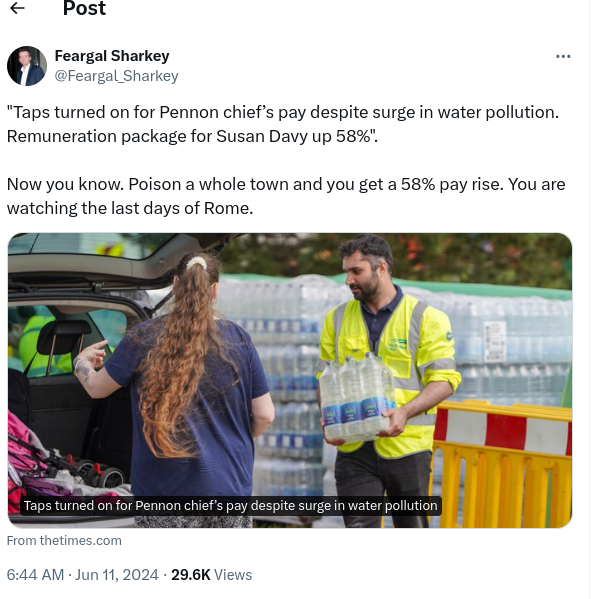
Poison a whole town and you get a 58% pay rise. You are watching the last days of Rome.

Feargal Sharkey, Richard Foord and Paul Arnott comment on Susan Davy’s jackpot pay rise on “X”.

But first a word from outgoing MP Simon Jupp (March 5 2024):

Thanks to this Conservative Government, we finally have the tools to hold South West Water to account.”

Just who is he kidding?

You are watching the last days of Rome

Feargal Sharkey 11 June

“Taps turned on for Pennon chief’s pay despite surge in water pollution. Remuneration package for Susan Davy up 58%”.

Now you know. Poison a whole town and you get a 58% pay rise. You are watching the last days of Rome.

South West Water has officially gone rogue

Richard Foord 10 June

This is a slap in the face for billpayers. South West Water has officially gone rogue and the Govt has let them get away with it. We need to crack down on their profiteering. If you want real action to fix our water industry, then @LibDems on 4th July.

It’s time to make water companies pay for their environmental vandalism. 

Paul Arnott 10 June

Disgraceful. South West Water’s Chief Exec has made a big show of foregoing £237,000 in performance bonuses this year – and then quietly taken nearly £300,000 in shares. It’s time to make water companies pay for their environmental vandalism. #VoteLibDem

And from “holding SWW to account” Tory candidates Simon Jupp and David Reed:

Nothing!

Owl has yet to find any matching comment from either of them on “X”. 

But the outgoing chancellor, Jeremy Hunt, vows to do more to help six-figure earners should Tories win the general election.

Sarah Wollaston quits as chair of NHS Devon in protest at further cuts

Does this leave an opening for Sarah Randall-Johnson (aka “Scandal Johnson” in Private Eye) the ruthless stripper of community hospital beds? 

See this post for chapter and verse on her past record.

Andrew Gregory www.theguardian.com 

A former Conservative MP and influential chair of the health select committee has quit a senior NHS post, saying she felt unable “to sign off on a further cut” with the “elastic already stretched too far”.

Sarah Wollaston, a GP for two decades before she joined parliament in 2010, resigned as chair of NHS Devon on Tuesday with immediate effect. She said she was “not happy” with new plans promising “unachievable” results that would only be possible with “unacceptable consequences” for patients.

She took aim at the government over the “frankly shocking” state of infrastructure in the NHS, warning of a “shocking waste of public money” and “lost opportunities” as crumbling hospitals and GP surgeries struggle to access vital capital funds. The crisis made her “genuinely sad”, she said.

Health bosses have repeatedly warned ministers of the desperate need to replace rundown buildings in order to protect the safety of patients and staff. The maintenance backlog has increased to £11.6bn in England, the Guardian reported earlier this year.

“With regret, I have decided to resign as chair of NHS Devon,” Wollaston wrote on X. “Thank you to all the wonderful NHS, care and voluntary sector teams that are out there doing their very best in challenging circumstances. Did not feel able to sign off on a further cut; elastic already stretched too far.”

Wollaston, who was appointed chair of NHS Devon in 2021, also criticised a funding regime that she said harmed NHS organisations facing the worst pressures.

“It really makes no sense to ‘punish’ the most challenged systems with penalties on their capital budgets when access to capital is essential to improving their performance, conditions and safety. The state of our infrastructure in too many places is frankly shocking.

“The next government needs to stop the cycle of capital to revenue transfers and pay serious attention to investing in NHS infrastructure. Also need to address the shocking waste of public money and lost opportunities due to delays in accessing capital.”

NHS Devon is one of the most severely challenged healthcare systems in England, with “significant financial and performance problems”, the Health Service Journal reported.

Wollaston added: “Genuinely sad to be leaving NHS Devon but in a nutshell, not happy as chair to sign off on the financials so time for me to go. No point promising the unachievable, especially if only achievable with unacceptable consequences.”

Wollaston became the Conservative MP for Totnes in Devon in 2010. In 2019, she quit the party to join Change UK, later becoming an independent MP before losing her seat in the election that year standing as a Liberal Democrat.

In a statement, Elizabeth O’Mahony, the south-west regional director of NHS England, thanked Wollaston for her “valuable contribution”. NHS Devon’s deputy chair, Kevin Orford, was named interim chair.

South West Water crypto progress report 11 June

If the clarity of the water matches the clarity of this report – there is still work to be done.

Just add lemon! – Owl

South West Water progress report:

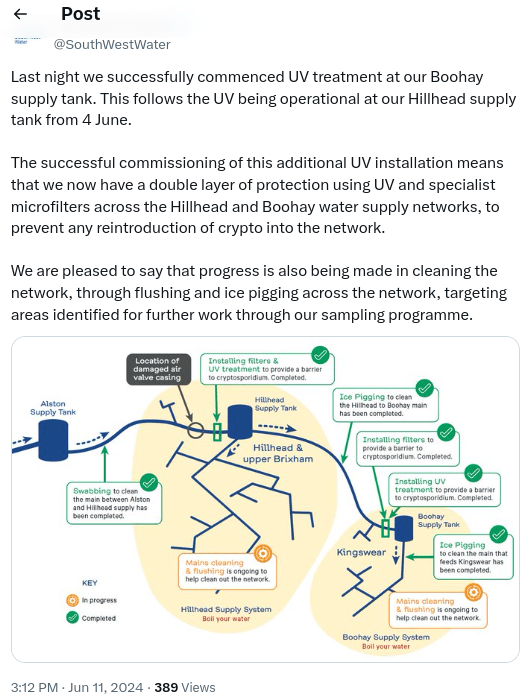
Last night we successfully commenced UV treatment at our Boohay supply tank. This follows the UV being operational at our Hillhead supply tank from 4 June.

The successful commissioning of this additional UV installation means that we now have a double layer of protection using UV and specialist microfilters across the Hillhead and Boohay water supply networks, to prevent any reintroduction of crypto into the network.

We are pleased to say that progress is also being made in cleaning the network, through flushing and ice pigging across the network, targeting areas identified for further work through our sampling programme.

East Devon General Election news 2024: Full list of candidates for Honiton and Sidmouth, Exmouth and Exeter east constituencies

The list of candidates setting their sights of being elected by East Devon residents in the July general election have been announced.

eastdevonnews.co.uk

The district council has released the names of the candidates nominated for the Exmouth and Exeter East constituency, and the newly-created Honiton and Sidmouth constituency,

The country will go to the polls on Thursday, July 4, 2024, after a general election was called in May.

Honiton and Sidmouth is one of the new constituencies that will replace East Devon at the next general election.

This follows a review by the Independent Boundary Commission for England.

Melanie Wellman, East Devon District Council acting Returning Officer, said: “We urge everyone to register to vote by the 18 June deadline to make sure their voice is heard. We want to make sure this is the highest turnout possible.”

An EDDC spokesman said: “With the election only weeks away, East Devon District Council’s election team are urging all eligible voters to register and ensure their participation in shaping the country’s future.”

The candidates nominated for the Exmouth and Exeter East constituency are:

Name of Candidate/Description of Candidate (if any)

  • Paul Arnott – Liberal Democrats – for a fair deal
  • Mark Baldwin – Climate Party
  • Helen Dallimore – Labour Party
  • Olly Davey – Green Party
  • Peter Faithfull – Independent
  • David Reed – The Conservative Party Candidate
  • Garry Sutherland – Reform UK
  • Daniel Wilson – Independent

The candidates nominated for the Honiton and Sidmouth constituency are:

Name of Candidate/Description of Candidate (if any)

  • Jake Bonetta – Labour Party
  • Vanessa Coxon – Independent
  • Hazel Exon – Party of Women
  • Richard Foord – Liberal Democrats
  • Henry Gent – Green Party
  • Simon Jupp – The Conservative Party Candidate
  • Paul Quickenden – Reform UK

The East Devon constituencies – left is the Exmouth and Exeter East constituency and right is the Honiton and Sidmouth constituency. Images: EDDC.

To register to vote or to check your registration status, visit the official government website here.

For more information from EDDC about the UK General Election, see here.