Exmouth and Exeter East – Win As One backs Paul Arnott

This is a unique seat. winasone.org.uk

The challenger in the last three elections was the unique progressive Independent Claire Wright, who is not standing again. She squeezed all the opposition parties. She is now actively supporting the LD candidate, Paul Arnott, the leader of East Devon District Council with a strong local press profile and a former fellow Independent who supported her in 2019.

Under a fair electoral system, we would be able to vote with our hearts. Lending parties votes to keep the Conservatives out wouldn’t be necessary, and the Green Party would win the representation in Parliament that their level of popular support should entitle them to.

Paul is committed to changing the voting system and has pledged to champion this issue and Proportional Representation in Parliament. That’s why our East Devon local group is supporting him.

(Click here for link)

“Is it safe to swim off Budleigh?” – A risk based approach to enjoying our fantastic bay

Peter Williams fightingpoolution.com 

Like many local residents, I was attracted to Budleigh by the dream of enjoying many golden days in and around our beautiful blue sea and iconic pebble beach. For many though, that dream has become a nightmare of almost daily sewage alerts, and fears over the safety of swimming off our beach. To some extent, web sites like this – along with the Escape FB page, have undoubtedly raised awareness of the threat caused by South West Water’s faulty sewage infrastructure and management. I don’t apologise for that, but I would say that our objective is to raise awareness and drive much-needed improvement, through posting carefully researched and accurate information.

However, I’ve lost count of the number of Facebook comments saying people are too scared to venture into the water. That’s a huge shame, and many times I believe, these fears may be unfounded – IF we consider the available data. In fact, throughout the last four Summer seasons, the sampled water quality has been excellent (approx 4% of the ‘Safe’ limit) around 80% of the time.

Although not ‘advice’, this post sets out my personal step-by-step guide to making informed decisions on when – and where – to swim.

STEP 1: Where NOT to swim, ever!

Every week between May and September, the Environment Agency sample the water quality at various points in all of our local brooks and the sea. The analysis of these samples is posted publicly here.

The 2023 sampling data shows that the large volume of water flowing out of Otter Mouth is typically 6 times the government’s ‘safe’ limit for bathing. That’s why I would never swim in the vicinity of the estuary mouth.

Even worse is the water flowing out of the Kersbrook, which emerges a few meters into the sea, straight out from the mini roundabout at Lime Kiln car park (line up the two yellow posts and that’s were the brook emerges). In 2023, the average water quality emerging from the stream was 14 times greater than the ‘safe’ limit. The volume of water coming out of the brook is usually quite low, so any pollution dissipates quickly. But again, I would never swim within 30 metres either side of the stream outfall.

To a lesser extent, the water flowing out of the Knowle Brook (Budleigh’s high street stream), was on average 11 times greater than the safe limit. Again, this dissipates quickly when it runs into the sea, but I would always avoid the immediate area.

You can see all of the sewage outfalls on this Google Map we have created. This includes data on all outfall locations and recent dumping performance.

STEP 2: Check the EA daily POLLUTION RISK FORECAST for Budleigh

Every morning the Environment Agency run a pollution risk forecast, which is published on this Gov UK web site, plus our own LoveBudleigh web site, with alerts published sometimes, but not always, on the SSRS app.

I recently compared the pollution risk forecasts over the last 4 years with the subsequently-published sample data analysis, and on every occasion that there was a pollution forecast, the water quality was actually poor or unsafe over the next 48 hours.

As a result, although the EA say that the alert only runs for 24 hours, I personally would never swim within 48 hours of a forecast alert being made.

STEP 3: Check the SSRS app to see if there is a pollution Alert from one of the Sewage Overflows. If so: check WaterFit to see WHICH overflow this comes from.

SSRS alerts happen when one of South West Water’s sewage overflow sensors are triggered, normally after at least 20 minutes of a sewage spill. These alerts can happen at any time of the day, but the SSRS alert does not show WHICH sewage overflow has been triggered.

Up to June 2024, SSRS has reported over 60 sewage alerts for Budleigh, more than any other year by a long way. The reason for 2024’s huge number of sewage dumps is because Lime Kiln sewage pumping station (which handles 100% of Budleigh’s sewage), is effectively ‘broken’. ‘Budleigh Sewage Action’ have organised a dedicated meeting with senior staff from South West Water, and invited several local EDDC councillors to attend and help present your views. Our objective is to fully understand the issues, and push SWW for a swift solution to this totally unacceptable situation.

This is where the risk-based approach to swimming comes in. Although many people are understandably put off by these almost daily alerts, it’s also true that when we have had alerts from Lime Kiln, but when NO EA Risk Forecast had been issued, AND there have been water samples analysed from the middle section of the beach, then the vast majority of times the sample subsequently comes back as ‘safe’. In fact, most times the water quality at the Telephone Box sampling location is Excellent (ie: around 4% of the ‘Safe’ E-coli level), even after an SSRS sewage discharge warning.

The reason for this may be linked to how the Lime Kiln pumping station is currently broken, and the fact that any sewage discharges are dumped on the East side of the Otter mouth (just past our iconic Otter Head cliffs).

So personally, I check the WaterFit web site and check WHICH of Budleigh’s overflows has been triggered. IF it is Lime Kiln (and 90% of the time it is), then I can make an informed, risk-based decision.

It’s also worth considering the layout of our beach, and think about the lowest-risk area is to swim.

So using our Budleigh Sewage Map, we can measure the distance from the Lime Kiln overflow outfall to the main beach area below Lime Kiln car park, which is about 600 meters. The distance from the outfall to the red telephone box by the Longboat Cafe – where the EA sampling is carried out – is 1km. But the distance from the outfall to Steamer Steps, where many of our residents actually swim, is 1.6km, or 1 mile distant.

So my personal view is that, IF there is NO EA POLLUTION FORECAST, and we get an SSRS alert – which I check with WaterFit is coming from Lime Kiln overflow, then I personally am normally happy to swim off Steamer Steps. The exception to this is if there has been recent heavy and prolonged rain, or if the alert comes from one of the other sewage overflows.

As I said, this is not advice as such, but simply the risk-based process which I use to determine if I’m happy to get out and enjoy our wonderful bay.

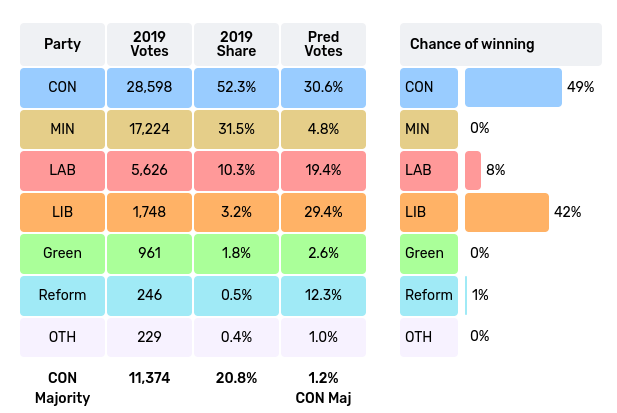
Breaking News: Electoral Calculus narrows Tory lead over Paul Arnott for LD to 1 per cent in Exmouth & Exeter East

www.electoralcalculus.co.uk

This is now clearly a two horse race: with Tories on 49% chance of winning; Lib Dems on 42%

None of the other candidates has a realistic chance.

Party2019
Votes
2019
Share
Pred
Votes
CON28,59852.3%30.6%
MIN17,22431.5%4.8%
LAB5,62610.3%19.4%
LIB1,7483.2%29.4%
Green9611.8%2.6%
Reform2460.5%12.3%
OTH2290.4%1.0%
CON Majority11,37420.8%1.2%
CON Maj

Planning applications validated by EDDC for week beginning 27 May

Dirty waters: how the Environment Agency lost its way

Having created a watchdog for the environment, the government took its teeth out and muzzled it. Can public outrage rouse the Environment Agency to action?

One of the Guardian’s “Long Reads”.

Owl recommends that you go online to read the history of this disgraceful process of sidelining a once proud watchdog.

The sad story starts in 1991.

By Hettie O’Brien www.theguardian.com 

Extract from concluding paragraphs:

“Cleaning up rivers has become an electoral issue that commands near-universal support. Conservatives are now being forced to reckon with the consequences of cutting the agency’s funding and encouraging it to take a softer approach. This has resulted in the absurd spectacle of public arguments about who is to blame for the state of rivers conducted by the very people who are responsible for the state of rivers. The only thing on which ministers seem to agree is that it is all someone else’s fault. Yet despite all the talk of pollution, neither Labour nor the Conservatives have pledged to restore the money cut from the agency’s budget since 2010.”

Labour reminds ‘non-battleground’ candidates not to spend time campaigning in those seats

The Labour Party has reminded candidates in ‘non-battleground seats’ – which include Exmouth & East Exeter as well as Honiton & Sidmouth – not to spend too much time campaigning in those seats. In our seats, candidates and members had already been advised to campaign in Plymouth instead. This is further confirmation that ONLY the Liberal Democrats are seriously fighting to defeat the Conservatives in our area.

seatonmatters.org 

The Labour candidate for Honiton & Sidmouth, Jake Bonetta (pictured), had already signalled his support for this strategy, writing to members about Plymouth and saying ‘We cannot let the Tories win here’, as this site has already reported. Unfortunately, Jake has had to spend recent days in hospital – we wish him well. Labour’s Exmouth candidate has yet to comment. The Green Party has a similar strategy, with members travelling Bristol to help elect its co-leader Carla Denyer.

Jake Bonetta: “We can’t let the Tories win here”

Is Tory morale collapsing?

General election poll: Quarter of 2019 Tory voters think party deserves to win no seats

A quarter of people who voted Conservative at the last election believe the party deserves to lose all its seats at the general election, a new poll has found.

Jacob Phillips www.standard.co.uk (Extract)

Nearly half of all voters think the Tories deserve to be totally wiped out, a survey by Public First has found.

The pollster quizzed 2,011 Brits between June 7 and 9 about what they expect and hope will happen when voters go to the polls on July 4.

Forty-six per cent of those polled believed the Tories “deserve to lose every seat they have” with 35 per cent disagreeing.

When asked what the ideal number of seats they would like to see the Tories win 24 per cent of people polled wrote zero.

Despite continual movement of sewage tankers, Budleigh has bathing risk warning

Budleigh Salterton 13/06/2024 08:30: Advice against bathing: pollution risk warning

From a Budleigh correspondent:

Dear Owl,

How can Budleigh Salterton beach be classified as “excellent” when time after time sewage is discharged into the sea?

I find it difficult to accept that if the Environment Agency (EA) issues an alert and declares this a “Short Term Pollution” event, samples from this event can be discounted. This is why, in total last year, Budleigh  had only 12 pollution risk warnings and the most recent classification is Excellent, based on samples taken from 2019 through to 2023

What sort of mind dreamt up this fix? It is all very well for the EA to say that

“The EA applies the law and issues real time alerts via Swimfo,and excludes samples in Short Term Pollution incidents from our data, just as our peer regulators across Europe do.” and

“It is also in line with World Health Organisation advice on best practice.”

Really, this “best practice” happens throughout the world? If this is the case surely the UK  needs to lead to stop this fiddle.

I would vote for any political party who could seriously try to sort this out.

A Budleigh Correspondent.

PS Another thing I do not understand is the regular number of tankers which are dyno-rodding their way through Budleigh High St. carrying sewage waste. And yet, today 13/06/24 Swimfo advises                                                                       

Budleigh Salterton

 Bathing is not advised today

Latest annual classification:

 excellent

Do we need to get more tankers on the job?

How much raw sewage is released into rivers and the sea, and what are the rules?

According to the Environment Agency, there were 3.6 million hours of spills, compared to 1.75 million hours in 2022.

Every major English water company has reported data suggesting they’ve discharged raw sewage when the weather is dry – a practice which is potentially illegal.

BBC News www.bbc.co.uk 

Water companies can release untreated sewage into rivers and seas when it rains to prevent it flooding homes, but such spills are illegal when it’s dry.

On dry days there is less dilution and sewage can cause more damage to the local environment and pose a health risk to swimmers.

How much sewage is released into the sea and rivers in England?

Sewage spills into England’s rivers and seas by water companies more than doubled in 2023.

According to the Environment Agency, there were 3.6 million hours of spills, compared to 1.75 million hours in 2022.

Water UK, the industry body for sewerage companies, said this was “unacceptable”, but argued that the record levels were due to heavy rain and increased data collection.

However, the Environment Agency said that increased rainfall does not override water companies’ responsibility “to manage storm overflows in line with legal requirements”.

Some environmental charities blame water companies for a failure to fix leaky pipes and other damaged infrastructure – and criticise the regulator for not forcing them to act.

Why is sewage released into the sea and rivers?

Most of the UK has a combined sewerage system, meaning that both rainwater and wastewater – from toilets, bathrooms and kitchens – are carried in the same pipes.

Wastewater is usually sent to a sewage treatment works.

But capacity can sometimes be exceeded during heavy rainfall, especially if dry ground cannot quickly absorb large quantities of water.

This could lead to inundation of sewage works and potential flooding of homes, roads and open spaces.

The system is therefore designed to overflow occasionally, and discharge excess wastewater into the sea and rivers.

This is called combined sewer overflows , external(CSOs).

However, according to the BBC there is evidence that some water companies are potentially spilling sewage when it is not raining.

Without rainwater to dilute the waste, this can lead to higher concentrations of sewage entering waterways – and is therefore illegal.

The BBC has examined spill data sent by the nine sewage companies from 2022 to the Environment Agency and cross-referenced it with rainwater. The results of the BBC’s analysis suggest there may have been dry spills starting on more than 200 days in 2022 lasting over 29,000 hours – including during the record summer heatwave when people were cooling off in England’s rivers and seas.

To confirm this has happened the Environment Agency says they carry out further checks and visit the sites where the spills may have taken place.

The BBC also found that untreated sewage was illegally released into Lake Windermere in the Lake District in February 2024 after a fault.

Water companies which are found to have breached the rules by spilling on dry days or failing to meet other conditions can be fined or prosecuted.

What is being done to tackle sewage discharges?

In April 2023 the Conservative government announced a plan, external to improve water quality.

As part of this, it said polluters could face unlimited fines in the future, external which would be re-invested into a new Water Restoration Fund which aims to improve water quality.

Six months later Water UK, the industry body, announced plans on behalf of its members to almost double spending to pay for upgrades and cut sewage discharges.

It said this would be the “most ambitious modernisation of sewers since the Victorian era”, but that customer bills would have to rise by £156 a year to cover the cost.

This week the UK’s political parties released their manifestos including their proposals for the sewage industry.

Steve Reed, Shadow Secretary of State for Environment, Food and Rural Affairs told the BBC that a Labour government would “put the water companies under special measures to force them to clean up their act”.

“We will give the regulator tough new powers to make law-breaking water bosses face criminal charges and ban the payment of their multi-million pound bonuses until they clean up their toxic filth,” he added.

The Liberal Democrats have said they will introduce a sewage tax on water company targets and set legally binding targets to prevent sewage dumping bathing waters and “highly sensitive nature sites by 2030”.

Sian Berry, parliamentary candidate for the Green Party told the BBC: “Private water companies have failed to invest, resulting in sewage leaks and run-off at record levels. It’s made our coastlines and inland waterways filthy and unhealthy when they should be clean and safe.”

The BBC has approached Reform for comment on this issue.

What are the health risks of swimming in polluted water?

In May 2024, a team of the UK’s top engineers and scientists warned of the growing public health risk from human faeces in the country’s rivers, and called for more regular testing.

The presence of faeces can expose people to bacteria such as salmonella and E.coli, which cause diarrhoea and vomiting, or viruses like hepatitis A which can lead to liver infection.

Also in May, thousands of residents in Devon were told to drink bottled water after their supply was contaminated with the cryptosporidium parasite – possibly as a result of a faulty valve on private land. Consumption of the parasite can cause prolonged diarrhoea.

How can I check if the sea near me is clean?

Every week between May and September, the Environment Agency measures the water quality at “bathing sites” across England, and in some places it issues daily pollution risk forecasts.

You can search its website, external by location. There are similar websites, external where you can find out about beaches and bathing water in Scotland, Wales or Northern Ireland.

But outside of these times and locations regularly testing for organisms carrying faecal-oral disease is not carried.

By the end of this year all water companies are expected to have maps showing near real-time discharges at their storm overflows to keep the public better informed.

How clean are UK waters overall?

Sewage spills have only been routinely monitored for a few years, external, so it is difficult to tell exactly how they have changed over time.

However, overall water quality has been monitored for decades. This also accounts for other sources of pollution, such as agriculture.

In May 2023, the Environment Agency said that 16% of assessed surface waters in England achieved “good” ecological status, external, including:

  • 14% of rivers and lakes
  • 19% of estuaries
  • 45% of coastal waters
  • 93% of designated bathing waters

Water quality is generally higher in other parts of the UK, external.

In Scotland, around two-thirds of surface waters are classed as having “good” ecological status.

In Wales the figure is 40%, and in Northern Ireland 31%.