After backing the Tories since 2005, the Sun changes its tune.
In Owl’s view only the Lib Dems can beat the Tories in Honiton & Sidmouth – Richard Foord; and Exmouth & Exeter East – Paul Arnott.
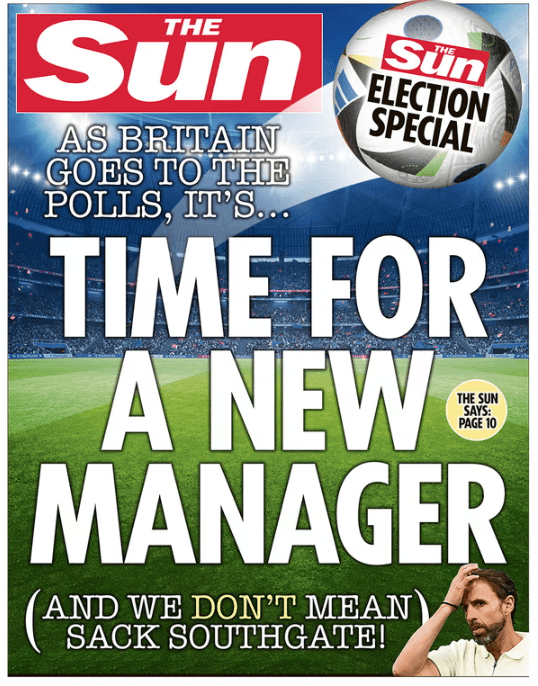

After backing the Tories since 2005, the Sun changes its tune.
In Owl’s view only the Lib Dems can beat the Tories in Honiton & Sidmouth – Richard Foord; and Exmouth & Exeter East – Paul Arnott.
How low can desperate Tories sink? – Owl
It has been an election campaign marked by controversial claims and counter-claims, but a row in the parliamentary constituency of Torbay in Devon has perhaps topped the lot.
Daniel Boffey www.theguardian.com
A local charity for visually impaired people, Devon in Sight, has accused Tory canvassers of “stooping to an all-time low” by allegedly suggesting that the local Liberal Democrat candidate, Steve Darling, is not actually blind.
The comments were said to have been made by a Tory doorknocker calling at the house of an unnamed elderly couple in recent days.
According to a press release issued by the charity, a canvasser in the Livermead area suggested that Darling, who has a guide dog called Jennie, was “faking his sight loss” and “using his guide dog for ‘political purposes’”.
Grahame Flynn, Devon in Sight’s chief executive, who employs Darling’s wife, who is also blind, said: “With Steve Darling’s consent, I would like to confirm that he has been living with a rare genetic eye disease that started in childhood.
“He was formally registered blind in his teens with a deteriorating eye condition that may well end in total sight loss. Furthermore, Steve is registered with the council as severely sight impaired (blind). He first registered with our charity in 1986.
“Steve was on the waiting list for a guide dog for almost three years before being matched with Jennie, his current guide dog. To politicise someone’s disability is highly unsavoury and Steve and everyone living with little or no sight in Devon deserves better.”
When asked to respond to the claims, the Conservative candidate Kevin Foster wrote on X: “Am out with my team regularly and never heard this type of line used. Odd the charity has not been in touch at all about this alleged incident, even to confirm if someone is actually a representative of my campaign.”
Foster faces a tough fight to hold on to the seat, which he won with a majority of 17,749 at the last election. The Liberal Democrats held Torbay until 2015.
Darling, a Liberal Democrat councillor, said he was hopeful for the election and he hoped the row over his blindness would not be a “distraction”, although he said his wife had been particularly hurt by the alleged comments.
“It is sometimes the case that it is the political spouse that feels things more strongly than the candidate,” he said. “My issue is that it seems to pose the question, ‘How can he possibly be registered blind and be capable of doing something like this?’”
The Liberal Democrats’ deputy leader, Daisy Cooper, called for an investigation. She said: “This appears to be a disgraceful and desperate slur from the Conservative campaign in Torbay. It is insulting to everyone living with a visual impairment, and the voters of Torbay deserve so much better.
“Rishi Sunak must immediately condemn these remarks and suspend the Conservative candidate for Torbay while these reports are thoroughly investigated.”
The Conservative party did not immediately respond to a request for comment.
Analysis by the Wildlife Trusts found 28 constituencies where there is a “nature majority”. Exmouth & Exeter East is singled out as one that could be decided by voters who care about the natural world. The charity previously found that 84 per cent of Tory voters were dissatisfied with the party’s handling of nature issues.
Adam Vaughan The Times print edition 2 July
Four fifths of Britons back the next government launching a public inquiry into the scandal of raw sewage dumping.
Wet weather helped to drive a record number of discharges into rivers and seas last year, with the duration doubling to 3.6 million hours. Recent polling has shown that a majority of people think Britain’s seas are now too dirty to swim in.
A YouGov poll of 2,000 adults found that 82 per cent supported an independent inquiry into sewage spills. Only 7 per cent opposed it, with 11 per cent undecided.
The research suggests that Labour and the Liberal Democrats have been right to prioritise the subject in their election campaigning. Support for a public inquiry rises to 92 per cent among Labour voters and 88 per cent among people who voted Lib Dem in 2019.
Despite all the major parties promising to tackle water pollution, the poll suggests a lack of faith in politicians to solve the problem. Only 7 per cent said they would trust “any or most” politicians to deal with the matter, compared with 59 per cent who would not. The remainder either would trust some politicians and not others, or did not know.
“Our new polling data reveals just how deep the scars of the sewage scandal run, with a staggering lack of public trust in politicians to tackle the issue of sewage pollution,” said Giles Bristow, chief executive of Surfers Against Sewage, which commissioned the survey.
“This should be a clear sign to each and every party that their commitments to improve the health of our rivers, lakes and seas are not bold enough.”
The charity has been touring the UK in a double-decker bus, travelling to destinations including Saltburn, Windermere, Hastings and Plymouth in an attempt to ensure that water pollution remains a prominent issue.
The polling ranked environment and climate change as the fifth most important issue for voters, behind the cost of living, health, the economy and immigration, but ahead of tax, housing and Britain’s relationship with the EU. The Times’ Clean it Up campaign has called for stronger regulation to improve water quality.
Conservationists have claimed that dozens of seats could be decided by voters who care about the natural world. Analysis by the Wildlife Trusts found 28 constituencies where there is a “nature majority”. To define a “nature majority” they took the predicted vote majority — based on Electoral Calculus’s poll of polls — then subtracted the number of Wildlife Trust members in each constituency.
In Suffolk Coastal, won at the last election by Therese Coffey, the former environment secretary, and previously a safe Tory seat, the charity calculated a nature majority of 3,695. In Exmouth & Exeter East, where David Reed is the Conservative candidate, the majority was 3,077. The assumption that other parties could benefit in such seats is based on the charity previously finding that 84 per cent of Tory voters were dissatisfied with the party’s handling of nature issues.
“We are putting politicians on notice that votes for nature could change the outcome of many key seats this election,” Craig Bennett, chief executive of the Wildlife Trusts, said.
Dear fellow citizens of East Devon,
On Thursday, we will remove the Conservative government that has broken Britain over the last 14 years. Hundreds of areas will elect Labour MPs, scores will return Lib Dems, and a few, hopefully, Greens. But does East Devon want to be part of this change? Or are we content to remain a Tory backwater, as we have been for 100 years?
This is the question on the ballot paper. Devon has been shockingly taken for granted by the Tories. If we do not remove them now, what will that tell the incoming Labour government? Oh, they stripped our community hospitals of their beds. They left them to be demolished for housing. But, hey, East Devon is still happy to have a Tory to represent us? It would hardly be surprising if a Labour minister concluded: these people are complete suckers – we’ve got other areas to attend to first.
If we want to be part of the change, if we want to be listened to and taken seriously, that means voting for it. And voting for a new government, in this area, means voting Lib Dem – if you vote Labour or Green or other, your vote will be wasted and you could be helping the Tories to cling on.
I’m not a Lib Dem. I don’t think they’re perfect. They’ve made some big mistakes – but so, for that matter, has Labour (remember Iraq?). But under our first-past-the-post voting system – which Labour supports – to be part of this year’s change we have to choose the party that’s most likely to beat the Conservatives in our local area, and in both Honiton/Sidmouth and Exmouth/Exeter East, that means the Lib Dems.
It helps that in both constituencies, the Lib Dems have outstanding, genuinely local candidates – Richard Foord, who has made his mark supporting Seaton Hospital, and Paul Arnott, who has led the fight to end Tory corruption in the district council over the last decade. But even if they didn’t – do you really want another Tory carpetbagger who cares little for our area?
On Thursday, make sure you cast your vote for change. In both our constituencies, the results will be close. There are still too many of our neighbours who ARE content to let the old corruption carry on. They must not prevail. Instead, vote for a different East Devon, and a different Britain.
Please think about this, and pass the message on to your families and friends.
Martin Shaw, former Independent Devon County Councillor.
seatonmatters.org Posted on July 2, 2024
Breaking: Survation, the pollster that @bestforbritain’s @get_voting relied on to recommend a Labour vote in Exmouth/Exeter East, has withdrawn its projection, saying that it ‘has low confidence’ in it. This case no longer has any credibility.
It gives me little satisfaction to be vindicated on this, since much damage has already been done. But there are still over 24 hours before the polls open. The ‘Labour’ tactical case has now collapsed. Caput. The EEE line in
@Survation’s spreadsheet is simply empty.
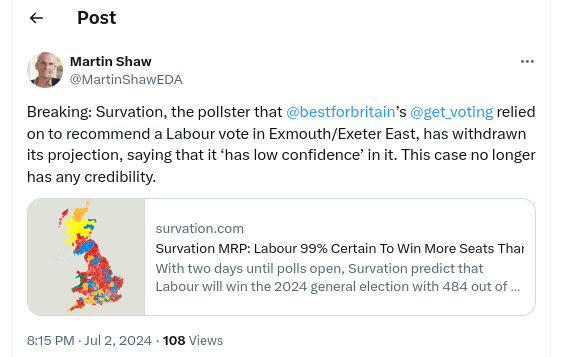
The line in their spreadsheet for Exmouth & Exeter East is now entirely blank.
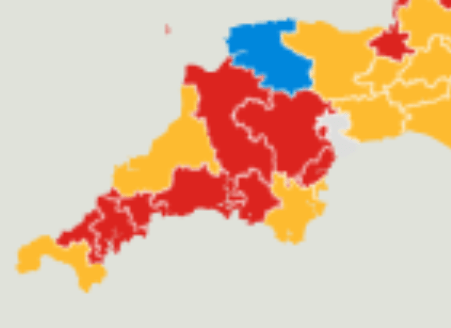

The latest projection from the Financial Times shows Richard Foord still lagging behind the Tory by 4.7 per cent. Meanwhile, the same pollsters show Paul Arnott pulling ahead of the Tory by 4.5 per cent in Exmouth.
The lessons. First, these are projections and could be out. Second, they confirm that in both areas, the battle is between the Tories and the Lib Dems. Third, if you want change, vote for it – in our area, vote Lib Dem. If you vote Labour, Green, or other, you are likely to help the Tories cling on. Now that’s something you DON’T want to wake up to on Friday.
This is now moving towards the edges of polling error. – Owl
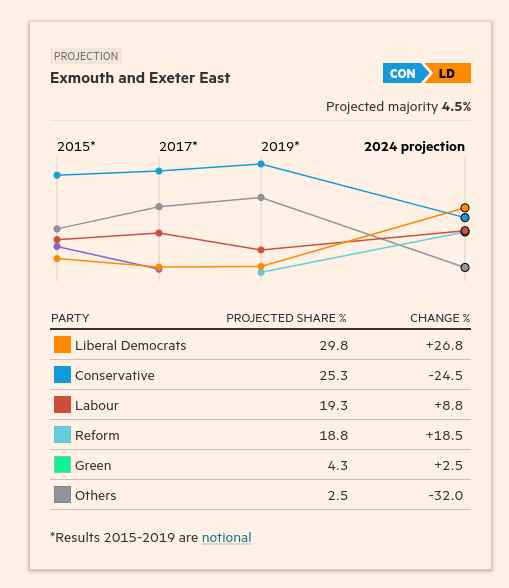
Exmouth & Exeter East – FT now projects:
Lib Dem 29.8%
Conservatives 25.3%
Labour 19.3%
Reform 18.8%
Green 4.3%
Others 2.5%
Tactical voting and disaffection with mainstream parties make this Thursday a once-in-a-lifetime general election that could reshape the political landscape for decades, the leader of the Liberal Democrats has argued.
Peter Walker www.theguardian.com
With a series of smaller parties expected to make breakthroughs in terms of vote share and seats, Ed Davey said the Lib Dems seemed poised to entrench themselves in a swathe of formerly Conservative territory, particularly in the south.
“I think this is a once-in-a-century election,” the Lib Dem leader told the Guardian between campaign stops in Tory-held seats. “I mean, 1997 was a once-in-a-generation. This is a once-in-a-century.”
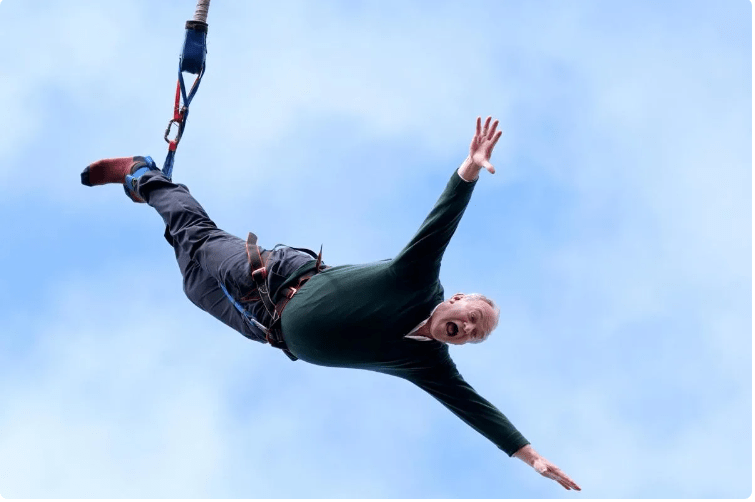
Launching the final week of his defiantly unorthodox campaign with a bungee jump at a football ground in Eastbourne followed by a Zumba class in John Redwood’s former seat of Wokingham, Davey insisted such antics had brought attention to party policies in areas such as social care and sewage in rivers.
“We’ve never seen Liberal Democrat policies talked about as much,” Davey said, speaking in a rear section of the party’s battlebus festooned with wetsuit tops and swimming shorts drying on the backs of the seats.
“Isn’t that weird? When we’ve done it from a lectern in a suit at a press conference, people don’t want to talk about our policies. When I fall off a paddleboard or go down a waterslide, people talk about our policies. I like to think we are running a positive campaign, a bit of fun but mixed with serious messages.
“After I did the bungee jump, one of the guys who works at the football club stopped me, saying that he looks after his dad and what we’re saying about care and carers is so important.”
While the Lib Dems are at pains not to formally reveal how many target seats they are focusing on, an initial focus of about 50 has expanded as formerly unwinnable constituencies including Stratford-on-Avon and South Cotswolds have come into play.
Dislike of the Conservatives and an increased willingness for people to vote tactically to remove Tory MPs could have a particular impact in such areas, Davey said.
“We will take out a lot of Conservatives,” he said, arguing that formerly ultra-safe Tory areas such as Henley, once represented by Boris Johnson, and Witney, David Cameron’s former seat, were on “a knife-edge” and Sussex was “looking incredible”.
“People are realising that this is a quite extraordinary election. They need to vote tactically to get out the Conservatives. In many cases, that’s us,” he said. “People should recognise that this is an election where you can literally change the political geography of our country, and for a long time. Be brave, do something different.”
While the same polls that have said the Lib Dems could end up with 60 or more seats have also predicted gains for the Greens and Reform UK, Davey said it could be harder for these parties, given the need for resources and, apart from in a few places for the Greens, a base of local councillors on which to build.
In the 2019 election, Davey said, the Lib Dems “started fighting places where we hadn’t got councillors”, piling up more votes but producing just 11 MPs, an experience that directly led to the current ultra-focused campaign.
Some polls have said the Lib Dems could even end up with more MPs than the Conservatives, becoming the main opposition. Davey, however, said the only target was to overtake the Scottish National party and become the third biggest party in the Commons.
“What I can say is our campaign is [going] better than we had expected,” he said. “I’m going to seats that I hadn’t expected to. But I’m cautious as well, because we don’t want to overstretch ourselves.
“The Tories have helped us because they have been so awful. I’m happy to concede that. The desire to remove this shockingly bad government has focused people’s minds and they have looked beyond the tribal lines in a way which I haven’t seen before.
“There is a chance that people will vote for the party best placed to beat the Conservatives, and people know in the south of England and the south-west that’s us, broadly speaking.”
Much of the campaign success so far has hinged on Davey’s willingness to throw himself into a variety of camera-friendly stunts. He began Monday morning bungee jumping from a platform hoisted by a vast crane at Eastbourne’s football club, yelling “Vote Liberal Democrat!” as he fell.
Hours later, wearing an orange-pink T-shirt and black shorts, Davey was enthusiastically joining in with a Zumba class in a Wokingham park, carrying on for several songs, by which point most of the photographers had stopped taking pictures.
While large parts of Thursday’s outcome remain in doubt, Davey said he was certain of one thing. Asked if this was the most fun he had had in an election campaign, he replied immediately: “Yes. Without a doubt.”
Prediction: Con 61, Lab 470, Lib Dem 71, SNP 15, Reform 7, Labour majority of 290
Our latest poll-of-polls shows Labour’s lead over the Conservatives back to 20pc, with Reform up 3pc, and the Lib Dems still with a chance of getting more seats than the Conservatives. Labour is now very likely to form the next government. – Electoral Calculus, July

It is now possible to dream of not only the Tories losing power but also of the Lib Dems forming the opposition.
Think how progressive that combination might be?
Dream further: both of East Devon’s constituencies have Lib Dem members of parliament.
In this dream, our MPs would be members of a select band, not just cannon fodder for the voting lobby.
Think what powerful voices they would have to hold the Government to account AND to promote the interests of this part of the country, neglected for so long by the Tories, and with newly elected Labour concentrating on the north/south divide and its industrial heartland.
Richard Foord has already shown, in two years, how much more effective he has been as a constituency MP (for Tiverton and Honiton) than Simon Jupp (for East Devon).
He also had the added prominence of holding a Lib Dem portfolio (Defence Spokesperson).
In contrast, Simon Jupp was a bag carrying PPS who, by convention, had to avoid criticising his government, in other words he was muzzled.
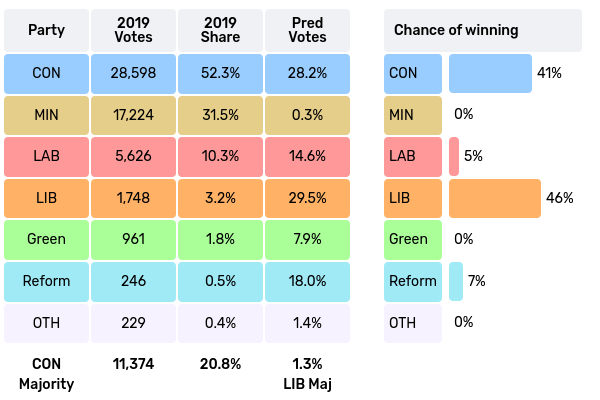
Latest prediction from Electoral Calculus (who actually poll the constituency) restores a narrow lead for Paul Arnott in Exmouth & Exeter East. Labour trail in fourth place but have taken Lib Dem votes as Reform have reduced Tory votes.
Seaton’s Liberal Democrat MP for the last two years, RICHARD FOORD (pictured speaking), dominated last night’s hustings in the Gateway, leaving his Conservative rival, Simon Jupp (on the right, looking on) a marginal figure. As Richard outlined his decades of experience in the military and education, Jupp’s background a special political adviser seemed no match.

As Richard recounted, it was he who, after hearing from the League of Friends of the threat to a wing of Seaton Hospital, first alerted the local community. Jupp repeated the lie that he had been ‘blocked’ from joining the Hospital Steering Committee which was set up in November at the public meeting I organised, but the simple truth is that – as I reminded the hustings – he didn’t bother to turn up, despite already having canvassed in Seaton for a whole year by that point.
Concerns about the NHS and social care dominated the meeting, but the Party of Women candidate, Hazel Exon, provoked anger from the floor when she answered questions about the environment by repeating her conspiracy theories about trans people – which were ably challenged by a young woman in the audience.
Jupp showed his right-wing instincts by pitching for support from climate and vaccine sceptics, but sounded subdued – the audience had largely moved beyond the Conservatives. Having moved first to Exmouth and then to Sidmouth so that he could call himself a ‘local man’ in his election leaflets, Jupp must now be wondering where he will go after Friday’s result.
The “Prof” (for that is what he is) takes another look at who is best placed to defeat the Tories in Exmouth & Exeter East.
“Let’s look at the fundamentals. The Lib Dems, whose vote Claire Wright effectively took over in 2015, 2017 and 2019, had always been the challengers in the area. The Lib Dems were far ahead of Labour in the local elections in 2023. Claire herself is backing Paul Arnott, the Lib Dem candidate, this time. The one MRP projection which we know takes these factors into account, Electoral Calculus, tips Paul to run the Tories very close, as does the Financial Times. The bookies have him a narrow favourite with Labour as also-rans.“
‘PROJECTED TORY WIN’ says tactical voting site, StoptheTories.vote, for Exmouth & Exeter East (EEE).
Although Simon Jupp only got 50 per cent of the vote last time, leading him to jump ship to what he thought was the safety ground of Honiton & Sidmouth (where the Tories had 60 per cent), it now looks as though his successor could cling on – while Richard Foord blocks Jupp in his new seat.
‘TACTICAL VOTE UNCLEAR. Data is mixed on best progressive party’, says StoptheTories.vote about EEE. ‘VOTE LABOUR OR LIB DEM’. The voters in this constituency are the victims of the new ‘MRPs’, which offer projections of local results based on a national model of how voters with particular social backgrounds might behave, given certain baseline political assumptions. The trouble is that these models are NOT polls of actual local voters, and they are NOT designed to provide tactical voting advice.
Crucially, their baseline assumptions are often flawed. For most of the models, the key assumption is that the opposition parties’ 2019 shares tell us who the main 2024 challenger is likely to be. The problem is that in EEE the main challenger was Claire Wright, the Independent who is not standing this time, who got over 40 per cent. Most of the models simply can’t cope with that, as several pollsters have admitted to me when I’ve questioned them. So they’re left using the 4.5% that Labour got in 2019 to pitch them as the main challenger over the Lib Dems who got 2.8% – although both lost their deposits and these miserable scores tell us nothing about how Claire’s 40 per cent will vote.
Let’s look at the fundamentals. The Lib Dems, whose vote Claire Wright effectively took over in 2015, 2017 and 2019, had always been the challengers in the area. The Lib Dems were far ahead of Labour in the local elections in 2023. Claire herself is backing Paul Arnott, the Lib Dem candidate, this time. The one MRP projection which we know takes these factors into account, Electoral Calculus, tips Paul to run the Tories very close, as does the Financial Times. The bookies have him a narrow favourite with Labour as also-rans.
Yet other tactical sites are using the flawed MRPs to say that Labour are the challengers, Labour are understandably reluctant to look a gift horse in the mouth, and many would-be tactical voters are totally confused. Much damage has already been done, with the opposition vote sufficiently split, perhaps, to let the Tory squeak through. I can only say that, based on my understanding of the fundamentals and the problems of the so-called polls in this case, Paul Arnott remains the best bet to take the seat. He would also be an excellent MP. I hope that voters will give him the chance.
Will Hutton starts the debate about how to fund and build a high-investment, inclusive, high-wage capitalism that treats its workers fairly.
Will Hutton www.theguardian.com
Since its foundation in 1900, the Labour party has had a Janus-headed attitude to capitalism. It needs capitalism to be successful, dynamic and job creating, even while it instinctively distrusts capitalism, with its capacity to generate extreme inequality, invest too little, cut corners and treat workers exploitatively. But its past efforts at improving things – nationalisation, top-down planning, championing strong trade unions or simply (as New Labour did) largely giving capitalism its head – have not been notably successful. It has been a standoff that the Conservative party has ruthlessly exploited.
The seismic importance of 4 July is that Conservatism’s approach to wealth generation – trying to shrink the state whose size and excess taxes supposedly “crowds out” suppressed investment and enterprise – is exposed as a dead end of stagnant living standards and eviscerated public services. Keir Starmer, boxed in by this dreadful legacy, has declared that Labour will become the party of growth and wealth generation. Only thus can sustained tax revenues be generated to repair the ravages of the past 14 years. My bet is that he has a better than even chance of pulling it off – and transforming Labour into Britain’s natural party of government.
His first advantage is that the economic evidence is unambiguous: the state does not “crowd out” investment, and low taxes do little to stimulate enterprise. What capitalism needs from the state is well-designed and stable policy that proactively manages the business cycle while “crowding in” innovation, infrastructure and abundant fit-for-purpose training, and shapes the savings system to deliver buoyant company share prices – the necessary if insufficient precondition for raising capital to enable higher investment and a startup and scale-up boom.
This is becoming the new common sense in business, finance and the financial markets. It is why investors are buying shares anticipating a Labour government, and why Dame Amanda Blanc, CEO of Aviva, suggested last week that there could be as much as £100bn from UK insurers ready to flow into business investment if chancellor Rachel Reeves can deliver her promises on stability. That alone would go some way to lift British public and private investment by £100bn every year – the scale of the gap between us and our major competitors – while not risking another Liz Truss-style fiasco.
One important avenue to growth, cited in the Labour manifesto, is the prospect of unleashing some of the £1.4tn funds fossilised in Britain’s 5,100 defined benefit pension fund schemes. Linked to a generous fraction of workers’ final year’s pay, they have become a financial burden. To wind them up, companies have closed them to new members, creating a £1.4tn universe of wholly risk-averse zombie funds. They need to be consolidated into bigger funds that can take risks – and the money made to work to accelerate Britain’s investment recovery.
There is the tool to hand. One of the most startling policy successes of the past 20 years has been New Labour’s Pension Protection Fund (PPF), established in 2005, which takes over the management of distressed defined benefit pension funds, guaranteeing the future pensions. Managed with great professionalism, the PPF has already consolidated more than 1,100 pension funds and is currently worth £33bn with a £12bn investment surplus – one of the most successful funds of its type globally in securing high investment performance. Industry insiders believe that there is another £600bn locked up in small, high-cost zombie funds that could be liberated for productive investment.
The first staging post would be to scale up the current PPF to at least £100bn. Conservative objections that this would leave the pension funds with no fiscal backstop can be easily overcome; backed by the state, the PPF will become the new backstop via a guarantee that does not score as public borrowing. Nor, because the PPF is so rich, would the state ever be at risk. Reeves will be on her way.
After all, such a guarantee is already delegated to the UK Infrastructure Bank (UKIB) to underwrite £10bn of commercial bank lending on infrastructure projects. Reeves should lift the facility to £50bn. A similar guarantee would enable the British Business Bank (BBB) to offer venture debt to startups and scale-ups, and seek out promising companies to back: there is an estimated annual shortage of up to £10bn of venture lending that needs to be closed. My understanding is that a scaled-up PPF would support both the UKIB and BBB; at a stroke, Britain would have equipped itself with an investment trio of financial institutions dedicated to serious multibillion-pound economic development and resultant growth – without additional direct government borrowing. It’s a fiscal get-out-of-jail-free card.
Against this background, Reeves can use her proposed rewriting of the fiscal rules to supplement public investment directly. The Financial Times recently reported that asset managers would buy an extra £20bn-£30bn of government debt if it were earmarked for investment projects and R&D. Altogether, the UK’s growth rate could accelerate to above 2.5% by the end of the parliament, with even the dropped £28bn target for green spending met. Growth would be higher again the more Britain regained access to lost EU markets.
In the near future, before growth kicks in, Starmer and Reeves may have to increase the current yields from capital gains, inheritance and council tax by up to another 1% of GDP. But overall there will be the funds to resuscitate education, the NHS, local government, defence, the criminal justice system, the arts and welfare. Do I dream? Some commitments are in the manifesto, others set out in Reeves’ Mais lecture in March, others have not been excluded during the election campaign, and the ambitious teams in the investment trio are all standing by for the call.
Some in the Treasury will oppose. And never underestimate the conservatism and parochialism of the pension fund world. Geopolitics may kill all hopes. But Britain under Labour could at last fulfil its economic promise and build a high-investment, inclusive, high-wage capitalism that treats its workers fairly. This time, no mistakes.
The Liberal Democrats are increasingly confident they can beat the Conservatives in large parts of southern England, including the two Oxfordshire seats formerly held by David Cameron and Boris Johnson.
Kiran Stacey www.theguardian.com
Ed Davey, the Lib Dem leader, spent Sunday campaigning in Bicester, where the party believes it can defeat the Conservative candidate, Rupert Harrison, a highly regarded economist and one-time adviser to the former chancellor George Osborne.
Davey’s visit was part of a strategy that has seen the party roam further into safe Tory territory as the campaign has gone one, buoyed up by polls that show it picking up support across large parts of the south and south-east.
A party source said: “We’re really encouraged by what we’re seeing in the final stretch of the campaign. Tory support seems to be collapsing in southern England and we’ve continued to pick up support.”
The party went into the election focused on 80 seats where it finished second in 2019 – almost all Tory held. Officials say more of those 80 are now in play than when the campaign first began. “Canvass returns are looking better than they were a week ago, and even better than they were two weeks ago,” said one.
Internal Lib Dem polling seen by the Guardian suggests there will be close races in Bicester and Woodstock, Didcot and Wantage, Henley and Thame – which includes much of Johnson’s former seat – and Witney, Cameron’s old constituency. The party believes each of these could be won by a margin of just 500 seats.
This tallies with national polls that suggest the party has picked up more than one percentage point during the campaign, while the Conservatives and Labour have shed support. Large-scale MRP models suggest every pollster expects the party to win Henley and Thame, but they are split over which party will win the other three Oxfordshire target seats.
The party will spend the final days of the campaign targeting Labour voters in seats where Labour finished third in 2019, hoping they can unlock as many as 25 seats in a final frantic effort. As well as the Oxfordshire seats, the party is pouring resources into Theresa May’s former seat of Maidenhead, as well as the south-western seats of Frome and East Somerset, and Torbay.
Labour hopes to win The Sun’s backing next after The Sunday Times became the first Murdoch-owned newspaper to switch allegiance from the Conservatives and endorse Keir Starmer.
Adam Sherwin inews.co.uk
An editorial in Rupert Murdoch‘s flagship Sunday broadsheet said the Conservatives had “in effect forfeited the right to govern” and that it was “the right time for Labour to be entrusted with restoring competence to government”.
The newspaper has endorsed the Conservative Party in every election since 2005.
But the lukewarm support does not necessarily mean that all News UK titles will urge readers to vote Labour, i understands.
While newspaper circulations have declined, reducing their influence, the Murdoch papers have traditionally sought to back the winning side in elections.
Labour welcomed The Sunday Times switch, which accompanied an exclusive joint interview with the party’s leader and his shadow Chancellor, Rachel Reeves.
But winning the support of The Sun, which has backed the Conservatives for the past 15 years, is seen as a symbolic prize by the Labour leader’s team.
Pat McFadden, Labour’s election campaign co-ordinator, told LBC: “We always welcome endorsements, I think they matter.
“We have changed, broadened our appeal. You can’t win by just speaking to people who already agree with you.
“I would like The Sun to endorse us but it’s a decision for them.”
Labour also won the endorsement of the Financial Times on Sunday night. In a leader column headlined “Britain needs a fresh start”, the paper wrote: “The Conservatives have run out of road. Labour must be given a chance to govern.”
Shadow Health Secretary Wes Streeting posted on X, formerly Twitter: “The Sunday Times backs Labour. Britain needs change. If you want change, you have to vote for it.”
But a News Corp insider said that the endorsement was “more about the anti-Tory mood than support for Labour”.
“If the Tories are heading for a hammering then the papers have to acknowledge that and remain relevant,” they said.
“But at The Sun, the feedback from readers is they are fed up with the Tories but they still don’t trust Labour on key issues like immigration, tax and union rights.”
The Sunday Times held fire until its final edition before polling day to make its call. It wrote in its election editorial: “We cannot go on as we are, and we believe it is now the right time for Labour to be entrusted with restoring competence to government.”
“Britain needs to do better as a place to live, work and do business.”
The period since 2016 was described as being “defined by political chaos that has fatally distracted the political class from those issues that matter most to voters – healthcare, schools and the economy”.
The switch was in stark contrast to other right-of-centre Sunday papers which led with dire warnings that a Starmer government would “wreck” Britain.
David Yelland, former editor of The Sun, wrote on X: “The Tory Sundays are in collective nervous breakdown as their power wilts, these front pages are wild howls at the moon.”
Ayesha Hazarika, a former Labour adviser, said: “Although newspaper endorsements are not as potent as they once were, a significant move for The Sunday Times to back Labour after almost 20 years.”
Baroness Hazarika added: “Support for Scottish Labour in the Daily Record and Sunday Mail is also worth noting – Scotland is very important in this election.”
Sky News political reporter Ben Bloch described it as a “big blow to Rishi Sunak”.
Paul Mason, the former BBC journalist who sought selection as a Labour candidate, wrote on X: “Sunday Times becomes first Murdoch newspaper to back Labour … the rationale is functionalist: my car keeps breaking down so I must change it but it offers no clue as to why the car is so faulty… only that changing the salesman didn’t help either.”
Carol Vorderman, the TV personality-turned-anti-Tory campaigner, said: “The Sunday Times has endorsed Labour today… do you think that will change many people’s view? I don’t think so.”
The Sunday Mirror, as expected, urged readers to vote Labour, along with The Observer. The Independent used a blacked-out front page to urge people to vote for Labour.
The Sunday Express and Sunday Telegraph lined up for the Tories.
The Mail on Sunday wrote: “It is not all over yet. Vote Conservative on Thursday and we may yet escape a long and punishing season of hard Labour.”
Sir Tony Blair convinced Mr Murdoch to back New Labour at the 1997 election after years of wooing.
But The Sun‘s full-throated backing for Sir Tony, at the launch of the 1997 general election campaign, has not been repeated for Sir Keir, who sanctioned prosecutions of a number of tabloid journalists over hacking allegations when he was director of public prosecutions.
The paper’s daily “Sun Says” editorial columns have been critical of the prospectus offered by Labour throughout the campaign.
The Sunday Times leader column may register less highly with voters than Sir Elton John’s call for a Labour government on Saturday.
Whilst the influence of newspaper endorsements may be declining, The New York Times editorial calling for President Joe Biden to drop out of the US presidential election after his faltering debate performance last week caused shockwaves in Democrat circles.
 East Devon Watch