“In February this year, East Devon District Council formally voted to express “no confidence” in South West Water. Many incidents both before and after that decision have fully justified the vote, but the major sewage spill at The Maer last night represents an historic new low. Despite multiple reassurances from South West Water that they have Exmouth under control, they simply do not. This incident not only impacted our residents but also the tens of thousands of tourists that visit Exmouth.
“Our officers and the Environment Agency attended the site as soon as the spill was reported and took direct action to advise residents and visitors not to bathe in the water. I thank them for their rapid response. Due to the severity of the spill, today we have had to ‘red flag’ bathing until we are satisfied that any sewage has dispersed. We are also closely monitoring the impact on one of our car parks.
“As a council, we are meeting South West Water following the vote of no confidence and the ongoing issues with the company. But I urge them to think about their actions and agree a way forward to ensure this does not happen again.
“We will continue to monitor the situation and will hold South West Water to account.”
The popular tourist hotspot received an influx of beachgoers this week following the hottest recorded day of the year and the start of the summer holidays.
Following the burst, the Environment Agency has advised the public to avoid getting into the sea in the Exmouth area due to the pollution risk.
“Bathing is not advised due to pollution from sewage. Affected bathing water: Exmouth,” warned the organisation.
South West Water confirmed they are working to install a temporary pipe to manage the leak and a red flag has been put up the beach to stop bathers from entering the water.
East Devon District Council also cautioned beachgoers against bathing: “We have been made aware at 1731 this afternoon of a pollution incident on private land next to the Maer Road pumping station in the Exmouth area. Bathing is currently not advised in this area on Exmouth seafront.”
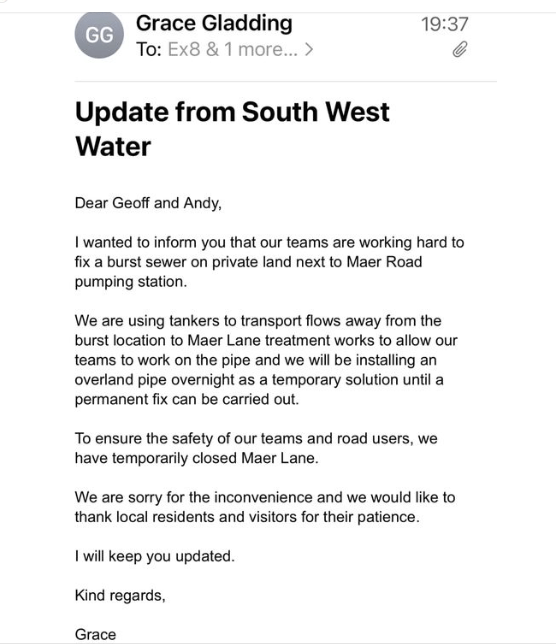
In a statement, South West Water said: “Our teams are working hard to fix a burst sewer on private land next to Maer Lane wastewater treatment works. We are using tankers to transport flows away from the burst location to the treatment works to allow our teams to work on the damaged pipe.
“We will be installing an overland pipe as a temporary solution until a permanent fix can be carried out. To ensure the safety of our teams and road users, we have temporarily closed Maer Lane, and we would like to thank local residents and visitors for their patience.”
The water regulator proposed a £104 million penalty for Thames, as well as a £47 million penalty for Yorkshire Water and £17 million for Northumbrian Water, as the first batch of results from its biggest-ever investigation into the industry.
The penalties relate to water firms’ management of their wastewater treatment and sewer systems, which have come under heavy criticism for releasing too much pollution into rivers.
A correspondent sends these images from the Lime Kiln car park and comments:
This tank appeared about a week ago. Is it anything to do with what Susan Davy has described as surface water separation to reduce the flow that is being pumped up to Exmouth?
As a Budleigh resident I was pleased to read the letter from Susan Davy that the sewage is being dealt with and all will be well by 2028.
Then I started to read between the lines.
We just have to wait until 2028 when more sewage capacity will come on stream in Exmouth.
Then I read that sewage is flowing again in Exmouth down some country lanes.
I have a deep scepticism that the Exmouth wastewater treatment will be sorted by 2028 even for the current Exmouth residents.
And then the government wants house building plus, plus in East Devon. With 2/3rds of the district a natural Landscape where will it go? Exmouth you bet. Where will these houses sewage go? Exmouth Waste Water Treatment Plant and then the sea?
Bad luck Budleigh Salterton. You will be at the tail end of the pipeline – you will be back a hundred years to the 1930s when the sewage was routinely piped out to sea!
I shall copying this to David Reed to ask him to remember that the small town of Budleigh Salterton is part of his constituency. We are part of the Exmouth sewage fiasco. We have been suffering, like Exmouth, with tankers through our High Street, poo in our bay, trees dead in the Kersbrook next to the pumping station etc. and likely to continue for years to come.
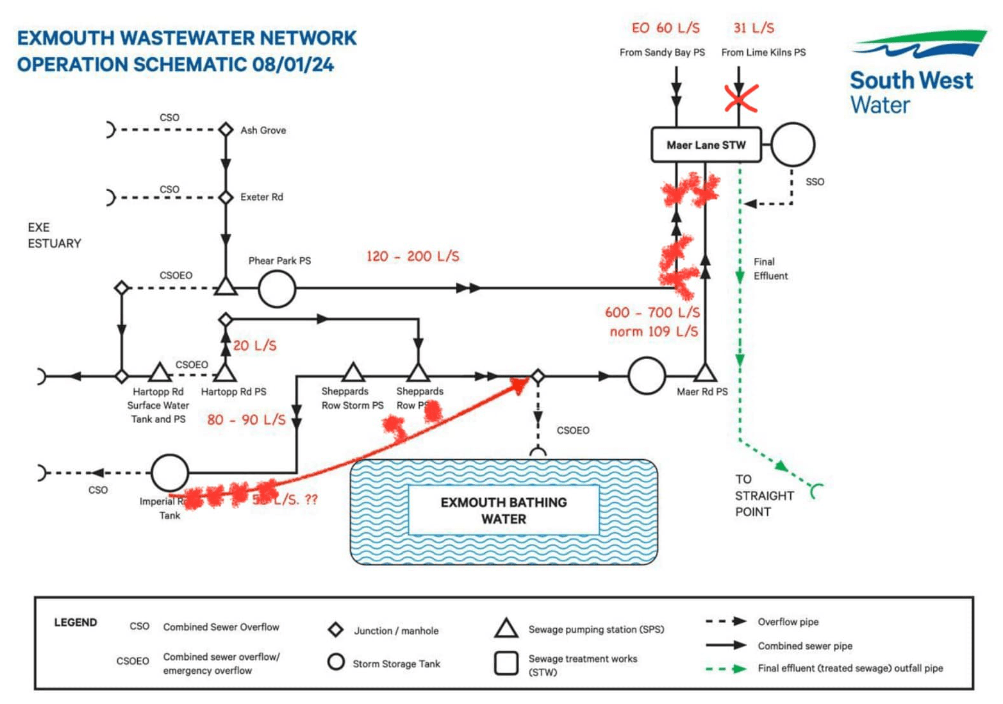
Bursts on all Exmouth main rising mains and all part of the plan to pump more sewage to Maer Lane and out to sea.
Network diagram below with locations of bursts in the last 8 months.
Upgrades to pumps prior to upgrading the rising mains. Despite assurances that these pipes have been upgraded we continue to see sewage pipe bursts across Exmouth network.
Through CCTV investigation, we have identified infiltration into the sewers in Budleigh Salterton. Infiltration is when surface or groundwater enters the sewers in places it’s not meant to, such as through manhole covers or pipes in need of repair. This means that a lot more water enters the sewers and increases the risk of activating our storm overflows.
Through repairing the pipes, we can reduce the volume of water travelling through the network, which will help reduce the risk of spills and pollutions from these assets.
The plan for Budleigh Salterton
In September, work will begin to start reducing the amount of water that is entering the sewer network. The work will be carried out in stages and is planned to continue throughout the autumn.
We’re planning to repair the sewers with the very latest lining technology, which will reduce the number of excavations needed as the repairs all happen inside the pipes.
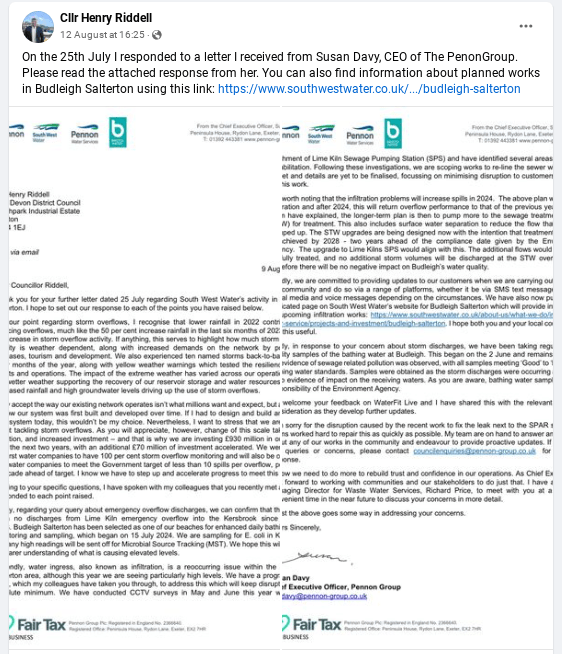
On the 25th July I responded to a letter I received from Susan Davy, CEO of The PenonGroup. Please read the attached response from her. You can also find information about planned works in Budleigh Salterton using this link:https://www.southwestwater.co.uk/…/budleigh-salterton
Thank you for your further letter dated 25 July regarding South West Water’s activity in Budleigh Salterton. I hope to set out our response to each of the points you have raised below.
To your point regarding storm overflows, I recognise that lower rainfall in 2022 contributed to reducing overflows, much like the 50 per cent increase rainfall in the last six months of 2023 caused an increase in storm overflow activity, If anything, this serves to highlight how much storm overflow activity is weather dependent, along with increased demands on the network by population increases, tourism and development. We also experienced ten named storms back-to-back in the latter months of the year, along with yellow weather warnings which tested the resilience of our assets and operations. The impact of the extreme weather has varied across our operations. with the wetter weather supporting the recovery of our reservoir storage and water resources, but the increased rainfall and high groundwater levels driving up the use of storm overflows.
I fully accept the way our existing network operates isn’t what millions want and expect, but a product of how our system was first built and developed over time. If I had to design and build an entirely new system today, this wouldn’t be my choice. Nevertheless, I want to stress that we are serious about tackling storm overflows. As you will appreciate, however, change of this scale takes time, ambition, and increased investment – and that is why we are investing £930 million in our region over the next two years, with an additional £70 million of investment accelerated. We were one of the first water companies to have 100 per cent storm overflow monitoring and will also be one of the first water companies to meet the Government target of less than 10 spills per overflow, per year a decade ahead of target. I know we have to step up and accelerate progress to meet this target.
Turning to your specific questions. I have spoken with my colleagues that you recently met and have responded to each point raised.
Firstly, regarding your query about emergency overflow discharges. We can confirm that there have been no discharges from Lime Kiln emergency overflow into the Kersbrook since 26 July 2023. Budleigh Salterton has been selected as one of our beaches for enhanced daily bathing water monitoring and sampling, which began on 15 July 2024. We are sampling for E. coli in Kersbrook and any high readings will be sent off for Microbial Source Tracking (MST). We hope this will provide a clearer understanding of what is causing elevated levels.
Secondly, water ingress, also known as infiltration, is a reoccurring issue within the Budleigh Salterton area. although this year we are seeing particularly high levels. We have a programme of work, which my colleagues have taken you through, to address this which will keep disruption to an absolute minimum. We have conducted CCTV surveys in May and June this year within the catchment of Lime Kiln Sewage Pumping Station (SPS) and have identified several areas requinng rehabilitation. Following these investigations, we are scoping works to re-line the sewer within Fore Street and details are yet to be finalised, focussing on minimising disruption to customers affected by this work.
It is worth noting that the infiltration problems will increase spills in 2024, The above plan will reduce infiltration and after 2024. this will return overflow performance to that of the previous year. As my team have explained, the longer-term plan is then to pump more to the sewage treatment works (STW) for treatment. This also includes surface water separation to reduce the flow that is being pumped up. The STW upgrades are being designed now with the intention that treatment capacity is achieved by 2028 – two years ahead of the compliance date given by the Environment Agency. The upgrade to Lime Kilns SPS would align with this. The additional flows would therefore be fully treated, and no additional storm volumes will be discharged at the STW overflow, and therefore there will be no negative impact on Budleigh’s water quality.
Thirdly, we are committed to providing updates to our customers when we are carrying out works in the community and do so via a range of platforms, whether it be via SMS text messages, email, social media and voice messages depending on the circumstances. We have also now published a dedicated page on South West Water’s website for Budleigh Salterton which will provide information on upcoming infiltration works: httos://www.southwestwater. co.uk/about-ustwhat-we-do/improvilu-your-service/projects-and-investmentibudleigh-salterton. I hope both you and your local constituents find this useful.
Lastly, in response to your concern about storm discharges, we have been taking regular water quality samples of the bathing water at Budleigh. This began on the 2 June and remains ongoing. No evidence of sewage related pollution was observed, with all samples meeting ‘Good’ to ‘Excellent’ bathing water standards. Samples were obtained as the storm discharges were occurring and there is no evidence of impact on the receiving waters. As you are aware, bathing water sampling is the responsibility of the Environment Agency.
We welcome your feedback on WaterFit Live and I have shared this with the relevant team for consideration as they develop further updates.
I am sorry for the disruption caused by the recent work to fix the leak next to the SPAR shop. Our teams worked hard to repair this as quickly as possible. My team are on hand to answer any queries about any of our works in the community and endeavour to provide proactive updates. If you have any queries or concerns. please contact councilenquiriesPennon-grouP.co.uk for a timely response.
I know we need to do more to rebuild trust and confidence in our operations, As Chief Executive, I look forward to working with communities and our stakeholders to do just that. I have asked our Managing Director for Waste Water Services. Richard Price, to meet with you at a mutually convenient time in the near future to discuss your concerns in more detail.
I trust the above goes some way in addressing your concerns.
Yours Sincerely,
(Signed) Susan Davy, Chief Executive Officer, Pennon Group E: sdavy@pennon-group.co.uk
“Good to see some actual detail in Susan Davy’s response to Henry’s letters this time.
The timeline for lining the sewer main in Fore Street is later than planned (Sept vs July), but – when completed – this should make a substantial difference.
Also good to see they have followed through on our request for a dedicated web page detailing what they are doing to fix Lime Kiln pumping station.
Some progress I’d say, and a little more honest than previous platitudes!”
Owl also notes “some progress” but is inclined to be a little less charitable.
Susan Davy spends her first two paragraphs blaming the weather and moaning that the sewage system she “inherited” was not designed the way she would have chosen. [Surprise, surprise!]
[The things you have to do to earn a £1m crust these days!]
Looks like a case of a bad workman blaming her tools.
The essence of her reply is that it will all come good in 2028 when the Exmouth sewage treatment works are “upgraded” alongside increased pumping from the Budleigh Lime Kiln holding tank (with a little bit of surface water separation as well). Owl seems to remember that last December’s experiment in boosting pump pressure in Exmouth didn’t end well. – Stop Press – see below!
South West Water’s record on meeting investment deadlines is on “amber” alert, one of the worst in the industry and SWW has yet to submit any plans.
Stop Press
Coincidentally, as Owl was preparing this article a sewer main leading to this very treatment works burst, flooding the area, reported by Escape prompting an apology from Grace Denning, South West Water:·
Geoff Crawford: “I hear some say that this has been running across the field and down Maer Lane, across into Littleham brook, out to sea all week.”
I guess the new daily water sample tests have picked that up.
Finally her parting shot
Finally: According to Susan Davy, South West Water is conducting more independent pollution sampling in bathing waters and rivers. At the Otter Head she states: “samples were obtained as the storm discharges were occurring and there is no evidence of impact on the receiving waters.” Owl finds this difficult to accept and wonders whether the sampling points are being “gamed”.
Feargal Sharkey, who toured the country to campaign for Labour during the general election, said: “What we need right now is drive, determination and ambition to conduct a complete radical reform, a root and branch restructuring of a failed industry and a failed system of regulation. We really need leadership, which is currently somewhat sadly lacking.”
Doesn’t look like this will happen. – Owl
Activists warn of ‘extreme anger’ if ministers fail to reform water regulator
Anti-sewage campaigners have warned of “extreme anger” if the Labour government does not radically reform the water regulator.
Sources at the Environment Agency (EA) and in the Labour party have told the Guardian that while Labour had spent time considering reforms of the EA and Ofwat in order to fix the sewage crisis, some stricter options that had been proposed were now off the table.
Campaigners say the watchdog, Ofwat, has been too lax on the water companies and prioritised low bills over spending on improving sewer systems.
Last year there was a 105% rise in raw sewage spills into England’s rivers and seas – it was discharged for more than 3.6m hours and this made 2023 the worst year for storm water pollution.
Options sources say have been discussed with campaigners, the EA and other stakeholders included merging Ofwat and the EA, giving Ofwat more powers and a policy prioritising environmental benefits over costs to consumers, and giving the regulators more independence from government.
At the moment, for example, the EA shares a press office with Defra and its communications are directed by ministers, which makes it difficult to take long-term actions that the government could think too politically damaging, or to hold the government to account.
The EA faced steep funding cuts under Conservative government austerity which has made it difficult for the regulator to enforce environmental laws. Proposals to increase its funding will not be taken forward, the Guardian has been told.
Now policies that campaigners say are less ambitious have emerged and include working with the EA to stop water company self-monitoring for sewage spills – an initiative that was already happening under the Conservative government – and writing to Ofwat to ask them to make sure funding for vital infrastructure investment is ringfenced and can only be spent on upgrades benefiting customers and the environment.
The environment secretary, Steve Reed, has asked Ofwat to ensure that when money for investment is not spent, companies refund customers, with money never allowed to be diverted for bonuses, dividends or salary increases.
Charles Watson, the founder of River Action, said the government had promised regulatory reform of the water companies, adding: “Fixing the nation’s failed environmental regulatory system was rightly a central part of Labour’s environmental campaigning promises during the general election.
“A root cause of the extensive pollution of our waterways is the combination of Ofwat’s allowing of the water companies to pay out too much to shareholders at the expense of infrastructure investment and the Environment Agency’s failure to enforce existing regulations – thus enabling polluters to be able to act freely with impunity.
“[Failing to address these problems] will be met with extreme disappointment and anger by the huge numbers of the public who voted on 4 July to clean up our waterways.”
Water campaigner and former Undertones frontman Feargal Sharkey, who toured the country to campaign for Labour during the general election, said: “What we need right now is drive, determination and ambition to conduct a complete radical reform, a root and branch restructuring of a failed industry and a failed system of regulation. We really need leadership, which is currently somewhat sadly lacking.”
In the months running up to the election campaign, Reed spoke in parliament blaming weak and underfunded regulators for the sewage scandal. During one debate he said: “The Conservative government cut the EA’s resources in half. That led to a dramatic reduction in monitoring, enforcement and prosecutions, leaving illegal sewage spills to double between 2016 and 2021.”
He also referred to Ofwat as a “broken regulator”, and said: “If [water companies] downgrade and cover up sewage spills, they are rewarded with permission to increase their customers’ bills, which boosts their profits. Fewer reported spills – not actual, but reported – and more profits mean bigger bonuses for the water bosses.”
Doug Parr, the policy director for Greenpeace UK, said: “The government is as acutely aware as anyone that the current water and sewage system has failed, and that the regulators bear some of the responsibility for that failure. It has been the reckless prioritisation of dividends – while gaming the regulations – that is responsible for a significant amount of our current woes. Blocking this entirely should focus the industry on keeping pollution out of a revitalised water system, rather than just extracting cash from our dying one.”
The Green party MP for North Herefordshire, Ellie Chowns, added: “Refusing to strengthen regulation with the excuse we can’t afford to sets a dangerous precedent for our public services. The Environment Agency has already had its funding cut to the bone. The Labour government needs to reverse these Conservative cuts and give the agency the funding and teeth it needs to protect our natural environment.
“It demonstrates that Labour still don’t understand that restoring and defending our environment isn’t just an optional nice-to-have benefit but is fundamental to our wellbeing and economic prosperity.”
A Defra spokesperson said: “The new government will never look the other way while water companies pump record levels of sewage into our rivers, lakes and seas. We were elected on a mandate to strengthen regulation, crack down on water companies and begin the work of cleaning up Britain’s rivers, lakes and seas. That is exactly what we will do. The water (special measures) bill will deliver on our commitments, giving regulators new powers to ban the payment of bonuses for polluting water bosses and bring criminal charges against persistent lawbreakers.”
The equipment at these locations has reached the end of its life and requires replacing. Exmouth’s play areas at Baker Close, Carter Avenue, Byron Way, and Littleham Village Hall, are amongst those which will be refurbished.
Whitebridges, Willow Walk and Allhallows play areas in Honiton will also be upgraded, as well as Slewton Crescent play area in Whimple and Land of Canaan play area in Ottery St Mary.
Share your thoughts on what you would like to see in the refurbished play areas before 5pm on 23 August 2024 on EDDC’s Commonplace consultation website.
The consultation questions ask what local families think about the current play areas and the kinds of activities that they would like to be included in the refurbishment.
After the consultation, the council will identify its preferred supplier to manufacture the equipment. EDDC hopes to install the new play areas in summer next year.
Councillor Geoff Jung’s EDDC’s Portfolio Holder for Coast, Country, and Environment, said: “Recent upgrades to East Devon’s play areas in Budleigh Salterton, Beer, and Exmouth have proved very popular. I am delighted that nine extra locations will be refurbished, and I encourage local families to share their thoughts about what they would like to see at their nearest play area.”
Ideas for various regeneration schemes in the town and along the seafront have been encompassed in a plan by East Devon District Council to create a blueprint vision for Exmouth.
The hoped-for redevelopment of the Gateway area, which includes the railway station, Imperial Road car park, retail space and the leisure centre, is arguably the most aspirational.
It proposes to create a public space so “the relationship between the town centre, estuary, Imperial recreation ground and the railway station is strengthened”.
The plan, which is being steered by East Devon’s placemaking in Exmouth town and seafront group, envisages a new “state-of-the-art facility” with an open, pedestrianised area between the railway station and the potential new building.
Within this area, the plan proposes a new leisure centre and new theatre, with reconfigured bus stops, tourist information centre and play areas.
The ‘placemaking’ group’s chairman, Cllrr Nick Hookway (Liberal Democrat, Exmouth Littleham), said its plans for the Gateway area were “unimpeded” by the recent loss of £4.4 million of Levelling Up funding the town had secured.
That cash, secured by Devon County Council (DCC), would have been used to block up the subway, improve bike parking and cycle lanes, and widen pathways for pedestrians, but this work will not progress after residents lobbied to keep the subway open.
“The DCC scheme was very specifically limited to highways and pavements, whereas East Devon District Council, which owns a lot of land in the Gateway area, has its own aspirations about what to do there,” Cllr Hookway told the Local Democracy Reporting Service.
“Land ownership is important, as some is owned by us, some by Stagecoach and some by DCC, and one of the challenges is to unlock the potential of that area to produce a place that meets everyone’s wishes.”
Cllr Hookway added that a key rationale for the placemaking plan, which proposes other schemes including in the Queen’s Drive area, Beach Gardens and Pier Head, was to court private investment.
“The [district] council doesn’t have a great deal of money to develop these plans, but you have to have a plan, and by doing so the aim is to provide the opportunity for businesses to consider ideas within the realms of the plan,” he said.
“It removes uncertainty, as it says what we want to do and businesses or developers can work with that.”
At the placemaking groups’s most recent meeting, members were calling for some “quick wins” to help show the town some progress was being made.
A third consultation on the plans was held in March, which courted more than 700 online responses and around 26 emailed comments.
The meeting also confirmed that it would work to ensure a £45,000 grant linked to part of the plans was spent before a March deadline.
The money is for developing feasibility options at Queen’s Drive and Beach Gardens, two areas of the wider plan for the town and seafront.
In a document containing initial design briefs, schemes could involve an “inclusive events’ space” near the existing Queen’s Drive Space, and providing events’ infrastructure and sheltered seating.
Aspirations for Beach Gardens, near Exmouth Pavilion, include relocating 26 parking spaces to create a larger public area that could host events better, provide cycle infrastructure, and a play area for “all age groups”.
The council needs to decide which ones to draw up firmer plans for.
“It is envisioned that the character of the [Beach Gardens’] area is set to undergo significant transformations focusing on sport, arts, culture, and recreation,” according to a document outlining the wider Exmouth proposals.
“The Pavilion is a key cultural and entertainment destination. The Beach Gardens’ car park will be repurposed to offer high-quality public space, complementing the Esplanade as a hub for arts, sports, and culture.”
The £45,000 funding is from the government’s £2.6 billion Shared Prosperity Fund.
East Devon District Council secured nearly £1.8 million, part of which is allocated to Exmouth, over three years ending in March 2025.
Beyond Queen’s Drive and Beach Gardens, there are also ideas for the Pier Head area.
The plan proposes relocating the 70 parking spaces there to “significantly enhance the sense of arrival for all” into this part of the town by sprucing it up.
That includes creating a more welcoming arrival space for visitors, especially those who arrive by ferry, and also designing an “iconic pavilion that acts as a seating/waiting area”.
But the proposals also mention that it could act as some form of recreation space.
Letter from rail ministers suggest proposals won’t be funded
A plan to reopen Cullompton railway station appears to have hit the buffers after claims by Devon’s Liberal Democrats that the new government is scrapping the scheme.
Richard Foord, MP for Honiton and Sidmouth, said he had spent two years pressing the previous government to re-open Cullompton station, and that he had been hopeful Labour would honour the scheme.
Mr Foord had been reassured by comments made in parliament last month by Rachel Reeves, the chancellor, that “projects that have already started… will go ahead”.
Ms Reeves was responding to a question from fellow Lib Dem Gideon Amos, the MP for Taunton and Wellington, who had asked about the prospects of Wellington’s railway station scheme going ahead.
But Lord Hendy the minister for rail, has now written to both MPs and, according to the pair, has stated the re-opening of Cullompton and Wellington stations would not be funded. He offered “only a vague commitment to ‘attempt to consider’ the two projects” as part of the wider review of government-backed transport initiatives.
“I’ve seen the hard work and dedication that has gone into helping get things off the ground [in regards to Cullompton station], yet now we find out that, despite direct promises from the chancellor in the House of Commons, the Department for Transport (DfT) may be seeking to quietly side-line the project,” Mr Foord said.
“The re-opening of stations at Cullompton and Wellington are vital to ensuring our railways serve the needs of our communities.
“People have had enough of hollow promises. The chancellor must honour her word and press the DfT to release the funding for the re-opening of these vital commuter stations.”
Luke Taylor (Liberal Democrat, Bradninch) the leader of Mid Devon District Council, echoed Mr Foord’s disappointment.
“Infrastructure investment is essential for Mid Devon’s planned new homes, to the east of Cullompton, at the proposed Culm Garden Village,” he said.
“Homes cannot happen without infrastructure investment like the railway station or the Cullompton town centre relief road.
“We welcomed our new government’s commitment to people and homes, but now, following the abandonment of the station, there must be serious questions on the commitment to the relief road and the new junction 28 replacement on the M5.”
A spokesperson for the DfT pointed to a statement last month by Louise Haigh, secretary of state for transport, that she is commissioning a review of the department’s capital spending portfolio – essentially cash earmarked for large projects.
“We will bring in external expertise and move quickly to make recommendations about current and future schemes,” Ms Haigh told parliament.
“This review will support the development of our new long-term strategy for transport, developing a modern and integrated network with people at its heart, and ensuring that transport infrastructure can be delivered efficiently and on time.”
She added there had been a “gap between promised schemes and the money available” and a “lack of openness with the public about the status of schemes”.
A bidding process for around £10 million of unspent cash amassed by East Devon District Council (EDDC) from contributions made by developers as part of planning approval for their schemes is set to begin soon.
The money comes from community infrastructure levies (CIL) and what are known as Section 106 contributions, writes local democracy reporter Bradley Gerrard.
CIL is a charge that local authorities can set on new developments to raise funds to help fund infrastructure, facilities and services – such as schools or transport improvements – needed to support new homes and businesses.
Section 106 cash can be used for highways improvements, providing facilities such as play parks, and can also be linked to affordable housing.
The council’s latest infrastructure funding statement shows it has around £10 million of unspent funds.
Staff shortages in its planning department have meant that the council has had difficulty allocating the money, and couldn’t produce a statement for the 2022/23 financial year outlining how much it had received from such contributions.
Cllr Todd Olive (Liberal Democrat, Whimple and Rockbeare) who chairs the strategic planning committee, said the council now had a CIL working group and a new team of officers.
Ed Freeman, an assistant director in the planning department, said they hope to create a shortlist from bids from strategic infrastructure providers, such as Devon County Council and the NHS by the autumn.
“We have agreed an outline of the process and put that in motion, so we are hoping to approach providers in the next few weeks to start that process,” Mr Freeman said.
Cllr Dan Ledger (Independent, Seaton) said CIL and Section 106 money could be earning interest. “I’d like to propose that any future interest we get from this type of money is ring-fenced for infrastructure funding,” he said.
While a motion was approved to ask the council’s cabinet to consider this, deputy leader Paul Hayward (Independent, Axminster) warned about unintended consequences.
“It will have a significant impact on the council’s budget to we need to be careful what we wish for,” he said.
“I understand from this committee’s perspective [the interest]should be ring-fenced, but we need to find out the implications, as while it might be a laudable and worthy motion, if it could have detrimental effects elsewhere then that needs to be unpicked.”
East Devon District Council is considering putting pressure on the government to change the law so that unfinished developments are completed sooner, writes local democracy reporter Bradley Gerrard.
Councillors routinely express frustration that some developers start building work, but then halt progress, often for financial reasons.
This can be problematic for authorities which have to show that they have approved a certain number of homes per year, and crucially, that they have five years’ worth of land that is going to be developed.
If work on some land stops, this can put pressure on councils to approve more applications to meet that five-year requirement.
Cllr Mike Howe (Independent, Clyst Vale), vice chair of the strategic planning committee, suggested that developers should be forced to complete projects within a certain timeframe, and if this date was missed then they should face the prospect of a financial cost or the option to give up their planning permission.
“I’ve long held the belief that if an applicant gets planning permission and they make a material start but don’t continue to build, that after three or five years, even if it is not completed, they should have to start paying business rates or council tax,” he said.
“I believe there needs to be a carrot and stick approach as I don’t think developers should be able to sit on a site and not pay any council tax or rates on it.
“And if they don’t want the site any longer, then they should have the option to rescind their planning permission so they don’t have to pay the charges on it.”
Ed Freeman, an assistant director of the council’s planning department, said this was not something the council could pursue by itself, and that legislation would be needed to be able to charge business rates or council tax on buildings that don’t yet exist.
The strategic planning committee agreed to ask the cabinet to ask the government to consider passing legal changes to incentivise developers to complete the sites they have planning permission for within a maximum timeframe.
Plans for a transformation of parts of Exmouth have been given a lukewarm response from key people in the town, writes local democracy reporter Bradley Gerrard.
The Exmouth placemaking plan curates ideas in five areas, including Queen’s Drive and Beach Gardens car park, with 13 potential projects suggested for phase one with a total value of £6 million.
The vision, which is being spearheaded by East Devon District Council (EDDC), is to improve the East Devon town over the next 10 years and has been subject to various consultations over the past two years.
Some of the more controversial ideas – which are not cast-iron plans – include a potential multi-storey car park as part of development of the existing Imperial Road car park, and a new leisure centre.
However, the potential for a park and ride system has been more warmly received, as has the notion of creating a space for events north of Queen’s Drive Space, which houses some of the town’s replica dinosaurs.
But Exmouth’s mayor, Councillor Joe Whibley (Independent, Exmouth Town), doesn’t think the town council is fully behind the plan as it stands.
“Collaboration has been spoken about, with hopes that the town, district and county council would have their logos on documents [thus endorsing the plans], but in terms of the town council, there is quite a long way to go,” he told an East Devon group called ‘placemaking in Exmouth town and seafront’.
“They see the placemaking plan, and some of its specific projects in specific places, and they feel like they have come from nowhere with no link to what is going on in the town, using places that are currently used for other things.”
He suggested the district council explains the plan to the town council once more.
His comments were endorsed by fellow town councillor Graham Deasy, who felt the latest consultation was presented as a ‘fait accompli.’
He said: “We’re spending time criticising it or trying to make further suggestions instead of being involved at the development stage,” he said.
Others councillors felt the consultation questions were inadequate, and that some residents felt the district council is “looking to do things to Exmouth, rather than for it”.
But Gerry Mills, East Devon’s project manager for place and prosperity in Exmouth, said the most recent consultation was the third in two years.
He acknowledged, though, that councillors had not had time to refine the plan before this year’s consultation, and that this might be contributing to the mixed response.
This year’s consultation, in the first two weeks of March, received 712 responses and around 26 emailed comments.
Mr Mills also defended the write-up of the consultation’s findings, and urged councillors to be bold.
“There have been comments about the content of the consultation report, but we have only removed two comments as they were offensive, and we couldn’t publish them, but beyond that we haven’t filtered it and have published the responses, warts and all,” he said.
“And in terms of ideas such as the Exmouth Pavilion and multi-storey car park, these are aspirational and there will be an opportunity to refine specific projects.
“But before we subject the placemaking plan to austerity cuts, bear in mind that when governments come and ask whether we have projects ready to go or approved plans, they will be looking for aspirational schemes.”
He acknowledged some of the so-called big-ticket ideas would be “highly costly”, but that if the town said “we’re never doing that, then it is potentially self-defeating”.
Can it really be that a developer is sensitive to public opinion, gets the message their plan is not what the community wants, and pulls out in less than 24 hours after gaining planning permission?
Where does that leave LibDem controlled Somerset council?
Frome residents have gone from despair to elation within 24 hours after an unpopular housing developer backed out of development a town centre site.
The Saxonvale site has been the subject of two competing proposals for its regeneration – one from the Bristol-based Acorn Property Group, the other from the locally-based Mayday Saxonvale.
Following a six-hour meeting on Wednesday afternoon (July 31), Somerset Council’s executive committee announced it would be selling the site to Acorn – prompting outcry and scatching criticism from local residents and politicians.
Less than 24 hours later, Acorn announced it was withdrawing from the project – leaving the door open for the more popular Mayday scheme to be implemented.
Acorn issued the statement confirming its withdrawal to the Local Democracy Reporting Service shortly after 3pm on Thursday afternoon (August 1), shortly before the same statement was posted on its social media channels.
A spokesman said: “Acorn Property Group prides itself in working with local communities to provide much needed regeneration through residential-led schemes.
“Further to the meetings on July 31, 2024, it has become abundantly clear that in this case, despite our best endeavours to work with all the stakeholders, the local community does not wish to work with Acorn, and on that basis we have decided to withdraw from the process.
“Acorn wishes Frome and the local community the best of luck going forward in developing this wonderful site in whatever way they choose to take the matter forward.”
The withdrawal of Acorn does not automatically mean that the site will be sold to Mayday Saxonvale, and Somerset Council has not provided a time-scale for how soon a final decision would be taken on the site’s future.
Officers indicated on Wednesday afternoon (July 31) that selling the site on the open market (rather than an unconditional sale to either Mayday or Acorn) would not lead to the site being redeveloped quicker.
Responding to Acorn’s departure, Somerset Council leader Bill Revans said: “We note the decision from Acorn Property Group and will now carefully consider our next steps.”
Councillor Steve Tanner, leader of Frome Town Council, added: “We are aware of the statement Acorn have made that they have withdrawn their bid for Saxonvale.
“We have spoken with Somerset Council about this and they have indicated that they are currently considering their options.
“We will remain in touch with Somerset Council and await further information.”
Damon Moore, one of the directors at Mayday Saxonvale, told The Guardian on Thursday (August 1): “We’ve got our future back. It’s extraordinary.”
Councillor Shane Collins, the Green councillor for the Frome East division, added: “This is unprecedented news. In nine years of being a councillor, I’ve never heard of a developer pull out due to community feeling.
“This shows the power of community in Frome. Fantastic news, from the depths of depression yesterday to elation today.”
Somerset Council’s next executive committee meeting will take place in Taunton on Monday morning (August 5); however, the agenda for this was published before the Saxonvale decision was issued, and therefore cannot be altered.
The next executive meeting after this – and therefore the soonest this matter could be publicly discussed again – will be on September 2.
Housing targets imposed on local planning authorities is an emotive subject.
Persuading local residents to accept these targets is made all the more difficult when these targets are set in ways that are difficult to understand and not obviously linked to local demographic needs or solving affordability issues.
Angela Rayner’s proposed method seems to fail on all counts.
As readers can see below the method is deceptively simple.
Take 0.8% of the current housing stock and multiply it (“uplift” in the jargon) by a number derived by dividing average house prices over the last three years by annual earnings.
Why 0.8%?
Well it seems to get the overall answer the Secretary if State wants and it’s easy to calculate, but Owl can’t see any link to demographic or economic growth needs. The more you have already, the more you need in the future. [Lichfields below attempt a rationale].
And the affordability “uplift”?
Well that comes from an underlying assumption that idealised market conditions apply and that increasing supply will reduce prices. It is highly questionable that this assumption holds for second and retirement home hotspots such as Devon and Cornwall. In any event, the market is controlled by a small number of developers who are unlikely to build at such a rate as to reduce prices.
For some reason you don’t start counting until that ratio exceeds four then you “uplift” the number you first thought of by 15% for each “excess” unit above four. You can then apply a cap if the number gets too big!
Curiously, the method (if it survives consultation) will be “mandatory” but the results are not “binding”.
Does it distribute new development where it is needed and will it address the shortfall of affordable and social housing?
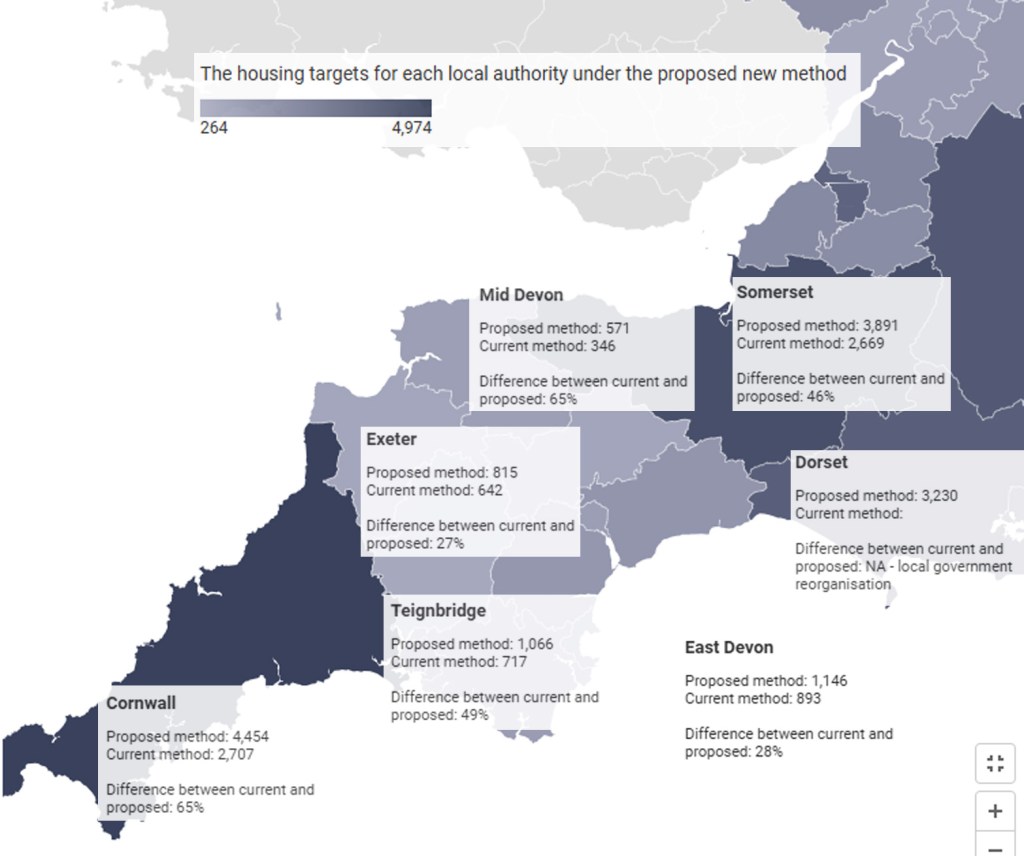
Here are local examples of what this calculation yields locally compared to the existing method (source):
(Note some 26 councils, including some in Devon, do not have comparable figures because under the current system they have a joint plan with one or more neighbouring authorities or have recently been involved in local government reorganisation.)
Among the changes proposed by Government (much trailed in the media) is a new Standard Method (SM). If adopted, it will provide the kinetic force that drives the boost to housing delivery that the Government is seeking.
The SM for local housing need has a long history (see our chronology here). Under almost constant review since it was formally introduced in 2018, it has proved very difficult to change; attempts at its revision (or indeed abolition) have generated controversy and hit the buffers.
The current SM is based on a four-step approach for each local authority area (LAA)[1]:
Using the 2014-based household projections, take the 10 year average growth rate (with the current year being the base year);
Apply an uplift, based on the latest median workplace-based affordability ratio (formula set out in national guidance);
Apply a cap, where appropriate. Where the strategic policies for housing in the current plan are less than five years old, cap the need (from steps [1] and [2]) at 40% above the current plan requirement. Where more than five years old, cap the need at 40% above whichever is higher of the current plan requirement or household projections; and
[For the 20 largest urban areas nationally] – apply a further 35% uplift to step [3].
At the time of writing this generates a national total of around 305.7K net additional homes per annum, of which around 99K is in London. Against this current local need, the aggregate of local housing targets (or requirement figures) in adopted Spatial Development Strategies and Local Plans is 231K; a level around which the supply of extra homes has broadly aligned since 2017[2].
The proposed new SM adopts a two-step approach for each LAA:
Take 0.8% of the current housing stock of the area;
Apply an uplift, based on a three-year average of the median workplace-based affordability ratio, with an increase of 15% for every unit above four.
At the time of writing, this generates a national total of around 371.5K net additional homes per annum, of which around 80.7K is in London. Outside the capital, compared to the current SM, 90% of LAAs areas will see an increase in their LHN figure, and 69% will see an increase of over 200 homes per annum.
You can access the specific numbers for each District in England direct from the Government-produced spreadsheet or via our interactive map.
Beyond the individual numbers, what can we say about the proposal?
Mandatory but not binding
A lot of political debate about the SM has conflated it with the term ‘housing targets’ and revolved around what adjective should be used to describe it: is it advisory, a starting point, mandatory or binding?
The NPPF proposals suggests the proposed SM would be:
mandatory in that it should be the basis for establishing need in Local Plans, with no provisions – exceptional or otherwise – for using a different method;
not binding in that it is not the same as the housing requirement (or target) in the local plan, which is to be set on the basis of the presumption in favour of sustainable development (NPPF para 11 a) and b)). Local Plans may be justified in providing for less housing than needed in their area if there are areas or assets of particular importance that restrict development or if the adverse impacts of meeting need would significantly and demonstrably outweigh the benefits.
The mandatory element and a 0.8% stock-based starting point means a small number of locations (perhaps more remote areas or towns that have experienced de-industrialisation) will see high estimates of need alongside very low (or even negative) levels of household growth. In these locations, providing new housing as a flat percentage of stock may in some instances give rise to housing market displacement (similar to that which afflicted some areas of housing market renewal in the 1990s) or may prove not to be deliverable. Previously, such areas might have cited the NPPF’s provision for ‘exceptional circumstances’ and sought to rely on an alternative needs assessment; now, if they are to conclude that it would be inappropriate to set a housing requirement that meets the SM figure in full (and if there are not nationally-designated protection policies), it will be necessary for them to explain how adverse impacts of planning for those needs in full will significantly and demonstrably outweigh the benefits under the ‘tilted balance’.
A stock-based approach
The Government’s big proposal is to shift from measuring housing need based on demographic projections to one that starts with the current number of homes in an area.
The advantages of a stock-based method advocated by Government might be said to be that it:
Remains relatively simple, using national and freely-available statistics that are produced consistently for all local areas, are robust and updated regularly;
Uses inputs that are stable over the medium to long term (including using smoothed averages where appropriate);
Avoids the circularity and volatility of household projections, whereby:
Repeated iterations of ONS population and household projections fluctuate based on trends, making it difficult to plan
Low rates of housebuilding lead to low levels of household growth (by migration or household formation) in an area, which is then perpetuated by trend-based projections
Addresses the fact that even a big uplift for acute affordability in such an area is unlikely to makes a significant impact if it is applied to a small rate of household growth (a big % uplift to a small number is still a small number).
Ensures that at least 300,000 homes can realistically be achieved, with this number being at the minimum end of what experts believe is necessary to address affordability and need for affordable homes over the long term;
Ensures the SM genuinely ‘boosts’ housing supply, across all parts of the country, as per the original intention of the policy.
In the context that the ’tilted balance’ of the NPPF presumption may be invoked in some cases (where the ‘harms’ of development are weighed against the benefits of new housing) it will be important – in applying a stock-based method – for it to be clear how the numbers associated with that approach in each area are consistent with securing the benefits that new housing will bring, absent the usual demographic starting point.
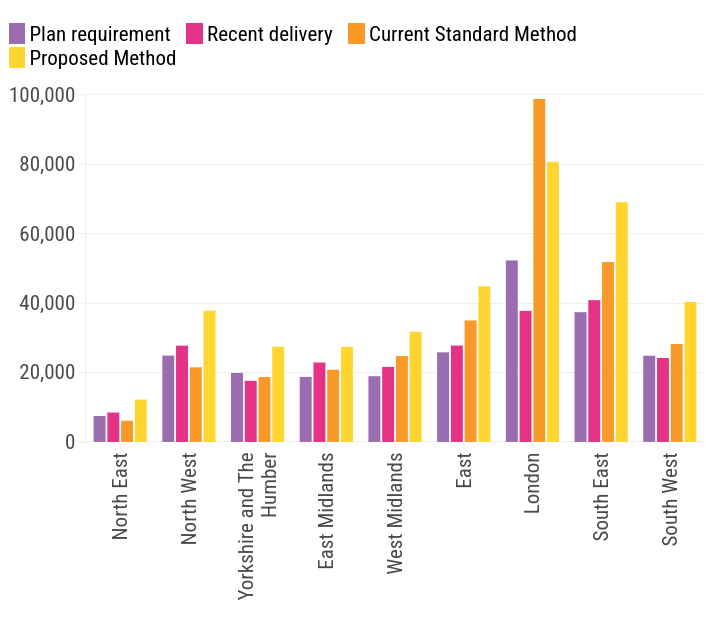
Higher than past delivery, current local targets, and the current standard method, in every region[3]
Within the headline national increase, the proposed SM would see boosts in every region (see Figure 1). It is double the current North East’s need figure[4] and 76% higher than the figure in the North West. The need would be in the order of 20 – 70% higher than recent rates of housing delivery[5] across all regions except London (where the need figure is well over double). Some individual LAAs will see very marked increases, particularly where the demographic trends in the period 2009-14 (the recessionary period which informed the current SM’s demographic starting point) were very low[6]. A consistent criticism of the current SM was that it under-cooked housing need in many parts of the midlands and north, where local plans were often already aiming to provide for more homes, often for economic and ‘levelling up’ reasons.
Figure 1 Regional Breakdown of Housing Target and Delivery Data
Source: MHCLG / Lichfields analysis
But if the regional story is interesting, it is the type of planning issues it generates that tells us what kind of challenges the new method will introduce and some indication of how many homes the proposed method – alongside the envisaged changes to the NPPF might generate.
Targets and Constraints
We have correlated the housing target and delivery data with four ‘types’ of LPA area, to explore what this tells us about the impact of the numbers in combination with proposed new NPPF policies:
Category 1: London (the area covered by the Mayor’s London Plan).
Category 2: LPAs where their administrative area is mostly built-up and/or constrained with a significant amount of Green Belt. This is in the context that the NPPF proposes to make brownfield development within settlements acceptable in principle and – most significantly – to compel reviews of the Green Belt and for ‘Grey Belt’ to be capable of development in situations where there is no five year land supply or the Housing Delivery Test (HDT) result is below 75%.
Category 3: LPAs where the administrative area is mostly built up and/or constrained by other national constraints (e.g. national landscapes) for which there is no fundamental change of policy.
Category 4: LPAs in the rest of England – i.e. areas which are unlikely to have fundamental other national policy constraints.
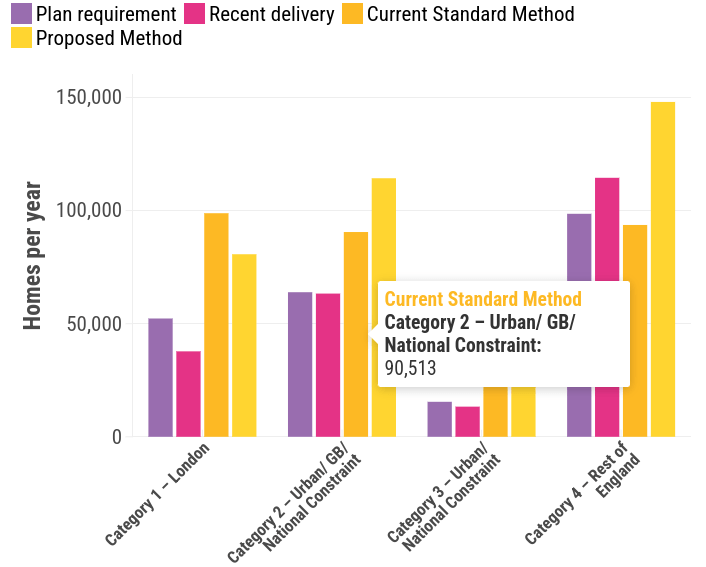
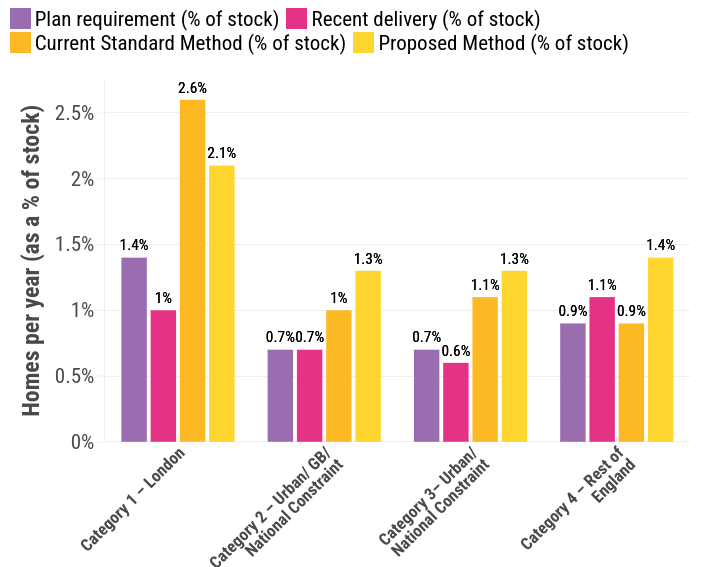
The housing target and delivery data is cascaded through these four categories by absolute annual numbers (Figure 2) and as a percentage of housing stock (Figure 3).
Figure 2 Housing Target and Delivery Data by LPA Type (Dwellings per annum)
Source: MHCLG / ONS / Lichfields analysis
Figure 3 Housing Target and Delivery Data by LPA Type (Dwellings per annum as % of Housing Stock)
Source: MHCLG / ONS / Lichfields analysis
This analysis shows that:
London has been delivering at 38% of the current SM (at circa 38K dpa), below its London Plan target[7], but its recent delivery (1.0% of current stock) is relatively high compared to other constrained areas. The proposed SM rate is down, from 2.6% in the current method, but at 2.1% is still stretching. One can contemplate that some proposed NPPF changes to policy on Green Belt review might drive higher targets and delivery, but it is untested whether London will meet needs in full – achieving even the current London Plan targets (of 53.2K) by end of the current London Plan target period would be an achievement.
LPAs that are predominantly urban and/or constrained by Green Belt have existing local plan targets and recent rates of housing delivery at around 70% of the current SM and a stock growth rate of just 0.7%, reflecting that Green Belt constraints (and the absence of up-to-date local plans) have tended to suppress delivery. The proposed SM represents a 26% uplift compared to the current formula, but in combination with the NPPF proposed change to policy on Green Belt and renewed focus on cross-boundary working, there must be expectation that a far greater proportion of needs will be met. If future plans saw, say, 85% of the higher proposed need effectively planned for (up from 70% of current need now), this would deliver an extra 30-35,000 homes each year at a rate of stock growth of 1.09%.
The other areas LPAs that are predominantly built up and/or constrained by other national protections currently see the lowest rates of planned growth (0.7% of stock) and represent a relatively small total share (6-8%) of housing need. It is unlikely their rate of housing delivery will change much as a result of the proposed NPPF or revised SM.
Across the Rest of England, Local Plan requirements and recent rates of delivery have been above the current SM (at c.115K per annum); they would be stretched by the new proposed SM (at c.148K) but would – if met in full – still be at 1.4% of stock, similar to the rate that the London Plan has been targeting. On its face, that ought to be achievable, and its contribution to total housing need would increase to c.40% from 30% currently (but its share of recent housing delivery has been punching above its weight, at around half).
Will this achieve Government ambitions for 1.5m?
In combination, one can see how the proposed Standard Method, in combination with proposed NPPF revisions (particularly on duty to cooperate and Green Belt review) has the potential to unlock planning constraints to housebuilding in many locations that have so far capped local plan targets, and to stretch delivery in less constrained areas where current targets are largely already met. 300K per annum looks readily achievable based on the policy platform set out, in the context that rates close to 250K have been achieved in the recent past, despite the challenges in London and in the areas where around a third of local housing need in England has been locked up in areas where local plan coverage is lower than average and where Green Belt has constrained development, and where rates of stock growth have been consequentially low.
Over the course of an economic cycle, the level of housing delivery will fluctuate with the market, but overall rates of delivery will be a significant function of the amount of land released by the planning system, which is shaped by the targets that are set via a housing need methodology and the national policies of the NPPF that direct how much need is actively planned for in local plans. The Competition and Markets Authority (CMA) found that: “The planning system is exerting a significant downward pressure on the overall number of planning permissions being granted. Over the long-term, the number of permissions being given has been insufficient to support housebuilding at the level required to meet government targets and measures of assessed need.”
In December 2020, we said the current Standard Method was a method that “with a fair wind, [is] a recipe for maintaining (just) current national rates of housing delivery [of around 230K], but seem unlikely to get England over the 300K hurdle.” In February 2023, we said that the then proposed changes to the NPPF could lead to a fall to 156K.
The hiatus in plan making in combination with the recent housing market downturn looks set to see rates of house building at 170-190K this coming year (a fact the Secretary of State highlighted in her Parliamentary statement) and recovery will be gradual. Looking ahead, based on our analysis of the four categories above, we can conclude that the new method alongside the NPPF is readily consistent with achieving an annual run rate of the 300,000. Getting to that by the end of the Parliament is eminently realistic but would nevertheless be an achievement with which the Government could be justifiably pleased, given past rates of delivery and its starting point.
But what about the 1.5m ambition? Even setting aside the practical and market challenges, the new method and policy framework as currently proposed seems unlikely to get there. This is because it is not proposed to be calibrated to achieving an accumulating 300K pa target over five years.
Until Local Plans are in place[8], housing supply in most areas will be monitored against a target (the SM) that is refreshed each year, with any shortfall from that year wiped clean. This means that the under-delivery against 300K in initial years will not be added to the annual requirement for future years in most places. Therefore planning decisions focused on future delivery will be made based on what is needed to achieve the annual target for five years from that rolling date, not the beginning of the Parliament. Although a worsening affordability due to prior under-delivery in early years might nudge the Standard Method figure up slightly, it is unlikely to be sufficient to ‘make good’ the annual shortfall of 100-150K that will accumulate in the short term. It might be that some simple adjustments to the NPPF or the PPG to fix the base date of the five year housing land supply calculation in areas without Local Plans is a way of resolving this inconsistency.
Annex: Chronology of the standard method
The introduction of the National Planning Policy Framework (NPPF) in 2012 saw the responsibility of determining local housing needs and housing requirements fall to local planning authorities, having previously been established within Regional Spatial Strategies. Whilst guidance on how housing needs should be assessed was published in 2014, authorities adopted a broad range of assumptions and approaches, and establishing housing need quickly became one of the most time-consuming and costly parts of the plan-making process. The idea for a simple, standardised approach was first mooted in 2016, and has evolved over the last eight years as follows:
March 2016 – the Local Plan Expert Group reports to Communities and Secretary and to the Minister of Housing and Planning that key issues facing plan makers include authorities struggling with a complex local plan process and housing needs not being met. The LPEG recommended a shorter, simplified, standard methodology for assessing housing need, which amended the planning practice guidance (PPG) to (1) provide greater clarity on the starting point (based on household/population projections), (2) set a clearly defined market signals uplift (based on either 10%, 20% or 30% uplifts, depending on the affordability ratio) and (3) confirm how to factor affordable housing needs (a further 10% increase to housing needs if required). It was suggested that economic-led factors were removed from the housing need assessment process, but plan-making authorities could include these in the housing requirement if appropriate;
February 2017 – Government publishes the White Paper ‘Fixing our broken housing market’ and responds to LPEG report confirming it will consult on a standard method for assessing housing needs;
September 2017 – Government publishes ‘Planning for the right homes in the right places’ consultation which includes proposed standard method as follows; (1) baseline, based on household projections over a 10 year period; (2) uplift for affordability [formula-based]; (3) cap, where applicable, depending on current plan age. At the time, Government estimated this would yield 266,000 homes nationally (of which 72,000 in London). Elements of this stemmed from the LPEG recommendations, but there were differences;
November 2017 – the Autumn Budget confirms that the Government aims to deliver 300,000 homes a year by the mid-2020s;
July 2018 – a revised NPPF is published which requires local authorities to use the ‘standard method’ for informing strategic policies, unless exceptional circumstances justify an alternative approach. It is introduced into the PPG in September 2018.
September 2018 – the ONS publishes 2016-based household projections which indicate substantially lower household growth nationally than the previous 2014-based projections (which underpin the standard method). This significantly undermines the ability of the standard method to achieve 300,000 homes per year nationally. The Government almost immediately consults on changes to the standard method to confirm that the 2014-based projections will continue to be the starting point, in order to support the aspiration to deliver 300,000 homes per year. This consultation also suggested that, in the long-term, government would review the formula and establish a new method by the time the next projections were issued;
August 2020 – Government consults on proposed changes to the standard method which introduces some amendments to the standard method, including amending the baseline (being the higher of either 0.5% of stock or household projections) and amending the affordability uplift (to also take into account 10-year change). This yields 337,000 homes a year nationally. The proposal proved controversial and was dubbed the ‘mutant algorithm’
December 2020 – The Government backtracks and instead retains the existing method but with a ‘fix’ to incorporate a 35% uplift to the 20 largest urban areas within the standard method which brings the total annual number to around 300,000, but with concerns about whether or not those numbers can be achieved;
April 2021 – Government formally withdraws the changes consulted on in August 2020, instead stating that it will retain the existing approach and the additional 35% uplift in the 20 largest urban areas;
December 2023 – a revised NPPF is published which adds that the outcome of the standard method is an ‘advisory starting point’ for establishing a housing requirement, but continues to state that there may be ‘exceptional circumstances’ which justify a different approach but that this alternative should still reflect demographic trends and market signals. It also states that there is no need for the 35% uplift to be redistributed if needs cannot be met in the urban areas.
[1] As explained in the Planning Practice Guidance here at ID2a-001 through to ID2a-016 Revision Date 20 02 2019 [2] See statistics of net additional dwellings here [3] With the exception of the current Standard Method in London, due to the 35% urban uplift; the proposed figure is 80.7K compared to 98.8K currently, but 73.2K excluding the urban uplift. [4] Although this is lower than current Local Plan targets in the region. [5] Based on net housing additions in the three years 2020/21 to 2022/23. [6] By way of example, Redcar & Cleveland has a current standard method figure of just 45 per annum (just 0.06% of its current stock) which would increase to 642 under the new method; its recent rate of net additions has been 425dpa. [7] A trend explored by the London Plan Review earlier in 2024. There are some inconsistencies over housing delivery figures in London, as explored by the Review; DLUHC Net additions are used for the purposes of this analysis. [8] Less than a third of Local Plans are up to date and less than five years since adoption.
Another Devon council has called for South West Water (SWW) to tackle the quantity of sewage entering streams, rivers and local bathing waters.
The motion – passed unanimously by the full Teignbridge Council – calls for the company to provide full details of the steps it is taking to keep sewage out of the Teign estuary, together with timescales and costs for the work.
It follows hot on the heels of a South Hams Council resolution demanding a face-to-face meeting with SWW chief executive Sue Davy. During that debate, council leader Julian Brazil (Lib Dem, Stokenham) said he would not happy until a water company executive somewhere in the UK went prison for polluting waterways.
Teignbridge Council took on board a motion signed by nine councillors demanding action.
They said that SWW had spent £54 million on the Buckland treatment works at Newton Abbot in 1991, aiming to end the practice of releasing sewage into the estuary, but it still went on.
Cllr Chris Clarance (Ind, Shaldon and Stokeinteignhead) said: “I believe we owe it to our residents to press South West Water for answers and solutions to the current appalling situation.”
Cllr Jackie Hook (Lib Dem, Bushell) added: “They are not performing as they should be, so it is right that we challenge them.”
And Cllr Andrew McGregor (SD Alliance, Bishopsteignton) added: “We need to be a lot more vocal. The level of sewage is potentially ruining our tourist industry.”
South West Water says reducing storm overflows is its top priority, and it welcomes ‘robust scrutiny’ from councils.







 Lion House 10 Fore Street Hill Budleigh Salterton Devon EX9 6PERef. No: 24/1487/LBC | Validated: Fri 19 Jul 2024 | Status: Awaiting decision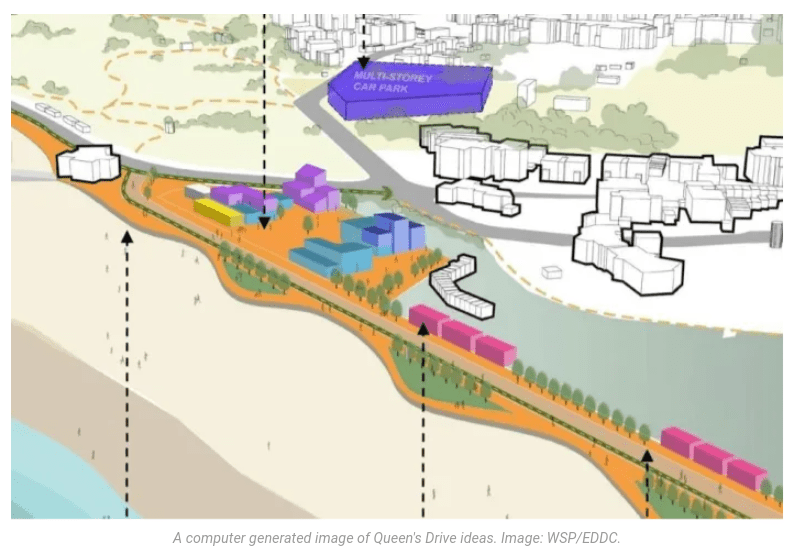
 East Devon Watch