
- Agricultural storage building
 Curlew Farm Trinity Hill Road Combpyne Axminster EX13 8SZRef. No: 24/2259/AGR | Validated: Fri 25 Oct 2024 | Status: Awaiting decision
 - Non-material amendment to 15/2902/MRES : Changes to the allotments to introduce steps, reduce the number of planters to improve accessibility, remove one allotment and add a picnic bench, amend access to the orchard and change the vehicular gate from a single gate to double gates. Old Park Farm Two West Clyst ExeterRef. No: 24/2258/NMA | Validated: Fri 25 Oct 2024 | Status: Awaiting decision
- Discharge of condition 7 for 24/0331/MFUL : Condition 7 (Ground investigation) Land North And South Of Station Road, Warwick Close, Wells Avenue, Land Opposite Greenacres Close And Land Adjacent To Ottery Road Near Sidmouth Junction Sewage Pumping Station FenitonRef. No: 24/2257/DOC | Validated: Fri 25 Oct 2024 | Status: Awaiting decision
- Proposed garage conversion and first floor extension above. 6 Glenview Honiton Devon EX14 2NTRef. No: 24/2256/FUL | Validated: Fri 25 Oct 2024 | Status: Awaiting decision
- Discharge of conditions for 23/0842/FUL: Condition 3 (Schedule of Materials (External Finishes), Conditon 5 (Schedule of Materials (Windows & Doors), Condition 6 (Schedule of Materials (Rooflights), Condition 7 (Schedule of Materials (Rainwater Goods), Condition 13 (CEMP), Condition 15 (Natural England Bat License), Condition 17 (Drainage Statement) and Condition 18 (Levels) Land And Buildings At Barton Farm Village Way AylesbeareRef. No: 24/2254/DOC | Validated: Fri 25 Oct 2024 | Status: Awaiting decision
- T1, Beech : reduce canopy height to leave a 5m minimum high tree, MDC 80mm. Reduce canopy spread to leave an even and balanced shape. 4 Bretteville Close Woodbury Exeter EX5 1JQRef. No: 24/2246/TRE | Validated: Fri 25 Oct 2024 | Status: Awaiting decision
- Non-material amendment to 17/1019/MOUT: Amend the wording of Condition 5 (Framework Plan and Appearance Palette). Land North Of Old Tithebarn Lane Clyst HonitonRef. No: 24/2243/NMA | Validated: Thu 24 Oct 2024 | Status: Unknown
- Minor amendment for 14/0330/MOUT : Add upper limit parameters for the employment and commercial/community land Goodmores Farm Hulham Road Exmouth EX8 5BARef. No: 24/2242/NMA | Validated: Thu 24 Oct 2024 | Status: Awaiting decision
- Alterations to existing garage roof 3 Inner Broomfield London Road Rockbeare Exeter EX5 2EBRef. No: 24/2239/FUL | Validated: Wed 23 Oct 2024 | Status: Awaiting decision
- Yew: reduce the crown by approximately 2.5m with maximum diameter cuts of less than 70mm to achieve less than a 30% crown reduction; maintain a clearance of 0.5m from telecommunications line and 0.8m around power cable. May House Musbury Axminster EX13 8ARRef. No: 24/2238/TRE | Validated: Wed 23 Oct 2024 | Status: Awaiting decision
- Removal of existing patio door to existing bedroom, infilling of opening to form a window aperture with masonry construction, and installation of new matching window. Amberwood Nursing Home 231 Exeter Road Exmouth EX8 3EDRef. No: 24/2237/FUL | Validated: Wed 23 Oct 2024 | Status: Awaiting decision
- Holm Oak: fell. 16 Old Home Farm Rousdon Lyme Regis DT7 3YLRef. No: 24/2240/TCA | Validated: Wed 23 Oct 2024 | Status: Awaiting decision
- Proposed extension and first floor conversion to garage building Old School House School Lane Exmouth EX8 3APRef. No: 24/2228/FUL | Validated: Tue 22 Oct 2024 | Status: Awaiting decision
- Discharge of Condition for 24/1645/FUL: Condition 4 (cladding) and Condition 5 (roof tile) 10 Bishop Court Colyton EX24 6RQRef. No: 24/2231/DOC | Validated: Wed 23 Oct 2024 | Status: Unknown
- Discharge of Condition for 24/1401/FUL: Condition 4 (tree protection) Little Acre Woodbury Lane Axminster Devon EX13 5TLRef. No: 24/2230/DOC | Validated: Tue 22 Oct 2024 | Status: Unknown
- Portal frame dual pitch agricultural building Kingsdown Farm Salcombe Regis Sidmouth EX10 0PDRef. No: 24/2221/AGR | Validated: Mon 21 Oct 2024 | Status: Awaiting decision
- Discharge of condition for 24/0139/FUL: Condition 5 (lighting). Kenwood Woodhouse Hill Uplyme DT7 3SLRef. No: 24/2213/DOC | Validated: Mon 21 Oct 2024 | Status: Awaiting decision
- Discharge of conditions for 08/2365/LBC : Condition 5 (roofing materials) Starrs Dairy Sowton Exeter EX5 2AERef. No: 24/2232/DOC | Validated: Mon 21 Oct 2024 | Status: Awaiting decision
- Discharge of condition for 24/0230/LBC: Condition3 (Archaeology) Halls Farm Metcombe Ottery St Mary EX11 1SSRef. No: 24/2219/DOC | Validated: Mon 21 Oct 2024 | Status: Awaiting decision
- Minor amendment for application 23/1762/FUL: Alteration to approved style of roof and dimensions of porch 4 Pikes Cottages Church Road Colaton Raleigh Sidmouth EX10 0LLRef. No: 24/2214/NMA | Validated: Mon 21 Oct 2024 | Status: Awaiting decision
- Pyrocantha hedge – hard trim.5 Kingsholme Colyford EX24 6RJRef. No: 24/2218/TCA | Validated: Mon 21 Oct 2024 | Status: Withdrawn
- Discharge of Condition for 24/1095/FUL: Condition 3 (Tree Protection) and Condition 4 (Surface Water/Drainage) Hillcrest Woodhouse Hill Uplyme Lyme Regis DT7 3SLRef. No: 24/2216/DOC | Validated: Mon 21 Oct 2024 | Status: Awaiting decision
- Ash 200 – fell. Ash 310 – fell. Shute Barton Shute Axminster EX13 7PTRef. No: 24/2207/TRE | Validated: Mon 21 Oct 2024 | Status: Awaiting decision
- Discharge of condition for 24/0271/LBC: Condition 3 Barn East Of Hooperhayne Colyton EX24 6SHRef. No: 24/2209/DOC | Validated: Mon 21 Oct 2024 | Status: Awaiting decision
- Walnut – prune back the tips of 3 branches by approximately 1m to give adequate clearance to the building. Remove the growth from the wound of propped branch. Great Seaside Farm Branscombe Seaton EX12 3DPRef. No: 24/2211/TRE | Validated: Mon 21 Oct 2024 | Status: Awaiting decision
- Roofing over livestock yard phase 2 Thorndene Farway Colyton EX24 6DGRef. No: 24/2172/FUL | Validated: Wed 23 Oct 2024 | Status: Awaiting decision
- First floor extension to the rear of the property. 24 Oakbeer Orchard Cranbrook Exeter EX5 7BLRef. No: 24/2152/FUL | Validated: Mon 21 Oct 2024 | Status: Awaiting decision
- Temporary agricultural workers dwelling Land At HarpfordRef. No: 24/2123/FUL | Validated: Mon 21 Oct 2024 | Status: Awaiting decision
- Demolition of existing house and outbuildings; construction of three new sheltered accommodation residential units (Almshouses) 4 East Budleigh Road Budleigh Salterton EX9 6HFRef. No: 24/2113/FUL | Validated: Wed 23 Oct 2024 | Status: Awaiting decision
- Roofing over livestock yard phase 1 Thorndene Farway Devon EX24 6DGRef. No: 24/2108/FUL | Validated: Wed 23 Oct 2024 | Status: Awaiting decision
- Proposed floodlighting scheme to the approved MUGA Ingrams Sports Pavilion London Road Cranbrook Exeter Devon EX5 7LFRef. No: 24/2112/FUL | Validated: Tue 22 Oct 2024 | Status: Awaiting decision
- Construction of a part above ground fish pond, with pergola over and adjacent bike store housing pond filter equipment; Construction of 2no. driveway gate pillars 47 Clyst Valley Road Clyst St Mary Devon EX5 1DDRef. No: 24/2099/FUL | Validated: Fri 25 Oct 2024 | Status: Awaiting decision
- Convert bedroom 5 into a shower room and hall with additional partition wall; rooflight on rear elevation and extraction fan on rear 10 Bicton Place Exmouth EX8 2SURef. No: 24/2098/LBC | Validated: Fri 25 Oct 2024 | Status: Awaiting decision
- Alterations and extensions to the existing property to include a single storey extension (to the west) with terrace over; a two storey extension (to the north); a two storey extension (to the south); and the replacement of the pitched garage roof with a flat roof. 7 Northview Road Budleigh Salterton EX9 6BZRef. No: 24/2092/FUL | Validated: Wed 23 Oct 2024 | Status: Awaiting decision
- A storage shed to be used for agricultural machinery and fodder. Barn Hayes Field HuxhamRef. No: 24/2073/FUL | Validated: Tue 22 Oct 2024 | Status: Awaiting decision
- Change of use from sheltered housing (Class C2) to form 9 No. apartments (Class C3) with associated operational development comprising: new fenestration; addition of 2 No. external balconies to 2nd and 3rd floor levels; re-application of external render; and external landscaping works. Abbeyfield Court Station Road Sidmouth EX10 8NWRef. No: 24/2023/FUL | Validated: Tue 22 Oct 2024 | Status: Awaiting decision
- Single storey rear extension / side extension, first floor side extension, outbuilding, garage and parking space, roof lights to the existing roof space. 13 Park Way Exmouth EX8 3QGRef. No: 24/1988/FUL | Validated: Wed 23 Oct 2024 | Status: Awaiting decision
- Installation externally of 3no. non-illuminated signs Hartgrove Hill Farm Trinity Hill Road Musbury Axminster EX13 8TBRef. No: 24/1952/ADV | Validated: Mon 21 Oct 2024 | Status: Awaiting decision
- Single storey rear extension to the south elevation Oaklands Gerway Lane Ottery St Mary EX11 1PWRef. No: 24/1918/FUL | Validated: Fri 25 Oct 2024 | Status: Awaiting decision
- Proposed construction of detached garage Virtues Vineyard Southleigh EX24 6JARef. No: 24/1727/FUL | Validated: Tue 22 Oct 2024 | Status: Awaiting decision
- Second floor extension to the rear of the existing property 6 Henrietta Place Exmouth EX8 1LDRef. No: 24/1681/FUL | Validated: Mon 21 Oct 2024 | Status: Awaiting decision
- Demolition of existing garage, construction of side extension to provide garage and mezzanine accommodation Fairview Littledown Lane Newton Poppleford Devon EX10 0BGRef. No: 24/0622/FUL | Validated: Fri 25 Oct 2024 | Status: Awaiting decision
Monthly Archives: November 2024
Planning rules have failed to link new homes to public transport, report finds
A decade of planning rules designed to create housing connected to public transport routes has achieved nothing, a report has found, with millions of people in new homes still dependent on cars to get to local amenities.
Peter Walker www.theguardian.com
The study by the Royal Town Planning Institute (RTPI) looked at more than 1.6m homes given planning permission in England from 2012 to 2021, finding that while major housing developments are supposed to be designed around transport infrastructure, this has not happened.
On average, across all the developments studied, it was twice as fast to reach the nearest hospital by car than public transport.
For other amenities such as schools, GPs, employment centres and town centres, car travel was 1.5 times as quick. There had been virtually no progress across the decade, the study found.
The National Planning Policy Framework (NPPF), which governs planning decisions across England, is explicit that new developments should be located to prioritise easy use of public transport, or walking and cycling, with sites chosen to help this.
The RTPI is calling on ministers to look at what changes can be made as part of the consultation process about the revised NPPF, which aims to create 1.5m new homes during this parliament.
The report, compiled with data from LandTech, a property information company, found that cycling came closest in convenience to a car, taking on average 1.3 times as long to reach such destinations, while noting that this was not an option available to everyone.
While there were significant differences between regions, even in London it still took on average 1.3 times as long to reach major destinations by public transport than in a car.
Across England as a whole, 96% of the new homes studied were no more than 20 minutes’ drive from a town centre, but this was only 66% for a 20-minute trip on public transport and 47% for a walk of the same distance.
Victoria Hills, RTPI chief executive, said: “It is essential that planning policies truly serve communities by creating environments that support health and sustainability. Planning should work for the people it impacts, ensuring communities flourish in healthy, well-connected places.
“To avoid repeating the mistakes of the past decade, the new NPPF must prioritise housing development in areas that reduce car reliance, bridge regional accessibility gaps, and support genuinely sustainable, vibrant communities. The time for policymakers to act is now.”
Among its recommendations, the report suggests more investment in public transport; seeking to release development sites closer to existing transport infrastructure such as train stations; and disincentives for driving such as higher parking fees.
The proposed new NPPF has already been criticised by some councils for imposing targets for new housing, which they say are completely unrealistic for their area, both in terms of what can be built and, in some cases, the amount of homes needed.
A Ministry of Housing, Communities and Local Government spokesperson said: “New homes must serve the needs of their communities and through our proposed NPPF we will create more opportunities for walking, cycling and public transport.
“Alongside our planning reforms we will work closely with councils, developers and local communities to deliver more sustainable transport links and infrastructure to support new housing.”
Cranbrook – Construction firm ordered to remove sales centre

Cranbrook sign (image courtesy: Daniel Clark/LDRS)
EDDC says it was put up without planning permission
A construction firm in an East Devon town is being asked to remove a building it installed.
Taylor Wimpey’s sales centre, which was recently installed in Cranbrook town centre has been given a notice that requires the permanent removal of the building.
The enforcement notice requires that the building is removed and that the site is returned to its former condition within 3 months.
Cllr Todd Olive, East Devon District Council’s Portfolio Holder for Strategic Planning, said:
“We are acutely aware that the residents of Cranbrook want to see a vibrant town centre that includes a range of facilities. We also know that residents want to see a better balance between the emphasis placed on house sales by the developers and the provision of community infrastructure.
We want to see further shops coming forward at this prominent high street location. It is deeply frustrating that Taylor Wimpey chose to go ahead with the installation of their sales centre that will block this objective.
These works were undertaken without planning permission. The developers were advised before going ahead that planning permission was required and that the proposed site would be unsuitable.
The Council acted swiftly to write to the developer requesting that the building and associated flags and signage were removed by the 25th October. This was not complied with and the issuing of the enforcement notice represents the beginning of formal action.
The future of Cranbrook town centre is of critical importance for the success of the growing community. The Cranbrook Plan anticipates a vibrant, self-supporting town centre that includes a range of uses and activities to draw people in. With the imminent completion of the supermarket, high street shops and children’s nursery, the town centre is now starting to take shape. The Council will also shortly be considering a masterplan for the ongoing development to the town centre.”
Chairman of Cranbrook Town Council, Cllr Les Bayliss, added:
“Cranbrook Town Council agrees with East Devon District Council and supports the action that they have taken.”
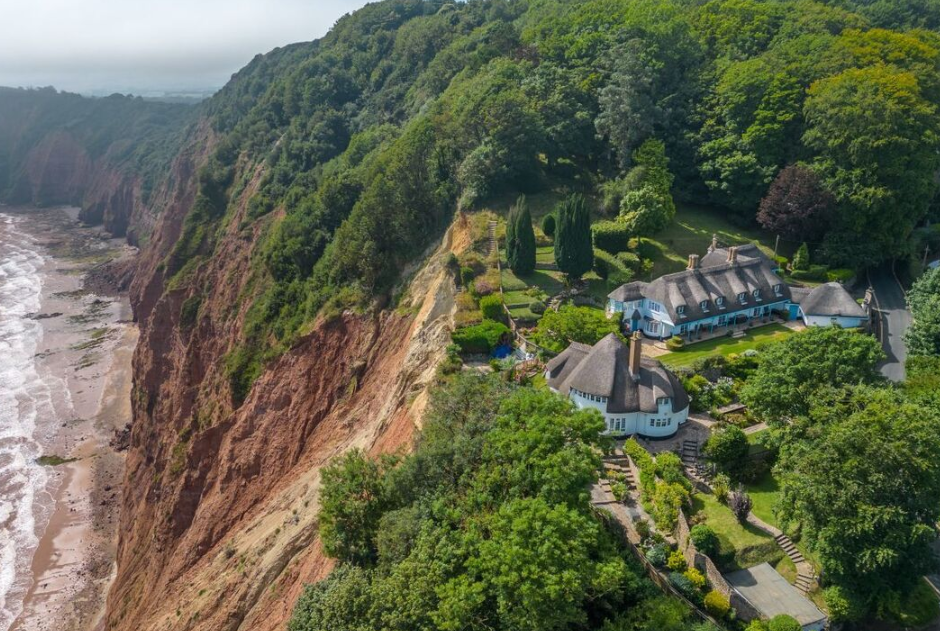
Dramatic photos of the Sidmouth cliff fall at the end of last week appear in National Newspapers today
Thousands of tonnes of earth crashed to the ground at the end of last week just under Peak Hill leaving one of Sidmouth’s magnificent properties teetering on the brink.
Cliff path diversions have been put in place.
Only now are photographs emerging today in National Newspapers showing the true scale of the fall.
‘It won’t wash’: Environment secretary’s bid to cosy up to water pollution protesters backfires
Is Labour, at heart, an urban party? – Owl
The environment secretary has caused a backlash among groups demanding an end to the pollution of rivers by water companies after a direct appeal ahead of a demonstration backfired. The intervention by Steve Reed, who wrote to activists saying they could trust him with forging change within the water industry, was met with anger by campaigners who said he was avoiding the key issue – that water privatisation has failed.
Sandra Laville www.theguardian.com
In his letter to members from the 130 groups taking part in the March for Clean Water on Sunday, who include Surfers Against Sewage, the GMB union, the Wildlife Trusts and the RSPB, Reed said he shared their anger about record levels of sewage pollution. He wished them a well-attended march and said he looked forward to working with them towards a shared ambition of cleaning up rivers, lakes and seas for good.
But since Labour took power, Reed has ruled out what many who will take to the streets are calling for: the return of the water industry to some kind of public ownership. In making the decision to rule out public ownership, using existing powers available to him under the special administration regime, he was accused of relying on flawed analysis paid for by water companies.
In the letter, distributed by the march organisers River Action, Reed said the independent commission he set up, along with the water (special measures) bill going through parliament, would start the change needed in the sector.
Some campaigners criticised Reed’s attempt to claim allegiance, saying he had failed to address deep-rooted problems in the privatised water industry in England, where ownership has become concentrated in a web of private equity, foreign investment and pension funds.
Becky Malby, of Ilkley Clean River Group, said Reed should use his existing powers to take failing water companies into special administration. She said the public would not tolerate paying increasingly large bills to companies that remained under criminal investigation by the Environment Agency for suspected illegal sewage dumping and the financial regulator Ofwat.
Ash Smith, of Windrush against Sewage pollution, who is scheduled to speak on Sunday, said attempts to win over the marchers would not wash. “Steve Reed is trying to own the march by supporting clean water,” said Smith. “But there is massive public support to end the scandal that privatisation has brought. His refusal to face the facts and to rely on water company-funded fiction about costs is setting captive bill payers up to bail out private equity and keep the unforgivable exploitation going on for another five years.”
River Action said it had concerns about Reed’s repeated references to the need to promote economic growth within the sector. “Our polluted water bodies do not need economic growth,” a spokesperson said. “They need effective and uncompromising environmental protection and regulation. As we can see with recent developments at Thames Water, the financial model of the water industry is unravelling fast and in some cases broken beyond repair.”
Matt Staniek, of Save Windermere, said Reed’s intervention was a weak attempt to pacify public anger. “The government is clearly failing to enforce existing laws and continues to allow private equity to profit at the expense of bill payers and the environment,” he said. “They are proposing measures that fail to address the core issue – that privatisation has failed.”
A Defra spokesperson said: “We share the public’s concern about the health of our waterways, and it is encouraging to see so many people actively engaged in this important cause. This government is committed to cleaning up our rivers, lakes and seas and has wasted no time in acting.”
The spokesperson added that the new bill would hold companies to account and ensure they met the high standards the public rightfully expected. “This includes strengthening regulation to ensure water bosses face personal criminal liability for lawbreaking, and giving the water regulator new powers to ban the payment of bonuses if environmental standards are not met,” they said.
Value for Money Tsar linked to string of overspends
Owl – speechless!
The government’s new Value for Money chief has headed up several big projects that went massively over-budget.
Jennifer McKiernan www.bbc.co.uk
David Goldstone has previously worked as a top executive on the London Olympics, Parliament’s restoration and HS2 high speed rail.
He will now head up the government’s new Office for Value for Money (OfVM), external, advising Chancellor Rachel Reeves on “how to root out waste and inefficiency”, according to the Treasury.
Downing Street defended his appointment, saying Mr Goldstone is a “highly experienced public sector leader” with a “track record of working on complex high-value programmes”.
Asked if he represented value for money, a Number 10 spokeswoman said “yes”.
Reeves announced his appointment saying it’s “vital that we are driving efficiency and reducing wasteful spending” and his role would “help us realise the benefits from every pound of public spending”.
However, responding to the Budget on Wednesday, Reform UK leader and Clacton MP Nigel Farage said Mr Goldstone had “served for many years on the board of HS2, which I would suggest is the very opposite of value for money”.
The resurrected high speed rail project, HS2, had an initial budget of £38bn in 2009, but is now expected to cost at least double that.
Mr Goldstone’s LinkedIn page lists a position on the HS2 board from January to June 2012 and again from 2024, where he is a Treasury nominee, although he does not appear to have been in post in the intervening years.
He was the finance and programme director of the Government Olympic Executive, delivering the 2012 London Olympics that cost three times as much as expected, coming in at £9bn.
Mr Goldstone was also chief executive of the Houses of Parliament Restoration and Renewal project and was mauled by MPs last year for receiving a £168,000 bonus, external, despite delays costing about £100m a year in maintenance costs.
Speaking to LBC, Conservative leadership hopeful Kemi Badenoch said there should not be a need for an office to determine value for money.
She said: “We are constantly trying to solve problems with more quangos, more bureaucrats, more politicians. This is not how you deliver growth.
“We should be able to determine value for money within the civil service itself.
“If they cannot do that, then I have no confidence that an Office for Value for Money will know how to do that either – that expertise should already be in the Treasury.”
The OfVM will have a team of 20 civil servants working under Mr Goldstone, who is expected to stay in post for one year, with the “possibility of extension”, according to the Treasury.
Mr Goldstone’s salary is understood to be about £950 per day for an average of one day a week’s work – a total salary of roughly £50,000 a year.
When it was put to Treasury minister Darren Jones that the OfVM salary would be worth £250,000 if he were full-time – significantly more than the prime minister is paid – he told LBC the “rate of return for the improvements… will be far, far greater”.
Jones added: “We can’t expect people to work for free.
“Actually, the day rate for David is, on a benchmark basis, competitive.”
The Treasury has been contacted for comment.
Planning applicatons validated by EDDC for week beginning 14 October
- Modern steel portal frame building providing clear span space for storage of hay, machinery, and equipment. The Oaks Aylesbeare Exeter EX5 2DERef. No: 24/2212/AGR | Validated: Fri 18 Oct 2024 | Status: Awaiting decision
- T1, Copper Beech: crown thinning, removing up to 20% of the foliar area to allow dappled light through the canopy; to also reduce extended vertical leaders to tie in with the main canopy, as per annotated photograph attached, removing up to 3m branch ends and making target pruning cuts of up to 40mm. The Gables West Hill Road West Hill Ottery St Mary EX11 1UZRef. No: 24/2203/TRE | Validated: Thu 17 Oct 2024 | Status: Awaiting decision
- Discharge of Condition for 17/1019/MOUT: Condition 35 (Roads, Sewers, Drains, Surface Water etc) in relation to Phase 3 (ref. 22/2000/MRES) Land North Of Old Tithebarn Lane Clyst HonitonRef. No: 24/2198/DOC | Validated: Fri 18 Oct 2024 | Status: Awaiting decision
- County matter application for Variation of Conditions 1, 22 and 24 of planning permission DCC/4206/2020 (Application for determination of conditions under first periodic review) to extend the end date of mineral extraction and restoration and submission dates for restoration and aftercare schemes.Uplyme Quarry (Shapwick Quarry) Uplyme Lyme Regis DT7 3SPRef. No: 24/2195/CM | Validated: Wed 16 Oct 2024 | Status: Awaiting decision
- Monkey Puzzle tree – fell and remove. Rosehill 30 West Hill Budleigh Salterton Devon EX9 6BURef. No: 24/2173/TCA | Validated: Thu 17 Oct 2024 | Status: Awaiting decision
- Discharge of condition for 24/0816/LBC: Condition 4(Fireplace), Condition 5 (Repairs), Condition 6 (Windows & Doors) and Condition 7 (Doors) Barton House Church Hill Otterton Devon EX9 7HURef. No: 24/2182/DOC | Validated: Thu 17 Oct 2024 | Status: Awaiting decision
- T1, Oak: 1.5-2m tip reduction to the west mid canopy limb. T2, Ash: fell. T3, Hornbeam: 1m crown reduction. T4, Oak: 1.5-2m crown reduction on the west. Cranford Beeches Harcombe Road Axminster Devon EX13 5TBRef. No: 24/2180/TRE | Validated: Thu 17 Oct 2024 | Status: Awaiting decision
- Lime – re-pollard to previous pruning points. The Coach House The Croft New Road Beer EX12 3HSRef. No: 24/2192/TCA | Validated: Thu 17 Oct 2024 | Status: Awaiting decision
- T1, Oak : 10-15% crown reduction via thinning. Maximum diameter of cuts, 60-70mm. Hamilton Lodge Colyford Road Seaton Devon EX12 2SNRef. No: 24/2176/TRE | Validated: Thu 17 Oct 2024 | Status: Awaiting decision
- Certificate of Proposed Lawful Development to alter the existing external opening and form new opening and create internal shower room.Maryland 2A Mayfield Drive Exmouth EX8 2HDRef. No: 24/2178/CPL | Validated: Wed 16 Oct 2024 | Status: Awaiting decision
- Construction of a detached triple garage with dependent relative’s accommodation above Apple Tree Farm Broadhembury Honiton EX14 3JZRef. No: 24/2177/FUL | Validated: Wed 16 Oct 2024 | Status: Awaiting decision
- Proposed single storey extension and alterations to dwelling and conversion of outbuilding to form annexe Summers Barn Payhembury Honiton EX14 3HJRef. No: 24/2170/FUL | Validated: Wed 16 Oct 2024 | Status: Awaiting decision
- Rear extension to existing annex, glazing to external walkway between annexe and main dwelling; repairs and protective measures have been proposed including, replacing concrete render with lime render, replacing gypsum plaster with lime plaster, thermal improvements, stair remodelling and chimney and roof structure repairs; flood protection measures including a raised boundary edge, door replacements and improvements, drainage amendments and drainage channels Ebford Cottage Lower Lane Ebford Exeter EX3 0QTRef. No: 24/2189/LBC | Validated: Wed 16 Oct 2024 | Status: Awaiting decision
- Rear extension to existing annex, glazing to external walkway between annexe and main dwelling; replacing concrete render with lime render, and flood protection measures Ebford Cottage Lower Lane Ebford Exeter EX3 0QTRef. No: 24/2188/FUL | Validated: Wed 16 Oct 2024 | Status: Awaiting decision
- Minor amendment for application 24/1256/FUL: Alteration to fenestration 5 Oaktree Close Exmouth EX8 4QLRef. No: 24/2183/NMA | Validated: Wed 16 Oct 2024 | Status: Awaiting decision
- T1, Oak: reduce lateral spread via thinning by up to 3m, maximum diameter of cut (MDC) 75mm; crown lift to 3m above ground level, MDC 50mm; remove major hazardous deadwood. T2, Western Red Cedar: crown reduce by, height 3m, MDC 50mm; west aspect by 2.5m, MDC 50mm; south aspect by 2.5m, MDC 2 @ 75mm, rest @ 25mm; east aspect by 1.5m, MDC 50mm and north aspect by 2.5m, MDC 50mm; crown lift to 3m above ground level, pruning low limbs back to source on parent stems, MDC 75mm. 68 Clyst Valley Road Clyst St Mary Devon EX5 1DERef. No: 24/2181/TRE | Validated: Wed 16 Oct 2024 | Status: Awaiting decision
- Two storey side extension and single story front extension following demolition of detached garage and rear conservatory. 25 Hazeldene Gardens Exmouth EX8 3JARef. No: 24/2179/FUL | Validated: Wed 16 Oct 2024 | Status: Awaiting decision
- County matter application for Removal of Condition 28 and Variation of Condition 29 of planning permission DCC/4205/2020 (Extension of Uplyme Quarry) to amend the submission date of the Phase 1 Restoration Scheme.Uplyme Quarry (Shapwick Quarry) Uplyme Lyme Regis DT7 3SPRef. No: 24/2196/CM | Validated: Wed 16 Oct 2024 | Status: Awaiting decision
- Prior notification for a proposed change of use from agricultural shed to class C1 (guesthouse) North Mill Dairy Membury Axminster EX13 7TNRef. No: 24/2187/PDR | Validated: Wed 16 Oct 2024 | Status: Awaiting decision
- Certificate of Lawfulness to demolish the former dairy building and return the area to garden curtilageSite Of Till House London Road BroadclystRef. No: 24/2185/CPL | Validated: Wed 16 Oct 2024 | Status: Awaiting decision
- T1, Sycamore: removal. T2, Holly: reduce by 1200mm. T3, Hawthorn: removal. T4, Acacia: fell, leaving 1m tall stump. 11 Cranford Sidmouth Devon EX10 8UTRef. No: 24/2166/TCA | Validated: Tue 15 Oct 2024 | Status: Awaiting decision
- Replacement of existing garage Marley Hayes Cottage Marley Hayes Exmouth EX8 5DHRef. No: 24/2159/FUL | Validated: Tue 15 Oct 2024 | Status: Awaiting decision
- New replacement single storey side extension and new balcony terrace with alterations to fenestration. Lyonesse 12 Fore Street Hill Budleigh Salterton EX9 6PERef. No: 24/2167/FUL | Validated: Tue 15 Oct 2024 | Status: Awaiting decision
- Rear single storey extension to replace existing extension and conservatory. 40 Primley Road Sidmouth EX10 9LFRef. No: 24/2162/FUL | Validated: Tue 15 Oct 2024 | Status: Awaiting decision
- Lawful development certificate for construction of outbuilding (Permitted Development Class E)10 Marine Parade Budleigh Salterton EX9 6NSRef. No: 24/2164/CPL | Validated: Tue 15 Oct 2024 | Status: Awaiting decision
- Discharge of Conditions for 21/1348/FUL: Condition 3 (Materials), Condition 4 (Landscaping) 28 Cranford Avenue Exmouth Devon EX8 2PZRef. No: 24/2160/DOC | Validated: Tue 15 Oct 2024 | Status: Awaiting decision
- EIA screening opinion for the construction of a 100MW/250MWh Battery Energy Storage System (BESS) and associated infrastructure Land East Of Substation (Exeter Battery Storage) BroadclystRef. No: 24/0007/EIA | Validated: Tue 15 Oct 2024 | Status: Awaiting decision
- Discharge of condition for 23/2349/FUL: Condition 3 (Material samples), Condition 6 (Landscaping scheme) and Condition 16 (sound insulation). Lower Stone Cottage Blackhorse Devon EX5 2APRef. No: 24/2165/DOC | Validated: Wed 16 Oct 2024 | Status: Awaiting decision
- 1, Ash: fell (Ash die-back). 2, Ash: fell (Ash die-back). 3, Ash: fell (Ash die-back). 4, Oak: fell. Rooks Acre Rousdon Devon DT7 3XRRef. No: 24/2158/TCA | Validated: Wed 16 Oct 2024 | Status: Awaiting decision
- Discharge of conditions for 22/2631/FUL: Condition 1 (Time), Condition 2 (Plans condition), Condition 3 (Written scheme of investigation), Condition 4 (post investigation assessment), Condition 5 (schedule) Land Rear Of 5 Flightway Business Park Dunkeswell EX14 4RDRef. No: 24/2149/DOC | Validated: Mon 14 Oct 2024 | Status: Awaiting decision
- T1: Variegated Maple – remove branches that have reverted to being unvariegated. Reduce by approximately 1-1.5m to clear overhanging branches from neighbours garden and shape. 3 Watering Court Fore Street Otterton Devon EX9 7HBRef. No: 24/2155/TCA | Validated: Mon 14 Oct 2024 | Status: Awaiting decision
- T1, Cherry : fell – unwanted self sown seedling. T2, Bay : reduce by approximately 1m and trim side growth – continued management. 22 Woodlands Budleigh Salterton EX9 6ATRef. No: 24/2145/TRE | Validated: Mon 14 Oct 2024 | Status: Awaiting decision
- Construction of a three bay garage and first floor annex extension with balcony. Four Winds Ebford Exeter EX3 0PARef. No: 24/2135/FUL | Validated: Fri 18 Oct 2024 | Status: Awaiting decision
- Discharge of condition for 24/0604/FUL: Condition 4 (Materials) Upham Farm Farringdon Exeter EX5 2HZRef. No: 24/2137/DOC | Validated: Mon 14 Oct 2024 | Status: Unknown
- Discharge of condition for 20/1001/MOUT: Condition 14 (Works to be carried out) Winslade Park Clyst St Mary EX5 1DARef. No: 24/2141/DOC | Validated: Mon 14 Oct 2024 | Status: Awaiting decision
- Erection of porch to front elevation of property 8 Grindle Way Clyst St Mary EX5 1DFRef. No: 24/2131/FUL | Validated: Wed 16 Oct 2024 | Status: Awaiting decision
- T1: Birch – lift lower branches to give 2.5m clearance over footpath and reduce crown by approximately 0.5m to a suitable pruning position. T2: Oleaster – crown reduce by 1.5m and re-shape to leave a natural form. G1: x2 Birch – reduce height by approximately 2m and re-shape. G2: row of Bay – reduce overhang by 1m and re-shape. T3: Bay – reduce by approximately 5m and re-shape. T4: Corkscrew Willow (dead) – fell. T5: Liquidambar – lift to 2m and shorten long branches on crown by 0.5m to a suitable pruning position. 3 Station Road Budleigh Salterton EX9 6RJRef. No: 24/2119/TCA | Validated: Thu 17 Oct 2024 | Status: Awaiting decision
- Construction of two storey workshop/garage Sunningdale Buckerell Devon EX14 3ERRef. No: 24/2111/FUL | Validated: Tue 15 Oct 2024 | Status: Awaiting decision
- Copper Beech – crown reduction to the east, south and west aspects by 1 to 1.5m. Crown reduction to the north aspect (where the tree is unbalanced) by 2 to 2.5m. Marycourt Convent Road Sidmouth Devon EX10 8RERef. No: 24/2104/TCA | Validated: Mon 14 Oct 2024 | Status: Awaiting decision
- Variation of condition no.2 (approved plans) and confirmation of condition no.4, (self-build exemption) on planning permission 24/1485/FUL (Demolition of existing dwelling, proposed construction of 1no. replacement dwelling) – changes to design and proof that property is a self-build The Oaks Aylesbeare EX5 2DERef. No: 24/2100/VAR | Validated: Wed 16 Oct 2024 | Status: Awaiting decision
- Change of use of land for the siting of three holiday cabins and conversion of existing forestry building to provide for holiday use, creation of parking area, bat building, bin storage and landscaping. Land East Side Of Oak Hill East BudleighRef. No: 24/2091/FUL | Validated: Tue 15 Oct 2024 | Status: Awaiting decision
- Two storey extension on the west elevation, single storey extension on the south elevation, alteration to existing dormer on the north elevation and roof alteration to facilitate a first floor balcony on the south elevation. 6 Southdown Close Beer Seaton EX12 3ANRef. No: 24/2087/FUL | Validated: Fri 18 Oct 2024 | Status: Awaiting decision
- Alterations to roof, fenestration and dormers, installation of solar panels and cladding. Offwell Barton Offwell Honiton EX14 9SARef. No: 24/2083/FUL | Validated: Fri 18 Oct 2024 | Status: Awaiting decision
- Variation to Condition 2 (approved plans) and removal of condition 4 (cladding materials) on Planning Permission 20/0769/FUL (Construction of single storey front, side and rear extension, front and rear dormer window with terrace and front porch. Provision of cladding to main house) changes to roofline and external materials. Woodlands Withen Lane Farringdon Exeter EX5 2JHRef. No: 24/2082/VAR | Validated: Mon 14 Oct 2024 | Status: Awaiting decision
- The installation of 50MW battery clusters with ancillary equipment, including inverter units, 132kV transformer compound, site welfare and switch room, and two water tanks to provide standby, emergency electricity to support and facilitate renewable and low carbon energy projects Land To The West Of Wareham Road Scouse Farm Blackpool Corner Axminster EX13 5UERef. No: 24/2067/MFUL | Validated: Thu 17 Oct 2024 | Status: Awaiting decision
- T2, Weeping Lawson Cypress: removal of lowest limb extending across the boundary to 12 Lilley Walk. 21 Church Hill Honiton EX14 2DBRef. No: 24/2066/TRE | Validated: Mon 14 Oct 2024 | Status: Awaiting decision
- Replace modern windows : 1no. window and 1no. dormer window on west elevation; 1no. window and 1no. dormer window on east elevation and 1no. window on north elevation. Flat 7 Green Gables All Saints Road Sidmouth EX10 8EURef. No: 24/2064/LBC | Validated: Mon 14 Oct 2024 | Status: Awaiting decision
- Variation to the design of previously approved bungalow under approval reference number 22/0547/FUL 70 Malden Road Sidmouth EX10 9NARef. No: 24/2052/FUL | Validated: Mon 14 Oct 2024 | Status: Awaiting decision
- Construction of a shed at the rear of the United Reform Church for the storage of food/items belonging to Sid Valley Food Bank United Reformed Church Primley Road Sidmouth EX10 9LBRef. No: 24/2044/FUL | Validated: Tue 15 Oct 2024 | Status: Awaiting decision
- Proposal to remove agricultural occupation condition on 90/P0535. (Agricultural Dwelling) Sunnyfield Bungalow Yarcombe Honiton EX14 9NBRef. No: 24/2040/VAR | Validated: Wed 16 Oct 2024 | Status: Awaiting decision
- Certificate of Proposed Lawful Development for the installation of PV array.Abbeyfield Society Marjorie Baker House Vicarage Street Colyton EX24 6LJRef. No: 24/1965/CPL | Validated: Thu 17 Oct 2024 | Status: Awaiting decision
- New lighting to existing footbridge and footpath. Exmouth Community College Gipsy Lane Exmouth Devon EX8 3AFRef. No: 24/1910/FUL | Validated: Fri 18 Oct 2024 | Status: Awaiting decision
- Proposal to renew rear pitched roof with cement fibre slates 47A High Street Budleigh Salterton EX9 6LERef. No: 24/1845/FUL | Validated: Fri 18 Oct 2024 | Status: Awaiting decision
- Demolition of existing garage and erection of new oak framed garage Sowden Cottage Sowden Lane Exmouth EX8 5ADRef. No: 24/1745/FUL | Validated: Fri 18 Oct 2024 | Status: Awaiting decision
- Proposal to Install No. 3 Fascia Signs and No 4. Totem Signs Land Adjacent To Babbage Way Exeter Science Park Clyst Honiton EX5 2FNRef. No: 24/1552/ADV | Validated: Mon 14 Oct 2024 | Status: Awaiting decision
- Renovation of existing first floor dormers including replacement of windows (retrospective) 104 & 106 High Street Sidmouth EX10 8EFRef. No: 24/1214/FUL | Validated: Mon 14 Oct 2024 | Status: Awaiting decision
 East Devon Watch