Police force forking out three police chief salaries

Minister not happy about Devon & Cornwall’s “one for the price of three” police chief costs – Owl

A Home Office minister has criticised the decision to pay three people a chief constable salary of £180,000 after two force bosses were suspended, calling it “not a good use of public money.” Lord Hanson of Flint voiced his concerns at Westminster after being informed about the upheaval at the top of Devon and Cornwall Police.

Nick Lester, PA Chief Lords Reporter www.devonlive.com

The police and crime commissioner for the force area had applied to the Home Office for a special grant to cover the escalating wage bill, Parliament heard. This comes amid worries over the length of time it takes for the Independent Office for Police Conduct (IOPC) watchdog to investigate cases.

Chief Constable Will Kerr was suspended in July last year following the launch of an inquiry into “serious allegations of sexual offences” against him, which he has denied. He was replaced by Acting Chief Constable Jim Colwell, who was suspended last month pending an investigation into potential gross misconduct over claims he used his work mobile phone to exchange messages of a “personal nature”.

Former Dorset chief constable James Vaughan was recently appointed as interim boss of the Devon and Cornwall force. Amid the ongoing investigations, all three are being paid a chief constable salary.

According to The Telegraph the Chief Constable role commands a salary of roughly £180k a year, meaning it would cost at least £540,000 to pay for all three of them simultaneously, as Devon and Cornwall Police must do. The BBC has reported that former Chief Constable Will Kerr, currently under investigation, is on a salary of £197k, or £16,400 a month.

Raising the issue in the House of Lords during a question on the work of the IOPC, Tory former minister Baroness Blackwood of North Oxford said: “A situation has arisen in Devon and Cornwall where not one but two chief constables have been suspended on full pay pending investigation.

“I understand that the Police and Crime Commissioner has made an application for a special grant in order to cover the costs of full pay for three chief constables and as we have just heard the IOPC can take its time in these investigations. Can the minister say what approach he intends to take in this and similar situations going forward? “.

In response, Lord Hanson stated: “I do not have that information in front on me. I will report back to the police minister. I am not aware of the particular request from the Police and Crime Commissioner, but I will, if she will allow me, follow it up with my colleague the police minister and write to her.”

He further added: “Self-evidently having three salaries for a chief constable is not a good use of public money.” Earlier, non-affiliated peer Lord Mackenzie of Framwellgate, a former chief superintendent, expressed one of the main complaints about the IOPC was the length of time investigations take. He noted: “Clearly this is causing some concern.”

Lord Hanson continued: “It is absolutely vital that investigations are done speedily, on time, are publicly accountable and their recommendations are implemented.” He revealed that the Government would be publishing police reform plans in the New Year, which would cover a range of issues including standards and the IOPC.

A spokesperson for Police and Crime Commissioner Alison Hernandez told The Telegraph: “She’s getting hacked off with politicians stating that this is somehow her fault. We have a situation where these men were accused of improper conduct and she, a woman, has taken action, yet she is getting the blame.”
Reforming the water sector: MPs launch new inquiry

committees.parliament.uk 

The Environment, Food and Rural Affairs (EFRA) Committee is today (Thursday 19 December) launching a new inquiry, Reforming the Water Sector, to scrutinise the breadth of issues confronting the water sector. 

The inquiry comes at a time when water companies are facing strong criticism for their environmental, financial and customer satisfaction performance, and a backlash for paying out large dividends to shareholders and bonuses to company executives. 

The water sector faces important concerns such as weak resilience of water supply systems and future water security, while the UK’s water supplies are affected by a number of threats including agricultural and sewage pollution.  

MPs will run this piece of work as a long-term inquiry which will see them take evidence in the coming months on a range of issues including the financial stability of the water sector, support for vulnerable consumers, water security, sewage overflows and agricultural pollution, and emergency responses to flooding, outages and drought. 

The Committee will hold the first evidence session of this inquiry in January, where it will consider the impact of Ofwat’s final determination on how much water bills will be permitted to rise over the next five years. It will then take evidence from some of the worst performing water companies to determine what has gone wrong in the sector and how the Government can make improvements.  

This new inquiry will examine the Government’s work taking place in this area, including the progress of the Water (Special Measures) Bill, and the work of the Government’s Independent Commission into the water sector, which is expected to report in mid-2025. 

Chair comment

(The Rt Hon Mr Alistair Carmichael, Orkney & Shetland, Lib Dem) 

“Over the past few years we have seen a strong backlash to water companies’ failings. Companies have breached environmental rules over sewage discharges while paying out huge dividends to shareholders, and big bonuses to executives, even as they have taken on ever more debt.  

“In this inquiry our Committee will investigate the deep-rooted problems underlying the industry. The experience of sewage discharged into our rivers and seas, supply outages and outbreaks of contamination in domestic water supplies have all fed a deep dissatisfaction with the current performance of water companies.

“Our inquiry will delve into the complex structuring of water companies’ finances, examine the challenges of upgrading the sector’s aged infrastructure, and investigate the real impact people are feeling from increases to their water bills. 

“We need a water system that is fit for the future. The Government and the regulator Ofwat urgently need to restore public confidence in the sector.” 

Ofwat rolls over and concedes 98% of South West Water’s consumer price hike

Having proposed a 10% cut in their July draft decision!

So with one bound Susan Davy wins the jackpot! – Owl

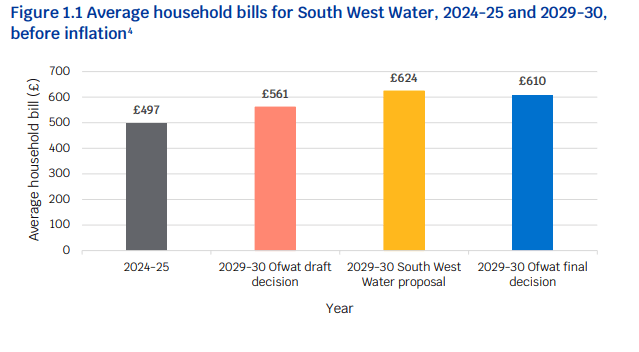
As already reported by Owl, Ofwat has greed to let South West Water (SWW) hike its annual charges to customers from an average of £497 in 2024/5 to £610 by 2029/30, an increase of  £113 or 22.7% at FY 24/5 prices (i.e. excluding inflation). 

The regulator had originally proposed a much smaller increase of £64 or 12.9% in July but has been persuaded by SWW to change their minds. The final result is that Ofwat managed to shave only £14 or 2.2% from what SWW had proposed.

Note the figures above do not take into account the £50 per household government contribution in the South West area, which will be removed for 2025-26 onwards.

Significant changes from the draft decision for South West Water are:

 • Ofwat increased their day-to-day expenditure allowances by £181 million to £2.3 billion for the South West area, and £43 million to £573 million for the Bristol area. This mainly reflects additional allowances for energy costs, business rates, bioresources growth and network reinforcement. Allowances for energy costs and business rates will be adjusted at the end of the price control period to reflect actual changes in prices. 

• Ofwat increased their allowances to invest in new infrastructure and resources, by £106 million for the South West area and £17 million for the Bristol area. This mainly reflects better evidence provided by the company for its cost estimates and the need for investment. It also follows an increase in requested expenditure for the South West area, mostly driven by increased regulatory requirements. For both areas, Ofwat increased allowances for preventing raw water deterioration. This allowance also rises for investing in water interconnectors to improve resilience in the South West area. 

• Ofwat changed some of their performance targets and financial incentive rates. This follows updated performance data for 2023-24, which Ofwat has taken into account in setting targets that are both stretching and achievable. For the South West area, Ofwat increased stretch on water quality contacts, as it is currently a relatively poor performer on this measure. 

Ofwat says that they will continue to hold South West Water to account against its targets for improved service for customers and the environment and expect it to report on its performance every year. If the company does not deliver the expected outputs and outcomes, this will be reflected in lower bills for customers. Where it delivers a better level of performance, it will be allowed to collect more, to reflect the additional benefits to customers it has created.

Download Ofwat’s overview of South West Water’s final determination

NB the Office for Environmental Protection (OEP) has just found that Ofwat was failing to comply with the law as the regulator was not cracking down hard enough on water companies. The notice served said Ofwat was “failing to take proper account of environmental law with regards to duties on sewerage companies and its duty to make enforcement orders” and “failing to exercise its duty under environmental law to make enforcement orders”. – Owl

Richard Foord:  South West Water must be held to account on pollution

This week will see MPs debating a new law concerning the water industry.

Richard Foord MP

The Water (Special Measures) Bill is designed to give water company regulators new duties and powers to address pollution, poor financial management, and poor outcomes for customers.

The Bill will enable the government and regulators to block the payment of bonuses for water company executives, enable automatic and “severe” fines, and ensure the monitoring of every sewage outlet.

I am working on an amendment alongside Liberal Democrat colleagues to strengthen the Bill, which is still too weak in places.

South West Water has been fined millions of pounds for various environmental offences in the last few years, including for causing the deaths of thousands of fish in the River Axe.

There have been illegal sewage spills and breaches of environmental permits, as well as sewer collapses.

Ofwat’s annual performance report found that South West Water reported an 80 per cent year-on-year increase in serious pollution incidents with a whopping 111 such incidents per 10,000 km of sewer, during 2023-24.

Despite the eye-watering fines and the increase in reports of pollution, South West Water’s total dividend payout for 2024 was an incredible £126.9 million.

This was higher than the previous year’s payout of £111.7 million.

SWW chief executive, Susan Davy, now earns £860,000 after collecting a £298,000 shares bonus last year.

Ms Davy had “foregone” an annual bonus which would have been worth £237,000 in cash and shares, but still picked up the £298,000 long-term performance award.

So much for water company bosses being made to give up their bonuses following poor performance!

Much of this money would be more appropriately spent on essential repairs to the sewage network.

Last week I invited Susan Davy into Parliament to explain sewage spills along our coast – and the lack of transparency in SWW’s monitoring of such pollution.

I was disappointed that Ms Davy argued against monitoring spills on volume rather than on length of time.

Environmental groups tell me that this would be an easy measure to introduce, as well as being more revealing.

I consider that water companies should be made to introduce this increased transparency.

Water companies have been permitted to dump enormous volumes of sewage because the Conservative Government did not equip the regulators – the Environment Agency and Ofwat – to do their jobs properly.

We owe it to all those who enjoy spending time in our rivers and seas – and to our precious marine life – to get this Bill right, and I am working on it!

Breaking: South West Water price hike agreed by Ofwat

Average bill for 2024/5 is £497 and will rise to £610 in 2029/30 (22.7%) to which inflation will have to be added. (Source BBC)

Watchdog warns Defra and Ofwat they could face court over sewage dumping

So could the water companies – but who will have to foot the bill for clearing up the mess from this scandalous failure? – Owl

The government, its water regulator and the Environment Agency could all be taken to court over their failure to tackle sewage dumping in England after a watchdog found failures to comply with the law.

Helena Horton www.theguardian.com 

An investigation by the Office for Environmental Protection (OEP) found Ofwat, the Department for Environment, Food and Rural Affairs (Defra) and the Environment Agency (EA) all failed to stop water companies from discharging sewage into rivers and seas in England when it was not raining heavily. The OEP was set up in 2020 to replace the role the European Union had played in regulating and enforcing environmental law in the UK.

The law permits water companies to spill sewage only during exceptional circumstances such as extreme weather, but in reality human waste is routinely dumped in waterways even when it is not raining. Sewage is spilled into rivers and seas because in the UK there are combined sewage overflows (CSOs) into which water runoff from roads, sewage from homes and businesses, and “grey water” such as that from baths and washing machines all combine.

When this volume becomes too much and risks backing up into people’s homes, it is instead spilled into rivers and the sea. Water companies have failed over the years to update their sewage systems to stop this from happening, and the regulator and government both have legal duties to ensure the companies spill sewage only under extreme circumstances.

Helen Venn, the chief regulatory officer at the OEP, said: “The core issue identified in our investigation is the circumstances in which the regulatory system allows untreated sewage discharges to take place. We interpret the law to mean that they should generally be permitted only in exceptional circumstances, such as during unusually heavy rainfall. This is unless an assessment of the CSO concludes that the costs to address the issue would be disproportionate to the benefits gained.

“We will decide next steps when we have considered the responses to these decision notices. That could include court action.”

The OEP investigation followed the submission of a formal complaint two years ago by the campaign group WildFish.

Guy Linley-Adams, the in-house solicitor for WildFish, said: “What the OEP’s announcement has clarified is that much of the storm sewage pollution that is plaguing English rivers would not be occurring had government and regulators done their jobs properly. The Environment Agency must secure compliance with the 1994 regulations, which means it needs urgently to review the unlawful permits it has given to water companies to bring them into line with the law.”

Defra, Ofwat and the EA have each been sent a notice by the OEP outlining the findings and saying what steps each needs to take to put matters right. They have two months to respond and confirm whether they will take the steps required; if they do not do so, the watchdog could take them to court.

The investigation found Defra failed to comply with the law by drafting guidance for water companies and regulators that did not reflect the true legal extent of their duties not to stop sewage being spilled, and failing to make enforcement orders when waste was being dumped.

It also found Ofwat was failing to comply with the law as the regulator was not cracking down hard enough on water companies. The notice served said Ofwat was “failing to take proper account of environmental law with regards to duties on sewerage companies and its duty to make enforcement orders” and “failing to exercise its duty under environmental law to make enforcement orders”.

Ofwat is due to announce on Thursday how much water bills can rise by over the five years from next April.

The EA failed to comply with environmental law in three different ways, according to the OEP investigation. These include failing to take proper account of environmental law in devising guidance relating to permit conditions, setting permit conditions that were insufficient to comply with environmental laws and failing to exercise permit review functions in relation to discharges from CSOs. This meant the agency was found to be too lax in allowing water companies to spill sewage; they could not do so without a permit issued by the agency and the EA was allowed to review or revoke these if they were being inappropriately used.

An EA spokesperson said:“We recognise regulation of the water industry needs to improve, which is why we are transforming our approach with more people, powers and data alongside better training for our staff. This is ensuring we have a water system fit for people and the environment. We’ve also made significant progress in addressing the issues identified by the OEP and are consulting on updates to our permitting approach and regulatory framework for storm overflows.”

A spokesperson for Ofwat said: “We are actively taking steps to remedy the issues the OEP has identified. We will continue to prioritise our enforcement investigation into all wastewater companies which started in 2021 to ensure that companies are meeting their environmental obligations.”

A Defra spokesperson said: “For too long, water companies have pumped record levels of sewage into our rivers, lakes and seas. In just 5 months, this Government has acted decisively to refresh outdated guidance to make extremely clear our expectations around storm overflows. We welcome the OEP’s acknowledgement that this government is rectifying the issues identified. We will carefully consider the OEP’s allegations of breaches before formally responding in due course.

“Furthermore, we’re placing water companies under special measures through the Water Bill, which includes new powers to ban the payment of bonusses for polluting water bosses and bring criminal charges against lawbreakers. We’re also carrying out a full review of the water sector to shape further legislation that will transform how our water system works.”

The government has also announced that water companies will be forced to double compensation for customers who experience tap water outages, sewage floods, boil water notices or low water pressure. Consumers will be automatically paid up to £2,000 under the new scheme.

This year, tens of thousands of homes in Brixham were left without clean drinking water after the parasite cryptosporidium was found in the supply. Many were told to boil water before using it for a month. Water companies have been accused of failing to properly compensate those who face these disruptions to their supply and damage from sewage flooding their homes.

Labour and Whitehall’s Metropolitan ideas on devolution show little understanding of rural communities

The Devolution White Paper claims, without evidence, that there is an appetite for reorganisation. “Fewer politicians, with the right powers, will streamline local government to focus on delivering for residents. We will deliver this process as quickly as possible, including through legislation where it becomes necessary to ensure progress.” …..”New unitary councils must be the right size to achieve efficiencies, improve capacity and withstand financial shocks. For most areas this will mean creating councils with a population of 500,000 or more” [i.e. something bigger than half of Devon]

Not obvious to Owl that increasing the separation between the local electorate and politicians making local choices achieves devolution.

As today’s Guardian editorial puts it: 

“Such streamlining could bring some benefits. Most people don’t grasp the different duties of the various government tiers (in rural areas this usually includes parish as well as district and county councils). But disrupting local democracy is not a thing to be done lightly, especially when public trust in politics is widely understood to be fragile. Organisational change directs huge amounts of energy inwards and there is no good evidence that larger councils are more effective. Ministers should be mindful of the towns and villages where a district council is the most visible elected body – and may also be different, politically, from the surrounding county. When larger councils are under colossal strain due to long-term underfunding of their social care obligations, there are benefits to keeping some services separate.”

Owl will have more to say on this in due course

Devon’s district councils and county council could merge

Miles Davis www.bbc.co.uk

Devon County Council is expected to be merged with the eight district councils in the county

Devon County Council and the county’s eight district councils are expected to be merged into some form of a new unitary authority in the biggest shake-up of local government for decades.

It is not yet clear what will happen to Plymouth City Council and Torbay Council, which already stand apart with unitary status.

Elected mayors will be introduced in areas covering multiple authorities with the possibility of Devon and Cornwall being combined, following the announcement by Angela Rayner, Secretary of State for Housing, Communities and Local Government.

The government said it wanted to “streamline” local councils while critics have said the change could undermine local decision-making.

The local government picture is complicated in Devon with district councils and Exeter City Council responsible for areas like housing, local planning and waste collection and the county council responsible for highways, adult social care, children’s services and public health.

In Plymouth and Torbay the unitary authorities are responsible for all aspects of local government.

Devon County Council and Torbay Council, but not Plymouth City council, are already working together on a Combined County Authority (CCA) set up earlier in the year to have more control over areas such as skills training and public transport.

The measures in the English Devolution White Paper include proposals to create “strategic authorities” in the hope of “bringing together councils over areas that people live and work in”.

Councillors in Cornwall have said they do not want to share powers with Devon or any other larger south west region.

Paul Arnott, leader of East Devon District Council, said devolution would not cut costs

Paul Arnott, the Liberal Democrat leader of East Devon District Council, the largest district council in Devon, said he and other leaders were in favour of devolution but this had been badly managed.

He said: “This is being rushed, it hasn’t been consulted on and it risks throwing the baby out with the bathwater.

“District councils do a lot of good stuff already whether it’s protecting communities from the sea, emptying your bins, it’s your planning authority.

“They do a lot and I’m not convinced at the moment that the government really understand that in the ambition to push devolution down through the country they may actually be losing really well organised district councils.”

James McInnes, Conservative leader of Devon County Council, said it was “a big thing” for the district and county councils to think they might be “swept away”.

He said: “I’d prefer for us to find a way forward than have it be done to us by government.”

McInnes said all council finances were under “extreme pressure” and any move to unitary status would be “a distraction”.

He said: “I hope we can continue talking to each other and agree a way forward that will be right for the residents of Devon.”

McInnes said he was in regular talks with leaders in Cornwall, Torbay and Plymouth and that a strategic authority for Cornwall and Devon was a possibility – although he would prefer that to be led by a strategic board, rather than an elected mayor.

A map shows the district councils and the unitary authorities in Devon

A map shows the district councils and the unitary authorities in Devon

Devon County Council, run by the Conservatives, is the largest authority with a population of more than 800,000, external, according to the 2021 census, and employs about 5,000 people, external.

Populations of district council areas, external range from the smallest of about 57,000 in West Devon to the largest of just over 150,000 in East Devon with about 130,000 people living in the Exeter City Council area.

Labour-run Plymouth City Council has a population of about 265,000, external and about 2,500 employees, external while Conservative-led Torbay Council has a population of about 136,000, external and employs about 1,000 people, external.

Angela Rayner, Secretary of State for Housing, Communities and Local Government, said the policy would “see communities, people and places across England begin to take back control over the things that matter to them”.

She said every region of England would be covered by new “strategic authorities”, similar to the regions that currently have elected regional mayors.

Rayner said having directly-elected mayors would avoid duplication and give cities and regions a bigger voice.

East Devon council gets funding to sort River Axe pollution

East Devon District Council said the £4m would help improve the water quality in the River Axe.

It said the fund would also help with plans for 1,000 homes due to be built nearby in the next 15 years.

Archie Farmer www.bbc.co.uk

The authority said a range of factors, which included agriculture run-off and new homes built in the area, contributed to the pollution in the river.

It said the funding would be used to “upgrade sewage treatment plants and septic tanks, as well as measures to prevent flooding” and “wetlands will also be constructed and water saving measures on council homes will be introduced”.

Councillor Paul Arnott, council leader, said “it will help us to unlock much needed new homes in Axminster” and “it will help us to act on our recent Declaration of a Nature Emergency, external“.

“The River Axe is of national importance for its biodiversity but has been in a very poor condition due to the phosphates that have been pouring into its waterway and harming the wildlife it supports.

“This funding will help us to address this urgent situation, enable delivery of the local plan and start to clean up one of East Devon’s most important rivers for wildlife.”

Councillor Todd Olive, portfolio holder for Strategic Planning at the council, said: “Nutrient pollution is an urgent and complex problem across England, where increased levels of nitrogen and phosphorous from a variety of sources – including both homes and agriculture – can have serious consequences for natural habitats and wildlife.

“While helpful in unlocking housebuilding projects currently blocked due to this pollution, first and foremost this funding will help protect our natural world, which is so crucial to East Devon in so many ways.”

East Devon collects drinks cans weighing roughly ‘62 elephants’ each

Did you know that East Devon collects an impressive 250 tonnes of drinks cans each year? This weight is roughly equivalent to that of about 62 elephants!

Authored by News Desk www.thedevondaily.co.uk 

In honour of Recycling Week (14th–20th October), East Devon District Council (EDDC) is excited to share the journey of your drinks can—from your home to the shop shelves.

Every recycled aluminium can, can be back on the shelves in a shop in just 60 days! Plus, drink cans can be recycled infinitely!

East Devon is currently ranked 6th in the country for recycling, with an impressive 60.5 per cent of household waste recycled. But we need your help to reach the top spot! By participating in Recycling Week 2024, you can make a big difference.

Here’s how: Just recycle 5 extra items each week. It could be Dee Dee the deodorant can, Rey the plastic spray bottle, Yogi the yogurt pot, Fitz the perfume bottle, or Hube, the humble toilet roll tube. Every small action counts and can help East Devon surpass the magic 65 per cent recycling mark!

Here’s what each item can be turned into and its impact:

  • Dee Dee the Deodorant Can: Recycle 12 extra deodorant cans a year (1 a month), and you’ll help create enough material to make a children’s bike frame!
  • Rey the Plastic Spray Bottle: By recycling 26 extra spray bottles a year (2 a month), you can contribute enough recycled material to produce a new plastic recycling bin for your community.
  • Yogi the Yogurt Pot: If you recycle 1 extra yogurt pot a week, that totals 52 pots a year, which can be transformed into enough material for up to 10 new plant pots or drainage pipes.
  • Fitz the Perfume Bottle: By recycling 24 extra perfume bottles a year (just 2 a month), you’ll contribute enough material to produce over 5,000 new glass containers! That’s enough to package a whole range of products, from cosmetics to food items—helping reduce waste and support the circular economy!
  • Hube, the Humble Toilet Roll Tube: By recycling four extra toilet roll tubes each week, you’ll contribute 208 tubes over the year—enough to produce 8 rolls of paper towels or create over 1,000 greeting cards for local schools!

To make recycling even easier, remember to:

  • Download the East Devon app for collection reminders and recycling tips
  • Use the Alexa recycling skill for instant advice
  • Sign up for green waste collection for just £52 a year

Beyond recycling, EDDC is encouraging residents to reduce the waste that they produce through more sustainable lifestyles. There are lots of ways to make more environmentally friendly choices, such as buying products which are reusable or have less packaging. Visit EDDC’s managing waste at home webpage for more advice.

Cllr Geoff Jung, EDDC’s portfolio holder for coast, country, and environment, said: “I am thrilled to see East Devon’s residents actively participating in recycling efforts. Collecting 250 tonnes of drinks cans annually is no small feat, and it highlights our community’s commitment to sustainability. This is just the tip of the iceberg. We recycle so much more than this.

“Our recycling and waste team go above and beyond every week to collect the huge volumes of recycling that wouldn’t be possible with the residents. 

“As one of the highest achieving teams at EDDC, we would like to thank them for their efforts in keeping the authority as one of the best recyclers (currently 6th) in the country. As we mark Recycling Week, let’s all push a little bit more to support our recycling heroes and improve our efforts. Every can recycled contributes to a greener future for East Devon. Together, we can achieve great things!”