Police force forking out three police chief salaries

Minister not happy about Devon & Cornwall’s “one for the price of three” police chief costs – Owl

A Home Office minister has criticised the decision to pay three people a chief constable salary of £180,000 after two force bosses were suspended, calling it “not a good use of public money.” Lord Hanson of Flint voiced his concerns at Westminster after being informed about the upheaval at the top of Devon and Cornwall Police.

Nick Lester, PA Chief Lords Reporter www.devonlive.com

The police and crime commissioner for the force area had applied to the Home Office for a special grant to cover the escalating wage bill, Parliament heard. This comes amid worries over the length of time it takes for the Independent Office for Police Conduct (IOPC) watchdog to investigate cases.

Chief Constable Will Kerr was suspended in July last year following the launch of an inquiry into “serious allegations of sexual offences” against him, which he has denied. He was replaced by Acting Chief Constable Jim Colwell, who was suspended last month pending an investigation into potential gross misconduct over claims he used his work mobile phone to exchange messages of a “personal nature”.

Former Dorset chief constable James Vaughan was recently appointed as interim boss of the Devon and Cornwall force. Amid the ongoing investigations, all three are being paid a chief constable salary.

According to The Telegraph the Chief Constable role commands a salary of roughly £180k a year, meaning it would cost at least £540,000 to pay for all three of them simultaneously, as Devon and Cornwall Police must do. The BBC has reported that former Chief Constable Will Kerr, currently under investigation, is on a salary of £197k, or £16,400 a month.

Raising the issue in the House of Lords during a question on the work of the IOPC, Tory former minister Baroness Blackwood of North Oxford said: “A situation has arisen in Devon and Cornwall where not one but two chief constables have been suspended on full pay pending investigation.

“I understand that the Police and Crime Commissioner has made an application for a special grant in order to cover the costs of full pay for three chief constables and as we have just heard the IOPC can take its time in these investigations. Can the minister say what approach he intends to take in this and similar situations going forward? “.

In response, Lord Hanson stated: “I do not have that information in front on me. I will report back to the police minister. I am not aware of the particular request from the Police and Crime Commissioner, but I will, if she will allow me, follow it up with my colleague the police minister and write to her.”

He further added: “Self-evidently having three salaries for a chief constable is not a good use of public money.” Earlier, non-affiliated peer Lord Mackenzie of Framwellgate, a former chief superintendent, expressed one of the main complaints about the IOPC was the length of time investigations take. He noted: “Clearly this is causing some concern.”

Lord Hanson continued: “It is absolutely vital that investigations are done speedily, on time, are publicly accountable and their recommendations are implemented.” He revealed that the Government would be publishing police reform plans in the New Year, which would cover a range of issues including standards and the IOPC.

A spokesperson for Police and Crime Commissioner Alison Hernandez told The Telegraph: “She’s getting hacked off with politicians stating that this is somehow her fault. We have a situation where these men were accused of improper conduct and she, a woman, has taken action, yet she is getting the blame.”
Reforming the water sector: MPs launch new inquiry

committees.parliament.uk 

The Environment, Food and Rural Affairs (EFRA) Committee is today (Thursday 19 December) launching a new inquiry, Reforming the Water Sector, to scrutinise the breadth of issues confronting the water sector. 

The inquiry comes at a time when water companies are facing strong criticism for their environmental, financial and customer satisfaction performance, and a backlash for paying out large dividends to shareholders and bonuses to company executives. 

The water sector faces important concerns such as weak resilience of water supply systems and future water security, while the UK’s water supplies are affected by a number of threats including agricultural and sewage pollution.  

MPs will run this piece of work as a long-term inquiry which will see them take evidence in the coming months on a range of issues including the financial stability of the water sector, support for vulnerable consumers, water security, sewage overflows and agricultural pollution, and emergency responses to flooding, outages and drought. 

The Committee will hold the first evidence session of this inquiry in January, where it will consider the impact of Ofwat’s final determination on how much water bills will be permitted to rise over the next five years. It will then take evidence from some of the worst performing water companies to determine what has gone wrong in the sector and how the Government can make improvements.  

This new inquiry will examine the Government’s work taking place in this area, including the progress of the Water (Special Measures) Bill, and the work of the Government’s Independent Commission into the water sector, which is expected to report in mid-2025. 

Chair comment

(The Rt Hon Mr Alistair Carmichael, Orkney & Shetland, Lib Dem) 

“Over the past few years we have seen a strong backlash to water companies’ failings. Companies have breached environmental rules over sewage discharges while paying out huge dividends to shareholders, and big bonuses to executives, even as they have taken on ever more debt.  

“In this inquiry our Committee will investigate the deep-rooted problems underlying the industry. The experience of sewage discharged into our rivers and seas, supply outages and outbreaks of contamination in domestic water supplies have all fed a deep dissatisfaction with the current performance of water companies.

“Our inquiry will delve into the complex structuring of water companies’ finances, examine the challenges of upgrading the sector’s aged infrastructure, and investigate the real impact people are feeling from increases to their water bills. 

“We need a water system that is fit for the future. The Government and the regulator Ofwat urgently need to restore public confidence in the sector.” 

Ofwat rolls over and concedes 98% of South West Water’s consumer price hike

Having proposed a 10% cut in their July draft decision!

So with one bound Susan Davy wins the jackpot! – Owl

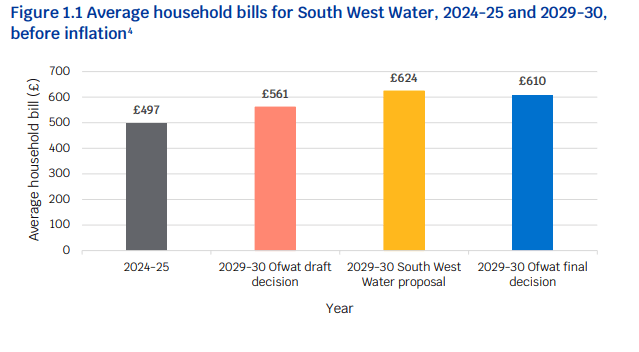
As already reported by Owl, Ofwat has greed to let South West Water (SWW) hike its annual charges to customers from an average of £497 in 2024/5 to £610 by 2029/30, an increase of  £113 or 22.7% at FY 24/5 prices (i.e. excluding inflation). 

The regulator had originally proposed a much smaller increase of £64 or 12.9% in July but has been persuaded by SWW to change their minds. The final result is that Ofwat managed to shave only £14 or 2.2% from what SWW had proposed.

Note the figures above do not take into account the £50 per household government contribution in the South West area, which will be removed for 2025-26 onwards.

Significant changes from the draft decision for South West Water are:

 • Ofwat increased their day-to-day expenditure allowances by £181 million to £2.3 billion for the South West area, and £43 million to £573 million for the Bristol area. This mainly reflects additional allowances for energy costs, business rates, bioresources growth and network reinforcement. Allowances for energy costs and business rates will be adjusted at the end of the price control period to reflect actual changes in prices. 

• Ofwat increased their allowances to invest in new infrastructure and resources, by £106 million for the South West area and £17 million for the Bristol area. This mainly reflects better evidence provided by the company for its cost estimates and the need for investment. It also follows an increase in requested expenditure for the South West area, mostly driven by increased regulatory requirements. For both areas, Ofwat increased allowances for preventing raw water deterioration. This allowance also rises for investing in water interconnectors to improve resilience in the South West area. 

• Ofwat changed some of their performance targets and financial incentive rates. This follows updated performance data for 2023-24, which Ofwat has taken into account in setting targets that are both stretching and achievable. For the South West area, Ofwat increased stretch on water quality contacts, as it is currently a relatively poor performer on this measure. 

Ofwat says that they will continue to hold South West Water to account against its targets for improved service for customers and the environment and expect it to report on its performance every year. If the company does not deliver the expected outputs and outcomes, this will be reflected in lower bills for customers. Where it delivers a better level of performance, it will be allowed to collect more, to reflect the additional benefits to customers it has created.

Download Ofwat’s overview of South West Water’s final determination

NB the Office for Environmental Protection (OEP) has just found that Ofwat was failing to comply with the law as the regulator was not cracking down hard enough on water companies. The notice served said Ofwat was “failing to take proper account of environmental law with regards to duties on sewerage companies and its duty to make enforcement orders” and “failing to exercise its duty under environmental law to make enforcement orders”. – Owl