I will not allow poor planning to destroy what makes our area so special – David Reed MP

Dear David, why not “put your money where your mouth is” by “cleaning up your own backyard” first? That is something you do have the power to do, rather than wring your hands over the plight of “developer led” Cranbrook whose residents were abandoned by the Tories for years. It’s not until your party lost power locally that any progress has been made.

You might also take a more robust line with South West Water. – Owl

PS You’re beginning to sound as if your needle’s stuck in a groove.

See: “Build,build, build Skinner back on the campaign trail” (earlier this month) and “David Reed MP says we have to build at scale without proper joined up thinking” (last September”)

[David Reed campaigning with “Build, build, build” Phil Skinner a few weeks ago]

David Reed MP for Exmouth & Exeter East www.devonlive.com

I love our county and this part of the world. I cherish the open green spaces, rolling hills, stunning coastline, and beautiful waterways. I’m also captivated by the rich history of our villages and towns, which have thrived for millennia.

Change is inevitable, but it must be managed responsibly. While we must adapt to modern times, we should preserve our collective past, which gives us a sense of grounding and helps us avoid repeating the mistakes of previous generations.

I’ve spent a lot of time in Cranbrook, both during the run-up to the General Election and since being elected. I’ve studied how the town was designed and, more importantly, what infrastructure was promised to support the growing population and surrounding areas. This includes roads, schools, medical services, supermarkets, community centres, and sewage treatment works.

I’ve been shocked by how much of this promised infrastructure remains undelivered. I’m equally dismayed by how hard the people of Cranbrook have had to campaign for basic amenities like a supermarket. This is unacceptable, and we should never put any community in this position again.

The not-so-new Labour Government has pledged to build 1.5 million new homes during this Parliament, likely by 2029. However, there is no clear plan to ensure that the infrastructure required to support these homes is delivered in parallel. On top of that, the Government is undertaking significant local government reorganisation, and further stripping power from local communities and limiting their ability to voice concerns.

As I’ve said many times, I’m not against housebuilding. But I am against developments that fail to deliver the necessary infrastructure. And I oppose mass housebuilding that erodes the beauty and history of our wonderful county.

So, what does this mean for us? Each local council with planning authority is required to create a local plan. This plan identifies land available for development, and the local council works with central government to deliver housing. In our case, the Liberal Democrat-led East Devon District Council (EDDC) has proposed building tens of thousands more homes in the Exmouth and Exeter East constituency. However, in their 270-page local plan, only two pages are dedicated to infrastructure. Worse still, the process for submitting feedback on the local plan is so convoluted that it almost seems designed to discourage public engagement.

I will finish this article as I began. I love our home. I will not allow poor planning and headline-grabbing targets to destroy what makes our area so special. We are temporary custodians of this land, and I want it to be protected and enjoyed by future generations. I will continue to fight and push back whenever I see a lack of joined-up thinking or when housing developments are planned without the necessary infrastructure to support them.

Devon’s natural beauty is being destroyed as it becomes national blackspot for sewage spills

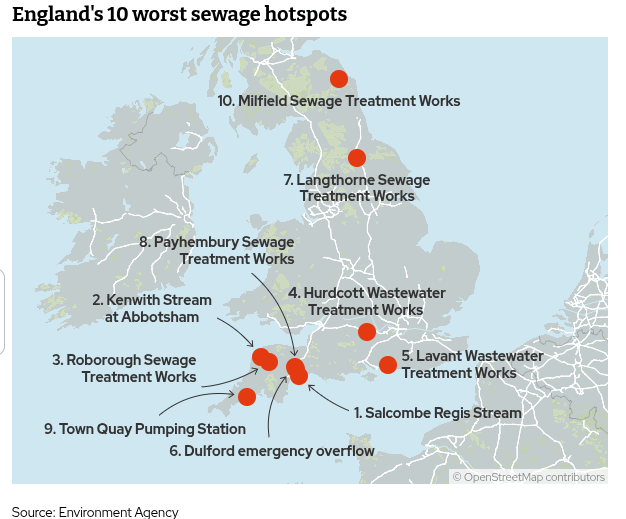
“Of the 10 most frequently used overflows, five were in Devon. Another was in neighbouring Cornwall, meaning six were in the region served by South West Water (SWW).”

How Devon’s beaches and rivers became the centre of the sewage crisis

Sewage was spilt in one village in Devon 366 times in 2024, as the county was home to five of the worst 10 pollution blackspots in England

Lucie Heath inews.co.uk 

Devon is known for its rolling hills and dramatic coastline, but locals warn its natural beauty is being destroyed by sewage pollution as the area has become a national blackspot for spillages.

Official statistics released on Thursday show untreated waste was dumped a near-record 450,398 times across England in 2024 – the equivalent of 1,234 spills per day or 51 per hour.

Sewage pollution is a problem across the country, but the issue has become particularly acute in the south-western county.

Water companies dump sewage from points in their network known as “storm overflows”, of which there are more than 14,000 across England.

Of the 10 most frequently used overflows, five were in Devon. Another was in neighbouring Cornwall, meaning six were in the region served by South West Water (SWW).

The single worst offender was a wastewater treatment plant in the village of Salcombe Regis, next to the coastal town of Sidmouth. Raw sewage was dumped at this site 366 times in 2024.

“It’s a beautiful remote part of the countryside, absolutely stunning,” said Richard Foord, the Liberal Democrat MP for Honiton and Sidmouth. “People are disgusted.”

Richard Foord on the beach at Salcombe Mouth, the worst hit spot for sewage spills in 2024 

Foord said his inbox is filled with “residents who are massively frustrated to turn up at the local beach only to find that there are signs warning them against swimming because of the sewage spills”.

“People live in my constituency because they want to be near the sea,” added Caroline Voaden, the Liberal Democrat MP for South Devon.

“People want to have their kids in the water, they want to be out on boats, on paddle boards … it’s also about the health of our ecosystem.”

The poor state of Devon’s coast hit the headlines several times in 2024.

In March, sewage was released for 12 hours at Sidmouth, where Queen Victoria spent time as a child.

In the peak of summer, no swim warnings were issued at Exmouth Beach on multiple occasions. Hundreds of residents and businesses in the town are currently suing SWW as part of a mass legal action, claiming beach closures resulted in a significant drop in trade during their crucial tourism season.

Swimmer Jo Bateman is taking separate legal action against the water firm, saying it prevented her from taking her daily swims at Exmouth Beach due to multiple sewage discharges.

Water companies typically dump untreated sewage when their systems cannot cope with an influx of rainfall, although they have also been shown to discharge illegally during dry weather.

The weather will have played a factor in the deluge of sewage hitting Devon’s rivers and beaches in 2024. The South West experienced an incredibly wet start to the year and Devon recorded its wettest February on record.

“This is not an excuse but is important context,” said Richard Price, managing director of Wastewater Services at SWW. He pointed out that the firm was one of five that reduced the number of sewage spills across its network between 2023 and 2024.

This will offer little solace to the residents of the South West who have been fighting sewage pollution for decades, but still find themselves wading through waste.

Surfers Against Sewage (SAS), the campaign group that has been at the forefront of bringing this issue to the public’s attention, was founded in Cornwall in 1990 by a group of surfers keen to sound the alarm over the terrible state of Britain’s oceans.

“The thing with the South West is the amount of coastline those counties have and how important that is as part of the place, as part of the economy, as part of what draws people to there,” said Dani Jordan, Director of Campaigns and Communities at the charity.

“It should be something that’s there for all of us to enjoy in whatever way we choose to.”

In response to the recent swell in public outrage over the sewage crisis, water companies plan to invest £104bn up to 2030 in fixing their networks. Bills will increase by an average of £30 per year across the country to pay for it.

Jordan said she wants to remain “optimistic”, but the latest statistics are a reminder of how little progress has been made on the issue to date.

“We’re campaigning for an end to sewage pollution impacting the places we swim, surf and play by 2030…we 100 per cent know that the investment they’re going to put in over the next five years isn’t going to result in an end to that,” she said.

“We have lost trust in the water companies.”