
Though according to this excoriating report from the National Audit Office he could have included the Environment Agency, the Drinking Water Inspectorate and Defra as well.
But all will be well as Steve Reed, Environment Secretary, says polluting water bosses face up to two years in jail for illegal water spills (with caveats).
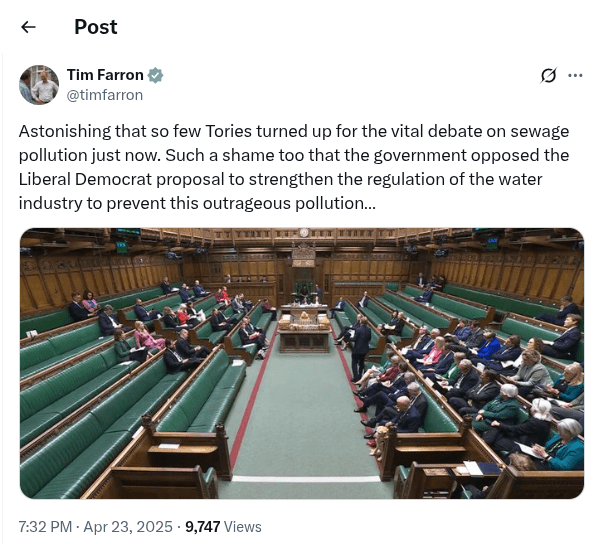
See today’s post: Pollution and Sewage – Have Devon Tories, including David Reed MP, given up?
Regulators have failed to deliver a trusted and resilient water sector – NAO press release
- Consumer trust is at an all-time low and confidence in water companies to act in the interest of the environment and provide a reliable service has fallen
- Government and the regulators have failed to drive sufficient investment in the water sector which now needs to build 30 new projects at a cost of £52bn to meet future water demand
- Regulators have not managed the rising tide of risk associated with the sector, which is contributing to increasing bills for customers
- While the UK has one of the highest standards of drinking water in the world, performance has not improved for almost a decade in key measures, including mains bursts, supply interruptions and pollution incidents
The Department for Environment, Food and Rural Affairs (Defra) and water regulators have failed to drive necessary investment for the sector, which now faces significant environmental, supply and infrastructure challenges, says the National Audit Office (NAO).
The report audits the three water regulators (Ofwat, the Environment Agency, and the Drinking Water Inspectorate) and Defra, which sets policies for the water sector. It examines their effectiveness in driving operational improvements; ensuring the nation’s future water supply and attracting necessary investments to meet government targets.
To tackle the challenges, including an anticipated daily shortfall of 5 billion litres of water by 2050, the sector now needs to attract an unprecedented amount of investment. Ofwat anticipates a 70% increase in infrastructure spending, totalling £47 billion in the next five years. This is part of £290 billion required to meet government targets over the next 25 years.
The need for investment coincides with a period of weakening financial performance, declining public trust and falling investor confidence. In 2023-24, Ofwat was concerned about the financial resilience of 10 of the 16 major water companies.
Although there is no national plan, there are 30 major water supply projects in development, including nine reservoirs. Ofwat estimates these projects will cost an additional £52 billion to build.
Over the next five years water companies must fulfil 18,000 actions to reach the Environment Agency’s (EA) expectations on environmental performance – this accounts for £27 billion of the £47 billion enhancement spend. Out of the 8,780 actions completed by the water companies in the last five years EA has conducted site inspections on 1%.
The regulators do not have a good understanding on the condition of infrastructure assets, as they do not have a set of metrics to assess their condition. On the work water companies have done, they have overspent for the last four years (some of these costs will be added to consumers bills) and moved slowly. At the current rate, it would take 700 years to replace the entire existing water network.
The poor performance has led to a record low in consumer trust. The highest-profile cause of environmental harm is the use of storm overflows, where companies release untreated sewage into rivers and seas.
The Environment Agency and Ofwat are taking enforcement action against every wastewater company over their management of sewage. There is no regulator responsible for proactively inspecting wastewater assets to prevent further environmental harm.
The NAO report recommends that Defra must understand the costs and deliverability of its plans, alongside the impact they will have on customers’ bills. Defra needs to address the gaps in regulatory responsibilities, and Ofwat and the other regulators need to work together to improve investor confidence and build consumer trust.
“Given the unprecedented situation facing the sector, Defra and the regulators need to act urgently to address industry performance and resilience to ensure the sector can meet government targets and achieve value for money over the long term for bill payers.”
Gareth Davies, head of the NAO
 East Devon Watch