
This is a catch-up post to Owl’s earlier one on two press articles published over the past few weeks.
These articles report the details of how Devon Councils are tearing themselves apart as they attempt to find acceptable reorganisation plans to meet the Government’s criteria for eliminating district councils and imposing strategic mayoral authorities on top of what’s left.
Owl’s earlier post contained a stark warning on costs.
This article describes Devon County’s revised plan conceding an independent Torbay
Devon County Council has put forward a plan to create a new unitary authority.
Bobby Angelov www.midweekherald.co.uk
This plan, which is set to replace the existing two-tier district and county council structure, is seen as the most logical option to avoid disruption to key services and reduce funding deficits.
The proposal comes after the Government gave local authorities in Devon a deadline of November 28 to present their proposals.
Councillor Paul Arnott, who is leading the local government reorganisation, said that after thorough research and community engagement, it was clear that a single unitary authority replacing the eight district councils and Devon County Council was the most logical option.
The new council would function alongside the existing Plymouth and Torbay unitary authorities.
Mr Arnott said: “New Devon would provide stronger local accountability, smarter use of public money, consistent, high-quality public services and will create opportunities for our area’s economy bringing in new investment and jobs.
“It will allow us to join up local services, bringing together the strengths of district councils and the county council and will also allow for much closer working, and enhanced local decision-making, with key partners including the NHS, police and voluntary sector.”
The model was described by Councillor Julian Brazil, the leader of Devon County Council, as the “least worst” option amidst real-term funding cuts from central government.
Mr Brazil said: “The Government is intent on forcing through changes which will cost many millions of pounds to implement and provides a great deal of uncertainty for residents and staff who provide critical services.
“This option has emerged as the least worst, and if we do not put it forward then we may inadvertently pave the way towards a disastrous disruption to existing key services such as adult social care and children’s services.”
The new council would see the formation of Neighbourhood Area Committees, potentially comprising representatives from various organisations, including town and parish councils, police, and local health services.
These committees would introduce a new level of local decision-making to communities.
More than 6,000 Devon residents have already completed a survey on the local government reorganisation, with the council seeking further input before making a final decision in November.
The council is inviting residents to complete the New Devon survey by October 14, which can be found on the council’s website.
The input will play a significant role in shaping decisions around the local government reorganisation.
The aim is to create a system that benefits everyone living and working in Devon.
Here is Exeter’s response
Plans to reorganise local government in Devon have been heavily criticised by a rival council leader.
Miles Davis www.bbc.co.uk
All of the district councils and the county council will be abolished and replaced by unitary authorities in the biggest shake-up of local government for 50 years.
Devon County Council unveiled its plans on Thursday to create the unitary authority New Devon – retaining the geographical area currently covered by the county council.
Exeter City Council leader Phil Bialyk, who wants to see an expansion of Exeter into a new unitary authority, dismissed the county council plans as “ineffective” and “too remote” and said any collaboration between councils in Devon had “broken down”.
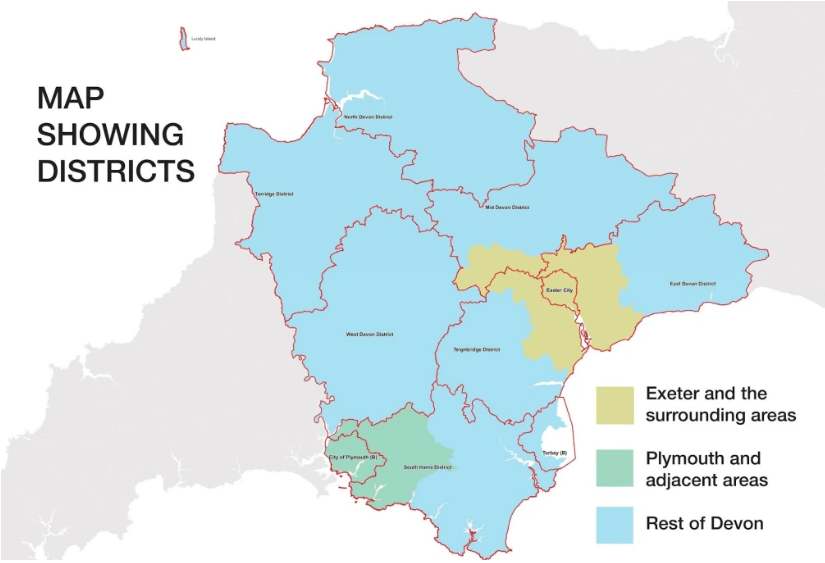
Exeter City Council wants to see an expanded Exeter, an expanded Plymouth and the rest of Devon as a coastal and rural authority Image source, Exeter City Council
Under Devon County Council’s plans, New Devon would have a population of about 830,000 and keep the current unitary authorities in Plymouth and Torbay.
At the moment the biggest unitary council in England by population size is North Yorkshire with about 615,000 people.
Bialyk said New Devon would be “too distant and remote to be able to reflect the needs and priorities of many residents and communities” and would “just deliver more of what our residents already receive”.
He said the plan put forward by Devon County Council “would reduce accountability, create a democratic deficit and reduce the ability to respond to the diverse needs of local areas in an effective way”.
Bialyk said the local government reforms should be an “opportunity” to design new local authorities.
He has put forward a plan for a new unitary authority for an expanded Exeter which would take in towns like Exmouth and Dawlish to the south and Crediton to the north.
That would exist alongside an expanded Plymouth and a separate rural and coastal unitary authority with a population of about 675,000.
The government asked all local authorities in any given area to work together , externalon coming up with proposals and share information.
However, Bialyk said: “Devon County Council has not engaged me at all – collaboration has broken down.”
Announcing the Devon County Council plans on Thursday, its Liberal Democrat leader Julian Brazil said it was the “least worst option”.
Deputy leader Paul Arnott, Liberal Democrat, said the council had been “handed a lemon” by the government and was attempting to “make democratic lemonade”.
Arnott said that keeping the same geographical area would “provide stronger local accountability” and “smarter use of public money”.
An expanded Exeter would have a population of about 255,000 people.
Plymouth City Council also wants to expand to take over parts of the South Hams and boost its population from about 265,000 to about 300,000.
Torbay Council is considering three options – to remain as it is, to expand into parts of South Hams and Teignbridge, or to cover all of South Hams, West Devon and Teignbridge.
Each area as a whole will have to submit one plan by the end of November,, external which might contain different proposals put forward by individual councils.
Note from Owl – See this post on cost implications for unitary authorities with populations below 300,000, and this post: Exeter townies vote to pull up the ladder on Devon’s rural bumpkins.
 East Devon Watch