Labour to axe 800 councillors and 43 councils in huge shake-up

The latest tranche of local government reorganisation decisions have been announced in a written statement (or see below). These cover what were traditionally known as Essex (population c 2m) Hampshire and the Isle of Wight (pop.c  2m), Norfolk (Pop c. 1m) and Suffolk (Pop c. 0.75m). These “counties” have been variously divided into five or three unitary authorities and their distict councils abolished.

The 500,000 population guidelines for gaining unitary authority status goes out the window and along with it any prospect of savings. 

“For the other 14 areas going through local government reorganisation, I would like to emphasise that the decisions taken here, and previously in Surrey, do not set any precedent. Decisions will be taken individually, based on the published criteria referred to above, the merits of each proposal we receive, and the local context.” The Rt Hon Steve Reed OBE MP  Secretary of State for Housing, Communities and Local Government.

[I.e. Steve Reed is cuffing it, a decision making technique much in vogue at the moment.]

Whatever happens, one certain consequence will be a dilution of elected representation. A diminished number of councillors will have a much larger number of constituents to represent over a wider range of services. Adding a strategic mayoral authority on top of all this will not bring local decision making closer to people. A strange thing to do in the name of preparing the way to devolution. Unless you see them as “nimbys”, blocking development. – Owl

Dozens of local authorities face abolition under proposals to merge areas and widen cities, but critics warn savings may be outweighed by social care costs

Max Kendix, Political Correspondent www.thetimes.com

Labour will establish 15 new councils and cut 800 councillors as part of the biggest reorganisation of local government in half a century, in a move the Conservatives accused of being “outright gerrymandering”.

The boundaries of Southampton, Portsmouth, Norwich and Ipswich will be expanded in an effort to boost housebuilding in the suburbs and prevent “nimby” district councils from blocking development.

Forty-three councils across Hampshire, Essex, Norfolk and Suffolk will be scrapped by 2028, ending the system of two-tier local government in these areas. 

The announcement is a retreat from the government’s previous commitment for new councils to have at least 500,000 residents, in favour of smaller councils.

Labour is likely to benefit electorally from the approach, which expands the boundaries of cities, where they are more likely to control the council.

Sir James Cleverly, the shadow local government secretary, said this was “outright gerrymandering from a Labour government desperate to shore up its collapsing support”. 

He accused Labour of “engineering council sizes to fit their own partisan political interests, sidestepping the proper process and dodging accountability.”

At present, county councils preside over transport and social care, while smaller district councils are responsible for rubbish collection and day-to-day planning permission.

In Essex, five unitary councils will replace the county council and all 12 district councils.

Norfolk and Suffolk’s county and district councils will be replaced by three unitary councils in each area. Hampshire will have four unitary councils. Elections for the new councils will take place in 2027, and those councillors will start in 2028.

Ministers say these structures are inefficient, and that getting rid of senior, highly paid posts such as chief executives and finance directors will save about £6 million a year across the four areas.

They hope to replicate the arrangement across England, leading to up to 60 new unitary authorities by the end of the parliament. Transferring the responsibility for managing adult social care to these new councils could come with significant extra costs.

The announcement is a retreat from the government’s previous commitment for new councils to have at least 500,000 residents.

The County Councils Network has previously published evidence that opting for smaller councils of about 300,000 people would increase social care costs by between £180 million and £270 million, by reducing purchasing power and economies of scale.

About 500 to 1,100 extra senior managers would be hired to run social care and children’s services if functions carried out at county level were split between smaller councils, the report estimated.

Government sources have pointed to evidence provided from other sources that suggest that councils of 200,000 to 250,000 people can still end up being a cost-effective approach.

Rachel Reeves argued last week that the government’s approach to land use had “priced young people out of the housing market and hemmed in our most dynamic cities”.

Ministers will point to Portsmouth as being the second-most densely populated local authority outside London, and argue that it needs “space to grow”. In Ipswich, the town boundaries have remained largely unchanged since the middle of the 19th century, even as the population has grown.

Steve Reed, the local government secretary, said the reorganisation “presents a once-in-a-generation chance to make sure our councils match the modern realities of our places, making sure outdated boundaries are not constraining growth, particularly in our towns and cities.” He added that “in too many places, council boundaries are misaligned with the needs of their local communities and how those communities live their lives.”

Statement: The Rt Hon Steve Reed OBE MP, Secretary of State for Housing, Communities and Local Government.

questions-statements.parliament.uk

This Government is undertaking the biggest reform of local government in a generation, ending the two-tier system and replacing it with new single-tier unitary councils. This agenda is key to this government’s vision of local councils that deliver good services for residents and are equipped to drive economic growth, but can empower their communities.

As a government, our number one ambition is growing the economy and putting more money in the pockets of working people. Driving economic growth means acknowledging that cities, towns, and villages don’t all perform the same roles in the national economy – they specialise in what they’re best at. Public service demand also isn’t the same across the country. Some areas have high levels of homelessness and temporary accommodation, others have high need for adult social care due to an older population. Local leaders, both in councils and mayoralties, need to be able to focus on the specific needs of their area.

Reorganisation presents a once-in-a-generation chance to make sure our councils match the modern realities of our places, making sure outdated boundaries are not constraining growth, particularly in our towns and cities. In too many places, council boundaries are misaligned with the needs of their local communities and how those communities live their lives. In Ipswich, for example, the boundaries have remained largely unchanged since the middle of the 19th century, even as population has grown. These outdated and misaligned structures slow down decisions, stifle housing growth, and fragment public service delivery.

This is particularly important for key government priorities on housebuilding, like our target of building 1.5 million homes in England this Parliament. The housing needs of local communities are best met by councils who are closely connected to their communities and understand a place’s local identity. This connection is crucial in ensuring that local government can boost economic growth and design public services that respond to local residents.

Reorganisation must also respect local identity, and the distinctive nature of the rural, urban and coastal communities across our country. We want to see councils that are connected to their local residents and communities; councils that mean something to the people they serve.

DECISIONS

I am pleased to announce today the next step in our vital reforms to reorganise local government. On 5 February 2025, councils in the 21 areas of England that still have two-tier local government and neighbouring small unitary authorities were invited to submit proposals for unitarisation.

We invited six areas to put forward proposals by 26 September 2025 – East Sussex and Brighton and Hove; Essex, Southend-on-Sea and Thurrock; Hampshire, Isle of Wight, Portsmouth and Southampton; Norfolk; Suffolk; and West Sussex.

My department received 17 proposals in total across the areas. I would like to thank councillors and officers in these areas for their hard work. As the House was informed on 19 November, all the proposals received were taken to consultation, which closed on 11 January 2026. We have now considered each proposal carefully against the criteria set out in the invitation letter of 5 February 2025, alongside the responses to the consultation, all representations and all other relevant information to assess the proposals. In summary, these criteria are:

  • whether each proposal achieves for the whole of the area concerned the establishment of a single tier of local government;
  • whether the councils are the right size to achieve efficiencies, improve capacity and withstand financial shocks;
  • whether the unitary structures prioritise the delivery of high quality and sustainable public services to citizens;
  • whether councils in the area have sought to work together to come to a view that meets local needs and is informed by local views;
  • whether new unitary structures support devolution arrangements;
  • whether new unitary structures enable stronger community engagement and deliver genuine opportunity for neighbourhood empowerment.

Decisions on each area have been made on a case-by-case basis, on its own merits, respecting the differences of local circumstances and local people’s views. In two areas, I have not yet made a decision, and will make a decision as soon as practicable, so reorganisation can be completed on the planned timeline.

Today, I have written to the Leaders of councils setting out decisions and/or next steps for all six areas. I have decided to implement the following proposals, subject to Parliamentary approval, in these areas:

Essex, Southend-on-Sea and Thurrock: 5 unitary proposal, creating the councils referred to in the proposals as:

  • West Essex Council (current local government areas of Epping Forest, Harlow and Uttlesford)
  • North East Essex Council (current local government areas of Braintree, Colchester and Tendring)
  • Mid Essex Council (current local government areas of Brentwood, Chelmsford and Maldon)
  • South West Essex Council (current local government areas of Basildon and Thurrock)
  • South East Essex Council (current local government areas of Castle Point, Rochford and Southend-on-Sea).

Hampshire, Isle of Wight, Portsmouth and Southampton: 5 unitary proposal (option 1A) submitted by Eastleigh, Fareham, Hart, Havant, Portsmouth, Rushmoor and Southampton councils, creating the councils referred to in the proposals as:

  • North Hampshire Council (current local government areas of Basingstoke and Deane, Hart and Rushmoor)
  • Mid Hampshire Council (current local government areas of East Hampshire, New Forest, Test Valley and Winchester, less 11 parishes from all 4 areas)
  • South East Hampshire Council (current local government areas from East Hampshire, Fareham, Gosport, Havant, Portsmouth, 3 parishes from East Hampshire and 1 parish from Winchester)
  • South West Hampshire Council (current local government areas of Eastleigh, 4 parishes from New Forest, Southampton and 3 parishes from Test Valley)
  • Isle of Wight Council will remain as a separate unitary authority.

Norfolk: 3 unitary proposal, creating the councils referred to in the proposals as:

  • West Norfolk Council (current local government areas of Breckland, King’s Lynn and West Norfolk, and 9 parishes from South Norfolk).
  • Greater Norwich Council (current local government areas of Norwich, 19 parishes from Broadland, and 16 parishes from South Norfolk).
  • East Norfolk Council (current local government areas of Broadland (less 19 parishes), Great Yarmouth, North Norfolk, and South Norfolk (less 25 parishes)).

Suffolk: 3 unitary proposal, creating the councils referred to in the proposals as:

  • Central and Eastern Suffolk Council (current local government areas of West Suffolk, 21 parishes from Mid Suffolk, and Babergh (less 31 parishes)).
  • Western Suffolk Council (current local government areas of Mid Suffolk (less 29 parishes), and East Suffolk (less 25 parishes).
  • Ipswich and South Suffolk Council (current local government areas of Ipswich, 31 parishes from Babergh, 8 parishes from Mid Suffolk, and 25 parishes from East Suffolk).

In implementing the above proposals for reorganisation in Hampshire, Portsmouth, Southampton and the Isle of Wight; Norfolk; and Suffolk, I will exercise my power to modify the base proposals received from councils, in order to make the boundary changes that the councils requested.

Further information on the decisions taken in these areas can be found in the letters to council leaders in the areas, which will be published on gov.uk later today. A summary of the responses to the consultations for proposals in these areas will also be published today.

In East Sussex and Brighton and Hove and West Sussex, after carefully considering the four proposals received across the areas, I have not yet made a decision, due to concerns regarding all four of the proposals I received. But I would like to reassure the House that I am still fully committed to delivering reorganisation in these areas with elections in May 2027 and changes coming into effect from April 2028.

I am considering modifications that could address my concerns, including an option for potential modification of the proposals for further consultation. I have set out further details in a letter to council leaders this morning

I would also like to confirm our commitment to repay in-principle £200m of Thurrock Council’s debt in 2026-27. This is a significant and unprecedented commitment which reflects an assessment of value for money for national and local taxpayers, given the significant unsupported debt at the Council linked to historic capital practices. This follows the recent announcement in October 2025 as part of reorganisation in Surrey to repay in-principle £500m of Woking Borough Council’s debt in 2026-27.

We have not taken these decisions lightly and they have not been made simply because debt is high at these councils. The decision for Thurrock Council reflects an assessment of value for money and acknowledgement that, even after significant local action to reduce debt, the Council still holds significant unsupported debt that cannot be managed locally in its entirety. I would like to thank the Council’s current leadership for its grip of the financial situation and to recognise the progress that has been made to reduce debt.

Further detail on this can be found in the letter to Essex council leaders, which will be published on gov.uk.

To prevent failures like those seen in Thurrock and Woking from happening again, we will now bring into operation the statutory powers enacted in 2023 – but never used by the previous government – which allow direct intervention where authorities take excessive risks in their borrowing and investment practices. These powers will ensure that essential capital investment in services, housing and growth can continue, but within a much stronger framework of safeguards to protect taxpayers from costly and avoidable failure. We will soon launch a consultation to engage with the sector and stakeholders in developing and implementing these powers.

I am pleased to be able to confirm how the £63m in transition funding announced in February will be allocated – making this the first government to provide funding for the reorganisation process. We will provide at least £900,000 for each new unitary authority to help establish effective services and governance arrangements, ensuring funding is provided fairly, consistently, and as quickly as possible. This will mean the Essex invitation area receives £4.5m for five new unitary councils; the Hampshire, Portsmouth and Southampton invitation area receives £3.6m for four new unitary councils; the Norfolk invitation area receives £2.7m for three new unitary councils; and the Suffolk invitation area receives £2.7m for three new unitary councils. We will also provide the Surrey invitation area with £1.8m for two new unitary councils. This approach reflects the differing levels of complexity involved across areas and allows for a small central reserve to be used later for targeted support if needed. Funding will be issued through established, flexible grant mechanisms and my officials will be in touch with councils to confirm next steps.

NEXT STEPS

Delivering reorganisation for the benefit of all residents is a shared endeavour, and ongoing collaboration will be vital to ensure that these reforms are implemented with the interests of residents at their heart.

We remain committed to the timetable we have set out previously, with elections to the new unitary councils taking place in May 2027, ahead of them going live and delivering services in April 2028.

For the other 14 areas going through local government reorganisation, I would like to emphasise that the decisions taken here, and previously in Surrey, do not set any precedent. Decisions will be taken individually, based on the published criteria referred to above, the merits of each proposal we receive, and the local context.

I will deposit in the House library copies of the letter and documents I have referred to, which are also being published on gov.uk today.

Cornwall devolution: Could an independence bid be lost?

Background

Cornwall and the Isles of Scilly received over €1 billion in EU funding from 2000 to 2020, including Objective One status, because its GDP was below 75% of the EU average, making it one of the poorest regions in Northern Europe.

Following Brexit, they were allocated £186 million to spend on local investment through the Shared Prosperity Fund. This funding runs out at the end of March. Cornwall got nothing in the recent “Pride in Place” handouts that mostly went to urban areas.

Cornish identity plays a big role – but is it backed up by science?

In 2014 “The Cornish” were recognised as a national minority under the European Framework Convention for the Protection of National Minorities, the same status as other Celtic communities the Scots, Welsh and Irish.

On the question of “Cornish Identity” Owl’s scientific correspondent has some interesting observations to make. The science doesn’t fit comfortably with this idea.

A paper published in “Nature” in 2015 examined the fine-scale genetic structure of the British population. What this examination showed was that those of deep Cornish heritage did form a distinct genetic subgroup in Britain. But it also showed that those with deep Devonian heritage also formed their own distinctive subgroup. Furthermore, only these two counties, Devon and Cornwall, in England had distinctive populations that mapped the county boundaries. Other genetic groupings were more widely distributed with some significant overlapping as well. 

The genetic differences between Cornwall and Devon are comparable to those between islands in Orkney. 

The ancestry profile of Cornwall is quite different from that of the Welsh clusters and is much closer to that of Devon and Central/Southern England. ​

The authors argue more generally that in non-Saxon parts of the United Kingdom, there exist genetically differentiated subgroups rather than a general ‘Celtic’ population. 

Now throw into the mix the strict hierarchical rules that Labour is sticking to in its local government reorganisation plan such as: full devolution powers only go to strategic mayoral authorities (SMA); and SMA must preside over two or more unitary authorities. 

Owl has sympathy with the Cornish cousins. We aren’t really that different.

Is Cornwall about to lose its independence bid?

The long-running campaign for Cornish devolution has been brought sharply into focus by the Labour government’s plans to decentralise power from Westminster. But Cornwall wants devolution without being forced into a marriage with Devon.

Martyn Oates www.bbc.co.uk South West political editor

Cornwall celebrated St Piran’s Day earlier this month. At Westminster, it was marked by a debate led by Camborne and Redruth Labour MP Perran Moon.

Events to mark St Piran’s Day are not unusual in parliament. Neither was a call Moon made for the devolution of “bold, flexible and meaningful powers” to Cornwall.

However, his call also fired a shot across the government’s bows just weeks before the Devolution and Community Empowerment Bill is expected to become law.

The campaign for Cornish devolution has been ongoing for decades. The actual process began just over 10 years ago when it was the first rural area in the country to be granted a “devolution deal” in 2015.

In 2023, Cornwall Council negotiated an upgrade to a “Level 2” deal, external with Rishi Sunak’s government, later ratified under Labour.

Cornwall’s established enthusiasm for devolution seems, at first sight, a perfect fit with this government’s determination to roll out “devolution by default” nationally.

But conditions minsters are imposing are problematic for many.

So, what are the problems?

One is the government’s insistence the basic unit for devolution should be two or more unitary authorities (all councils are soon expected to be unitary under government plans) grouped together, becoming a strategic authority.

Cornwall being forced to form a larger unit with Plymouth, Devon or anywhere else is anathema to the majority of Cornwall’s elected politicians, whose red line is devolved powers should be exercised by Cornwall alone.

Ministers also insist the highest level of devolved powers over things, such as planning, will only be granted to areas which accept a directly-elected mayor, who leads the strategic authority.

Cornwall unquestionably wants those top-flight powers.

For one thing, its early adoption of devolution means it has already climbed the lower rungs.

‘National minority’

Last year, Cornwall Council passed a motion calling on the government to formally recognise the county as the fifth nation of the UK, alongside England, Scotland, Wales and Northern Ireland.

The government already accepts the Cornish have a special status in law and in 2014 they were recognised as a national minority under the European Framework Convention for the Protection of National Minorities, much like the Scots, Welsh and Irish.

The idea of a mayor is also firmly opposed by Moon and others – although some opponents of a combined authority say they might reluctantly accept a mayor if it were the price of a good deal for Cornwall alone.

Cornwall, by the by, has form when it comes to possible mayors.

Before it accepted its Level 2 deal under the Conservatives, Cornwall Council’s leadership had sought and been offered a Level 3 deal with a mayor.

Following the realisation that proposal would not command a majority in the council chamber, the plan was abandoned in favour of the less ambitious Level 2 deal.

So linking high-level devolution mayors is not a Labour novelty.

The Conservatives took the same view – but with the crucial difference that they were prepared to offer a mayor to Cornwall alone.

In his St Piran’s Day speech, Moon argued – not for the first time: “Cornwall is a mature, stable unitary authority with deep experience of strategic planning, economic development and cultural engagement.

“It must be treated as a single strategic authority with the same powers available to a mayoral combined authority.”

Cornwall’s devolution must, he says, be “bespoke” because “the Cornish are the only people in the UK with national minority status who do not yet have access to the highest levels of devolution”.

Cornish MPs Noah Law, Andrew George and Ben Maguire have made similar arguments in the Commons.

Maguire once lambasted any attempt to force Cornwall into a mayoral union with Devon as “insulting, unlawful and dangerous”.

But the government has so far stuck to its devolution rulebook. As the legislative process nears its end, nothing has really changed.

Replying to Moon in the Commons, Devolution Minister Miatta Fahnbulleh was perhaps deliberately vague.

“I look forward to continuing to work closely with our Cornwall MPs as we deliver this government’s agenda, secure the devolution deal and work together to ensure that we unlock the huge economic and local potential of this amazing part of the country,” she said.

One ministerial intervention over the course of this saga stands out.

Last November, Local Government Secretary Steve Reed sent a brief note to Cornwall Council.

“In recognition of Cornwall’s distinct local identity and history of programme delivery across the Cornwall footprint, the government is minded on an exceptional basis, to work with you to explore designating the council as a Single Foundation Strategic Authority,” he wrote.

A ‘bespoke deal’?

Were this to happen, he said it would lead to “unlocking the powers and functions available at that level of the Devolution Framework and start Cornwall on its journey to deeper and wider devolution”.

Could this be the “bespoke” deal or, at least, the first step towards it?

Some think so – but it is worth paying close attention to the language used.

A foundation authority is the basic entry-level tier of devolution in the new structure. The guidance attached to the bill is clear that that this attracts only “limited devolution”.

Essentially that is where Cornwall is now – indeed the government already describes the Devon and Torbay Combined County Authority – another Level 2 deal inherited from the Sunak era and rubber-stamped under Labour – as a foundation authority, external.

And the possibility of single authority foundation status is not as exceptional as it might sound.

In 2024, the Devolution White Paper was clear that “in exceptional circumstances the Secretary of State will have the power to designate an individual local authority as a Foundation Strategic Authority only”.

The bill guidance suggests “in rare cases, a single council which previously reached an agreement with government to access non-mayoral devolution” or “where it proved challenging for a combined authority or combined county to be established across a particular area at this stage of its devolution journey”.

Cornwall was one of a handful of councils that had negotiated single-authority devolution deals by the change of government in July 2024 and it always seemed plausible that it would be rolled over into single foundation status.

One other point about these “exceptional” single authority deals comes across loud and clear – they are not supposed to be permanent.

Going it alone

The White Paper says they will be granted “only as a stepping-stone towards forming a Mayoral Combined Authority or Mayoral Combined County Authority”, while the bill guidance describes them as an “interim” arrangement.

The only new thing here really is the indication that the government does not plan to force Cornwall into a union with Devon – though the legislation does explicitly give the secretary of state powers to impose strategic authorities and mayors “without the consent of local areas”.

But going it alone – as the legislation stands – would see Cornwall denied substantial new powers, plus the apparent expectation that it would upgrade to a mayoral combined authority at some point in the future.

Across the country as a whole, the devolution map is now largely coloured in – in principle a least.

The legislative process enshrining it all in law is also down to its last few weeks, with no indication that ministers plan to make a last-minute exception for Cornwall.

But attempts are under way to change their minds.

This week sees further debate in the House of Lords before it comes back to the Commons for the final sign-off.

Cornish Liberal Democrat peer Robin Teverson will be leading the final push for a Cornish carve-out in the Lords.

Amendments in his name would prevent areas with national minority status being forced into a combined authority or being denied top-level devolved powers, even if they refuse to accept a mayor.

‘Right direction’

However, opposition to a combined authority with Devon is not quite unanimous.

One dissenter is South East Cornwall Labour MP Anna Gelderd, whose constituency borders Devon and has economic ties.

“A Cornwall-only deal risks being left on the starting blocks as other areas race towards improvements, as we remain on the foundation-level settlement,” she said.

“On the other hand, a combined authority deal could unlock transformative funding and powers that Cornwall might not secure on its own.

“To succeed, this approach would need to ensure that Cornwall’s voice isn’t drowned out, or that resources are unfairly distributed.

“With the right safeguards, working with Devon could deliver real benefits while respecting Cornwall’s identity, history, and ensure better outcomes for residents.”

Fifteen months into this process, we should know soon whether ministers are prepared to budge.

The final word goes to Perran Moon, who claims “we’re right at the sharp end of this process now”.

He said: “We met the minister last week to go through some of the key asks… She is speaking to Cornwall Council before the end of this month and we know there are amendments coming up in the Lords.

“So I’m hopeful, I’m optimistic, but I’m not going to promise anything until there’s blood on the paper, so to speak”.

Phil Bialyk steers Exeter in a race to the bottom: economic growth and living standards amongst UK’s poorest

Is this the real reason that Exeter City Council leader Phil “Turkey” Bialyk has made a takeover bid to annex 15 parishes from within Teignbridge District Council, 28 parishes from East Devon District Council and 6 parishes from Mid-Devon District Council to create a “Greater Exeter” Unitary Authority? – Owl

Centre for Cities finds Exeter economic growth and living standards performance among worst in country’s 63 largest places 

Exeter Observer exeterobserver.org

Independent think-tank Centre for Cities has found that Exeter’s economic growth and living standards performance is among the worst in the country’s 63 largest cities and towns.

Its 2026 outlook report focussed on the relationship between economic performance and living standards in the primary built-up areas which it assesses in its annual comparison studies. It also considered data on housing, skills, employment, innovation and productivity in each area.

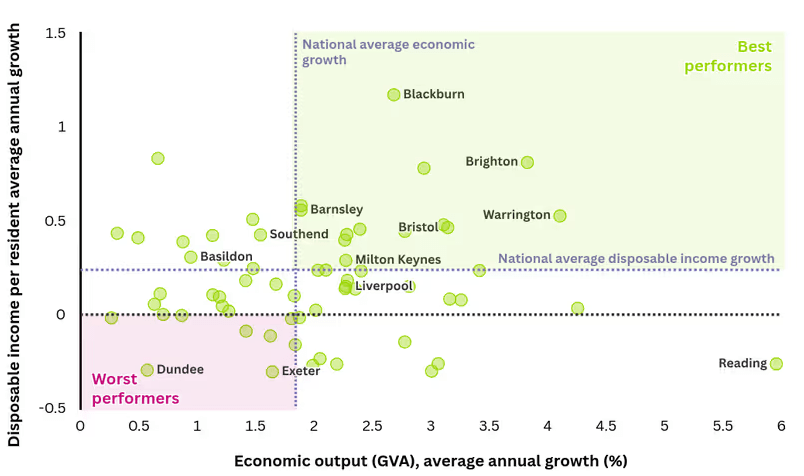
It found that Exeter saw declining living standards alongside below-average economic growth in the ten years to 2023, placing it among the worst performers in the country alongside Aberdeen, Birkenhead, Burnley, Dundee, Ipswich, Middlesbrough, Sunderland and Wigan.

Disposable income per resident fell in all nine areas. Centre for Cities said that had these places improved living standards on a par with the best-performing areas, their residents “would have had an extra £9,400 in their pockets over that decade”.

Best and worst performers on economic growth and living standards since 2013. Source: Centre for Cities.

Its 2026 report also placed Exeter fourth from bottom on the city’s ratio of private to public sector jobs, one place above Cambridge, and fifth from bottom for average weekly workplace earnings at £628.10.

Earnings in Cambridge, however, were second only to London, and nearly 150% higher than Exeter at an average of £924.50 per week.

As a result, Exeter has the seventh most unaffordable housing in the country even though average house prices here are the lowest among the top ten least affordable cities.

The report also found that Exeter had the highest population growth rate among the 63 places in the study – 15.5% – as the number of people living here increased from just under 120,000 in 2014 to more than 138,000 in 2024 – a rise of 18,610.

Exeter City Council leader Phil Bialyk seized on this finding to lead his budget speech at the council’s meeting a fortnight ago, but failed to mention any of the report’s other insights into the city’s misfortunes.

He also ignored the impact of student numbers on Exeter’s population. During the 2013-14 academic year there were just over 26,500 students registered at the Streatham and St Luke’s campuses, rising to just under 32,500 by 2023-24 – an increase amounting to one third of the whole city rise.

Newtown & St Leonard’s councillor Matt Vizard followed Phil Bialyk at the meeting. He said: “Isn’t it great that Exeter is the fastest growing city in UK? Reflect on that for a moment. That’s incredible, that’s not by accident”.

He added, referring to the last fourteen years during which Labour has been in control of the council: “I think the leadership of the council here over the past decade and more has been absolutely critical to that, as has the work of our previous MP and our current MP for the city.”

Exeter & Plymouth fail to make long list for UK City of Culture 2029, Exeter scrambles to hold elections

Remember that Exeter City Council leader Phil “Turkey” Bialyk prioritised making a bid for this over holding elections and claimed he didn’t have the resources for both.

He has now been forced into organising the elections rather late in the day. It could end up being a double whammy for him.

Doesn’t look like sound judgement to Owl.

UK City of Culture 2029 longlist revealed

Department for Culture, Media and Sport www.gov.uk

  • Each place will now receive £60,000 to develop a full application
  • The announcement comes as over 230 towns register interest in the inaugural UK Town of Culture competition

Nine places across the UK have been longlisted to be the next UK City of Culture in 2029 and will each benefit from a funding boost to support their bid for the title.

The nine longlisted locations are: Blackpool, Inverness-Highland, Ipswich, Middlesbrough, Milton Keynes, Portsmouth, Sheffield, Swindon and Wrexham.

Winning this title will have enormous benefits for local communities, with previous hosts attracting millions of pounds in additional investment and thousands of visitors to their area, as well as generating new jobs.

Today’s announcement comes as over 230 towns have thrown their hat into the ring to become the UK’s first-ever Town of Culture by registering their interest in bidding for that title. Many towns have also declared that they will be submitting a bid, to highlight their unique story and the elements of their local culture and heritage that they would celebrate should they be successful.

The competition is open to applications from small, medium and large towns for just under two more weeks, with the winner then tasked with delivering a vibrant cultural programme in 2028.

Both of these competitions are part of the Prime Minister’s ambition to restore pride in every part of Britain. Throughout this year, both competitions will continue to shine a light on local visions and voices from across the UK, which will encourage local investment, create a lasting sense of pride, and open doors to the arts for everyone.

Culture Secretary Lisa Nandy said:

For far too long, opportunity has not been shared equally across the country. The UK City of Culture and new UK Town of Culture competitions recognise the enormous contributions made by communities all over the UK who are all part of the story of who we are as a nation.

I look forward to seeing what the nine longlisted places have in store as they progress in the competition. I also urge any towns thinking about entering the UK Town of Culture competition to seize this opportunity and get involved. It’s a chance to show the country what makes them unique and shine a spotlight on their cultural offer, enriching the lives of local people.

The UK City of Culture longlist was recommended by an independent expert advisory panel, chaired by Sir Phil Redmond and supported by Deputy Chair, Claire McColgan. Panel members have been selected based on their wide range of expertise from across the UK.

The longlisted places will now work to finalise their bids, which will explain how they would use culture to create transformational opportunities and better lives for people living in their local area.

All nine longlisted places will receive £60,000 each to help them to develop their full bids for the competition – up from £40,000 since the last competition.

For the first time ever, there will be a confirmed cash prize of £10 million for the UK City of Culture winner to help them deliver a show-stopping year of rich cultural activity rooted in their unique identities and drawing on local strengths and stories. The three most impressive bids from places that reach the shortlist but are not selected as the winner will receive £125,000 each to help them to take forward elements of their bid.

Scores of illegal sewage spills every day as worst areas revealed (SWW heads the list)

Richard Foord, the Liberal Democrat MP for Honiton & Sidmouth, said: “South West Water is a disgrace. I wrote to the chief executive about spills at Salcombe Regis last October, and received the cliched reply about ‘we take the issues raised seriously’. Rubbish!”

[Meanwhile David Reed MP for Exmouth and Exeter East is presumably still striving to stay “on the same page” as everyone except his constituents while his predecessor Simon Jupp continues reaping the benefits of being Director of Corporate Affairs to the Pennon Group (parent company of SWW) – Owl]

A Times investigation shows there were nearly 15,000 dry-day sewage spills last year. Water companies could face prosecution as swimmers fall ill

Adam Vaughan, George Willoughby www.thetimes.com

Scores of illegal sewage spills into rivers and the sea took place across England on average every day last year, a Times investigation has found.

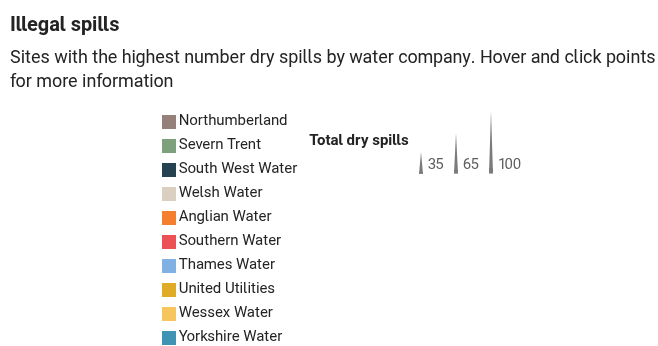
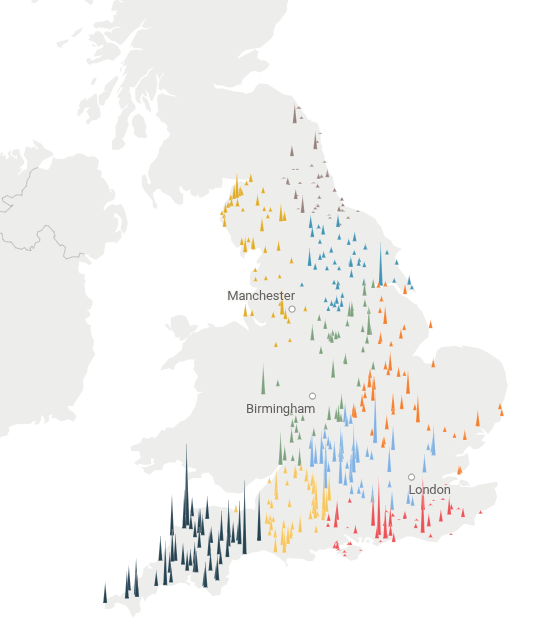
Documents, data, residents’ accounts, video and analysis show a widespread picture of companies illegally breaching permits regulating sewage spills from about 2,500 outfalls. The findings led regulators to warn that water companies face prosecution if they do not act.

Hundreds of thousands of raw sewage discharges from outfalls each year are legally permitted due to heavy rainfall. However, spills after a dry period of more than 24 hours are defined as illegal by the Environment Agency. 

The Times can reveal the true annual extent of those criminal incidents for the first time. 

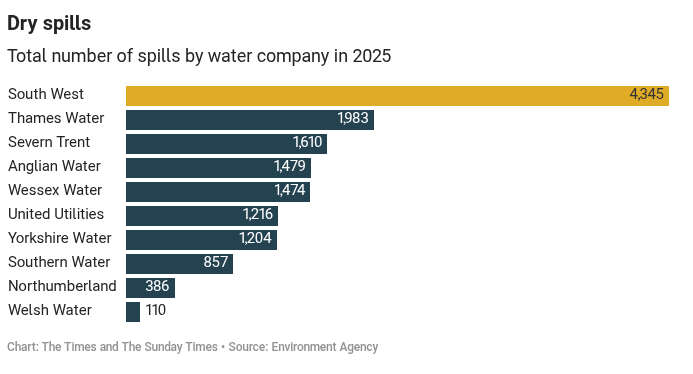
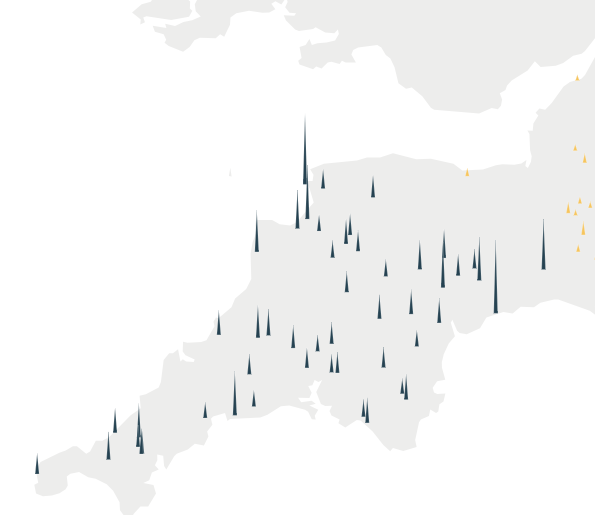
There were almost 15,000 dry-day spills last year. South West Water had more than 4,300 discharges, making it the most serious offender. It was also responsible for the two worst sites in the country, both near beautiful beaches in Devon.

Debt-laden Thames Water, which is at risk of collapsing into temporary nationalisation, caused nearly 2,000. Even Severn Trent, the poster child of best practice in the water sector and the only company to be awarded the top environmental rating by regulators, was responsible for about 1,600.

The spills by ten companies are not just illegal but pernicious. Wild swimmers have come to expect discharges after heavy rain but not after a dry day, putting them at greater risk of falling ill. The pollution is also more concentrated, making it more harmful for fish and other aquatic life.

Feargal Sharkey, the Undertones star and water campaigner, said the figures showed an “absolute exploitation and abuse of both environment and customers”. The angler turned activist, 67, noted the spills only related to those at sewage treatment works, so “god knows” what was happening in the rest of the sewer network.

He said: “Clearly government is now complicit in presiding over one of the greatest acts of criminality and lawbreaking that we’ve witnessed in the modern world in this country. The truth is, government needs to start bringing criminal charges against the executives and boards of those water companies that were knowingly, wilfully disregarding the law.”

Water companies have previously tried to cast doubt when campaigners accuse them of illegal spills, because so many are legally permitted when rain overwhelms capacity. But the dry-day figures are self-reported by the companies and not in dispute.

Since January the sector has been privately submitting the incidents to the Environment Agency, which believes they are overwhelmingly illegal. The numbers were released to The Times under transparency laws.

Detail for South West Water

The figures were then further analysed by Surfers Against Sewage, a campaigning charity, which found that raw sewage had been dumped in 142 official swimming spots around England. Four fifths of those bathing waters were usually “good” or “excellent” quality, the two best possible ratings.

Portreath in Cornwall, Fell Foot at Windermere, Cumbria, and Totland Bay on the Isle of Wight were among the worst-affected bathing waters, the campaigners found. During the May-to-September bathing season, when most people swim, 43 of the 142 were hit by a total of 838 hours of sewage spills on dry days.

The charity linked dry spills to 20 people falling sick, based on swimmers submitting reports to its app last year. Reports were logged across 14 locations, and Sidmouth, Gyllyngvase and Westward Ho! had numerous cases. One person, who was forced to take eight days off work, had their sickness attributed by a doctor to poor water quality. One of the 20 reports was for a child under the age of five.

The group counted cases where people swam within 3km of a spill location, covering the duration of the discharge and 24 hours afterwards. Giles Bristow, chief executive of Surfers Against Sewage, said: “Water companies’ brazen disregard for the law is creating a public health emergency right under our noses.”

The Times can disclose that the Environment Agency is ordering water companies to draw up action plans by the end of the year for any sites in 2026 where numerous dry-day spills took place. Phil Duffy, chief executive of the Environment Agency, said: “If we don’t see the progress needed from the industry, we will take further robust action including prosecutions.” He called the agency a “changed regulator”.

The worst site in England was a sewage treatment works run by South West Water at Salcombe Regis. Just south of the village in south Devon, it discharges into a stream that runs to the sea, where it emerges at Salcombe Mouth beach. It discharged raw sewage into the stream 117 times on dry days last year. They took place despite the company claiming last month it had “drastically” reduced spills at the works, which it had blamed on pipes connected to the wrong drains.

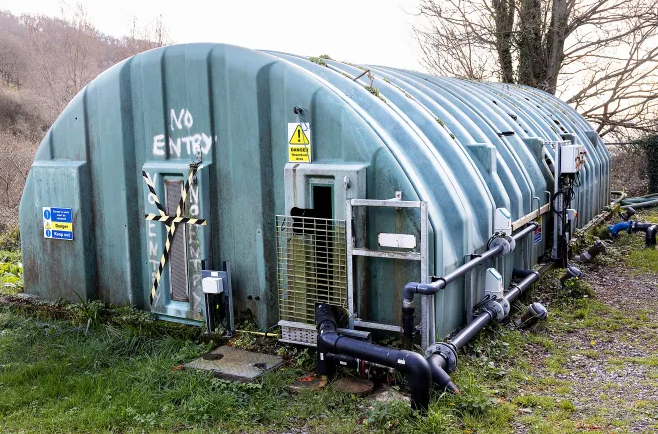
South West Water wastewater treatment works at Salcombe Regis, Devon – Mark Passmore for The TimesSalcombe Regis

Susan Davy, who had been chief executive of South West Water until she retired in December, is understood to live nearby. The company is investigating the sewage treatment works, Environment Agency emails seen by The Times show.

Richard Foord, the Liberal Democrat MP for Honiton & Sidmouth, said the pebble beach was a picturesque spot. He said: “South West Water is a disgrace. I wrote to the chief executive about spills at Salcombe Regis last October, and received the cliched reply about ‘we take the issues raised seriously’. Rubbish!”

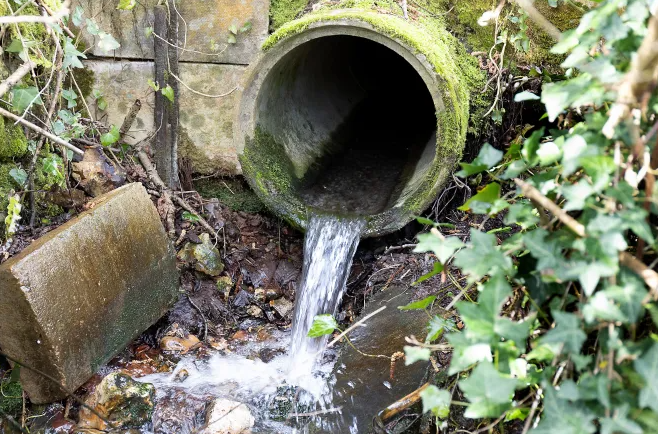
An outlet pipe near the South West Water Salcombe Regis treatment Works – Mark Passmore for The TimesSalcombe Regis

The second-worst site was a sewage works at Croyde in north Devon owned by the same company. It discharged 113 times right next to Croyde beach, a popular surfing spot and holiday destination. The coastline is designated a national landscape, a protected area formerly known as an area of outstanding natural beauty. South West Water also had the joint-fourth-poorest site, Abbotsham in north Devon, which had 86 spills into Kenwith stream.

Southern Water’s Lavant sewage treatment works was third, releasing raw sewage 96 times into the River Lavant, one of England’s globally rare chalk streams. Passing through Chichester, the waterway runs to Chichester Harbour. The harbour has several environmental designations recognising its importance for wildlife.

Photos and videos of the Lavant downstream of the Southern outfall, shared by the resident Rob Bailey, show clear signs of “sewage fungus” in the past three years. The fungus is formally known as a biofilm that is harmful to freshwater life.

Nick Backhouse, chairman of the Chichester Harbour Trust, said the state of the Lavant was now “dire” and Southern’s investment programme was a “small drop in the ocean”.

He said: “Chichester Harbour is one of Britain’s most important coastal landscapes, with rare saltmarsh, mudflats and internationally significant birdlife meeting the freshwater of the South Downs’ chalk streams.”

In joint fourth was Thames Water’s Stewkley sewage treatment works. Last year it caused 86 dry-day spills into a tiny stream, Hardwick Brook, in the Rushy Common Nature Reserve near Witney.

The Times recorded underwater video of the stream near the outfall. Upstream, the stones and plants of the riverbed can clearly be seen. Downstream, the water is extremely murky and aquatic flora is barely visible. Like Salcombe Regis and Lavant, the works have a long track record of high raw sewage spills.

Across England as a whole the total duration of dry-day spills last year was 157,803 hours.

The figures come during The Times’s Clean It Up campaign, which calls for better regulation, and after Channel 4’s Dirty Business drama.

Barbara Evans, a professor of public health engineering at the University of Leeds, said sewer blockages and a lack of capacity at sewage treatment works were two immediate reasons for the illegal spills. She added: “But the underlying reasons are climate change-related intensification of rainfall and long-term underinvestment in maintenance and upgrading in the system as a whole.”

Official figures at the end of this month are expected to show a significant fall in total legally permitted sewage spills last year because it was so dry last year. The decrease will be from a record high of 3.61 million hours in 2024.

Water UK, the industry body, said: “No spill is ever acceptable. Water companies are working to end them as fast as possible by tripling investment. Companies are investing £12 billion to halve spills from storm overflows by 2030 including relining and sealing sewers to prevent groundwater infiltration — one of the main causes of dry day spills.”

South West Water said: “Our customers want to see immediate action to reduce the use of storm overflows and this is our absolute priority — we have a record, multibillion-pound investment programme in place and while change on this scale takes time, we are already seeing results and we have committed to complete this work a decade ahead of government targets.”

Thames Water said: “Heavy rainfall can have an instant, adverse impact on our sewer infrastructure. However, over wider catchment areas rainwater and groundwater moves much more slowly, filtering through different geological formations at different rates. As a result, there can be a delay between a period of heavy rain and the increased flow reaching an overflow point, sometimes even occurring during dry weather.”

Steph Pullan, director of asset management at Yorkshire Water, said: “We know our historic performance hasn’t been as good as it should have been and we are focused on delivering improvements for our customers and the environment.”

Southern Water said groundwater levels in Lavant had been exceptionally high. Nick Mills, the director for environment and innovation, said: We’re tankering and pumping around the clock, and when that’s not enough we use storm overflows under Environment Agency oversight to keep communities safe.”

‘Heartbroken’ family want bonuses for water bosses banned over sewage scandal

South West Water says: “Remuneration is conditional on delivery of key objectives…”

I.e. Read the small print! – Owl

Tens of thousands have signed a petition amid the sewage scandal

(45,800 signatures this morning – add yours today on link below).

Lauren Beavis SWNS, Abigail Neep www.devonlive.com

A Devon family forced to cut swimming trips to their local beach over sewage fears is calling for a ban on bonuses for water bosses.

The Astleys live 20 minutes from Sidmouth beach in Devon, and they would visit often, saying they ‘lived and breathed’ by the water.

Marc, 61, his wife, Laura, 47, and four children, Sofia, 13, Sam, 14, Thomas, 17 and Molly, 19, are used to taking their swimmers, kayaks and paddleboards to the sea and local rivers all year.

Thomas even swam in the sea every month for a year in fancy dress to raise money for marine conservation.

Thomas Astley swam in the sea every month for a year in fancy dress to raise money for marine conservation

But as the years have gone by, the family’s “beloved” trips to the beach have become increasingly less frequent due to sewage spills revealed to them via the Surfers Against Sewage app.

The “heartbroken” family have also been left unable to swim in their local waterway, the River Otter, which has been revealed as one of the most polluted rivers in the country.

They have been forced to cut their swimming trips due to sewage fears and are now demanding change.

The “grim reality” has inspired Marc and his children to become dedicated ocean activists and campaigners.

Marc said that watching his son’s determination made him realise he needed to do more, and the family have now set up a petition to call for water company bosses to receive no more bonuses unless environmental regulations are met.

The Change.org petition, ‘Sewage should not = bonuses for bosses!’ has amassed 42,500 signatures in just under two weeks.

The petition comes at a charged moment as water bills are set to rise by an average of 5.4%, roughly £33, from April 2026, taking a typical annual bill to around £639.

Meanwhile, South West Water, the sector’s worst performer for pollution incidents in 2024, discharged an estimated 544,429 hours of untreated sewage into Devon and Cornwall’s seas and rivers.

Data from the Environment Agency Event Duration Monitoring system showed SWW pumped sewage into more than 1,100 different overflow locations, equating to approximately 153 sewage spills per day across the network of South West Water.

Marc, of Ottery St Mary, Devon, said: “We all love being at the beach, swimming at the sea even in December, taking the kayaks and paddle boards out.

“We even have to drag our kids out of the water sometimes when they are blue in the face!

“But when we first started swimming years ago, compared to now, the number of times we have had to knock the beach visit on the head and abandon mission because of a spill is completely outrageous.

“It really is heartbreaking seeing the kids itching to get into the water and having to tell them no because it’s serious and it could damage their health.

“For many people in Devon, the sea isn’t just scenery, it’s somewhere they swim, surf and spend time with their families.

“The response to the petition shows how deeply people care about the health of our rivers and seas.

“Enough is enough!”

Marc said the family created their petition, which is calling for stronger legislation surrounding the extra payments that water company executives receive, after watching Channel 4’s new documentary ‘Dirty Business’ – which explores an investigation into the UK’s sewage scandal.

Marc added: “This is about accountability!

“We were left so outraged and angry after watching the documentary that we were discussing as a family what we could do about it.

“So we created our petition with a simple principle: if environmental standards aren’t being met, executives shouldn’t be receiving bonuses.

“The government has introduced new powers intended to block pay-outs when environmental performance fails.

“But loopholes remain, rewards can still be restructured as retention payments or routed through parent companies.

“To the public, that looks like bonuses by another name.

“Meanwhile, families across the country are still checking sewage alerts before going for a swim!

“It is outrageous.”

Marc added that what particularly “enraged” his family and their community is “the sheer arrogance” of the water companies, who continue to increase their sewage spills.

He said: “These water companies are constantly pumping out PR.

“Even days after ‘Dirty Business’ was released they put out press releases chastising water users for putting items down the loo that they shouldn’t.

“We obviously don’t condone that, but it is just so tone deaf whilst they are the ones being exposed.”

Environmental activists have said the country’s sewage scandal is now a mainstream issue for communities, families and business owners that rely on clean rivers and coastal waters.

Marc says the amount of signatures that the petition has amassed over a short space of time highlights the “strength of feeling” from the country about the issue.

Marc said: “I just cannot understand why, with the level of anger, the strength of feeling there is now and how upset people are, politicians aren’t getting together and saying let’s do something about it.

“How they are still allowed to fudge bonuses is beyond me because water companies have a complete and utter disregard for their clients and customers.”

When the petition reaches 50k signatures, the family are going to contact their local MPs and bring their call to action to all water companies and parliament’s Number 10.

He added: “If you have the power, and can make such a big decision as to allow American planes to land in this country with the view to get them to bomb another country – why can’t you clamp down on water companies?”

Marc now runs Ocean Activist, a community initiative based in Ottery St Mary, which aims to raise awareness of ocean pollution and encourage communities to speak up for cleaner seas.

You can follow the family’s petition here:

https://www.change.org/p/sewage-should-not-bonuses-for-bosses

A spokesperson for South West Water said: “Remuneration is conditional on delivery of key objectives and is overseen and awarded independently. We recognise our customers’ concerns and are tackling the issues that matter to them most.

“We have cut spills at bathing beaches by 20% as part of our long-term plan – a 15-year journey backed by major investment and innovation to reduce the use of storm overflows. Change on this scale takes time, but the results are starting to show.”

Who are the key figures in the sewage crisis, and where are they now?

Water companies have been in the public eye for the wrong reasons again recently. South West Water was in the dock pleading guilty to supplying water unfit for human consumption, while the regulator fined South East Water £22.5m for repeated supply failures that affected more than 280,000 people over three years.

Sandra Laville www.theguardian.com

As the full scale of the sewage pollution scandal has been revealed to the public over the past six years, key figures working for the regulators and the privatised companies have been heavily criticised. Channel 4’s drama Dirty Business has focused attention on individuals at the heart of the scandal.

The Guardian examined what some of the main characters are doing today.


  1. James Bevan
    Sir Bevan, a former Foreign Office mandarin, was chief executive of the Environment Agency from 2015 until March 2023. He has been criticised from inside and outside the agency for failing to police the behaviour of water companies, stifling frontline fieldwork, reducing monitoring, failing to protect rivers, gagging staff, and when faced with growing public outcry about the state of English rivers, trying to weaken the tough regulations which repeatedly show how waterways are being choked by a cocktail of sewage and agricultural pollution.

    Bevan said he liked the system of operator self-monitoring, in which water companies were given the powers to report their own pollution – described by critics as marking their own homework. The Labour government is ending the practice. Bevan told MPs: “We have some quite sophisticated ways to check that data.”
    He was appointed a non-executive director of Dwr Cymru, or Welsh Water, a not-for-profit water company with no shareholders, in February 2025. The company said: “His extensive experience of environmental regulation and public policy … have been constructive and valuable during a period of significant activity including regulatory reform and investment in the sector.”

  2. David Black
    Black was chief executive of Ofwat from April 2022 to 2025. He joined the regulator in 2012 as director of economics, and was later promoted to chief regulation officer.

    In his time at the regulator water companies hugely extended their debt burden, above the Ofwat benchmark of 60%, created complicated offshore structures to minimise tax bills and paid high dividends while neglecting infrastructure. The economist Dieter Helm has described the way private companies have run the water industry as “great financial engineering”.
    Black left Ofwat in August 2025 after the government’s decision to replace the regulator. He is scheduled to appear at the Weekend of Mistakes Festival 2026 at Hay-on-Wye this month. He will talk about what went wrong with the UK’s water industry – and how to fix it – at the £150-a-ticket event.

  3. Richard Aylard
    Aylard, a retired Royal Navy officer, joined Thames Water in 2002 as corporate responsibility director and then became its external affairs and sustainability director.
    He was at the forefront of public anger over sewage pollution and water outages across south-east England. He is still at Thames Water as a director and special adviser to the chief executive. He has acted as a primary spokesperson for the company on environmental performance, such as discussing investment plans for sewage infrastructure.

  4. Matthew Wright
    Wright was chief executive of Southern Water between 2011 and 2016, when the company illegally discharged billions of litres of raw sewage into protected waters across Hampshire and Kent.
    A judge fined Southern a record £90m in 2020 for dumping between 16bn and 21bn litres of raw sewage into some of the most delicate environments in the country and falsifying data by “very significant under-reporting” of its number of illegal pollution spills. Ofwat had imposed a record £126m penalty on Southern in 2019 for the same offences.
    Wright, who was paid more than £5m during his time at the helm when the failings occurred left the company in December 2016 and became UK director of the Danish renewable energy firm Ørsted until 2020. He later worked at National Grid ESO and served as chief operating officer of Exagen Group until February 2024 as it shifted towards renewable energy. He admitted that the offences at Southern Water had happened “partly on my watch”.

  5. Susan Davy
    Davy was chief executive of South West Water for five years and was its chief financial officer from 2015 until her retirement in December last year. She ran the company while it was responsible for repeated sewage pollution and was given a two-star rating for environmental performance.
    She was also in charge when it supplied water unfit for human consumption to 2,500 households in 2024, for which it pleaded guilty on 4 March.
    Davy received an £803,000 pay package in the last financial year in her role after receiving £191,000 in long-term bonuses.
    On leaving she said: “Running a water company is always interesting, often challenging, but totally fulfilling. I have enjoyed taking responsibility for the provision of a sustainable service to millions of homes.”
    Ofwat imposed a £24m enforcement package on South West Water last summer after a three-year investigation into its failures in managing wastewater treatment works and sewer networks.
    The regulator said the company had failed to upgrade its treatment works to prevent sewage discharges into the environment, failed to properly deal with the content of its sewers and failed to put in the resources to monitor its treatment works properly.

  6. Nicola Shaw
    Shaw, the chief executive of Yorkshire Water, had her bonus banned last year under a law Labour brought in in 2025 to stop bonuses being paid to the heads of companies found to be the worst for sewage dumping.
    Yorkshire Water was given a £47m fine in 2024 for excessive spills from storm overflows as a result of poor maintenance. Ofwat said the company routinely released sewage, failing to ensure that discharges from storm overflows occurred only in exceptional circumstances, which had “resulted in harm to the environment and their customers”.
    Shaw still received extra payments totalling £660,000 from Yorkshire Water’s Jersey-registered parent company, Kelda Holdings, in the 2023-24 and the 2024-25 financial years.

  7. Sarah Bentley
    Bentley was the chief executive of Thames Water from September 2020 to June 2023. She joined from Severn Trent and promised an eight-year turnaround for the company, but left with immediate effect after three years following a public outcry over the discharge of raw sewage into rivers and missing targets on pollution and sewer flooding.

    Bentley said in 2023 that she would forgo her bonus for the 2022-23 financial year, but the company was accused of a flimsy PR stunt after it was revealed she had been given nearly double her annual salary with a £1.5m pay package. Bentley did little to stem the huge debts Thames Water took on, which stand at almost £20bn, or reduce record sewage pollution into the environment.
    She left during a major Ofwat investigation into illegal sewage discharges from almost three-quarters of Thames Water’s treatment plants. The regulator imposed a £104m penalty on the company in June 2024 for routinely discharging raw sewage into the environment. It said almost 70% of Thames’s treatment plants had operational problems, and that the company had failed to manage its wastewater networks effectively.

  8. David Henderson
    Henderson was the chief executive of Water UK, the trade association for the industry, when water companies were negotiating with Ofwat seeking reductions in pollution fines and higher returns on investment.
    Henderson is a former Downing Street official who was a longtime adviser to first Gordon Brown and then David Cameron.

  9. David Miliband
    Miliband was environment secretary in October 2006 at the time when the deal for Macquarie to take over Thames Water was agreed. Miliband has been president and chief executive of the International Rescue Committee (IRC), a global humanitarian aid organisation, since 2013.

  10. Regina Finn
    Finn was chair of Ofwat when it approved the Macquarie deal.
    Macquarie initiated a period of heavy financial leverage, debt accumulation and dividend extraction. It loaded Thames Water with significant debt while extracting about £1.1bn in dividends and interest payments, leaving it with a legacy of high debt. Thames Water has since admitted that the company sweated assets for decades.
    Finn now works as a director at the consultancy firm Lucerna Partners. One of her major clients is Thames Water.

Serial offender SWW now pleads guilty at Plymouth Magistrates’ Court

A week ago it was Exeter.

Another week, another court, another slapped wrist?

Why do we have to tolerate this? – Owl

South West Water admits illegal pollution in Devon and Cornwall

Jonathan Morris www.bbc.co.uk

Investigators found 336 illegal spills in the seven years to March 2020 at the firm’s Bodmin sewage works. Sewage reached the River Camel, a protected conservation area known for Atlantic salmon, otters and bullhead fish.

Untreated sewage was released 231 times between 2016 and 2021 at Harlyn beach in Cornwall, which is popular with families and tourists.

South West Water pleaded guilty to six illegal spills at nearby Holywell sewage pumping station.

Sewage flowed into Hooe Lake in Plymouth for 88 hours over a bank holiday weekend from 28 August to 1 September 2020 after a failure at the pumping station there.

Clarissa Newell, the Environment Agency’s environment manager for Devon and Cornwall, said: “Getting to this point and securing these guilty pleas was only possible thanks to years of thorough investigation and hard work by Environment Agency officers.”

The Environment Agency continued to do everything in its power to ensure “polluters must pay”, she said.

South West Water said the charges related to “historic matters between 2015 and 2021” and it had invested significantly since then, preventing more than 8,300 spills and cutting storm overflow use by 17% in the past year, with spill duration down by 25%.

It said upgrades had been made at the sites involved and it had worked to remove surface water and illegal connections from the network.

A spokesperson apologised “for what happened in the past” and said the firm remained focused on delivering cleaner rivers and seas.

South West Water was fined £2.15m in 2023 for similar pollution offences.

‘Broken privatised model’

Campaign group Surfers Against Sewage said while it was “all well and good” EA had prosecuted South West Water, it was not hopeful there would be much change.

Jo Morley, Surfers Against Sewage’s head of campaigns and advocacy, said: “In 2023, the same company was prosecuted for 13 charges and fined £2.15m, and here we are again, still swimming and surfing in sewage whilst polluters profit.

“These fines are simply the cost of doing business for water companies who pour sewage into our waters, making us sick whilst they cash in.

“The government must stop pandering to the polluters – the entire broken, privatised model needs to be torn up and replaced to end this scandal.”

Sewage pollution an “ongoing civil emergency” Cllr Paul Arnott 

Leader of EDDC gets a cameo quote in Leigh Day’s South West Water sewage pollution claim, latest Update 23.02.26:

Claim expands across Devon and Cornwall – Letter Before Action issued to South West Water and parent company Pennon Group PLC. Lead partner Oliver Holland describes this as “an important step in the claim”.

Which towns have been impacted by sewage pollution? 

As sewage pollution continues to affect the lives and livelihoods of coastal and river-based communities throughout the UK, residents and businesses in the South West are taking action. They are bringing a group legal claim against South West Water Limited (South West Water) and Pennon Group Plc in relation to allegations that these companies are responsible for sewage pollution affecting their coastal communities.   

The claim was initially brought on behalf of residents and businesses in Exmouth and Budleigh Salterton. It has since expanded to include other towns and beaches across South West Water’s area of appointment that are among the worst affected in the region. These include:  

  • Dawlish Warren and Dawlish (Devon) 
  • Sidmouth and Salcombe Regis (Devon) 
  • Teignmouth and Holcombe (Devon) 
  • Fistral Beach (Newquay, Cornwall) 
  • Longrock Beach (near Penzance, Cornwall) 

As highlighted in the recent Channel 4 docudrama, Dirty Business, sewage pollution is a widespread and severe issue across the country. The communities identified in this claim are among those most severely affected across the South West. 

Local beaches play a vital role in these communities, with local economies heavily dependent  on tourism. They are also culturally and socially significant, providing opportunities for sea swimming, water sports and access to the coastline. However, according to local reports, South West Water repeatedly discharges large volume of untreated sewage, with detrimental consequences for the condition and usability of these beaches.

The effects of these discharges have been acknowledged by both the Environment Agency and South West Water. In recent years, the Environment Agency has issued numerous ‘Advice Against Bathing’ notices in recent years, and South West Water has regularly stated on its website that discharges may affect bathing water quality.

More broadly, beaches across the South West have faced repeated disruption as a result of sewage pollution. The leader of East Devon District Council, Paul Arnott, has described the situation as an “ongoing civil emergency” following repeated closures from Seaton to Sidmouth. 

In 2022, Surfers Against Sewage identified Longrock beach as “joint worst” in England for sewage alerts. More recently, during the August 2024 Bank Holiday weekend, red flag warnings were raised on Exmouth Beach to prevent people from entering the water. Fistral beach has also been affected, with sewage alerts leading to the cancellation of surf events.

Go to the Leigh Day website to find out how to join.

Exmouth anti-pollution activists Sarah Lambert & Andy Tyerman feature in National News

Following last week’s Channel 4 docudrama on sewage pollution and the attitudes of the privatised water industry and regulators ” Dirty Business”; many National Newspapers wrote follow on pieces at the weekend.

The Guardian article started by describing Sarah Lambert’s experience and quoted Andy Tyerman of Exmouth’s anti-sewage pollution campaign Escape: “The situation is not getting better, things are getting tangibly worse.”

Dirty water, death and decline: the inside story of a privatisation scandal

www.theguardian.com (extract)

Sarah Lambert took her usual morning swim for 40 minutes off Exmouth town beach before her volunteer shift helping disabled people get access to the water.

A wheelchair user herself, Lambert’s regular sea swims twice a week between the lifeboat station and HeyDays restaurant were the perfect form of exercise for her disability.

It was August 2024, and a dry summer’s day on England’s south-west coast.

At 4.15pm, lifeguards shut the beach, erected red flags and asked people to leave the water after East Devon district council was alerted to a catastrophic burst of the main pipe pumping sewage to the town’s Maer Lane treatment works.

But it was too late for Lambert. She started vomiting later that day and was admitted to hospital suffering life-threatening sepsis after being infected by E coli and Citrobacter bacteria, both of which are commonly found in sewage.

Anger about the state of the privatised water industry in England intensified this week after the screening of Channel 4’s docudrama Dirty Business. It weaves the human tragedy of the death from E coli O157 poisoning of eight-year-old Heather Preen in 1999, who had paddled just the other side of the Exe estuary from Lambert’s swimming spot, with the unfolding of an environmental and public health crisis. It explores three decades of underinvestment by water companies, uncovered in part by amateur sleuths Peter Hammond and Ash Smith, as well as the cosy relationship between the water companies and those meant to be holding them to account.

Lambert is now frightened and anxious about sea swimming, the form of exercise she used to love. “I was seriously ill, I spent a week in hospital before I had to have 10 more days of intravenous antibiotics at home,” said Lambert, 47, who is part of a group environmental legal claim against the local water company, South West Water.

“It took me a long time to recover. I am disabled, so I am quite vulnerable, and I moved to Exmouth to be coastal. The sea is just on my doorstep, but I don’t swim there any more. None of this is right, none of this is acceptable.”

England remains an anomaly across the world, as the only country apart from Chile where water, a natural resource, is owned by private companies for profit. The then Conservative prime minister, Margaret Thatcher, promised in 1989 that privatisation would deliver higher investment.

But as far back as 2002, ministers were warned in a report, which has remained secret, that privatisation would allow large external private equity shareholders to load companies with debt, and the financial regulator Ofwat inevitably would lose any regulatory control.

Now, Prof Pedro Arrojo-Agudo, the UN special rapporteur on the human right to clean water, has singled out the English system for criticism, saying water should be managed as a publicly owned service, rather than run by private companies set up to benefit shareholders.

Lambert, like others across the country who closely monitor the performance of their water companies, agrees with the UN rapporteur.

“The situation is not getting better, things are getting tangibly worse,” said Andy Tyerman, of Exmouth’s anti-sewage pollution campaign Escape. “South West Water set its own target for 2025 to be a four-star performer. But they have never been anything higher than two-star for more than 10 years. They set a target of no more than 20 sewage spills on average; last year there were 40 spills on average. We seem to be going backwards to the 1990s.”………

The water company whistleblowers exposing shocking practices

The Times (Extract)

(Feargal Sharkey) says he has been contacted by a huge number of people in recent days who were infuriated by Dirty Business. “It portrayed in the starkest way possible the brutal reality of what’s been going on in the background: that even behind all of these sensational headlines and the Times campaign and the work that everybody’s done, you see the lengths the water companies, the Environment Agency and indeed the government, were going to to wilfully look the other way. Everybody in the country should be outraged. Peter and Ashley are just the beginning of an absolute tidal wave of anger that’s heading in the government’s direction.”

More on: South West Water admits supplying water unfit for humans after ‘abhorrent’ parasite outbreak

SWW pleaded guilty at Exeter magistrates’ court yesterday.

Mr Joseph Millington, acting on behalf of the Drinking Water Inspectorate (DWI) , called for the sentencing to take place at the crown court, where larger fines can be issued.

He said: “Given the high-profile nature of this case, and to ensure that the message is heard loud and clear by local residents that the criminal justice system will treat offences of this nature with the utmost seriousness, we respectfully submit that the crown court would be the most appropriate venue to deal with this case,”

But Mr Dominic Kay KC, representing South West Water, argued that sentencing should take place at the magistrates’ court. He said the company’s view was that the incident was at the “medium” level of culpability in sentencing guidelines.

Read on to find out who won this particular argument: the DWI or SWW? – Owl

Alex Ross www.independent.co.uk

A total of 143 people were confirmed to have caught the waterborne disease, which causes sickness and diarrhoea, after it entered the water network in Brixham almost two years ago, due to a damaged valve in the network.

The company, which initially said the water was safe to drink as cases first emerged, issued a “boil water” notice to thousands of households and businesses, instructing them not to drink tap water without boiling it first.

South West Water has admitted supplying water unfit for human consumption after an outbreak of cryptosporidiosis in a Devon seaside town that left dozens of people ill.

At Exeter Magistrates’ Court on Wednesday, the firm pleaded guilty to supplying water unfit for human consumption within the Littlehempston Water Supply Zone between 31 March and 1 June 2024.

Inside the courtroom were several residents from Brixham, some of whom claimed to have suffered medical conditions since the outbreak, including irritable bowel syndrome. They said the town had suffered “untold damage” as a result of the outbreak.

Water minister Emma Hardy also reacted to the guilty plea, describing it as a “crucial step toward accountability”. She said: “Contamination of drinking water is rare – but it is utterly unacceptable. The communities affected by this abhorrent incident in Brixham deserve answers.”

The prosecution was brought by the Drinking Water Inspectorate (DWI), which investigated the incident along with the UK Health Security Agency. The court heard that it was the DWI’s view that the offence was at the “higher end of culpability”.

Mr Joseph Millington, acting on behalf of the DWI, said: “Not only was this a high-profile case, but this incident impacted a significant number of people across a broad geographical area.

“It resulted in an adverse impact in the public confidence in water supply in the area.”

“Its effects were, some of the complaints say, long felt after the lifting of the boil water notices [which lasted eight weeks]. There was, of course, local inconvenience, economic impact, and impact on education throughout this incident.”

Mr Millington called for the sentencing to take place at the crown court, where larger fines can be issued.

He said: “Given the high-profile nature of this case, and to ensure that the message is heard loud and clear by local residents that the criminal justice system will treat offences of this nature with the utmost seriousness, we respectfully submit that the crown court would be the most appropriate venue to deal with this case,”

But Mr Dominic Kay KC, representing South West Water, argued that sentencing should take place at the magistrates’ court. He said the company’s view was that the incident was at the “medium” level of culpability in sentencing guidelines. District Judge Stuart Smith decided to keep the case in the magistrates’ court for sentencing, which will take place in June.

Among those in the public gallery was resident Tanya Matthews, who was one of the first people to report feeling unwell on social media, triggering a wave of similar complaints. After falling ill, the 42-year-old said she went to hospital with continued stomach complaints, and now suffers from irritable bowel syndrome.

She told The Independent: “I’m just glad we’ve got this far and someone will take accountability for what happened. The town and its people have suffered untold damage from the outbreak, and now we are being heard.”

Following the outbreak, locals had complained about a lack of communication from the company and the knock-on impact of the incident on tourism for the town.

There was also anger after South West Water initially said the water was safe to drink on 14 May, after the first confirmation of cases of cryptosporidiosis, before issuing the “boil water” notices a day later.

Following the outbreak, South West Water chief executive Susan Davy, who stepped down last year, said she was “truly sorry”.

Ms Davy said: “To those in the affected area and our customers across the southwest, I am truly sorry for the disruption and wider anxiety this has caused. While incidents like these are thankfully very rare, our customers expect a safe, clean, and reliable source of drinking water.”

Also speaking after Wednesday’s hearing, residents Lisa and Kris Horswill said they still do not drink tap water as a result of the outbreak. “Now they will get fined, but who will that hit? Those paying the bill, of course,” said Mrs Horswill, 54.

Caroline Voaden, MP for South Devon, said the admission was a “long time coming”.

She said: “I am glad that SWW have owned up to their serious failures. This awful event should never have happened.”

Marcus Rink, chief inspector of the DWI, said: “While such incidents are very rare, this incident had a significant impact on the public and the wider community. The court will now decide what the outcome of the failing should be.”

The case was adjourned for sentencing at Exeter Magistrates’ Court in June.

Breaking: Caught with their pants down! But will they get more than a slap on the wrist?

Water firms pleads guilty to Brixham bug outbreak

SWW admitted the offence, contrary to the Water Industry Act 1991, at Exeter Magistrates’ Court. It will be sentenced at a later hearing.

Brixham MP, Caroline Voadon, said: 

“Last summer, the government finally started to overhaul our water industry by promising to abolish Ofwat. But progress has been glacially slow. They must go much further and faster – this industry must be properly regulated and held to account.”

http://www.radioexe.co.uk

Devon’s main water supplier has admitted to providing water unfit for human consumption following a parasite outbreak in Brixham. 

In a hearing at Exeter magistrates’ court today (March 4), the firm admitted a charge brought by the Drinking Water Inspectorate.

In May 2024, the microscopic parasite Cryptosporidium entered the local water network through a damaged valve, leading to four hospitalisations and 143 cases of people falling ill with symptoms such as fever, stomach pain, vomiting, and diarrhoea. 

The waterborne disease parasite is found in animals and human faeces, according to the UK Health Security Agency.

For nearly eight weeks, the town was under strict boil water notices. Up to 16,000 homes and businesses were affected and relied on bottled water stations distributed throughout the area. 

The notice remained in effect until July 2024, causing significant disruption to daily life and the local economy.

Over the eight weeks, more than 1,000 technicians, engineers, and scientists worked 24/7 to sanitise the network, with just over 20 miles of pipes flushed 27 times at high velocity. 

The company reported a total cost of £16.3 million in the dedicated tourism recovery fund, as well as a three-year commitment to help the region bounce back from the negative publicity. 

In total, the outbreak cost South West Water £16.3 million in compensation it had to pay to affected customers.

MP Caroline Voadon serves the area, says 

“This admission of guilt has been a long time coming. I am glad that SWW have owned up to their serious failures. This awful event should never have happened.

“But the mismatch between rhetoric and action plagues our broken water industry. Whether it is protecting customers or the environment, too many water firms say one thing, then do another.

“I want to thank the Drinking Water Inspectorate for bringing the case and the many campaigners who worked tirelessly to ensure the anguish they felt during the cryptosporidium outbreak was not forgotten.

“Last summer, the government finally started to overhaul our water industry by promising to abolish Ofwat. But progress has been glacially slow. They must go much further and faster – this industry must be properly regulated and held to account.”