
Thought for the day … on inequality

“Private housebuilders have been accused of “appalling self-interest” over their lobbying against building more accessible homes for disabled residents.
The Home Builders Federation (HBF) has been objecting to councils across England that wish to fix new targets to increase the number of homes with room for wheelchair users and which could be adaptable.
It has made submissions to at least 17 authorities, from Liverpool to Sevenoaks, arguing that new local planning policies seeking more accessible housing could make it unprofitable to build new homes. The submissions also question whether predictions of an ageing population mean an increased demand for adaptable and accessible housing would be certain.
Charities including Age UK, the Centre for Ageing Better and Disability Rights UK said on Tuesday they were alarmed at its objections to planning policy proposals to make greater disability access mandatory. It said only 7% of homes were classed as accessible and that building to a higher accessibility standard would cost about £500 more.
The HBF represents highly profitable housing firms including Persimmon, which recorded gross profits of £565m in the first six months of this year, during which it built 8,000 new homes – a margin per home of about £70,000.
“Without homes that enable us to live safely and independently for as long as possible, we will see increased and unsustainable pressure on our health and social care services and much-reduced quality of life for people in older age,” the charities told the HBF in an open letter.
Unless it was enshrined in local planning policy, it remains optional under national regulations to incorporate features that make new homes suitable for people with reduced mobility and some wheelchair users. It also remains voluntary to make them fully wheelchair accessible, unless town halls make it mandatory.
In one submission to Broxbourne council in Hertfordshire, the HBF said: “The key issue we have with … policies that add financial burdens on the development industry in this local plan is that they have not been effectively tested.”
Objections have been raised by the HBF where it believes councils have not taken into account the financial impact of the proposals alongside other demands such as the provision of affordable housing, and said that if a council wanted to prioritise disabled access, it should reduce its demands for affordable homes.
An HBF spokesman said: “New homes are already more accessible than those built previously, but not all homebuyers want a home that has been adapted for accessible use.
“If government deemed that all homes should be built to higher accessibility standards it could make it a requirement. Currently levels are set by the planning system, which specifically requires local authorities to provide evidence to support their demands.”
“Their attitude is appalling self-interest,” said Cllr Pam Thomas, a wheelchair user and cabinet member for inclusive and accessible city at Liverpool city council, which has faced objections from the HBF to its plan to make 10% of new homes wheelchair accessible. “If they looked at this properly they would realise there wasn’t a problem with the cost or [extending] the footprint. They need to have a social conscience here.”
“Cuts to public services and benefits that disproportionately affect the least well-off, single parents and disabled people put the government in breach of its human rights obligations, a study for the UK equalities watchdog has found.
Echoing the recent findings of the UN special rapporteur on extreme poverty, Philip Alston, the study concluded the scale of the cuts and their lopsided impact on the most disadvantaged were a policy choice, rather than inevitable.
“There were a lot of choices, and the government chose to balance the budget on the backs of the poorest,” said the study’s co-author, Jonathan Portes, a professor of economics at King’s College London.
The study examined the impact of spending on the NHS, social care, police, transport, housing and education between 2010 and 2015 on various groups in England, Scotland and Wales. It also looked at the expected impact of spending plans for these sectors to 2021-22, and tax and benefit changes.
On a per-head basis, reductions since 2010 were significantly higher in England – equivalent to about 18% – than in Wales (5.5%) and Scotland (1%), in part because the devolved governments chose to mitigate some effects of the cuts, it said.
The poorest 20% of people in England lost an average of 11% of their incomes as a result of austerity, compared with zero losses for the top fifth of households.
Measured in cash terms, total spending on public services will have fallen by £1,500 per household in England by 2021-22, compared with just under £500 in Wales and £200 in Scotland, according to the study commissioned by the Equality and Human Rights Commission. …”
https://www.theguardian.com/society/2018/nov/28/spending-cuts-uk-human-rights-obligations-report
“More than 600,000 homes across England are currently vacant, with a third empty for six months or more, government figures show.
Official figures obtained by Attic Self Storage revealed the number of vacant properties has increased over the last few years to a 605,891 high. At the same time, homelessness has also increased with the latest government figures showing more than 4,700 people are sleeping rough on any given night in England. …”
https://www.housebeautiful.com/uk/lifestyle/property/a25261859/vacant-homes-england/
“Millions of women in low-paid, part-time work will be among the main losers from tax and benefit changes that will come into effect in April, despite repeated government promises to help them, a new study of the chancellor’s recent budget has shown.
Analysis of the latest changes, carried out by the Institute for Public Policy Research (IPPR), has also found that income for the top 10% of households will increase by £1bn more than for the bottom 10%, widening the overall earnings gap between the richest and poorest.
Philip Hammond used his third budget to bring forward by a year a Conservative manifesto pledge to increase the tax-free personal allowance to £12,500 and raise the higher-rate tax threshold to £50,000.
Last week the women and equalities minister, Penny Mordaunt, said the government was committed to helping low-paid women. “We need to broaden out our work beyond the FTSE 350, beyond London, beyond women executives and big business,” she said. “We need to focus on small business, part-time work, women from all parts of the UK, low-paid women, women with multiple barriers to meeting their full potential.”
But the IPPR study, released to the Observer, shows that the vast majority (73%) of those who will fare worst from the budget changes – missing out on tax cuts because they earn too little to profit from the rise in allowance, and suffering reductions in real incomes as a result of the benefits freeze – will be women.
Many of these are part-time workers, a section of the workforce where median pay is £10,000 a year, and so below the new personal tax threshold of £12,500. …”
Here he is at 12 years old talking about his love for money and his hero:
https://www.bbc.co.uk/news/av/uk-43922740/the-voice-of-the-12-year-old-jacob-rees-mogg
Owl says:
Matthew 21:16 (King James version)
“And said unto him, Hearest thou what these say? And Jesus saith unto them, Yea; have ye never read, Out of the mouth of babes and sucklings thou hast perfected praise?”
Don’t think Jesus meant praise for the Conservative Party!
Oh, and his hero Arnold Weinstock?
“Arnold Weinstock spent 40 years building the General Electric Company into a British industrial powerhouse encircling the globe, selling power plants to China, locomotives to America and advanced radar systems to the Gulf. Weinstock’s style of management was frugal and unique. He prided himself on the company’s dingy headquarters at Stanhope Gate in the heart of London. Walls were never painted until they peeled. Visitors were offered water, not tea or coffee.
He would work in his sixth-floor office until late in the night, checking management accounts from dozens of subsidiary companies line by line. Managers lived in dread of the late-night call from the boss who insisted that every screw be properly accounted for.”
https://www.thisismoney.co.uk/money/news/article-1551157/The-16311bn-wreckers.html
“Construction of homes for social rent drops 80% in a decade:
The number of new homes built for social rent has fallen by almost four-fifths in a decade, according to official figures that come as more than 1 million families are stuck on waiting lists for council housing in England.
Figures released by the Ministry for Housing, Communities and Local Government show just 6,463 homes were built in England for social rent in 2017-18, down from almost 30,000 a decade ago.
Condemning the lack of new social housing, Labour said that a the current rate of construction it would take at least 170 years to house the families on waiting lists.
John Healey, the shadow housing secretary, said: “These figures confirm the disastrous fall in the number of new affordable homes for social rent under the Conservatives.”
Despite the sharp decline, the overall number of properties constructed in England that were classified by the government as affordable rose by 12% last year to 47,355.
The bulk were built for so-called “affordable rent”, where rental costs are capped at 80% of local private sector rents. Affordable rent properties are typically favoured by the building industry because developers tend to make larger profits on them.
Unlike affordable rent, social rental properties also take into account local incomes as well as house prices. Campaigners have criticised the term affordable rental properties for “turning the English language on its head”, saying they are still unaffordable to many people in London and the south east.
The number of affordable rent properties has soared since they were introduced by the Conservative-Liberal Democrat government in 2011, as the number of social rent properties has declined. Almost 27,200 were built last year, up from about 24,300 in 2016-17.
About 57% of all new affordable homes built last year were for affordable rent, while just 14% were for social rent. The rest are intermediate affordable housing, which includes shared ownership properties and affordable home ownership schemes.
In England, about 1.25 million families were registered on the waiting list for social housing between 2016-17. About two-thirds have been waiting for more than a year. On average, an English local authority has more than 3,500 families on its books.
In her Conservative party conference speech last month, Theresa May said a cap on local authority borrowing for the construction of new homes would be scrapped, a step designed to increase the number of new homes built across Britain.
Patrick Gower, a residential research associate at the estate agency Knight Frank, said the prime minister would be encouraged by the 12% rise in the number of affordable housing completions.
He said the number of affordable homes starting to be built last year also increased by 11% to 53,572. “The number of homes likely to complete in the coming two to three years is also likely to increase,” he added.
Increasing the number of affordable homes has become a top priority amid a national housing shortage exacerbated by high house prices. High rental costs have added to the pressures facing households across the country.
Councils used to build more than 40% of affordable or social homes in the 1970s but there has been a shortage of properties since Margaret Thatcher introduced right to buy in the 1980s.
Mark Robinson, the chief executive of Scape Group, a public sector construction outsourcer, said: “Councils must be empowered to build social housing themselves, as they were in the 1970s.”
“Major areas of concern remain with , a group of MPs warn today in an urgent report calling on ministers to push back any vote on the flagship welfare reform.
The Commons Work and Pensions Committee claims that getting “managed migration” – the process of transferring claimants from existing benefits to universal credit – wrong when it starts in mid-2019 could “plunge claimants into poverty and even leave them destitute”.
Despite money being allocated for universal credit at the Budget, the committee warns that “major areas of concern” about the welfare reform remain.
It adds that MPs in the Commons have not had a chance to scrutinise and report on the revised regulations brought forward by the government in November, and claims the indicative timetable suggests “there will be no opportunity for expert scrutiny”.
While a specific date has not yet been allocated for the vote by the government, the committee recommends that no vote take place until the Social Security Advisory Committee (SSAC) has been able to report on the regulations.
The report states: “These regulations have a profound effect on the lives of millions of people, including some of the most vulnerable in society. It is impossible to overstate the importance of getting them right.” …
“At least 320,000 people are homeless in Britain, according to research by the housing charity Shelter.
This amounts to a year-on-year increase of 13,000, a 4% rise, despite government pledges to tackle the crisis. The estimate suggests that nationally one in 200 people are homeless.
Shelter says its figures, which include rough sleepers and people in temporary accommodation, are likely to be an underestimate of the problem as they do not capture people who experience “hidden” homelessness, such as sofa-surfers, and others living insecurely in sheds or cars, for example.
Newham in east London is ranked as England’s number one homelessness hotspot, with at least one in every 24 people in housing insecurity. More than 14,500 people were in temporary accommodation in the borough, and 76 were sleeping rough.
In the capital as a whole, 170,000 people – equivalent to one in 52 – have no home. Westminster had the most rough sleepers, 217, followed by Camden, with 127. In Kensington and Chelsea, the UK’s richest borough, there were over 5,000 homeless people – equivalent to one in every 29 residents.
The figures indicate how homelessness and housing insecurity is spreading beyond its traditional heartland of London into the wider south-east and Midlands, and the impact of high rents and welfare cuts ripples outwards.
Outside the capital, high homelessness rates were recorded in Birmingham, Luton, Brighton & Hove, Slough, Dartford, Milton Keynes, Harlow, Watford, Epsom, Reading, Broxbourne, Basildon, Peterborough and Coventry.”
“Families living in poverty because of the benefit cap could consider taking in a lodger to make ends meet, a minister has suggested, prompting a scathing response from the MP questioning him about the system.
Justin Tomlinson, the junior work and pensions minister, told MPs that other ways families could cope with the impact of the cap would be to move, or to seek to renegotiate their rent so it was cheaper.
Answering questions from the work and pensions committee, Tomlinson also said there was no specific government analysis taking place about the impact on people of the cap, introduced under David Cameron’s government, and reduced in 2016.
The absolute maximum amount of benefits a couple can receive, whatever their circumstances, is £20,000 a year, rising to £23,000 in London.
While the government argues it incentivises people to work and prevents the unfairness of people on benefits receiving more than the average wage, critics say it is pushing many families into extreme poverty and debt.
Questioning Tomlinson and the DWP’s head of working-age benefits, Pete Searle, the Labour MP Ruth George asked what analysis was being done into this effect. Stephen said that as part of a wider evaluation of “other outcomes” of the policy, officials were looking into how people “respond to the cap”.
George said: “Responding to the cap – does that include things like having to switch the heating off and be freezing cold at night? Does that include things like not being able to feed their children to a nutritionally decent standard?”
Almost two-thirds of people affected by the cap were not entering work, George, the MP for High Peak, said.
Tomlinson responded: “Of those, some will have made other changes, including in their housing costs, whether that is either moving or renegotiating what their rental housing costs are. Or they could, for example, take in a lodger. So there’s other circumstances than work.”
George responded with incredulity: “These are large families, they’ve often got three children in one bedroom. How are they going to take in a lodger?”
Tomlinson said this was an argument in favour of the government’s bedroom tax: “If there’s three children in one bedroom then you should start joining us in supporting releasing more family homes through or spare room subsidy changes.”
While some tenants in social housing are allowed to take in lodgers, for those in private accommodation it usually needs the landlord’s permission, and any income would need to be declared.
Explaining the reasons for the benefit cap to the committee, Tomlinson said it had three objectives: saving money; the “fairness test” over comparisons with working incomes; and incentivising work.
This had worked for many families, he said. “For those people where it has made a difference, it has significantly improved their life chances, for not just them but for their children.”
But George pointed out that of those affected by the cap, 81% are not subject to “work conditionality” – meaning circumstances such as very young children dictate they are not automatically expected to seek work.
Later in the session, the committee chair, Frank Field, asked if there were any plans to raise the cap, given rising rents and other costs.
Tomlinson replied: “There isn’t any work at the moment that I’m aware of that’s looking to change that cap.” Searle added that it was reviewed at least once every parliament.”
“Denise Coates, the multibillionaire founder and boss of the gambling firm Bet365, paid herself £265m last year in a record-breaking pay deal for the chief executive of a British company.
The huge pay package, which equates to nearly £726,000 a day, dwarfs the previous UK record set by Coates when she collected £217m a year earlier.
Coates was paid a base salary of £220,004,000 in the year to March 2018, accounts filed at Companies House on Wednesday reveal. On top of this, she collected dividend payments of £45m from her more than 50% shareholding in the Stoke-based company. Bet365 made a £660m profit last year from a record £52.6bn of bets.
Her pay is more than 9,500 times the average UK salary, 1,300 times that collected by the prime minister and more than double that paid to the entire Stoke City football team, which Bet365 owns and which was relegated from the Premier League last season.
Luke Hildyard, a director of the High Pay Centre, said: “Why does someone who is already a billionaire need to take such an obscene amount of money out of their company? It is difficult to find a reason beyond pure greed.
“A payment of this size would be impossible to justify for someone whose business was in unquestionably life-enhancing products or services. It is doubly offensive when awarded to a betting company CEO at a time when problem gambling is spiralling out of control.”
Mike Dixon, the chief executive of the addiction charity Addaction, said: “It’s astonishing that a CEO of one gambling company is paid 26 times more than the entire industry’s contribution to treatment. We know problem gambling affects more than 2 million people. We need a proper levy on gambling industry profits so more people can get help and support.” …
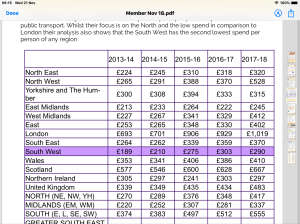
Source: IPPR, published in South West Councils News
“Hypocrisy in British politics comes as no surprise to your mole, who has recently had to report on Brexiteers with second homes in Europe, the Mail discovering closed borders are bad, and liberals defending the gulag. But this latest IRONY ALERT has slapped it right in the snout.
Esther McVey, the recently resigned Secretary of State for Work & Pensions overseeing Universal Credit’s disastrous roll-out, has tweeted to the general public about her lower wages after stepping down from the government post.
“By resigning, my salary has been halved,” she tweeted, to a nation of people experiencing punitive sanctions, delayed payments, cuts to their benefits, rent arrears, loss of income, eviction, food bank use, and less money for their disabilities, illnesses and child support thanks to her former Department’s policies.
In what McVey clearly thought was a SICK BURN in response to a guy on Twitter suggesting jokingly that she should be sanctioned for leaving a job voluntarily (as is the case under the DWP’s social security system), she clarified that – actually, yes – she did suffer a loss of income when she left her job.

This wasn’t quite the zinger she hoped it would be, however, considering the horrifying lack of self-awareness that someone on an MP’s salary – who had presided over a government system making people worse off against their will – would think it appropriate to point out the loss of income from their own political decision.
“Extracts from the UN report on poverty in GB by Professor Philip Alston,
16 Nov 2018
• 14 million people, a fifth of the population, live in poverty. Four million of these are more than 50% below the poverty line,1 and 1.5 million are destitute, unable to afford basic essentials.
• For almost one in every two children to be poor in twenty-first century Britain is not just a disgrace, but a social calamity and an economic disaster, all rolled into one.
• The Government has remained determinedly in a state of denial. British compassion for those who are suffering has been replaced by a punitive, mean-spirited, and often callous approach apparently designed to instill discipline.
• In England, homelessness is up 60% since 2010, rough sleeping is up 134%.
In-work poverty is increasingly common and almost 60% of those in poverty in the UK are in families where someone works.
• Low wages, insecure jobs, and zero hour contracts mean that even at record unemployment there are still 14 million people in poverty.
• One pastor said “The majority of people using our food bank are in work…. Nurses and teachers are accessing food banks.”
• The costs of austerity have fallen disproportionately upon the poor, women, racial and ethnic minorities, children, single parents, and people with disabilities.
• The Equality and Human Rights Commission forecasts that another 1.5 million more children will fall into poverty between 2010 and 2021/22 as a result of the changes to benefits and taxes, a 10% increase from 31% to 41%. Sanctions against parents can have unintended consequences on their children.
The experience of the United Kingdom, especially since 2010, underscores the conclusion that poverty is a political choice. Austerity could easily have spared the poor, if the political will had existed to do so. Resources were available to the Treasury at the last budget that could have transformed the situation of millions of people living in poverty, but the political choice was made to fund tax cuts for the wealthy instead.”
Owl says: how will Randall-Johnson and her cronies try to malign Claire Wright on this one with the overwhelming evidence Claire and her committee produced to show that cuts have gone much, much too far – to the point where it seems basic human rights are being infringed every day particularly for the dying?
Could Randall-Johnson and her cronies imagine some of the things described below happening to their parents, partners, siblings, friends?
What happened to this country – and this county – that health care has been allowed (nay, encouraged) to sink so low?
And all a political choice, NOT an economic one.
Shame on you Tory Health and Wellbeing Scrutiny for allowing this to happen.
“A scrutiny review into the system that’s designed to replace community hospital beds is recommending a raft of measures that will be debated at Devon County Council’s Health and Adult Care Scrutiny Committee, on Thursday this week.
I chaired the review, which took place during the summer and found that the care at home (or Rapid Response) service was very stretched and care of the dying in particular was highlighted as an area of concern, especially since community hospital beds had been closed.
Over 200 Devon community hospital beds have been closed in the past five years or so.
We interviewed a range of witnesses, including Dr Paul Hynam, GP and Secretary of the Local Medical Committee, GP, Dr Mike Slot (whose concerns prompted the review), Ann Rhys, Assistant Director of Care at Hospiscare and Richard Westlake, Chair of Exeter Patient and Public Involvement Group.
Also interviewed were various senior managers from Devon County Council and the local NHS.
I proposed the Spotlight Review after Sidmouth GP, Dr Mike Slot, attended the January Health and Adult Care Scrutiny Committee to outline his concerns about how care at home (or Rapid Response) was working.
Dr Slot said that although he supported it in principle, there simply weren’t enough carers available to look after patients.
On Thursday (22 November) health scrutiny councillors will be asked to endorse 12 recommendations, including:
– No further community hospital bed closures
– Consideration of reopening some community hospital beds on a flexible basis to ease pressure on the system
– A review of all intermediate (temporary bed-based) care provision across the county
– A standardised approach to Rapid Response across the county, including having GPs on the team
– A review of Hospiscare’s role in end of life care, with a view to providing more financial support
Sadly, the biggest pressure on the local healthcare system seems to be care of the dying.
This outcome was predicted by some GPs before the community hospital beds were closed.
Hospiscare’s Assistant Director of Care, Ann Rhys, told councillors that since the community hospital beds had closed Hospiscare had seen a significant increase in pressure on the service and a resultant large increase of patients dying in their 12 bedded inpatient unit in Exeter.
In the last three months (reported over this summer) 40 patients have been unable to access Rapid Response.
Worryingly, staff can make phone contact three to four times a day to the Rapid Response service because there is NOT support available. This is very time consuming and has a significant impact on community teams.
Councillors were very concerned to hear that one East Devon Hospiscare nurse had reported that in just one month during the summer there were eight instances where no care was available.
GP feedback revealed that the service has led to a lack of confidence by some GPs who say they spend a long time trying to find carers to support a patient at home, only to find there is no support available.
The result is then an admission to the local acute hospital instead. Something the service was set up to avoid.
The NEW Devon Clinical Commissioning Group did not provide hospital readmission rates to the scrutiny review, despite being asked several times to do so.
A survey to GPs prompted responses mostly from East Devon. Some of the comments are below:
– “Sometimes it can take some time to get a call back informing you that they cannot get the care requested, meaning the patient needs to be admitted much later in the day.”
– “Since the closure of community beds and supposed reallocation of funds the service seems rather worse than better.
– “I take the view when with a patient that I won’t be able to access Rapid Response but if I can it’s a bonus.”
– “Sadly SPOA (Rapid Response) sounds great, but in reality, it’s a time-consuming referral with low probability of delivering the service you want.”
– “I have had three recent episodes where I have called SPOA (Rapid Response) in recent months and they have been unable to put in appropriate care. Patients have been sent to the RD&E for admission. It is a frustrating process – often not staffed well enough so details at the point of contact cannot be taken. Most cases seem to involve two to four calls back to speak to the right person. GPs under pressure are tied up for too long by the service. So long in fact it has made me not want to use the service. It would be easier to admit patients than it is to call SPOA and arrange care – or try to arrange the care…. “
– “Our allocated care agency handed back their contract and we have been left with very little support for care… when we need Rapid Response to support patients and prevent admission we cannot link into subsequent long-term care packages. I had one chap with a neurological condition who had Rapid Response for over a year!”
I am really really glad this piece of work was carried out and I am proud to be the spotlight review’s chair.
For years we have been told by senior managers that the system is working well, with just a few minor problems. This report and the conversations we have had with people who work at the coalface clearly shows a different picture. A worrying picture that needs fully examining.
I trust that councillors who sit on Devon County Council’s Health and Adult Care Scrutiny Committee will fully support the recommendations.
Here’s the link to the report, which will be debated and voted on Thursday (22 November) https://democracy.devon.gov.uk/documents/s22439/RR%20Report%20final.pdf
“The UN envoy’s visit and report concluding that “Austerity has inflicted misery on people” (Report, 17 November) could not be more important. His confirmation that poverty and humiliation has been heaped upon millions of vulnerable men, women and children by this government has to be a spur to action for us all. As Philip Alston said with great clarity, “in the UK poverty is a political choice”. A deeply shameful one. For once, someone listened to those who are struggling to survive and care for children without homes, healthcare or an income. After all, a personal or health crisis can plunge anyone into poverty.
We can all get caught up in the demands, distractions and problems of our everyday lives (including Brexit), but this reflects on our humanity and it is to our shame if every one of us does not continue to fight against these punitive policies with every fibre of our being. Rising destitution and a generation of children suffering deprivation must never become the new normal. Food banks and practical help are essential in the short term, but we have to achieve change and constantly reject government rhetoric denying the devastating impact of austerity policies and denigrating vulnerable people as “undeserving”. All this while tax cuts are given to the rich. None of us can stand by.
Liz Udall
Carshalton, London
• At last, someone has looked behind the curtain of Brexit Britain and found what really fuelled the anger. It took the UN’s rapporteur just two weeks to see the reality, but Labour under Jeremy Corbyn has consistently failed to highlight this issue as a key factor in the Brexit vote, ignoring the reality that has been obvious for years as wages stagnated and working conditions worsened under Tory austerity policies after the financial crash.
Austerity policies have plunged millions of British people into poverty; even in the prosperous part of London where I live we have several regular beggars and Big Issue sellers, as well as rough sleepers in several doorways and in our church halls, all as a direct result of continuing Tory nastiness.
But let’s not worry, the art market is booming and someone just parted with a few million dollars for some trinkets worn by Marie Antoinette, so some of us have plenty. I wonder where they got it from?
David Reed
London
• Your article quotes Philip Alston saying that child poverty in Britain is “not just a disgrace but a social calamity”. I fear that Brexit shenanigans will swiftly drown his voice, but I would nevertheless like to add a caveat to his conclusions. Child poverty is a more palatable way of describing the poverty of parents. This is not just semantics but results in different policies and practice. The former is more likely to lead to stigmatising and humiliating handouts to children, such as free school meals or sanitary provision. If we accept that millions of parents are struggling to do their best for their children then we will seek different solutions, such as a living wage for all (including those under 25) and a benefit system that doesn’t drive people to desperation. It is through adults that we can and must address the poverty of children.
Carole Easton
Chief executive, Young Women’s Trust
• It has become all too clear that it is not enough to describe elephants in the room to government ministers who as a matter of policy do not recognise elephants (Editorial, 19 November). The time has come for the anti-poverty lobby to set our own national objectives to relieve the debt, hunger and ill health of impoverished UK citizens. The good health and wellbeing of every citizen in or out of work must become a national priority.
The level of the statutory minimum wage, unemployment benefits and pensions must be set by referring to minimum income standards research, with particular attention given to maternal nutrition. Rents must be controlled. Such policies for preventing poverty-related mental and physical ill health, infant deaths and shortened lives, with adequate minimum incomes and truly affordable housing, can be paid for by capturing for the public good a small percentage of the large increases in the value of British land. That ought to lead to the abolition of council tax and business rates, and even to a reduction of income tax. Land value is currently captured only for private benefit, much of it by national and international speculators.
Rev Paul Nicolson
Taxpayers Against Poverty
• No surprise that Philip Alston has found the government is in denial about the effects of its welfare policies or that it is now dismissive of his findings. But this latest denial only reinforces Mr Alston’s assessment. It is also yet another example of the complete inability of this government to show any understanding or ability to change policies in the light of evidence.
Judy Stober
Bruton, Somerset
• I have just come back from a session at the local food bank in a small town in Devon. A young homeless man has been sanctioned a whole month’s universal credit (£246). His “crime”: he failed to attend an interview at the jobcentre because he was ill. With him was a friend: sanctioned for 168 days. His “crime”: he started work and failed to let the jobcentre know. They stopped his benefit, but he was still sanctioned.
So the rise in food bank use is nothing to do with universal credit?
Angela Ford
Devon
• Gateshead council is not the first to find a link between universal credit and suicide (Report, 16 November). Activists have been raising this issue for years now, often carrying a banner listing the names of the dead. Nearly everyone in the mental health field – as well as those who work in social care or for the police – recognises the link between the current benefits system and suicide risk.
There are aspects of universal credit that seem almost designed to produce or exacerbate mental health problems, from the anxious, shame-provoking initial six-week wait which drives so many people to food banks, to the frequent loss of income, to the relentless pressure for even those whho are seriously ill or disabled to display constant work readiness, to the allocation of household income to one person, even if that is someone who has been convicted of domestic and financial abuse. I could go on.
If the government is serious about promoting mental health and preventing suicide, it would scrap universal credit as an urgent priority before more people die. It may only be one factor in a suicide attempt, but that one factor is often the final straw.
Dr Jay Watts
Consultant clinical psychologist
• Thank you for using the front page of Saturday’s Guardian to highlight the findings of the UN’s poverty envoy, particularly as this has featured little elsewhere in the media. Other news including the turmoil over Brexit, though massively important, must not let us lose sight of the harsh realities in the lives of many in our desperately unequal society.
Jan Westwood
Chapel-en-le Frith, Derbyshire
• Did you pray for forgiveness in church on Sunday, Mrs May? You should hang your head in shame.
Anne Page
Shoreham-by-Sea, West Sussex”
“If you’ve ever suspected that popping into your local supermarket rather than heading to a bigger superstore is damaging your wallet, then your hunch is correct.
Big brands are cashing in on the convenience and accessibility of their in-town locations and charging around £10 more per shopping trolley.
The BBC investigation looked at Tesco, Sainsbury’s, Marks & Spencer and Waitrose and found huge variations in prices. For example, in a regular Tesco you would pay 9p for a banana versus 25p in express stores.
The supermarkets say that the price difference is due to the higher cost of running the smaller branches, but the findings offer food for thought for customers who are deciding where to pick up their shopping.
Not only are the bananas pricey but the investigation found Tesco customers would pay 91p for a bag of mixed peppers in a superstore versus a hiked price of £1.15 in the store closer to their door.
In Marks & Spencer, a banana in a regular store costs 18p versus 40p in their local stores, while red seedless grapes are £2 versus £2.80 in a local branch.
And this all has a big impact on your total bill. At Marks & Spencer the same trolley of shopping cost £103.26 at the Birmingham High Street store and £112.44 at Simply Food in Birmingham New Street Station.
Even some branded products, like Mr Kipling’s French Fancies, varied in price depending on the size of store. In Sainsbury’s the cheaper location charged £1.60 versus £1.95 in the smaller, pricier shop.
Shops were visited between September and October this year, and prices were analysed. At Sainsbury’s and Marks and Spencer stores in Birmingham, and Waitrose shops in Shropshire, 45 of 50 items cost more in the convenience location. And at the Tesco Express, 39 of 50 items cost more than in the superstore.
Although the big chains say the varied pricing is a business decision based on overheads at different locations, for those customers who are not able to access larger facilities out of town (for example, if they don’t have a car), the impact is real.”
“Local government in the UK has been “gutted” by government policies reflecting the “dismantling of the social safety net”, a United Nations report has found.
Since the onset of austerity, cuts to local government funding have transferred service costs to users who are “least able to pay”, according to Philip Alston, the UN’s special rapporteur.
Alston, who examined UK poverty on a 12-day tour, said local authorities are “even struggling with the basic services they are statutorily obligated to provide”.
This, he said, was just one of the ways the “overall social safety net is being systematically dismantled”.
The UN official referenced the National Audit Office’s finding that local government has incurred a 49% cut in funding since 2010-11, and highlighted the effect this has had, with Northamptonshire County Council’s unprecedented section 114 notices.
Alston said: “Local authorities, especially in England, which perform vital roles in providing a real social safety net have been gutted by a series of government policies.
“Libraries have closed in record numbers, community and youth centres have been shrunk and underfunded, public spaces and buildings including parks and recreation centres have been sold off.
Alston claimed that 14 million people – one fifth of the population – live in poverty, and noted that Institute for Fiscal Studies calculations predict a 7% rise in child poverty between 2015 and 2022.
Despite these factors, Alston claimed ministers were in “a state of denial” about UK poverty.
“The ministers with whom I met told me that things are going well – this is not the story I heard in my travels through Wales, Scotland, Northern Ireland and in quite a few cities in England,” he said.
Other areas in which social security have been undermined include cuts to legal aid and benefit reductions.
A government, however, said it “completely” disagreed with the UN’s analysis.
“With this government’s changes, household incomes have never been higher, income inequality has fallen, the number of children living in workless households is at a record low and there are now one million fewer people living in absolute poverty compared with 2010.
“Universal credit is supporting people into work faster, but we are listening to feedback and have made numerous improvements to the system including ensuring 2.4 million households will be up to £630 better off a year as a result of raising the work allowance.”
Alston’s full report will be presented to the UN Human Rights Council in Geneva next year.”
https://www.publicfinance.co.uk/news/2018/11/un-inspection-highlights-gutted-local-government
“Amber Rudd has replaced Esther McVey as secretary of state for work and pensions, becoming the fifth person to be appointed to the position since Iain Duncan Smith resigned in March 2016.
McVey relinquished her post after quitting Theresa May’s cabinet in disagreement over the Brexit deal, which she says “does not honour” the result of the referendum.
Over the past two and a half years, the work and pensions secretary role has resembled a game of musical chairs: Stephen Crabb, Damian Green, David Gauke, Esther McVey and now Amber Rudd have all been in the hot seat. On average, since March 2016, the secretary of state for work and pensions position has swapped hands every six and a half months. …”
https://www.moneyobserver.com/news/amber-rudd-becomes-fifth-work-and-pensions-secretary-march-2016
“Kwasi Kwarteng was branded “absolutely shocking” after dismissing a UN report which uncovered “staggering” levels of child poverty by talking about “good management of the economy”.
The Brexit minister was confronted on BBC One’s Andrew Marr Show with the plight of brain-damaged teenager Emily Lydon, who faces losing her home as part of her move to Universal Credit.
The 19-year-old was asked to attend a work capability assessment but is deaf and cannot walk because her mother contracted the human form of mad cow disease (BSE) when she was pregnant with her.
Kwarteng called it “a sad story” and said “what [the government has] done is manage to reduce the deficit”.
It comes after professor Philip Alston, special rapporteur for the UN on extreme poverty, accused ministers of being in a “state of denial” about the levels of child poverty in Britain.
Prof Alston found “a lot of misery, a lot of people who feel the system is failing them, a lot of people who feel the system is really just there to punish them” during his 12-day tour of UK cities.
But Kwarteng simply said “I don’t know who this UN man is” and claimed “it is a total distortion to suggest that the government has somehow mismanaged the economy”.
When faced with Emily Lydon’s story, he said: “I spent 18 months as the Chancellor’s PPS. I got to know the Treasury very well.
“I was involved in the last Budget. If you look to the last Budget, which was very, very well received, you could see the benefits of good and strong economic management.
“What we’ve done is manage to reduce the deficit, I know Polly doesn’t like going on about it, but the actual economic framework which this country is in is a very strong one.”
Guardian columnist Polly Toynbee, who was also a guest on the flagship politics show, pointed to the Sunday Times article which featured Lydon’s story and said: “They were the ones that paid the price.”
To which Kwarteng replied it was “a sad story” and went on to criticise Labour’s nationalisation agenda as being likely to drive up debt.
Marr then pressed Kwarteng on the UN report, calling it “shameful”.
Kwarteng said: “I don’t know who this UN man is. He obviously comes from the UN but I don’t know what his particular background is and he came up with a report.
“Now, poverty, the benefits, the difficulty people have: that’s absolutely something we should be focused on but I think it is a total distortion to suggest that the government has somehow mismanaged the economy to the extent where this is a massive problem.”
Kwarteng’s appearance on the show was greeted with a torrent of criticism on social media …”
 East Devon Watch