Reform UK permanently expels Devon County Councillor who reported colleague over expenses allegations

In the glare of scrutiny how does Reform stand up? – Owl

Reform UK has permanently expelled Ed Hill from the party over two issues, including actions linked to his reporting of a colleague over allegations around electoral expenses.

Bradley Gerrard, Local Democracy Reporter www.devonairradio.com 

Cllr Hill, who had been the election agent for Neil Stevens for part of the local election campaign, reported him to police after claiming Cllr Stevens had exceeded official spending limits.


Documents seen by the Local Democracy Reporting Service showed Cllr Neil Stevens’ election campaign spending limit was £1,827.04. Each division has a set spending limit based on the number of voters in that area.


However, documents submitted by Cllr Stevens and his replacement election agent, Robert Edwin Sheridan Jr, showed he recorded expenditure of £1,995.72, an overspend of £168.68.


Cllr Neil Stevens said at the time he believed the spending limit only related to the money he had personally contributed to his campaign – £1,703.60 – and not to donations of £292.12 he received, meaning he believed he was below the spending limit.
Reform UK has now decided to permanently expel Cllr Hill, and outlined in a letter that its party secretary, Adam Richardson, has reviewed Cllr Stevens’ expenses and is “satisfied there is no overspend”.


This is because, the letter states, Cllr Stevens included items which did not need to be recorded on his election expenses form.


“Several items were wrongly included that pre-dated the regulated period,” Mr Richardson said.


“Once excluded, the return falls below the statutory limit, leaving headroom for the candidate. In law, this was an error of form, not a criminal breach, as recognised in Finch v Richardson [2008] WLR (D) 389.”


Cllr Hill, who now represents his Pinhoe & Mincinglake ward as an independent member of Devon County Council, said he had “acted in good faith” in terms of his decision to report Cllr Stevens. 


Reform UK removed Cllr Hill from his post as chairman of the Exeter branch in June, and later expelled him from the party after he sent a letter campaigning on the issue of auto-enrolment of eligible children for free school meals.


The letter was purportedly signed by all of Reform UK’s county councillors, however, the party claimed some members had not given their permission for their names to be used.
Cllr Hill said he believed he had secured permission from Reform UK’s Devon members via conversations with one councillor in a WhatsApp group.


Cllr Hill appealed the decision to expel him in July, but has now been expelled permanently.


“The appropriate response would have been to raise the matter [of Cllr Stevens’ expenses] internally, where the position could have been explained and corrected,” the letter said.


“Cllr Hill’s conduct in referring a potential breach to the police was not improper in itself. Members are entitled to raise genuine concerns about legality and, had he stopped there, no complaint would lie against him.


“The difficulty arises from his decision to take the matter simultaneously to the media, in a way which created reputational harm for fellow members and for the party before the facts were tested.”


Cllr Hill stated that he had raised the issue with the party and to the county council before informing the media.


The Reform UK letter added that when internal disagreements are aired in the press, it “undermines trust, destabilises local campaigns, and exposes the party to reputational damage disproportionate to the underlying issue”.


“In both matters, the committee finds a consistent pattern of poor judgment,” the letter added.


“By attributing signatures to others without consent, and by escalating an administrative error into public allegations of fraud, Cllr Hill has shown disregard for the standards of integrity and loyalty expected of a Reform UK councillor.


“Whatever his intentions, the effect has been to destabilise colleagues, undermine confidence, and bring the party into disrepute.” 


Cllr Hill said: “I want to make it clear that I acted in good faith, and in line with my duty as an elected councillor, to ensure transparency and accountability in the democratic process.”


He added that while he was “disappointed” at the party’s decision, “I remain committed to representing the residents of Pinhoe & Mincinglake as an independent councillor”.


“My focus continues to be on serving the people who elected me,” he added.


Reform previously stated that Cllr Stevens had submitted an application for relief and that it expected this to be successful.


When contacted for comment on Cllr Hill’s permanent expulsion, :Cllr Stevens said he “noted the content of the Reform press release and the clarification it provides”.
He said he could not make a further comment because of his decision to take the matter to the High Court to seek relief.
 

Ed Hill posted this comment on DevonAir’s facebook page:

I want to reassure residents that I took the right steps on this. I sought advice from the Returning Officer and the County Council’s legal team, and was told clearly that I had a duty to refer the matter to the police.

That’s exactly what I did, and the investigation is still ongoing.

This article refers to an internal Reform HQ investigation.

My focus remains on representing our community and making sure everything is done properly and transparently.

Revealed: river pollution twice as bad inside national parks as outside them – Dartmoor the worst.

Sewage spilt for 49,000 hours from 62 sites on Dartmoor with spills from Mary Tavy, Dunsford and Moretonhamstead accounting for a third of them.

So many of Devon’s rivers are polluted within a few miles of their source. – Owl

River pollution twice as bad inside national parks as outside them

Damian Carrington www.theguardian.com (Extract omitting comments from water companies other than SWW)

Sewage is pouring into the rivers inside national parks at twice the rate that is occurring outside the protected areas, it can be revealed.

Campaigners described the situation as “outrageous” and said rivers and lakes in national parks in England and Wales should be the cleanest and most protected in the country.

There are 464 water company overflow sites inside national parks and the average duration of sewage spills for each site in 2024 was 549 hours – the equivalent of eight hours a day for two months. In total, there were 254,808 hours of sewage outflows in national parks last year.

A report by the Campaign for National Parks (CNP) and the Rivers Trust also found that more than half of the rivers in national parks failed to meet the good ecological status required by law. Slurry and fertiliser runoff from farms and toxic pesticides also contributed to the ailing state of the bodies of water. The national parks worst affected by sewage overflows were Dartmoor, the South Downs, the Broads and Eryri, also known as Snowdonia.

As well as rivers, national parks contain internationally renowned wetlands and sensitive chalk streams, and host a huge variety of wildlife including salmon, beavers, water voles, bitterns and eels. They are valued by millions of visitors and help reduce flood risk downstream.

The campaigners are urging the government to bring forward stricter regulations, which were promised in January, and to ensure all sewage treatment works in national parks are upgraded to the same standard required in more populated areas. The Guardian revealed a year ago that wildlife was faring worse inside national parks than outside.

“National park rivers are being poisoned, drained and neglected – if we can’t protect these, we can’t claim to be serious about ending the UK’s water crisis,” said Dr Rose O’Neill, the chief executive of the CNP. “This outrageous level of sewage reflects ageing and poorly maintained infrastructure that is ill-designed and undersized to cope with actual resident and visitor populations.”

She added: “Without change, local groups working to protect national park waterways are often swimming against the current. Water regulators and companies have ignored national parks for far too long.”

David Johnson, a technical director at the Rivers Trust, said: “This data presents a tragic tale of underinvestment and mismanagement of the rivers that flow across our most iconic landscapes. Serious action is needed to break the cycle of pollution and destruction.”

Sewage pollution across the nations has become a big political issue and in July the government promised the biggest overhaul of water regulation since the industry was privatised in 1989 and pledged new laws in 2026.

In January, the flooding minister, Emma Hardy, told parliament: “We will strengthen through new regulation the role that public bodies, including water companies, must play in delivering better outcomes for nature, water, climate and access to nature in these special places.” However, the new regulations have yet to be put in place.

A spokesperson for the Department for Environment, Food and Rural Affairs, said: “The government is taking action to clean up England’s rivers, lakes and seas, especially in our iconic national parks and landscapes. [Across the country] we’re rebuilding sewage pipes to slash pollution levels in half with over £104bn of private investment.”

The CNP-Rivers Trust report analysed data on the combined sewage overflows (CSOs) occurring in national parks. CSOs occur when raw or partially treated sewage is discharged from water works and are only supposed to happen during extreme heavy rainfall.

In Dartmoor, the average hours of overflow per CSO was three times that outside national parks in England and Wales last year, in the South Downs and Broads it was 2.9 times, the New Forest 2.6 times and Eryri 2.4 times. Some rivers are particularly affected with, for example, the Lymington River in the New Forest national park having suffered 2,800 hours of sewage outflows in 2024.

Dartmoor also had the longest total duration of sewage releases, 49,076 hours in 2024, with Eryri second worst with 47,187 hours. Only two of the 13 national parks had sewage spill rates better than the rest of the country: Northumbria and North York Moors.

One reason for the disparity is that sewage treatment works deemed to be serving fewer than 2,000 people are not legally required to use “secondary treatment”, which removes organic matter, and therefore offer only basic water treatment.

The report found only 42% of water bodies in the national parks were classed as having good ecological status. That was better than the 12% of rivers in healthy condition outside national parks.

But with 57% of rivers in national parks failing to meet the minimum, legally required state, “there is still a hell of a long way to go”, said Gareth Ludkin at the CNP. “The [sewage infrastructure] is no longer adequate, and probably never has been, for large influxes of people visiting the parks – it’s just out of date and defunct.”

The South Downs is the national park most affected by water industry sewage, which is cited as a reason for 80% of its failing rivers. Pollution from farming is also a significant issue in most parks, listed as a reason for 76% of the failing water bodies in the Broads.

Overall, about half the failing rivers in national parks are the result of farm or sewage pollution, or both. In addition, a toxic chemical cocktail is polluting some rivers and lakes in national parks, the report said, including pharmaceuticals used by people and flea-killing chemicals used on dogs.

Vanessa Rowlands, the chair of National Parks England, praised the work of the national park authorities, communities, farmers, landowners and government agencies in making the ecological condition of national park rivers better than those outside. But she said: “We need to go further and faster. Waterways are the cornerstone of our habitats. Yet, as the report illustrates, our efforts are hampered by poor infrastructure, lack of investment and weak regulation.”

Hazel Tranchant, from South West Water, said: “Dartmoor experienced high storm overflow hours in 2024, and we recognise we need to do more to reduce spills.” She added that 2023-24 was the wettest hydrological year on record, “which made this a challenge”.

She said a quarter of the 62 CSOs in Dartmoor already met the legal requirement of fewer than 10 spills a year, with another quarter to be improved by 2035, and the rest by 2040.

…The CNP is calling for the new water legislation to include legally binding targets to clean up rivers, lakes and streams in national parks, meaning all CSOs must be fixed by 2035; all sewage works must have secondary treatment; all waterways must achieve at least good ecological status; and toxic chemicals must be banned. It also wants stricter regulation and support for farmers to better manage slurry and muck spreading.

Time to bring the water companies into administration – writes Kate Wilcox

A letter from a correspondent:

Dear Owl,

“ I wouldn’t go in there;  a couple of weeks ago I developed a blistering rash all over my arms after going in the water; my colleague got sick after going in and had to have antibiotics.  We have all been ill as a result of going in the water.”  This was an RNLI lifeguard’s account of the harm that the polluted seas are causing him and his colleagues as told to me this week as I walked along the beach, unable to go for a swim because of yet another illegal sewage spill caused by SWW. At least two reported sewage spills caused by South West Water have taken place this week on Exmouth beach alone according  to Surfers Against Sewage. 

On Tuesday 10th September the whole of the south coast and many other coastlines around the country had sewage alerts according to the Surfers Against Sewage website.  The rainfall was not unexpected or exceptional but as we know,  water companies abuse the sewage overflow permit system to  release millions of gallons of untreated sewage into our seas and rivers.

South Water levy the highest water rates in the country on its customers; its infrastructure project plans are little more than aspirational nonsense with targets for delivery constantly missed – it is one of the worst companies for failing to meet its infrastructure projects deadlines -unlike the huge bosses’ pay packets, business acquisitions and generous dividend payments which appear right on time.  The pension funds who invest in the water industry and the bosses have had their cake and everyone else’s so it is time for them to put and shut up and for the government to restore faith in its ability to look after the little people whose businesses are going under and  whose communities are dying on their feet because holidaymakers are literally sick of swimming in polluted water.

The Government is in crisis on many fronts. It could start to earn the trust and respect of its electorate by tackling the environmental vandalism wrought by years of water privatisation. The answer to the ongoing environmental and economic catastrophe caused by the years of underinvestment and greedy grab for profits by the privatised water industry is to put them into administration and if necessary renationalise the industry. .  It is time that Keir Starmer searches down the back of his sofa for that moral compass that he wielded to such great effect when defending two environmental activists in the MacDonalds libel case forty years ago and in later years as an outstanding  DPP. It is his decision ultimately to bring the water industry into administration and so help to save our coastal communities, our environment and marine life and to protect the health of people who want to enjoy our lovely beaches and seas and of those who keep us safe at sea. 

Twenty years ago David Attenborough on a Planet Earth programme about the oceans, stated that we have the power to choose whether to protect or destroy the oceans.  We are running out of time and we need decisive government action now to help nature recover and in the process protect our fishing industry, our marine life and our coastal communities.

Yours sincerely,

Kate Wilcox

500 new homes in East Devon over five years – councillors back bold new plan to deliver more affordable housing

Local authorities have had the ability to sell council houses to their tenants since the Housing Act 1936. Sales ran at modest levels until Margaret Thatcher introduced her “Right to Buy” (at a discount) scheme in 1980. Sales then took off.

What has now become abundantly clear is that, since 1980, too little of the receipts from these sales has been reinvested in renewing the depleted social housing stock.

The  “Right to buy” scheme was abolished in Scotland (2016) and Wales (2019). 

Now Labour plans to introduce major reforms to it in England. These reforms are discussed in a BBC report below.

Before that there is some welcome news from EDDC describing how the current council is trying to reverse the trend locally. – Owl

EDDC press release

An ambitious plan to deliver 500 high-quality, energy-efficient homes over the next five years has been described as “one of the most significant housing commitments ever made” by East Devon District Council.

The £100m Build and Buy Housing Investment and Delivery Plan, approved by the council’s Cabinet, is designed to tackle long-standing housing pressures across East Devon, where the average house price now exceeds £346,000 – more than 10 times the local average salary.

The plan proposes a dual approach to delivering more affordable homes:

  • 250 homes built on council-owned land by regenerating existing estates and developing underused sites. Delivery methods will include traditional builds, Modern Methods of Construction and joint ventures with partner organisations.
  • 250 homes acquired through Section 106 agreements, off-the-shelf purchases, collaborative deals with developers and housing providers.

Meeting diverse housing needs

The council’s housing register currently shows over 2,300 households in need of affordable housing, and demand continues to rise. This plan seeks to directly address those needs while also delivering temporary accommodation, supported housing and homes for older residents.

The programme will deliver a mix of two, three and four-bedroom homes across the district, while housing tenures will focus on affordable rents, with some scope for shared ownership where it enables wider delivery.

A sustainable and community-focused programme

All homes will aim to be ‘net zero ready’, which supports the council’s ambition to be carbon neutral by 2040. The homes will feature energy-efficiency measures and maximise the use of renewable energy.

Strong community engagement features in the plan, with local residents, councillors and partners involved at every stage. Each development will include tailored consultation to ensure transparency and alignment with local priorities.

Financing

The £100m investment will be funded through a mix of borrowing, government grants, developer contributions, capital receipts and Right to Buy receipts. Every scheme will be modelled to ensure it is self-financing through rental income.

Looking ahead

The first phase of acquisitions is expected to move quickly, with new homes potentially available as early as 2026, while larger-scale build projects will begin from 2027/28 onwards.

Councillor Dan Ledger, Portfolio Holder Sustainable Homes and Communities, East Devon District Council, said: “This is one of the most significant housing commitments ever made by East Devon District Council. We’re not just building houses; we’re creating communities where people can feel proud to live. The plan marks a turning point in how we work with and support residents, especially as it has shaped by extensive community feedback from our Housing Strategy consultation. Safe, secure and affordable housing underpins a thriving community, and this programme reflects our shared ambition to provide the right homes, in the right places, with the right support.”

Labour plans further Right to Buy restrictions in England

Paul Seddon www.bbc.co.uk

Newly-built social housing in England will be exempt from Right to Buy for 35 years, under government plans to further scale back the policy.

Social tenants will also have to live in their properties for much longer before qualifying for the scheme, which allows them to buy at a discount.

Housing Minister Matthew Pennycook said it would help local authorities “protect much-needed social housing stock” and build new homes at scale.

But the Conservatives branded the latest plans an “attack on aspiration”.

Introduced in 1980, Right to Buy became a signature policy of the Thatcher government and was initially credited with increasing rates of home ownership.

But in recent years the policy has been blamed for depleting council housing stock, after successive governments failed to replace properties sold under the scheme, often at a significant discount.

It was abolished in Scotland in 2014, with Wales following in 2018.

Since coming to power last year, Labour has stopped short of doing the same in England, but has significantly pared back the policy as part of broader plans to boost affordable housing.

In November’s Budget, it slashed the maximum discounts available to tenants to between £16,000-£38,000, down from £102,400 to £136,400.

Discount rates

Now it has confirmed new social homes will be exempt from the scheme for 35 years – longer than the 10 to 30 years suggested in a policy paper ahead of a two-month consultation earlier this year.

The government said the longer period would ensure councils do not lose homes before they can recover costs from building them – noting the “payback period” on most new developments is at least 30 years.

It has also announced new discount rates to sit alongside the cash caps announced at the Budget.

Under the plans, discounts will start at 5% of a property’s value, down from 35% for houses and 50% for flats currently.

As now, social tenants will still be able to increase this discount by 1% for every year they live in their property, but only up to a new maximum of 15% of the home’s value or the new cash cap, whichever is lower.

Tenants will also have to have lived in their properties for at least ten years before qualifying, up from three years currently.

The government says the changes will require changes to legislation, to be delivered “when parliamentary time allows”.

‘Unsustainable’

The government has also confirmed it will not be extending Right to Buy to housing association tenants – an idea previously suggested by Boris Johnson shortly before he was ousted by his own MPs in 2022.

The move was welcomed by the National Housing Federation, which represents housing associations, which added that losses in local authority stock had been “unsustainable”.

The moves to further restrict Right to Buy are likely to be welcomed by the Local Government Association, which has previously warned that replacing sold-off homes was becoming “increasingly impossible” for councils it represents.

It had been pushing, external for a longer 15-year qualifying period, and more flexibility for councils to set their own minimum discounts, including the option of not offering any initial discount to new tenants.

However, Conservative shadow housing secretary Kevin Hollinrake accused Labour of “turning its back on the very families who work hard and want a stake in their future”.

“For decades, Right to Buy has helped millions take their first step onto the housing ladder. Now, this government is making it harder than ever to own a home,” he added.

Is this the next pollution disaster?

Toxic leachate from landfill sites is being “laundered”, “repackaged into fertiliser” and spread on farmland!

Thousands of tonnes of toxic landfill liquid added to sewage and spread on English farms

More than 750,000 tonnes of liquid from landfills are mixed with sewage at water treatment works and spread on farmland across England each year, it can be revealed.

Rachel Salvidge www.theguardian.com

Generated by hundreds of landfills across the country, leachate – the liquid that drains through landfill waste carrying a cocktail of chemicals – is regularly tankered to sewage treatment works, where it mixes with domestic sewage and industrial effluent to create sludge, also described as “biosolids”.

The process produces treated liquid, discharged into rivers and seas, and solid sludge, sold by the water companies to farmers as fertiliser. But many toxic chemicals escape treatment, ending up in waterways or accumulating on fields. Currently all of England’s rivers fail to meet legal standards for chemical pollution.

Analysis by the Guardian and Watershed Investigations shows about 3.5m tonnes of leachate are generated each year, with more than 750,000 tonnes sent to sewage works unable to deal with chemicals found in leachate such as Pfas “forever chemicals”, some of which are carcinogenic, as well as PCBs, dioxins, flame retardants, solvents, endocrine disruptors, microplastics and other hazardous chemicals.

“Some of these wastes simply shouldn’t be going into sewage treatment works – it’s basically a form of laundering,” an Environment Agency source who did not wish to be named said. “You lose the leachate in bulkier material to dilute and disperse it.”

Forensic scientist and Pfas expert Dr Dave Megson said he was “amazed that this was happening”, having assumed it was only “a relatively minor practice” under strict controls.

“It seems like the whole system is out of control,” he said, saying that most sewage plants were designed for human waste, not chemical effluents, and that adding large volumes of leachate could “disrupt the efficiency of treatment sites” and make them less effective.

The EA source said: “What you really need is an upfront treatment facility … the level of treatment just isn’t there at most works. Pfas and similar chemicals just pass straight through.”

The analysis found about 1.7m tonnes of leachate received only basic biological treatment. Of the 750,000 tonnes sent to water company works and mixed with sewage, about 536,000 tonnes were treated this way. The volumes add strain to already overstretched plants, contributing to raw sewage spills into rivers and seas.

Megson said his “main concern is the toxic chemical load … passing through those sites and then directly into our food chain”. He said landfill leachate “can contain thousands of toxic chemicals. They were buried for a reason … we don’t want them in our wider environment.”

Instead of being “repackaged into fertiliser”, many chemicals survived treatment, were “reconcentrated into sludge and applied directly on to our food”, he added, calling the situation “an absurd series of events” needing urgent intervention.

While leachate from some inert landfills may be harmless, others contain a toxic chemical mix. Operators do only basic monitoring, with no routine tests for Pfas and many other pollutants. Checks of the leachate when it arrives at the sewage treatment works are minimal, and sludge is still tested only for heavy metals under outdated 1989 rules, leaving most contaminants unregulated.

Leachate and sludge are locked in a cycle. It is sent to sewage plants as the cheapest disposal option – water companies are paid to take it and profit by selling the resulting sludge to farmers. Farmers accept it as cheap fertiliser; while the water sector relies on them because there are few alternatives.

The dependency is so entrenched that farmers once threatened a “sludge strike” over inheritance tax, though it never materialised. An EA source said cutting off leachate to sewage works overnight would trigger an “absolute crisis”, overwhelming specialist treatment facilities and forcing government intervention.

“Whichever policy government chooses to adopt, there’s going to be an impact somewhere,” they said. “It’s about trying to find a way through this, which doesn’t negate the fact that there is environmental harm being caused now.”

Historical and closed landfills are a significant problem because they generate leachate for decades, with the older ones leaching directly into the environment. Operators are supposed to set aside aftercare funds during the life of a site, but these pots are often limited. If disposal costs rise – for example if waste must be diverted to expensive hazardous treatment plants – funds could run out, leaving “orphan sites” with no one responsible for long-term management.

The figures reveal a striking regional imbalance in the amount of leachate generated. Landfills in the south-west reported 1,264,563 tonnes, followed by the north-west at 719,405 tonnes and the south-east (excluding London) with 500,835 tonnes.

Severn Trent Water and United Utilities’ works treat the most permitted leachate, according to the analysis, with 447,000 and 156,000 tonnes reported received in 2023. Wessex Water (103,203), Southern Water (36,806), Northumbrian Water (16,484), South West Water (6,884) follow.

The Environment Agency source said some plants accepted leachate without the necessary permits, meaning sludge volumes probably exceed official figures: “There was a degree of designed ignorance – some companies turned a blind eye and waited for us to come to them.” The agency is now drafting standard rules permits for tankered liquid wastes but lacks the resources to bring all sites into line quickly.

Efforts are complicated by the five-year investment cycles of water companies, overseen by Ofwat. Even if ministers demanded tougher treatment standards tomorrow, water companies would not have the right technology in place for years.

A Water UK spokesperson said companies “treat waste in line with rules set by the government and the Environment Agency … that specify the type and level of residual chemicals” to be removed. But they called for a ban on “forever chemicals like Pfas”, backed by a national plan for removal and a “producer-responsibility scheme” so manufacturers fund clean-up and restoration.

The Environment Agency acknowledged that while some leachate was pretreated before going into the sewage system, some was directly discharged or tankered into sewage works, along with other industrial effluents and domestic sewage. A spokesperson said it was “working closely with the landfill industry and water companies to better understand the challenges these chemicals pose … including reviewing all tankered waste disposals at wastewater treatment works to ensure permit conditions protect the environment and are being met.”

Georgia Elliott-Smith of campaign group Fighting Dirty said: “The fate of toxic liquids oozing out of old landfill sites is an enormous dirty secret between landfill owners, the EA, and water companies.” She said that if, as the group suspected, authorities were failing in their duty to protect health and the environment, the group would pursue high court action “to force them to do the right thing”.

The sentiment is echoed by Dr Dan Drage of the University of Birmingham, who said much stricter upstream regulation was needed to ensure new chemicals were proved safe before mass production. Too often, he said, chemicals were marketed only for “their potential for harm” to emerge later, leaving “a complex and almost incomprehensible clean-up job” decades on.

Leachate, Drage said, contained persistent and toxic substances that, when sent to wastewater plants, were “effectively re-released” into the environment, risking contamination of waterways and agriculture and chronic exposure through food and drink.

Devon and Cornwall crime up by 11.7%, despite national decrease

Not a good news day for Alison Hernandez – Owl

Crime rates in Devon and Cornwall increased by 11.7% in the last year, according to the latest data, which shows national rates decreased.

By Caroline Robinson www.bbc.co.uk

Comparing the 12 months to March 2025 with the 12 months leading up to March 2024 showed an increase which was inconsistent with the national trend – a 1.7% decrease over the same period.

A spokesperson for the Office of the Police and Crime Commissioner (OPCC) for Devon, Cornwall and the Isles of Scilly said it was committed to driving improvements and holding the police to account to achieve fewer crimes, victims, and offenders.

Devon and Cornwall Police said it had nothing to add to the OPCC statement, ahead of a Police and Crime panel.

‘Improved reporting of crime’

There were increases in violence without injury offences, stalking and harassment, public order offences, criminal damage and arson, sexual offences and shoplifting, according to the figures.

The force said these increases were the main contributors to the increase in total crime across the force area.

Devon and Cornwall Police had the second highest crime rate within its most similar force (MSF) group, behind North Wales, the data showed.

The OPCC spokesperson added: “The increase in recorded crime includes a 15.2% increase in theft and this is largely due to an increase in reported shoplifting offences.

“Police data teams have carefully considered this comparison and concluded the most likely explanation is that the improvement in the 101 non-emergency service has increased the reporting of crimes.”

It said this included the opening of public enquiry offices, significant improvements with the length of time taken to answer calls to the 101 number, and improvements in the recording of crime.

Top cop walks away with £165k amid ‘gross misconduct’ probe

A top police chief under investigation for gross misconduct walked away with a six-figure payout — all while never being arrested or charged

Lewis Clarke www.devonlive.com

Details of the financial settlement awarded to former suspended Devon and Cornwall Chief Constable Will Kerr following his decision to retire are now able to be publicly shared by the Police and Crime Commissioner.

In July, Mr Kerr, who has been under investigation for the past two years but has not been arrested or charged with any offence, announced he had chosen to retire stating it was in the “best interests” of his family and the force.

Commissioner Alison Hernandez is now in a position to confirm Mr Kerr received a settlement payment of £165,539 – the equivalent of nine months of his annual salary.

Had Mr Kerr not retired, he would have continued to receive his usual monthly wage because an investigation into gross misconduct by the Independent Office for Police Conduct (IOPC) remains ongoing with no certainty when it will conclude.

Mr Kerr was suspended in July 2023 by the Police and Crime Commissioner following a mandatory referral to the IOPC. His contract was due to run until December 2027, meaning taxpayers could have been funding the salary of a suspended chief constable for 29 months had a settlement not been reached.

We use your sign-up to provide content in ways you’ve consented to and improve our understanding of you. This may include adverts from us and third parties based on our knowledge of you. More info

Commissioner Hernandez has since announced that Interim Chief Constable James Vaughan has agreed to remain in post until January 2027, bringing stability to Devon & Cornwall Police which would not have been possible had Mr Kerr remained suspended.

Now confirming the details of Mr Kerr’s settlement terms, she said: “Mr Kerr was suspended on full pay from July 2023 as per the requirements of police regulations while investigations into his conduct continued.

“With no certainty on the length of the IOPC investigation the reality we were facing was significant additional costs to taxpayers and continued leadership instability.

“By reaching a financial settlement, that uncertainty has now been resolved and efforts can now be fully focused on delivering a stable and effective police force.”

The Commissioner said she remained “incredibly frustrated” by the length of time the ongoing investigation was taking.

Leader issues ‘define by actions’ plea over asylum hotel protests

Julian Brazil says blaming ills on ‘tiny minority of desperate people is not the answer’ amid bid to halt protests and amplify councillor cohesion.

Bradley Gerrard www.devonlive.com 

Devon’s leader has issued a call for the county to embrace unity amid recent protests outside an asylum hotel and elevated political tensions over the wider issue of immigration.

Julian Brazil, the Liberal Democrat leader of Devon County Council, told his cabinet that he wanted to speak “not just about policy, but about people”, as part of efforts to encourage cohesion among all residents in the county.

He said he wanted to talk about the “values that define us, not just in documents, but in our actions”.

Protests have occurred outside the Hampton by Hilton hotel, near Exeter airport, for the past six weeks, broadly split into two groups; those who have expressed welcome for the migrants, largely organised by Stand Up To Racism, and those who have concerns about the immigration system.

Cllr Brazil said he understood that people were “frustrated” given the strain many feel the country is experiencing, but urged residents to express their anger in different ways.

“The country is facing real challenges—rising costs, stretched public services, and a growing sense of disconnect,” he said.

“Our county faces cut upon cut by central government and a wholesale reorganisation [of this council], which will prove immensely costly and disruptive.

“But I want to be absolutely clear: to blame all our country’s and our county’s ills on a tiny minority of desperate people is not the answer. It’s not true, and it only serves to divide us.”

The comments came after a heated full council meeting earlier this month, whereby several Reform UK members walked out before a vote could be taken on a zero tolerance to hate crime motion.

Their exit had been preceded by Lib Dem member, Cllr Syed Jusef ( Okehampton Rural) seeming to suggest that anyone who didn’t support the motion – which was approved – was racist. Cllr Jusef apologised for any upset, stating he had not meant to say the word ‘racist’, but instead to ask whether those who opposed the motion had ‘respect’.

Cllr Brazil did not directly acknowledge that incident, but stressed that Devon’s values should be about “tolerance and compassion”.

“There are children staying in that hotel,” he said.

“Children who have fled war, famine, and persecution. Many are terrified and confused. I urge anyone who wishes to protest to be mindful of their circumstances.

“These are not criminals. These are not people who arrived illegally on boats. They are some of the most vulnerable people in the world—many have been tortured, persecuted, and are now waiting in the asylum system.

“They have come here legally, seeking safety and a better life. Who among us wouldn’t do the same?”

He added that hate and discrimination had “no place in Devon”, and asserted that residents “must treat asylum seekers with the dignity and respect we would expect for ourselves”.

“We must be vigilant against those who seek to poison our communities with fear and division,” he added.

Cllr Brazil also expressed thanks via Councillor Michael Fife Cook (Yelverton Rural), the Reform UK leader on the council, for efforts by one of his colleagues who helped disperse protesters from the hotel on Saturday.

Cllr Ed Hill (Independent, Pinhoe and Mincinglake) and Cllr Angela Nash (Reform UK, Wonford & St Loyes) attended the protest on Saturday (6 September), and were able to enter the hotel and relay information from inside to protesters outside, which helped encourage those protesting to relocate to Cathedral Green in Exeter.

Cllr Brazil’s comments were endorsed by his cabinet colleagues, with Councillor Cheryl Cottle-Hunkin (Liberal Democrat, Torrington Rural) stating “kindness and compassion were vital”, especially given the “only thing that separates us and them is luck”.

She added that so many of the residents had provided donations to refugee children in 2016 who were being housed in Great Torrington after the so-called Jungle Camp in Calais was bulldozed by French authorities, that people had to be turned away.

“That kindness is the majority of people and it makes me sad to see protests outside the hotel as we need to remember that they are people in there,” she said.

“We need to make sure people of every background and culture can live peacefully in Devon without fear.”

Deputy leader Paul Arnott (Liberal Democrat, Seaton & Colyton) claimed this was a “moment where we turn a corner”.

“The people in the hotel are not who those online, divisive people who have been inciting the protests, are saying they are,” he said.

“Perhaps there is a rogue element of national parties encouraging attendance.

“But in terms of the local community around the hotel, they have given nothing but love, support and charity.”

“I hope we can draw a line under this now,” he said.

Exmouth residents ‘gutted’ as site for 700 homes approved

Exmouthians have expressed their dismay as planners approved a controversial site that had around 1,100 objections against it.

Bradley Gerrard www.exmouthjournal.co.uk

The move means that land at St John’s in Exmouth, near the internationally significant Pebblebed Heaths and Grade II* listed St John in the Wilderness Church, will be able to accommodate around 700 homes.

Besides huge opposition from residents, environmental groups such as Devon Wildlife Trust, the RSPB and Natural England all had concerns, as did the Environment Agency and Historic England.

Some councillors who represent Exmouth were equally puzzled about the proposal to allocate the site, with Cllr Brian Bailey (Conservative, Exmouth Littleham) stating there was “no way on God’s earth the site is sustainable”, and Cllr Nick Hookway (Liberal Democrat, Exmouth Littleham) outlining “very real concerns” about access to the site “due to the proximity to the Pebblebed Heaths and the impact on wildlife”.

Only two residents were allowed to speak in relation to each site, which was criticised by some councillors as well as some members of the public.

Resident dismay

Resident John Hamill expressed dismay at the decision to approve the St John’s site. The decision means development of the land is deemed acceptable but is not the approval of a specific scheme.

“To say it is disappointing is an understatement,” Mr Hamill said.

“We’ve made the case for over a year to each councillor to look at the environmental, historical, and people impacts of the proposals and feel nobody has listened.”

He added that he felt the strategic planning committee, which has been tasked with identifying sites across East Devon that can collectively accommodate nearly 21,000 homes between now and 2042, had been “driven by fear of government quotas rather than what’s right for the residents”.

This criticism relates to the fact that East Devon has been allowed to produce its emerging local plan under so-called ‘transitional arrangements’, which means it is allowed to target a lower number of homes over the life of the plan.

The committee has been frequently reminded that a “significant change” to the plan could derail the process of adopting it in time, which could risk the district having to find more than 26,000 homes over the life of the plan.

That would be additional 5,227 homes, meaning the council would need to find locations for 1,188 per year out to 2042 rather than the lower 950 annually it is aiming for.

Mr Hamill added that he lived close to where the access road from the St John’s site was being proposed, which would emerge onto the B3179 near a tight S-bend at Outer Ting Tong.

“Since June, there have been five significant accidents there, one of which required the air ambulance,” he said.

“The road won’t take it, and councillors know that yet don’t seem to have the confidence to say that we need to stop this. That road will end up killing people.”

Resident Nigel Humphrey said he was “gutted”.

“I can understand all of their arguments with regards to the government pushing the housing targets, but it comes down to the site itself, which is not suitable, sustainable or viable, and they know it, but are saying they risk having to find even more houses across the district if they don’t put it in,” he said.

He also had concerns about how the site would be accessed, and questioned whether the site could be cohesively developed given significant parts of it will have to be left alone due to their proximity to St John in the Wilderness Church, plus the fact part of the site lies within a buffer zone that discourages development due to the proximity to the Pebblebed Heaths.

And there’s an added complication in that this buffer zone is echoed by a mineral consultation area – essentially meaning it is land which Devon County Council believes could have valuable mineral deposits.

Planning officer Ed Freeman stated the only part of any potential development that would be within the buffer zone would be an access road, which he said highways experts had no issue with.

While there were suggestions about allocating part of the site, and potentially accessing it from a different location, it was Exmouth Green Party councillor, Olly Davey (Exmouth Town), who said that “with a heavy heart I propose to accept the officers’ recommendations”.

“It’s really obvious there aren’t many alternatives,” he said.

“I think the lack of alternative sites, and the fact nobody else wants our allocation in terms of the number of homes, means it has to be accepted,” he said.

He added that planning applications for the site would still have to be subject to the usual process, and so would be scrutinised by the council’s planning committee, which decides the fate of individual schemes rather than considering district-wide development proposals like the strategic planning committee does. 

Cllr Bailey, who sits on the strategic planning committee, added that he felt some of his fellow committee were “bending over backwards to make it work”.

“I don’t see why as there’s a limit to what you can and can’t do,” he said.

“We should be looking after people, and this site had 1,100 complaints, which is a significant amount, so I’m at a loss to understand why we’re doing this.”

However, Councilor Todd Olive (Liberal Democrat, Whimple and Rockbeare), who chairs the strategic planning committee, reminded members that officers had initially not recommended it, noting that it had eventually been included because of the potential benefits a larger site can bring.

“By concentrating development in one place, you can achieve the necessary funds to put infrastructure in place,” he said.

“It’s the very same rationale in terms of pursuing a second new community; by concentrating development you get a better outcome, and I don’t think splitting the 700 homes on the St John’s site across lots of others would achieve a better outcome.”

Nine members of the committee voted for the Exmouth allocations, with one voting against and two abstaining.

Speaking after the meeting, Cllr Olive told the Local Democracy Reporting Service, that it might seem “counterintuitive” to go against the concerns of organisations that were consulted, but queried whether many appreciated that only part of the site would be developed.

“I have a strong suspicion that they object to the site as a whole, and if we were proposing to build on the whole site, I’d agree it would be inappropriate,” he said.

“But as one member noted, there are pressures not only to deliver against national government housing numbers, but a moral imperative to deliver housing for young people in East Devon; we have a duty to deliver housing and ameliorate the lack of availability and affordability.”

South West Water rated poor by watchdog over complaints

South West Water (SWW) has been rated poor by the water industry watchdog, over the number of household complaints and the company’s handling of them.

Kirk England www.bbc.co.uk

“It’s really disappointing,” said Catherine Jones from the Consumer Council for Water (CCW), which represents the views of water customers in England and Wales and carried out the research.

It comes after the utility company announced average customer bills for this year would go up by 28%.

SWW said it is “doing everything it can to keep bills affordable” adding that contact centre staff have received additional training.

‘Poor performer’

The CCW report, external – which reviewed household customer complaint handling by all water companies from April 2024 to March 2025 – highlights that SWW received fewer complaints from its household customers than in the previous year.

However, as other companies saw a greater decline in complaints, SWW was moved into the “poor performer” band.

The watchdog said that SWW had seen more “stage 2 escalations” and generated more complaints to the CCW in 2024/25 than in the previous year.

SWW was only one of three companies that provide water water and sewerage services that were rated as poor for their overall complaint performance for 2024/25. The others were Yorkshire Water and Thames Water.

The CCW research shows that SWW received fewer water and wastewater complaints in 2024/25 than the year before but had dealt with more issues related to billing.

The analysis by the CCW shows that SWW saw 72.696 complaints per 10,000 connections during that period.

“SWW needs to look at how they handle complaints but also at the root cause of the complaints and how to stop them happening in the first place”, said Ms Jones, head of company engagement at CCW.

“We know there has been this massive bill increase across England and Wales and the company needs to be explaining what people’s money is going on and why the bills are increasing,”, she added.

“Better communication could stop a lot of the complaints happening in the first place.”

‘Nothing has improved’

Customer Roger Haworth, from Widecombe in the Moor, said: “I’m absolutely outraged my bill has increased given the performance of the company.”

Mr Haworth called SWW to complain after his bill went up from £26 a month, to £38 a month earlier this year, although he did not continue the formal complaint process further.

“Nothing has improved, bills have gone up and they are still polluting our environment, it’s absolutely unacceptable,” the 79-year-old added.

Failures at the company over sewage spills have led to a £24m enforcement package after an investigation by the water industry regulator Ofwat.

In January, the company announced plans to almost double its investment in the environment to £2.5bn between 2025 and 2030.

In a statement SWW said: “Our customers are at the heart of everything we do and when things go wrong, we work hard to put them right as quickly as possible. We recognise that we have more to do, and we are already taking action to try and provide a resolution the first time a customer contacts us.

“Our contact centre staff have received additional training and are committed to improving the service they provide. In response to customer feedback, we have also made our bills easier to understand and have a new dedicated section on our website providing answers to the questions we get asked about the most.”

It added it had a new £200m support package for customers and that bills were “funding a third of our record-breaking investment to improve water quality, protect the environment and boost resilience”.

South West Water taken to court over cryptosporidium outbreak in Devon

South West Water is being taken to court over a parasite that infected the water supply in parts of Devon last summer and left dozens sick.

Helena Horton www.theguardian.com

More than 140 people were confirmed to have the diarrhoea-type disease, which also causes stomach pains and vomiting, typically lasting for about two weeks. Four people were hospitalised at the time.

About 16,000 households and businesses in the Brixham area were told by the water company not to use their tap water for drinking without boiling it first.

A water tank at Hillhead reservoir had been found to contain the parasite, the company said at the time. The contamination caused mass disruption in the area, with holidaymakers cancelling their guesthouse bookings and a school having to shut.

The Drinking Water Inspectorate (DWI) said the summons had been issued to the company for prosecution for potential offences under section 70(1) of the Water Industry Act 1991. This makes it a criminal offence for a water company to supply water that is unfit for human consumption.

Marcus Rink, the chief inspector of the DWI, said: “The Brixham incident was serious with significant impact on the public and the wider community. Accordingly, I consider it appropriate to pass the matter to the court to consider the evidence in the public interest.”

Caroline Voaden, the Liberal Democrat MP for South Devon, applauded the DWI’s decision, saying: “I am pleased to hear that the Drinking Water Inspectorate has decided to take South West Water to court over the cryptosporidium outbreak in Brixham last year. It’s important we find out exactly what South West Water knew, and when, and why they told people the water was safe to drink when it wasn’t.

“Many of my constituents still don’t trust the drinking water and are paying for bottled water more than a year on from the outbreak. This incident affected the whole community, damaged businesses, hurt the local economy and, most importantly, made many people severely ill. It’s taken a long time to get to this point, but finally, we are seeing South West Water brought to account.”

A spokesperson for South West Water said: “We will reflect on this summons. South West Water has cooperated fully with the Drinking Water Inspectorate from the outset of this incident to help in its investigations.

“We take this incident extremely seriously, and we will continue to engage fully in response to these legal proceedings. In the meantime, our focus remains on delivering clean safe drinking water to our 2 million customers across Cornwall, Devon and the Isles of Scilly.”

New East Devon community could shun South West Water

East Devon’s major second new community of 8,000 homes could shun South West Water and opt for an alternative provider.

A map of the second new community in East Devon, which the public has voted to name Marlcombe (Image courtesy: East Devon District Council).

Bradley Gerrard, local democracy reporter www.radioexe.co.uk

Planners behind the forthcoming development, which will be named Marlcombe after a public vote out of four possible names, are focused on ensuring vital infrastructure for the new town is in place before homes are built.

East Devon has said it is keen to learn lessons from Cranbrook, where there were early successes, such as schools being opened early in the town’s life, but problems in other areas, with Morrisons only opening in December last year – some 12 years after the first residents moved in.

As part of its efforts to control how Marlcombe develops, senior planners have told the Local Democracy Reporting Service that an alternative water and sewage provider could be sought.

“Speaking for the administration, we don’t trust South West Water to deliver the relevant infrastructure, and certainly not in time for the second new community,” said Councillor Todd Olive (Liberal Democrat, Rockbeare and Whimple), the cabinet member for place, infrastructure and strategic planning.

“The reason we are putting all this effort into a masterplan and a delivery vehicle is to make sure it comes forward with infrastructure at the right time.”

South West Water said it was “confident” it could meet the requirements of it in relation to the development of the new community, which will be sited between Exeter Airport and Crealy Adventure Park.

Cllr Olive added that SWW would “freely admit” a new treatment works is needed in the west end of East Devon, but that the council couldn’t let the wait for that impact the new community.

“We need a strategy that makes sure the second new community’s sewage will be dealt with and not be dumped on beaches,” he added.

In July, the water regulator Ofwat proposed a £24m enforcement package following its findings that South West Water had failed to meet its legal obligations in managing its wastewater treatment works and network.

“These failures resulted in the company spilling wastewater to the environment when it should not have done,” Ofwat said at the time.

Ian Lake, head of solution development & technical performance at South West Water, said: “We have been liaising with the East Devon District Council for a number of months and will continue to keep them updated throughout the development of the delivery plans for drinking water and wastewater infrastructure for the new community of Marlcombe.

“We are confident we can meet the necessary requirements for these services.”

It’s possible Marlcombe will need around 10 individual treatment plants, and that the work of installing the sewage system as well as maintaining it, could be given to another firm.

Council officers have stated that while no decision has yet been taken, this responsibility could be handed to another existing water company, or even an entity that the council sets up through the Marlcombe delivery entity – a notional Marlcombe Drainage Co.

The council is aiming to create a so-called ‘delivery vehicle’ that will steer the development’s progress, and not rely on third-party commercial entities, as in the case of Cranbrook.

Crucially, the council said it is not seeking to become a housebuilder, but rather strike agreements with landowners and developers to help housing come forward at the right time alongside infrastructure.

It is also considering the power to pursue compulsory purchase orders of land, but has stated it would prefer mutual agreements over this approach.

Cllr Olive added that he hoped to work with developers, because the council could potentially secure cash towards major infrastructure upgrades that would help unlock the housing projects that developers would benefit from.

A key example was the need for airport junction enhancements on the A30, and connectivity improvements between that location and the A3052. Council estimates suggest each of these schemes alone would cost tens of millions of pounds.

Cllr Olive said the council could help secure that cash to enable a developer to fund those works before completing the homes it aims to sell.

He stated that Cranbrook had secured some successes in this regard, helping bag around £100 million in infrastructure investment, notably in relation to Cranbrook railway station.

Elsewhere, the council is hopeful Marlcombe could attract major funding for passing loops on the west of England mainline to potentially double service frequency from hourly to every 30 minutes.

A loop would enable trains to pass one another on an area of track that is currently only a single line.

The council said it was aiming to publish its masterplan in October, and hoping to launch its development corporation in early 2027.

“There were some positives with Cranbrook, such as the first primary school being open by the time just 30 homes were occupied, but the decision to leave everything to the developer was a fundamental mistake,” Cllr Olive said.

“I think the way we are approaching Marlcombe will lead to a significantly better outcome, and sooner, with infrastructure delivered early in the programme relative to how it came forward in Cranbrook.

“We need to show the people of East Devon that this is going to be the outcome. It isn’t down to them to take our word for it, there were mistakes and so it is down to us to prove we can do it better this time around.”

Even in the drought SWW is still top of the poops

Almost 8,000 potentially illegal spills happened on dry days during the first half of the year and South West Water was responsible for more than a quarter….

…South West Water, which serves Devon, Cornwall and parts of Dorset and Somerset, was by far the worst offender. The company, which recently hired a former Tory MP who was previously critical of its “unacceptable” behaviour, spilt raw sewage 2,323 times into rivers and seas on dry days….

…South West Water said that rain falling in one place could take more than 24 hours to move through a catchment and trigger a spill in another area. This type of situation was due to topographical reasons and was outside of its control, it said…..

Are we buying this topographical explanation after such a dry season? – Owl

Thousands of potentially illegal sewage spills in first half of 2025

Adam Vaughan www.thetimes.com (Extract)

Almost 8,000 potentially illegal spills happened on dry days during the first half of the year and South West Water was responsible for more than a quarter.

Hundreds of the raw sewage spills in England occurred since the bathing season started on May 15, polluting rivers and seas when wild swimmers would least expect it.

Most of the hundreds of thousands of sewage spills each year are legally permitted, happening during times of heavy rainfall to stop sewage backing up into homes and businesses.

However, outfall permits issued to water companies do not allow for discharges on dry days so releases on a day without rain are likely to be illegal. Environment Agency (EA) figures released to The Times under transparency laws showed 7,888 dry day spills between January 1 and June 30.

South West Water, which serves Devon, Cornwall and parts of Dorset and Somerset, was by far the worst offender. The company, which recently hired a former Tory MP who was previously critical of its “unacceptable” behaviour, spilt raw sewage 2,323 times into rivers and seas on dry days.

The southwest has scores of beaches and spots such as the River Dart that are popular with wild swimmers. Most people who take part in open water swimming know to avoid waterways after periods of heavy rain when sewage pollution and agricultural run-off usually increase the risk of harmful bacteria such as E. coli being present.

By comparison, swimmers do not expect dry day spills, which are defined by the EA as ones with no rainfall above 0.25mm on the day and 24 hours before. They also tend to concentrate the pollution because it is not diluted by rainfall.

Anglian Water was responsible for the second-highest number of dry day spills, with 1,370 over the period, while Wessex Water was third on 982. Northumbrian Water had the fewest, with 292.

Since January, the EA has required water companies to report dry day spills on a rolling basis. The regulator is reviewing how many have breached company permits, which could result in written warnings and financial penalties.

The industry body Water UK said: “No spill is ever acceptable. Water companies are working to end them as fast as possible by tripling investment. Over the next five years, companies will invest £12 billion to halve spills from storm overflows by 2030, including relining and sealing sewers to prevent groundwater infiltration — one of the main causes of dry day spills.”

The EA said: “The number of pollution spills happening in dry weather is unacceptable. We investigate every dry spill and our message to the industry is clear: we will not hesitate to take robust enforcement action where we identify serious breaches.”

South West Water said that rain falling in one place could take more than 24 hours to move through a catchment and trigger a spill in another area. This type of situation was due to topographical reasons and was outside of its control, it said.

A spokeswoman added: “We are clear that storm overflows must only be used when absolutely necessary.” The company said a multibillion-pound investment plan was in place to curb the spills……

“Sweet dreams and pillow talk”. The Great South West acts as Mayoral Authority sharing development plans with ministers.

Over many years Owl has tried to draw attention to various un-elected, unaccountable groups, usually initiated by developers, who have positioned themselves to speak on our behalf. The Great South West, the latest, does now have council leaders on its board but their/our plans seem to be developed in secrecy.

How much of this do YOU know and is common knowledge? – owl

According to reports in The Times:

“A client of the lobbying firm that employs Angela Rayner’s partner secured two meetings with ministers in her department this year, according to disclosures.

Transparency returns showed that Great South West, a group of councils and business partnerships, met the housing minister Baroness Taylor of Stevenage to discuss its funding in March, followed by a meeting with Alex Norris, the regional growth minister.

The group employs Henham Strategy as its lobbyist, a firm where Rayner’s partner, Sam Tarry, works as an adviser.“….

….”Great South West recently received £281,250, while the government cut funding to other pan-regional partnerships.

This was granted on the grounds that the southwest region did not have any mayoralties with the capacity to cover the work previously covered by the partnerships on coordinating investment.”

….The MHCLG said: “Any suggestion of impropriety in this matter is completely unfounded. It is also standard practice for ministers to meet with regional stakeholders to discuss funding and strategic priorities.

“The Great South West received an additional year of funding to support its transition towards a mayor-led model of regional collaboration, as it is the only area not currently covered by a mayoral combined authority.”

A Henham Strategy spokesman said: “Sam Tarry does not conduct any work for Henham Strategy with any client or on any project related to MHCLG departmental responsibilities and has not been involved with the Great South West account.”…

The Great South West carve-up

Since 2017 Owl has been reporting on the chequered history of The Great South West lobbying group. Steve Hindley, the developer with the “Midas” touch until it went bust, started it rolling.

The low point was probably reached in Jan 2020 when it made a big pitch, with full fanfares, to Sajid Javid, then Chancellor of the Exchequer (but an Exeter alumni), a couple of weeks before he resigned during a Boris Johnson cabinet reshuffle. 

It then seemed to have fizzled out, until Susan Davy put the day job to one side to offer a reboot, in June 2021, of the “economic expertise” of Pennon in a paper grandiosely entitled  Levelling Up the Great South West: A G7 Legacy

Now, on your behalf, they have bent the ear of ministers with The Great South West Housing Prospectus 2025 prepared by Henham Strategy “positioning the Great South West as a proactive, opportunity-rich region ready for housing investment.”

This will be music to Angela Rayner’s ears!

No effort has been spared in its preparation as described by the said Henham Strategy:


“The final prospectus combined strategic regional narrativewith individual site showcases, designed to help investors quickly assessopportunities and understand their value. The design and tone wereintentionally practical, accessible, and geared toward sparking furtherconversation. This project required more than copywriting. At the core, itdemanded the ability to translate between two sectors that often struggle tocommunicate effectively. We helped local government tell its story in termsthat resonate with investors.” [Sic]

The Big Picture

Recognise it?

Ex Devon MP named among ten worst modern politicians

Owl thinks this gives “Tractor Porn” Neil notoriety when he was nothing more than a fool and should be left in obscurity.

How would readers rank him as a constituency MP alongside the likes of neighbouring Hugo Swire or his successor Simon Jupp?

All best forgotten.

He resigned for a particularly naughty reason

Lewis Clarke www.devonlive.com

Neil Parish, the former Conservative MP forced to resign after admitting to watching pornography in the House of Commons, has been ranked among the “ten worst modern British politicians” by Daily Mail writer Dan Hodges.

Dan published his list on Thursday, August 28, describing Parish as “the most obscure politician on the list” but one who had squandered what should have been a “job for life”.

Mr Parish represented Tiverton and Honiton from 2010 until 2022, when he resigned following the scandal. At the time of his re-election in 2019, he held a majority of 24,000, making the seat one of the safest Conservative strongholds in the country.

In his column he wrote: “The most obscure politician on the list. And if he’d had the slightest bit of political nous, the former member for Tiverton would still be lounging in blissful obscurity. Re-elected in 2019 to the granite-safe Tory seat with an unassailable majority of 24,000 he had a job for life.

“But the ex-farmer had other ideas. In April 2022 he was accused by a female colleague who had witnessed him watching pornography in the Commons chamber.

“A more cynical – some might say accomplished – political operator would have denied the charge.

“Not Neil Parish.

“Looking for images of a combine harvester called “The Dominator” he had, he said, “reached another website with a very similar name,” whereupon he “watched for a bit”.

“Parish resigned and in the by-election that followed the Lib Dems snatched the seat with the biggest swing in parliamentary history.”

Mr Parish’s inclusion on the list places him alongside a range of political figures past and present, including Boris Johnson, Liz Truss, Ed Miliband, Nick Clegg, Peter Mandelson, Suella Braverman, Keir Starmer, Theresa May and Sue Gray.

Since leaving Parliament, Mr Parish has launched a podcast on farming and environmental issues and has continued to campaign with local Conservatives in Devon.

Ministers didn’t do cost review of English council mergers

What lies behind the reorganisation into mega councils? Not a lot!

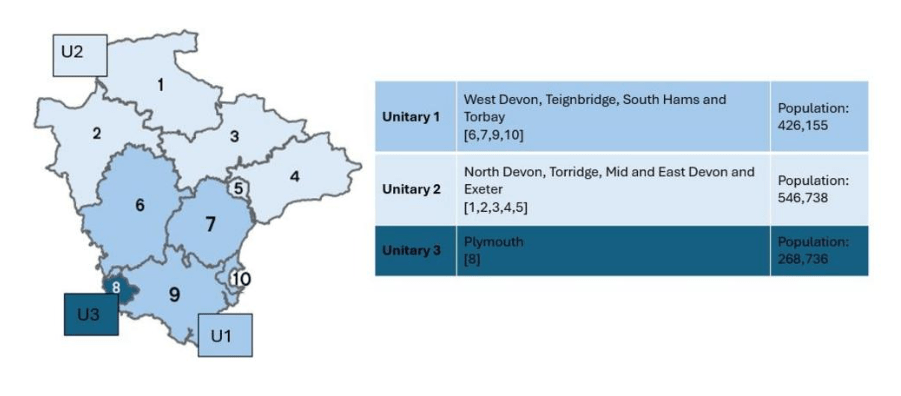
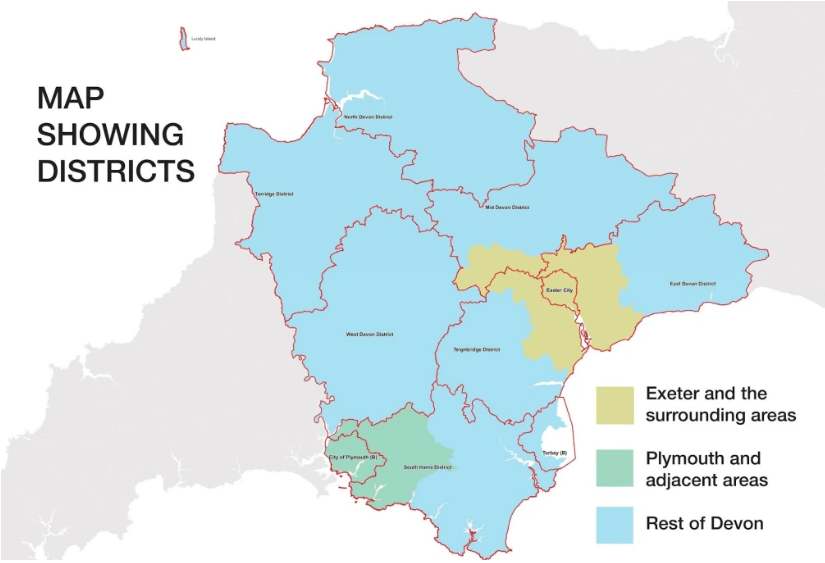
Plymouth and Exeter’s self interest “go it alone” unitary bids will likely wipe out any benefits from Angela Rayner’s devolution reorganisation plans.

Here’s why:

Latest analysis shows “that splitting county areas into unitary councils with populations as small as 300,000 will create hundreds of millions of new unsustainable costs for local taxpayers”. – Owl


Joshua Nevett www.bbc.co.uk

The UK government did not do its own analysis of the cost of the biggest reorganisation of councils in England for decades, the BBC has learned.


Deputy Prime Minister Angela Rayner said “a significant amount of money” could be saved by merging councils in 21 areas into single authorities.


Rayner’s department, the ministry of local government, based its cost estimates on a 2020 report commissioned by the County Council Network (CCN) that said £2.9bn could be saved over five years.


But the CCN has since revised its analysis and now says the reorganisation could make no savings and actually cost money in some scenarios.


Tim Oliver, chairman of the CCN, said local government reorganisation “could unlock billions in efficiency savings to be reinvested in frontline services”, if it was delivered at the right scale.


Oliver said the CCN supported the government’s reforms but added: “We are concerned over the potential costs of reorganisation where proposals seek to replace the two-tier system with multiple small unitary councils.”


A two-tier system means responsibilities are split between a county council and district councils.


Councils involved in the reorganisation have been submitting plans to create new local authorities in their areas.


Some have proposed setting up multiple smaller unitary authorities in their areas.
In Essex, for example, the county council has proposed three new unitary authorities in the region.


The government will decide which proposals to take forward and intends to inform most councils next year.


A government spokesperson insisted the reorganisation “will improve services and save taxpayers’ money”.


Financial shocks


Ministers talked up the potential to save money as one of the main benefits of local government reorganisation.


Speaking to MPs in June, Rayner said: “Local government reorganisation will lead to better outcomes for residents and save a significant amount of money that can be reinvested in public services and improve accountability.”


But her department insisted it was not necessary to commission separate in-house analysis of the cost of reorganisation at the public’s expense, in response to the BBC’s freedom of information request.


The government’s savings estimates were based on data produced by PwC, an accounting firm, and analysis by the CCN, external, a cross-party lobbyist group.


A PwC report in 2020 estimated potential savings of £2.9bn over five years if all councils in two-tier areas were replaced by single authorities.


But in updated analysis this year, external, the CCN said the reorganisation could cost £850m over five years and deliver no savings if 58 new councils, based on a minimum population of 300,000, were created in all 21 two-tier areas.


“Under this scenario no long-term efficiency savings would be delivered, meaning it would be more efficient to retain the current two-tier system in England,” the CCN’s analysis said.


Oliver said the CCN’s analysis showed “that splitting county areas into unitary councils with populations as small as 300,000 will create hundreds of millions of new unsustainable costs for local taxpayers”.


The councillor said the government must ensure the new councils created are the right size to achieve efficiencies, improve capacity and withstand financial shocks.


“Failure to do so could pile further strain on already under pressure care services and at a time when many county and district authorities could see their funding reduced,” Oliver said.


‘Mega councils’


The District Councils’ Network (DCN) said the reorganisation could produce poor results given the funding pressures already facing local government.


“It’s astonishing that the government has undertaken no independent analysis before embarking on the biggest reorganisation of councils for 50 years,” said Sam Chapman-Allen, chair of the District Councils’ Network.


“Mega councils, with populations of half a million people or more, could be imposed on areas when there’s no independent, up-to-date evidence to justify councils of this size, and many large councils created previously are struggling financially.”


The DCN said it was not too late for the government to commission analysis on the optimal size of councils to maximise potential savings.


Liberal Democrat deputy leader Daisy Cooper said: “It beggars belief that the government has embarked on a huge reorganisation of vital services, in a way which piles even more costs onto councils, whose finances are already on the brink.”


Stephen Atkinson, Reform UK leader of Lancashire County Council, said: “It is extraordinary that Angela Rayner is pushing ahead with these huge changes to local government without either proper consultation or any independent analysis of how much it might actually cost.


“To make fundamental changes to 20 councils in one year is unprecedented and will lead to vulnerable children and adults falling between the gaps.”


The Ministry of Housing, Communities and Local Government said: “Councils across the country have also told us that bringing services together under one roof means residents get joined-up support when they need it most, while clearer structures mean people know exactly who’s responsible for delivering their services.


“Councils will also develop their own proposals for how reorganisation works best in their areas, as we fix the foundations of local government through our Plan for Change.”

England to sell eight times more council homes than it built last year, report finds

England will sell off more than eight times as many council homes in 2025-26 as were constructed the previous year, research has found.

Rachel Hall www.theguardian.com

Right to buy is depleting council housing stock more quickly than public housing can be replaced, forcing people to spend more money on private market rents and obtain less secure tenancies, a report from the thinktank Common Wealth finds.

Its analysis of government data in England found that 38,170 social homes and 2,850 council homes were constructed by the government in 2023-24. In 2024-25, 2,260 council homes were built. There were 13,966 sell-offs of council houses through right to buy in 2023-24 and 8,656 in 2024-25. An analysis in the i Paper estimated that 18,500 council homes will be sold off in 2025-26 – more than eight times more than the number built in 2024-25.

The report concludes that if the government wants to increase the supply of social rental housing quickly, it must invest in buying back and restoring homes sold off under right to buy, alongside more council housebuilding.

Adam Peggs, the report’s author, said: “We need to pull every effective lever we can find to expand public housing. Council housing gave people secure, low-cost homes in the past. With the right framework, it can give people high-quality, genuinely affordable homes, with real democratic voice in the future too. But we need to build the political will to make it happen.

“Every day of delay is another day families languish in squalid temporary accommodation. The government has the tools to turn this emergency around – and more quickly than they might admit – they just need to use them.”

The report, which is published on Thursday, is also calling for expanded “right of first refusal” powers, enabling local authorities to be the preferred buyer when ex-social homes and private rental homes enter the market.

Since 1980, 2.4m council homes have been sold off under right to buy, at a discount that Common Wealth calculated was valued at £194bn, accounting for house price appreciation, with 41% now belonging to private landlords. As a result, council homes have collapsed from accommodating about 30% of households in the late 1970s to 6% today, a decline of about 80%.

Common Wealth’s report analysed council buy-ups of existing homes for public and social housing in seven countries, and determined that funding and incentivising a national right to buy back scheme would be a cost-effective policy in the UK.

The Spanish government has granted powers for a right of first refusal to the country’s new national public housing company after Barcelona acquired 1,500 homes – more than one-fifth of new affordable homes in the city – through right of first refusal powers since 2016, often below their market value.

The report also recommends a national rollout of a London scheme, in which the Greater London Authority bought 1,500 mostly ex-council homes in the first year of its right to buy back scheme. The New Economics Foundation calculated that this would generate a net saving to the taxpayer within 16 years.

A 2024 report from the Joseph Rowntree Foundation concluded that buyouts would offer better value for public money, rather than paying housing benefit to private landlords or private temporary accommodation.

Kwajo Tweneboa, a social housing campaigner and the author of Our Country in Crisis, said: “Homes that were once publicly owned are now profit-generating assets for private landlords. That’s the legacy of right to buy. Reversing that damage isn’t just a nice idea. It’s essential.

“Buying back ex-council homes and investing in a new generation of high-quality, genuinely affordable council homes must be the backbone of any serious plan to fix this crisis. That means central government stepping up with proper funding and power – not just warm words and weak targets.”

A Ministry of Housing, Communities and Local Government spokesperson said: “We do not recognise these figures. We know, however, that too many social homes have been sold off before they can be replaced, which has directly contributed to the worst housing crisis in living memory.

“That’s why we have introduced right-to-buy reforms to reverse the decline in much needed council housing, alongside investing £39bn to deliver the biggest boost to social and affordable housing in a generation.”

Developer wins Lympstone housing appeal for 42 homes

“Though the inspector agreed the site “does not represent an appropriate location for the proposed housing”, the inspector noted that East Devon District Council did not have a five-year housing land supply.”

The Government has changed the goal posts by increasing our housing target – we were close to a 5 year supply but now we aren’t! See here. – Owl

Bradley Gerrard www.exmouthjournal.co.uk

The developer behind a plan for 42 homes in an East Devon village has been given the green light by a government inspector after the local council blocked one version but then accepted another.

A proposal to build 42 homes on land between Meeting Lane and Strawberry Hill in Lympstone was initially refused by East Devon District Council’s planning committee in August last year.

But then the developer, 3 West, put in a tweaked version of the scheme, including making it an ‘outline’ plan, meaning it was seeking permission to build ‘up to 42 homes’, with the exact figure to be agreed at a later date.

That revised version was rubber-stamped by East Devon’s planning committee in November, but this prompted the developer to appeal the decision to reject its initial scheme.

Now the Planning Inspectorate has allowed the appeal, meaning 42 homes can be built on the site.

The council’s approval of the subsequent outline scheme on the same site was deemed a “material consideration” by the inspector.

Furthermore, “moderate weight” was given to the fact that the site was included in the council’s emerging local plan, which has yet to be ratified but identifies areas where homes could be built. That inclusion came after the initial planning application was refused.

The main issues dealt with by the inspector included whether the site was appropriate for housing, the effect on the character and appearance of the area and the scheme’s potential impact on protected trees, and whether there was adequate social housing that was also properly dispersed across the site rather than clumped together.

Fears about the impact on the nearby Exe Estuary and Pebblebed Heaths European Protected Site was a final factor.

But even though the inspector agreed the site “does not represent an appropriate location for the proposed housing”, the inspector noted that East Devon District Council did not have a five-year housing land supply.

Meeting housing targets

This is a government requirement upon councils, meaning they have to have enough approved planning sites to show they can meet their annual housing target over the next five years.

While East Devon had a 4.5 year supply when it initially refused the application last year, changes to national planning policy since then mean it now only has nearly three years’ worth.

The inspector also agreed with the council that the affordable housing was not suitably dispersed throughout the site, but concentrated in one area.

The council had raised the fear that this could limit social cohesion, and the inspector said there appeared to be no reason why the affordable housing “could not be dispersed throughout the development without materially harming the character and appearance of the area”.

The developer has proposed 35 per cent of the properties would be affordable, and has pledged nearly £293,000 to help fund further affordable homes in other areas of the district. That step has been taken because developments in rural areas are required to have a 50 per cent level of affordable housing, although funding can be given in lieu of some on-site provision.

The inspector also felt there was suitable mitigation proposed by the developer to ensure that the Pebblebed Heaths would not be unduly impacted, and while some heritage concerns were noted – especially in regard to Thorne Farmhouse – they were not deemed significant. 

“Having considered the benefits and adverse impacts of the appeal scheme, I conclude that the adverse impacts identified, namely conflict with the council’s spatial strategy, limited harm in respect of the proposed affordable housing provision and less than substantial harm to the heritage significance of the listed building at Thorne Farmhouse would not, cumulatively, significantly and demonstrably outweigh the substantial benefits of the proposal when assessed against the policies of the framework taken as a whole,” the inspector stated.

“Therefore, the presumption in favour of sustainable development, as set out in the framework, applies.”

The developer also submitted a claim for costs against the council, but the inspector refused this.

Now South Hams council launches water quality monitoring project

A new water monitoring project to help tackle pollution has been launched by a Devon council.

Zhara Simpson BBC News, South West www.bbc.co.uk

South Hams District Council said it was “ramping up efforts to tackle water pollution” so that communities, experts and agencies could better understand what was happening in the area’s rivers and estuaries.

The council said the kit – from local marine tech firm Teledyne Valeport – enables the public to see real-time data on water quality in key areas across the district for the “very first time”.

It said the data would be shared publicly via an online dashboard in late 2025.

‘Tackle real problems’

The council said it teamed up with like-minded local groups which had been pushing for better river health.

It said from the Yealm to the Avon, Dart, Erme and Salcombe-Kingsbridge Estuary, community-led river and estuary groups had helped shape the project, including advising on the best locations in which to put the sensors.

Executive member for climate change and biodiversity John McKay said it was a brilliant example of collaboration between communities, researchers and businesses to help “tackle real problems”.

He added: “Local groups have been key to shaping this project and now we are giving them, and everyone else, access to real-time water quality data so we can all play a part in protecting our rivers and coastline.”

‘Real-time insights’

The project has been funded by the government and is being delivered in partnership with Innovative UK, the University of Plymouth and Teledyne Valeport, the council said.

The Environment Agency and local harbourmasters have also supported the project.

Innovation and project manager at Teledyne Valeport Amy Thompson said its sensors were able to provide the kind of real-time insights into water quality that it hopes will tackle water pollution.

She said: “This project is utilising our latest sensors, all designed and manufactured at our Totnes facility.

“It’s incredibly rewarding to see our instruments that are used worldwide being applied to such an important local initiative.”

Exeter townies vote to pull up the ladder on Devon’s rural bumpkins

Ditto Plymouth and Torbay (if given the chance).

Currently none of these three meet the original population targets set by Angela Rayner of 500,000 for the creation of new unitary authorities to create a single tier of authorities as she abolishes district councils.

Plymouth has only half the target population, Torbay has only a quarter, Exeter even less, so land grabs are in the air.

In fact, if Torbay is allowed to continue to be a unitary, then East Devon, with a similar population, has an equal right to be one as well, particularly were it to swallow Exeter in a reverse takeover to what is being proposed in the press article below.

This is naked self interest on the part of city dwellers and Owl is surprised to see it being led by a Labour controlled council.

Put crudely, those living in compact urban areas don’t want to contribute to providing services for the more costly and dispersed rural ones.

For example this is the line being peddled in Torbay: “People in Torbay have been warned they face steep rises in council tax if a local government shake-up sees them having to  join forces with their neighbours.

The bay has the lowest rate of council tax in Devon, but if Torbay is joined to neighbouring councils such as South Hams and Teignbridge in the forthcoming revamp of local councils, bay bills will inevitably rise.

The map below shows vividly how Exeter City’s carve-up between the “haves” and the horseshoe of “have nots” would look.

Predictably, there has already been a very sharp backlash to Exeter’s “land grab” from Teignbridge councillors.

Angela Rayner’s aim is to get rid of district councils and create a set single tier councils. Overarching these “principal authorities (PA)” would be a “mayoral strategic authority (MSA)” who would get significant funds devolved from Whitehall.

All the districts have signed up to the 1-5-4 option. The “1” is Plymouth and the “5” and “4” refer to an east west split of the nine districts, including Exeter City and Torbay

Although geographical, or ceremonial, Devon could be a single PA it would be unwieldy both in area and population.

There are other options, the obvious, and simplest, is to divide the county into two with one of the two cities of Plymouth and Exeter in either half. Vainglory from the city leaders seems to trumping common sense.

Remember also that Angela Rayner’s proposal dramatically reduces your democratic representation in local affairs. The working assumption is that district wards will be abolished and your representation, however these PAs are created, will be based on existing county divisions.

Currently, we in East Devon are represented by 60 district councillors in 30 wards plus 11 county councillors in 9 divisions. After the abolition of districts our representation at local level will drop from 71 councillors to just 11. Their case load will become overwhelming.

Another Rayner rule is that a strategic mayor must control more than one PA.

Recently, all the Devon authorities signed up to a “South West Peninsular Mayoral Strategic Authority (MSA)”, obviously leaving open the door for Cornwall to join at some future date.

Already Angus Forbes wealthy “businessman, entrepreneur and philanthropist” from Australia, who came to Plymouth in 2019, is on manoeuvres. 

He garnered sufficient signatures to require Plymouth City Council to hold a referendum on having its own mayor. He had the backing of Reform but narrowly lost after the government intervened to kick the operational date until after the reorganisation, rendering the referendum pointless.

He is now rooting for the mayoral office to be in Plymouth.

County councillor Alan Connett, LibDem Exminster, sums it all up when he says:

“Changing the way councils are organised and run in Devon is a cash-wasting priority for the Government that is being rushed through.”

With land grabs being submitted by both Plymouth and Exeter, and Cornwall insisting on staying as it is, a county wide unitary, unpopular decisions will have to be made by government or the timetable will have to slip. As planned, this deeply unpopular reorganisation will begin to be implemented in the run up to the next election, well before any benefits appear. Owl expects things to slip.

All authorities are all holding consultations on reorganisation with different timescales and it is difficult to see how one’s voice can be heard in all the noise.

Exeter plans to lead a brave new Devon

The city would absorb 49 towns and villages in the process

Guy Henderson www.devonlive.com

Exeter has been urged to ‘be brave’ and go ahead with bold plans to go it alone in the massive nationwide local government shake-up.

Members of the city council were almost unanimous – just one councillor abstained – in backing a proposal for Exeter to become a stand-alone unitary council, absorbing 49 other Devon communities in the process.

Councillors heard that the 49 – comprising 28 in East Devon, 15 in Teignbridge and six in Mid Devon – are parishes that naturally look to Exeter for work and leisure.

“I believe that Exeter has a responsibility to lead,” said city council leader Phil Bialyk (Lab, Exwick). “Not to demand, not to dictate, but to lead with clarity, humility and deep respect for the communities around us.

“We need to find the best possible option for all of Devon.”

The city council’s strategy would boost its population to more than 250,000, fitting the government’s criteria for one of its new unitary authorities, but other councils around Devon continue to come up with other plans.

The existing district authorities all favour a ‘1-5-4’ model in which Plymouth stands alone and the rest split to create two larger councils.

Under that option, the five-council section would include Exeter, East Devon, Mid Devon, Torridge and North Devon. The four-council section would be Torbay, Teignbridge, South Hams and West Devon.

But Torbay has said it wants to go it alone, and one Torbay councillor described Exeter’s recent decision to pursue a unitary future as ‘a huge rock thrown into the pool’.

If Exeter’s proposal for it and Plymouth to be two unitary councils with the rest of Devon forming another, Torbay would be part of a giant coast-to-coast council stretching from the southernmost tip of the South Hams to the most northerly part of North Devon, and taking in the Somerset, Dorset and Cornwall boundaries.

A report to the city council said Exeter’s strategy reflects its position as a major urban hub with strengths in housing growth, knowledge economy, innovation, education, climate science and transport connectivity.

Cllr Michael Mitchell (Lib Dem, Duryard and St James) said: “This is the start of a journey, but the destination is still unclear.”

He also echoed calls for strong town and parish councils under the new unitaries to make sure local issues were at the top of the agenda.

Cllr Laura Wright (Lab, St Thomas) went on: “This isn’t about Exeter swallowing up the surrounding areas. These are areas which already have a strong local connection. It makes so much sense.”

Cllr Ruth Williams (Lab, Mincinglake and Whipton) said some of the other options favoured by other councils were a ‘back of a fag packet effort’. “How can they think that clumping five districts and four districts together is going to work for those residents?

“No thought seems to have been put into it at all.

And Cllr Josie Parkhouse (Lab, Pennsylvania) told the meeting: “This is our chance to lead. Let’s seize it.”

A period of six weeks of intense public engagement starts now. All councils have been asked to consider their options before a deadline of November 28, when their preference must be submitted to the government. Ministers will then make a final decision, and the new councils will take control in May 2028.

Elections to the new councils will be held in May 2027, with councillors acting in a ‘shadow’ role leading up to the final switch a year later.