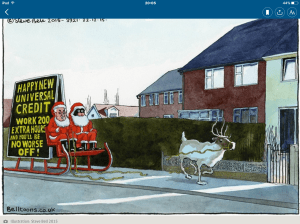
Happy Christmas tax credit claimants

image

credit: Steve Bell, Guardian online today

Zero- hours contract where your employer doesn’t employ you for more than 16 hours a week, so you can’t take another job to make up the hours?  Tough – have you and the kids eat less or turn off the heating, perhaps?  Your choice.

EDDC doesn’t just charge vulnerable elderly people for falls! Oh, no …

Should you (unwisely) think that EDDC has not stooped so low as to charge £26 to pick up elderly people – think again – it has MANY more charges than that! Here is a list of the EXTRA charges that EDDC plans to charge its elderly, vulnerable people in private housing from April 2016 (there is no similar list in this document for what it currently charges or will charge its own sheltered housing residents).

The table in the link below compares EDDC’s charges to those of Exeter City Council and Torbay Council, and, by and large, the EDDC charges are mostly slightly lower than those of both councils. However, all the councils make extra charges of some kind. Do note that, in the case of EDDC, it appears that there is no personal visit involved in all these services:

“Activate the alarm in an emergency and one of our operators will respond within 60 seconds. They will assess the situation and call for help from a contact or emergency service when necessary.”

http://eastdevon.gov.uk/housing/housing-support-for-elderly-disabled-and-vulnerable-residents/home-safeguard-alarm-services/how-the-home-safeguard-system-works/

Here are the extra charges from April 2016:

Additional Pendant £1.00/week
Smoke alarm £0.50/week
Heat detector £0.50/week
Extreme temperature £0.50/week
Carbon monoxide £1.00/week
Flood detector £1.00/week
Falls detector £1.00/week
Pill dispenser £1.50/week

Click to access the-knowledge-18-december-2015-issue-32.pdf

On a different site, it appears that, for the basic service (and what would that be!) EDDC charges “less than £5 per week” from which we can gather that vulnerable people pay around £250 per year for the basic service.

If one adds ALL the extra services to the basic amount, vulnerable people will be paying an extra £338 – a total cost of around £558 per year if all services are taken.

Careline itself will provide a basic service for £125 per year (current special offer) or a basic plus falls service for £195 per year.

https://www.careline.co.uk/order-careline/

Just one small query: modern alarms mostly combine smoke, heat, carbon monoxide and extreme heat sensors in one alarm – why would one pay for four?

For those vulnerable people who have relatives, they might prefer to look into one of the mobile phones and/or pendants that calls relatives and/or the emergency services immediately, such as this one from Amazon that includes a pendant for a one-off charge of £29:

http://www.amazon.co.uk/Lifemax-672-Home-Safety-Alert/dp/B001CIPW0M/ref=pd_cp_364_3?ie=UTF8&refRID=1MFDF2R0JY2XN84C9YXB

or this one with a fall monitor for £150
http://www.amazon.co.uk/dp/B0186FP8RU?psc=1

(though there are MANY others at similar or lower prices and neither of these have been personally verified nor are any of these personally endorsed or recommended by Owl being simply for comparison purposes) nor do these pendants go through to a 24 hour control centre (though these are available from providers other than EDDC, see above).

For those vulnerable people who do not have relatives – tough, you are old and you must pay for it.

This is Austerity.

Garden city boss sacked because he is local and has too many ties to the area!

Kent Messenger article:

“Plans to build a garden city in Kent have been left in disarray after the chief executive of the body set up to build it has left after just five months in the job.

The departure of Robin Cooper as boss of Ebbsfleet Development Corporation was announced at a board meeting this morning. Mr Cooper was hired in July to lead the construction of a new town on brownfield land between Dartford and Gravesend.

It is understood the Department for Communities and Local Government wants to appoint a new chief executive with fewer close connections to the county. Mr Cooper left his job as director of regeneration, community and culture at Medway Council to take up the post at the EDC.

https://andrewlainton.wordpress.com/2015/12/21/dclg-sack-garden-city-head-for-being-a-local/

“Prohibitively expensive” to connect remaining rural broadband not-spots

The most recent figures showed that 3.3 million homes and businesses have been connected since 2010 – taking superfast broadband from 45 per cent of premises to 83 per cent.

However, ministers admit that it may be “prohibitively” expensive to connect the remaining premises, because of “demanding terrain and increased distances”.

Seven trial schemes have been set up to try to reach the “final five per cent”, using new solutions including fibre optic, satellite and wireless.

Ministers, who cut funding from £10 million to £8 million, say the results of those trials will be “published soon”, but there is no date for putting in the technology in rural areas.

Instead, David Cameron announced he would explore a Universal Service Obligation, the right to demand 10Mbps wherever you live, by 2020.

Some areas of London, Birmingham and Manchester are also projected to have large blackspots, but commercial operators are expected to plug those gaps by 2017.”

http://www.westernmorningnews.co.uk/Homes-parts-Westcountry-missing-superfast/story-28400169-detail/story.html

Yet EDDC maintains that it can connect remaining rural areas in East Devon itself more cheaply than the Devon and Somerset Consortium.

Owl sees expensive consultants on the horizon … though no doubt the new HQ in Honiton will be super, super fast!

Votes versus seats in the 2015 general election

“Disproportionality is the degree of mismatch between parties’ shares of votes and their shares of seats, with measures of disproportionality usually calculated for national elections. This year’s general election was criticised by many as the least proportional ever. Chris Hanretty acknowledges that on some measures, this is a valid claim, but demonstrates that calculating a measure for local disproportionality gives a better sense of how the mismatch varied across England, Scotland and Wales. …

… constituencies in the South West also have high levels of local disproportionality – in part because of a large number of wasted votes for UKIP, but more because of the failure of the Liberal Democrats in what was previously a successful hunting ground.”

http://www.democraticaudit.com/?p=18360