Charge council tax on unbuilt homes says Lords Committee

“The [House of Lords] Economic Affairs Committee in its report “Building more homes” has strongly recommended that the Government must lift its target by 50% and build 300,000 homes each year to tackle the housing crisis. It also suggests that Local authorities and housing associations must be freed to build substantial numbers of homes for rent and for sale.

Key findings

In their report, “Building more homes”, published today, the cross-party House of Lords Economic Affairs Committee criticises the Government’s housing policy for:

Setting a new homes target which will fail to meet the demand for new homes or moderate the rate of house price increases.

Restricting local authorities’ access to funding to build more social housing.

Creating uncertainty in the already dysfunctional housing market by frequent changes to tax rules and subsidies for house purchases, reductions in social rents, and the extension of the Right to Buy. All of these changes reduce the supply of homes for those who need low cost rental accommodation.
A narrow focus on home ownership which neglects those who rent their home.

Conclusions

The Committee makes wide-ranging recommendations to address the housing crisis, including:

Restraints on local authority borrowing should be lifted. Local authorities should be free to borrow to fund social housebuilding as they are other building programmes. This would enable local authorities to resume their historic role as one of the major builders of new homes, particularly social housing.

The current historically low cost of borrowing means local authorities could make a large contribution to building the houses we need for the future. Further, the new Prime Minister has announced that the Government will abandon their fiscal target. This paves the way to increase local authority borrowing powers.

Council tax should be charged on development that is not completed quickly. The Government’s reliance on private developers to meet its target of new homes is misguided. The private sector housebuilding market is oligopolistic with the eight largest builders building 50% of new homes. Their business model is to restrict the volume of housebuilding to maximise their profit margin. To address this the Committee recommend that local authorities are granted the power to levy council tax on developments that are not completed within a set time period.

Maximise the use of public land. The Government must take decisive steps to build on the very substantial holdings of surplus publicly owned land. The Committee recommends that a senior Cabinet minister must be given overall responsibility for identifying and coordinating the release of public land for housing, with a particular focus on providing low cost homes. The National Infrastructure Commission should oversee this process.

Local authorities should be given the power to increase planning fees. Local authorities should be able to set and vary planning fees to help fund a more efficient planning system and the upper cap on these charges should be much higher than the current limit. …”

http://www.publications.parliament.uk/pa/ld201617/ldselect/ldeconaf/20/20.pdf
Swire: between a rock and a hard place this weekend

Junior ministerial appointments such as Swire’s will probably be sorted out next week.

What an awful long weekend it will be for him, worrying about whether he will be left to try to keep Boris under control or demoted to ordinary constituency MP.

Or perhaps Mrs May might have some other post in mind for him – back to Northern Ireland or Culture, Media and Sport – under some younger, grammar-school-educated boss.

It’s a hard life.

Something for Leadsom and Parish to chew on

“… In Defra’s case, the National Audit Office found that £65.8m of penalties were imposed by the European Commission over failure to properly administer Common Agricultural Policy payments. Of these penalties, most (£38.6m) related to the Single Payment Scheme, with £13.3m from Rural Development, £9.9m in cross compliance penalties and £4.0m from other schemes.

One particular problem the department has is ensuring the details submitted by farmers are kept up-to-date. Where there is a mismatch in information, Defra withholds a proportion of the payment. More than £25m in outstanding payments is estimated to be owing.

Auditor general Amyas Morse said: “The department continues to struggle with managing the complex CAP scheme in a way that ensures accurate, timely payments to farmers. As a result, it has incurred EU penalties of £65.8m related to the CAP scheme in 2015-16, and estimates that it owes 13,000 farmers a total of at least £25.3m.

“Exit from the European Union will not, in the short term, reduce these penalties. The department therefore needs to ensure its strategy for tackling these challenges is effective.”

A Defra spokeswoman said: “We are taking action to tackle the causes of disallowance and are making a significant investment in our mapping data. This will be used to better administer CAP payments.”

http://www.publicfinance.co.uk/news/2016/07/defra-and-mod-accounts-qualified

With new agriculture Minister Mrs Leadstrom on record as having said that UK farmers should not be relying on EU payments, Farmer Parish may be in for a bit of a tough time as piggy-in-the-middle.

Jo Cox, MP

Jo Cox’s funeral took place today.

Her husband’s message:

Jo would ask us not to fight hate with hate but draw together to drain the swamp that extremism breeds in. Thinking of all victims of hatred today”

Jo’s fund is just £15,000 short of its £1.5 milion target for three charities she supported: Royal Voluntary Service, Hope Not Hate and The White Helmets, each of which will get one-third of the funds raised.

It would be a fitting tribute to her to see that target achieved today.

https://www.gofundme.com/jocox

West Hill: new parish council boundary “compromise”

Independence day as West Hill splits

11:01 15 July 2016 Eleanor Pipe
Proposed new West Hill parish council boundary
Compromise reached over divisive boundary issue

“West Hill looks set to form its own parish council after a contentious bid to gain independence was given the green light.

A long and acrimonious battle came to an end on Wednesday (July 13) when members of East Devon District Council’s (EDDC) cabinet voted in favour of the village breaking away from the governance of Ottery.

The bid was launched by the West Hill Parish Campaign Group (WHPCG), which argued the community has its own identity.

During the consultation process, a bitter row broke out over the proposed boundary.

Speaking at Wednesday’s meeting, WHPCG chairman Margaret Hall said: “Our primary objective has always been to establish a parish council for West Hill. We know we have overwhelming support for this from residents of West Hill. We are disappointed by the boundary, however, we do recognise the need for compromise. We do look forward to working positively with all our neighbouring councils in the future.”

The compromised boundary option means the new parish will be far smaller than the current West Hill ward, but it does incorporate some households in Higher Metcombe, who strongly objected to being included in the Ottery ward.

Mayor Glyn Dobson – not speaking on behalf of the town council – said: “I will be sorry to see West Hill go, because the parish of Ottery will lose approximately 25 per cent of its precept. However, if it’s the will of the majority of West Hill residents, I respect that.”

District councillor Peter Faithfull said the issue should be postponed entirely – as the level of acrimony did not allow for constructive debate. However, Councillor Phil Twiss argued there is a clear case for West Hill forming its own parish council.

EDDC needs to issue a final go-ahead before the proposal will come into legal effect on April, 1, 2017. The first elections could be held in May 2017.”

http://www.sidmouthherald.co.uk/news/independence_day_as_west_hill_splits_1_4617573

Judge quashes out-of-town planning permission for discount store

Wonder how this applies to out-of-town industrial developments?

Mr Justice Ouseley has quashed planning permission for an Aldi store in Mansfield after finding a series of errors in the way in which the planning authority processed the application.

Mansfield District Council had given permission to developer Regal Sherwood Oaks for a food store of 1,925 square metres at Sherwood Oaks Business Park, for which the intended occupier was Aldi.

Developer Aldergate Properties challenged this citing an adverse impact on its development in the town centre contrary to the sequential test in planning policy designed to protect town centre retailing from out-of-town rivals.

Aldergate argued that the council erred in its approach to the sequential test, imposed a condition personal to Aldi without considering relevant planning policy objections to this and failed to consider whether the proposal accorded with the development plan.

In his judgment, Ouseley J said Mansfield had misinterpreted the National Planing Policy Framework as the necessary sequential test has not been carried out and a material factor has not been taken into account.

He also did not accept that the planning committee would have been aware of guidance on personal conditions “in the absence of specific evidence to that effect.

“This is not just because this is not a very common point, but also because the evidence produced by the district council did not show that their training had covered this particular aspect of conditions, and nothing more was forthcoming despite requests.”

He also found the council had misinterpreted its development plan.”

http://localgovernmentlawyer.co.uk/index.php?option=com_content&view=article&id=27743%3Ajudge-quashes-planning-permission-over-interpretation-errors-&catid=63&Itemid=31

Sharp fall in house building and maintenance

“A sharp fall in housebuilding ahead of the EU referendum dragged down the construction sector in May as firms mothballed projects and delayed new work. Housing construction tumbled 3.2% during the month after edging down 0.1% in April, the biggest drop since February 2014.

Earlier this week the UK’s biggest housebuilder, Barratt, said it could reduce the rate at which it builds new homes as the company prepares for a possible slowdown following Britain’s vote to leave the EU.

The impact of an underperforming housebuilding sector on the broader industry was to drag down output by 2.1% on the previous month and by almost 2% on the previous year. Housing output has now fallen in every month this year apart from February, and things could slow further after the 23 June Brexit vote.

The latest figures from the Royal Institution of Chartered Surveyors, published earlier this week, found that buyer interest and expectations of future sales withered in the post-referendum period. Government cuts to local authority spending were also to blame for a fall in repairs and maintenance activity, highlighting the need for Theresa May’s new infrastructure ministry to boost growth.

Local authority spending on repairs and maintenance has declined sharply in real terms since the middle of 2014, mainly in response to cuts to council budgets.

In May, construction firms reported a fall in new work and repairs and maintenance by 2.6% and 1.4%, respectively. “The fall in May 2016, taken together with the strength of April’s figures, continues a longer trend of broadly flat output growth since the start of 2015,” the ONS said. “Within all new work, there were decreases in all work types, except infrastructure. The main contribution to the decrease came from private new housing.”

Chris Williamson, chief economist at financial data provider Markit, said the drop in construction output adds to “what’s looking like an ugly run of data for the sector”. “It looks like there’s worse to come; possibly much worse. Markit/CIPS PMI survey data recorded the steepest contraction of construction activity for seven years in June as projects were put on hold in the lead up to the EU referendum. Housing and commercial construction were especially badly affected,” he said.

http://www.theguardian.com/business/2016/jul/15/sharp-fall-in-uk-housebuilding-drags-down-construction-sector?CMP=Share_iOSApp_Other

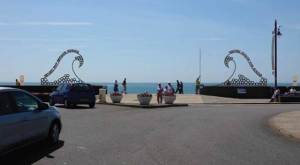
The Seaton Seaside “chickens”

image

Much furore about a new sculpture erected on Seaton seafront a few days ago as part of its Jurassic Coast arts interpretation. Many people have remarked that it looks like two chickens heads, with some even saying that the noise of the wind passing through the sculpture even sounds like chickens clucking!

The saga began long ago in 2014 when the controversial sculpture was first mooted, when, in September 2014, then Mayor, Tony Woodman and Councillor Val Christmas voted against the project, which was carried by a majority of Seaton Town Council:

http://www.viewfrompublishing.co.uk/news_view/33584/21/1/seaton-oppositiongrows-to-proposed-jurassic

A photograph of the sculpture was published in the Midweek Herald on 8 April 2015:

http://www.midweekherald.co.uk/news/controversial_waves_sculptures_get_the_go_ahead_1_4025621

where it was reported that a survey of 200 people asked if they liked the design overwhelmingly approved of it.

The two newspaper reports seem not to have been seen by many people in Seaton who have taken to social media to violently disagree about the merits of the artwork.

Lobbying

“An influential Conservative member of the House of Lords has been accused of lobbying the government for the benefit of the coal industry, despite previously saying he does not argue for the industry’s interests.

Viscount Matt Ridley, a journalist and businessman, benefits financially from coalmines on his estate and has used his column in the Times newspaper to downplay the seriousness of climate change.

The former chairman of Northern Rock wrote to energy minister Lord Bourne in April to tell him about a Texas-based company with “fascinating new technology, which may well interest the Department of Energy and Climate Change”.

http://www.theguardian.com/environment/2016/jul/15/matt-ridley-accused-of-lobbying-uk-government-on-behalf-of-coal-industry

Tipton school closes as 750,000 new places needed by 2025

What a masterstroke of bad planning and bad decisions. Instead of small, village schools we will probably end up with mega- primary schools where 4 and 5 year olds will be overwhelmed.

“An extra 750,000 school places will be needed in England by 2025 to keep up with a population bulge, says an official forecast from the Department for Education.

The pressure on creating new schools and extra classrooms will be one of the challenges for incoming Education Secretary Justine Greening.

Schools will have faced 16 consecutive years of rising pupil numbers.
The Department for Education says it has committed £7bn to extra places.
Between 2009 and 2016, the school system had already expanded to take in an extra 470,000 pupils.

From 2016 to 2025, the projection says there will be another 10% of pupils in the state school system, up from about 7.4 million to about 8.1 million.” …

http://www.bbc.co.uk/news/education-36796999