The Great EDDC Section 106 Scandal of 2016 – and probably earlier years

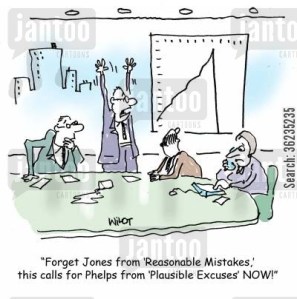
Forget Jones from Reasonable Mistakes, this calls for Phelps from Plausible Excuses NOW!

OWL’S SUMMARY:  EDDC HAS NO EFFECTIVE MONITORING OF SECTION 106 PAYMENTS DUE AND OFTEN RELIES ON DEVELOPERS TO TELL THEM WHAT THEY OWE TO THE COUNCIL.  THIS IS NOT JUST A PROBLEM FOR THIS FINANCIAL YEAR BUT, ACCORDING TO EXTERNAL AUDITORS, COULD HAVE HAPPENED IN PAST YEARS TOO.

Due to the explosive nature of the report detailed below, it is hardly surprising that the Audit and Governance Committee is meeting in the afternoon on 17 November 2016 at 2 pm, while most people have to be at work.  Had it been held in the evening there might well have been some seriously embarrassing problems for the committee.  As it is, even the afternoon session is likely to throw up some VERY tough questions.

Only recently added to the EDDC Audit and Governance Committee agenda papers is this little nugget of a report – it is only 21 brief pages and deserves very focused reading.  The report is as per the link below:

KPMG: Management of s106 contributions

and boy, what interesting reading it makes!

It seems that a local elector complained to EDDC’s external auditors – KPMG, new to the job this year – that it appeared that management of Section 106 payments (the money due from developers) was, in Owl’s lay-owl opinion, not fit for purpose – as reported in recent East Devon Watch postings:

HERE and HERE

The elector concerned alleged serious mismanagement of the listing, monitoring and collection of Section 106 money – the payments due from developers as part of their requirement to mitigate any problems that the development might cause and for the provision of green, open and play spaces within and around their developments.  This was as a result of a Freedom of Information request to which EDDC responded that it did not have the information the elector required.

BEAR IN MIND THAT DETAILED BELOW ARE SUMS FOR THE LAST FINANCIAL YEAR ONLY AND THE EXTERNAL AUDITOR DID NOT EXAMINE PREVIOUS YEARS.

After a very light-touch investigation by the new auditors KPMG (which simply sampled various agreements in this financial year only rather than forensically analysing them all over a period of several years), they found:

     “As at 31 March 2016 the Council had £5.8 million of s106 contributions held on its Balance Sheet.  During the 2015/16 financial year it accounted for £1.9 million of s106 receipts.
      We found that at the Balance Sheet date there was a gross amount of £636,000 in s106 contributions due to the Council where it had not identified that conditions had been met which triggered liability for payment from the relevant developer.
     No invoices had been raised seeking payment and consequently this amount had not been included in the 2015/16 financial statements, meaning the accounts were understated.
      When other audit findings are taken into account there was a net understatement of £227,000 in the Council’s financial statements. This is because our financial statements audit work had separately identified that the Council had incorrectly accounted for an amount totalling £409,000 for a different s106 agreement which actually related to another body.
     Whilst we have not exercised formal audit powers in response to the objection, our work has indicated that the issues raised by the objector are correct and we have upheld the objection.”

Here are the external auditors findings FOR THIS YEAR ONLY in more detail:

“Our evaluation of the processes has identified the following control weaknesses.
1. An absence of summarised financial information to facilitate the monitoring of s106 contributions
The Council currently has no summarised monitoring document which shows the value of all s106 contributions outstanding at any one point, with the trigger which would lead the contribution to be payable and, if the contribution is liable to be paid, the current status of the collection process. In addition to this the Council does not currently have the information in a format which is consistent with s106 contribution triggers so it cannot determine if triggers have been met.
2. Lack of challenge or enforcement of the Cranbrook developers’ legal obligation to provide information
From our understanding there is no challenge or enforcement of the developers’ legal obligation to provide the Council with details of the number of dwellings constructed, sold and occupied, instead only information on completions is supplied. In addition this information should be received quarterly but our testing suggests that it is received on an ad hoc and untimely
basis.
3. Understanding of financial and accounting implications of triggers being met and the communication between Planningand Finance over this
It has been found that at present there is a gap in the understanding of the financial and accounting implications of a contribution trigger being met within Planning, due to an oversight in communication between Finance and Planning over the treatment.  When contributions become virtually certain to be received, but are not invoiced for practical or commercial reasons, they should be recognised as accrued income.  At current however, given this gap in understanding in the planning team, the Council’s Finance team only accounts for s106 contributions when the cash has been received or an invoice has been raised. This has led to the financial accounts having an incomplete accrued income balance on the Statement of Financial Position.
In addition to the evaluation of the s106 processes and controls, we performed testing to enable us to quantify the potential misstatement as a result of the control weaknesses found in the system.
We focused this testing on s106 agreements associated with the Cranbrook development, as these agreements (individually and in total) represented the major value of all agreements in place. We requested a listing to be prepared of all s106 contributions that the Council has in place at the Cranbrook site and found that there were nine contributions that had been triggered and are due to the Council. It was also found that there was a tenth contribution where it was uncertain if the trigger point had been met and the financial value of the contribution, this is therefore not included within the misstatement below. The contributions ranged from £5,000 to £200,000 in value individually, see page 12 for further details.
It was found that the planning Officer was aware of the individual cases, but not the aggregate position of the un-invoiced amounts. None of the contributions had been invoiced or accrued in the financial statements but as noted previously, there is no evidence of financial loss and the misstatement is one of accounting treatment. If the total value of this misstatement was recognised in the Council’s accounts,the Grants in Advance balance would increase by £636,000, as documented below.
It is noted however that this is the gross misstatement as a result of the weaknesses in the system and that our final accounts audit procedures had already identified a misstatement that overstated the Grants in Advance balance by £409,000. This was because the Council had incorrectly accounted for a s106 contribution due from a developer but payable to another body, rather than the Council itself.

Consequently, when concluding effect of these misstatements on our audit opinion, we were able view the impact at 31 March 2016 as a net understatement to the balances is £227,000.  This was reflected in our reporting to the Council’s Audit & Governance Committee in September 2016.

Whilst neither the gross or net misstatement were considered individually material to the financial statements, they are nevertheless significant sums. Given the weaknesses identified in the Council’s controls, it is possible that understatements of a similar scale or even larger could be apparent at any point in time.”


One thought on “The Great EDDC Section 106 Scandal of 2016 – and probably earlier years

Comments are closed.