Devon may soon be the only non-unitised county in this part of the South West – but for how long?

So, Somerset is moving towards a unitary authority (see below). Inevitable really, isn’t it.

The new HQ for the already combined Taunton Deane and West Somerset authority is ten minutes walk from Somerset County Hall. Taunton Deane and West Somerset are intending to spend £11 million altering their building to accommodate their merger requirements – when Somerset County Hall has a lot of spare capacity.

Meanwhile EDDC proceeds apace with Blackdown House, their new HQ in Honiton, at a minimum cost of £10m – and an ultimate cost of probably MUCH more than that – without at any factoring into their calculations of the likelihood of a unitary Devon proposal similarly coming forward with the same arguments for big savings.

EDDC’s consultants apparently estimated the open market value of Blackdown House on completion of the building to be £3 million. Given the current economic situation, even that might be optimistic.

So a potential BIG loss looming – with the local taxpayer picking up the bills? And that’s if HQ builder Interserve s

If Somerset goes unitary, that will be Somerset, Cornwall and Wiltshire all unitary and Dorset double unitary. Devon will be an anachronistic exception.

Has Devon County Council leader John Hart anything to tell us?

And Owl bets soon-to-be-ex-Leader Paul Diviani may be very pleased with the timing of his exit!

“£250m spent but no starter homes yet built under flagship fund”

“The government has spent £250m to boost starter home construction without a single property being built so far, it has emerged.

Dominic Raab, the housing minister, made the admission in response to a question from John Healey, the shadow housing secretary, who described the situation as “a betrayal of young Brits looking for help to buy a first home”.

In March 2016 the government announced a £1.2bn fund to help deliver “200,000 quality starter homes by 2020 exclusively for first-time buyers at a 20% discount on market value”. The promise was originally made in the Conservatives’ 2015 election manifesto.

The aim was to use the cash to support the purchase and cleanup of sites to guarantee the construction of starter homes. The policy recognised that the cost of making brownfield sites useable could make some places unviable for development. Ministers believed that targeted interventions could help increase housebuilding at the bottom of the market where the affordability crisis had bitten most deeply and particularly affected millennials.

In January 2017, Gavin Barwell, then housing minister, said the first homes would be built that year after partnership agreements with 30 local authorities.

He said: “This first wave of partnerships shows the strong local interest to build thousands of starter homes on hundreds of brownfield sites in the coming years. One in three councils has expressed an interest to work with us so far.”

However, after Raab confirmed that “£250m of the starter homes land fund has been spent to date”, a spokesman for his department said, adding: “At the moment no specific starter homes have been built yet.”

The government has now placed the operation of the flagship fund under review.

A spokesperson for the Ministry of Housing, Communities and Local Governmen, said: “We have spent £250m buying land to build affordable properties, and work is underway getting them ready for development. It is important we get starter homes right and we aim to introduce regulations on them alongside our new planning policy before building gets underway.” …”

https://www.theguardian.com/society/2018/may/02/250m-spent-but-no-starter-homes-built-under-flagship-fund

Unitisation … today Somerset, tomorrow? Will the (very fat) turkeys vote for Christmas?

“Scrapping Somerset councils ‘may save £28m a year’ ”

“Abolishing all six local authorities in Somerset could save £18m to £28m each year, the county council leader says.

Conservative David Fothergill has asked for work to begin to look at how a unitary arrangement could work.

The plan would see several single-tier authorities – or one – replacing local councils including the county council.

The idea has been met with mixed responses with one councillor saying it would mean getting “turkeys to vote for Christmas”.

Mr Fothergill said: “At a time of unprecedented financial pressures on all councils we are all looking at different ways to be more efficient, make savings and protect the front-line services that our residents value so much.

“I believe that we owe it to our residents to look at this option too.

“I want start the ball rolling on work to establish the benefits and costs of such a change so that we can all make an informed decision as to whether a unitary model is the right way to go.”

News ‘a bombshell’

He said savings from introducing a single-authority would include £500,000 per year by moving from five chief executives to one, and about £1m per year by reducing the number of councillors covering the county by about half from the current 300.

Analysis: Ruth Bradley – BBC Somerset

While it’s relatively unusual for councillors to decide to get rid of their own authorities, it’s not unheard of.

In fact Somerset has been looking to the example of its near-neighbours to see just how it could work here – and how much money it could save.
Wiltshire became a unitary authority in 2007 – the same time as Cornwall – merging four districts and a county council into what is now the biggest local authority in the West of England.

But that was in a different political era, pre-austerity rather than as a reaction to government cuts.

And next year Dorset is due to scrap its nine councils and set up two new unitaries.

Interestingly it has managed to achieve this with near-consensus from all the councils involved – something which Somerset will be keen to emulate, given the fractured nature of the last attempt at this here in 2007.
Buckinghamshire was also signed off by the government earlier this year to go unitary at the same time as Dorset.

Somerset is hoping to have its model in place by the 2021 local elections.

Other savings would come through reducing the number of HR, customer services and finance teams, and reducing the number of IT and utilities contracts and transport costs.

The Conservative leaders of West Somerset and Taunton Deane said they were prepared to discuss the idea, while the Liberal Democrat leader of South Somerset described the news as “a bombshell” and said “none of us [district council leaders] want to go down this route but we have to put the people or Somerset first”.

Independent county councillor, Mike Rigby, said he was pleased with the plan and “had been calling for this for years”.

“It’s going to require some turkeys to vote for Christmas so it’s not in the bag yet, though I suspect the momentum will become irresistible,” he added.
There were protests outside parliament in London in 2007 when the Liberal Democrats made a similar proposal.”

http://www.bbc.co.uk/news/uk-england-somerset-43972967

Lies, damned lies – and election leaflets!

Should you get one of these, feel free to ask a few questions!

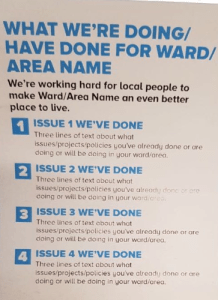
“Conservatives are standing for election in east London on their record of “ISSUES WE’VE DONE” for “AREA NAME”, according to their leaflet.

The leaflet, promoting the Tory candidate for Ilford Town, sets out in blue capitalised letters “WHAT WE’RE DOING/HAVE DONE FOR WARD/AREA NAME”.

Underneath, it lists issues one to four that “we’ve done” for Ilford. In what appears to be an embarrassing copy-and-paste error, the leaflet reads: “Three lines of text about what issues/projects/policies you’ve already done or are doing or will be doing in your ward/area name.”

The latest in a series of leaflet gaffes ahead of the local elections on Thursday, images of the leaflet quickly went viral on social media.”

https://www.huffingtonpost.co.uk/entry/election-leaflet-ilford-conservative_uk_5ae9983de4b022f71a038ce3

“Trying to maximise income purely from commercial revenues is NOT what the public want.”

CIPFA chief executive Rob Whiteman has told a conference this morning”

“… At some point in the next 15 – 20 years local government needs to be reorganised. We need to be aware reorganisation would be a good thing.”

But he predicted there was unlikely to be “any meaningful local government reform” for some time.

Local government must rebuild trust with the public, Whiteman told his audience. “In its present form, local government is not perfect.

“I do not think that trying to maximise income purely from commercial revenues is what the public want.”

Don Peebles, head of CIPFA UK policy and technical, echoed this, suggesting local government’s commercial investments should be more about keeping council finances afloat rather than maximising profit.

He said recent changes to the prudential code – the statutory guidance for local government on borrowing and investments – reflected that “the priority is not maximisation of return but the protection of capital”. …”

https://www.publicfinance.co.uk/news/2018/05/local-government-uncertain-place-10-years

“Housing Issues Can Make Mental Health Problems Worse”

Well, duh! No surprise there!

“Housing issues can make mental health problems worse or even cause them, according to a new study by the mental health charity Mind.

The charity surveyed 1,780 who described themselves as having mental health problems and nearly four in five of those said a housing situation had made their mental health worse.”…

https://www.huffingtonpost.co.uk/entry/housing-issues-can-make-mental-health-problems-worse_uk_5ae890e0e4b02baed1be6f74

MPs in power: “Reckless Opportunists”

Owl says: MPs as elites, out of touch and just in it for the glory – well, we know a lot about that in this part of the country!

(By the way, if your/our MPs have not been about much recently it is because they have been despatched to areas where the party in power might lose control in local elections tomorrow).

“[Amber] Rudd exemplifies a political class light on expertise and principle, yet heavy on careerism and happy to ruin lives. All the key traits are here. In a dizzying ascent, she went from rookie MP in 2010 to secretary of state for energy in 2015, before being put in charge of the Home Office the very next year. Lewis Hamilton would kill for such an accelerant, yet it leaves no time to master detail, such as your own department’s targets. Since 2014 Sajid Javid, Rudd’s replacement, has hopped from culture to business to local government, rarely staying in any post for more than a year. Margaret Thatcher kept her cabinet ministers at one department for most of a parliamentary term, but this stepping-stone culture turns urgent national problems – such as police funding and knife crime – into PR firefighting.

Another hallmark of Rudd exemplifies a political class light on expertise and principle, yet heavy on careerism and happy to ruin lives. All the key traits are here. In a dizzying ascent, she went from rookie MP in 2010 to secretary of state for energy in 2015, before being put in charge of the Home Office the very next year. Lewis Hamilton would kill for such an accelerant, yet it leaves no time to master detail, such as your own department’s targets. Since 2014 Sajid Javid, Rudd’s replacement, has hopped from culture to business to local government, rarely staying in any post for more than a year. Margaret Thatcher kept her cabinet ministers at one department for most of a parliamentary term, but this stepping-stone culture turns urgent national problems – such as police funding and knife crime – into PR firefighting.

Another hallmark of this set is the disposability of its values. Cameron hugs Arctic huskies, then orders aides to “get rid of all the green crap”. As for Rudd, the May cabinet’s big liberal vowed to force companies to reveal the numbers of their foreign staff, stoking the embers of racism in a tawdry bid to boost her standing with Tory activists. Praised by Osborne for her “human” touch, she was revealed this week privately moaning about “bed-blocking” in British detention centres.

And when things get sticky, you put your officials in the line of fire. During the Brexit referendum, Osborne revved up the Treasury to generate apocalyptic scenarios about the cost of leaving. While doomsday never came, his tactic caused incalculable damage both to the standing of economists and to the civil service’s reputation for impartiality. Rudd settled for trashing her own officials for their “appalling” treatment of Windrush-era migrants.

None of these traits are entirely new, nor are they the sole preserve of the blue team. At the fag end of Gordon Brown’s government, the sociologist Aeron Davis studied the 49 politicians on both frontbenches. They split readily into two types. An older lot had spent an average of 15 years in business or law or campaigning before going into parliament – then debated and amended and sat on select committees for another nine years before reaching the cabinet.

The younger bunch had pre-Westminster careers that typically came to little more than seven years, often spent at thinktanks or as ministerial advisers. They took a mere three years to vault into cabinet ranks. This isn’t “professionalisation”. It is nothing less than the creation of a new Westminster caste: a group of self-styled leaders with no proof of prowess and nothing in common with their voters. May’s team is stuffed full of them. …

Davis depicts a political and business elite that can’t be bothered about the collective good or even its own institutions – because it cannot see further than the next job opportunity. In this environment, you promise anything for poll ratings, even if it’s an impossible pledge to get net migration down to the tens of thousands.this set is the disposability of its values. Cameron hugs Arctic huskies, then orders aides to “get rid of all the green crap”. As for Rudd, the May cabinet’s big liberal vowed to force companies to reveal the numbers of their foreign staff, stoking the embers of racism in a tawdry bid to boost her standing with Tory activists. Praised by Osborne for her “human” touch, she was revealed this week privately moaning about “bed-blocking” in British detention centres.

And when things get sticky, you put your officials in the line of fire. During the Brexit referendum, Osborne revved up the Treasury to generate apocalyptic scenarios about the cost of leaving. While doomsday never came, his tactic caused incalculable damage both to the standing of economists and to the civil service’s reputation for impartiality. Rudd settled for trashing her own officials for their “appalling” treatment of Windrush-era migrants.

None of these traits are entirely new, nor are they the sole preserve of the blue team. At the fag end of Gordon Brown’s government, the sociologist Aeron Davis studied the 49 politicians on both frontbenches. They split readily into two types. An older lot had spent an average of 15 years in business or law or campaigning before going into parliament – then debated and amended and sat on select committees for another nine years before reaching the cabinet.

The younger bunch had pre-Westminster careers that typically came to little more than seven years, often spent at thinktanks or as ministerial advisers. They took a mere three years to vault into cabinet ranks. This isn’t “professionalisation”. It is nothing less than the creation of a new Westminster caste: a group of self-styled leaders with no proof of prowess and nothing in common with their voters. May’s team is stuffed full of them. After conducting more than 350 interviews with frontbench politicians, civil servants, FTSE chief executives and top financiers, Davis has collected his insights in a book. The argument is summed up in its title: Reckless Opportunists. …”

https://www.theguardian.com/commentisfree/2018/may/01/amber-rudd-career-elite-ordinary-people-contempt