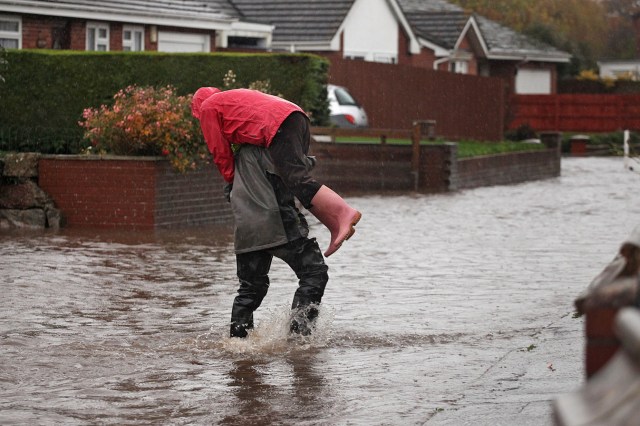
Dear John Hart, stop playing King Canute. Put your wellies on!


Correspondence from a water-logged Feathered Friend! (Hope you dry out soon – Owl)

Owl is, indeed, very wise to keep a close eye on this District’s increased risk of flooding due to climate change, where the local floodplains are over capacity and drains are unable to cope with the recent more intense rainfall, which was highlighted in last night’s BBC Spotlight, reported from the old bridge over the River Clyst in Clyst St Mary. 

The investment of a quarter of a million pounds to alleviate long-standing problems from extensive flooding from the River Clyst at Clyst St Mary is welcomed by this community, although this sum will not alleviate all the local flooding problems in this fragile area.

Hopefully, the much publicised major Winslade Park development by Burrington Estates https://winsladepark.com/   will not exacerbate the  problematic flooding issues in this village? The Developers’ proposals for Zone B (elevated commercial units with parking below) & Zone  J (substantial car parking) are in high risk flood zones and will require significant flood relief measures to ensure that the Grindle Brook (which flows into the River Clyst) does not create substantial deluges in these areas. Storms Imogen (2016),  Ciara and Dennis (2020) created major flooding in these areas and to lower-lying parts of the village, with the A376 dual carriageway and local roads being overwhelmed and the 2020 storms are not over yet!

Clyst St Mary’s residents and businesses certainly support a better management of flood defences and storm drains and although these vital improvements will cost millions of pounds – such figures pale into insignificance against the catastrophic cost to the lives of flood victims!

However, Devon County Council Leader, John Hart’s solution to encourage a modern day dad’s army of individuals, villages and Parish Councils to do more for themselves, using self-help methods seems unrealistic, blinkered, impracticable and somewhat utopian! Historically, King Canute demonstrated that no mortal could hold back the tides and the power of leaders is worthless in such situations! 

We are all prepared to ‘do our bit’ to protect our local and wider environment and support local authorities. However, we are already manually clearing DCC drains,  cutting DCC grass verges, pruning DCC trees, collecting/disposing of DCC autumn leaves, improving DCC potholes etc but we do need a little help from local and national government and regulators to build essential, significant flood defences for protection against climate change!

A Water-logged Feathered Friend!


Flood insurance cover does not protect thousands of new homes

Thinktank says 70,000 new builds in high risk areas are not covered by government-backed scheme

Josh Halliday www.theguardian.com  

Tens of thousands of families who bought new homes in flood-risk areas are facing “crippling” financial costs, as they are ineligible for cover under a government-backed insurance scheme, a study has found.

Research by the liberal conservative thinktank Bright Blue found that 70,000 homes had been built on land at the highest risk of flooding in England since 2009, including 20,000 that were not protected by flood defences.

Homes built after 1 January 2009 are not eligible for insurance under Flood Re, a government scheme launched in 2015 with the aim that about 350,000 homeowners would have access to affordable cover.

However, the scheme has been criticised – not least because tens of thousands of people who bought new homes in flood-prone areas in the past decade are not covered. The government ordered a review into flood insurance following the storms over Christmas.

The study found that about £31bn worth of properties had been built after 2008 on land in England at the highest risk of flooding. The vast majority of these properties are protected by the Thames Barrier in London, it said, although £5bn worth of buildings remain unprotected.

Of the 70,000 new homes built in these at-risk areas since 2008, 20,000 are not protected by flood defences. Lincolnshire had the greatest concentration of undefended at-risk homes, according to the report.

The thinktank said the government had not done enough to inform new-build homebuyers of their flood risk over the past decade and should step in to help. Helen Jackson, the author of the report, said: “Government policy over the past decade has seen individuals as entirely responsible for finding out their flood risk, but obviously many are simply not aware.

“Many of those seeing their communities deal with flooding would view this onus on them as individuals to have understood how flooding could affect them as a bit heartless.”

The National Planning Policy Framework, which guides local planners on the government’s housebuilding policies, states that “inappropriate development in areas at risk of flooding should be avoided” by directing development away from areas at highest risk. It adds that where development is necessary, it should be “made safe for its lifetime without increasing flood risk elsewhere”.

However, experts say that any housebuilding on high-flood-risk land risks exacerbating the problem elsewhere because it involves paving over green space that would otherwise help soak up rainwater.

A government spokesperson said: “Local authorities have a responsibility to assess the number of homes their communities need and have the final say on planning permissions for new developments. However, flooding risk should always be a consideration to ensure building takes place where this risk is lowest.

“Where development in a risk area is absolutely necessary, sufficient measures should be taken to make sure homes are safe, resilient and protected from flooding.

“To better understand if some households are not receiving sufficient insurance cover, we have announced an investigation into this issue.”  [Owl might have to ask the weasels what the last few paragraphs mean]

With more rain forecast, County Leader, John Hart, says you are on your own!

On last night’s BBC Spotlight, Adrian Campell reported from the river Clyst on the increased risk of flooding due to climate change. This follows a number of serious flooding problems in the last week especially on the river Yealm. He reports that our drains can’t cope with today’s more intense rainfall. The river Clyst is to get a quarter of a million pound investment to alleviate long standing problems. [Preparing the way for more development – Owl?]

More intense rainfall because of climate change means that new methods are needed to manage flood defences and storm drains.The County Council Lib Dems have called for millions more to be spent on improved drainage. Council Leader, John Hart’s solution, however, is to encourage a modern day dad’s army of individuals, villages and Parish Councils, where they care, to do more for themselves. Self-help, he said, is going to be the order of the day.

Beautiful homes on sunlit uplands? Not once the developers are in charge

Owl notes that in following its jobs led, high growth strategy to: build, build, build; EDDC has rolled over to developers for years. Cranbrook comes to mind. Owl fears that it’s going to get worse. As reported earlier, Barnstable is now the go to place for high tech start-ups. It’s more attractive.

Richard Vize   www.theguardian.com 

Boris Johnson’s “smash the system” approach to public policy is about to reach every street, town, village and field in the country. The government is preparing to dynamite development controls and unleash market forces on our physical world, moving power from councils to developers and inflicting great harm on the built and natural environments.

While No 10 adviser Dominic Cummings and eugenics aficionado Andrew Sabisky grab the headlines, it is Jack Airey who may well have the more lasting impact on our lives. As Johnson’s new adviser on housing and planning, Airey is leading the charge to strip local councils of meaningful control over local development. Just last month, in his role as head of housing at influential right-wing thinktank Policy Exchange, he published his manifesto, Rethinking the planning system for the 21st century.

Airey is undoubtedly right that the planning system is not fit for modern times. Fertile land is being gobbled up for ugly, sprawling, car-dependent, amenity-free housing developments. Poorly planned building is exacerbating the menace of floods. Too few new buildings minimise their carbon footprint. Developers constantly dodge their obligations to build social housing. There are too few homes. Planning decisions can take too long and the rationale can be opaque. But junking democratic accountability and putting developers in charge is not the answer.

A white paper on planning reform is expected in the coming weeks. Johnson is clearly in the mood for bold, high-risk policies, and Policy Exchange is playing to that tune by proposing land is simply divided into development and non-development zones. “Market conditions” will then determine how development land will be used, with few controls. Councils will be reduced to mere administrators of the system, banned from taking a view on any scheme no matter how awful.

The green belts are in their sights, of course. They could be stripped of their protections.

Apparently this free-for-all will create “a more beautiful built environment”. The Policy Exchange report is full of this sort of seductive phrasing. The current restrictions “prevent dynamic places from growing naturally”, as if there is anything natural about a cheap, ugly development on what used to be a field. The choice we are offered is the current system – painted as dystopian state control reminiscent of the Soviet Union’s infamous Gosplan state planning committee – and the sunlit uplands where untrammelled market forces spontaneously enhance our environment and help us become carbon neutral.

It claims councils are saddled with too many policy objectives around development, often pulling in different directions. Of course there are conflicts, and it is the role of local and national politicians, accountable to voters, to do their best to resolve them. The outcomes will be inherently imperfect, but still superior to allowing the answers to be determined by those whose primary objective is to maximise profit.

As councils have repeatedly demonstrated, it is developers who hold back housebuilding, rather than planning. Figures released by the Local Government Association yesterday revealed that 2.6m units

Search begins for superfast broadband provider in Devon and Somerset

Owl recommends searching the archive using a combination of these terms: Twiss; broadband supremo; omnishambles. How far back can you go?

The search is on to find a new contractor to roll out superfast broadband across Devon and Somerset.

Daniel Wilkins

www.exmouthjournal.co.uk /news/devon-somerset-superfast-broadband-procurement-1-6526131

Connection Devon and Somerset (CDS) is working with Building Digital UK (BDUK) on a new procurement process.

The Government has confirmed an extension for the CDS programme, helping to provide a £38 million public investment in the region’s broadband.

Funding has also been provided by Heart of the South West local enterprise partnership, local authorities, the European Regional Development Fund and the Rural Development Programme for England.

Councillor Rufus Gilbert, Devon County Council cabinet member for economy and skills and CDS board member, said: “CDS is working hard to find alternative broadband providers for our residents and businesses.

“BDUK has always stated its commitment to extend the funding for the programme, and it has backed us by doing exactly that.”

Final bids from qualified bidders in the procurement process are expected to be received by CDS by late summer, and contracts are due to be awarded in December.