Asked if face masks should become compulsory in shops, Mr Gove told the Andrew Marr Show on Sunday: “I don’t think mandatory, no.”
“But I would encourage people to wear face masks when they are inside, in an environment where they are likely to be mixing with others and where the ventilation may not be as good as it might.
“I think that it is basic good manners, courtesy and consideration, to wear a face mask if you are, for example, in a shop.
“It is always better to trust people’s common sense.”
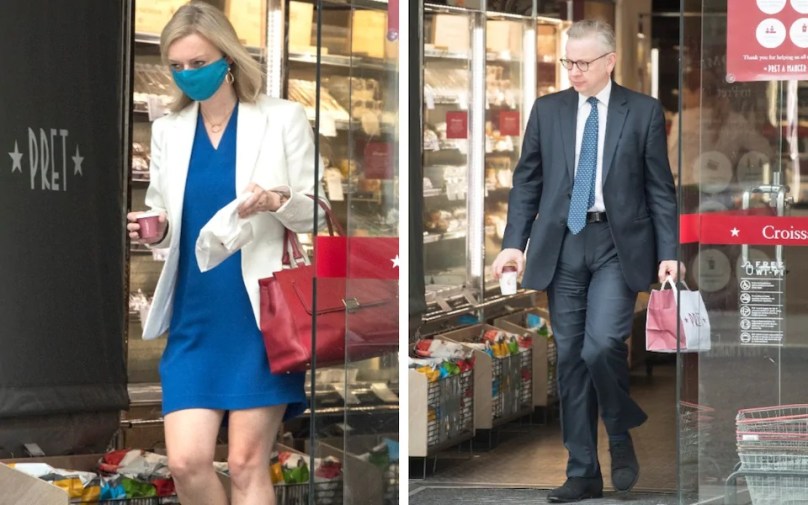
This picture appears on the front page of today’s Telegraph. The caption reads: “Cabinet colleagues Liz Truss and Michael Gove visit the same Pret a Manger in Westminster on Tuesday, one wearing a mask and one without.”
The largest study to date examining rates of coronavirus infection in the general public has found that there was a significant reduction of the virus before lockdown restrictions were eased.
According to researchers at Imperial College London, the rates of infection fell during May, the last month of lockdown, halving every eight to nine days.
There were on average 13 positive cases for every 10,000 people, with an overall reproduction number of 0.57 – lower than previously reported.
Other key findings were that young adults, aged 18 to 24, were more likely to test positive than other age groups, underscoring the need for this age group to adhere to social distancing measures to protect vulnerable friends and family, and that those Asian ethnicity were more likely to test positive than those of white ethnicity.
Also, care home staff and healthcare workers were more likely to be infected with COVID-19 during lockdown than the general population, and anyone who had recent contact with a known COVID-19 case was 24 times more likely to test positive than those with no such contacts.
The Real-time Assessment of Community Transmission (REACT-1) programme, commissioned by DHSC and carried out by a team of scientists, clinicians and researchers at Imperial College London, Imperial College Healthcare NHS Trust and Ipsos MORI, provides a baseline for further research a clearer picture of the spread of the virus to help inform measures tailored to limit its spread.
“Community testing is a vital step in ongoing efforts to mitigate the pandemic, but to be successful this must be based on robust scientific evidence and sound statistics,” said Professor Paul Elliott, FMedSci, director of the programme at Imperial College London.
“Through this surveillance programme with DHSC and Ipsos MORI we’re gathering the critical knowledge base necessary to underpin community testing and facilitate a greater understanding of the prevalence of COVID-19 in every corner of England.”
In the second part of the programme (REACT-2), various antibody tests have been assessed for accuracy and ease of use at home.
Plans are underway to roll this out to 100,000 people to identify the levels of antibodies against the virus that causes COVID-19 in the general public.
The Office for Budget Responsibility, the Treasury’s official forecaster, has published three possible scenarios for the UK economy as it tries to recover from the coronavirus pandemic:
Central scenario
The economy recovers more slowly than previously anticipated, with gross domestic product (GDP) regaining its pre-virus peak by the end of 2022. GDP falls by 12.4% in 2020.
Business investment is 6% lower over five years than expected by the OBR in March before Covid-19 spread. Job losses and business failures are significant. Scarring caused by job losses and lower levels of business investment mean the level of GDP after inflation remains 3% lower at the start of 2025 than anticipated in March.
Unemployment more than doubling from 1.3 million last year to 3.5 million in 2021. Outstripping the damage inflicted by the 2008 financial crisis, the unemployment rate peaks at 12% in the final three months of 2020.
The hit to the economy, coupled with the rise in state spending to cushion the blow, results in a sharp rise in government borrowing this year. The budget deficit – the shortfall between income from taxes and expenditure – hits £322bn, or 16% of GDP.
The UK’s national debt – the sum total of every budget deficit recorded in history – increases above 100% GDP for the first time since the early 1960s in all years of the scenario.
Best-case scenario
Activity rebounds relatively quickly, similar to the OBR’s central scenario published in April during the early stages of the Covid-19 emergency. GDP returns to the pre-virus peak by the end of March next year, and there is no enduring economic scarring.
Unemployment still however reaches a peak of 10% in the three months to September. As many as 1.9 million people would be out of work next year, as employment begins to gradually rise again.
GDP still also falls by 10.6% this year, although snaps back rapidly next year.
The limited damage to employment helps to protect household finances, enabling a recovery in consumer spending to levels close to that expected in March.
The government’s budget deficit hits £263bn this year, or 13% of GDP, before gradually dropping back by 2025 to end up near the levels expected before coronavirus struck.
Worst-case scenario
Economic output recovers even more slowly, returning to its pre-virus peak only by 2024. This results in a more significant loss of business investment, company failures and persistently high levels of unemployment.
Due to lasting economic scarring caused by the depth of the crisis and slow recovery, GDP after inflation is 6% lower at the start of 2025 than was expected in March 2020.
Unemployment peaks at 13% in the first three months of 2021, in a jobs crisis worse than the period of high unemployment under the Thatcher government of the 1980s. As many as 4 million people would be out of work next year.
GDP plunges by 14.3% this year, marking the worst recession for three centuries. The severe blow to household finances from the sharp increase in unemployment causes a severe decline in consumer spending, hurting the economy. Household consumption does not return to its pre-virus peak at all in the five-year scenario.
Due to the economic collapse and higher levels of state spending necessary, the budget deficit reaches£391bn, or 21% of GDP.
According to the latest COVID Symptom Study data, rates of new COVID cases have stopped declining with over 23,000 suspected cases in the UK.
According to the latest COVID Symptom Study app figures, there are currently 1,472 daily new cases of COVID in the UK on average over the two weeks up to 04 July 2020 (excluding care homes) [*]. The data suggests no decline from last week (1,445 cases). The latest figures were based on the data from almost 3 million users, 11,639 swab tests done between 21 June to 04 July (a full regional breakdown can be found here).
The latest prevalence figures estimate that 23,459 people in the UK currently have symptomatic COVID and highlights a big regional difference across the UK. While nations like Northern Ireland have almost no active cases, the rates for other English regions, like the Midlands are showing high numbers. The Midlands has 6,556 predicted symptomatic COVID cases compared to 2,254 in the North West.
This estimate is in line with the most recent ONS Infection survey in which 25,000 people in England were estimated to be infected with COVID-19 during the two week period that goes from the 14th to the 27th of June. The latest prevalence map also indicates that parts of Wales currently have high numbers of predicted symptomatic COVID. This new prevalence data based on large numbers allows the COVID Symptom Study to look at the country in a much more detailed way than other current data sources.
Tim Spector, Professor of Genetic Epidemiology at King’s College London, comments:
“It is disappointing to see that the number of daily new cases is no longer falling as they have been in previous weeks, this could be a temporary blip or due to the easing of lockdown and the amount of social contact slowly increasing. Importantly our updated analysis of the prevalence is still continuing to show that The Midlands and Wales are key areas in the country where the amount of COVID is remaining relatively high. It is important that we keep a close eye on these areas.
With the growing number of people suffering for extended periods of time, we are going to be focusing on these long term sufferers to help us research causes and potential treatments. But in order for this to be possible, we need all our users to continue to log in, if they have been ill and have got better.”
Additional notes
[*] This analysis requires swab testing, which was kindly provided by the Department of Health and Social Care for England. As Scotland and Wales are not yet offering tests to app users, we provided indirect estimates using countrywide averages and wide confidence limits. Testing is happening in Northern Ireland, but the number of participants is too few to generate an accurate estimate. These figures exclude care homes as there is not enough data from the app to estimate this population.
The government’s long-awaited strategy for tackling floods in England does not go far enough and appears to conflict with Boris Johnson’s “build, build, build” plan for more housing, experts have said.
Billed by ministers as the most comprehensive flood defence plan in a decade, the fresh approach will mean more money spent on natural solutions to counter floods, such as capturing water on fields.
But the plan, unveiled on Tuesday, stopped short of banning any new building on land at the highest risk of flooding, disappointing experts, local authorities and flood-hit communities.
Prof Hannah Cloke, a hydrologist at the University of Reading, said the government’s pledge to review house building on floodplains did not “sound in tune” with the prime minister’s commitment to cutting red tape to build new homes more quickly under “Project Speed”.
Cloke said: “A fortnight ago Boris was attacking ‘newt counting’ and bemoaning the pace of progress in the UK. Dealing with flooding shows precisely the difficulties behind his promise to build better, faster and greener. Sometimes being better and greener requires building more slowly and carefully, or we risk long-term economic and social costs that we cannot afford.”
The government pledged in its 2020 budget to spend £5.2bn on flood defences by 2027, which it said would create about 2,000 new flood and coastal projects, and improve the protection of 336,000 properties in England.
Academics welcomed the investment in natural flood solutions, such as hollows to catch floodwater, and the government’s support for making properties more resilient to floods.
George Eustice, the environment secretary, said the government was considering giving the Environment Agency more powers to prevent building on high-risk floodplains but stopped short of saying that fewer homes should be built in these areas.
About 20,000 homes a year are built on land at the highest risk of flooding in England, equating to one in 10 of all new homes since 2013.
Planning policy says housing should be based in areas at the least risk of flooding, yet local authorities, which face penalties if they miss house-building targets, say they feel powerless to stop developments and are concerned these construction projects will only increase in number.
Heather Shepherd, of the National Flood Forum, which supports at-risk communities, said the government was “asking for problems” by continuing to build on floodplains and plug new properties into ageing infrastructure. “If you’re to think of nature as a solution then our floodplains become precious and a resource to mitigate flooding. If we build on them we’re taking away a natural way of managing flood risk,” she said.
Shaun Davies, the Labour leader of Telford and Wrekin council, Shropshire, which had weeks of floods in February, said there was little in the new government approach to reassure residents.
Davies said he raised concerns with Eustice in February about the conversion of an old power station into 1,000 new homes on the Shropshire floodplain but that that development was still going ahead.
The insurance firm Zurich said the extra cash to help flood-hit homeowners recover from damage “misses the point” and that at-risk residents need financial support to defend their homes “before extreme weather strikes – not after they have been flooded”.
Eustice said: “Our record investment and ambitious policies will better protect homes, schools, hospitals and businesses, but we also recognise that we cannot prevent flooding entirely, which is why we will ensure that communities at high risk are more resilient.”
There is “compelling” evidence that air pollution significantly increases coronavirus infections, hospital admissions and deaths, according to the most detailed and comprehensive analysis to date.
The research indicates that a small, single-unit increase in people’s long-term exposure to pollution particles raises infections and admissions by about 10% and deaths by 15%. The study took into account more than 20 other factors, including average population density, age, household size, occupation and obesity.
There is growing evidence from Europe, the US and China that dirty air makes the impact of Covid-19 worse. But the study of the outbreak in the Netherlands is unique because the worst air pollution there is not in cities but in some rural areas, due to intensive livestock farming.
This allows the “big city effect” to be ruled out, which is the idea that high air pollution simply coincides with urban populations whose density and deprivation may make them more susceptible to the virus.
The scientists are clear they have not proven a causal link between air pollution and worse coronavirus impacts. Conclusive evidence will only come with large amounts of data on individual people, which is not yet available, rather than average data for regions as used in the analysis.
But scientists said it was important to do the best research possible as understanding the link may be important in dealing with further Covid-19 outbreaks and could signal where subsequent waves will hit the hardest.
Many scientists agree that air pollution is likely to be increasing the number and severity of Covid-19 infections, as dirty air is already known to inflame the lungs and cause respiratory and heart disease that make people more vulnerable. But not all agree that the evidence so far is good enough to demonstrate a large impact.
“What I was struck by was this really was a strong relationship,” said Prof Matthew Cole, who conducted the research with his colleagues Ceren Ozgen and Eric Strobl at the University of Birmingham, UK. Unlike most studies to date, the paper has been reviewed by independent scientists and accepted for publication in a journal, Environmental and Resource Economics.
The team concluded: “Using detailed data we find compelling evidence of a positive relationship between air pollution, and particularly [fine particle] concentrations, and Covid-19 cases, hospital admissions and deaths. This relationship persists even after controlling for a wide range of explanatory [factors].”
The most prominent previous study was conducted by Harvard University researchers and found an 8% increase in coronavirus deaths for a single-unit rise in fine particle pollution. Cole said: “We used data at much finer resolution, with the average size of the 355 Dutch municipalities being 95 km2 compared to the 3,130 km2 for a US county.”
“This means we can more precisely capture each region’s characteristics, including pollution exposure,” he said. The new analysis also uses Covid-19 data up to 5 June 2020, allowing it to capture almost the full wave of the epidemic.
An additional factor considered was the Netherlands carnival gatherings that take place in late February, particularly in the livestock farming regions in the south and east of the country. This is where coronavirus cases were highest and where air pollution is highest, due to the ammonia emitted from livestock farms, which forms particle pollution. Coles’ team used statistical methods to estimate the impact of these gatherings. “But it did not knock out the effects of pollution, which I really thought it would,” he said.
Among the other factors taken into account were average income, level of education, smoking, share of population receiving incapacity benefits and closeness to international borders.
“As analyses of a possible link between air pollution and Covid-19 progress we are beginning to see much better studies emerge,” said Prof Frank Kelly, at Imperial College London, UK. “This new study appears to be the best to date.”
He said the work used high quality data and controlled for multiple possible confounding issues. “Further research elsewhere is required to confirm these findings, but we have now reached a point in the pandemic where datasets are robust enough to ask the question,” he said.
Prof Francesca Dominici, who led the Harvard Study, praised the work as “very good” and agreed that it added to her team’s work. She said it was important to examine the relationship between air pollution and Covid-19 outcomes across many countries, as each country’s data would have its own strengths and weaknesses and different confounding factors can be at play.
“Air pollution is not yet getting enough attention because of the slow peer-review process [for academic studies]” Dominici said. “But hopefully as this and other studies are published, the topic will get more attention and most importantly will affect policy.”
However, Prof Mark Goldberg, at McGill University in Canada, warned that averaging data across a region masked the variations among individuals and could mask other potential explanations for the correlation between dirty air and coronavirus. He is concerned that over-interpreting the correlation distracts from other important factors.
“The issue with severe cases is social and economic deprivation – which correlates with air pollution – and [underlying health] conditions,” he said. “I see it in Montreal: the poorest areas with high numbers of people living together, on low incomes and working multiple jobs were hardest hit.”
Cole accepts that only individual-level data will conclusively resolve the question of a link. “We can’t rule out [some unknown factor] until the data gets better. But it’s difficult to know what that would be.”
Obvious tensions, chaotic scenes, an accidental vote and a councillor locked in a toilet – this was what greeted residents who tuned into the first virtual Honiton Town Council meeting last night.
It was the first meeting of Honiton Town Council since the Coronavirus lock down began, it was also the first time the council has held a meeting online.
Due to the coronavirus pandemic councillors voted to suspend an Annual General Meeting of the council. Council AGMs usually involve the election of a new mayor and deputy mayor but due to the current circumstances councillors voted to suspend the meeting.
This means that the current mayor, John Zarczynski, will keep his position for another year. However, due to the resignation of councillor Duncan Sheridan Shaw earlier this year councillors had to elect a new deputy mayor.
Councillor Carol Gilson was voted in as the new deputy mayor, with six councillors voting in favour of her appointment, two against and one abstention.
Councillors Taylor, Gilson, Dolby, Coombs and Carrigan appeared to be tuning into the meeting from the same house with each councillor taking it in turns to be in the hot seat. This congregation of councillors in one house was criticised by a fellow councillor and by a member of the public.
After the appointment of councillor Carol Gilson as deputy mayor proceedings turned to the issue of re-establishing the council’s HR Committee.
Councillors Kolek and Pollington requested that the committee be made up of all members of the full council due to a number of recent high profile resignations. This proposal was quashed by their fellow councillors.
Councillors then voted on re-establishing the HR committee under a previous frame of reference, meaning that the HR committee would be made up of councillors holding committee chair positions.
When the vote came to councillor Gilson she was absent from the call, the deputy town clerk, Heloise Marlow, moved on and eventually came back to councillor Gilson when she reappeared on the conference call.
When asked where she had been she told councillors she had been ‘locked in the toilet’. The town clerk admonished councillor Gilson and asked that she please inform the meeting’s chairman before leaving a meeting in future.
Councillor Gilson then voted against re-establishing the HR committee under the previous frame of reference but quickly realised that she had in fact intended to vote in favour of the motion.
This led to much confusion. The town clerk remarked: “I honestly don’t know what to do now.”
Despite councillor Gilson’s botched vote the motion was still carried.
It’s a dramatic turnaround – Mr Trump previously mocked others for wearing masks, and suggested some might wear such personal protective equipment to show their disapproval of him, even after the US Centers for Disease Control recommended face coverings.
Meanwhile, the UK government was initially reluctant to advise the general public to wear face coverings, even as other countries in Europe did.
It introduced rules requiring people to wear face coverings on public transport in June, and now says people in England must wear face coverings in shops or face a fine.
Globally, many authorities – including the World Health Organization (WHO) – initially suggested that masks were not effective in preventing the spread of the coronavirus. However, they are now recommending face coverings in indoor spaces, and many governments have even made them mandatory.
What’s changed – and why?
The number of governments recommending face coverings has gone up significantly over the past six months.
As of mid-March, about 10 countries had policies recommending face coverings – now more than 130 countries and 20 US states do, says Masks4All, an activist group of researchers that advocates the use of homemade masks during the pandemic.
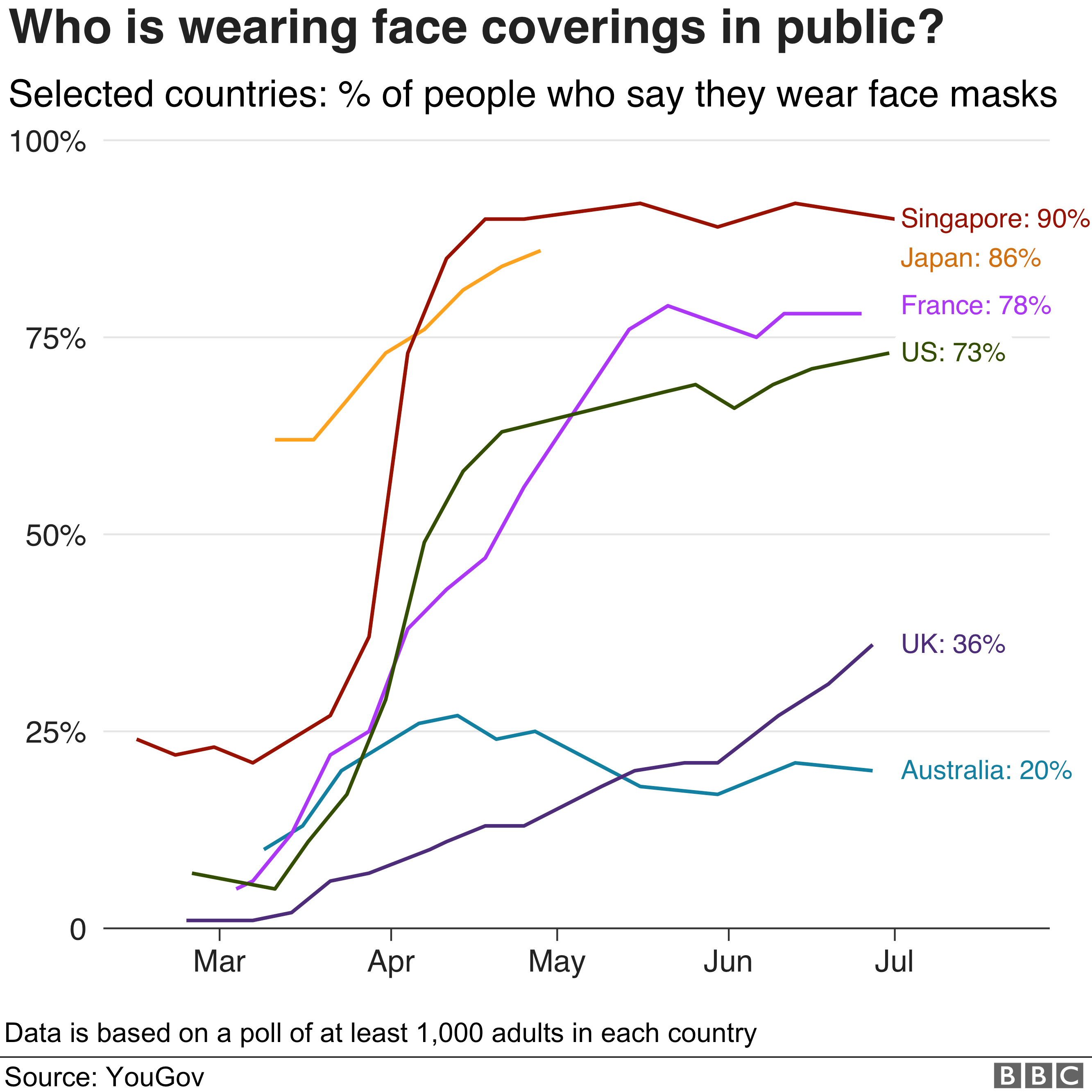
Some studies also suggest that people’s attitudes have changed.
“Countries with no previous history of wearing face masks and coverings amongst the general public rapidly adopted usage such as in Italy (83.4%), the United States (65.8%) and Spain (63.8%),” says a report by the Royal Society – one of the leading science bodies in the UK.
The changes appear to be partly due to a better understanding of how Covid-19 spreads.
Initially, the WHO said masks should only be worn by medical workers, or people who had symptoms like coughing and sneezing.
However, in recent months, there’s been increased evidence that many people with the virus do not have symptoms – but can still be contagious – and masks can stop them from passing it on to others. The WHO changed its guidance in June.
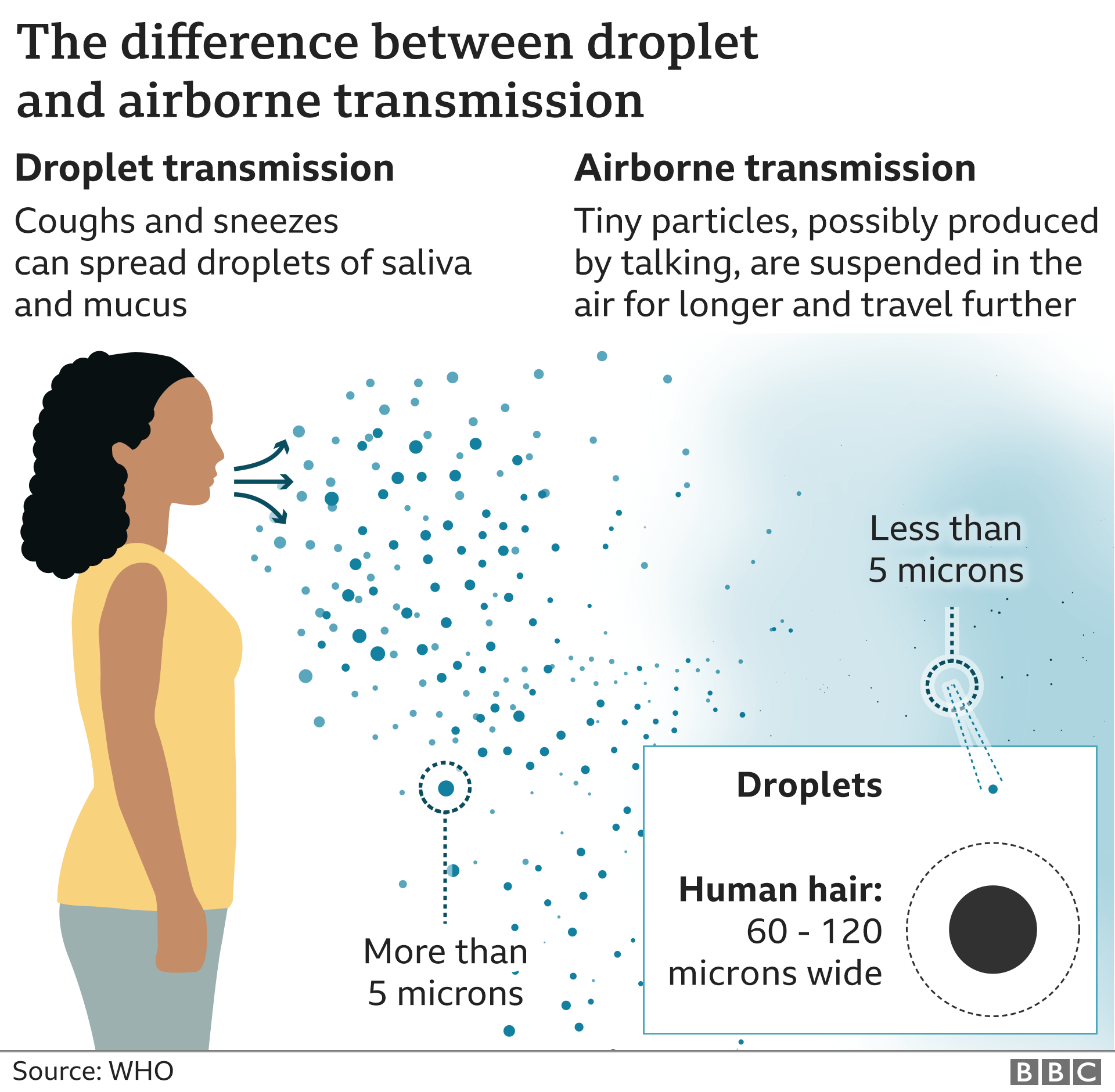
Meanwhile, there is more awareness that the risk of transmission is higher in poorly ventilated indoor spaces – and evidence to suggest that the virus could be spread by tiny particles suspended in the air.
This means that if everyone wears face coverings it will “protect against the most common mode of transmission – droplets – and to some extent maybe aerosol droplets,” says Kim Lavoie, chair of behavioural medicine at the University of Quebec at Montreal’s psychology department.
Prof Lavoie adds that “there has been increased research” into face coverings, including observational studies which indicate “countries with high mask wearing seem to have lower infection rates”.
There is also growing acceptance that the pandemic could continue for a long time – and, if so, face coverings could be seen as something necessary to help people adapt, and reduce risks as businesses and schools re-open.
“Covid’s not going anywhere – we’ll probably have a vaccine in years, not months,” says Prof Lavoie, who has been leading the iCARE Study, an international survey into Covid-19 related behaviours. “So all these principles need to be integrated and adapted to the new normal life.”
Why do countries have such different attitudes?
Even as government policies have changed – there’s a big gap in how willing people are to wear masks.
About 83% of people in Italy, and 59% in the US, say they would always wear a face mask outside their home – but only 19% of people in the UK say the same, according to the Covid-19 Behaviour Tracker – a project run by the Institute of Global Health Innovation at Imperial College London with polling company YouGov.
“The US, UK and Canada have been relatively slow to accelerate mask wearing versus, for example, Spain, France and Italy,” says Sarah P Jones, a health behaviour researcher at Imperial College London, and one of the creators of the tracker.
She says mask wearing can vary based on how vulnerable people feel about an illness, whether they believe the costs outweigh the benefits, and how readily available masks are.
In countries with steep rises in mask wearing, people may have experienced “rapid increases in perceptions of severity and vulnerability”, “rapid policy changes mandating use of face masks”, and a sense that “I see lots of other people doing it, so it must not be a big deal to wear a mask”.
Prof Lavoie agreed that places that “got hit quickly and hard”, like Italy, may have adopted mask wearing more readily.
Finally, people in countries that experienced the 2003 Sars pandemic – or other respiratory outbreaks – were readier to start wearing masks.
“In East Asia, there’s plenty of recent memory of respiratory pandemics, and a cultural awareness that masks are a good idea,” says Jeremy Howard, a research scientist at the University of San Francisco, and one of the Masks4All founders.
By contrast, “there’s just no recent history of respiratory pandemics in the West” and many Western and international institutions have “almost entirely ignored East Asian scientists”, he argues.
Many countries were particularly cautious over recommending face masks because of a lack of clinical trials proving their effectiveness, says the Royal Society’s report.
However, “there have been no clinical trials of coughing into your elbow, social distancing and quarantine, yet these measures are seen as effective and have been widely adopted,” it adds.
Why are some still reluctant to wear masks?
A majority of countries now recommend or require face coverings in some situations.
However, most people still appear much more willing to use hand sanitiser, social distance or wash their hands regularly, than wear face masks, according to data from both the Covid-19 Behaviour Tracker, and iCARES.
People feel that hand washing and social distancing are things they can easily control, says Prof Lavoie.
By contrast, “mask wearing is a little more complex – you have to find and purchase a mask, put it on and dispose of it a certain way, and they’re uncomfortable to wear.”
And the changing guidance from the WHO and many governments could have caused difficulties.
Many experts believe that governments were reluctant to recommend face coverings because they feared there would be a shortage of PPE equipment for medical workers – but by suggesting that they were ineffective at preventing transmissions, they now sound inconsistent.
“Mixed messaging, not being transparent about data, or how the government makes certain policy decisions, can undermine trust” and make it harder to convince people to wear face coverings now, Prof Lavoie says.
Mr Howard believes that many governments in the West were slow to act on masks until they were badly affected by the pandemic.
Nonetheless, he thinks that Boris Johnson and Donald Trump can have a positive impact now by wearing masks publicly.
“Role models are absolutely real,” he says, and ever since Mr Trump wore a mask, “a lot of folks who were previously anti-mask are now saying that was a patriotic thing for him to do.”
This is especially important now that the US is experiencing a new wave of infections, he adds.
“The five trusts with the highest death rates are in the south-west (80%), north-west (68%), south-west (62%), east of England (60%) and London (54%).”
Analysis such as this may make uncomfortable reading, and it may not be perfect, but Owl has consistently argued for more analysis of emerging data. Readers also need to be reminded that the “south-west” referred to above is the NUTS definition extending eastwards to Gloucestershire and Wiltshire.
A wide disparity in coronavirus mortality rates has emerged in English hospitals, with data seen by the Guardian showing that one hospital trust in south-west England had a death rate from the disease of 80% while in one London trust it was just 12.5%.
The figures, which NHS England has compiled but never published, show the age-standardised mortality rates that all of the country’s 135 acute hospital trusts have recorded during the pandemic. Doctors regard age as the single biggest predictor or risk factor for dying from Covid-19.
They cover the period from the start of the coronavirus crisis in March, through its peak in late March and April, up until 15 May, by which time 42,850 – or 85% – of the 50,219 deaths so far in all settings had occurred in England and Wales.
It is the first such data to emerge about how many people have lived or died in each trust after being treated there because they had been left critically ill by the disease. They are based on patients who were treated in an intensive care or high-dependency unit or on a ward.
Senior doctors said the dramatic gap in death rates of 67.5 percentage points between the trusts with the highest and lowest rates was notable and may mean that some hospitals needed to learn lessons from others.
“That is a huge variation, a huge range. I’m surprised at the degree of variation. A spread between 12.5% and 80% is quite stark,” said Dr Alison Pittard, the dean of the Faculty of Intensive Care Medicine. It represents the intensive care specialists who have played the lead role in treating what is now more than 100,000 people hospitalised in England with Covid-19.
Dr Nick Scriven, a former president of the Society for Acute Medicine (Sam), said: “The range does look larger than you would expect and should prompt further analysis and thought as to why this may appear as it does, which for the general population will be concerning.”
However, both Pittard and Scriven cautioned that the data did not give a full picture of differential death rates between hospitals because it did not take account of four other key factors for risk of death from Covid-19, namely gender, ethnicity, deprivation and underlying health problems. All four have been found to significantly increase a patient’s chances of dying.
NHS England has plotted each trust’s death rate, and the number of patients with Covid-19 each of them admitted, on a graph which it has shared with some senior doctors. Crucially, though, it has not identified the trusts on it. It has only disclosed which of the NHS’s seven regions the trust is in.
The five trusts with the highest death rates are in the south-west (80%), north-west (68%), south-west (62%), east of England (60%) and London (54%).
The five trusts with the lowest death rates are in: London (12.5%), Midlands (13%), London (14%), London (15%) and the south-east (15%).
Doctors pointed out that some trusts’ apparently high mortality rates could be skewed because they were based on them having treated fewer than 100 patients by 15 May, which makes their rates less reliable. But other trusts with notably high or low mortality had treated up to 2,350 patients over the same period, so their rates are more likely to be reliable.
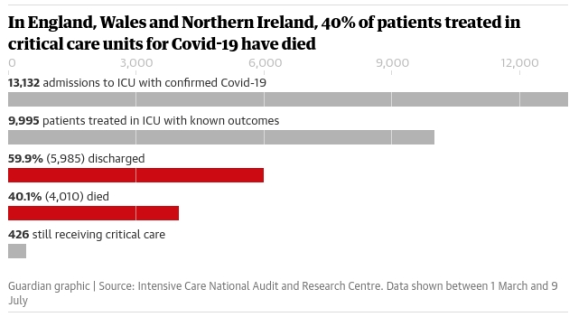
Research published by the Intensive Care National Audit and Research Centre shows that of 9,995 patients treated in intensive care units with known outcomes, 5,985 (59.9%) have been discharged and 4,010 (40.1%) have died, while 426 others are still receiving critical care.
Mortality among such patients in intensive care has improved from 50% early in the pandemic to 41% now, reflecting in part medical teams’ better understanding and treatment of Covid-19.
There is no suggestion that a high or low death rate indicates that patients have received a worse or better standard of care at any particular hospital. The makeup of the local population that a trust serves is the single biggest factor underlying a high or low death rate, Pittard said.
“We know that poorer communities and BAME communities have a higher risk of mortality, so if a trust is in an area of higher-risk individuals you woud expect that trust’s Covid-related mortality rate to be higher,” added Pittard.
NHS England’s data shows that 26 of the 135 trusts had a death rate between 12.5% and 25%. “That’s reassuring, absolutely. It’s positive that 26 trusts had that low mortality,” said Pittard.
However, at least half of patients treated at 11 trusts died. “Eighty percent does seem an extremely high number,” she added.
Dr Sue Crossland, the president of the Sam, said hospitals’ use of non-invasive ventilation, the early involvement of critical care teams and lying ventilated patients on their front – “proning” – have saved patients’ lives as doctors have better understood how to deal with Covid-19.
An NHS spokesperson said: “We do not recognise these figures, which appear to be experimental analysis of unverified data. But there is now a wide range of published data on the role that health inequalities, including pre-existing conditions and other health factors, have played when it comes to the impact of Covid, including from the ONS and Public Health England.
“The NHS is accelerating work to tackle health inequalities, and will shortly be providing local services with a range of actions they should build in to their plans for the coming months.”
Speaking to the Herald, Neil Parish was asked about groups such as Excluded UK who represent individuals and businesses excluded from the Government’s Covid-19 financial support measures.
He said: “We have been supplying their problems into government but the policy comes via the chancellor so I will do my best to represent people’s views and where we can help, we do.
“Some people do fall outside of the schemes and that’s what we have been trying to sort out with a meeting with the treasury minister this week.”
Mr Parish was in Honiton visiting the street market and said he was happy to see businesses begin to reopen so that the life can begin to return to some kind of normal.
He said: “We now need to start opening things because while the government has quite rightly supported businesses by furloughing people, we are borrowing huge sums of money to do it and of course at some stage, this money will have to be paid back.
Mr Parish also encouraged tourists returning to the area to act responsibly. He said: “What I said in parliament last week was we want the tourists to come back but we want them to behave.
“By that I mean, just don’t take too many risks. Please don’t get too drunk so that you don’t know what you’re doing and just take it carefully.
“I think then most people will be happy to have tourists back but we don’t want too many people ignoring the rules. It is a very difficult one but I think on balance I welcome them back but I can see people being concerned.”
Mr Parish, who has been the local MP for a decade now also said the pandemic shows how important health is. He said: “I think this has been the hardest period [of my tenure as MP]. We’ve come through Brexit, one way or the other which every side of the argument you were on, and in a way it shows that our health is so important and something like Covid has laid us completely low but what it has also shown is that the community can come together. I think there are some positive sides and fortunately, Devon has not seen a massive amount of Covid but we just hope there won’t be any spikes.”
Face coverings must be worn in shops and supermarkets in England from Friday 24 July, Boris Johnson has announced.
Enforcement will be carried out by police – not retail staff – and anyone failing to wear a face covering while shopping will be subject to a fine of up to £100, or £50 if paid within 14 days.
The rules to tackle coronavirus will be the same as those currently applicable on public transport in England, which means children under 11 and people with certain disabilities will be exempt.
The wearing of face coverings became compulsory in Scotland last week and around 120 countries – including Germany, Spain, Italy and Greece – now require coverings to be worn in public places.
Announcing the move, a Number 10 spokesperson said: “There is growing evidence that wearing a face covering in an enclosed space helps protect individuals and those around them from coronavirus.
“The prime minister has been clear that people should be wearing face coverings in shops and we will make this mandatory from July 24.”
The decision, due to be outlined by Health Secretary Matt Hancock in a Commons statement on Tuesday afternoon, follows four days of conflicting statements from ministers and demands from opposition MPs for clarity.
Responding to the announcement confirming mandatory face coverings, shadow health secretary Jon Ashworth said: “The government has been slow and muddled again over face coverings.
“Given the government’s own guidance issued on 11 May advised in favour of face masks, many will ask why yet again have ministers been slow in making a decision in this pandemic, and why it’ll take another 11 days before these new guidelines to come into force.”
London mayor Sadiq Khan went further and called the government’s “confused communications” on the subject a “disgrace”.
“We can’t afford to wait another day and the government should bring this policy in immediately – further delay risks lives,” he urged.
And the British Chambers of Commerce’s co-executive director Claire Walker said: “Businesses need clarity on the approach to the wearing of face coverings that is consistent and supported by public health evidence.
“Shops and other indoor businesses need to know what the new rules are as soon as possible.
“Updated guidance, including on enforcement, should be issued swiftly so firms can maintain their COVID-secure status and continue their operations successfully.”
In his most recent statement on face coverings, 12 hours before the official confirmation by Number 10, Mr Johnson said: “I think that as throughout this crisis people have shown amazing sensitivity towards other people and understanding of the needs to get the virus down by doing things cooperatively.
“I think wearing masks is one of them. In a confined space what you’re doing is you’re protecting other people from the transmission that you might be giving to other people.
“And they in turn they’re are protecting you. It’s a mutual thing. People do see the value of it.”
But just one day earlier, Michael Gove suggested masks in shops should not be mandatory, saying he believed shoppers should be encouraged to wear them, but he believed in “people’s good sense”.
And Home Secretary Priti Patel was pictured meeting her French counterpart indoors without wearing a mask over the weekend – despite being seen wearing one speaking to him outdoors on the same day – sparking claims ministers were sending mixed messages.
Image: Priti Patel switched between wearing and not wearing a mask
Since 11 May, government guidance has advised the public to wear face coverings in enclosed public spaces, where they may come into contact with people they would not usually meet.
The use of face coverings became mandatory on public transport in England from 15 June.
Although Mr Hancock will confirm that the government guidance will be updated to make the wearing of face coverings in shops and supermarkets compulsory, he will say that guidance for other settings will be kept under review.
Regulations will be made under the Public Health (Control of Disease) Act 1984. While shop employees should encourage compliance, the government said retailers and businesses will not be expected to enforce the policy.
The impact of HGVs travelling through Sidford and Sidbury is to be assessed – with a weight restriction on lorries still possible.
Devon’s cabinet member for roads had asked officers to look into limitations on the A375 which runs through the two East Devon villages.
Both have been blighted by big vehicles using their narrow roads, and it is feared a new business park off Two Bridges Road in Sidford will make the situation worse.
Plans for the scheme had been turned down over highway safety concerns but were approved on appeal.
A government inspector ruled that the benefits of the multi-million-pound scheme outweighed the effects and inconvenience of an increase in HGV traffic in the area.
Councillor Stuart Hughes, Devon County Council (DCC) cabinet member for highways, has previously championed the idea of a 7.5-tonne weight restriction on the route through Sidbury to the traffic lights junction at Sidford Cross.
A meeting of the East Devon Highways and Traffic Orders Committee (HATOC) heard an update on the proposal on Friday.
Cllr Hughes said: “There has been a lot of concern in Sidbury and Sidford about the increase of HGVs using the road to the business park following the planning approval.
“We will keep an eye of things to see how it pans out and we will be monitoring the impact on traffic carefully and consider any interventions that may be needed on the highway, including a weight limit.”
If the idea became a reality, HGVs which fell foul of the restriction would have to take a signed diversion route away from the villages.
This would likely to be via the A30 to the Daisymount roundabout.
However, Ottery Valley representative Cllr Claire Wright said this would have implications on traffic flows in the B3180 in her ward.
Cllr Hughes added: “Whenever you introduce a weight limit, it will just move the HGVs elsewhere.”
The impact of HGVs will be monitored before any interventions aimed at road safety, if required, are put in place.
Vehicles heavier than 7.5 tonnes would still be able to use the A375 for necessary access and to carry out deliveries.
Councillor Ian Hall has called for the move on the A358, to the north of the town, over safety fears.The road’s current 60mph limit runs from just past the entrance to Axminster Town Football Club’s ground in Tiger Way to the single-file Weycroft Bridge.Calls had been made to cut the restriction to 30mph.
The East Devon Highways and Traffic Orders Committee unanimously agreed on Friday that a Speed Compliance Action Review Forum (SCARF) should look into the measure.
Cllr Hall said: “This stretch of road is a 60mph zone and, as you go south into Axminster, it is still 60mph.
“Literally 20 yards away is the turning into Tiger Way where the football club is and there are real concerns about turning right and left.
“We have speeding motorists who jump the traffic lights on the bridge and it is a real issue at night.
“The stretch needs to be reduced in speed.”
Cllr Phil Twiss added: “I support this as the town has expanded north towards the Weycroft Bridge.
“While the 60mph was sensible ten years ago, it isn’t now, and it is very dangerous, so would support some sort of activity to reduce the speed of cars.”
Councillors unanimously agreed that Devon County Council officers should carry out a review through the SCARF process.
Data from this will help determine if the the current speed limit on the road is still appropriate.
[Owl simply gives a taster to encourage readers to go to her blog. At last we are getting some transparency]
Clair:“A plan to build thousands of new houses across East Devon was unveiled last week, with proposals for specific areas in the county.
I have since spent time talking with strategic planning officers to try and understand the detail of the national policy driving this.
Strategic planning is technical and complicated and takes some learning. I was heavily involved in strategic planning while a councillor on East Devon District Council between 2011 and 2015, so I felt compelled to examine this new plan and its proposals.
I will endeavour to explain my findings below!”
This she does under the following headings. Owl’s view is that her “explanations” highlight the absurdity behind most of the policies and government diktats that will lead to a massive increase in house building in East Devon.
Government housing policy
Affordability uplift
Affordable/social housing element within GESP
Developers fund the Conservative Party
The employment land con
Police investigation into planning in East Devon, in 2013
Areas of Outstanding Natural Beauty
Who leads this work?
Green proposals
GESP timetable and supporting papers can be found here
“Shoppers were allowed to return to the high street in June as stores began to reopen in England and Northern Ireland, but figures show that few chose to do so.Retail footfall collapsed by 65% compared with the same month last year, according to research by data company Springboard.”
Health considerations were all that mattered in the early stages of the Covid-19 pandemic. Governments ordered businesses to shut even though they knew activity would fall sharply as a consequence. There was a clear message to the public: stay at home and save lives.
The lockdowns had the desired effect. The number of new cases soon peaked; after a lag, so did the number of deaths. There was a clear pattern. Countries that took the toughest action brought the infection rate down more quickly than those that delayed or imposed less draconian restrictions.
So, as the number of Covid-19 cases came down, the focus of governments started to change. They started to fret about the long-term consequences of a protracted lockdown on jobs, poverty and wellbeing, and began easing the restrictions.
This has been done in a phased way. In England, for example, businesses such as garden centres were allowed to open in May, non-essential shops welcomed back customers from 15 June, and it was possible to get a drink in a pub or stay the night in a hotel from 4 July. Gyms, swimming pools and spas were told last week that they could soon reopen.
The government messaging has changed. Instead of the dire warnings about the risk of catching the virus, the line now is that it is safe to go out and have a good time provided precautions are taken. Hence the appearance of the chancellor, Rishi Sunak, as an unmasked waiter at a branch of the restaurant chain Wagamama last week.
It is taking time for the new message to get through. The British Retail Consortium said shopper numbers in the second half of June were more than 50% down on the same period a year earlier despite English non-essential stores being allowed. Pubs and restaurants traded at half their pre-crisis levels in the first weekend of post-lockdown trading in England.
That’s not surprising. The economist Maynard Keynes said one reason for the severity of the Great Depression was the lack of “animal spirits” among entrepreneurs, who were paralysed by uncertainty over their future prospects and therefore reluctant to invest, no matter how low interest rates went. The solution, Keynes said, was for the government to step in and fill the gap left by the private sector, because state investment in public works would boost activity and help revive animal spirits.
Keynes’s analysis explains what is currently happening in the UK and in other western economies, except this time the real drag on activity comes not from a reluctance of businesses to invest (although that is a concern) but of the unwillingness of consumers to spend.
On the face of it, this is curious. Interest rates have never been lower. Incomes have been protected by furloughs and other wage subsidy schemes. Governments have taken a step-by-step approach to restarting their economies, always insisting that what they are proposing is based on scientific evidence.
Yet a return to the pre-crisis level of activity is being hampered by high levels of perfectly understandable uncertainty. People were told this was the most serious pandemic since Spanish flu at the end of the first world war. They were told not to be complacent when infection rates went down because there was a high risk of a second wave. They were told to wear face masks on public transport and to keep their distance in all social situations. When they go for a haircut or a drink in the pub, the barber and the bar staff are wearing masks.
What does that mean? It means life has not remotely returned to normal and nobody knows for sure when it will. Uncertainty prevails, and until that uncertainty melts away there is little chance of a full economic recovery.
Take Australia, a country that acted swiftly at the first signs of the crisis and has a death toll barely into three figures. With a record like that, it might be thought that consumers in New South Wales and Queensland would be relaxed about the lockdown imposed on Melbourne last week after an increase in the number of cases. Yet restaurant bookings in states other than Victoria have suffered even though the number of newly confirmed Covid-19 cases has remained low. The message to consumers in Sydney and Brisbane is that if it can happen in Melbourne it can happen here, so why take a chance.
There are things governments can do to affect consumer psychology and Rishi Sunak tried some of them in his mini budget last week. A temporary cut in VAT for hospitality and tourism is designed to get people back into the habit of eating out and staying the night in B&Bs. Similar thinking lies behind the £10 off “eat out to help out” vouchers for meals in August. The idea is that if people do it once or twice they will realise it is safe and so become less cautious.
It is not that simple, though. Some consumers are not going to fancy dining in an environment that they fear will have all the ambience of an operating theatre, while giving discounts to people who would have eaten out anyway is a waste of money.
Phase 1 of the economic response to Covid-19 was lockdown. Phase 2 was a gradual reopening that kindled hopes of a quick bounce back. Phase 3 is the critical one that will determine whether or not those hopes are realised. The evidence so far suggests it will be a long haul.
Only months after the privatised water sector was vigorously lobbying against Labour’s general election pledge to bring the industry back into public ownership, this summer’s annual filings show record amounts paid to private sector bosses.
Multimillion pound payoffs and golden hellos at Thames Water and record pay for bosses across the water industry have been variously condemned as eyewatering, obscene and a national scandal.
Only months after the privatised water sector was vigorously lobbying against Labour’s general election pledge to bring the industry back into public ownership, this summer’s annual filings show record amounts paid to private sector bosses.
Last week it emerged that Steve Robertson, 62, the former boss of Thames Water who left the company last year, received a £2.8 million pay-off. It included a £2 million ex-gratia payment because he had not received any bonuses during his three-year tenure due to the company’s chronic failures on leaks.
That news follows revelations in The Times of the bonanza promised to his successor, the most generous package ever offered in the sector. Sarah Bentley, 48, who was poached from Severn Trent, has been hired on the promise of a £12 million three-year deal including a £3 million “golden hello” in compensation for loss of bonuses at her former employer.
Liv Garfield, 44, the chief executive of Severn Trent, was paid £2.7 million last year, a rise of 10 per cent, including £1.8 million in bonuses.
Steve Mogford, 64, chief executive of United Utilities, the north west England supplier, was paid £2.5 million, a rise of 5 per cent, of which nearly £1.6 million were bonuses Chris Loughlin, 67, the chief executive of the South West Water group Pennon, had a pay rise of 60 per cent, taking his earnings to £2.1 million, of which £1.4 million was in bonuses.
The bumper payouts coincided with a scathing report by the Commons public accounts committee, which said that the private sector’s stewardship of the nation’s water supplies and the rate of leakage — 3 billion litres a day or 20 per cent of the country’s daily usage — had left the UK within 20 years of running out of water.
Michael Gove, the Cabinet Office minister, previously said that water bosses’ high pay was helping to make the argument for nationalisation.
Rachel Fletcher, the chief executive of Ofwat, the regulator, has said that pay levels have “damaged customer trust”.
Luke Pollard, the shadow environment secretary, said last night: “When millions of litres of water are being lost in leaks every week, water company bosses should not be pocketing huge bonuses and inflated pay.
“Over lockdown, more people spent time at their homes so water bosses know people will be paying more in [metered] water bills. Bumper bonuses are a national scandal when so many households are struggling to afford rising bills.”
Mike Keil, policy head at the Consumer Council for Water, said: “Customers will find some of these eye-watering payments hard to swallow especially where executives appear to be rewarded for poor performance.”
Severn Trent argued that on a wide definition, 67 per cent of Ms Garfield’s bonus was related to customer services. United Utilities said that less than 50 per cent of Mr Mogford’s bonus was customer service-related. Pennon said that less than 10 per cent of Mr Loughlin’s bonus was based on customer service measures.
Is this formal recognition that the Local Enterprise Partnerships idea has failed?
The questions Owl has are these: How is “The Great South West” and its Chairman Steve Hindley accountable to us, the people who live here? Who gets to choose the “Great Leader” of the “Great South West”? How is what they do, and plan to do, on our behalves scrutinised?
Without satisfactory answers to these questions wouldn’t we be in danger of jumping out of the frying pan into the fire?
As owl has said before (eg here and here) these initiatives always seem to involve the same business men (not women) with a background in property or construction, who hop from one quango to another, without achieving any positive change for the region.
Owl is surprised that so many are prepared to jump so unquestioningly on this band wagon.
The government is being urged to move swiftly to recognise the four counties of the far South West as a region in their own right.
Veteran Devon MP Sir Gary Streeter has written to the Prime Minister, with the backing for MPs from across Cornwall and the Isles of Scilly, Devon, Somerset and Dorset.
His letter is prompted by the news that the Government intends to delay any decision until after the forthcoming White Paper on Devolution.
Leaders of the Great South West campaign met the Prime Minister in Downing Street in November last year. They explained the background to their campaign to win recognition for the four counties as a bloc.
Sir Gary said the campaign was supported by the three local enterprise partnerships, all local authorities and all MPs in the region.
“Since 2016, an alliance of all stakeholders behind this project has been painstakingly put in place.” Sir Gary said. This included the Western Morning News, one of our sister print titles.
His letter to the Prime Minister, copied to the Chancellor, the Communities Secretary and the Chief Whip, asks for recognition of the Great South West region now and not after the White Paper on devolution has run its course. Sir Gary said that could result in a delay of up to 18 months.
All the MPs from across the region have given their support, though Sir Gary did not ask Ministers or shadow Ministers to endorse the letter.
“We feel we have waited long enough,” Sir Gary said. “We need this now so we can speak coherently to the Government, and the Government can speak to us.
“I think our region is going to be one of the hardest hit economically by the pandemic, and it will be significant to have a framework for the Government to talk to.
“It has taken a long time to put together this alliance of LEPs, local authorities and business communities. We need to see some success for this campaign to ensure that we keep the alliance together.”
The past couple of years has seen the rise of regional blocs such as the Northern Powerhouse and the Midlands Engine.
“The Government very much likes strategic collaboration and devolution,” Sir Gary said. “We are pushing at an open door.”
In his letter, Sir Gary said the Great South West campaign had put together a “compelling prospectus for growth” in its Securing our Future document. That was launched and submitted before the last election.
“It strongly supports the government’s levelling up agenda by delivering a massive £45 billion boost to the regional economy and creating 190,000 new jobs by 2035,” Sir Gary writes.
“We were pleased to learn that at the Downing Street meeting in November you gave your whole-hearted support to this project.”
He said that Steve Hindley, chair of the Great South West steering group, wrote recently to the Communities Secretary to reiterate the urgency of granting the regional recognition and seedcorn funding needed, “not least to help us recover from the impact of Covid-19”.
He added: “It was a huge disappointment for us to learn last week that the government is not proposing to grant us recognition at this time, but intends to delay any decision until after the forthcoming White Paper on Devolution has been issued and consulted upon, which could easily result in a delay of possibly a year or more.
“There is a strong feeling in our region that other regional groupings have been recognised and supported and that once again, the South West is being short-changed.
“We are writing to draw to your personal attention to the strength of feeling across the region about this matter, and to urge government to release the full potential of the Great South West and the many benefits to our constituents by granting recognition immediately – even if this has to be fine-tuned once the White Paper and subsequent legislation has taken place.”
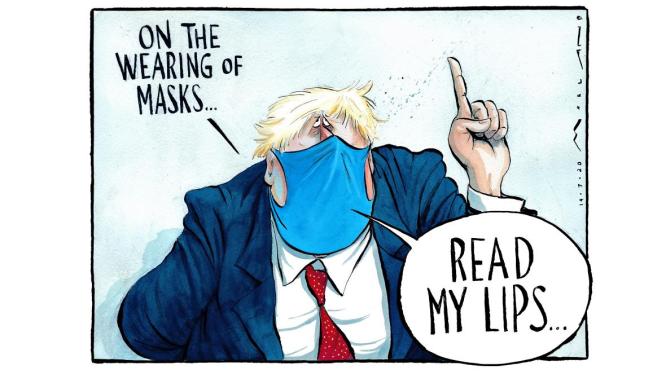
Another example of Government indecisiveness as Boris Johnson dithers over face masks. Michael Gove demonstrates his libertarian tendencies by saying that wearing them should not be compulsory, but then claims good manners means masks should be worn.
We have been here before when Boris Johnson dithered over introducing lockdown. Dithering costs lives. – Owl
Boris Johnson is under mounting pressure to force people to wear face coverings in shops.
He has resisted calls so far despite admitting the evidence for such a move was growing.
Cabinet Office Minister Michael Gove said it should be voluntary, while trying to guilt-trip people into wearing them in shops.
Sources think a switch in the rules could be announced this week.
It comes as the UK’s Covid-19 death toll rose yesterday by 21 to 44,819.
Labour has called on Mr Johnson to make face coverings compulsory in shops in England – as they are on public transport.
Shadow Cabinet Office Minister Rachel Reeves told the BBC: “I think that would be a sensible way forward. People are increasingly wearing them but greater clarity from Government about that would be helpful.
“People want to do the right thing but they want to know what the right thing is.
“I think it would inspire greater confidence and might encourage more people to go out and spend money if they see more people wearing face masks in shops.”
Mr Gove stopped short of saying they should be compulsory, but claimed good manners meant masks should be worn.
He said: “I would encourage people to wear face masks when they’re inside in an environment where they’re likely to be mixing with others and where the ventilation may not be as good as it might.
“I think that it is basic good manners, courtesy, consideration to wear a face mask if you are, for example, in a shop.”
He added: “The Government at all times does look at the evidence about what the best way to control the disease is… My view is it’s always better to trust people’s common sense.”
Paddy Lillis, chief of shop workers’ union Usdaw, said: “It should never fall on shop workers to enforce the wearing of face coverings. They are dealing with more abuse than normal and this could be another flashpoint.”
Beauty salons and spas are among the places that can reopen from today.
Face masks are due to become mandatory at almost all times in public in the Balearic Islands from today, with fines of about £90.
Elsewhere in Spain, British tourists are also likely to have to adhere to similar tougher restrictions in Andalucia this week.
Meanwhile, Mr Gove echoed the PM’s call for people to return to work if they can. He said it was crucial to “fire up the economic engines”.
TUC chief Frances O’Grady said: “The worry is the Government is being driven by, ‘How do we get people using restaurants and bars?’. For that we need people currently working at home to get back into town centres.
“The more you relax lockdown, the tougher you have to be on public transport to make sure we don’t end up going back to square one with local outbreaks that get out of control.”
A list of 20 hot spot areas has been drawn up by the Government amid fears they will be forced back into lockdown like Leicester.
Two – Ashford and Folkestone – are in Kent, but the rest are in the North and the Midlands. Kirklees and Bradford in West Yorkshire have been targeted for “enhanced support”. Blackburn, Rochdale, Oldham, Rotherham and Barnsley are also of “concern”.
Meanwhile, Home Secretary Priti Patel fears authorities may have avoided tackling illegal sweatshops in Britain’s fast-fashion industry over worries they would be accused of racism.
There are suspicions virus cases in Leicester were fuelled by exploited staff in the city’s textile factories working when ill.


 East Devon Watch