Will the UK’s housebuilding algorithm join the government’s growing AI graveyard?

There a number of dangers in using algorithms. Owl highlights a couple.

They need to be explained and not just transparent. Neil O’Brien MP published a formula to calculate an “adjustment factor” based on affordability. But what was the underlying logic? What was it supposed to be doing? Where did it come from? As a general rule if those who commissioned and created an algorithm cannot explain, in simple language ,what it is doing, then they themselves don’t understand how it works sufficiently for it to be used.

There has been a number of papers published in recent years suggesting that algorithms used in public service should undergo a rigorous testing process. Obviously the recent algorithms we are hearing about haven’t been thoroughly tested. – Owl 

Thomas Macaulay thenextweb.com 

It’s been a seriously rough few weeks for algorithms in the UK.

The problems started on August 7, when the British government scrapped an algorithm used in visa applications, following allegations that it was creating “speedy boarding for white people.”

Weeks later, England joined Scotland, Wales, and Northern Ireland in ditching a model used to calculate school exam results after evidence emerged that it had penalized poorer students.

The algorithms must have thought their month couldn’t get any worse. But in the last two days, they’ve been hit with another double dose of bad news.

Yesterday, the Guardian revealed that around 20 councils — local government authorities in the UK — have stopped using an algorithm to detect fraudulent welfare claims.

Researchers from the Data Justice Lab (CDJL) found that one algorithm was dumped after falsely flagging low-risk claims as high-risk, while another was dropped because it simply didn’t make a difference to the council’s work.

The CDJL also discovered that Sunderland council had scrapped a separate algorithm designed to make efficiency savings, while Hackney had ditched one that identified children at risk of abuse.

“Algorithmic and predictive decision systems are leading to a wide range of harms globally, and… a number of government bodies across different countries are pausing or canceling their use of these kinds of systems,” Dr Joanna Redden from the Data Justice Lab told the Guardian.

She might not have long to wait to add another to the list.

Meet the planning algorithm

The British government recently introduced a new formula for calculating where new housing is built. But planning consultancy Litchfields today claimed the algorithm would lead to more homes being constructed in the countryside and suburbs — typically Tory-voting areas — and fewer in towns and city centers.

The plans have achieved the rare feat of attracting critics from across the political spectrum.

Conservative MP Neil O’Brien warned Tory-voters wouldn’t want more housing where they live; Labour’s Kate Hollern accused the government of “leveling-down areas;” and the Green Party’s Natalie Benett said the plans would “step up regional inequality even further, and hack into the greenbelt for the benefit of mass housebuilders.” 

Whether the housebuilding algorithm joins the ones used for exam results and welfare claims on the shelf. But it will certainly be under increased scrutiny over the months to come.


Algorithm angst: Conservatives detect the hand of Cummings in the planning white paper – West Country Bylines

More on Neil O’Brian MP

Finally, something is getting up the noses of supporters of the Conservatives.

Anthea Simmons westcountrybylines.co.uk 

It seems it’s not the request to slap ‘do not resuscitate‘ orders (DNRs) on all care-home residents at the height of the first wave of the pandemic. Nor is it the ongoing scandal of billions spaffed on non-existent PPE ordered without scrutiny from companies with party connections. It’s not even the non-exam grade fiasco, or the ‘world-beating’ (at failing) ‘test, track and trace’ system, or the explosion in the national debt or the news that we are amongst the worst hit of the major economies or that we are near the top of the tables for Covid-19 deaths relative to population size.

They also don’t seem much exercised by Russian interference in our elections, or Johnson’s endless holidays or the absolute catalogue of ineptitude, blame-shifting and U-turns. None of that appears to be more than an irritation. As for the leaked government contingency plans in the event of a covid-19 second wave coupled with a no-deal Brexit? Nah. Project Fear, innit! (Leaked in the Sun! The Sun!)

But planning…Well, that’s a different story. Take a look at this:

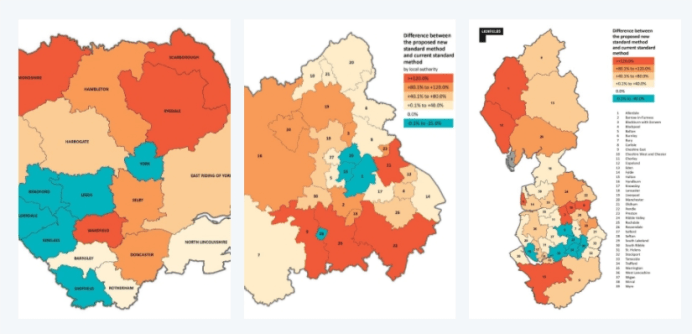
In each region you can see how housing numbers go down in large cities (often below what has been delivered recently!) and up in shire and suburban areas

It also proposes continuing a south-east centric growth model


Originally tweeted by Neil O’Brien MP (@NeilDotObrien) on 24/08/2020.

Interesting, huh? But it’s the comments’ section where our curiosity was piqued.

“Having read the papers on new planning proposals put out by Mr Jenrick, I have come to the conclusion that he knows nothing about the function of planning, nothing about rural areas and nothing about Conservative voters. His proposals are a disaster for the Conservative vote and will be a disaster for the countryside. According to this man, it is possible to both build on land and to increase green spaces! A miracle worker, no less. Even if your role is housing minister, surely you should understand that land has more uses than housing. Surely he should know that land is not an elastic commodity. What a disaster.”

Another responds;

“Please don’t labour under the illusion that this has anything to do with Mr Jenrick – he’s just a figurehead. These authoritarian planning proposals, which are utterly top-down and at the expense of local self-determination, are known to come from Dominic Cummings. Local democracy is simply an annoyance for someone as ruthless, tone deaf and philistine as Mr Cummings.”

They can see clearly what’s going wrong.

“This is the price paid for Brexit and the consequent rise of Dominic Cummings. The implemention of his planning dreams, which owe nothing to traditional Conservative values. The Conservative stronghold of the South East is to get a large dose of concrete. Hordes of independent councillors will spring up and quite probably a few independent MPs but the new Blue Wall won’t worry

[…] will greatly weaken the Conservative Party without Labour firing a shot. A rather selfless own goal.”

There are many more comments along these lines, citing Cummings’ thirst for revolution and disruption, good or bad, as the driver behind policy. One goes so far as to describe the planning proposals as ‘Johnson’s poll tax’. Hmm.

We will be writing more on the implications for Cornwall, Devon, Dorset and Somerset but, in the meantime, it’s worth reflecting on what gets the danders up.


Boris Johnson dismisses claim he will quit in six months due to Covid fatigue as ‘absolute nonsense’

Is Lord Voldemort practising the Dark Arts in Westminster, briefing against the PM? Is Sir Humphry a fully fetlocked stalking horse for disgruntled members of the party? Has anyone issued a statement saying they have “full confidence” in Boris Johnson? – Owl

By Catherine Neilan, Politics Live Editor 25 August 2020 www.telegraph.co.uk 

The Prime Minister has rubbished suggestions he could step down in the next six months, labelling them as “absolute nonsense”. 

Sir Humphry Wakefield, Dominic Cummings’ father-in-law, had reportedly claimed that Boris Johnson was still struggling to recover from Covid-19 and would stand down in six months, it was reported on Monday. 

Sir Humphry, father of Dominic Cummings’s wife Mary Wakefield, went on to compare the Prime Minister having the virus to being gone in the fetlock, a term used to describe an injured animal. 

“If you put a horse back to work when it’s injured it will never recover,” the Times reported him as telling one of their readers. 

Mr Johnson was hospitalised for two weeks after catching coronavirus back in March, spending three days in intensive care.

He later told journalists that the team had “contingency plans in place… for what to do if things went badly wrong”. 

However, he recovered without having to be intubated and was discharged before spending another fortnight recuperating at Chequers. 

Just days after he returned to work, the Prime Minister became a father again, with he and partner Carrie Symonds welcoming baby Wilfred to the world. 

For several weeks after his return, Mr Johnson appeared gruff and short of breath. He has lately embarked on a fitness regime of jogging and healthy eating as he champions a ‘Better Health’ anti-obesity campaign. 

In July, he said he had already lost more than a stone since he became ill. 

During a visit to a factory in Devon on Monday, the Prime Minister told local reporters: “I’m feeling, if anything, far better than I was because I’ve lost some weight”. 

The report about him stepping down was “absolute nonsense”, he added.

One senior Government source told the Telegraph: “He is buzzing with energy the whole time. This whole thing is absurd.”

Another added: “It is just absolutely bizarre. I have never heard anything further from the truth. It’s utter nonsense.”

The second source said there were “no signs of long Covid-19”, the condition that has plagued some sufferers of the disease many months after infection. 

Mr Johnson has been urged to step up support for these “forgotten victims” of the pandemic. 

Liberal Democrat MP and chair of the coronavirus all-party Parliamentary group Layla Moran has written to the Prime Minister asking him to formally recognise this condition, and set up a working group to address their needs. 

She said: “Those living with the long-term impact of Covid-19 have become the forgotten victims of this pandemic. Many are suffering daily from debilitating symptoms but feel they’re not being listened to or taken seriously.  

“It’s vital the government listens to these concerns and steps up support including for those who weren’t hospitalised or tested. We also need further efforts to boost research into treatments that could provide much-needed relief to patients.  

“We’ve heard harrowing evidence from those who have lost loved ones to this terrible disease and have been given the cold shoulder by Number 10.

“The Prime Minister must commit to meeting with bereaved families and agree to their calls for a judge-led public inquiry.” 


Woman, 75, ‘first to catch coronavirus within UK’

www.bbc.co.uk

The earliest person to contract coronavirus within the UK has been identified, scientists believe.

Analysis of samples by the University of Nottingham showed a 75-year-old woman, from Nottinghamshire, tested positive on 21 February.

A Surrey resident was previously believed to have caught the virus first.

The woman is also understood to be first in the UK to die after contracting Covid-19.

News of the case has emerged only now, because samples were being analysed in retrospect by researchers as they investigated the origins of the UK pandemic.

Nearly 2,000 routine respiratory samples taken from patients at a Nottingham teaching hospital between January and March were tested.

The report states: “Patient 1 in this study is, to the best of our knowledge, the earliest described community-acquired case of SARS-CoV-2 in the UK, admitted to hospital care on the 21st of February 2020, and was also the first UK COVID-19 death, preceding the earliest known death by 2 days.”

Analysis by Michelle Roberts Health Editor

Until now, the first transmission of coronavirus within the UK was thought to have occurred on 28 February. But this new research suggests there were home-grown cases earlier than this.

Although the study comes from only one hospital in Nottingham, it signals that coronavirus was circulating undetected in Britain at least in early February 2020.

The findings are perhaps not surprising, given the limited testing early on in the pandemic which meant only a small number of people were checked for the virus.

Plenty of people have been doubting the official timeline of coronavirus spread. Other research published in May revealed France’s first case was in December 2019 – almost a month earlier than previously thought.

Studies like these help build a more complete picture of the history of the outbreak, but do not tell us what the virus will do next.

Even if more people have been exposed to the virus than first appreciated, it’s not clear whether this means more of us will be immune to the disease.

The work also revealed that early coronavirus cases in the UK would have been identified if testing criteria had at the time been less strict, say the scientists.

Professor Jonathan Ball, one of authors of the study, said there was “widespread community transmission of coronavirus” in Nottingham in early February.

However, the researchers said the cases went undetected because testing for coronavirus required a strict criteria to be met like a recent travel history.

‘Expand diagnostic capacity’

Prof Ball said: “Had the diagnostic criteria for Covid-19 been widened earlier to include patients with compatible symptoms but no travel history, it is likely that earlier imported infections would have been detected, which could have led to an earlier lockdown and lower deaths.

“However, the capacity for testing available nationally was not sufficient at the time to process the volume of testing required.

“In order to prepare for any future pandemic such as this, the UK urgently needs to invest in and expand diagnostic capacity within NHS and PHE diagnostic laboratory services.”

A Department of Health and Social Care spokesperson said: “NHS Test and Trace is working, it’s completely free and is stopping the spread of coronavirus.

“During this unprecedented pandemic we have rapidly built the largest network of diagnostic testing facilities in British history, meaning anyone with coronavirus symptoms can get a test.”


Children raised in greener areas have higher IQ, study finds

Growing up in a greener urban environment boosts children’s intelligence and lowers levels of difficult behaviour, a study has found.

Damian Carrington www.theguardian.com 

The analysis of more than 600 children aged 10-15 showed a 3% increase in the greenness of their neighbourhood raised their IQ score by an average of 2.6 points. The effect was seen in both richer and poorer areas.

There is already significant evidence that green spaces improve various aspects of children’s cognitive development but this is the first research to examine IQ. The cause is uncertain but may be linked to lower stress levels, more play and social contact or a quieter environment.

The increase in IQ points was particularly significant for those children at the lower end of the spectrum, where small increases could make a big difference, the researchers said.

“There is more and more evidence that green surroundings are associated with our cognitive function, such as memory skills and attention,” said Tim Nawrot, a professor of environmental epidemiology at Hasselt University in Belgium, where the study was conducted.

“What this study adds with IQ is a harder, well-established clinical measure. I think city builders or urban planners should prioritise investment in green spaces because it is really of value to create an optimal environment for children to develop their full potential.”

The study, published in the journal Plos Medicine, used satellite images to measure the level of greenness in neighbourhoods, including parks, gardens, street trees and all other vegetation.

The average IQ score was 105 but the scientists found 4% of children in areas with low levels of greenery scored below 80, while no children scored below 80 in areas with more greenery.

The benefits of more greenery that were recorded in urban areas were not replicated in suburban or rural areas. Nawrot suggested this may be because those places had enough greenness for all children living there to benefit.

Behavioural difficulties such as poor attention and aggressiveness were also measured in the children using a standard rating scale, and the average score was 46. In this case, a 3% rise in greenery resulted in a two-point reduction in behavioural problems, in line with previous studies.

The researchers took into account the wealth and education levels of the children’s parents, largely ruling out the idea that families who are better placed to support children simply have more access to green space.

Higher levels of air pollution are known to impair intelligence and childhood development but this factor was also ruled out as an explanation.

Instead, the scientists suggested lower noise levels, lower stress – as found in other research on green space benefits – and greater opportunities for physical and social activities may explain the higher IQ scores.

Dr Mathew White, an environmental psychologist at Exeter University in the UK, who was not part of the study team, praised the quality of the research.

“I’m always wary of the term intelligence as it has a problematic history and unfortunate associations,” he said. “But, if anything, this study might help us move away from seeing intelligence as innate – it could be influenced by environment, and I think that is much more healthy.”

White said it was reasonable to suggest more exercise and less stress as reasons for the higher IQ scores. “But I’m not sure why general intelligence should be improved by these things,” he said. “My guess is the intelligence measures are really picking up a child’s ability to concentrate and stick at a task, which has been shown in green space studies before.”

A study of children living in Barcelona, published in 2015, showed more green space was associated with better working memory and attention.

The researchers in the new study were able to account for many of the factors likely to affect IQ but data on the type of green space was not available. Previous work has shown this can be important, with trees giving more benefit to child development than farmland or scrubland, for example.

The team also did not have information on where the pupils attended school but most Belgian children go to nearby schools.


The next algorithm disaster – This time, it’s housing growth – Neil O’Brien MP

Neil O’Brien: The next algorithm disaster – coming to a Conservative constituency near you. This time, it’s housing growth.

[According to Lichfields, the planning consultancy (see below) the algorithm would increase East Devon’s annual target from 928 to 1,614 (74% incease) – Owl]

Neil O’Brien is MP for Harborough. www.conservativehome.com

“Algorithms have been in the news, not for good reasons. One lesson from the A-levels row is that principles which seem reasonable can lead to outcomes you don’t expect. Another algorithm’s coming down the tracks: the new formula for how many houses must be built in different places. There are few with higher stakes.

I wrote about the housing White Paper in my last column: it proposes not just to change the methodology for assessing housing need, but also to make a standard methodology compulsory for the first time. In other words, if we don’t like the results of the new algorithm, we’ll have blocked off the emergency exits.

The new algorithm is set out here. It’s not particularly easy to read. For example, one of many factors is set out in bullet point 30:

Adjustment Factor = [( Local affordability factor t = 0 – 4 4) x 0.25) + (Local affordability ratio t = 0 – Local affordability ratio t = 10) x 0.25] +1 Where t = 0 is current yearr and t = -10 is 10 years back.

Clear enough for you?

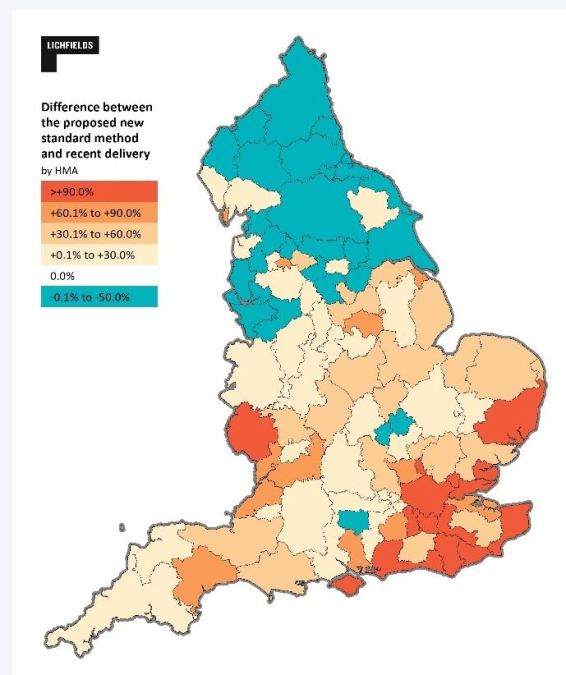
I thought it might be a while before we saw what the new algorithm would produce in practice. But Lichfields, the planning consultancy, has translated the algorithm into what it would mean for local authorities.

The numbers that the formula spits out can be compared to the number of homes actually being delivered over recent years, or to the numbers in the current (optional) national formula. Whichever way you look at it, it’s controversial.

I’ve long argued we should concentrate more development in inner urban areas, for various reasons I’ll come back to below.  But this algorithm doesn’t do that – at least not outside London.  In the capital, the algorithm would indeed increase numbers substantially.

But in the rest of England the formula takes the numbers down in labour-run urban areas, while taking them dramatically up in shire and suburban areas which tend to be conservative controlled.

Overall, the algorithm proposes a south-centric model of growth for Britain (with some growth in the midlands).

If we compare the algorithm to recent delivery, the South East has been delivering just over 39,000 homes a year, and will be expected to increase that to just over 61,000, a 57 per cent increase. The East of England would see a 43 per cent increase, the East Midlands a 33 per cent increase, the West Midlands a 25 per cent increase and the South West a 24 per cent increase.

For the North East, North West and Yorkshire, the numbers the algorithm proposes are lower overall than the numbers delivered over recent years. But as with A-levels, the devil’s in the detail.

The really controversial changes are within regions, where the algorithm suggests jacking up numbers for shires, while taking them down in urban areas. Comparing the existing national formula to the proposal, we can see this for most large cities.

The number for Birmingham comes down 15 per cent, while the rest of the West Midlands goes up 52 per cent.

Numbers for Leicester go down 35 per cent. The rest of Leicestershire goes up 105 per cent.

Nottingham goes down 22 per cent, the rest of Nottinghamshire goes up 48 per cent.

Southampton goes down 17 per cent, Portsmouth down 15 per cent and Basingstoke down 23 per cent, but the rest of Hampshire would go up 39 per cent.

Wealthy Bristol would see some growth (5 per cent) but much lower than the rest of Gloucester, Somerset and Wiltshire (47 per cent).

It’s the same story up north. Leeds down 14 per cent, Sheffield down 19 per cent, and Bradford down 29 per cent. But the East Riding up 34 per cent, North Yorkshire up 80 per cent, and North East Lincolnshire up 123 per cent.

In the north west the core cities of Manchester (-37 per cent) and Liverpool (-26 per cent) see huge falls, while the areas around them shoot up. In Greater Manchester, for example, the growth is shifted to the blue suburbs and shires. Outer parts go up: Wigan up 10 per cent, Bury, up 12 per cent, and Rochdale up 97 per cent. And areas to the south and north of the conurbation up much further: Cheshire up 108 per cent, while Blackburn, Hyndburn, Burnley and the Ribble Valley together go up 149 per cent.

But it isn’t just that the numbers in the new formula are lower than the old formula for urban areas. In many cases the new formula suggests a lower number than their recent rate of delivery. This is true of Sheffield (12 per cent below actual delivery), Leeds (16 per cent), Bradford (23 per cent), the entire North East (28 per cent), Nottingham (30 per cent), Manchester, (31 per cent), Leicester, (32 per cent) and Liverpool (59 per cent). The new formula seems to assume we are going to level down our cities, not level up.

It’s true that there’s another step between the Housing Need Assessment which this algorithm produces and the final housing target, which can be reduced a bit to account for delivery constraints like greenbelt.

But if we go with this algorithm unamended, outside London most Conservative MPs will be seeing large increases in the housing targets for their constituencies, while many Labour MPs see their local targets reduced. Is this what we want?

Leaving aside the politics, I think not. Compared to the rest of Europe, the UK has much less dense cities.

Places like Dundee, Glasgow, Liverpool, Sunderland, Birkenhead, Hull and Newcastle all had smaller populations in 2017 than 1981, while places like Birmingham and Manchester weren’t much bigger. Our cities have untapped potential, many went through a period of shrinkage and have space, and there are health and environmental reasons to prefer urban growth too.

In dense urban areas, people are more likely to walk or cycle – and in the UK, people in cities walk twice as far as those in villages each year. This reduces public transport costs and improves health.

Denser cities can sustain better public transport and so cut car congestion and time spent travelling. As well as reducing pollution from transport, denser cities reduce energy use and pollution because flats and terraced homes are much more energy efficient.

I’m not sure the draft algorithm is even doing what Ministers wanted it to. The document in which it is set out says that “the Government has heard powerful representations that the current formula underestimates demand for housing in the growing cities in the Northern Powerhouse by being based on historic trends.”

But the algorithm seems to do the exact opposite.

There may be technical reasons why things aren’t working out: there’s lots of ways to measure affordability… differences between residence-based and workplace-based income measures… there were certain caps in the old model, population projections have changed and so on.

However, the bigger issue is this.

There’s no “objective” way of calculating how many homes are “needed” in an area. While there are ways of carving up the numbers that are seen as more or less fair, ultimately a vision is required.

Projections of population growth are circular: the projected population growth for the farmland between Bletchley and Stony Stratford would’ve been pretty low before we built Milton Keynes there.

Likewise the forecast for the derelict Docklands of the early 1980s. While there are real economic constraints, the future need not resemble the past.

Though it took a huge effort, Germany raised East Germans from 40 per cent to just 14 per cent per cent below the national average income since reunification. That’s levelling up.

Do we want to continue to concentrate growth in the South East? Do we want European-style denser cities, or for them to sprawl out a bit more? An algorithm can help deliver a vision: but it’s not the same as one.”


 

Exmouth homes picked at random will have vote on how £300K is spent on sport

Another, rather different form of consultation – Owl

Becca Gliddon eastdevonnews.co.uk 

Residents in Exmouth are being selected at random to vote on how £300,000 will be spent on boosting sport in the town.

East Devon District Council will post out 5,000 letters to homes in Exmouth, asking residents to vote for their favourite projects.

The £300,000 fund, collected by the council from house developers building in the area, will be used to create new sports facilities, or improve existing ones.

Last year EDDC canvased Exmouth residents and groups on how best to spend the Section-106 developer cash.

From next week selected residents will be asked to choose which of seven eligible projects, chosen by the council, should receive a cash boost.

They will receive a unique code to register their vote online.

Cllr Geoff Jung, EDDC portfolio holder for coast, country and environment, said: “I would urge everyone that gets a letter to please take the time to vote, they really can make a difference.

“This is a fantastic amount of money to spend in Exmouth on some much-needed sports improvements.

“We would usually do the voting face-to-face at large events, but in these current difficult times that isn’t possible and isn’t likely to be possible for some time to come.

“This way of doing an online vote ensures that only people that live in Exmouth can vote, and that people can’t vote multiple times.

“This means the vote is more meaningful and representative.”

The seven projects residents will be asked to consider are:

  • £150,000 to resurface the large sand-astro pitch at Exmouth Community College, which is at the end of its life. The pitch is used by community groups in the evenings, and college students in the week.
  • £210,000 for a new drainage system at Exmouth Rugby Club for the two pitches and grass area next to Marine Way. Currently matches and training are often called off because of waterlogged pitches.
  • £240,000 to expand the current free-to-use Phear Park concrete skate park, used by skateboarders, scooters and BMX riders.
  • £150,000 for new sports equipment at Brixington park, all free to use; a games area with goal, an outdoor gym, pitch improvements – drainage, levelling and new football goals; a marked cycle area, extended and improved footpaths and seating.
  • £40,000 for additional, safer, car parking at Withycombe Raleigh Common Football Pitches, home of the Brixington Blues and used by other clubs.
  • £5,000 for a free-to-use back and neck stretch and exercise wall in Phear Park, with instructions.
  • £60,000 for a free-to-use concrete humped and sloped track in Carter Avenue Park for BMX, skate boards and scooters.

Letters will be arriving at the 5,000 randomly-selected Exmouth homes in the week beginning August 31.

EDDC said extra measures would be taken if certain age groups or locations were deemed ‘significantly under-represented’ in the vote.

Cllr Paul Millar, EDDC portfolio holder for democracy and transparency, said: “Rather than wait until physical voting can take place again, I am delighted that with the support of council staff, a way of having the Exmouth community voting remotely has been identified and created.

“With £300,000 of developer contributions to distribute, these are significant projects, the completion of which will support exercise opportunities and wellbeing across the town.”

He added: “As the council plan for a future post-Covid, the quality of council-owned outdoor spaces has never been more important.

“I urge everybody who receives a letter, to take the time to read through the project proposals and vote on which projects will ultimately get the go ahead.”


Public consultation starts on flood risk management strategy

At this stage this consultation looks to Owl to be dealing with procedural issues of how Devon County Council and other agencies should  develop plans, who is responsible for what etc. The interesting stage will be the next one. Just get on with it – Owl

Beth Sharp www.sidmouthherald.co.uk 

A public consultation is underway on Devon’s latest flood risk management strategy.

The draft document, produced by Devon County Council and partner authorities, outlines how the risk of flooding to property and infrastructure will be managed and reduced over the next six years, from 2021 to 2027.

The strategy looks at how plans for flood alleviation schemes can be developed and how communities can increase their resilience against flooding and the impact of climate change.

Through partnership working and community engagement, investment is prioritised to target high risk communities. Natural and sustainable flood management measures will be promoted, where appropriate, in all flood investigations and improvement projects, to reduce the scale, or need, of hard engineering solutions.

The second part of the strategy prioritises areas and communities to be considered for investment in flood alleviation works.

Although priorities are subject to change, it currently includes Sidmouth, Exeter, Kingsbridge, Tiverton, Dawlish, Teignmouth, Exmouth, Newton Abbot, Seaton, Kingsteignton, Totnes, Bideford, Ilfracombe, Budleigh Salterton, Crediton and Okehampton.

Industry professionals, town and parish councils and members of the public are all invited to have their say before the consultation closes on Thursday, October 15.

Councillor Roger Croad, Devon County Council cabinet member for environment, said: “We want to ensure Devon is more resilient against the risk of flooding and that the county is adapting and preparing for the effects of future climate change. We recognise that flood risk to property and infrastructure is increasing as a result of climate change, and we’re seeking to proactively manage this with our partners, in a way that is underpinned by the latest science and projections, using local expertise and knowledge.

“This document not only sets out the strategy for reducing flood risk in Devon, but also how to do so in a sustainable way that will minimise the negative impacts on the natural, built and historic environment.

“Where possible it’s also seeking improvements that will benefit Devon’s communities and natural environment.”

The draft strategy can be viewed on Devon County Council’s Have Your Say webpages.


The algorithm strikes again!

Devon people sent on 350-mile round trip for coronavirus test

Paul Greaves www.devonlive.com

People living in parts of North Devon are being told to travel to Wales to get tested for the coronavirus due to a flaw in the online booking system.

The NHS Test and Trace system is facing criticism after it emerged a person from Ilfracombe who has Covid-19 symptoms would be directed to a test centre in Swansea – 175 miles away. Such a journey could take more than three hours.

It would see them drive past centres in Taunton, Bristol and Cardiff on their six-and-a-half hour round trip.

The geographical glitch affects other coastal areas in the country with the booking system seemingly confused by water.

People in Felixstowe, Suffolk, have been directed to Clacton-on-Sea in Essex, with the Government coronavirus test booking website saying it is just 13.8 miles away.

However, the journey is 40 miles by car, taking almost an hour to get from one place to another.

And people in the region with symptoms of Covid-19 would be forced to drive past their closest test centre in Ipswich on their way to Clacton.

One person from Felixstowe who tried to book a test online told the PA news agency: “If I was travelling by boat, then Clacton would be my nearest test centre.

“I tried to book online but was only given the option of going to Clacton so I called 119. The operator got the same results.

“They told me that it is not just my region – some people in Newcastle are being directed to test centres in Scotland instead of ones in the city.

“I have symptoms so am going to get them checked out. But I can imagine that others would be put off by the prospect of two hours in the car – while driving past their actual nearest centre.”

Another example shows that a person in Gosport, Portsmouth, is directed to the test site at Chessington World of Adventures, in Greater London, rather than a Covid-19 drive-through test site in Portsmouth.

Driving from Gosport to the Portsmouth centre takes around 26 minutes for the 11-mile trip, while driving from Gosport to Chessington takes almost an hour-and-a-half for a 67-mile journey.

A person with Covid-19 symptoms in Weston-super-Mare is directed to a testing centre in Cardiff – which takes more than an hour in the car.

However, there is a drive-through testing site at Bristol airport around 25 minutes away.

Some people with a Southampton postcode are being directed to Swindon – around a four-hour round trip.

Problems with the booking system have been highlighted from early on in the crisis but it appears that glitches in the system are yet to be rectified.

Labour said it was “hugely disappointing” that the issues were still occurring and called on the Government to address the issues as a “matter of urgency”.

Councils scrapping use of algorithms in benefit and welfare decisions

Councils are quietly scrapping the use of computer algorithms in helping to make decisions on benefit claims and other welfare issues, the Guardian has found, as critics call for more transparency on how such tools are being used in public services.

Sarah Marsh www.theguardian.com 

It comes as an expert warns the reasons for cancelling programmes among government bodies around the world range from problems in the way the systems work to concerns about bias and other negative effects. Most systems are implemented without consultation with the public, but critics say this must change.

The use of artificial intelligence or automated decision-making has come into sharp focus after an algorithm used by the exam regulator Ofqual downgraded almost 40% of the A-level grades assessed by teachers. It culminated in a humiliating government U-turn and the system being scrapped.

The fiasco has prompted critics to call for more scrutiny and transparency about the algorithms being used to make decisions related to welfare, immigration, and asylum cases.

The Guardian has found that about 20 councils have stopped using an algorithm to flag claims as “high risk” for potential welfare fraud. The ones they flagged were pulled out by staff to double-check, potentially slowing down people’s claims without them being aware.

Previous research by the Guardian found that one in three councils were using algorithms to help make decisions about benefit claims and other welfare issues.

Research from Cardiff Data Justice Lab (CDJL), working with the Carnegie UK Trust, has been looking at cancelled algorithm programmes.

According to them, Sunderland council has stopped using one which was designed to help it make efficiency savings of £100m.

Their research also found that Hackney council in east London had abandoned using data analytics to help predict which children were at risk of neglect and abuse.

The Data Justice Lab found at least two other councils had stopped using a risk-based verification system – which identifies benefit claims that are more likely to be fraudulent and may need to be checked.

One council found it often wrongly identified low-risk claims as high-risk, while another found the system did not make a difference to its work.

Dr Joanna Redden from the Data Justice Lab said: “We are finding that the situation experienced here with education is not unique … algorithmic and predictive decision systems are leading to a wide range of harms globally, and also that a number of government bodies across different countries are pausing or cancelling their use of these kinds of systems.

“The reasons for cancelling range from problems in the way the systems work to concerns about negative effects and bias. We’re in the process of identifying patterns, but one recurring factor tends to be a failure to consult with the public and particularly with those who will be most affected by the use of these automated and predictive systems before implementing them.”

The Home Office recently stopped using an algorithm to help decide visa applications after allegations that it contained “entrenched racism”. The charity the Joint Council for the Welfare of Immigrants (JCWI) and the digital rights group Foxglove launched a legal challenge against the system, which was scrapped before a case went to court.

Foxglove characterised it as “speedy boarding for white people” but the Home Office said it did not accept that description. “We have been reviewing how the visa application streaming tool operates and will be redesigning our processes to make them even more streamlined and secure,” the Home Office added.

Martha Dark, the director and co-founder of Foxglove, said: “Recently we’ve seen the government rolling out algorithms as solutions to all kinds of complicated societal problems. It isn’t just A-level grades … People are being sorted and graded, denied visas, benefits and more, all because of flawed algorithms.”

She said poorly designed systems could lead to discrimination, adding that there had to be democratic debate and consultation with the public on any system that affected their lives before that system was implemented. “These systems have to be transparent, so bias can be identified and stopped.”

Police forces are increasingly experimenting with the use of artificial intelligence or automated decision-making.

The West Midlands police and crime commissioner’s strategic adviser, Tom McNeil, said he was “concerned” businesses were pitching algorithms to police forces knowing their products may not be properly scrutinised.

McNeil said: “In the West Midlands, we have an ethics committee that robustly examines and publishes recommendations on artificial intelligence projects. I have reason to believe that the robust and transparent process we have in the West Midlands may have deterred some data science organisations from getting further involved with us.”

Research from the Royal Society of Arts published in April found at least two forces were using or trialling artificial intelligence or automated decision-making to help them identify crime hotspots – Surrey police and West Yorkshire police.

Others using algorithms in some capacity or other include the Met, Hampshire Constabulary, Kent police, South Wales police, and Thames Valley police.

Asheem Singh, the RSA thinktank’s director of economics, said: “Very few police consulted with the public. Maybe great work is going on but police forces don’t want to talk about it. That is concerning. We are talking about black-box formulae affecting people’s livelihoods. This requires an entire architecture of democracy that we have not seen before.”

Without consultation “the principle of policing by consent goes out of the window”, Singh added.

The National Police Chief’s Council said it was unable to comment.

The Centre for Data Ethics and Innovation, an independent advisory body, is reviewing potential bias in algorithms. “Our review will make recommendations about how police forces and local authorities using predictive analytics are able to meet the right standards of governance and transparency for the challenges facing these sectors,” it said.


West in line for 50,000 jobs in the “green economy”

The front page of the Western Morning News (WMN) introduces this report from the TUC by saying it echoes demands from the Great South West alliance of businesses, local MPs, councillors, and the region’s Local Enterprise Partnerships (championed by the WMN).

Owl thinks it places a quite different set of priorities on: “Build,build,build”, benefiting the community and environment, not just developers.

Report can be found here

Philip Bowern Western Morning News 24 August

Close to 50,000 jobs could be created in the South West if the government backs a regional programme for green infrastructure, trade union bosses believe.

New analysis by the TUC, out today, show 46,453 jobs could be directly created in the next two years in the South West if the government supported fast-track investment in the so-called ‘green economy:

The commissioned research by Transition Economics forms part of a national TUC report – ‘Voice and place: how to plan fair and successful paths to net zero emissions’ – that draws on the expertise of local union reps on the challenges and opportunities available, with case studies and recommendations for regional and national policy.

According to the federation of trade unions, lessons must be learnt from previous recessions in order to achieve a fair and successful transition to a net zero South West, whilst boosting jobs and avoiding mass unemployment.

Fears have been expressed by environmentalists that the Prime Minister’s pledge to “build, build, build” to overcome the recession caused by Covid-19 could undo years of work to improve air quality and combat climate change.

But the TUC highlights that thousands more jobs in supply chains could also be supported in the region as a result of an £85 billion national intervention, while still observing green credentials.

The numbers of new jobs are based on ‘shovel-ready’ locally-led infrastructure projects that promote a greener, fairer and stronger economy including:

  • 16,755 jobs building much-needed social housing
  • 12,691 jobs creating sustainable transport networks, with expanded rail, electric car charging points and more cycle lanes and pedestrian routes
  • 9,564 jobs retrofitting social housing and public buildings to higher environmental standards

Trade union leaders say plans must be tailored for the industry, culture and geography of the region, with prime opportunities to:

  • Accelerate the upgrade of the rail system
  • Improve the travel network with -charging points for electric vehicles and plans for pedestrian and cycling schemes
  • Build high-quality social housing with low carbon technologies; and retrofit social housing and public buildings
  • Harness the South West’s green energy potential, using the region’s world class R&D resources and expertise.

The Cornwall and Isles of Scilly Local Enterprise Partnership has already announced 1,100 jobs would be supported following a £14.3 million cash boost, as part of the government’s Getting Building Fund.

But the TUC say that while helpful this is just a drop in the ocean given the real threat of job losses and mass redundancies expected in the coming months.

The South West is set to be hard hit by the post-Covid recession, with the tourism and hospitality industries badly affected during lockdown and still suffering as the region emerges tentatively from tough measures imposed to slow the spread of the pandemic.

According to the latest government figures 83,400 workers in Cornwall remain furloughed under the job retention scheme amounting to 37% of the Cornish working population.

The number of people claiming welfare and unemployment support since March has also more than doubled since the lockdown began – from 8,810 claimants , to 20,530 in July, clear warning signs of struggles to come, says the TUC.

Architects hope to tear down garden fences of England’s future homes

Localism was all about giving local communities a say in how their area was developed – can anyone spot it here? – Owl

Robert Booth www.theguardian.com 

Finalists in design contest plan communal gardens to boost social integration on estates

  Igloo has proposed car-free, self-build estates with communal gardens. Photograph: Homes for the Future

Could it be farewell to the traditional back garden? Architects shortlisted by the government to design prototype housing in England have called time on fenced-off sanctuaries and want to replace them with communal gardens to boost social integration.

Ministers have shortlisted six teams of designers to be teamed with volume housebuilders in an attempt to make the next generation of housing estates greener, healthier, better for elderly people and quicker to build. Several of the winning designs in the government’s Home of 2030 contest show communal spaces running right up to front doors, shared vegetable gardens and outdoor community dining areas.

One of the designs suggests four homes built around a courtyard garden that the residents can also book via an app for private use. Otherwise it would be shared. The proposals run contrary to the bulk of new housing that is built with private gardens, however small, partly because of planning rules that mean homes have to be spread out for privacy.

 A design by the architecture firm Perpendicular, whose director says ‘we need to remove the ubiquitous rear garden’. Photograph: Homes for the Future

Under the schemes, which have been awarded £40,000 development grants, homes could be self-built, include straw walls or green roofs, and some of the prototype estates are designed as car-free zones.

“We’re on a crusade to abolish greed-driven identikit development on soulless estates,” said Chris Brown, the director of Igloo, whose designs for free, self-build estates with communal gardens are among those shortlisted. “After Covid-19, people will want their towns and cities back, to make beautiful places where home schooling and working from home is designed in – not an afterthought – and where the climate, nature and community are prioritised over profit.”

Patrick Usborne, the director of Perpendicular, which oversaw another winning entry using wood panels made from British-only timber, said: “There’s an English perception that owning your castle needs its own land. But if we are to improve community cohesion we need to remove the ubiquitous rear garden and bring together external spaces for the community.”

The contest has the backing of the housing minister, Chris Pincher, as well as ministers with responsibility for elderly care and energy. The government gave designers four key requirements. The homes should be adaptable to how needs change as people become older, have net zero carbon emissions, promote healthy living, and be deliverable in large numbers.

The six finalists announced on Sunday have been told they will be introduced to developers bidding to build on public land managed by Homes England, to explore the possibility of developing bids.

 Homes with a central shared garden designed by Openstudio. Photograph: Homes for the Future

But entrants fear their designs will be resisted by builders determined to stick with existing blueprints for homes. Volume housebuilders are poised to erect hundreds of thousands of new homes to their standard designs on greenfield sites under planning changes announced earlier this month.

“The momentum in the system to build standard speculative estates is so strong,” said Brown.

Usborne added: “There may not be enough incentive from the government to make change and there’s not enough appetite in the housebuilding businesses.”

Michal Pajakiewicz, the director of Studio Open, which is proposing the bookable garden, said he hoped housebuilders would understand that people are starting to use their homes differently, with more working from home.

Pincher said: “This competition demonstrates the best of British design being brought to bear on a key issue for today, and future generations: delivering homes that are good for the planet and that promote healthy, independent living for older generations.”


Planning reforms are an attack on local democracy

Crispin Truman, chief executive of CPRE, writes today’s: The Thunderer www.thetimes.co.uk 

At the start of the month Robert Jenrick, the housing secretary, announced changes to the planning system that look to enact the most radical reforms since the end of the Second World War. It is now clear that a key policy of the new system could remove the right of residents and constituents to have a say on developments, effectively halving democratic input in the planning process.

Tremors are rumbling across the country as the realisation dawns that local democracy is under attack. Tectonic plates are shifting in the way we build homes, schools, hospitals, parks and all the other places that are essential for healthy, vibrant communities and green space, in rural and urban areas.

At CPRE, the countryside charity, our ear is to the ground. A survey with our network of 50 local groups to gauge initial reactions to the reforms shows unanimous concern at the loss of local democracy and the risk to our countryside, but that it is not too late to make sure communities are at the heart of decision-making about their environment.

Our litmus tests for these reforms will be: do they provide better quality housing that is genuinely affordable and zero carbon? Will we be able to build healthier places with public transport, ready access to plentiful green space and vibrant and connected communities? Will they protect and enhance our precious countryside for future generations? Will there be robust legal guarantees for public involvement in both policies and development projects?

Planners can deliver these if we give them a chance and if local authorities and communities are given more power. However, planning has become a convenient bogeyman for a government intent on deregulation that will deliver even greater developer profits.

The best way to deliver the places that we need, at the pace we need them, is to (i) make it easier for councils to get local plans in place, and then to hold developers to those plans; and (ii) invest in more of the affordable homes that are needed locally. The government has a golden opportunity to reform the planning system and to put people and nature at its heart.

Let’s learn the lessons of the lockdown and reform planning by making sure that communities have more of a say over what happens in their area, while treating the climate, nature and housing emergencies as the emergencies that they are. Anything less would be the opposite of levelling up or building back better.


The final straw? Tory heartlands in revolt over planning reforms

In the lane beside the 12th-century church in Earnley, West Sussex, Robert Carey spotted a flattened toad. “There’s a picture of what’s happening to local residents,” he said. “Squashed.”

Owl believes that if sufficient pressure is put on the Government (and Tory MPs) there is a good chance of another U – Turn on these ill conceived planning “reforms” – see post on the consultation.

Robert Booth www.theguardian.com 

Boris Johnson’s reform proposals for the English planning system – widely seen as tipping the balance of power in favour of developers and away from local objectors – have gone down badly in this corner of the Conservative heartlands. Voters like Carey fear not just a loss of local power, which is already angering some local Conservative politicians, but the threat of “rural sprawl” creating new landscapes of unbroken low-density development across the shires. It means, one local objector said, the “suburbanisation” of the countryside.

It took less than 24 hours for the threat to become real after the planning white paper was unveiled. An application landed the next day with the parish council from an emboldened developer to build 100 homes on a stubbly wheat field on the edge of Earnley. It is exactly the sort of site that could be zoned for growth under the government’s new planning system, meaning that builders automatically get outline planning permission as long as the designs broadly meet a pre-agreed local plan.

Steve Culpitt, the managing director of the site’s developer, Seaward Properties, was understandably happy with the new policy, which he said “pulls the rug from beneath” opposition. “The major problem with all these sites is the objectors,” he said. “You always hear from them but never the supporters.”

If the scheme goes ahead, the flint cottages of Earnley will merge with the modern housing estates of the neighbouring beach settlement of East Wittering. It is not a unique scenario. East Wittering is ringed with fields where housebuilders including Barratt Homes have plans for 1,450 homes which could all be built under the new zoning system. It would increase the settlement’s size by 60%. Opponents like Carey fear they could be almost powerless to prevent it if the white paper becomes law.

Another rebellion is brewing 20 minutes east along the already busy A27. Four days after the planning reforms were launched, the UK’s largest housebuilder, Persimmon, lodged an application to erect 475 homes on wheat fields that would blend the settlements of Ferring and Goring-by-Sea.

“If and when this new planning regime comes into force this will be vulnerable,” said Ed Miller, the secretary of Ferring Conservation Group, who described the reforms as “an absolute attack on local government and local democracy”. Miller filled out his consultation response last week, describing the plans as “a betrayal of localism” and authoritarian.

The local MP, Peter Bottomley, has previously alerted Johnson to the development, saying that people must not be deprived of “the green lungs between them”.

Despite the concerns, the planning white paper is an attempt to tackle serious problems. It is billed as supporting the prime minister’s drive to “build, build, build” Britain’s way out of the Covid-19 recession while meeting an urgent need for more housing.

English housing stock grew by 241,000 homes in 2018/19 but 340,000 new homes a year are needed over the next decade, according to research commissioned by the National Housing Federation.

More are needed in West Sussex than in most other areas of the country, with 51,000 new households expected to be created in the next 15 years, according to Office for National Statistics projections, a 14% increase.

There are also 3,800 homeless people in Brighton & Hove, according to a 2019 analysis by the housing charity Shelter.

“Thanks to our planning system, we have nowhere near enough homes in the right places,” said Johnson in hisforeword to the planning white paper. The time has come to “tear it down and start again”.

The paper proposes that instead of each application being decided through an individual democratic process, councils will be asked to draw up multi-year plans that divide land into zones for development and protection.

Outline approval would be automatic in growth zones and there would be a statutory presumption in favour of development in renewal zones. Local voices must be heard when the local plan is drawn up, the policy states, but how this plays out remains to be seen.

Once the plan is fixed, the only say local people will have is over detail of developments, so-called reserved matters.

There would be protection for greenbelt and areas of outstanding natural beauty, but the new system looks certain to tilt the battlefield in favour of developers such as Barratt Homes. Its chief executive, David Thomas, said he welcomed “any proposals to speed up the planning system and provide transparency and certainty for both communities and housebuilders”.

The CPRE, the campaigning countryside charity, sees the proposals in more dramatic terms. “Policies that have allowed major housebuilders to trample over the wishes of local people will be reinforced with binding land release targets and reduced affordable housing contributions,” said Crispin Truman, its chief executive.

“Developers will be able to build what they want, where they want and for the most part when they want.”

A planning liberalisation that takes control from local voters could, however, create an electoral headache for the government.

Cllr Louise Goldsmith, until last year the Conservative leader of West Sussex county council, said local voters in the Tory strongholds were “very hacked off” with the plans. Alongside refuse collection and potholes, planning is often the issue on which local voters are most likely to regularly engage.

“People want a greater say, but this is greater centralisation,” said Goldsmith. “It worries every councillor because we want a happy community doing things in their community, but if they feel they are being done to … that’s quite a dangerous thing to happen.”

One voter the Conservatives might lose is Martin Silcocks, the landlord of the Thatched Tavern pub, a 16th-century inn overlooking a maize field where developers are poised to submit an application to build 226 homes.

“Oh good lord!” he said when he saw the plans. “It would destroy everything this pub stands for.” That includes his customers’ uninterrupted view of the sunset.

Silcocks used to vote Ukip. He switched back to the Conservatives in 2019, but is not happy with Boris Johnson. His daughter and her young family are looking for a home, but they do not expect to be able to afford the new houses.

Another Tory in rebellious mood is Libby Alexander, part of the Save Our South Coast Alliance, who feels the planning liberalisation would create expensive housing that was not needed and fail to deliver the cheaper accommodation that is in short supply.

“We are constantly being labelled as selfish and nimbyish when all we are doing is pointing out the obvious,” she said. “Local democracy is in danger of being slowly shut down.”

Alexander and her fellow campaigners fear new homes will be taken by elderly incomers rather than the local priced-out familiesThey are also concerned the houses will be at flood risk, destroy prime agricultural land and transform a rural landscape that is a key lure for tourists, who make a vital contribution to the local economy.

“If Boris just shut up and did nothing but help developers build affordable housing, that’s all we need in this country,” she said. “This is a Conservative speaking, but I am fed up with what is going on.”


Revealed: London councils take funds from developers to pay for planning guidelines

“The planning documents subsequently published set out major and potentially lucrative development strategies for the sites in which they have an interest. The payments are not declared in the documents.”

Robert Booth www.theguardian.com 

Councils have accepted hundreds of thousands of pounds from property developers to fund planning guidelines designed to help govern their own schemes, a Guardian analysis has found.

In deals that have been criticised for allowing unfair influence and marginalising local residents, bodies including housing developers, landowners and urban regeneration companies paid large sums to draft supplementary planning documents (SPDs), which councillors must then consider when determining planning applications.

The planning documents subsequently published set out major and potentially lucrative development strategies for the sites in which they have an interest. The payments are not declared in the documents.

Councils, which normally fund SPDs, and developers have denied allegations of conflicts of interest, but critics fear the arrangements mean “poachers become gamekeepers”.

The practice has emerged less than two weeks after ministers announced a wholesale reform of the planning system which campaigners and voters fear will hand greater powers to developers in order to speed up building.

According to responses the Guardian obtained under the Freedom of Information Act, Conservative-run Barnet council in north London received £223,000 from the housing association Notting Hill Genesis to cover the costs of a planning brief for Graeme Park, a 3,000-home estate regeneration. The borough accepted the money via its joint venture company with Capita.

The SPD for Graeme Park specified additional social housing only “where viable” and the housing association later proposed cutting the number of affordable homes by 257. The London mayor, Sadiq Khan, described it as “a classic example of how not to do estate regeneration”.

In Hounslow, west London, the Ministry of Defence (MoD) paid the Labour-run council £20,000 to fund supplementary planning guidance for a barracks site it is planning to sell for the development of 1,000 homes, which critics have attacked as over-development.

In response to a freedom of information request to all English councils, none outside the capital said they engaged in the practice.

The London councils insist the arrangements afford developers no unfair influence over what is permitted on the sites, but some cited budget shortfalls as the reason for needing to take the money. Critics, however, attacked the practice.

“It is blatant collusion between planning authorities and developers,” said Bob Colenutt, the head of research the Northampton Institute for Urban Affairs and author of The Property Lobby. “Is this what the government means by cutting planning red tape? … Poachers have become gamekeepers with local councils ceding yet more influence over planning to vested interests in speculative development.”

Steve Reed, the shadow communities and local government secretary, said: “Government cuts to council funding have left town halls without the resources to develop full planning guidelines so developers have been allowed to write their own. This appears to be part of a strategy to diminish the voice of local communities and let wealthy developers bulldoze and concrete over local neighbourhoods and green spaces increasingly at will.”

Reed said it was a harbinger of the “anti-democratic planning reforms” the government proposed earlier this month, which could fast-track development without a requirement for detailed planning consent.

Councils usually pay for and draw up SPDs to provide guidance for what developers will be allowed to do. Councils said that plans drawn up using developer cash must still be meet wider planning rules. They are a material consideration in planning decisions.

“It is often said that ‘he who pays the piper calls the tune,’” said Steve Goodrich, a senior research manager at Transparency International UK. “Any planning guidance developed which then contributes to council policy should be drafted in the public interest, not that of landowners and developers. Accepting payments for this work from those with a clear financial interest in the outcome risks exposing the authors to heavy and undue influence.”

Barnet council also received £140,000 from the development company Joseph & Partners to draft a strategy for the renewal of North Finchley town centre. It then entered into a partnership agreement with the firm. The planning document included a proposal to demolish an art deco shopping arcade and replace it with an 12-storey apartment building. Campaigners including Dave Davies, the Kinks guitarist who used to buy guitar strings at the arcade in the 1960s, are opposing the scheme.

Jonathan Joseph, the head of Joseph & Partners, denied there was any conflict of interest. “If and when any proposals do come forward for North Finchley, a full consultation and engagement process will be undertaken,” he said.

Barnet denied the arrangements gave developers the role of poacher and gamekeeper. An SPD cannot be in conflict with wider planning policies in the borough, it said.

Notting Hill Genesis stressed that Barnet “retained responsibility for final decision-making both on the SPD and subsequent planning decisions” for Graeme Park.

On the Greenwich peninsula, the landowner Scotia Gas Networks (SGN) paid the council almost £30,000 for a planning brief for a gas-holder site. The brief concluded the area could accommodate high-rise buildings including as many as 1,200 homes, offices, a hotel, shops and restaurants.

The council cited “a decade of government cuts” as a reason for needing to accept the funds, but said the landowner had no unfair influence over the planning brief.

Dan Brown, a spokesman for SGN, said: “We had no role in producing the planning brief and the brief does not necessarily reflect the most favourable possible outcome for us.”

In Hounslow, the MoD’s property arm spent £20,000 to fund supplementary planning guidance for its 18th century cavalry barracks, which it plans to sell as a site for 1,000 new homes. When Hounslow formally adopted a version of the planning strategy drawn up by the Defence Infrastructure Organisation, it made clear it “will be a material planning consideration in the determination of future planning applications”. Some local campaigners who oppose the plan say it amounts to “over-development” and want the buildings turned into a military museum.

“The draft planning brief underwent full public consultation,” said Lily Bath, the deputy leader of Hounslow council. “The brief is in no way a guarantee for planning permission, but provides a framework for consideration of future planning applications.”

An MoD spokesperson said it works “collaboratively with councils to draft guidance that ensure a quicker, and more cost efficient process for planning, design and development.”


It’s just a barn, isn’t it?

From a Correspondent:

Why would the Otterton Parish Council and the local amenity society, the Otter Valley Association, bother to comment and object to  planning application -20/1363/AGR – for an agricultural barn in Otterton?

Surely this is a very minor issue.

Yes, it is contrary to the Otterton Draft Neighbourhood Plan which is ready for a referendum when coronavirus permits. But there are other, hidden, issues.

The proposed location is in an extremely sensitive site on rising ground in an area designated as an Area of Outstanding Natural Beauty and adjacent to the Coastal Preservation Area. It is just on the outskirts of the village and only 2 fields from Ladram Bay Holiday Park. It can be seen from the coastal path.

There was a previous application 19/1853/AGR submitted in August last year, refused by officers under delegated authority, as recently as 17 Oct 2019.  Why the hurry for a barn? If there is a pressing need surely the sensible route would be to note the reasons for refusal and try to overcome them. Perhaps move it to a different location? But this is not the case. The current application differs very little from the 2019 application, apart from a different consultant submitting it.

Here is another mystery – on EDDC’s website the location of the site is: “Land West Of Piscombe Lane Otterton” and on the application form and other documents: “Land Adjacent to Faraway”. You would be forgiven in thinking that this was a parcel of land separate from any farm. It is only in EDDC’s  reasons for refusal of 19/1853/AGR that there is a hint of a farm – “a more suitable location could be found for the proposed building close to the existing group of buildings associated with Sea View Farm.”

Now Seaview Farm happens to be the mailing address of FWSC (LADRAM) LIMITED- the company which controls Ladram Bay Holiday Park, profit after tax £1,134,352 in 2018.

A couple of more minor matters. The 465 square metres permitted limit is exceeded in the submitted plans. The application claims that cattle are currently grazing in the field but, according to comments made on the application by a neighbour, no cattle have been seen for several years. Also according to the neighbour, hard standing has already been laid at the entrance gate and work started on the barn groundwork.

As a postscript it is interesting that Appendix A has 9 photos taken from all points of the compass of the site but not one from the coastal path.


Shortage of 6,000 public buses puts UK’s school return at risk

Ministers have privately warned of a shortage of 6,000 public buses needed to get children to school in England next week for the autumn term and have urged coach companies to fill the gap.

James Tapper www.theguardian.com

Low passenger numbers during the pandemic have led some bus companies, particularly in rural areas, to reduce services, while social distancing requirements on public transport mean that there will be lower capacity on such services.

Fears that many of the 750,000 children who travel to school by public buses will not be able to make it to classrooms were raised at a meeting chaired by Charlotte Vere, the transport minister.

Candice Mason, of Masons coaches in Tring, Hertfordshire, took part in the meeting last month between the Confederation of Passenger Transport (CPT), which represents operators, and Vere. “She opened the meeting very clearly stating her focus was on home-to-school transport,” Mason said. “Her role was to try and get as many children as possible on to dedicated home-to-school services and she believed there was a shortfall of about 6,000 vehicles.”

There are enough coaches in the UK to deal with demand, according to the CPT, but nobody knows where shortages might hit.

The start of the new school year in September is still mired in uncertainty. Several recent surveys indicate that the majority of parents intend to send their children back to school at the start of term but that a minority remain unsure as to what they will do. The rise of infection rates in the UK also suggests that schools may be disrupted by local lockdowns.

Councils are putting on extra children-only public buses, but admit that might not be enough and are adopting a wait-and-see approach.

Even if there is an interim solution at the start of term, by half-term there may be more severe transport shortages. Public transport bus companies have received extra funding from the government during the pandemic but coach firms have not, and face huge financial losses. The CPT believes that by November, 18,000 of the 42,000 people in the coach industry will be out of jobs and nearly 16,000 coaches will be off the roads – about half the UK’s total fleet.

Since the meeting between coach companies and Vere, the Department for Education has issued guidance to local authorities, alongside £40m of funding, saying that “at least 50% of [bus] journeys to school of two miles or less” need to be done on foot or bicycle to “make capacity available for those with longer journeys”.

Keith Glazier, the leader of East Sussex county council and spokesman on children and young people for the County Councils Network, said he was “pleased the government has listened to our concerns and issued guidance which offers the flexibility counties need” but that councils were struggling with uncertainty over numbers.

“How will parents react? Will public transport be available? And, if it is available, will they allow their children to use it?,” he said. “And what will be the capacity should everyone need it? In a small county like East Sussex, I’m just not sure we have the capacity, with all the coaches and private buses that are available, to do that.”

Bath and North East Somerset council warned parents last week that “due to capacity limitations” students using public transport “may not have their first choice”.

Kent has an extensive grammar school system which means many pupils travel longer distances to school. There are signs that many will avoid public transport. The county council runs a “Travel Saver” ticket scheme, but has had only 6,100 applications, compared with 24,000 last year. Kent expects many parents will drive their children to school.

Rob Williams, a former headteacher and now senior policy advisor at the National Association of Head Teachers, said: “It’s important that the government gives flexibility to help local authorities, schools and parents to find local solutions.

“With so much uncertainty, particularly around what happens if there is a second spike, we need to have solutions to problems like how to get children home if they get taken ill with covid-like symptoms and their parents don’t have a car.”

Pat Harris, of Busk, which campaigns for safety in coaches and buses, said there was a risk that councils would use double decker buses to transport children long distances. “We have serious concerns about safety if that happens,” she said.

A government spokesperson said: “Making sure all children are back in the classroom full-time in September is a national priority as this is the best place for their education, development and wellbeing.

“While we have confidence that the public transport network is safe and has enough capacity to accommodate pupils returning to school, we are also providing more than £40 million to help local transport authorities create extra capacity.”

Firms linked to Tories have won £500m pandemic contracts without having to bid

Nigel Nelson www.mirror.co.uk 

Firms linked to the Tory Party have won nearly £500million in pandemic contracts without having to bid.

Labour says at least 13 companies got the contracts with no competitive tendering.

Shadow Cabinet Office minister Rachel Reeves said: “There has been an alarming pattern of companies with links to the Conservatives doing well out of publicly funded projects during this pandemic. 

“People want their governments to use public money fairly and they don’t expect contracts to end up with ministers’ mates.”

She is demanding an independent probe.

One firm, Randox, received £133million for Covid testing.

It pays Tory MP and former Cabinet minister Owen Paterson £8,333 a month as an adviser.

Earlier this month, 750,000 unused Randox testing kits were ­recalled over safety concerns.

Serco is paid £108million for running the national contact-tracing service and nearly £46million by the DWP to run call centres.

Health minister Edward Argar was a senior executive and boss Rupert Soames is brother of former Tory MP Sir Nicholas Soames.

In November 2019, Rupert Soames’ wife Camilla donated £4,995 to the Tory Party.

PricewaterhouseCoopers, which won seven contracts, hired Theresa May ’s former top aide Gavin Barwell as a strategic adviser in January.

He is also a non-executive adviser at Arcadis – which was given a £1.5million consultancy contract with the Ministry of Justice in April.

Public First Ltd gets £840,000 to run focus groups for No10. It is owned by James Frayne, who started the New Frontiers think tank in 2003 with Dominic Cummings.

Dragontown Ltd was awarded a contract worth £675,000 to supply PPE to London’s Guys’ and St Thomas’ NHS Foundation Trust.

Lady Xuelin Bates, a director of this firm, is the wife of Tory peer and former minister Lord Bates and has donated £30,000 to the Tories.


Planning applications validated by EDDC week beginning 10 August

“Questionable forecasts” threaten the countryside.

Owl has recently received the latest report published by CPRE Devon entitled: “How many Homes? Reviewing the National Housing Need for England”. This follows CPRE Devon’s previous report on Devon’s Housing needs. 

This new report explains why current Government housing targets overestimate the need. For example, the current Government estimate is based on the Office for National Statistics (ONS) forecast made in 2014. Since then the ONS has made two further forecasts: in 2016 and 2018. Each of these has used revised modelling and assumptions on such things as the rate of household formation, based on new information. They forecast a substantially lower future need for new homes than assessed in 2014.

Owl will summarise this report in due course.

Meanwhile Owl spotted this:

Green belt around Coventry at risk from ‘questionable forecast’ by Office for National Statistics

Neil Johnston, Midlands Correspondent | George Greenwood www.thetimes.co.uk 

Ancient woodland that once formed the Forest of Arden is threatened by plans to build thousands of homes based on population forecasts that some deem implausible.

Andy Street, the Conservative mayor of the West Midlands, said that “questionable” forecasts by the Office for National Statistics (ONS) had been used to approve 11,000 new homes on the green belt around Coventry and others next to woods in Warwickshire.

The ONS expects Coventry’s population to rise by 32 per cent between 2011 and 2031, twice as much as Birmingham.

That has led Coventry city council to plan for more than 40,000 new homes and designate swathes of green belt land, which can only be developed in exceptional circumstances.

Although the prediction has changed over time, campaigners believe it is an overestimate. The Keep Our Green Belt Green campaign said that the ONS wrongly assumed foreign students at Warwick and Coventry universities would stay in the area after their studies.

According to the analysis, which four professors have reviewed, jobs have grown by 18 per cent in recent years but this was half that of some nearby towns.

They found births fell by 5 per cent between 2009 and 2017 while in Stratford-upon-Avon, Wolverhampton and Bromsgrove they rose by more than 5 per cent. Car registrations rose at a third of the pace of Birmingham, while A&E attendances grew by 10 per cent compared to 40 per cent in Wolverhampton, and 30 per cent in nearby Worcestershire.

In a letter seen by The Times Mr Street complained to Sir Ian Diamond, the national statistician, that with “two years of actual evidence” the ONS had to take responsibility for projections.

“The overall numbers projected for Coventry appear implausible and may be leading to poor long-term planning decisions,” Mr Street wrote.

Yesterday he said that the plans would cause “a catastrophic loss of precious green spaces”. He added: “Once precious greenbelt land is gone it cannot be replaced. The city council’s local plan is underpinned by questionable ONS population predictions.”

Mr Street said he was especially concerned about plans for 2,500 homes at Kings Hill, a deserted medieval village with three grade II listed buildings surrounded by ancient woodland.

“It means we would be joined with Kenilworth,” Angela Fryer, a nearby resident, said. “We just become one urban sprawl. We’ve lost our green belt at the stroke of the pen.”

Residents are also concerned about plans for 2,500 homes at Keresley, which is overlooked by a neolithic hill fort. There is another proposal for more than 2,000 houses in Meriden Gap between Birmingham and Coventry.

Peter Maddock, who lives in nearby Allesley Green, said: “ I despair at Coventry city council. So many people are trying to tell them how valuable our green areas have been to their physical and mental wellbeing.

“We tell them that the economic assumptions they made in 2017 are no longer valid and that the population growth assumptions are crazy. All again falling on deaf ears. “

Merle Gering, of Keep Our Green Belt Green, warned of huge damage to the West Midlands countryside. “Coventry council is planning to destroy jewels of the countryside needlessly to fill it with houses on the back of absurd claims of  hyperpopulation growth,” he said. “The Office for National Statistics should be ashamed of themselves. They know that it cannot be true that Coventry is growing twice as fast as Birmingham, three times as fast as Warwick, and four times as fast as Stratford-upon-Avon — the places where there actually is high jobs growth and a reason for really rapid population increase.”

The council said its local plan was adopted after “extensive public examination” and that a review could be triggered if there were unexpected changes to the area. It said its plans were based on figures published by the government over which it had no control.

A spokeswoman for the ONS said that ministers had given no sign of doubting the projections. “All of our methods have been explained to be fully transparent and helpful,” she said.