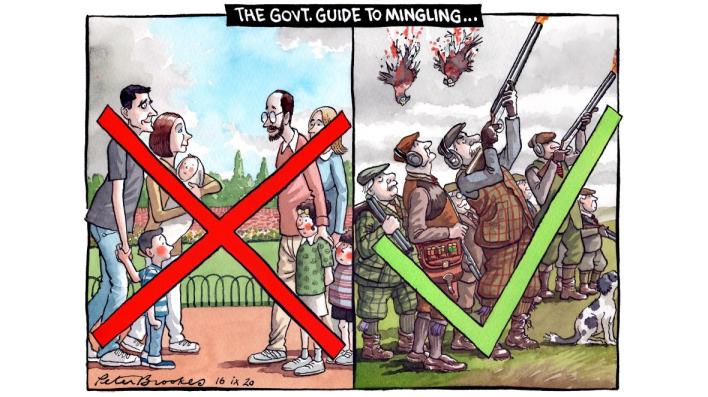
Covid-19’s second wave is being made in Boris Johnson’s Downing Street

The Guardian view on Boris Johnson’s second wave: made in Downing Street 

The prime minister’s over-promising and under-delivering has to end. If he tries to spin his way out of the looming coronavirus disaster it will cost the country dear

Editorial  www.theguardian.com 

The country is facing a second wave of coronavirus because the government is losing track of the outbreak’s spread. Testing capacity is being outpaced by an exponentially growing epidemic. Without testing the people who need testing, the authorities can’t see where cases are rising. With visibility of the disease’s extent obscured, its transmission is harder to slow. A second wave of Covid-19 could be more serious than the first. The NHS, still reeling from the disruption of the last few months, is dealing with a backlog of patients. Winter is coming and with it the possibility of a joint flu epidemic and Covid pandemic. Britain has been put in a dangerous place by Boris Johnson’s administrative failure.

The government messed up its Covid response in the first wave of coronavirus, making blunder after blunder. Britain had no mass testing capacity and was forced to impose a damaging lockdown that plunged the economy into its deepest recession in 300 years. England recorded the highest excess death rate in Europe. Ministers have had months to put things right. A new testing system was devised. The rationale of coming out of the national lockdown was that a functioning test-and-trace system would help the government to spot and suppress local outbreaks. This was the “whack-a-mole” strategy. But it only works if you know where the moles are.

There was little doubt that there would be a problem in autumn and winter. But we are barely out of summer and Mr Johnson’s system can’t cope. If the government can’t provide enough tests for people at this point in September, when ministers knew schools would be returning and have been actively encouraging people back to work, how will it achieve its “moonshot” ambition to process millions of tests a day? Mr Johnson, and his cabinet, do not look remotely up to the challenge. Instead of being open about the issue they alternate between being furtive, evasive and defensive. Public trust in the government’s Covid response is ebbing away: almost two-thirds of those polled think ministers have handled it badly.

The country has no option but for the government’s scheme to work. If it does not then we will face another damaging national lockdown. There needs to be a reset from the government in the way it acts and speaks. The over-promising and under-delivering by ministers has to end. One cannot spin one’s way out of disaster when there is a breakdown in frontline service delivery that affects millions of people’s lives. People are not at fault for demanding tests when they have been told to ask for them.

It is painfully clear that there has been a serious failure of the private laboratories that ministers created on the hoof to rapidly scale up testing operations. Ministers built the labs to run with itinerant PhD workers, who predictably caused staff shortages when they returned to their universities. The government needs to come clean about the mistakes it has made and demonstrate it has the leadership to put them right. A new political and communications strategy will be required to move the country on. Caution, not overconfidence, should be the order of the day.

Time is running out for Mr Johnson to show he recognises the danger ahead and is willing to prepare voters for difficult times. The government needs a humbler and more realistic way of going about things. Belief in a form of national exceptionalism led to lack of preparedness. Mr Johnson’s excessive self-confidence telegraphs hubris about the country’s ability to withstand a public health crisis. This may have been electorally successful but it has led to overreach and complacency. Britain’s painful Covid-19 experience ought to put a premium on competent and decent government. Yet Mr Johnson stokes Brexit’s politics of resentment to trump the politics of problem-solving. The country will pay a high price unless he changes course.


Exclusive: Hospitals told to clear beds for coronavirus spike in two weeks

Hospitals and councils have been told to find extra beds for coronavirus patients within two weeks as the NHS braces for a second spike in cases.

By Tony Diver www.telegraph.co.uk

With hospital admissions beginning to increase following a steep rise in virus infections, isolation units in which Covid-19 patients can recover are being set up, freeing space on wards for those needing the most care.

More than 10 million people will soon be living in local lockdown areas after the North East became the latest region to impose curfews, with Liverpool and parts of the West Midlands expected to follow within days.

Chaos at testing centres (see video below) continued on Thursday as Baroness Harding, the head of NHS Test and Trace, admitted that up to one million people a day are applying for 230,000 available tests.

It also emerged that Matt Hancock, the Health Secretary, is planning to adopt a national “traffic light” system for putting regions into lockdown, with local action being triggered when infection rates reach a set level.

A template for the so-called “escalation framework”, seen by The Telegraph, includes provision for “mandatory masks” at the amber level, suggesting face coverings will be legally required in even more settings than they are now.

The Telegraph understands that ministers will on Friday confirm that family visits to care homes will be paused in areas in which infections are highest.

While the proposals were still being finalised on Thursday night, they are expected to be included in the winter care plan aimed at reducing the spread of the virus among elderly residents.

Another 3,395 people tested positive for coronavirus on Thursday, with a further 21 deaths, as infection rates soared in much of northern England.

With cases reaching the highest levels since May (use the graphic below to find out about cases in your area) and the current trajectory pointing towards a second peak in the next two weeks, hospitals are preparing for a possible influx of patients after admissions tripled in a fortnight.

The numbers of people in hospital remain low compared with the first peak of the virus, however. 

Bolton, the coronavirus hotspot of England, has only two Covid-19 patients on hospital wards, according to the most recent NHS data. Across all 18 “intervention” areas listed on Public Health England’s watchlist, 141 people out of a population of more than five million are in hospital with the disease – one hospital case for every 38,000 people. 

MPs in London were told last week of plans to increase the number of “step down” beds in which coronavirus patients in the capital who no longer need hospital treatment can recover in isolation.

One MP briefed on the plans during a conference call with health bosses told The Telegraph: “The rate of infection is going up, and I was told hospitals have reserved beds for people coming out of hospital who need somewhere to recover.

“At the start of lockdown they were having to send people back to care homes or back to other facilities, with dire consequences, so they’ve booked places in respite care or empty care homes. People will go out of hospital, but they won’t return to their normal place of living. They just need care before they go back home so that they empty the hospital wards.”

A former minister added: “The effort is being made to step up capacity so that if there is a second spike the NHS doesn’t fall so far behind with other types of care.

“Different parts of London are looking at different ways to handle that, but everyone has learnt that terrible lesson that you cannot discharge people into care homes if there is any danger whatsoever that they might be Covid positive, so there is a big effort to find extra beds.

“Brent rented an entire care home and they discharged their people into another care home. I think other places will be doing that as part of their efforts to get ready for a second spike.”

Another source who was on the call said councils had been given the job of finding extra beds and that disused care homes were likely to be used.

The isolation wards would be in addition to the NHS Nightingale Hospitals, which provide extra capacity for treating people with coronavirus rather than space for them to recover.

Channel 4 News claimed on Thursday night that care home providers in Greater Manchester are being told they must accept Covid-positive patients from hospitals.

A leaked contract from Trafford Council outlines how eligible care homes will receive Covid-positive patients within just two hours of them being identified by the hospital as ready for discharge. It states that “some of these patients may have Covid-19, whether symptomatic or asymptomatic”.

Sage scientists have “considered the case” for a two-week lockdown during the October half term, meaning pupils would only lose one week of lessons, according to the Financial Times.

Lockdown measures were being imposed on Northumberland, North Tyneside, South Tyneside, Newcastle upon Tyne, Gateshead, Sunderland and County Durham at midnight on Thursday night, forcing pubs and restaurants to close at 10pm and banning two households from mixing.

Almost two million people will be affected by the latest lockdown – bringing the nationwide total under local measures to around nine million – with a further million likely to join them if, as expected, Liverpool and parts of the West Midlands are added to the list.

It was reported on Thursday night that restrictions will be announced on Friday for Lancashire, with the exception of Blackpool.

Senior Cabinet ministers were called to a meeting of the “XO” coronavirus operational subcommittee on Thursday afternoon to discuss more local lockdowns.

In Liverpool, the rate has jumped sharply from 67.5 cases per 100,000 people to 107.8 in the past week, a higher rate than many parts of the North East which are already in lockdown.

Last week Mr Hancock (seen announcing the latest restrictions in the video below) and Baroness Harding attended a virtual “London Covid-19 summit” at which they discussed an “epidemic response escalation framework” that would give greater transparency to decisions on putting areas into lockdown.

Areas with infection rates at the lowest level would be subject to national restrictions such as the “rule of six”, while areas above a certain rate of infection would be subject to more stringent measures. Those with the highest rates of infection would face the tightest restrictions.

The infection rates for each category would be made public, enabling people to prepare for the possibility of local lockdowns by monitoring published data on their area.

According to a draft document seen by the Telegraph, areas in the middle band would have “mandatory masks” and “restrict religious gatherings”, although the document gives no further detail about what that would involve. Areas with the highest rates would go into local lockdown.


England’s test and trace is a fiasco because the public sector has been utterly sidelined

“Which brings us to the central paradox: the UK ranks among the great hubs of scientific research. It has 44 virology labs across the NHS, and more throughout academia. It also boasts great public health expertise. Yet England’s testing regime is in meltdown. Why?”

Aditya Chakrabortty www.theguardian.com

A friend texts: his five-year-old daughter is sick. On hearing the symptoms, the NHS helpline adviser says she must be tested for Covid. So he and his wife have been trying for two days straight to book her a test, with almost nothing to show for it. All they are offered is a 120-mile round trip to Gatwick ­– a long drive for a feverish child. Meanwhile the family stays in the flat, its walls throbbing with their worries about sickness and school and work.

Similar stories are unfolding across the country this month. Westminster columnists may huff and puff about the rule of international law, but at the school gates people are furious about self-isolating for days on end and losing pay while waiting for the all-clear.

The most dangerous example of politicians breaking promises while a system fails its people is the utter collapse of what the prime minister calls the “world-beating”, “superlative” test-and-trace regime. Trust in a government seeps away when hundreds queue up in Bury for up to five hours for a test. Faith in the fairness of a scheme dwindles when a nurse in the south-west of England drives his daughter 50 miles for a booking – only to find they haven’t been sent the right QR code; oh, and the next available slot is in Dundee.

That nurse, those people queueing up, have had a gruelling six months. Some have seen sickness and death, or a drying-up of income. From the NHS to furlough, they need the public sector’s support. What they often get instead is a testing system that doesn’t even work. Failing at fundamental tasks, ministers instead threaten families with criminalisation if they so much as stop to chat with others.

What’s causing this chaos is not a shortage of swabs. Testing centres are cutting appointments because the Covid labs are already buckling under the workload. This is the “critical pinch-point”, admit senior officials, who apologise even as the health secretary, Matt Hancock, blames the public.

“When a service is free, it is inevitable that demand will rise,” he said on Tuesday. As if he hadn’t spent last month urging people to get tested. As if anxious parents, teachers and others just trying to do the right thing are freeloaders. As if a 150-mile round trip to sit in a car park with a swab up your nose is a family outing to top Alton Towers.

Much more is at stake here than a malfunctioning minister. Without a fully functioning test-and-trace system, the UK is doomed to ever more lockdowns, whether local or national. It’s essential to kicking the economy out of first gear and saving as many jobs as possible.

The biggest false opposition of 2020 is the one claimed airily by pundits and politicians: that there is a choice to be made between jobs and lives. Like other societies, the UK regularly has health issues and epidemics, both local and national. But when Salisbury suffered an outbreak of Novichok poisoning, no one went on Newsnight to lament the trade-off between the economy and health; the same applies in the case of sexually transmitted infections, which are spreading. Instead we rely on public health experts to control the spread of infection. The acute conflict, therefore, is between a broken test-and-trace regime and the economy: the first stymies the second.

Yet amid the biggest global pandemic in 100 years, England’s test-and-trace regime has crumbled within a week of schools reopening. With seven months to prepare for the start of autumn term and the outbreak of sniffles season (which was always going to prompt worried parents to seek a test), ministers have failed again.

Which brings us to the central paradox: the UK ranks among the great hubs of scientific research. It has 44 virology labs across the NHS, and more throughout academia. It also boasts great public health expertise. Yet England’s testing regime is in meltdown. Why?

It is not through penny-pinching. Ten billion pounds of your money and mine has been poured into test and trace. Rather, it’s because the vast majority of that expertise has been utterly sidelined. The system that is labelled “NHS test and trace” has hardly anything to do with the NHS. Each fragment of this system is contracted out to big private companies that often turn to subcontractors. So Deloitte handles the huge Lighthouse Labs that can’t get through the tests, while Serco oversees the contact-tracing system that regularly misses government targets.

Still, failure pays: Serco’s initial fee for running tracing was £108m. Then there are the consultants buzzing around this cash cow. Accenture pocketed more than £850,000 for 10 weeks’ work on the contact-tracing app ­– the one that still hasn’t been launched. McKinsey scooped £560,000 for six weeks’ work creating the “vision, purpose and narrative” of a new public health authority.

Early this year, Boris Johnson and Hancock faced a stark choice. They could take the expertise and systems of the NHS and public health authorities, however badly starved of cash and bashed about by a decade of hapless Tory ministers, and build around that a response to the pandemic. Instead, they ignored the scientists, brought in the outsourcers and went for size – except the shiny mega-labs were too late to help for most of Covid’s lethal first wave, and the contact-tracing was laughably poor.

The Nobel laureate and head of the Francis Crick Institute, Sir Paul Nurse, wrote three times to Downing Street and Hancock at the start of the pandemic, offering to coordinate university labs to help the NHS in testing for Covid. Had his proposal been taken up, he says, up to 100,000 tests a day might have been done from very early on. That alone could have avoided some of the deaths in our care homes. He didn’t get a reply, so his institute went ahead anyway. Similarly, nearly 70 leading virus experts wrote twice to Downing Street’s top scientists offering to help. As public health officials working at local and regional level, they were brushed off. Control was centralised. Even after all the lethal errors, Hancock and Johnson plough on, offering a vast £5bn contract for private companies to take over Covid testing. To my untrained eye, that appears another attempt at privatising much more NHS work.

Nurses, teachers, benefits offices: the sole pillar that keeps the UK from collapse in 2020 is its public sector. In this year of private businesses shutting down, it has been the government’s borrowing and spending that have kept people in jobs and saved even more firms from collapse. But just when the public sector has never been so important, government is stuffed with ministers and advisers known for their contempt towards it. While at the Department for Education, Dominic Cummings referred to teachers as “the blob”. Now he threatens a “hard rain” on Whitehall, while his boss, Johnson, wanders around like a wind-up double-glazing salesman issuing ever more extravagant promises – and when they fail you just know civil servants will again take the rap. Each flagrant failure of government is handily used to chip away trust in the very idea of governance.

These chancers bring to the state no imagination, nor any idea of how to mobilise its resources. Their main skill is looting it for money to give their mates in the private sector, while blaming it for their own fatal mess.

  • Aditya Chakrabortty is a Guardian columnist


Sasha on Tory activists: “dotty as the church stalwarts in The Vicar of Dibley”.

Sasha Swire review — this frisky account of the Cameron and May years is a hoot

“The voters rarely get a look-in. Tory activists are as dotty as the church stalwarts in The Vicar of Dibley. Parliament is seldom mentioned until the needle days of Brexit. This is government as a social reel among friends who are rivals, the tempo ever quickening, the dance becoming more and more frenzied until eventually the world goes bump, power is spilt and it is someone else’s turn.”

Quentin Letts www.thetimes.co.uk

Sasha Swire’s diaries are causing mayhem. David Cameron is aghast, Michael Gove’s wife is hopping, hopping mad, and Prince Andrew’s lantern jaw must be on Windsor Castle’s floor at the lèse-majesté of that damn Swire woman.

For those of us on the touchline? Bliss. Swire may have dropped social Hiroshima but with her description of how politics works she has done us a tremendous favour. Her frisky account of the Cameron and May years is both scandalous, a scalding hoot and a treasure chest for tomorrow’s historians.

The plotting, the texting, the endless Tory leadership jockeying and the near-constant conviction, even when in public they seemed so cocksure, that it would all end in electoral defeat to Labour: these, we now learn, were the realities of the inner-Cameroons as they governed our country.

Booze and sex banter abound and have inevitably been seized on by the outrage brigade but the diaries are a great deal more valuable than that. They catch the coyote-like ambition, the bitching, chaos, laughter, hypocrisy, fragility and occasional shaft of principled endeavour you find in high politics. The scandal, perhaps, is that we so rarely get to see it. George Osborne, in May 2010, grabbed the ministerial grace-and-favour house Dorneywood by driving down to Buckinghamshire and placing his toothbrush in the bathroom there before Nick Clegg could beat him to it.

There is method to this apparent childishness: Osborne uses Dorneywood as a base for political entertaining for the next six years. Whitehall and the Commons may be where they discuss policies but social get-togethers are where politicians gel, where they forge the alliances needed to win power.

William Hague makes a speech at Dorneywood for Osborne’s 40th birthday party. He informs the guests of “Osborne’s Law One” of politics: “Work out, ahead of anyone else, who will be the next leader, stick to them like glue and become indispensable.”

Cynical? Yes. But it is true, of all parties and in all countries. For all his cleverness and cartoon villainy, Osborne is not bullet-proof. Lady Swire’s husband, Sir Hugo, a Tory MP and minister, bumps into Osborne in October 2010. Boy George is on his phone. “Just reading my congratulatory texts,” says the new chancellor smugly. “Can’t be your phone, then,” says Swire. That little jest leaves Osborne strangely deflated.

For satirists, Swire’s diaries are chastening. No Spitting Image skit could ever match what was going on behind the Westminster arras between 2010 and 2019. Take the Chinese state visit in 2015. The Chinese ambassador to London is a diplomat of such elasticity that the Swires give him the nickname “Swivel Hips”. To prevent unseemly protests by Tibetans, the Chinese bus in obedient expats to wave flags on the Mall during President Xi’s carriage ride with the Queen. The Chinese want their security people to be allowed to run alongside the royal carriage but the Metropolitan Police say if they try to do anything of the sort they will be treated as terrorists and shot on sight. At the Buckingham Palace dinner for Xi, numerous Chinese communist officials with counterfeit invitations are caught trying to gatecrash the royal event. Given what Swire says about the filthiness of the palace cooking, they possibly had a fortunate escape.

The dinner ends with a screeching performance by the Army School of Bagpipe Music, to which the Australian high commissioner responds with the single word “ouch”. Sir Les Patterson lives.

Here is politics at its most personal, a steeplechase of splashy shindigs alleviated by the occasional, farcical public event. At the Foreign Office Hugo Swire summons the Ecuadorean ambassador to give him a dressing-down for letting Julian Assange take sanctuary in the embassy.

The ambassador tries to change the subject by inviting Swire to Ecuador. “I can arrange it for you, minister.” No thanks, says Swire. But “I will come one day, because I need a new panama hat.”

Cameron begs Hugo to stop making a fuss about Tony Blair staying at British embassies around the world, pointing out that he himself will be an ex-PM one day and will want similar freebies. In 2010, when Cameron speculates about his successor, he idly supposes it will be “someone like Jeremy Hunt”. Sasha groans and tells her friend Dave: “No! Please, far too wet. It’s only because he sucks up to you and tells you what you want to hear.” None of Cameron’s advisers would tell him that but the wife of a fellow Etonian minster has the social confidence to do so. And in 2019 when Michael Gove is caught in the briars of a press hoohah about youthful drug-taking, Hugo is asked how he would respond if asked if he had ever taken drugs. “Five-one-zero-three-nine-four,” barks Hugo. Why? “That’s my army number, the only thing I’m trained to give under hostile interrogation.”

The voters rarely get a look-in. Tory activists are as dotty as the church stalwarts in The Vicar of Dibley. Parliament is seldom mentioned until the needle days of Brexit. This is government as a social reel among friends who are rivals, the tempo ever quickening, the dance becoming more and more frenzied until eventually the world goes bump, power is spilt and it is someone else’s turn.

Repeat cameo appearances are made by camp, extravagant Greg Barker, an environmentally friendly Tory MP who organised the young Cameron’s polar huskies stunt and who became a peer. Barker has dubious business links in Russia. With US sanctions against Russia threatening to wreck his business career, we find Barker in a golf buggy at a five-star Sri Lankan hotel. “Better get used to this when we have to return the Porsche Cayenne,” says the eco-campaigner.

Could floppy-fringed Sir Hugo not have written a diary himself? Possibly not. Too decent an egg. Sasha, a journalist, has the necessary wildness. Her mother is Slovenian and her father is that Thatcherite thistle Sir John Nott. Sasha herself, though besties (although no longer, one imagines) with Samantha Cameron, the former home secretary Amber Rudd and Downing Street’s former gatekeeper Kate Fall, is a closet Brexiteer who sees the cliqueishness of the Cameroon “mateocracy”. She claims to have kept her journal without the intention, at any time, of publishing it. We believe you, dear heart! But out it has popped, as accidental as an Erica Roe, to enthral us with 500 pages of high-grade disclosures.

There are so many morsels: Osborne muttering that he will cut the Queen’s budget after the 2011 royal wedding because he was not offered a drink after the service; he and Cameron laughing about which women in politics were beddable and about which male ministers have the largest marital equipment; a “pompous” General Nick Carter, chief of the general staff, attending a dinner of sullen Remainers in June 2016; Archbishop Sentamu hosing back brandy after a day with Belfast Presbyterians; Dominic Raab going clothes shopping at the start of his 2019 campaign to become Tory leader; Lord Maginnis of Drumglass being so fat there is no flak jacket to fit him for a trip to Afghanistan; Cameron running up a £4,500 restaurant bill in Delhi, much of it on wine (he drinks like a camel, particularly bull shot and negronis); and Michael Heseltine’s habitual supper-party game of telling guests which jobs he intends to give them in his cabinet, the ancient lion never quite having got over his failure to become PM.

Soon after the 2010 election Prince Edward and his wife, the Countess of Wessex, arrive for a Hillsborough Castle garden party and Swire, being a minister’s wife, is pressed into chit-chat. The royal couple are “highly opinionated about political matters”, Edward being “overwhelmed with relief that the Conservatives have got in”. The countess, a sometime PR woman, is not the sparkiest of souls. Sasha goes over to her in the drawing room after dinner and tries to open the small-talk by saying: “So, bet he didn’t tell you he was a royal when he married you”. The countess is puzzled and says: “I knew he was a royal of course I did. What do you mean by that?” Sasha: “It was a joke!” Countess: “Oh.”

Still, the Wessexes come off lighter than the Duke of York, whose attempts to become a trade envoy are a verminous nuisance to the government. At an event with Northern Irish businessmen Andrew is “excruciatingly painful to watch, a mixture of blokeishness and royal arrogance”. At another palace banquet, Andrew wags a finger at the MPs on the table and loudly informs the foreign guests that whereas these politicians come and go, the royal family endures. No thanks to him.

Cameron may be upset that Lady Swire has spilled so many indiscretions but he comes across as a generally benign, hearty presence, one who patted both Swires on the bum and who, on a country walk, claims to have become so aroused by Sasha’s Eau d’Italie scent that he declares he might “push her into the bushes and give her one”. We need not take this literally. It is classic Cameron levity. Lady Swire praises Dave for his strong marriage and describes how he spends his downtime at Chequers watching Poirot murder mysteries. He emerges as a less tortured soul than the Machiavellian Osborne; mind you, I had no idea Cameron became so ardent about a second EU referendum. And there is something rotten about his remark in August 2011 while holidaying in Cornwall with the Swires. “What more do I want?” he says. “A great day on the beach, I’m with my old friends and I’ve just won a war.” He was talking of Libya.

Michael Gove develops into a plotter of Blackadderesque finesse.

Swire’s long friendship with Rudd is broken by the latter’s tricksiness as she tries to block Brexit. The rancour of those Brexit battles, particularly in the autumn of 2019, is evoked so well they set off my stomach acids. You gain a sense of an entire establishment aflame — and maybe it still is. The Swires, while protesting their exhaustion, toddle along to parties thrown by social alpinists such as Christopher Moran, owner of Crosby Hall. Why any sane person would willingly accept such invitations is baffling but Moran gives money to the Tory party. Sir Evelyn de Rothschild, the financier, will not like Lady Swire’s description of having to endure his haughty boasts at Lady Jane Rayne’s summer party in 2014.

I’m afraid there is little left of Sir Evelyn after two artfully destructive pages. She doesn’t even bother to get the old blower’s name right. Princess Michael of Kent mwaw-mwaws Sir Evelyn, fawning over him, flattering him. “Her head butts round him like a cat, her tail held high with a little hook on the end, and she is purring. You must really like men to do that and she clearly does — especially rich ones.”

With her domestic life in the West Country, Sasha Swire is not as self-absorbed as MPs. If the book has a polished hero it is her husband: dutiful, witty, accident prone. That is not an unfair summary of him, though there is a tantalising hint of a less amiable side when we learn that he stitched up Priti Patel’s departure from the cabinet in 2017. Again and again, the personal fuels the political. In 2016 Hugo is strongly inclined to back Brexit but he ends up supporting Remain owing to the tugs of his friendship with Cameron. Is that corrupt or is it honourable?

Looking back on two decades in the London political swirl, Swire writes “we had a great fairground ride”. Of the Cameroons she adds: “We all holiday together, our children play together, we text each other bypassing the civil servants. People just don’t trust outsiders any more and even more so in politics, where the media lurks in the bushes waiting to pounce. The governing class is simply holding up a mirror to a nation where friendships have replaced other mediums.”

According to William Hague, Osborne’s Rule Two of politics is “get inside your opponent’s minds”. Maybe that explains the sharp reaction against Sasha Swire. It may look as if she has dished dirt but in fact she has betrayed the way the Cameroons thought.

Westminster diaries are judged on three levels: the details they leak, the political era they re-create and the central character of the author. Swire scores highly on all three. She is funnier and ballsier than Chris Mullin and if she falls short of Alan Clark it is only because he was so devilish. Swire, holidaying with the Camerons, had better access than Mullin or Clark. But maybe that should be “holidayed”. After these indiscretions, her future vacations may be in Outer Siberia.

Swire on . . . Amber Rudd

“What’s it like, handling Old Ma May? It’s all very difficult, she says, like having a dragon breathing down her neck. Unlike with other cabinet ministers, she knows and understands Amber’s brief intimately, so she watches her with a much more critical eye. She says their meetings, which are few and far between, are agonising because of her long pauses as she digests material. She has learnt to grip the table so not to jump in and interrupt, which she apparently hates.”

On John Bercow

“Trumpets, red carpets, a carriage trip down The Mall with Chinese officials in blue tracksuits conducting obedient Chinese expats waving flags excitedly. The official address before parliament is a circus. The little weasel Bercow walked in with the Chinese premier and then, losing no opportunity to grandstand, pompously declaimed how many Asian leaders he had welcomed to Parliament and what excellent champions of democracy they were, the latest of whom being Aung San Suu Kyi of Burma. Dave looked furious as Bercow lectured him that the world was watching him and China. In fairness to the little creep, he has been a supporter of the Dalai Lama.”

On the Prince of Wales

“The butler arrives with tea and Duchy Originals biscuits, and they all sit down.

HRH: ‘Do you like the biscuits?’

[Hugo Swire:] ‘Oh yes, very nice, Your Royal Highness.’

‘I make them, you know.’

‘You make them?’

‘Yes, we have rows of them in the supermarkets in this country. They are very popular over here, you know, very popular.’

‘Yes, they are very tasty.’

The PoW turns to his private secretary: ‘We must give him a packet to take home with him.’”

On Boris Johnson

“Boris is, in many ways, an island, a spinning, mad island. He gets by having very good people to do the work, and the detail. “Cummings, he’s an excellent chap, we have a really good team in here now.” The atmosphere is certainly different as you walk into No 10. Everyone is smiling, despite the fact they are on death row. And even though he is an island he seems, like Trump, to be much more in touch with the people and the provinces. I don’t know what will happen to him, because events make politicians, but I have changed my view of him. Yes, he is an alley cat, but he has a greatness of soul, a generosity of spirit, a desire to believe the best in people, a lack of pettiness and envy which is pretty uncommon in politics, and best of all a wonderful comic vision of the human condition. He is not like any politician I have ever encountered before, and I have met many.”

On David Cameron’s cabinets

“I am increasingly irritated by how David, George [Osborne] and Kate [Fall, deputy chief of staff] have this monopoly on people’s careers in politics, using a completely erroneous set of criteria (good back story, woman, ethnic, good on TV, too posh, too mad, ghastly). It’s the politics of PR, not the politics of serious government.

From one conversation to the next I hear them move their players around the chess board, thinking they are oh so clever . . .”

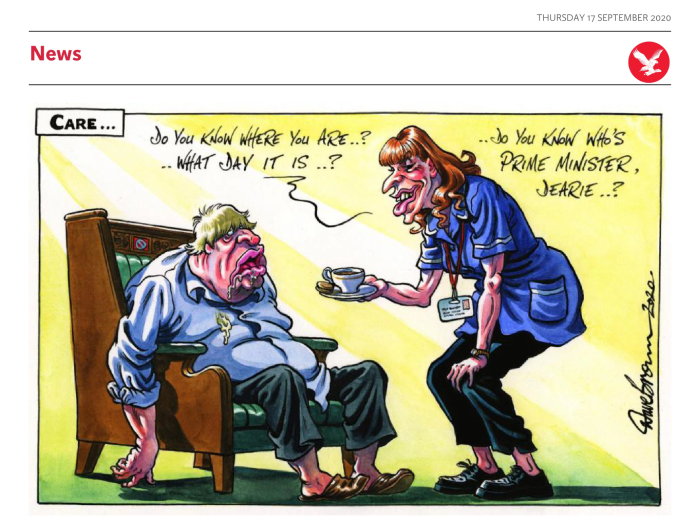
 

Viva Las Vagueness: Door Matt and Dido star in a cabaret of Covid cluelessness

In Las Vegas, they would call it a residency. So shabby has the government’s performance and messaging been over the coronavirus that Matt Hancock has found himself in the House of Commons almost on a daily basis, either to answer an urgent question or to make a ministerial statement on the latest Covid shambles.

John Crace www.theguardian.com 

And sure enough, the health secretary was back in the chamber on Thursday to outline the latest regional lockdowns that account for about one-seventh of the country – it can’t be long before there’s just a couple of villages in Cornwall open for business that are preventing another national lockdown being declared – and to announce a triage service for A&E departments. Press 1 if you think you are going to die in the next hour. 2 if you think you have a 50/50 chance of making it to the end of the day. 3 if you have broken a leg, and stop moaning. 4 to sod off and take some ibuprofen.

Hancock didn’t think to mention the collapse of coronavirus testing in many parts of the country. Nor did he say that the R number is now thought to be an alarming 1.7 in London and other areas. There again, if he had, he would have used up some of his best material for next week’s shows.

Not that Matt seems to be getting much enjoyment from all the attention, as he has become increasingly ratty. Like most Door Matts, Hancock’s natural instinct is to punch down. So rather than accepting his share of the blame for the things the government has got wrong, he has now taken to attacking opposition MPs – and even some on his own benches – for not being supportive enough. Like Boris, he can no longer accept a word of criticism. His reply to Labour’s Jon Ashworth, the shadow health secretary, who had merely pointed out some blindingly obvious truths, was a model of sneering gracelessness. At times like this, I think Hancock may be closer to losing his grip than even he realises.

Still, at least we will always have Typhoid Dido Harding, the interim chief executive of the National Institute for Health Protection, who was making a rare appearance before the science and technology committee. Right from the start she looked to be on edge. And once she opened her mouth, it immediately became clear why. Typhoid Dido really didn’t have much of a clue about anything.

She began by informing the committee that England only had the capacity for 242,000 tests a day, but she was totally unable to give an exact figure on the levels of demand. You could never be too sure, because about 27% were demanding tests when they had no symptoms. Typhoid Dido appeared to have no symptoms of meaningful neural activity. Trying to be helpful, her best guess was that demand outstripped capacity by three or four times. She thought that was a result.

Typhoid then went on to say that all would be well because testing capacity would double to 500,000 in a matter of six weeks. The committee chair, Greg Clark, raised an eyebrow. Given that the government had missed all its other testing targets, why should we believe this one? And as 500,000 was the average daily figure of people experiencing Covid-like symptoms in a normal year, wasn’t the level of tests hopelessly short of coping with a pandemic? Typhoid seemed astonished to learn that there was a pandemic going on and even more surprised to learn that children went back to school in September.

Things went from bad to worse as it emerged that tests were being rationed because laboratories couldn’t keep up with demand and that far from meeting the prime minister’s target of a 100% results turnaround within 24 hours, the government was only achieving a figure of about 33%. “The system is failing,” said Clark. Typhoid begged to differ. She reckoned 33% was a trailblazing success.

Eventually, Labour’s Graham Stringer intervened and asked the question on everyone’s mind: what on earth made her think she was the right person to head the new National Institute for Health Protection? Typhoid thought for a bit. It could have been that she had been chief executive of TalkTalk when it suffered a massive data breach resulting in her ignorance being described as a lesson to us all. It could have been that she had been on the board of the Jockey Club that gave the go-ahead to the Cheltenham festival. It could have been that she had been in charge of NHS test and trace, a service in which many employees made just two calls a month.

Or it could just have been that she was a Tory peer, married to a Tory MP, who was prepared to step up to the plate when her country called. An expert in logistics and key performance indicators who “could act faster over a broader landscape”. It now became clear she saw that her main asset was to be able to talk bullshit – though not particularly convincingly.

She wasn’t sure whether she would still be in the job if interviews ever started for it to be made permanent, but she wasn’t that bothered. Like Chris Grayling, who has just landed a £100k-a-year sideline in advising ports, despite having awarded a ferry contract to a company with no ferries, Typhoid Dido has the priceless asset of being able to fail upwards.


Shocking state of English rivers revealed as all of them fail pollution tests

All rivers in England have failed to meet quality tests for pollution amid concerns over the scale of sewage discharge and agricultural chemicals entering the water system.

Sandra Laville www.theguardian.com 

Data reveals just 14% of good ecological standard and none of good chemical standard

All rivers in England have failed to meet quality tests for pollution amid concerns over the scale of sewage discharge and agricultural chemicals entering the water system.

Data published on Thursday reveals just 14% of English rivers are of “good” ecological standard. There has been no improvements in river quality since 2016 when the last data was published, despite government promises that by 2027, 75% of English rivers would be rated good.

Figures released by the Environment Agency show for the first time that no river has achieved good chemical status, suggesting pollution from sewage discharge, chemicals and agriculture are having a huge impact on river quality. In 2016, 97% of rivers were judged to have good chemical status, though the standard of tests used this time was tougher.

EA chief, Emma Howard Boyd, said: “Water quality has plateaued since 2016, which isn’t good enough. There have been improvements over the last 25 years, for example waste water treatment works put 60% less phosphate and 70% less ammonia into the water environment than they did in 1995, but the general upward trend has not continued.“

Despite the government’s legally binding target, the new data suggests rivers are as in as poor a state as six years ago.

Howard Boyd said: “Today just 14% of our rivers are [rated good]. To get where we want to be everyone needs to improve how they use water now and that means water companies, farmers and the public.”

Guardian data revealed that raw sewage was discharged from storm overflows into English rivers for more than 1.5m hours by water companies in 2019. And the government and the EA has set up a storm overflow task force to try to tackle the growing problem of sewage pollution.

The environment minister Rebecca Pow said the water quality data published on Thursday showed urgent action was needed to reduce sewage discharge and address pollution from agriculture and chemicals. She said the data was “not comfortable reading”.

“We need to go further and faster on reducing the environmental impact from storm overflows and other sources of pollution including chemicals and agriculture,” said Pow. “More needs to be done urgently, and I met with water companies earlier this month to set out the high expectations this government has for our water environment, including in particular chalk streams.

“These results show we have a long way to go, with a new way of testing for chemicals more accurately reflecting what is in our water environment. While it’s not comfortable reading, this will allow us to plan more effectively to tackle the scourge of pollution.

“We are absolutely committed to achieving the water quality ambitions in our 25-year environment plan to improve at least three-quarters of our waters to be as close to their natural state as soon as possible.”

Dr Janina Gray, the head of science and policy at Salmon and Trout Conservation, said English river quality was the worst in Europe. She blamed a lack of political will, lack of investment and dramatic cuts to Environment Agency monitoring for the “depressing” picture.

“There has been absolutely no progress. Every single water body monitored by the EA in England has failed stricter new chemical standards. This means no waterbodies are in overall good health.”


MP told to apologise for breaching donation rules

A Conservative MP has been told to apologise for breaching rules on donations.

Laura Kuenssberg Political editor www.bbc.co.uk 


David Morris was found to have broken the paid advocacy rule when he asked a question in the Commons after accepting a £10,000 donation.

Parliament’s Standards Commissioner also criticised Mr Morris’s conduct during her investigation into the case.

Mr Morris will need to make a formal apology in the House of Commons.

Lobbying

MPs are not allowed to lobby for any person or organisation within six months of receiving any money from them as a donation.

Lobbying means trying to get support on any topic of interest, by asking parliamentary questions, approaching Ministers, public officials or other MPs.

The Commissioner, Kathryn Stone, considered the circumstances surrounding a question Mr Morris asked in the Commons on 22 October 2019.

In September 2019, Mr Morris had accepted a donation of £10,000 from Aquind Ltd, which was declared on his register of interests.

The firm is led by Ukrainian-born businessman Alexander Temerko, who is now a British citizen. Mr Termerko has donated more than £1m in total to the Conservative Party, and individual Tory MPs, in recent years.

Mr Morris’s question sought for Ofgem – the energy watchdog – to “protect” companies such as Aquind Ltd through new regulations.

The following day, Mr Morris also emailed a copy of his question and the minister’s reply to the Secretary of State for Business Energy and Industrial Strategy.

The commissioner found that the question and the email breached the rules on MPs conduct.

‘Disrespectful’

The commissioner accepted that Mr Morris’s rule breaking was inadvertent, but criticised his behaviour during her investigation as “regrettable and disrespectful of the House’s system of standards”.

The report on the case said Mr Morris also “repeatedly questioned the commissioner’s remit and her right to consult her officials”.

But it added, “Mr Morris subsequently apologised to the commissioner and the Registrar and outlined factors he considered had influenced how he had engaged with the investigation.”

The commissioner also noted that she understood him to be “deeply apologetic and remorseful for the tone adopted” in some of his correspondence, and that “no disrespect had been intended to me or my office.”

Sanctioning the MP for breaking the rules, the Committee on Standards noted that Mr Morris had “acknowledged he had breached the rules and apologised” and recognised that Mr Morris “had been dealing with particularly challenging and stressful personal circumstances which may have affected his judgment and behaviour during the investigation”.

The committee added: “Any breach of the paid advocacy rule must always be regarded as a serious matter.

“Mr Morris should apologise to the House by means of a personal statement, which should be agreed in advance with Mr Speaker and the Chair of the Committee.”

Calls for ‘wild belt’ land to be part of England’s planning strategy

Wildlife Trusts says designated new areas of protected land is needed to help nature recover

Sandra Laville www.theguardian.com 

New areas of protected “wild belt” land across the English countryside and in towns and cities must be created as part of the government’s planning changes to help nature recover, the Wildlife Trusts has said.

The trusts’ analysis of the planning changes outlined by the government in a white paper suggests they will damage nature, increase air pollution and leave local people with no say on protecting urban wildlife corridors.

The Wildlife Trusts is calling for the inclusion of areas of land to be specifically designated as places for nature recovery. They would be known as “wild belt”, protected from development and managed to allow the recovery of nature.

The trust said wild belt areas were needed in towns, cities and the countryside to ensure that 30% of England was in nature recovery by 2030.

Craig Bennett, chief executive of the Wildlife Trusts, said: “What is critical is making space for nature close to where people live and we need to protect them in the long term to allow nature to recover.

“This wild belt could be a roadside embankment, a river valley or somewhere which is important to local people. So we take a piece of land which is not much good in terms of biodiversity and give it wild belt status and manage it to put nature into recovery.

“This is our only hope. We have to help nature recover rather than just talking about slowing its decline.”

The government changes say local authorities must designate areas for growth, renewal or protection. But Bennett said the government should also map out a network of nature recovery areas in each of these zones to designate as wild belt.

Populations of the UK’s most important species have plummeted by an average of 60% since 1970, according to comprehensive analysis published last year.

This week the RSPB highlighted how too little land was managed for nature in the UK, and said the government had failed to reach 17 out of 20 UN biodiversity targets agreed 10 years ago.

The Wildlife Trusts said the white paper in its current form was a threat to nature. It said it has a bias towards permitting new developments, weakens environmental assessments of land and undermines the democratic process by reducing people’s opportunity to influence planning decisions.

The new zones suggested by the government would do nothing to reverse nature’s decline or integrate it into people’s lives, the analysis said. The trusts are urging members of the public to demand that the government prioritise wildlife and nature recovery in the reforms.

The wild belt designation would mean land that is of low biodiversity value could be designated for the recovery of nature. Bennett said it must reach into every part of England, from rural areas to towns and cities, securing the future of the new land that we are putting into recovery so that we can reach at least 30% of land in recovery by 2030 and address the climate and biodiversity emergency.


UK government releases latest plans for next May’s elections

Mark Pack President of Lib Dems www.markpack.org.uk

Yesterday, the government wrote to Returning Officers about its plans for the local elections, Mayor elections and Police and Crime Commissioner elections due in May next year in England and Wales.

Key points from the letter are:

  • The government’s plans are for the elections to go ahead: “based on the information currently available, polls can be delivered safely and securely, and the risk of transmission substantially reduced, if COVID-19 secure guidelines are followed closely.”
  • There are no plans for major changes in how the elections are run: “I believe there is no necessity for significant changes such as imposing an all-postal vote or
    changing polling days or times.”
  • Publication of some electoral registers will change: “The UK Government is bringing forward legislation to delay the deadline for publications of this year’s revised  Parliamentary and English local government registers by two months, from 1 December 2020 to 1 February 2021.”
  • Unlike Scotland, there are no plans for council by-elections to recommence before May: “Parliament legislated to push back the May 2020 elections and subsequent local by-elections to May 2021, and the UK Government continues to operate on that basis. We are not changing that legislation, meaning that you should not expect any kind of elections to be able to take place before May 2021.”


Anxious seven days for local Tory “Foot Soldiers” 

24 September is the publication date for Sasha’s Swire’s “Secret Diaries” when we get to read her indiscreet descriptions of those Hugo comes into contact with as an MP, rather than extracts.

This quote is attributed to Sarah Vine (aka Mrs Gove):

“And I must confess I rather enjoy her breezy, unself-conscious style: there aren’t many MPs’ wives who would dare describe the party’s foot soldiers as ‘toilet seats’.”

Any local Tory “Foot Soldier” who was “fortunate” enough to have attended a social gathering with the Swires, especially the favoured few who got invited to dine with them, could now feature in the book.

The problem for them is: do they get a “personal” mention, likely to be less than flattering; are they grouped under the blanket description of “Toilet Seats”; or are they simply ignored?

Which is the worst fate?

Obvious candidate names spring to Owl’s mind, including: Paul Diviani, Sarah Randall-Johnson, Christine Channon, Stuart Hughes, Andrew Moulding, Philip Skinner, Alison Hernandez, Jill Elson, John Hart……….(readers can make up their own list).


‘No Ships’ Chris Grayling To Be Paid £100,000 A Year To Advise Ports Company

Former transport secretary Chris Grayling, who once gave a no-deal Brexit ferry contract to a company with no ships, is to be paid £100,000 a year to advise a leading ports company.

www.huffingtonpost.co.uk

Grayling, once dubbed the “worst transport secretary of all time” by Labour, will collect his six-figure salary in return for just seven hours of work per week for Hutchison Ports Europe.

The Tory MP’s appointment as a “strategic adviser” was approved by the Advisory Committee on Business Appointments earlier this month, the latest MPs’ register of interests shows.

Grayling’s time at the Department for Transport left taxpayers with a £100m bill for ferries chartered to bring in vital supplies if there was a no-deal Brexit, but which were never used.

He also faced calls to resign after awarding one of the contracts – worth £13.8m – to run Channel crossings between Belgian port Ostend and Ramsgate in Kent to Seaborne Freight – a company which had no ferries.

But Grayling refused to apologise for the debacle, describing criticism of him as “baffling” and at one point telling the Commons “I did see ships”, in a reversal of Horatio Nelson’s famous quote. 

Liberal Democrat MP Christine Jardine said: “The now former minister for no ships must wish his list of successes was as long as his list of nicknames.

“With a role like this, the public deserve to know that MPs are on the side of public interest and not the pockets of lobbyists.

“To allow a conflict of interest would be an utter outrage.”

Grayling held on to his job before being eventually sacked by Boris Johnson when he replaced Theresa May as prime minister in 2019.

More recently, Grayling found himself at the centre of another controversy after he failed to be elected chair of the influential Commons intelligence and security committee despite being Johnson’s top pick for the post.

In a major snub, backbencher Julian Lewis was instead picked by the nine-strong committee.

Lewis was later stripped of the Tory whip for upending the prime minister’s plans, while Grayling quit the committee.


Sasha Swire’s wicked political character assassinations are revealed

Slashed by her poison pen: They’re the wickedest political diaries since Alan Clark’s. Now, in this blistering review, we reveal the full glorious carnage of Sasha Swire’s character assassinations

  • Sasha Swire’s upcoming book takes swipes at many high-profile Cabinet figures 
  • She also takes aim at the Royal Family and shares controversial anecdotes
  • The diarist with the wicked pen is the wife of former Tory minister Sir Hugo Swire

Simon Walters www.dailymail.co.uk 

Barely a single senior member of the governments of Boris Johnson, Theresa May and David Cameron emerges unscathed in the memoirs of ex-minister’s wife, Sasha Swire. 

The idea of the current Prime Minister with his finger on the nuclear button ‘scares the s***’ out of Lady Swire, wife of former Tory minister Sir Hugo Swire. 

Mr Cameron thinks it is ‘hilarious’ to joke with Lady Swire’s husband about the size of Michael Gove‘s manhood — and the former Prime Minister is drawn to Lady Swire because she is ‘lewd’. 

Meanwhile, Mrs May is Mrs ‘Glumbucket’, the ‘Maybot’, ‘Old Ma May’ or ‘old bat, crippled by her lack of intellectual confidence. 

Nor does Lady Swire, 57, spare the blushes of the Royal Family in her book, Diary Of An MP’s Wife. She says the Queen ‘fixed her beady eyes’ on her at a dinner at Hillsborough Castle in Northern Ireland when Sir Hugo was an Ulster Minister in the Cameron administration. 

Prince Philip ‘ranted’ about how ‘appalled’ he and the Queen were that guests used laptops during Palace ­banquets. And Sir Hugo is distracted at a meeting with Prince Charles by his ‘thick Hanoverian hands’. 

Lady Swire’s reaction to Prince Harry’s engagement to Meghan Markle in 2017 is to predict ‘trouble ahead’. The future ­Duchess of Sussex is ‘eating the redhead for breakfast’, she declares; he is ‘clearly not as clever as she is’. 

Lady Swire claims her book is a modern version of the highly acclaimed and outrageous Alan Clark Diaries in the Thatcher era. Like Clark, she gives a riveting insight into the political skulduggery and sexual high jinks of the Tory elite. 

She also pokes affectionate fun at her husband Sir Hugo, or ‘H’, as she refers to him and ­candidly talks of their marriage problems.

The book — the most indiscreet political memoir in decades — claims Boris Johnson was driven by jealousy of Cameron. He saw Cameron as a ‘fee-paying squit’ at Eton in comparison to his own status of King’s Scholar at the school. 

Lady Swire describes Johnson as ‘His Blondness’, adding that he used to be a ‘political calculating machine’ with ‘no political identity or proven ability to grasp difficult questions and decisions’. He had never been loyal to the Tories; his only loyalty was to himself. Many of Johnson’s colleagues did not take him seriously. 

When Philip Hammond was Chancellor in the May government and Boris Johnson asked him for an extra £150million for the NHS, Hammond replied ‘silly boy’, treating him like a ‘stupid child’. 

David Davis, then Brexit Secretary, ‘actually clipped Boris over the back of the head with his hand’ at the same meeting, shocking other ministers. Boris is a ‘big, fat, yellow, bouncy Labrador,’ says Lady Swire. ‘He is curiously vulnerable and longs to be loved and cannot understand it when he is not.’ 

Despite her criticisms of Johnson, by the time he becomes Prime Minister Lady Swire has warmed to him. He is an ‘alley cat’, but one with ‘greatness of soul, generosity of spirit and lack of pettiness,’ a rare quality in politics, she observes. 

Cameron always saw Johnson as a ‘liability’, says Lady Swire — and she does not spare the former PM. 

Many Tory MPs think Cameron would have done much better in the 2010 election, she says, if he ‘hadn’t been such a liberal wimp’. Lady Swire says Cameron’s campaigning style ‘lacked passion’. 

She even challenged him when their two families were holidaying in Cornwall: ‘Are you actually a Conservative, Dave?’ Cameron ‘dives into the surf, furious and flushed, to avoid me’. 

She says Cameron and his inner circle’s ‘obsession’ with promoting ministers with a ‘good back story’ led to big mistakes. 

Sajid Javid was given a Cabinet job ‘because they like the fact that he is a Muslim and his father was a bus driver in Bristol’. 

Transport Secretary Grant Shapps — Lady Swire calls him ‘Von Schnapps’ — was seen as ‘ghastly’ by some of Cameron’s team. Justine Greening was ‘loathed’ but had ‘to be kept in the Cabinet because she is a woman’. 

Lady Swire complains bitterly that Sir Hugo was denied a Cabinet job because ‘he is male white and privileged. They simply won’t let it happen’. 

She is no less ruthless in her treatment of Michael Gove. At one point, after a meeting of the National Security Council, Sir Hugo tells her he is ‘starting to think Gove is ever so slightly ­bonkers’. She adds that William Hague looked ‘exasperated every time Gove spoke’. 

Cameron ‘gave Gove a b*****king’ and ‘went ballistic’ when the ­Scotsman publicly attacked the ‘preposterous’ number of Etonians in Cameron’s inner circle. Boris Johnson’s brother, ex-Tory MP Jo, ‘almost burst into tears when he read it’. 

Gove’s aim in saying this was to wreck Boris Johnson’s chances of succeeding Cameron, declares Lady Swire, who adds: Gove is a ‘loose cannon’ and, as an ex-journalist, ‘mistakes headlines for achievements’. 

She describes Gove’s close ally Dominic Cummings, Johnson’s No 10 chief of staff, as ‘one of those odd amoebas you find in jars in school science labs’. Cummings is a ‘stark raving mad Rasputin’. 

Teaming him up with Gove, the ‘most volatile member of the Government, was always an explosion waiting to happen’. Lady Swire accuses Gove of ‘lying through his teeth’ and says that when he fell out with Cameron over Brexit, Cameron was so angry he said he would never have Michael or his wife Sarah Vine — a Mail columnist — or his children in his house ever again. 

She says Gove also upset former Tory leadership contender Rory Stewart, who looked set to ‘punch’ him when Gove made a joke that backfired about a jihadi kissing Stewart’s wife. It was ‘nutter Michael in a nutshell’. 

When Sir Hugo is knighted at Windsor Castle in 2016 he is worried it will be done by Prince Andrew, saying: ‘I’m not kneeling down in front of that man. He might knight me with his todger’

The book is full of shocking sexual shenanigans and pranks. At a birthday party for George Osborne in the Chancellor’s No11 flat, for instance, Lady Swire says Sir Hugo and Cameron were ‘laughing uproariously’ about the size of the private parts of certain Tories, including Gove. 

Gove’s manhood was ‘like a slinky that comes down the stairs before the rest of the body,’ said Sir Hugo. Cameron thought this ‘hilarious’. Sir Hugo started a ‘male conversation’ at the same party ‘about which women in politics are beddable and which aren’t’. 

Lady Swire is unabashed about why David Cameron liked her. It was ‘because I am not remotely nervous around him. I’m cheeky, occasionally lewd and sometimes a little too challenging’. 

During a weekend at Chequers hosted by the Camerons for several ministers and their spouses, Lady Swire says that the dinner conversation covers ‘STDs at Oxford, and my menopausal symptoms and libido’. She tells the gathering she enjoys sex much more in her 50s than in her 40s. 

Her indiscretions even shine a light on Osborne’s marriage break up with wife Frances, which crops up frequently in the diaries. At a 2012 barbecue hosted by Osborne at the Chancellor’s official country residence Dorneywood, Frances stayed in the kitchen for the entire event and ‘did not appear at all’. Lady Swire comments, simply: ‘Extraordinary.’ 

When the couple’s split was announced later, Lady Swire says the ex-Chancellor was ‘having a mini menopause and throwing all his toys out of the pram’. 

She tells how at a birthday party for a Cabinet Minister she embarrassed Lord [Ed] LLewellyn, Cameron’s No 10 chief of staff and now Britain’s Ambassador in Paris. ‘I smile, cup my hand, lower it between his legs, gather up his testicles and squeeze.’ 

When a military clash looms between Russia and America over Syria in 2017, Lady Swire says: ‘Putin and Trump have been getting their d***s out to prove which one is bigger.’ 

She tells how she and Home Secretary Amber Rudd casually discuss whether David Davis is ‘a shagger’. They agree he isn’t. She states in a preface to her book that she had never intended to publish her diaries because it would have been a ‘betrayal’ of her family and friends, adding that some of her entries ‘might offend without meaning to’. 

She changed her mind because ‘it is always men who write history’. 

Plenty of her friends — both male and female — may well not forgive her change of heart. 

Killer political quips 

  • George Osborne, former Chancellor: Looked like a ‘­caddish extra on Downton Abbey’. Pasty tax showed he was ‘too clever to be sensible’. 
  • Dominic Raab, Foreign Secretary: Arrived at a meeting ‘looking like he usually looks, sweaty, just out of the gym and wanting to kill people’.
  • Matt Hancock, Health Secretary: ‘Particularly disingenuous. Quite an actor that one.’ 
  • Esther McVey, former Work and Pensions Minister: ‘More ladette than lady.’ 
  • Francis Maude, Cabinet Office Minister in Cameron government: ‘Fagin-like, villainous-looking with tight little weasel eyes.’ 
  • William Hague former Foreign Secretary: He was ‘foolish’ to issue a statement about the ‘gynaecological secrets’ of wife Ffion in response to unsubstantiated ‘gay rumours’ about him. Hague is ‘only ever interested in himself, his ministers are gnat bites on his ankles, or so he makes them feel’. 
  • Oliver Dowden, Culture Secretary: Tells Sir Hugo he was fed up with his wife’s vegan cooking, so was thrilled to find a ham and chicken bake in the oven. He ‘gobbled it down lustily, and when his wife came home she asked where the dog’s food was’. 
  • John Bercow, former House of Commons Speaker: He is ‘a little weasel, creepy, revolting, little goblin, gripped by his own smug sanctity, dislikes Hugo’. 
  • Donald Trump: ‘A filthy, racist misogynist’. 


A rapier to Royalty

Describing meeting the Queen, Lady Swire said Her Majesty ‘fixes her beady eyes on me then swans past not saying a word’. 

The Queen asks the same question to anyone she doesn’t know, adds Lady Swire — ‘How long have you been doing this?’ 

When they say ­’decades’ or something similar, she says, ‘Gosh’ or ‘Wonderful’ or ‘Have you really?’ 

At a royal dinner, Prince Philip ‘ranted on about some royal banquet where the guests got out their laptops and how appalled he and the Queen were’. 

As for Prince Edward’s wife, Sophie Wessex, Lady Swire is enraged by a ‘fatuous’ comment she made at a royal garden party at Hillsborough Castle in Northern Ireland, where Sasha’s husband was a minister in the Cameron government. 

The Countess delivered a ‘long moan’ about sharing royal duties with her husband and being ‘­frozen out’. 

Prince Edward is described as an ‘overexcitable puppy’. When Sir Hugo is knighted at Windsor Castle in 2016 he is worried it will be done by Prince Andrew, saying: ‘I’m not kneeling down in front of that man. He might knight me with his todger.’ 

Those receiving knighthoods are never told in advance who is going to do the honours, she says, ‘because if it’s Princess Anne everyone complains and tries to switch days’. 


£40k package of support for East Devon businesses

To help businesses in East Devon at this challenging time, East Devon District Council is funding a £40,000 package of business support.

Daniel Wilkins www.sidmouthherald.co.uk

The support programmes, delivered by Honiton-based Cosmic and Business Information Point, will include packages of training, advice and direct consultancy.

This is specific, tailored support for East Devon businesses over and above any other regional support. The programme will offer guidance on how to adapt and thrive at this time.

The programme will be shaped by the businesses that engage and will be wrapped around their requirements, with a flexible offering of training, advice and consultancy, on a broad range of topics.

The Adapt and Thrive programme aims to work with businesses of all shapes and sizes, from the largest businesses to start-ups and established SMEs.

Training and advice could cover aspects such as financial management and business strategies; adapting to change; managing staff culture; agile project management; marketing tactics; or adopting new digital solutions and processes.

Upcoming training sessions can soon be booked by any eligible business based in East Devon.

There will also be a four-part start-up business programme for budding entrepreneurs starting soon.

Councillor Paul Hayward, East Devon District Council’s deputy leader and portfolio holder for economy and assets, said: “At a time when businesses, large and small, are struggling with ever-changing economic uncertainty, and the constantly shifting sands of consumer behaviour, it is essential that commercial organisations adapt to allow them to thrive in a completely different marketplace.

“Communication will be the key, and East Devon District Council is adapting its social media output to ensure that we reach as many businesses as possible to spread the message that we are here to help you – now, and in the future.

“Together, we’ll make East Devon the natural home for small business.”

Anyone interested in registering for support wanting an initial consultation should complete an enquiry form or visit the website for more information


Chancellor quizzed by MPs over hospitality sector concerns

Westcountry MPs have pressed Chancellor Rishi Sunak to recognise the continuing problems of the hospitality sector as furlough comes to an end and the impact of the coronavirus pandemic continues to be felt in the economy.

[Simon Jupp and Neil Parish seem to have kept their heads down – Owl]

Philip Bowern www.devonlive.com 

Central Devon MP and chairman of the Treasury Select Committee Mel Stride asked the Chancellor in a Commons question whether further targeted support was likely to be forthcoming for businesses after the end of October when furlough draws to a close.

Mr Stride said: “(Rishi Sunak) has done a tremendous amount to support jobs in our country.

“But, would he agree with me that there will be many thousands, perhaps even hundreds of thousands of jobs, which are going to be viable after COVID is dealt with but will not make it unless they are provided with further targeted support after the end of October?”

Mr Sunak told Mr Stride: “He is right that businesses do need support which is why many of the interventions we have put in place last through to next year – for example the business rates holidays and indeed our support for the economy and jobs through initiatives like our stamp duty cut to catalyse the housing market.

“Throughout this crisis I’ve not hesitated to act in creative and effective ways to support jobs and employment and will continue to do so.”

Meanwhile, St Austell and Newquay MP Steve Double won a pledge from the Treasury that it would keep under review the idea of running a winter version of the “Eat Out to Help Out” scheme.

Mr Double said: “August has been incredibly busy in Cornwall but we do face a big challenge as we head into winter for the hospitality sector.

“So could I ask (Rishi Sunak) if he would consider a similar sort of scheme to be run at some point during the winter to help as many businesses as possible survive the winter and be here for next summer?”

Financial Secretary to the Treasury Jesse Norman replied: “I would say that there is this wider package… of course the Treasury keeps all these measures under review… but it is a pretty formidable combination of VAT reduction, business rates relief and of course billions in tax deferrals and loans.”


If Hugo Swire was so “in” with “Dave” why did Hugo never get anything done for East Devon?

We learn from “Sasha’s Secret Diaries” that Hugo was so in with Dave he was the first one Dave called to get drunk with after his defeat.  So pally, yet Hugo couldn’t get him to do anything for East Devon. (Toilet seats too small to bother with?) – Owl

Cameron drowned Brexit sorrows with ‘endless bottles of wine’, book claims

www.independent.co.uk 

David Cameron drowned his sorrows after losing the Brexit referendum with a “lethal” negroni cocktail followed by wine, whisky and a “fat” Cuban cigar during a dinner with friends, a new book claims.

The chastened prime minister bolted from Downing Street to his home in Dean, Oxfordshire, on the day of his defeat, and asked the then Conservative MP Sir Hugo Swire and his wife, Sasha, to come along with “plenty of booze”.

The claims are published in The Times, which is serialising Lady Swire’s tell-all new book, Diary of an MP’s Wife: Inside and Outside Power.

A previous extract claimed that during a long coastal walk Mr Cameron asked Lady Swire to walk behind him, because “that scent you are wearing … makes me want to grab you and push you into the bushes and give you one”.

The latest tranche of diary entries includes 27 June 2016, days after the EU referendum. According to the book, Sir Hugo and Lady Swire arrived at the Cameron home, laden down with alcohol and top-end Cohiba cigars, to discover Samantha Cameron “devastated” by the result.

Lady Swire writes: “When Dave arrives, he makes a lethal negroni before we progress to endless bottles of wine, whisky and brandy.

“Over dinner, he is incandescent with anger, which is almost wholly directed against Michael [Gove].

“As for Boris [Johnson], he says that this whole episode was to do with his leadership ambitions and that he despised his lack of ideology, which is a tad ironic.

“David tells us that even when he switched sides, Boris was telling him via texts that Brexit ‘would be crushed like the toad beneath the harrow’ and that he (David) would survive.”

Mr Cameron’s rage at Mr Gove over his Brexit betrayal was also clear in his own memoir, in which the former PM called his tormentor a “foam-flecked Faragist”. He continued: “One quality shone through: disloyalty. Disloyalty to me and, later, disloyalty to Boris.”

The Independent has contacted Mr Cameron’s office for comment.

[Owl reminds readers that we have already seen Mrs Gove’s (Sarah Vine) Hissy Fit reply to the Diaries]


‘It’s like family’:Swedish housing experiment designed to cure loneliness

Erik Ahlsten is unequivocal. “This is the best accommodation I’ve ever had” His friend and neighbour Manfred Bacharach is equally enthusiastic. “I really like this way of living,” he says. “It’s very much my cup of tea.”

Derek Robertson www.theguardian.com 

The two are referring to their new home, Sällbo, a radical experiment in multigenerational living in Helsingborg, a small port city in southern Sweden. Its name is a portmanteau of the Swedish words for companionship (sällskap) and living (bo), and neatly encapsulates the project’s goals – to combat loneliness and promote social cohesion by giving residents incentives, and the spaces, for productive interaction.

Sällbo, which opened last November, consists of 51 apartments spread over four floors of a refurbished retirement home. More than half of the 72 residents are over 70s, like Ahlsten and Bacharach; the rest are aged 18-25. All were selected after an extensive interview process to ensure a mix of personalities, backgrounds, religions, and values, and all had to sign a contract promising to spend at least two hours a week socialising with their neighbours.

“A new way to live,” proclaims Sällbo’s website boldly, adding that it’s where “generations and cultures meet, with social life in the centre”. The project is administered by Helsingsborgshem, a not-for-profit housing company funded by the city council, and stems from an idea they had in 2016 amid concern about loneliness among older groups. Swedes are fiercely independent – young people start living alone earlier than anywhere in Europe – a trait that continues into old age; thanks to public policy and a wide range of municipal services many elderly people opt to remain in their own homes.

Yet a sense of isolation poses a real “danger to health”, according to the Karolinska Institute, and remains prevalent among retirees. “Our research showed that elderly people were feeling isolated from society, and were very lonely in their everyday life,” says Dragana Curovic, the project manager at Sällbo. “They were only mixing with others of the same age.”

At the same time, the 2015 refugee crisis meant organisations like Helsingsborgshem were under pressure to house growing numbers of people who were struggling to integrate with – and win acceptance from – Swedish society. So a plan was hatched to mix the two, with younger Swedish people acting “as a bridge”. “They are closer in age to the refugees, but closer in terms of culture and language to the older people,” says Curovic. “We hoped they would bring them together.”

Although less than a year old, and despite the complications of a pandemic, the arrangement seems to be working for young and old. One resident, a 92-year-old former teacher, has been giving English lessons. Ahlsten and Bacharach have been cooking communal dinners, doing repairs and odd jobs, and driving people around; Bacharach taught one resident, an Afghan refugee, how to drive. In return, the younger residents help with modern technology and social media, and how to find information online.

“It’s a real community,” says Ahlsten, “and the mix of people works very well.” Bacharach agrees. “It’s great doing things together and enjoying other people’s company,” he says. Since moving in, he’s joined the gardening group, the Sunday night movie club, and learned to play Canasta. There are sign-up sheets in the communal areas and dedicated Facebook groups for all the various activities; just as importantly, there’s plenty of space.

There’s a gym, yoga room, a library (stocked with the residents’ own books), and a large communal kitchen on every floor. The arts-and-crafts studio is stuffed with paints, wool, and other creative paraphernalia, while the residents themselves turned one space into a workshop, complete with tools and equipment (one of the pensioners, a former sea captain, has reinvented himself as a silversmith). Even the main lounge on the ground floor is a multifunctional space, with hi-fi equipment, table football, and a piano, donated by one of the residents so that “everyone can experience its joy”; she’s hoping to give lessons.

Rents vary from 4,620 to 5,850 Swedish krona (£409 to £518) per month, which is commensurate with similar-sized rent-controlled apartments in the city (private, one-bedroom rentals in the centre cost between 7,000 and 10,000 Swedish krona).

Ali Soroush, 21, an Afghan refugee, and Isabel Tomak-Eriksson, a native Swede, are one of the few couples. Soroush arrived in 2015 and is one of the refugees Helsingsborgshem had in mind when conceiving of Sällbo. He says it reminds him of his own culture, with people – particularly different generations – living and socialising together, and helping each other out. “The whole building is like a family,” he says.

Of course, intergenerational living carries the risk of some tensions breaking out but, so far, they have been minimal. Helsingsborgshem appointed a full-time “host”, to act as a facilitator and moderator – to “feel the atmosphere and deflate tension” says Curovic – but they’ve had precious little do. Indeed, mutual respect and understanding has flourished; there’s been neither excessive partying, nor any pedantic carping.

“You can always just close your door and relax or sleep,” says Ahlsten. And while Tomak-Eriksson notes the responsibility everyone feels as a Sällbo resident, she says it’s far from boring. “Pre-corona, there were parties all the time. Every weekend it was someone’s birthday or some celebration, and there were always people around – everyone had lots of visitors.”

This planned “togetherness” has also stood the residents in good stead during the pandemic – the threat of the disease has curtailed many of Sällbo’s social aspects, particularly among the elderly. There have been no cases yet, but no one is taking any chances; some are self-quarantining, and those who do continue to meet up do so in smaller groups, and in bigger areas.

“Corona has changed everything, but I’ve been busy,” says Ahlsten, who’s been running errands and doing shopping for those reluctant to venture out into public. Likewise Soroush and Tomak-Eriksson; “We’ve been offering our help to those who need it,” she says. “All the young people have.” And while being vigilant, and following guidelines around distancing and hand hygiene, others are more sanguine. “Not challenging, just boring,” says Bacharach on being asked how he’s coped. “We’re just waiting for it to be over.”

Even before the pandemic, Sällbo had attracted attention both within Sweden and internationally. Three municipalities are working on directly implementing the concept, and many more considering similar ideas. A delegation from Canada visited in February, while others from Italy, Germany, and South Korea have been in touch regarding study missions.

With loneliness on the rise and considered a genuine health risk – Sweden’s largest daily newspaper Dagens Nyheter asked earlier this year if it was “a new epidemic” – projects such as Sällbo are seen increasingly as a holistic solution to isolation, over-reliance on public services, and the trend, even among older people, for increasingly unhealthy internet use (wifi is free in communal areas, but tenants have to pay extra to get online in their apartments).

“We hope that people see that youngsters from other countries are not to be feared, and that you can have totally normal relationships between youngsters, elderly and other people,” says Curovic of Sällbo’s ultimate goal. “We want that to spread to society in general, and increase the willingness to integrate. And it’s starting to happen.”

Soroush has seen this change first hand. “In my old apartment building, even after one and half years I didn’t know any of my neighbours,” he says. “But here, from day one, you know everyone. It feels like home.”


Town council continues objection to 59-bedroom extra care apartments in Exmouth

Town councillors have continued their objection to plans for a four-storey retirement apartment block in Exmouth.

Daniel Wilkins www.exmouthjournal.co.uk 

McCarthy and Stone has lodged an application to build a 59-bedroom extra care accommodation complex on the site next to Tesco in Salterton Road.

If given the go ahead, an office block would also be built on the site which has been earmarked for employment uses in the Exmouth Neighbourhood Plan.

At its virtual meeting on Monday (September 14), the town council’s planning committee voted to continue its previous objection to the plans, saying amendments to the site layout and elevation have not addressed its concerns.

In September 2019, McCarthy and Stone lost an appeal after East Devon District Council refused an application for a 59-bedroom extra care apartment complex.

Town councillors said that 12 months on, not enough has changed and the application would be ‘harmful to the interests of Exmouth’ and is contrary to the town’s neighbourhood plan.

East Devon District Council will make the final decision on the application.


Honiton Town Council down to seven members after yet another resignation

(Last one out please switch off the lights – Owl)

Hannah Corfield honiton.nub.news

Resignations have become a bit of a theme recently at Honiton Town Council, with nine members quitting in 2020 alone.

Michelle Pollington announced yesterday that she would no longer be carrying out her role as councillor for the town, having been co-opted on back in June of last year.

Just seven members now remain on the Council, with one unable to participate due to ill health.

There are five vacancies in each of the two Honiton wards – St Paul’s and St Michael’s. The Monitoring Officer at East Devon District Council has received the required number of written requests, meaning that at least nine of these positions will go to an election due to take place in May 2021.

Michelle told Honiton Nub News: “There is such a small cohort of councillors left that it’s got to a stage where it’s not really functioning as a town council should.

“My intention when I joined was to be part of boosting the reputation of the Council and being part of positive change for the town, but during my time nothing has changed.

“There is a lot of negativity and preoccupation with historic disputes, which gives a bad perception of the town to those looking in.

“We need a fresh start and to move forward.”

The news of former Cllr Pollington’s resignation was announced at the full council meeting held yesterday evening – please see Honiton Nub News Facebook page for a recorded video.

In response, Mayor John Zarczynski commented: “I am sorry to see her go, but it didn’t come as a surprise. I fully expected her to follow when former Cllr Kolek resigned.

“Her short term – because as you know former Cllr Pollington was co-opted – was very much interrupted by the lockdown and I’m sure had it not been for the coronavirus she would have contributed a lot more to the Council.

“I do wish her luck in the future. Whether she will stand in the May elections, we’ll have to wait and see.”