Leaked figures reveal scale of coronavirus test shortage

“The government’s “world-beating” testing programme has a backlog of 185,000 swabs and is so overstretched that it is sending tests to laboratories in Italy and Germany, according to leaked documents.”

Thinking about  the “Moonshot” and the way the Government has outsourced the track and trace system, Owl is reminded of the following quote from John Glenn, US astronaut : “As I hurtled through space, one thought kept crossing my mind – every part of this rocket was supplied by the lowest bidder.” 

Gabriel Pogrund, Tom Calver and Caroline Wheeler www.thetimes.co.uk 

A Department of Health and Social Care report marked “Official: sensitive” also confirms that most British laboratories are clearing fewer tests than their stated capacity, as they are hit by “chaos” in supply chains.

The government claims that it has capacity for 375,000 tests a day. However, the actual number of people being tested for the coronavirus stalled to just 437,000 people a week at the start of the month — equivalent to just 62,000 a day.

Throughout last week, people in Covid-19 hotspots across the north of England struggled to get tests and were told to travel hundreds of miles for an appointment. In Bolton, which has the highest infection rate in Britain of more than 180 weekly cases per 100,000 people, no tests were available on the government’s online booking system between Thursday and Saturday.

One man in London with symptoms of the disease yesterday claimed that he had tried to book a test 60 times but found none available. Earlier in the week people in the capital had been told that the nearest site was in Aberdeen, an 18-hour round trip.

Boris Johnson used prime minister’s questions this week to reject claims by Sir Keir Starmer, the Labour leader, that the government’s testing effort was on the brink of collapse.

He has also commissioned Operation Moonshot, an ambitious plan to introduce up to 10 million daily tests by the spring, at a cost of up £100bn.

However, an investigation by The Sunday Times casts fresh doubt on the government’s ability to provide tests for a far smaller number of people.

Gavin Williamson, the education secretary, pledged last week that testing would be available in schools so that pupils could return safely. But schools of any size are receiving just 10 test kits each, and are being told to use them only in “exceptional circumstances” and where the pupils could not otherwise access tests at home.

Last night one Whitehall source said that the guidance would become even more stringent next week, while tests would be made available to teachers and not pupils.

For those who can get hold of tests, there is no guarantee of rapid results — or of any results at all. Leaked figures show that three-quarters of all tests miss government targets, taking longer than 24 hours from booking to result. One in four take longer than 48 hours.

Documents also show that voiding — the disposal of used tests due to human or technical error — has shot up. Randox, which won a £133m testing contract unopposed at the start of the outbreak, disposed of 12,401 used swabs in a single day on September 2. The company, which is based in Co Antrim, Northern Ireland, has voided more than 35,000 used test kits since the start of August.

Civil servants and laboratories have pointed the finger at each other for the chaos. Internal reports state that tests are mostly voided because of “swab leaks” and “damaged tubes” during transit, or human error, such as people sending urine rather than saliva.

But officials have cast doubt on the feedback coming from some labs, saying that they are freezing or throwing away tests after an arbitrary period.

It was claimed last night that Randox had blamed the high void rates on staff going on holiday. The company has not denied charging the taxpayer for voided results, but disputed the claim that it blamed employees taking leave.

Last week Randox placed job advertisements in an attempt to increase the workforce at its Covid laboratories. One ad read: “No previous experience required.” The adverts said: “It is NOT essential to have a science background.”

Staff have claimed that they are working 12-hour shifts at close to minimum wage to clear backlogs.

The foreign companies that are processing British tests include Eurofins, which is based in Luxembourg and has labs in Germany, and Immensa, based in L’Aquila, central Italy.

A source last night said that thousands of used tests in Germany could be “voided” because they were transported at the wrong temperature. Officials have also been told that processing tests from Britain is “not a priority” at foreign laboratories.

Jon Ashworth, the shadow health secretary, said: “People ill or with a sick child desperate for a test will be astonished that tests are piling up, left unprocessed, or even thrown away, because of errors in transportation and swabbing, while at the same time we are testing less than capacity. This really is ministerial incompetence at a whole new level.”

Last night Randox said it did not comment on voided tests or rates, but followed “accepted timelines for the validity of a sample, which ensure tests are accurate”. Failure to do so, the company added, would “jeopardise the accuracy and reliability of NHS Test and Trace”.

The Department of Health said: “Test and trace is working and our capacity is the highest it has ever been, but we are seeing a significant demand, including from people who do not have symptoms and are not otherwise eligible.”


Coronavirus cases in care homes spiral again

The coronavirus is spreading through care homes again, according to leaked documents that show the government is failing to protect the most vulnerable from the spiralling number of cases.

Gabriel Pogrund, Tom Calver and Rosamund Urwin www.thetimes.co.uk

A Department of Health report marked “official sensitive” and circulated on Friday stated that the rate of the coronavirus recorded through satellite tests — almost all of which take place in care homes — had quadrupled since the start of the month. It now stands at an estimated 1,100 new cases every day.

Matt Hancock, the health secretary, took an emergency update on Wednesday saying that outbreaks had been detected in 43 care homes after months of calm.

On Friday night he wrote to care home leaders to confirm that the virus had reappeared: “The infections are mainly affecting the workforce but clearly there is a risk the virus will spread to residents or to other parts of the care sector.

“Unfortunately, in some care homes, with recent outbreaks, this does appear to have occurred, with residents also becoming infected.”

A memo sent to the health secretary’s team lists care homes in Bristol, Nottinghamshire, Wiltshire and Wolverhampton as among the worst hit.

At the start of the pandemic the decision to move hospital patients into care homes, often without testing, contributed to 20,000 Covid-related deaths.

To prevent another outbreak, the government promised weekly testing for staff and monthly tests for care home residents in July. It reached the target only last week.

The majority (52%) of Covid-19 tests carried out by care homes take more than 72 hours to be processed.

In his message to care homes, Hancock ended with a warning about the potential dangers as winter approaches: “This winter will place unique pressures on the health and care system. Covid-19 will be circulating with seasonal flu and other viruses and transmission may increase.”

On the same day, scientists at Imperial College London warned that the R infection rate had reached 1.7 — meaning that cases were doubling each week.

Last week care homes in Newcastle, Gateshead and Sunderland shut their doors to visitors because of early signs that the virus was returning.

Jon Ashworth, the shadow health secretary, said: “Failures over tracing and isolation now mean infections are rising. Failure to protect care homes early on meant many lost their lives. It would be unforgivable if the same mistakes were made again.”

A health department source said: “We have been doing everything we can to ensure care home residents and staff are protected, including testing all residents and staff; provided 200 million items of protective equipment, ring-fenced £600m to prevent infections in care homes and made a further £3.7bn available to councils to address pandemic pressures.”


The Observer view on Boris Johnson’s lamentable summer 

Corruption and incompetence now define Number 10

Observer editorial www.theguardian.com

Boris Johnson has succeeded in achieving something no other sitting prime minister has done to date: he has made himself the target of excoriating criticism from not one or two, but three former leaders of his party, two of them also former prime ministers. It is an extraordinary indictment of his incompetence and his failure to take the business of governing this country seriously.

What prompted this was the unprecedented admission by one of his ministers that the government planned to break international law. In a Commons debate about the government’s internal market bill, the Northern Ireland secretary, Brandon Lewis, confirmed that in giving ministers the power to unilaterally overturn parts of the EU withdrawal agreement, the bill contravenes international law. In order to get there, the attorney general, Suella Braverman, had to, incredibly, assert in her legal advice that international law is trumped by parliamentary sovereignty, in contravention of the Vienna convention, and that the bill does not flout the ministerial code that places a duty on them to comply with the law.

This was an incendiary interjection during a critical week in the Brexit negotiations. If it was intended as a threat to bring the EU closer to the UK positions on the level playing field and fishing rights, it has backfired: the EU has threatened legal action if the government does not alter the bill by the end of the month. The UK’s threat to break a treaty it has already signed has further undermined trust and reduces the chance of the bare-bones free trade agreement that the government aspires to.

The real intention was, presumably, to signal to voters that the blame lies with the EU if no deal is reached, with all of the consequences that would have for an economy that has just suffered its biggest ever contraction as a result of coronavirus. It raises the question of whether there is any principle that Johnson would not trample over if it suits his political agenda.

In threatening to rip up the Good Friday agreement, which guarantees that there will be no border on the island of Ireland, even if that means introducing customs checks and, potentially, tariffs in the Irish Sea in the absence of a free trade deal, the government has further underlined its casual indifference to the Northern Ireland peace process. Any government that prioritised the longevity of the Good Friday agreement would have pursued a Brexit that kept the UK aligned with the single market and customs union; instead, Johnson has shown he is willing to play petty politics with a peace agreement that ended a conflict that cost thousands of lives.

The consequences will be felt not just in our relationship with the EU but in our relationship with the United States: Democratic lawmakers have already said that there will be no trade deal with the UK if Brexit undermines the Irish peace process. There are also broader repercussions for Britain’s international standing. So much of our criticism of dictatorships and rogue states around the world is founded upon their disregard for the rule of law, from China to Russia to Iran. How can Britain claim to speak with any authority when this charlatan is our prime minister?

Time and again, Johnson has shown that he is willing to take unconscionable risks in his political games, regardless of the consequences. It is a Vote Leave approach to governing that prizes populist slogans over real change, soundbites that poll well over any attempt to govern with competence. We have seen the costs in the government’s mishandling of this pandemic; a number of unforced errors have contributed to Britain’s terrible excess death rate.

And now, as a former chief scientific adviser warns that the UK is on “the edge of losing control” of the virus, there are alarming signs that the government has not used the summer hiatus to get a grip. The test-and-trace system, absolutely key to minimising a second wave of infection, is seriously underperforming. In many areas of the country, it is proving impossible to book a coronavirus test. The government is failing to enable people who have symptoms to stay at home by increasing statutory sick pay from its pitiful level of £96 a week; little surprise then that rates of compliance with the guidelines around self-isolation are far too low when many parents simply cannot afford to take a hit of hundreds of pounds if a family member develops a cough or a temperature.

Instead of addressing these serious failings, the government has tried to distract from them with a pie-in-the-sky £100bn “moonshot” pledge to carry out up to 10m instant Covid-19 tests a day next year. Instead of making it financially possible to comply with its guidance, the government has sought to shift the blame for rising infection rates to the public, despite the mixed messages it sent suggesting that the worst of the virus was over. Instead of preparing for a second wave, it spent the summer picking fights: stirring up strife with anti-racist protesters and the teachers’ unions, and sacking civil servants while insulating ministers from the consequences of huge errors such as the A-level grades scandal.

This is the government we have as Britain heads into a dangerous autumn, on the cusp of a second pandemic wave and at the most crucial stage of Brexit talks yet. Just as we have rarely been more in need of sober and competent stewardship, we have a prime minister who regards politics as a game and who views fomenting culture wars as fruitful political strategy. His government’s response – to the avoidable loss of life, or the blighting of a whole generation’s life chances, or the threatened breakup of the union – is lamentable.


Exasperated parents in England say test and trace still a ‘shambles’

Never mind just wait for the next moonshot.

Remember you can find advice on how to get a test in Devon here. – Owl

Aaron Walawalkar www.theguardian.com 

Exasperated parents in England have complained of a test-and-trace system still in “shambles”, with some struggling to book appointments for their children who have developed symptoms since returning to school.

One Brighton primary school teacher, who did not wish to be named, told the Guardian she had tried to book a test for her three-year-old daughter since Friday morning, but the only option offered was in Aberdeen – more than 600 miles away.

It comes after the health secretary, Matt Hancock, pledged on Monday that no one should have to travel more than 75 miles each way to get a test. The head of NHS test and trace subsequently issued an apology to people in England who have either been unable to secure a test or have been told to travel hundreds of miles.

Jack Cousens, a Basingstoke councillor, chronicled the difficulties he faced in trying to secure a test for his six-year-old son over the course of 12 hours on Friday.

In five separate attempts, he was told “there are no tests available right now,” and to check again later.

“It would be laughable if it weren’t so shambolic,” he said. “The PM and health secretary need to take responsibility here, own the problem and find a way to fix it.”

On his sixth attempt he succeeded in booking the last available slot at a Salisbury testing centre a “short-ish jaunt away”.

But author Clare Josa, from Salisbury, told the Guardian on Thursday that she was advised to travel to a test centre 140 miles away when trying to book an appointment for her husband.

“I’ve tried every hour (waking hours) since Monday lunchtime and there are zero postal tests available and, all but one time, there haven’t been any test centre tests either,” she said.

“My husband is too ill to drive and I don’t want to spend six hours in a car with him if he might be contagious. The Salisbury test centre is two miles from our home and friends who have driven past it say it looks empty.”

She added that her eight-year-old son had been sent home from school on Monday due to a cough and cold. The school nurse agreed to use one of the schools “precious” 10 Covid tests on him – which was sent to the lab the following morning – but by Thursday she had still not received any result.

Chris Kimberly, from Milton Keynes, tweeted about a similar experience. He said he had been trying to get a test for his son, who has developed a persistent cough since returning to school last week, for hours. “This is a shambles he said,” he said.

A Department of Health and Social Care spokesperson said: “NHS test and trace is working and our capacity is the highest it has ever been but we are seeing a significant demand for tests including from people who do not have symptoms and are not otherwise eligible.

“New booking slots and home-testing kits are made available daily for those who need them and we are targeting testing capacity at the areas that need it most, including those where there is an outbreak, and prioritising at-risk groups.

“Our laboratories are processing more than a million tests a week and we recently announced new facilities and technology to process results even faster. If you do not have symptoms and are not eligible to get a test you can continue to protect yourself if you wash your hands, wear a face covering and follow social distancing rules.”


Cornwall, Devon and Dorset could get combined authority with extra powers from Westminster

The Ministry of Housing, Communities and Local Government is set to publish a White Paper with South West set to be latest region to receive new powers

[Are we about to see “The Great South West” combined authority replacing our counties with the elimination of our distinct regional cultures? And who might we expect to be its Mayor? The man with the Midas touch? Is this another of un-elected Dominic Cummings’ “Moonshot” ideas? – Owl]

By David Parsley inews.co.uk 

Boris Johnson’s plans to ‘level-up’ the nation could lead to a new single authority for the South West of England with policy making powers in areas such as education, health, energy infrastructure and transport.

The Government’s White Paper on Devolution and Local Recovery, which is due to be published within weeks, will make reference to “regional partnerships” and herald the creation of formally recognised regional partnerships supported by the Government investment.

The Great South West group, an economic alliance that claims to have the support of the Prime Minister, believes the region should be given the same status as the Northern Powerhouse.

A spokesman for the group said: “Our aims include securing commitment from Government to recognise the economic potential of the area as part of its levelling up agenda, and to provide strategic backing and investment to fulfil our aims.”

At the heart of the Great South West’s proposals is £45bn of investment to create the cleanest economy in England, and the first to be net zero carbon.

Matt Barton, head of strategy at Cornwall Council, said: “The hope is that the Great South West will be one of the first to benefit given it has already submitted an ambitious prospectus ambition to Government.”

Plans not going far enough for some

However, the plan to hand powers from Westminster to the South West is unlikely to go far enough for some campaigners, including Sir Gary Streeter, the Conservative MP for South West Devon.

Sir Gary said: “The Great South West project is an attempt to inject some much-needed coherence into this region’s dialogue with government. Unfortunately, the government is now introducing a White Paper on devolution which may delay our recognition as a coherent region.”

A spokeswoman for the Ministry of Housing, Communities and Local Government, said the White Paper was imminent.

She said: “We have set out a clear commitment to level up all areas of the country by empowering our regions through devolving money, resources and control away from Westminster.

“We are considering a range of options and will set out our detailed plans in the White Paper that will be published this Autumn.”

Labour MP opposes plans

However, Ben Bradshaw, the Labour MP for Exeter, is against any move that led to counties losing their own individual identities.

“This is a ridiculous proposal from Boris Johnson – tearing up decades, if not centuries of people in England identifying with their county and in the case of historic cities like Exeter and Plymouth, with their city,” said Mr Bradshaw.

“What we need in the South West are local councils that are empowered and have the funds to deliver on behalf of their local communities and a coherent regional body like Labour’s Regional Development Authorities, which the Tories abolished, which can provide strategic leadership on economic development priorities across the South West and other regions as a whole.”


Sidmouth campaigner welcomes county council’s anti-racism proposals

Helen Matthew described the news as ‘absolutely brilliant’.


This week councillors supported a motion put forward by Ottery representative Claire Wright, inspired by the Black Lives Matter movement.

The motion said councillors should be encouraged to ‘promote and celebrate the role and work in Devon by BAME people, past and present’.

It also supports changes to the way history is taught to children, saying that schools should be encouraged to ‘reflect on how they challenge historic and persisting racist ideas’.

The council is being recommended to write to the Education Secretary urging him to contact schools and ask them to ‘ensure that the school environment and curriculum delivery allows all students to see themselves reflected and included’.

Mrs Matthew said the issue of school education is particularly important.

She said: “At primary school level, it should be brought into the curriculum, the transatlantic slave trade and colonialism, so when children are out and about in everyday life and they see racism or prejudice, they understand where it stems from.

“I think they really need to understand where it all comes from, because if it’s not taught they’ll never really grasp what racism is.

“I think what’s happening with Devon County Council and this going forward is absolutely brilliant, it makes my heart warm, it really makes me feel progress is happening, and it’s a good feeling.”

Cllr Wright drew up her motion after working with students at The Kings School in Ottery St Mary, including especially young BAME people.

Her proposals went before Devon County Council’s Cabinet on Wednesday, September 9, and will now be discussed by the full council on Thursday, October 1.

Cllr Alistair Dewhirst said that he was looking forward to the motion being adopted at the full council meeting, and Cllr Rob Hannaford said: “We do need to come to terms with the legacy of empire and slavery and it does need to be taught in schools.”

Update Winslade Park Planning Proposals – Clyst St Mary

From a correspondent:

Update to the meeting between Burrington Estates and The Parish Council – 9/9/20

A number of the Save Clyst St Mary team attended the meeting that took place in the village hall on Wednesday night. Burrington Estates gave a short presentation on their revised scheme, with a question and answer session at the end. We remain extremely concerned by a number of the answers given and the fact that there remains nothing written down in the planning application regarding a number of the contentious items. The planning application is at an outline stage and although there are some excellent facilities shown, it must be remembered that this is an indicative proposal. This potentially could result in many significant changes before the final application is given approval. This planning application has many elements to it and there are some good proposals in the application. Thank you for all the objections so far, for those households that still want to object please can I remind you that the closing date for objection to the revised scheme is 16th September. I have attached a copy of our template objection letter. As I previously said I am happy to take paper copies to East Devon (please post through our door 11 Clyst Valley Rd) or they can be emailed directly to planningwest@eastdevon.gov.uk 

Below are listed some of our concerns and the responses given by Burrington Estates on Wednesday evening:-

  1.       Although these amendments are an improvement on the original application – do you understand why local public trust was lost, when major changes were made to the proposals after the Public Consultation and this has proved damaging to the relationship between the parties and generated 155 initial objections?  However, there is support for sustainable employment numbers, for the renovation of the historic buildings, the introduction of cafes, bars, retail outlets and services, the reinstatement of the outdoor and indoor sports, leisure and fitness facilities and the swimming pool for use by the community.

The developers acknowledged that they submitted a very different application to the one shown at the Public Consultation in the village hall.

  1.       As professional planners you are aware that national planning laws are endorsed in Local Development Plans with the purpose of governing what is appropriate and what is inappropriate development.

So  why have you ignored planning policies in the East Devon Local Plan, the Neighbourhood Plan and the National Planning Policy Framework by proposing 54 homes on green fields in Zone A that are  specifically protected in the Local Plan; by replacing 14 supportable traditional dwellings (shown at the Public Consultation) with an incongruous, towering 40-apartment block structure in Zone D; by exclusively planning  for only employment uses when Strategy 26B  allocates  conversion primarily for housing and  by developing in  flood risk areas – all of which have now culminated  in the creation of an immensely large development which will pressurise existing oversubscribed infrastructure (particularly highways) and is contrary to countless policies in the Local Plans for the protection of communities? 

Burrington Estates are claiming that the site remains not viable to refurbish without development on the green fields. We asked if it’s not viable, why have they started work on the site and what happens if approval isn’t given the go ahead?  Burringtons claim that they are taking a commercial risk.

  1.       Can you understand the concerns within the community that the original Transport and Economic Impact Assessments contained major flaws that were highlighted by experts commissioned by the Parish Council, so there is continuing scepticism concerning the validity of economic data and statements that suggest that the entire development will not be financially viable without the housing in Zones A and D?  Burringtons purchased this complicated site with a full awareness of the planning history and environmental limitations and it is unacceptable to declare viability issues at this stage.

Burringtons are claiming that they have now met and satisfied the consultees’ concerns but we still have apprehension that their figures and data regarding traffic simply don’t stack up.

  1.       In the light of decisions made by the new  East Devon District Council regime, where they opted to withdraw from the Greater Exeter Strategic Plan, raising concerns about sizeable developments detrimentally affecting the characteristics of  rural districts without supporting infrastructure guarantees – surely sustainable development,  providing  quality rather than quantity would be more appropriate instead of submitting  incongruous proposals which equate to requesting planners to ignore statutory planning policy and promote excessive development in a small, rural village community?

The developers stated they build quality housing

  1.       Is it acceptable to build in flood risk areas without substantial flood relief measures being in place? Burringtons appear to accept that flooding will occur at times  in the new sizeable Zone J parking areas – but where are 395 vehicles going to park when Zone J is under water – existing approach roads and residential area?

We remain extremely sceptical that areas that were designated flood zones on the site will still be flooding. The developers stated they have a very sophisticated flood plan and in the event that the car parks were going to flood, areas of them would be closed off prior to the flooding.

  1.       Highways England had concerns regarding traffic from a potential workforce of between 2,500 and 3,000 (figures quoted by Burringtons at the Public Consultation). However, your amendments now appear to predict 1,381 jobs and 1,068 full -time equivalent workspaces with an emphasis that these could be higher depending on the final mix of uses on the site. Can you explain this disparity in predicted employment numbers? Do you agree that clarity is essential in predicting the expected significant increases in traffic, which will unquestionably overwhelm the capacity of the local highway network at peak times in an area that already suffers with major gridlock?

The developers agreed that the figures stated are a starting point and they might rise but could also be significantly less. (This was after they stated that a large proportion of the buildings have already been pre-let). However, yesterday Highways England reiterated their continuing concerns on significant increases in traffic.

  1.       Strategy 26B  for Winslade Park allocates housing  and a small amount of  office employment use  (only 0.7 hectares) on the brownfield areas and although other uses are supported for the provision of health services, crèches, nurseries, sports, leisure, restaurants and cafes – it must be stressed that B8 (storage and distribution) is totally inappropriate on this site.

It was acknowledged that the site was to be used only for health services, crèches, nurseries, sports, leisure, restaurants and cafes

Burrington’s left the meeting and The Parish Council (PC) debated their presentation. The PC agreed to employ their professional planning consultant to submit a response to the amendments. The PC objected to the design proposals for a block of 40 apartments in Zone D but agreed that if there was proof that the whole scheme was not financially viable without the development on the green fields in Zone A, the PC would not object to the housing development on the green fields.


However, having campaigned against inappropriate development and for the protection of these specific green fields for over 6 years – the Save Clyst St Mary Residents’ Association still objects to the development of housing on the green fields in Zone A because the proposals are against planning policy in the East Devon Local Plan and the local Neighbourhood Plan and we remain determined to represent the views of the 155 objectors in this community who did not support such development on green fields. We remain opposed to the amended Zone D height, massing and design of a 40 apartment block in this location and to proposals on flood risk areas and can only accept sustainable development of this site which will not detrimentally affect the highway network with increased traffic.


The Residents’ Association is a Member of The Campaign for the Protection of Rural England (CPRE Devon) and CPRE planning consultants are submitting another objection to these amendments to support our campaign. CPRE Devon continues to oppose the housing proposals on the green field land of Zone A which is outside the development allocation and in open countryside and contrary to the Development Plan Policy. They also oppose design, height and massing of the 40 apartment block in Zone D and highlight a failure to consider high quality design and place-making given the historic value of this site. They also favour the submission of an Environmental Impact Statement. They consider the proposals fail to demonstrate that the scheme will deliver a sustainable development and mutually supportive gains. The proposals focus on economic benefit and the quantum of development needed to deliver a viable scheme. CPRE Devon concludes that the proposals are not based on local need and do not respect the social and environmental aspirations and planning policy of the community and should therefore be refused. (A copy of their full objection will be available to view under Application 20/1001/MOUT on the EDDC planning website).


Why East Devon MPs voted against Labour bid to amend Fire Safety Bill to include Grenfell Inquiry proposals

Tory East Devon MPs have explained why they helped defeat a Labour bid to change the Fire Safety Bill and include proposals from the first phase of the Grenfell Tower Inquiry.

Becca Gliddon eastdevonnews.co.uk 

An amendment to the legislation was rejected by 188 votes to 318 in the House of Commons on Monday (September 7).

The Fire Safety Bill – introduced to prevent tragedies like Grenfell Tower in which 72 people died in June 2017 – seeks to clarify who is responsible for fire safety in blocks of flats.

Labour wanted to amend the bill to ensure that recommendations from the first phase of the Grenfell Tower Inquiry were put in place.

The Government says it is committed to implementing the measures – but a consultation on the proposals is needed first.

East Devon MP Simon Jupp and Honiton and Tiverton representative Neil Parish both voted against the amendment.

Mr Jupp said: “I voted for the Fire Safety Bill to help ensure the tragedy of Grenfell isn’t ever repeated.

“I want all those affected to continue to receive the support they deserve and new laws put in place to improve fire safety.

“The inquiry’s report recommended seeking the views of those affected and the wider public on the specific proposals.

“Labour’s amendment would have cancelled out the ongoing consultation before it’s completed next month.

“The Government accepts the recommendations of the inquiry in full and I voted against a move which goes against the inquiry’s report and the process to introduce legislation to protect people’s lives.”

Mr Parish added: “The subject of the Labour amendment is the subject of an ongoing public consultation on fire safety that ends on 12 October.

“This consultation must take place, as changes under the Fire Safety Order must be consulted on.

“As such, the proposed amendment would not have sped up the process for the necessary changes to be made to legislation and under the defeated amendments, regulations would still have had to have been drafted anyway.

“Further, in some areas, not only is the consultation proposing to implement the recommendations as set out by the Inquiry, but to go further still.

“My ministerial colleagues have assured me that fire safety is an absolute priority and the Government will move quickly to act on the feedback from the consultation once it is concluded.”

Phase two of the Grenfell Tower Inquiry is under way.

Its phase one report, published in October 2019, found that the tower’s cladding did not comply with building regulations and had fuelled the rapid spread of the blaze.

Labour’s proposed amendment to the Fire Safety Bill required flat owners or building managers in England and Wales to:

  • Share information with their local fire service about the design of external walls and the materials used;
  • Carry out regular inspections of lifts and individual flat entrance doors;
  • Share evacuation and fire safety instructions with residents of the building.

Labour MP for Exeter Ben Bradshaw said: “The Government’s decision to vote against Labour’s amendment to the Fire Safety Bill is a shameful U-turn on their commitment to implement the recommendations of the Grenfell Tower Inquiry.

“It is vital that the Government deliver on this promise so that a disaster like this is never allowed to happen again.”


Good News is Bad News

Journalists lose jobs on East Devon newspapers 

The newspapers in East Devon published by Archant are being converted to ‘good news’ only with journalists being made redundant

Philip Evans axminster.nub.news

The parlous state of the regional press in the UK, which has led to hundreds of local newspapers closing down in recent years, has been underlined by major changes about to be introduced by publisher Archant’s East Devon titles – the Exmouth Herald, the Sidmouth Herald and the Midweek Herald.

Hold The Front Page (HTFP), the newspaper industry’s dedicated website, is reporting today that Archant is planning a “radical” restructure involving their East Devon publishing operation based at Exeter Airport.

According to HTFP, a number of redundancies are being made including their South West group editor Jim Robinson and Devon editor Andrew Coley who is much admired in the East Devon towns covered by the Midweek Herald.

In addition, the HTFP reports that sports editor Steve Birley, his assistant, a photographer, three district reporters and a chief reported are being made redundant.

In their place, three new community editor posts post will be created, one covering each of the three areas who will be responsible for the editorial coverage of their area without the help of full-time reporters.

The restructure of the papers came after the announcement that Archant is now under new ownership.

London-based investment firm RCapital has taken a 90 per cent share in the Norwich-based business with responsibility for the pension scheme being taken over by the government’s Pension Protection Fund.

According to an internal email, the three East Devon weeklies are now set to become ‘good news’ titles along the lines of the recently launched Torbay Weekly.

Although newspapers I have edited in recent years have been in competition with the Herald, I have every reason to be saddened by this news.

I was editor of the Sidmouth Herald for nine years in the 1970s and I launched the Midweek Herald in 1981 when the titles were owned by notorious former Fleet Street journalist Jimmy Hall, late of this parish.

It’s where I met my wife Jackie and I still have many happy memories from my days in Sidmouth.

Among the reporters who worked for me was Mark Holland, who went on to become one of the most influential executives in the Australian press, and Geoff Baker who went into music PR and looked after Beatle Paul McCartney’s public relations for 15 years before moving back to his home town, Lyme Regis, where he works as a freelance.

The Midweek Herald has served East Devon well over the years, especially the towns of Honiton, Axminster and Seaton. Like all local newspapers, the past couple of years have been particularly challenging with advertising revenues dropping.

The Herald has employed many good journalists, among them Chris Carson, the area’s longest serving reporter who is highly regarded in the industry.

The conversion of the three East Devon Herald’s into ‘good news’ publications – with no coverage of council meetings, courts and crime – comes as a surprise to other local journalists and the sacking of the sports editor would indicate there will be little or no sport.

But fear not, Nub News, part of a network of 46 news websites throughout the country, with many new launches in the offing, is well established in East Devon with sites in Exmouth, Sidmouth, Honiton and Axminster.

We will continue to report all the major issues in our area as well as our unrivalled coverage of business, community events and sport.

We also offer free listings for local shops and businesses and free events listings.

If you have a news item for Nub News you can post it yourself using our ‘Nub It’ button on the website homepages, or contact one of our reporting team in East Devon:

hannah.corfield@nub.news (Sidmouth and Exmouth)

joe.bulmer@nub.news (Honiton)

philip.evans@nub.news (Axminster/Seaton/Sport)

francesca.evans@nub.news (Axminster/Seaton)

Boris Johnson’s premiership is a calamity for Britain – and he knows it

Twenty years ago, Boris Johnson hired me as political correspondent at the Spectator magazine. He was a joy to work for, a fine editor and a loyal colleague with the quickest mind I had ever encountered. 

Peter Oborne www.middleeasteye.net

Over the last few months I have found myself trying to reconcile the exhilarating and generous individual I knew so well back then with today’s prime minister of Britain. 

A prime minister who shamelessly lies to parliament, who misled the Queen over the prorogation of parliament, who wages permanent war on the independent civil service and who turned his back on Britain’s international obligations by pledging to tear up his own Withdrawal Agreement with the EU.

Two Johnsons

It’s impossible to equate the editor of the Spectator 20 years ago and today’s British PM.

It’s as if we are talking about two different people. Johnson of the Spectator stood up for the rule of law, for British institutions, for the union, for the international order and for the honest politics which as prime minister he daily subverts.  

Back then he had a sophisticated understanding of policy – one which disdained simple solutions. We would have lucid discussions of complex issues, either in weekly conferences or at the famous Spectator lunches.

Boris was sunny, liberal, optimistic and pragmatic. So how did Johnson of the Spectator turn into the man who trashes Britain’s reputation by ripping up international agreements?

I acknowledge Middle Eastern readers will have allowed themselves a hollow laugh by this stage, given Britain’s record in the region. The betrayal of the Arabs after World War One. The invasion of Iraq. The abuse of the UN Security Council resolution in Libya. The extraordinary rendition and torture. A blind eye to Israel’s violations of international law and being complicit in Saudi war crimes in Yemen.

British statecraft

Never before has there been a situation where a cabinet minister has flagrantly stated on the floor of the House of Commons that he knew a course of action was unlawful, but that he was going ahead to do it anyway.

Brandon Lewis, the Northern Ireland secretary, did just that this week when he confirmed that a new bill to override the Brexit withdrawal agreement “does break international law in a specific and limited way”. Even former Prime Minister Tony Blair had to produce a statement from his attorney general pretending that invading Iraq was legal.

This new policy of flagrantly breaking the law shatters our reputation. Why would any country ever sign a document with Britain again? Only yesterday Foreign Secretary Dominic Raab was lecturing Iran that it must abide by international law and “comply with its nuclear commitments & preserve the JCPOA”. Farcical. 

What stinking hypocrisy from the British foreign secretary. And immediately picked up by French Foreign Minister Jean-Yves Le Drian who took aside the wretched Raab to inform him that the UK’s proposed breaching of the Withdrawal Agreement was “unacceptable”.

Earlier this year, Britain condemned Iran’s detention of the British ambassador in Tehran on the basis of international law. We used international law to condemn Russia’s annexation of the Crimea, and the attacks on civilians in Syria’s Idlib. Yet Boris Johnson, an intelligent man, has gone ahead and deliberately trashed Britain’s reputation around the world. Why?

What follows is no more than informed speculation. No one can look into the soul of another human being and be sure about motive. But here is my own attempt at reconciling the inspirational editor I worked for two decades ago with the dishonest lawbreaker in 10 Downing Street today. 

Who runs Britain?

Early last year Johnson entered into a bargain with Michael Gove and Dominic Cummings, formerly the organisers of the Vote Leave campaign. They would propel him to Downing Street, enabling him to realise his ambition to become prime minister. 

In return Johnson would abandon the traditional Conservatism he supported at the Spectator. Cummings was installed in Downing Street as a “senior adviser” while Gove would run the government. I explained some of the elements of this arrangement in a Middle East Eye column in July.  

Johnson is in office. Gove and Cummings are in power. Note that yesterday it was Gove – not Johnson – who held talks with the European Union. This is Gove and Cummings’ policy, not Johnson’s. All politicians are in one sense actors in search of a scriptwriter. In Cummings, Johnson had found his scriptwriter.

Deep down, this Faustian pact makes Johnson miserable. Look at his recent photographs, and you can see the deep unhappiness in his eyes, which in recent weeks are starting to tell a story of private panic. 

His government is a national disaster but, remember, it’s also a private tragedy for Johnson.  

The reckoning 

Johnson is scared. He’s destroying Britain. He knows it. As a highly intelligent man he will sense that history will damn him as one of Britain’s worst prime ministers. It’s not just Brexit. The Covid-19 crisis is worse, with his government sending out chaotic messages and overseeing the worst death toll in Europe.

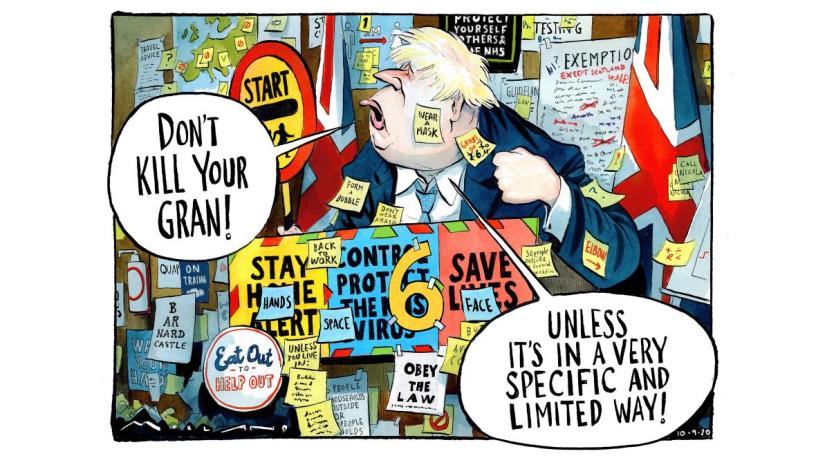
In the words of the Daily Mail, one of the prime minister’s biggest backers, “the government’s approach seems bewilderingly confused. Stay at home. Go back to work. Stay alert. Don’t mix with more than six people. Eat out to help out.”

Johnson won’t last. He may go of his own accord, though Gove and Cummings will fight to keep him. That’s understandable. He’s their tool and their only route to power, so he serves their purposes.

The Conservative Party may in due course act to remove him, as it has done before with leaders far better than Johnson. One way or another he will go. Times are far too serious now for Johnson’s trademark brand of cheery rascality and empty ebullience.

Fear, anxiety, and actual suffering are much more widespread, while economic disaster and national disintegration loom. The nation will want a sober leader at this grave and terrible time. 

The views expressed in this article belong to the author and do not necessarily reflect the editorial policy of Middle East Eye.


Sasha Swire about to publish: “Diary of an MP’s Wife”

Wow – what revelations to come if this is an abysmal peek from Private Eye:

SASHA SWIRE, wife of former Tory MP Sir Hugo Swire, is about to publish her 500-page “secret diary” covering the past 20 years, billed by publisher Little, Brown as “searingly honest, wildly indiscreet and often uproarious”.

Anyone writing about Diary of an MP’s Wife for the Mail titles may need to tiptoe round some of the indiscretions, such as Swire’s account of Lady Rothermere showing her round Feme House, the Rothermeres’ Palladian-style £40m mansion in Wiltshire. “I say ‘their’ house but of course Jonathan is some sort of non-dom so it’s actually Claudia’s,” Swire writes, “which she takes great pleasure in telling us.”

Lady Rothermere’s chief obsession, when not monitoring her husband’s assets, is the Chalke Valley history festival, which she helps to run. Swire describes milady’s arrival at the festival in 2018 “looking like a character straight out of a Jilly Cooper novel in tight white riding breeches. She is her usual regal self.”

She invites Swire’s companions, including cabinet minister Michael Gove, to drinks at Feme House. They dutifully trudge off to pay court — only to be snubbed. The Rothermeres “came down from their bedroom halfway through, said their hellos and then disappeared again”.

[Sasha Swire is the Daughter of Sir John Knott (former Secretary of Defence) and his Slovenian wife Miloska]

The Tories’ planning overhaul is about to come back to bite them 

Have you made any comment yet either to your MP or to the formal consultations? There are two consultations on planning reform with closing dates 1st October and 29th October. What the consultations are about and how to respond can be found here. – Owl

Chaminda Jayanetti www.theguardian.com 

After a decade of Conservative governments actively worsening Britain’s multiple housing crises, this one finally has a plan to get England’s housebuilders building.

There’s one problem – many Tories hate it. And if they don’t now, they will soon.

The government’s proposed new planning system, unveiled last month, is designed to get more than 300,000 homes built every year. Not only will Westminster be issuing mandatory housebuilding targets to councils, but because the plans focus on new housing in areas of peak demand, the impact will be greatest in London and the south-east, according to the planning consultancy Lichfields.

Many of those areas have Tory councils and Tory MPs. A report in the Times last week reflected growing backbench disquiet among Conservatives who might find local objections to large-scale housebuilding overridden by the new government targets.

“Councillors are kicking off. MPs are going to do the same. It’s in London, it’s in the shires,” the Times quoted one Tory MP. “I think a hell of a lot of people haven’t read a lot about it but it’s going to morph into something bigger when they do.”

The government has at least made up its mind – it will back housing developers over local opposition, even when that opposition consists of Conservative members and voters. But fears of untrammelled housebuilding everywhere outside the green belt are bound to provoke staunch resistance. A major parliamentary battle looms.

The reason housing policy is so fraught is because it is a crucible of competing rights and interests that exist at different levels of democracy. National government, local government, neighbourhoods and individuals all have strong and often conflicting views on how much housing should be built, on what terms and where.

The result is a mess. National government is primarily concerned with swing voters in marginals – and, critics argue, large property developers. Local communities often want to preserve their own neighbourhoods or avoid pressure on local amenities, and this aversion to housebuilding inevitably influences what councils do – or how fast they can do it. Individuals want somewhere affordable and decent to live, but are rarely able to pressure politicians to deliver.

Housing is where pure localism fails. Different localities may simply slam the door on newcomers, depending on the attitude of local politicians and voters. Solving the housing crisis becomes someone else’s job.

The government wants to override this by using planning reforms to sledgehammer councils into building more homes. It is this that is sparking concerns on Conservative benches.

The problem is that the plans do little to promote genuinely affordable housing. The current system is dysfunctional, but the new proposals risk making things worse by giving councils the choice of whether to spend financial contributions from housing developers on affordable housing, local infrastructure or potentially even council tax cuts. Tax cuts benefit more existing residents than affordable housebuilding does – and only an optimist would rule out the former trumping the latter in local decision-making.

In this way, the plans centralise decisions over how much housing is built, but localise decisions over whether any of it will be affordable. The main beneficiaries – as with help to buy and right to buy – will be those on the edge of homeownership, mainly on middle incomes and potentially swing voters.

The losers would be those with the least wealth, stuck in unaffordable or squalid housing. Often from low-turnout demographics and sometimes located in safe Labour seats, their votes are less critical to governments of either party.

All this reveals a gaping hole in the broader devolution debate – the assumption that the preferences of local majorities are the same as those of poorer individuals.

Some argue that locally made decisions are good simply because they are local. This is fundamentalist nonsense. For those who seek greater social justice, equality and poverty reduction, the task is to identify a framework of powers to rest at national, local and individual level that can best achieve those aims.

Sometimes that will require strong central government, other times devolution and local veto powers, and in many cases it will need individual socioeconomic rights – of which there is generally little mention in political debate. Different policy areas require different responses.

England needs more houses, more social infrastructure and more genuinely affordable places to live – especially council housing. The government has identified the interests of prospective homebuyers – and property developers – as aligned with its own, and intends to bulldoze past local opponents to get England building.

But those trapped in the sink of the housing market may find that neither national politicians nor local voters have their interests at heart.

  • Chaminda Jayanetti is a journalist who covers politics and public services


‘Waste and corruption on a cosmic scale’

Coronavirus: ‘Waste and corruption on a cosmic scale’: Plans for 10 million COVID-19 tests attacked

Owl can’t resist posting this even though it repeats some of the BMJ article. What will the National Audit Office make of it all? It’s a desperate way to spend the public purse.

Emily Mee news.sky.com

Leaked documents reportedly show the government plans to carry out up to 10 million coronavirus tests a day by early next year, but critics say the proposals represent “waste/corruption on a cosmic scale”.

The mass testing programme would cost £100bn – almost as much as the government spends on the NHS each year (£130bn) – according to a briefing memo seen by medical journal The BMJ.

A separate document revealed there were plans to grow the UK’s testing capacity from the current 350,000 a day to up to 10 million a day by early 2021.

On Wednesday, Prime Minister Boris Johnson announced ambitious plans for millions of people to be tested for coronavirus every day, in what he characterised as the “Moonshot approach”.

These documents provide more detail on what the government hopes to achieve, including plans for private companies GSK, AstraZeneca, Serco and G4S to help carry out the proposals.

But some scientists have already expressed doubts, while a memo published by the government’s scientific advisory group (SAGE) last week warned mass testing could lead to an increased number of false positive results.

Anthony Costello, a former World Health Organisation director and UCL professor, wrote on Twitter: “The PMs Moonshot nonsense (no science, feasibility, evidence) has been earmarked for £100bn, almost the entire NHS budget, w contracts for Astra, Serco and G4S.

“This is waste/corruption on a cosmic scale.”

Others pointed out current problems with the existing test and trace programme, after people complained of having to travel hundreds of miles from home to take a test.

“This plan transmits unbounded optimism, disregarding the enormous problems with the existing testing and tracing programmes,” Martin McKee, professor of European public health at the London School of Hygiene and Tropical Medicine, told The BMJ.

“It focuses on only one part of the problem, testing, and says nothing about what will happen to those found positive, a particular concern given the low proportion of those who do adhere to advice to isolate – in part because of the lack of support they are offered.”

He added: “On the basis of what is presented here, this looks less like Apollo 11, which took Neil Armstrong to the moon successfully, and more like Apollo 13.”

Professor Jose Vazquez-Boland, chairman of infectious diseases, University of Edinburgh, was more optimistic about the plans.

“The focus of testing currently remains on confirmation of suspected cases (people with symptoms), thus missing the point that most community transmission comes from those who are asymptomatic,” he said.

“Only a mass screening programme, such as this alternative plan announced by the prime minister, which involves the regular testing of all the population for asymptomatic transmitters, can keep COVID-19 under control and eventually lead to its eradication.”

In a document published on Friday, SAGE said the cheaper and faster tests needed for mass testing were less likely to be able to correctly identify positive and negatives than the tests currently used by NHS Test and Trace.

It said that in a population with low infections, twice-weekly tests with 99% specificity would lead to 41% of the population receiving a false positive over six months.

“In such circumstances, rapid follow-up confirmatory testing will be needed to determine whether individuals should continue to self-isolate – it is important to rapidly isolate infectious individuals, but efforts will be needed to quickly release false positives,” it said.

But the committee did say using testing as a point-of-entry requirements for particular settings, such as sporting events, could help these activities resume with a reduced risk of transmission, but would “require superb organisation and logistics with rapid, highly-sensitive tests”.

Under the plans, the Whitehall briefing memo says testing will be rolled out in workplaces, football stadiums, entertainment venues and also at GP surgeries, pharmacies, schools and other local sites.

People will be given digital immunity passports that would allow those who test negative to take part in more normal activities.

Those in high-risk occupations or who are more vulnerable – such as hospital staff, ethnic minority groups and teachers – would be prioritised for regular testing.

The government is banking on technology that “currently does not exist”, the briefing memo says, including a rapid 20-minute saliva test being piloted in Salford, Greater Manchester.

Dr David Strain, clinical senior lecturer at the University of Exeter and chairman of the BMA’s medical academic staff committee, said this means the mass testing strategy is “fundamentally flawed”.

“The prime minister’s suggestion that this will be as simple as ‘getting a pregnancy test’ that will give results within 15 minutes is unlikely, if not impossible, in the timescale he was suggesting to get the country back on track,” he said.

Will Boris Johnson’s “Moonshot” become lost in space? – The BMJ

Martin McKee is professor of European Public Health at the London School of Hygiene & Tropical Medicine and a member of the Independent SAGE convened by Sir David King. He writes in a personal capacity.

blogs.bmj.com 

Improved testing and new technologies must be part of a well thought out strategy, says Martin McKee
Boris Johnson does not do detail. Somehow he failed to read, or perhaps understand, the text of the EU Withdrawal Agreement that he presented as a “fantastic moment” for the country when he signed it in January 2020. As a consequence, he now finds himself in what is an unprecedented position for a British prime minister of declaring his intention not just to breach international law, but to reject provisions of a treaty he signed only a few months earlier. Sources in Whitehall have noted his preference for papers that are brief and avoid complexity, a preference apparently enforced by his special adviser Dominic Cummings. Nor does he seem to have a sense of curiosity, demonstrated by his repeated failure to attend COBRA meetings at the start of the pandemic. It was therefore unsurprising that his announcement of what has been termed a “Moonshot” project to vastly increase testing for coronavirus lacked any detail other than that it “will require a giant, collaborative effort from government, business, public health professionals, scientists, logistics experts and many, many more.”

Fortunately, some details have become available, in the form of a leaked description of the project and a Powerpoint presentation. They are not reassuring.

The concept is based on testing on a massive scale, up to 10 million tests each day. This will be achieved by widespread use of new, and not yet evaluated tests. These would be, as Johnson predicted in March, “as simple as a pregnancy test”.  Unfortunately, it soon became clear that the tests that the government purchased, for an estimated £17 million, did not actually work. Undeterred, his government now seems, if the documents are to be believed, to be willing to spend up to £100 billion in the hope that any technical problems can be overcome. This would be the equivalent of 70% of the annual NHS budget, prompting several of us who have read it to wonder if it could be a typo, although it is impossible to check as the government does not comment on leaked documents and has failed to provide any meaningful information to Parliament.

To the extent that there are any details, we must look to the Powerpoint presentation, prepared by the Boston Consulting Group. This exemplifies the problems inherent in many management consultancy presentations. First, it draws on an analogy that seems designed to appeal to the more gullible customers, in this case invoking a mission to the moon. Yet a few moment’s reflection reveals the problems with this analogy. When Nasa was programming the guidance in its Saturn V rockets, it knew exactly where the moon would be on 16th July 1969, when Apollo 11 would land. In the centuries since Galileo, astronomers had charted its path with ever greater accuracy. In marked contrast, as has become all too apparent, our ability to predict where the pandemic will be even a few days in advance is far from perfect.

Second, it seems to convey a great deal of information until you look closely. For example, a diagram of a system for scaling up testing in Greater Manchester contains a series of circles labelled, for example, data or validation. Yet these are floating in space, rather like cosmic bodies, with no indication of data flows or lines of accountability. Worse, there is at best lip service paid to existing structures, such as local government and its public health departments. Yet, in other places there is great detail. For example, it sets out a daily schedule for oversight of the project. Every day there will be a “Public Health, Clinical, Scientific Oversight forum” from 11.30-12.00, followed immediately by a daily leadership update. The possibility that a crisis might intervene, disrupting the timetable, does not seem to have been considered. Yet, at the same time there is no information about what these meetings will actually do.

There are many other problems, commented on elsewhere, such as how to deal with false negatives and false positives that will likely be much greater using the new tests. In comments to The BMJ, Jon Deeks, leader of the Cochrane Collaboration’s covid-19 test evaluation activities, said “These are plans from the world of management consultants and show complete ignorance of many essential basic principles of testing, public health, and screening.”

Above all, these proposals show no self-awareness of the problems that have beset England’s highly problematic covid-19 response so far. They portray a government whose ambition far exceeds its ability to deliver, and which sees governing as the practice of launching grandiose initiatives detached from any clear strategy. Many aspects seem totally detached from reality. The timetable presented in the documents envisage that it would be rolled out in early 2021. Given that this is being promised in a country where successive governments have spectacularly failed in almost every major information technology project they have undertaken in recent years, with the proposed system for post-Brexit trading nowhere near ready, this timetable seems, to say the least, rather optimistic. Even if it was delivered on time, by then hopefully we will be beginning to see a vaccine coming on stream.

Once again we see a preoccupation with numbers of tests. It lists target groups, with no indication of how they will be identified and by whom and what might happen once they have been identified. Those involved in the current response know that only a small proportion of people asked to self-isolate actually do so, although once again, Johnson seems unaware, as indicated by his answer to Keir Starmer at Prime Minister’s Questions on 9th September. There is no evidence of any understanding of the importance of a joined up Find, Test, Trace, Isolate and Support system.

One of the most concerning aspects of the Moonshot project is that it continues England’s obsession with standalone initiatives, developed without any apparent involvement of those on the ground or acknowledgement of existing structures. It transmits unbounded optimism, disregarding the enormous problems with the existing testing and tracing programmes.

Another is that this will distract from fixing the problems with the existing system, especially as public health staff are struggling with the abolition of Public Health England. Colleagues report that the consultants involved in developing the proposals have already taken up much of their valuable time.

There is a need to improve testing and new technologies could play an important role. However this must be part of a well thought out strategy, drawing, for example, on thinking in Germany with its focus on in-depth investigation of emerging clusters.

On the basis of what is presented here, this looks less like Apollo 11, which took Neill Armstrong to the moon successfully, and more like Apollo 13.

Hospital boss praised by Matt Hancock told to end ‘toxic management culture’

“A hospital boss championed by Matt Hancock has been told to end “a toxic management culture” after doctors were asked to provide fingerprint samples to identify a whistleblower.”

Denis Campbell www.theguardian.com 

Royal College of Anaesthetists criticise West Suffolk hospital chief executive after staff complaints

A hospital boss championed by Matt Hancock has been told to end “a toxic management culture” after doctors were asked to provide fingerprint samples to identify a whistleblower.

The Royal College of Anaesthetists (RCoA) has urged the chief executive of West Suffolk hospital, Steve Dunn, who Hancock described as an “outstanding leader”, to take urgent action to improve the wellbeing of senior clinicians and “thereby the safety of patients”.

In a strongly worded letter sent to Dunn in July, seen by the Guardian, the RCoA president, Prof Ravi Mahajan, reminded him that “undermining and bullying behaviour is unacceptable”.

Following a three-day review of the hospital, Prof Mahajan’s letter said senior anaesthetists had complained about a “toxic management culture that risks impairing their ability to care safely for patients”.

It comes after the Guardian revealed an unprecedented “witch-hunt” for a whistleblower who had tipped off a family about a potentially botched operation. The family of Susan Warby, who died five weeks after an operation in August 2018, was sent an anonymous letter highlighting errors in her procedure. This week a coroner concluded that errors in her care contributed to her death.

After the anonymous tip-off, staff complained of harassment by hospital managers, who demanded they provide fingerprints to identify which of them had alerted the family.

The incident, and other failings in patient safety, contributed to the hospital becoming the first ever to be relegated by Care Quality Commission (CQC) inspectors from “outstanding” to “requires improvement” in January.

Prof Mahajan’s letter to Dunn said the RCoA’s concerns about the trust were “reinforced not only by press coverage and a recent CQC report, but – more significantly – by confidential information given to the college by clinicians in your hospital”.

Weeks before Warby’s operation, Patricia Mills, a consultant anaesthetist at the trust, had raised alarm internally about patient safety over a doctor who had been seen injecting himself with drugs.

As the same doctor was involved in Warby’s care, Mills was immediately suspected by managers of alerting her family to the errors. Mills has consistently denied this. But managers demanded that senior staff, including Mills, provide fingerprint and handwriting samples in an attempt to identify the writer of the letter. The trust was criticised for its tactics by regulators and promised in January that it had “no intention of pursuing fingerprint requests further”.

But Mills still faces disciplinary action by the trust for refusing to provide her fingerprints.

Prof Mahajan’s letter did not mention Mills by name, but alluded to her treatment her after she raised concerns about the drug-taking doctor. It said: “I write to seek your personal assurance that action has been taken to ensure the wellbeing of anaesthetists, and thereby the safety of their patients, is being held as a key focus point by trust management … The college asks that senior management reflects upon previous behaviour and demonstrates a commitment to improving the management approach and morale of staff.”

The RCoA removed West Suffolk hospital, which treats many of Hancock’s constituents, from its voluntary list of accredited hospitals. It also shared its inspection report with the CQC.

Dunn and Hancock both described each other as “brilliant” in a Twitter exchange in December 2018 after Dunn was awarded a CBE for services to “services to health and patient safety”.

Matt Hancock (@MattHancock)

Huge congratulations to Steve Dunn for his rightful recognition by the Queen as CBE. A brilliant leader: and how typical he calls it a team effort. It is, of course, a team effort, but Outstanding teams need Outstanding leaders. Well done SteveDunnCEO #SteveDunnCBE https://t.co/UhX76TzwnG

December 29, 2018

In January the government ordered a rapid review of West Suffolk, which Matt Hancock recused himself from because of his ties to Dunn. It had been due to conclude in April, but has been delayed until December because of the coronavirus crisis.

In March the British Medical Association urged the trust to drop its disciplinary action against Mills. In a letter to the trust, it said: “West Suffolk Hospital does not need to wait for the recommendations of a rapid review in order to bring Patricia’s process to a close.”

It added: “There is strong evidence to support a clear link between Patricia raising patient safety concerns … within the trust’s whistleblowing policy and being subsequently investigated … these actions are at odds with the principles of a ‘just culture’ that is a guiding philosophy for NHS employers.”

A spokesman for the trust said: “Ensuring our colleagues work in a supportive, safe environment is good for our staff and means better patient care, which is why we have done extensive work this year to act on feedback about our working culture, including taking action to address the concerns raised by the Royal College of Anaesthetists.”

It said it could not discuss issues about individual members of staff.

Devon covid cases up 25 per cent in a week

Of the 53 new cases, 15 are in East Devon, 10 in Exeter, four in Mid Devon, seven in North Devon, four in the South Hams, six in Teignbridge, five in Torridge, and two in West Devon, with a further 11 in Torbay, and 26 in Plymouth.

www.radioexe.co.uk 

 Devon covid cases back to levels seen in May
It’s from a low base, but still worrying

Devon’s director of public health is urging residents to do their bit to reduce coronavirus spreading after a rise in cases.

While the number remains relatively low, recent days have seen an increased infections, with 53 cases in the last seven days, compared to 42 the previous week. Dr Virginia Pearson says not all of the new cases are linked to returning international travellers, which has been the pattern previously.

Dr Pearson, who also chair the multi-agency covid-19 Hhealth protection board, said: “Just like the rest of the country, we have seen a significant rise in the number of confirmed cases in September. Not all new cases are now linked to returning international travellers, which was the pattern we had seen recently.

“We must remember that coronavirus is still a very real threat to us all, especially to our older and vulnerable residents. It’s very easy, with the relaxation of restrictions we’ve had over recent months – the call for people to return to work and to support our high streets; our children returning to schools, colleges and soon to universities – to believe that life is back to normal.

“It is not back to normal.  The virus is still here and it is very easy to get infected, especially indoors.  I am therefore urging all Devon residents, of all ages, but specifically to our younger residents who perhaps do not feel the risk felt by older and more vulnerable residents, to follow the public health advice at all times.

“We are continuing to monitor the data very closely so that we can react immediately to situations as they arise.  But we also need you, the Devon public, to carry on doing your bit to reduce the risk of coronavirus spreading in our county this autumn.”

Maria Moloney-Lucey, public health specialist, said confirmed cases remain very low compared to the national average. There are current 6.6 cases being confirmed per 100,000 population in Devon, compared to the national average of 20.2, mainly in people of working age.

While the number of cases has risen, cases would need to triple to reach the level where they would be put on the government’s watchlist, and then double again before any intervention measures would likely to put in place, with cases needing to be around ten times higher than they currently are before any ‘local lockdown’ rules may be imposed.

There are currently five notable areas in Devon (Cranbrook, Broadclyst & Stoke Canon and  Clyst, Exton, Lympstone in East Devon, Bishop’s Nympton, Witheridge & Chulmleigh in North Devon, and Churston and Galmpton in Torbay)  which have recorded three or more cases in the last week – and Mrs Moloney-Lucey said that at least one of the clusters was linked to community cases and not international travel.

She added: “We are seeing a flurry of cases, and seeing some single cases where it isn’t possible isn’t able to link to where it originated from.”

Dr Phil Norrey, the council’s chief executive, added: “With 53 cases in the last week, you would expect to see more clusters, which tells us that it is out there and it is not just about stamping down on settings. We need to be clear to general population that it could crop up and pop out anywhere, and it has been doing so.”

He said that while the number of cases was being confirmed at a higher rate in the more populated areas, Devon doesn’t have the multigenerational and high density households that there are in other parts of the country.

Of the 53 new cases, 15 are in East Devon, 10 in Exeter, four in Mid Devon, seven in North Devon, four in the South Hams, six in Teignbridge, five in Torridge, and two in West Devon, with a further 11 in Torbay, and 26 in Plymouth.

Comment from Owl

Owl’s view is that the advice and analyses reported above does put what is going on in Devon, especially in the more populated areas, into perspective. For comparison Owl posts below a table of the historical evolution of symptom reporting from the Covid-19 symptom tracking app. This has always indicated a higher prevalence than confirmed cases which have been, and still are, influenced by the availability of easily accessible testing. This study also shows fluctuations.


8 July 15 July 25 July 30 July 21 August 10 Sept
North Devon

79

324

1076

561

327 572
East Devon

483

181

865

300

285

431

Torbay

386

715

228

Zero

331

445

South Hams 529 306 713 706 254

403


Estimated active case/million people under revised calculation methods (prevalence)  Aged 20-69

The Covid symptom study is now converting prevalence and showing estimated active cases (people with symptoms and likely to be infective) for each district as follows:

North Devon 35; East Devon 45; Torbay 34; South Hams 27

Boris Johnson lets rip another demented monologue in Commons 

What’s a Prime Minister to do when the Leader of the opposition keeps asking the “wrong sort of questions”? – Owl

John Crace www.theguardian.com

You could sense the impatience in Boris Johnson’s voice. He had come to prime minister’s questions prepared to take Keir Starmer on over the government’s new willingness to break international treaties. But the Labour leader was one step ahead. There was no need for Labour to get involved at this stage, when the EU and large sections of the Tory party were already up in arms at the prospect of the UK acting like a rogue, failed state. Let others do the dirty work for him.

Instead Starmer chose to direct all six of his questions to what was on many people’s minds: the ongoing mystery of why the government’s world-beating track-and-trace system was sending people on a 700-mile round trip on the off chance they will be able to get a coronavirus test whose results will probably be lost. Who was responsible for this mess?

“Of course I take responsibility,” Johnson said, before quickly seeking to allocate blame elsewhere. The real problem was that the scheme was just too successful: thousands of people who had been encouraged to get tested had done just that and now there wasn’t the capacity in the system even though there were 75,000 unused tests each day. It was time to go back to the old days when fewer people were tested and all those contact tracers could get back to making just one or two calls a week.

To be fair to the prime minister, he was a little less rubbish at PMQs than the week before. But not by much. It’s almost as if Boris is wilfully coming to the Commons unprepared as a point of principle. With no answers to any of Starmer’s questions, all Johnson could do was demand to know why he was being criticised.

Not for the first time, Keir tried to talk Boris through the basic format. He got to ask the questions and the prime minister was obliged to answer them. Or not. “The government can’t even manage a basic level of incompetence,” Starmer said. Johnson assumed the Labour leader had made a slip of the tongue and had meant to say “a basic level of competence”. But Starmer had it right first time. Just a basic level of incompetence would be a vast improvement on what the government was currently delivering.

 Keir Starmer says government lacks competence over Covid testing shortage – video

But still it niggled Boris that Starmer had not mentioned his plans to rewrite the withdrawal agreement and the Northern Ireland protocol. So he just let rip in a demented monologue. The fact was that when he had said the deal was oven ready, what he had meant was that it was ready for total incineration.

The deal that he had negotiated, forced through the Commons with less than three days debate and on which he had fought and won a landslide election victory had actually been a very bad deal. A complete turkey. Rather than protecting the Good Friday agreement, it had undermined it. So it had always been understood by him – if by no one else – that it would have to be renegotiated before 1 January. It was one of the more bizarre outbursts in a session that is becoming more surreal by the week. It can’t be long before the prime minister is required to take a 700 mile weekly drugs test. For performance diminishing drugs. MPs from both sides of the house could only look on in bewilderment.

There wasn’t a great deal more sense on offer at the Downing Street press conference later in the afternoon, when the prime minister announced the new lockdown measures that Matt Hancock had failed to mention in his statement the day before and had released to the media in the evening instead. In theory, the message should have been straightforward. Social gatherings were to be reduced to groups of six, unless you happened to be on a bus or in the pub in which case different rules applied.

But Boris being Boris just couldn’t help screwing things up. He announced the creation of a new vigilante squad of Covid marshals – presumably recruited from the track and tracers who had spent the last few months sitting next to a silent phone – who would be ready at a moment’s notice to burst in to people’s homes and arrest any stray grannies or grandads that had broken “The Rule of Six”. And yes it was going to be tricky for him too, as it would mean he couldn’t see all of his kids at the same time either. Even assuming they wanted to see him too.

So what you’re basically saying is that Christmas is cancelled, several journalists observed. Boris looked panicked. Only in July he’d said everything would be back to normal by Christmas and he hates to be the bearer of bad news. So he just started making things up. Forget the failed app and all the other broken promises, he said. Forget that he had once dismissed mass testing as a waste of time.

Now he was going for broke with Operation Moonshot. By Christmas everyone would be able to give themselves a daily test and then people could do what they wanted. Think of it like a pregnancy test, Boris said. Though hopefully with fewer positives than he usually got. Hell, theatres could even do tests on the whole audience and just allow in those who were negative. It was a completely bonkers piece of pantomime.

It took Chris Whitty and Patrick Vallance to add a touch of realism. We were a long way off either a vaccine or mass testing. The coming autumn and winter months were going to be hard. Future lockdowns might be needed. Yet again, on a day when the country had been crying out for leadership and direction, Boris had gone missing in action.


Farmers push for UK parliament to have final say on trade deals

“Minette Batters, president of the National Farmers’ Union (NFU), said politicians would be “immoral and hypocrites” if they did not back parliamentary moves to guarantee a greater level of scrutiny.”

Is Neil Parish being listen to? – Owl

Judith Evans and Peter Foster in London yesterday www.ft.com 

UK farmers are calling for parliament to be given a final say on post-Brexit trade deals as concerns mount that the agriculture sector will face competition from food produced to lower standards overseas.

Minette Batters, president of the National Farmers’ Union (NFU), said politicians would be “immoral and hypocrites” if they did not back parliamentary moves to guarantee a greater level of scrutiny.

She warned the process was “coming to the critical time” to ensure parliamentary oversight and prevent the British food market being flooded with cheaper overseas products made using drugs, pesticides and other chemicals that are banned in the UK.

Boris Johnson’s government is hoping to secure trade deals with the US and other countries to illustrate the economic benefits of the UK leaving the EU.

But British farmers are worried that Washington has listed “comprehensive market access for US agricultural goods in the UK” among its trade negotiating objectives, while the NFU has similar concerns over any deal with Australia. 

Ms Batters called for the House of Lords to amend the forthcoming trade bill — which is being debated by peers this week — to give parliament the ability to ratify or veto new trade deals.

She also said the NFU was urging the Lords to vote for an amendment put forward by Donald Curry, a crossbench peer, to the agriculture bill, likely to be debated next week. This would provide parliament with expert advice from the recently formed Trade and Agriculture Commission on the effects each deal would have on UK food and farming.

“If they rip out the amendment on the commission, it shows them to be immoral and hypocrites,” Ms Batters said in an interview with the Financial Times.

Ministers including the trade secretary Liz Truss have repeatedly said they will not compromise on food standards in securing future trade deals for the UK.

But Ms Batters said: “They talk the talk — are they going to back it or aren’t they?”

In July, the government abandoned hopes of reaching a trade deal with the US ahead of the November presidential election, which was seen as a victory for farmers worried that the UK would make concessions on food standards to secure a quick agreement.

As things stand, parliament will have only a limited scrutiny role after the failure of past amendments aiming to increase its involvement in trade deals. Other amendments designed to force food importers to meet UK production, environmental and animal welfare standards also failed.

Ms Batters warned that if the latest moves were also rejected it would be “game over”, with the opportunity lost to uphold food standards and ensure “democratic and transparent” scrutiny of deals.