UK looks to Belgium for Covid inspiration despite infections rise

Following on from the “Moonshot”; does Hercule Poirot have the solution to Matt Hancock’s case of rising infections? Possibly, not.

Daniel Boffey www.theguardian.com

Belgium has been cited by the UK health secretary, Matt Hancock, as a model for getting coronavirus under control – just as its public health body recorded a 15% rise in the number of daily infections compared with the previous week.

Despite a dip in the number of new infections in August, after a tightening of rules by the Belgian prime minister, Sophie Wilmès, the most recent data suggests the country’s success may be short-lived as people return to work and school.

An average of 509.7 people a day have tested newly positive during the past seven days, according to the latest figures by from Belgium’s scientific institute for public health.

Thursday marked the fifth successive day that the number of people newly infected has risen.

Hospital admissions are also up. Between 3 to 9 September, an average of 20.6 new admissions per day was recorded, an increase from 16.7 the week before.

Hancock had praised Belgium as he sought to justify strict new laws on social gatherings in England, including the so-called rule of six people, limiting the size of social groups.

The health secretary said the UK was learning from the experience of other European countries that had recorded an increase in coronavirus infections in recent months.

“Some of those countries have then got that second wave under control,” Hancock said. “If you look at what’s happened in Belgium, they saw an increase and then they’ve brought it down, whereas in France and Spain that just hasn’t happened.”

Belgium had a sustained decrease in the number of people recorded as being newly infected in August, after the government responded to a worrying spike the previous month.

A gradual lifting of social restrictions was halted by the government with the order that each household would only be allowed to meet and have close contact with five other adults from outside their household rather than 15, as had been previously permitted. The so-called social bubbles were to remain the same for a month.

Indoor events were also limited to 100 people or 200 outdoors, down from 200 and 400 respectively. The wearing of face masks in public was made obligatory.

But despite those measures, infections have since risen. Analysis by the Flemish Agency for Care and Health of contacts and sources of contamination, published on Thursday, has suggested a direct link with the start of the school year and the resumption of work after the summer holidays.


Evidence suggests Covid-19 circulating in UK before Christmas

My dad died of Covid last Xmas – he’d still be here if China hadn’t lied

Chris Pollard www.thesun.co.uk

THE daughter of a UK Covid victim who fell ill last December says he and many more could still be alive if Beijing had not covered up the outbreak.

Jane Buckland blasted: “If China hadn’t lied to the rest of the world and kept this hidden for so long, it could have saved countless lives.”

Her dad Peter Attwood, 84, became ill with a mystery cough and fever shortly after Christmas — more than two months before officials discovered the virus was spreading in Britain.

Peter died in hospital in January, with heart failure and pneumonia initially blamed.

But tests have now shown Covid was a cause of death — making him the UK’s first recorded virus victim and the first outside China.

CHINA’S ‘SECRECY’

Jane, who fears he caught it off her, fell ill with Covid symptoms on December 15 — meaning the deadly bug could have been spreading here at least two weeks before China said it even existed.

Peter, from Chatham, Kent, had never travelled abroad.

Jane said: “Covid has obviously been around for much longer than we know. People have been talking about a cover-up but we don’t know the scale of it.

“My father could still be here if we’d known about the threat of this horrible virus earlier.”

MPs last night said Peter’s case showed China had conducted a sinister cover-up of its outbreak while letting the bug secretly spread around the world.

Jane, 46, said her dad’s coughing got so bad that he was admitted to hospital on January 7.

She said: “The doctors did every test under the sun but couldn’t figure out what was wrong with him.

“His blood tests showed a high level of infection but they had no idea what it was.

“He died on January 30 and the provisional death certificate said it was heart failure and pneumonia.

“The virus was obviously running rampant in this country back in December or maybe even earlier.

“China was covering it up from the beginning.

“I had all the Covid symptoms — dry cough, fever, aches and pains, diarrhoea — before Christmas, but no one knew what it was.

“I went to Christmas parties and was hugging and kissing everyone, even people I didn’t know. That’s what people do at Christmas.

“If we’d known we were possibly spreading a deadly virus, things could have been very different.

“It’s no wonder so many people in this country ended up dying from it. How many lives could have been saved if we’d known what was really going on?

“My dad was elderly and had an underlying heart condition, so he would have been shielding.”

‘MISLEADING THE WORLD’

Former Tory leader Iain Duncan Smith said The Sun’s revelations offered damning proof China misled the world about the extent of its Covid outbreak last year.

He said: “This has absolutely proved positive that what was going on back in October in China, where doctors were speaking out and then were silenced, was that China knew all about human to human transfer about this virus and did nothing about it.

“Secondly, the World Health Organisation is also guilty because they failed to press China back in November and December when it became obvious that China had at least an epidemic on their hands.

“None of this was done until later — only at the end of January did China admit it had a problem. Then, it wasn’t until March 11 that the WHO declared a pandemic.”

The Sun says

HAD China come clean about Covid from the off, Peter Attwood might be alive today.

So might many of our 41,586 victims and hundreds of thousands worldwide.

Some scientists believe the disease erupted in Wuhan as early as last October.

China’s instinct was to lie, to cover it up, to play it down, to silence whistle-blowers.

An early global warning might have seen Peter, an 84-year-old heart patient, self-isolate for his protection.

It might even have persuaded Public Health England to grasp Covid’s seriousness, which it shamefully failed to do.

PHE was still minimising the dangers and bragging about its preparations at the end of February. By then Peter had been dead nearly a month.

No one yet knows Covid’s exact origins. And we do not blame China’s people.

But through its secrecy and deceit their Communist regime has worsened the damage this plague has inflicted on the world. One day it must make amends.

Boss of the Commons Foreign Affairs Committee, Tory MP Tom Tugendhat said: “China’s secrecy over the emergence of Covid has put at risk millions.”

Doctors saved some of Peter’s lung tissue because they suspected he may have had asbestosis, a lung condition caused by working around asbestos.

Deaths from it have to be referred to a coroner.

But Peter, a retired car dealership company secretary never worked with asbestos.

Last Thursday, Jane got an email from Kent coroner Bina Patel saying post-mortem tests had detected coronavirus in his lung tissue.

Miss Patel recorded his cause of death as “Covid-19 infection and bronchopneumonia”.

Previously, the earliest-recorded case of coronavirus caught in the UK was February 21.

It was only on March 5 that England’s chief medical officer Professor Chris Whitty said community transmission was likely to be happening inside the UK.

University of East Anglia Professor of Medicine Paul Hunter said of Peter’s case: “This is a remarkable development because it shows there was some virus transmission in the UK before anyone realised.”

How dad’s Covid case unfolded

DECEMBER 15, 2019: Jane comes down with Covid symptoms, but dismisses it as a bad cold. She continues to attend Christmas parties and care for her elderly parents.

DECEMBER 21: A cluster of patients with an unknown pneumonia-like illness are identified in China.

DECEMBER 28: Jane’s dad Peter starts suffering from a dry cough. His symptoms continue to worsen.

DECEMBER 31: China alerts the World Health Organisation of the new virus, which has spread in the Wuhan area.

JANUARY 2, 2020: Jane’s asthmatic daughter Megan, 18, has difficulty breathing.

JANUARY 7: Peter has become very ill and is struggling to breathe, so is admitted to a Kent hospital.

JANUARY 11: A 61-year-old man in Wuhan becomes the world’s first known casualty of the virus, believed to have originated in a wet market.

JANUARY 15: Doctors are puzzled by Peter’s illness. Blood tests show a high level of infection, but they are unsure what has caused it.

JANUARY 30: Peter dies. The cause is recorded as heart failure and pneumonia but doctors take tissue samples for further testing.

JANUARY 31: Two Chinese tourists from Wuhan are diagnosed with Covid-19 in York.

FEBRUARY 6: Stephen Walsh, from Brighton, becomes the UK’s third confirmed case. He caught it in Singapore and gave it to others on ski trip.

FEBRUARY 15: The first reported coronavirus death in Europe after 80-year-old Chinese tourist dies in France

FEBRUARY 28: The first British victim dies on board the Diamond Princess cruise ship.

MARCH 5: The first death is confirmed in the UK as cases of Covid-19 surge.

MARCH 26: New laws give police powers to enforce lockdown. Non-essential shops and businesses are forced to close. Parliament shuts.

SEPTEMBER 3: Kent coroner Bina Patel tells Jane her father died from Covid-19.


What is No 10’s ‘moonshot’ Covid testing plan and is it feasible?

“Mission Team”, “Moonshot Headquarters” and “Mission Analysis”, the “future vision” is 10m tests a day in early 2021. But the technology doesn’t yet exist – ring any alarm bells? This PM loves to clutch at straws. Don’t hold your breath! – Owl

Sarah Boseley www.theguardian.com 

They call it the “moonshot” – and it is as ambitious as any space adventure.

This is the name given to the government project that aims to ramp up testing to such a scale that it will return the country to some kind of normality. But is it feasible? And what about the cost?

Two internal government documents seen by the Guardian give an indication of the task, and the huge difficulties ahead.

The underlying proposition is simple.

As the documents explain, mass testing of the population on a very frequent basis would allow us all to know who is clear of the virus and allow those people to mix freely again.

The economy and British society as a whole could re-open safely. It would break the chain of transmission. Testing and tracing on this scale would mean the virus would be driven down into such low levels it would be almost eradicated.

One of the documents, titled UK Mass Population Testing Plan, is a briefing memo sent to the first minister in Scotland, which explains it could cost £100bn.

That might be a price worth paying if it worked – however, most of the technology simply does not yet exist. Getting 10 million people tested every day – however quick and simple the process – is a very big logistical ask for a country that has struggled to deliver a few hundred thousand.

The second is a 26-page PowerPoint presentation from the Department of Health and Social Care entitled: Moonshot mobilisation: briefing pack, dated 21 August.

The document is full of diagrams and charts, with pages headlined “Mission Team”, “Moonshot Headquarters” and “Mission Analysis”.

The narrative in both make it clear the prime minister believes the moonshot is the only way out for the UK economy in the face of a probable winter surge. He wants it to be UK-wide.

The documents have been shared with the devolved governments. They have also been to Sage – the government’s scientific advisory committee – and to the Treasury, which is modelling the impact to the British the economy.

And various companies making tests have been sounded out – drawing up much of the plan and leading on various “missions” are employees of Deloitte, the private sector consulting company that has already masterminded the establishment of drive-in testing centres, run by Serco.

The slides show current testing as 200,000 to 800,000 per day, with a rise to 2m to 4m a day in December.

The “future vision” is 10m tests a day in early 2021.

Moonshot is Johnson’s big hope, it makes clear.

“This is described by the prime minister as our only hope for avoiding a second national lockdown before a vaccine, something the country cannot afford. He would also like this to support the opening up of the economy and allow the population to return to something closer to normality,” says the memo.

“This is a top priority for the prime minister who is embedding No 10 staff within the project and has committed to removing any barriers to implementation. He has asked for a Manhattan Project-type approach to delivering the level of innovation/pace required to make this possible. He has also indicated that he would like this to be a cross UK endeavour. The devolved administrations have now been asked at official level whether we wish to embed staff within the moonshot project teams.”

But to some experts, the mission may be seen as more wishful thinking than a feasible way out of the pandemic.

The prime minister has said publicly he wants to move towards mass testing that is as simple as a pregnancy test and delivers a result in 15 minutes.

That technology does not yet exist, but it is a fundamental part of the moonshot package.

The big hope is firstly in saliva tests, which are quick and more comfortable than swab tests for the virus. This part of the plan is under way already.

Saliva tests have been piloted in Southampton, among healthcare workers and their families. The pilot was said to be successful – but no data has been released. It is understood that there were too few infections in the city to prove the tests worked.

That pilot has been extended in Hampshire – the documents suggests it will launch in Manchester as well. Mass screening is taking place in Salford. The same saliva tests are going to be offered to anyone who wants them. It’s both a trial of the saliva test and of people’s enthusiasm for population screening. Testing will take place at train stations and other places yet to be decided, the document says.

The plans suggest that schools, universities and other institutions would follow, while the technology was also to be used to target outbreaks around the country.

The plans feature the initials TBC for much of the detail here – to be confirmed. Finally, private sector organisations would be empowered to deliver testing in workplaces.

Beyond saliva testing, which has not yet been proved to work although it is promising, moonshot depends on a new generation of rapid antigen tests becoming available.

The DHSC has already contracted to buy some of them off the drawing board. It signed a deal with Oxford Nanopore, a young biotech company spun off from Oxford University, for a rapid test that can be turned around in 90 minutes before it had even gained its CE mark.

On 3 August, Hancock announced it was buying “millions of ground-breaking rapid coronavirus tests” from Oxford Nanopore, which features in the moonshot documents, and DnaNudge. They would be “rolled out to hospitals, care homes and labs across the UK to increase testing capacity ahead of winter”, he said.

“We’re using the most innovative technologies available to tackle coronavirus. Millions of new rapid coronavirus tests will provide on the spot results in under 90 minutes, helping us to break chains of transmission quickly,” said Hancock.

The documents do acknowledge that most of those tests are as yet unavailable. They talk of “developing, validating, procuring, and operationalising testing technology that currently does not exist” and “creating significant new logistical and manufacturing infrastructure and capacity”.


No rise in workers in UK city centres despite back-to-office plea

The number of people going back to work in offices has flatlined in the past two months despite the government push to get more workers into cities to protect Britain’s biggest urban economies from collapse.

Richard Partington www.theguardian.com

According to analysis of mobile phone tracking data by the Centre for Cities thinktank, worker footfall across 63 of the UK’s largest town and city centres was just 17% of pre-lockdown levels at the end of June, remained at 17% at the start of August and was still at 17% in the last full week of the month.

Worker footfall was down most in Oxford, Leeds and London. Numbers had risen most in smaller cities and large towns such as Mansfield, Basildon and Newport but still remained less than half the normal levels.

In July Boris Johnson urged companies to return staff to offices from the start of August to help reboot the British economy from the deepest recession on record. But many of Britain’s biggest firms have defied the plea. Ministers have warned that home workers could be vulnerable to being sacked.

Despite lockdown measures being relaxed, as much as 39% of the UK workforce continues to work remotely, according to the Office for National Statistics. However, there are significant variations by sector depending on the ease of home-working. As many as three-quarters of IT and professional workers who would usually occupy city-centre offices remain working from home, compared with 14% of staff in health and social care and a fifth in construction and manufacturing.

This month one of the Bank of England’s most senior officials, Alex Brazier, poured cold water on the drive to get workers back to offices, saying it was impossible to use densely packed city offices while adhering to Covid-safe guidelines. Concerns over rising infections, transport capacity and childcare while schools have been closed have also slowed the return to work.

The number of workers in city centres may rise in the coming weeks now that schools have reopened and as some firms bring staff back. The government is pushing to return civil servants to offices by the end of the month, and train operators have restored services to 90% of the usual schedule to carry more commuters.

On Wednesday it was reported that the US investment bank Goldman Sachs would bring back its 38,000 global staff part-time on a rota system.

In contrast to the low levels of worker footfall, the Centre for Cities report shows that visitor numbers shot up in seaside towns and smaller communities in August, aided by warm weather and the government’s “eat out to help out” scheme.

In a boost for parts of Britain that have typically lagged behind the economic performance of bigger cities, seaside towns such as Blackpool, Bournemouth and Southend, as well as smaller places such as Birkenhead and Chatham, proved particularly popular with visitors.

The report says city-centre footfall was above pre-pandemic levels in 14 of the 63 cities and towns studied. Visitor numbers in Blackpool were at 141% of pre-crisis levels, while visits to London were at 31% of normal.

Andrew Carter, the Centre for Cities chief executive, said: “There is little indication that workers are heeding the government’s call to return to their offices, and city centre restaurants, pubs and shops face an uncertain future while they remain at home. Unless we see a big increase in people returning to the office, the chancellor must set out how he will support the people working in retail and hospitality who could soon find themselves out of a job.”

U3A survey – Opportunity to respond to House of Lords post Covid 19 Inquiry


EM 09-07-20 U3A Survey link to Select Committee post Covid 19 inquiry

mailchi.mp

To Chairs, Secretaries and Treasurers

The Third Age Trust and U3A movement has been given an opportunity to respond to a House of Lords Inquiry.

U3A Movement’s CEO Sam Mauger said, “Many of you have contacted us about Covid and how it has impacted upon you. The Trust can respond to the Inquiry with the points that you feel should be included.”

The button below contains a link to the questions that they are gathering information about.

Please could you respond to the questions by 15 September.

Please share the link with your members and colleagues so they can also take part in the survey.

We will collate the answers and send them in by the deadline of 18 September.

Thank you so much

Link to Survey Questions 

Chair of the Third Age Trust, Ian McCannah, has created a report based from U3A members’ thoughts on how the U3A movement can move forward post lockdown.

Read the report in the button below.

Beyond Lockdown Report

This is an easy way to share this mailing. Click on this link and copy the URL to share this mailing on other platforms, including Beacon.


‘Festival of Brexit’ organisers launch application process

“Critics have dubbed it a “festival of Brexit” and pilloried it as a waste of £120m of public money, but the first plans for the festival of Great Britain and Northern Ireland – announced by Theresa May in 2018 – will officially launch on Wednesday.”

? – Owl

The festival’s boss, Martin Green, insists it is not about Brexit but about bringing people together

Critics have dubbed it a “festival of Brexit” and pilloried it as a waste of £120m of public money, but the first plans for the festival of Great Britain and Northern Ireland – announced by Theresa May in 2018 – will officially launch on Wednesday.

Using the working title Festival UK * 2022 organisers have opened applications for teams who wish to be commissioned to come up with ideas for the event.

As the asterisk suggests, the event’s final title is yet to be decided, said the festival’s boss Martin Green, formerly in charge of the Olympic ceremonies and Hull’s year as UK City of Culture. “We don’t want to name and brand the festival until we know its content.”

Green is the chief creative officer for an event which has been widely ridiculed since it was announced by May’s government – who made comparisons to the Festival of Britain in 1951 and the Great Exhibition of 1851 – and given the go-ahead by Boris Johnson last year.

But it is not about Brexit, insisted Green. It is about bringing people together for a national celebration of creativity and innovation and surely that is a good thing, he said.

“A lot of people, and I know some of them very well, were quite alarmed about the project when it was first launched because of what people said it might be. Now people can see what the project actually is, I hope those fears will dissipate.”

The title of the festival is important, with one recent report suggesting that the Scottish National party wanted the word UK dropped from the branding.

“To be honest, we absolutely don’t know where that came from,” said Green. “We have been working with the UK government and the governments of the other three nations really successfully from the outset. They have all signed up to do the project … the same project in the same way.”

The festival will open applications on Wednesday for individuals and organisations to create teams which will then be commissioned to come up with ideas for the event. Thirty teams, each receiving £100,000, will be chosen.

“This is the phase which is usually hidden from view because most of the time people go out and directly commission,” said Green. One reason was to ensure “we are reaching out to new talent and new blood and widen the pool”.

The teams can be between three and eight and could include organisations and individuals, whether artists, scientists, mathematicians or engineers. Green gave the example of “an AI company from Wales working with a biochemist from Cornwall and a visual artist from the Scotland”.

Crucially they are not yet pitching ideas. “We see too much of that happening. I don’t like artists and creatives not to be paid for what they are doing.

“It is possibly the most important work you will ever do on a project, yet sometimes you do see ‘tell us your idea and if we like it we’ll fund it’”.

The eventual plan is for 10 ideas to be chosen which will then become the festival.

“We are trying not to pre-determine things but to absolutely let the experts, the creatives, respond to a challenge and see what happens. Ultimately we are about new, exciting, very different ways of engaging with people creatively”.

Green acknowledged there was still a way to go in convincing people of the festival’s worth.

Before Covid-19, Green said he and his team talked to nearly 300 individuals and organisations across the UK: “Once you get the opportunity to sit down with people and say this is what we are thinking about doing, they engage with it.

“There is always a journey and different people and different sets of people come on board at different times. Why would I expect everybody to come on board just because I say so? This is about us proving that this is going to be a great and valuable world-beating project.”

Tories fear building spree in the shires – but not a pipsqueak from our local MPs.

The government’s planning reforms would lead to a 45 per cent increase in housebuilding under Tory councils outside London whereas the number of new homes in Labour areas would fall.

[Note for East Devon that will be 74 per cent. Owl would like to know what Simon Jupp and Neil Parish are doing about it]

Steven Swinford, Deputy Political Editor, George Greenwood www.thetimes.co.uk 

Conservative MPs have warned Boris Johnson that a “mutant” algorithm at the heart of the planning reforms would lead to overbuilding in the southeast and “permanently disadvantage” the North and the Midlands.

Under the changes, local discretion over the rate of building would be removed and central government would “distribute” an annual target, at present 337,000 a year, among councils using an algorithm. An analysis of data provided by Lichfields, a planning consultancy, shows that much of the new housing would be concentrated in Conservative local authority areas in the suburbs and shires, rather than in town centres.

Nearly 100,000 homes would be built in Conservative local authorities outside London, a rise of 45 per cent. In Labour-held local authorities the number of new homes would fall by 3 per cent, from 57,148 to 55,500.

The analysis was released as Tory MPs criticised the plans during a Commons debate late on Monday. Andrew Griffith, Tory MP for Arundel & South Downs, said that the algorithm was “blind to geography” and called for exemptions for green corridors. He said: “By piling on even more growth in the southeast, the algorithm is locking the North and Midlands into permanent disadvantage. Despite the government’s stated intent, the new formula is levelling down, not levelling up.”

James Sunderland, the Tory MP for Bracknell, said that the government had to apply “some form of judgment” on the science behind the algorithm.

“Many of my constituents are very sensitive about unsustainable house building,” he said.

Tory MPs in the Greater London area were also critical of the algorithm. The prime minister held a Zoom conference last month with 17 MPs, who warned him that the reforms risked “creating the slums of the future”.

The MPs, who included four ministers, said that the proposal to treble the number of homes built in London to 93,532 a year would do “real harm to the Conservative vote”.

A Ministry of Housing spokesman said: “The Planning for the Future white paper sets out longer term reforms which will bring forward a simpler, more transparent planning system. In addition, the consultation on changes to the current planning system sets out the elements we want to balance when determining local housing need, including meeting our target of delivering 300,000 homes, tackling affordability challenges in the places people most want to live and renewing and levelling up our towns and cities.”

How to get a Covid test in Devon if the system doesn’t give you a local slot – and news about local contact tracing


seatonmatters.org Posted on 

From statement by Cllr John Hart, Leader of Devon County Council: ‘There have been some recent problems with access to COVID-19 testing. This is not unique to Devon and is a result of national laboratory capacity being stretched and having to prioritise analysing tests for areas with a higher prevalence of COVID-19 cases. We have put additional local arrangements in place to boost local testing availability until national capacity can be increased. We are asking Devon residents to book a test as normal via the government website. However, if they are unable to book a local slot then they can email d-cg.devon.urgenttesting@nhs.net and they will be supported to access local testing.

The Devon contact tracing system

‘Currently some local authorities are piloting local contact tracing services (for example Swindon) but the approach in Devon has been to second three members of its public health team part-time to Public Health England to support their contact tracing, which is working well.

‘At present, the national NHS led Test & Trace system is performing well for Devon. For Devon, since its launch to 16th August, 86% of people were reached by Test & Trace which is one of the best in the country (15th out of 150 nationally), and 68% of close contacts were identified (21st out of 150 nationally).

‘These rates have improved locally and nationally in recent weeks, so the figures for Devon will be higher again although they are not available yet. Complex cases are referred to the Public Health England Local Health Protection Team for follow-up: they are currently reaching 100% of cases.’


Jill Dando memorial tree cut down by housing developer in ‘tragic’ mistake 

From a correspondent:

The destruction of the Jill Dando memorial tree at the former BBC studios has just come to my attention through the news, though it actually happened in August.

There is always a sadness when trees are cut down. It does seem that trees are common casualties, along with other wildlife, in planning developments. This case does seem extraordinary as the new building was designed around this tree.

But what caught my eye was that this is yet more student accommodation in the city. Why has the city approved:

“Luxury boutique student accommodation in Exeter”?

“Is an elegant private studio or a luxury en-suite serviced apartment your choice? With a friendly team available 24/7, and a cinema, games room and gym on hand, there is no need to look elsewhere, we have it all!!”

Exeter City has a current local plan requirement of 3058 houses per year and a proposed new standard requirement of 5116 and any brownfield land is needed for the people of the city, not for the university. After all the university has a large campus where it can build for its own students.

But the Greater Exeter Strategic Plan (GESP) would have picked up the pieces/land for the city. The neighbouring districts were going to help solve their land requirement problem with East Devon taking the lion’s share. Thank heavens the council had the courage to pull out.

Here is the article referred to:

Jill Dando memorial tree cut down by housing developer in ‘tragic’ mistake 

www.newsbreak.com 

Bungling developers building posh student homes have caused fury after cutting down a memorial tree for murdered television presenter Jill Dando by mistake.

The former BBC studios, where the tragic Crimewatch star started her career, are being replaced by a new student complex.

The scheme was only approved after the developers agreed to keep the beautiful Acer tree that had become a spot where her friends and former colleagues went to remember her.

But it has now emerged the developers preserved the wrong tree at Walnut Gardens in Exeter, Devon – and cut down Jill’s memorial last month.

It is understood a planning report identified the wrong tree to developers, leaving former colleagues and friends “devastated” by the “tragic” mistake.

https://img.particlenews.com/image.php?url=1v69fY_0WtjB8oh00

Blundering student housing developers mistakenly cut down the memorial while preserving the wrong one (Image: GOOGLE/APEX)

The developers StudyInn have now apologised and pledged to plant a fresh memorial tree and commission a sculpture of her on the site instead.

Exeter City Council said the memorial Acer tree was “not clearly marked” and a walnut tree that was more than 100-years old was instead identified as the one that needed saving.

Ms Dando’s former colleague at BBC Radio Devon Sarah Harris was among the friends who decided to plant the memorial tree where Ms Dando first worked for the corporation.

Sarah told the BBC she felt “upset and very, very let down”.

She said she had been communicating with the council and developers since February 2019 to ensure the tree was saved and was given several assurances it would be.

She added: “I’m devastated, but to think the walnut tree was the memorial – I mean she died in 1999, not 1899.

“You can’t have an old tree as a memorial tree – you plant a tree for somebody. I cannot believe it happened.”

Ms Harris added she did not blame the new developers who were given the wrong information.

Journalist and presenter Jill, who was murdered in 1999 outside her home, started her career working for the BBC in Devon.

https://img.particlenews.com/image.php?url=3lzueS_0WtjB8oh00
Planning application images of how the resited memorial tree should have looked after completion of the development. (Image: APEX)

She became a newsreader for BBC Radio Devon in 1985 and that year, she transferred to BBC South West, where she presented a regional news magazine programme, Spotlight South West.

In 1987, she worked for Television South West, then BBC Spotlight before being transferred to London the following year where she went on to achieve national fame.

The tree was cut down in August and was noticed by another former colleague, Charles Eden, who went to look at the site to find “bare earth”.

He said it was “tragic” but he hoped the new tree and statue will be “something Exeter can be proud of.”

https://img.particlenews.com/image.php?url=2EtYU7_0WtjB8oh00
The surviving Walnut tree in the grounds of the former BBC studios (Image: APEX)

Developer StudyInn confirmed the wrong tree was marked on a planning report.

A spokesperson said the company had been aware a memorial tree was on site which had to be preserved and relocated.

“There was a tree survey commissioned by the applicant and it identified some important tress for retention in their current position and one tree for relocation,” the spokesperson said.

“The only reference we had to go on as to the identification of the Jill Dando Memorial tree was in the Planning Inspectors approval notice condition 7, which identifies the Jill Dando Memorial tree as T98 in the tree report which accompanied the Planning Application.

https://img.particlenews.com/image.php?url=1PYv3W_0WtjB8oh00
Walnut Gardens in Exeter, Devon (Image: SWNS)

“The tree report itself does not mention the Jill Dando Memorial Tree and T98 is a Walnut Tree. So we protected the trees identified for retention and used a tree specialist to remove the Walnut tree (T98) and keep it safe and preserved for re-planting in the re-developed site.

“Unfortunately the actual Jill Dando Memorial tree was a small tree which because of its size was not marked to be retained on the tree survey and it was removed before we knew its identity.

“We are very sorry that this has happened and appreciate that this has caused distress, particularly to those people who were close to Jill Dando and had planted the original tree.

“We can only look forward from this point and do what we can to facilitate the new memorial.”

New owner for newspaper group

The company that owns the Exmouth Journal, Sidmouth Herald and Midweek Herald has announced it is to come under new ownership.

Beth Sharp www.sidmouthherald.co.uk

Norwich-based Archant has been acquired by Rcapital. It takes a controlling share, with a minority holding for the Pension Protection Fund, into which Archant’s long-defunct company pension has been transferred.

Chris Campbell, partner at Rcapital, said: “We are incredibly pleased to have worked alongside Archant’s management team and KPMG to put forward a plan that will restructure finances and inject fresh capital into one of Britain’s oldest local newspaper brands. We are hopeful, that with the support of its creditors, Archant will emerge from this challenging period as a stronger business that continues to provide a vital service to its clients and readership.”

There is no interruption to publishing in the business, which continues to trade as before.


Keir Starmer warns UK’s test-and-trace system on ‘verge of collapse’

Keir Starmer has warned the coronavirus test-and-trace system is “on the verge of collapse”, as ministers conceded that a lack of laboratory capacity which has prevented many people getting a test could take a fortnight to be resolved.

The hold-up in processing Covid results, which has seen some people asked to travel from London to Scotland for tests, prompted alarm from council leaders who said it could be calamitous in the period that pupils and students return to education.

With some care homes also warning about a lack of tests for staff and residents, the London mayor, Sadiq Khan, urged the government to get a grip, saying the country faced “a critical moment” in avoiding a full-scale resurgence in the virus.

Addressing the weekly cabinet meeting on Tuesday morning, Boris Johnson reiterated warnings for young people to socially distance after daily infection numbers shot up to nearly 3,000 for two consecutive days.

While the latest daily UK total, released later on Tuesday, fell slightly to just over 2,400, ministers announced new measures in Bolton following a surge in infections including restaurants and pubs being restricted to takeaways.

But efforts to prevent the UK following countries such as Spain and France in experiencing wider growth in cases risk being scuppered by persistent problems with the test-and-trace system.

After several days in which people reported being told the only available test was hundreds of miles away, or being unable to get one at all, a senior NHS official issued a “heartfelt” apology on Tuesday morning.

Sarah-Jane Marsh, the director of testing, tweeted: “All of our testing sites have capacity, which is why they don’t look overcrowded, it’s our laboratory processing that is the critical pinch-point. We are doing all we can to expand quickly.”

Prof Alan McNally, who helped set up the Milton Keynes Lighthouse Lab, one of three “megalabs” created to support the testing initiative, called on ministers to clarify the problems labs face.

“If we have genuinely hit the peak of what we can handle in terms of requests for tests, then make that public and issue a call to arms to labs to help in any way they can,” he said.

“Clearly we are looking at the beginning of another exponential increase in virus cases and the beginning of another large epidemic wave. Everything I’m looking at at the moment points towards that.”

Sir Chris Ham, former chief executive of the Kings Fund, said something appeared to have gone “badly wrong” at the Lighthouse labs in recent days. “This is a real canary in the mine moment for us as we begin to approach autumn and winter, that the numbers are moving absolutely in the wrong direction,” he said.

Answering questions from the Commons health and social care committee, the health secretary, Matt Hancock, said there had been “operational issues” connected to contracts to carry out tests, adding: “It’s a matter of a couple of weeks until we can get all of that sorted in the short term.”

Hancock highlighted that the government had moved to ensure that no one had to travel more than 75 miles for a test, but conceded: “I appreciate 75 miles is far longer than you’d want to go.”

Starmer said that while he accepted the full return of schools would bring some risks of higher infection levels, ministers should have got the testing system properly operational beforehand.

“What we’re now seeing is stories over the past few days that is showing the testing regime is on the verge of collapse,” he told the BBC. “Heartbreaking stories from people who need a test being told no tests are available, or the website is crashing, or people are being told to go miles and miles for a test. Nobody can argue that that is good governance.”

In a parallel warning, Khan said the government risked squandering its “window of opportunity over the summer” to put in place an effective test-and-trace system before schools and universities returned, and questioned why ministers were still focused on encouraging workers back to offices.

“To prevent this turning into a tragic second wave of Covid deaths, the government need to urgently get a grip on the test-and-trace system and level with the public about the severity of the situation,” Khan said.

“Sending out confusing mixed messages and berating people into returning to the office is the wrong approach approach given the current state of the virus.”

Another Labour local leader, Danny Thorpe, who heads Greenwich council in south-east London, said he was still waiting to be told by central government why many locals were first asked to go to Dundee, Leicester or Cardiff for tests, or told none were available.

“Government incompetence is going to cost lives,” he said. “It’s a week where we as a council have been flat out getting kids back to school, supporting local businesses and working with local universities and colleges, and for them to be asleep on the job is unforgivable.”

Teaching unions also warned that delays in testing could hamper the return of schools, with students and teachers who would test negative staying off unnecessarily.

Paul Whiteman, general secretary of the National Association of Head Teachers (NAHT), said: “The government assured us that this would be ready, but at the first sign of stress it seems to be falling over. This will put the successful and sustainable return to school at serious risk.

“It is unacceptable for this to happen when schools have put so much effort into getting their part of the plan right, and when pupils have had to endure so much uncertainty and disruption already.”

There are also worries that care homes in many areas are unable to have the mandated weekly testing for staff, and monthly tests for residents.

Nadra Ahmed, the chair of National Care Association, which represents many care homes, said many members had been in touch over a lack of tests or delays in receiving results.

“They are worried,” she said. “It does seem to be almost like a postcode lottery at the moment, which is even more alarming, because outbreaks may not be picked up. By now we were supposed to be doing daily testing by now.”

Addressing the Commons on Tuesday afternoon, Hancock stressed that the government was working “flat out” to expand testing capacity.

Referencing the worsening situation in Spain and France, Hancock also warned that the virus remains a threat. “This is not over. Just because we have come through one peak, it doesn’t mean we can’t see another one coming towards our shores,” he said.

More than 160 parts of England see a rise in coronavirus cases

More than 160 places in England have seen a rise in the number of coronavirus cases in seven days – with some places seeing the infection rate more than treble.


Gateshead, is among the areas seeing the most rapid increases, with Bolton, Liverpool, Birmingham, Hertsmere and Bury among the places which saw the rate double compared to a week before.

The latest data from Public Health England shows there are 196 areas in England with a new infection rate of more than 10 per 100,000. [Including Plymouth and East Devon – Owl]

Of these, 164 recorded an increase compared to the previous week, reports The Mirror.

Yesterday the government announced there had been 2,948 cases identified in the previous 24 hours.

The worst-affected area is Bolton, where 350 new cases were affected in seven days – more than double the previous week.

The rate in Bradford has also increased sharply, from 46.3 to 70.6 with 381 new cases.

Blackburn with Darwen is in third place, where the rate has risen from 47.4 to 62.8, with 94 new cases.

Other areas recording notable week-on-week jumps include:

  • Birmingham (up from 28.1 to 60.3, with 689 new cases)
  • Leeds (up from 29.6 to 47.9, with 380 new cases)
  • Liverpool (up from 14.9 to 35.7, with 178 new cases)
  • Gateshead (up from 13.4 to 46.0, with 93 new cases)
  • Salford (up from 37.5 to 60.3, with 156 new cases)

Paul Hunter, a professor in medicine at the University of East Anglia, said: “This represents a marked increase in the seven-day rolling average of 1,812 cases per day compared to 1,244 a week ago and 1,040 a week before that.”

Areas with more than 10 cases per 100,000

Bolton – 121.7, up from 48.3
Bradford – 70.6, up from 46.3
Blackburn with Darwen – 62.8, up from 47.4
Oldham – 61.2, up from 58.6
Birmingham – 60.3, up from 28.1
Salford – 60.3, up from 37.5
Rochdale – 59.8, up from 43.6
Burnley – 59.6, up from 30.4
Rossendale – 58.8 up from 40.6
Preston – 58.0, up from 38.4
Hertsmere – 57.2, up from 12.4
Pendle – 56.5, down from 77.1
Manchester – 56.1, up from 40.9
Tameside – 55.6, up from 36.2
Bury – 50.8, up from 25.7
Leeds – 47.9, up from 29.6
Gateshead – 46.0, up from 13.4
South Tyneside – 45.0, up from 35.8
Hyndburn – 44.4, up from 24.7
Middlesbrough – 44.0, up from 22.7
Leicester – 42.6, up from 25.7
Solihull – 42.5, up from 10.2
Hartlepool – 41.6, up from 10.7
Wirral – 41.4, up from 29.9
Corby – 38.8, down from 54.0
Sunderland – 38.5, up from 7.9
Kirklees – 37.1, up from 26.6
Blaby – 36.4, up from 21.7
Lincoln – 36.3, up from 7.0
Liverpool – 35.7, up from 14.9
Calderdale – 34.0, up from 21.3
Warrington – 32.9, up from 8.6

Knowsley – 31.8, up from 8.0
Selby – 30.9, up from 6.6
Broxtowe – 30.7, up from 9.6
Sheffield – 30.6, up from 14.5
Sefton – 30.4, up from 11.6
Newcastle upon Tyne – 30.4, up from 13.2
Spelthorne – 29.0, up from 13.0
Trafford – 27.0, down from 36.7
East Staffordshire – 26.7, up from 15.0
Wolverhampton – 26.6, up from 12.5
Sandwell – 26.2, down from 27.1
Northampton – 25.8, up from 23.2
Melton – 25.4, up from 0.0
Redbridge – 24.9, up from 11.5
West Lancashire – 24.5, up from 3.5
Barking and Dagenham – 24.4, up from 13.2
Barnsley – 24.3, up from 6.9
Peterborough – 24.2, up from 20.3
Wigan – 24.0, up from 11.3
Chiltern – 24.0, up from 11.5
Hounslow – 23.9, up from 9.9
Kensington and Chelsea – 23.7, down from 26.9
St. Helens – 23.3, up from 6.6
Harrow – 23.1, up from 17.5
North Tyneside – 23.1, up from 9.1
Stoke-on-Trent – 23.0, up from 16.4

Oadby and Wigston – 22.8, up from 15.8
South Ribble – 22.6, up from 7.2
Stockport – 22.5, up from 8.2
Harrogate – 22.4, up from 9.3
Castle Point – 22.1, up from 5.5
Scarborough – 22.1, up from 3.7
Bromsgrove – 22.0, up from 6.0
Havering – 21.6, up from 16.6
Newham – 21.5, up from 14.4
Nottingham – 21.3, up from 9.6
Stockton-on-Tees – 21.3, up from 11.1
Hammersmith and Fulham – 21.1, up from 22.7
Halton – 20.9, up from 4.6
Test Valley – 20.6, up from 3.2
Redcar and Cleveland – 20.4, up from 19.7
Coventry – 20.2, up from 18.8
Luton – 20.2, up from 9.9
Cheshire East – 20.0, up from 9.1
Elmbridge – 19.7, up from 17.5
Barnet – 19.7, up from 17.4
Rushcliffe – 19.3, up from 10.9
County Durham – 19.1, up from 10.8
Waverley – 19.0, up from 7.9
Northumberland – 18.9, up from 8.1
Kettering – 18.7, down from 37.3
High Peak – 18.3, up from 12.9
Wycombe – 18.3, up from 16.0
Great Yarmouth – 18.1, down from 31.2
Rotherham – 18.1, up from 9.8
Ashfield – 18.0, up from 2.3
Malvern Hills – 17.8, up from 2.5
Chorley – 17.8, up from 7.6
Tower Hamlets – 17.6, up from 15.1
Epping Forest – 17.5, up from 15.9
Rugby – 17.4, up from 7.3
Mansfield – 17.4, up from 6.4
Worthing – 17.2, up from 6.3
Walsall – 17.2, up from 9.5
Three Rivers – 17.1, up from 8.6
Harborough – 17.1, up from 14.9
East Northamptonshire – 16.9, up from 12.7
Lambeth – 16.9, up from 15.6
Dudley – 16.8, up from 9.0
Slough – 16.7, up from 9.4
Ealing – 16.7, up from 14.9
Barrow-in-Furness – 16.4, up from 0.0
North Somerset – 16.3, up from 6.5
Welwyn Hatfield – 16.3, down from 19.5
Newcastle-under-Lyme – 16.2, down from 25.5
Wakefield – 16.1, up from 12.1
South Staffordshire – 16.0, up from 4.4
Hillingdon – 16.0, up from 11.4
Windsor and Maidenhead – 15.8, down from 17.8
Wandsworth – 15.8, down from 18.2
Oxford – 15.7, up from 15.1
Tamworth – 15.6, down from 20.9
Watford – 15.5, down from 23.8
North Kesteven – 15.4, up from 4.3
Westminster – 15.3, down from 17.2
Staffordshire Moorlands – 15.2, up from 10.2
Norwich – 14.9, up from 13.5
Bristol – 14.9, up from 10.4
Haringey – 14.9, up from 14.1
Brent – 14.9, up from 12.1
St Albans – 14.8, up from 10.1
Ribble Valley – 14.8, down from 21.4
Wychavon – 14.7, up from 5.4
Surrey Heath – 14.6, up from 7.8
Blackpool – 14.3, up from 9.3
Wyre – 14.3, up from 3.6
Reigate and Banstead – 14.1, up from 6.7
Hackney and City of London – 14.1, down from 22.0
South Derbyshire – 14.0, up from 5.6
Croydon – 14.0, up from 9.3
Bracknell Forest – 13.9, up from 3.3
Wellingborough – 13.8, stayed the same
Southwark – 13.8, up from 12.9
North East Derbyshire – 13.8, up from 3.9
North Warwickshire – 13.8, up from 1.5
Enfield – 13.8, up from 13.5
York – 13.8, up from 4.7
Plymouth – 13.7, up from 9.9
Cheshire West and Chester – 13.7, up from 7.6
Stevenage – 13.7, up from 9.1
Bolsover – 13.7, up from 9.9
Epsom and Ewell – 13.6, up from 11.2
Richmond upon Thames – 13.6, down from 15.2
Swindon – 13.5, down from 20.7
Broxbourne – 13.4, up from 7.2
Uttlesford – 13.1, up from 11.0
Gravesham – 13.1, up from 6.5
Kingston upon Thames – 13.0, up from 10.7
Dacorum – 12.9, down from 22.6
Charnwood – 12.9, up from 4.8
Redditch – 12.9, down from 14.1
Breckland – 12.9, down from 28.6
Derby – 12.8, up from 7.8
Islington – 12.8, up from 10.7
West Oxfordshire – 12.7, up from 9.0
Tunbridge Wells – 12.6, up from 5.9
West Lindsey – 12.5, up from 1.0
Stafford – 12.4, up from 5.8
Lancaster – 12.3, up from 2.1
Basildon – 12.3, up from 6.9
Craven – 12.3, up from 1.8
Greenwich – 12.2, up from 9.7
Hambleton – 12.0, up from 7.6
Lewisham – 11.8, up from 10.1
Bromley – 11.7, up from 10.2
Wokingham – 11.7, up from 7.0
Mole Valley – 11.5, down from 13.8
Lichfield – 11.5, down from 12.4
Wiltshire – 11.4, up from 4.0
Bournemouth, Christchurch and Poole – 11.4, up from 5.3
Bexley – 11.3, up from 8.5
Cambridge – 11.2, down from 16.8
Runnymede – 11.2, up from 7.8
New Forest – 11.1, up from 8.9
Gedling – 11.0, up from 9.3
Woking – 10.9, up from 4.0
Adur – 10.9, up from 6.2
Worcester – 10.9, up from 5.9
Waltham Forest – 10.8, down from 15.2
Guildford – 10.7, up from 8.7
East Hampshire – 10.6, down from 11.4
North West Leicestershire – 10.6, up from 7.7
Arun – 10.6, up from 1.9
Chesterfield – 10.5, up from 1.0
Southend-on-Sea – 10.4, up from 9.8
Vale of White Horse – 10.3, down from 14.7
East Devon – 10.3, up from 6.8
Allerdale – 10.2, stayed the same
Bassetlaw – 10.2, up from 6.0
Shropshire – 10.2, up from 7.4
Tandridge – 10.2, up from 6.8
Carlisle – 10.1, down from 12.0
Camden – 10.0, down from 13.3
South Bucks – 10.0, down from 12.8

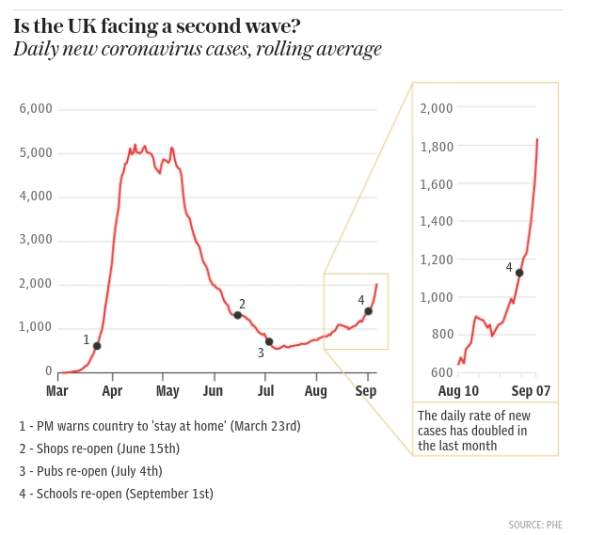
In charts: How the UK’s second wave is picking up pace

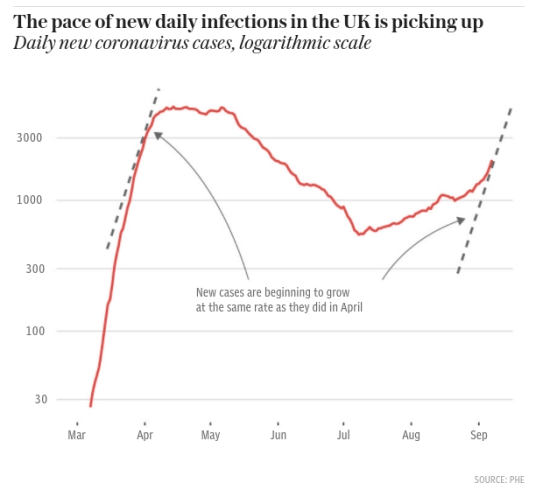
New infections of coronavirus in the UK are now growing as fast as they were at the beginning of April, according to Telegraph analysis.

By Alex Clark 8 September 2020 www.telegraph.co.uk 

Data on the last five days of new Covid-19 cases announced by Public Health England shows that new infections are now doubling every nine days, up from every 20 days just under a week ago.

That matches the daily rate seen between 6 and 7 April, where new coronavirus cases were doubling every eight to ten days, with a government scientific adviser today warning that the disease is again growing “exponentially” in the UK. 

After a spate of continuous decline in May and June, new cases of coronavirus began to tick up again in July – around when pubs and restaurants re-opened on so-called ‘Super Saturday’ on the 4th. 

At that point there were on average 700 new cases of coronavirus announced each day, down from a daily peak of over 5,000 in mid-April. 

By the beginning of September this daily rate had climbed to over 2,000 a day, however, up from around 1,000 towards the end of August – more than double.

This morning Professor John Edmunds, who is part of the Government’s Scientific Advisory Group for Emergencies (SAGE),  warned that cases are “increasing exponentially”, a phenomenon that can be seen when a logarithmic scale is applied to infections data, where straight lines represent such growth. 

Professor Edmunds went on to say that the UK has entered “a risky period” with the reproduction number potentially above the crucial figure of one.

“I didn’t want us to relax measures so much that we couldn’t open the schools safely without it tipping the reproduction number significantly above one,” he told ITV news.

“And we are already above one and we’ve opened schools.”

What’s different this time?

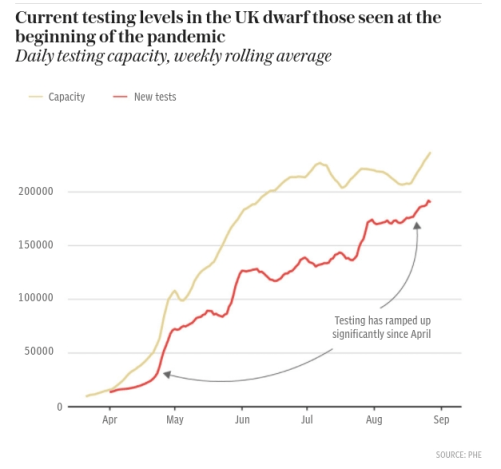
Unlike April, however, the UK now has a far more extensive testing regime – something that might over emphasise the number of fresh infections relative to the beginning of the pandemic.

In the past week alone there have been over 1.3m coronavirus tests, as opposed to just 95,188 in the first week of April. 

As of 2 September over 17m tests have been conducted in the UK, and around half of these have taken place since mid-July. 

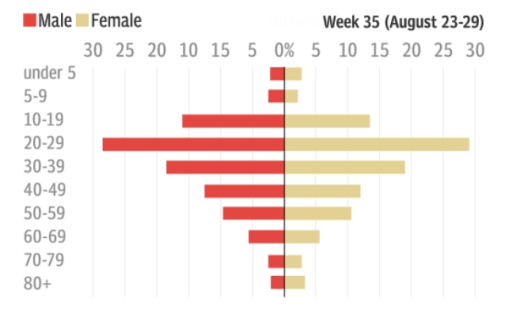
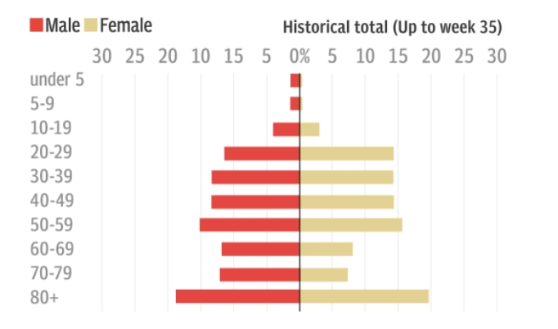
Not only are there more tests now. Those actually returning positive results are a markedly different demographic to the pandemic’s first victims.

The largest share of positive results are coming from the 20 to 29 age group – in the week to 28 August, 29 per cent of new coronavirus infections in women and 28 per cent of men were in that bracket, the biggest shares of any group. 

That contrasts with most of the pandemic in the UK, when older age groups, particularly those above the age of 80, were the predominant demographic affected by the disease. 

On Sunday, after it was announced the UK had seen nearly 3,000 new coronavirus infections, Health Secretary Matt Hancock warned young people not to “infect their grandparents”.

“The cases are predominantly among younger people, but we’ve seen in other countries across the world and in Europe, this sort of rise in the cases amongst younger people leading to a rise across the population as a whole,” said Mr Hancock.

“It’s so important that people don’t allow this illness to infect their grandparents, and to lead to the sorts of problems that we saw earlier in the year.”

On the other hand, Dr Neil Stone, an infectious disease specialist at University College Hospital in London, said: “I don’t believe the Covid-19 epidemic in the UK, US and elsewhere has ‘shifted’ to younger, healthier people.”

“They just weren’t being tested before.”


It is our democratic right to protest – but this government is crushing all opposition 

British democracy used to feel rock steady, unassailable: one could argue about the constitution, the voting system, the Lords, the monarchy, but about not the fundamental tenets.

Polly Toynbee www.theguardian.com

We’ve been taught how democracy settles disputes, enables power to change hands without bloodshed, and lets citizens of wildly opposing beliefs consent to be governed, policed and taxed.

But the wreckers running this government have lost any instinct for democratic values. If electoral victory entitles them to absolute power, all opposition becomes illegitimate.

So Extinction Rebellion activists face being treated as “saboteurs of democracy” – as organised criminals and terrorists – as the prime minister calls for new laws to protect the freedom of the press. But for one day only these climate breakdown campaigners shone a searchlight on the UK’s dysfunctional press – 80% owned by Rupert Murdoch and a few rightwing press barons, largely arguing against climate-saving policies and with a relentless anti-tax, anti-welfare, small-state agenda.

The Institute for Government (politically neutral) published a highly critical report on Monday, warning that the government was “well off-track” to meet its target of net-zero carbon emissions by 2050 and “lacking policies, with constant changes of direction, and failing to gain public consent”.

That calls for protest. Direct action risking arrest was always part of democracy. Protest – occasionally victorious, such as for the suffragettes – inhabits Britain’s history, whether it’s Peterloo, the miners, the Greenham women, the Iraq war march, anti-fracking or anti-HS2. That democratic tradition is now imperilled by threats of five-year prison terms and £10,000 fines.

In trying to exterminate opposing views, this government has lost any sense of balance or argument, as if planning to rule for ever.

The prime minister’s power-crazed chief adviser, Dominic Cummings, opens his mission-control centre, with data-tracking screens, staffed by “weirdos and misfits”. But his only mission is to destroy whatever holds the country together. Expect, we are told, a “big bang” for the British state.

The civil service is terrorised by five permanent secretaries being sacked or stepping down in six months, including the cabinet secretary: Cummings plans replacements with private-sector outsiders. Anyone not 110% with them is a foe: they will hear no other advice. Scapegoats are made of Public Health England (abolished) and Ofqual (decapitated). Judges are next, with curbs on their judicial reviews of government malfunctions.

Despised local government will see two-thirds of 218 district and county councils abolished, replaced by hundreds of mayors – gerrymandered, the Sunday Times suggests, to demolish what a government source called Labour “strangleholds” (not “heartlands”, note that language). Will Tory councillors who failed to rebel against a decade of depredations finally revolt at their own demise?

No one will stop any gerrymandering once the Electoral Commission is abolished. David Cameron made it harder for poor people, renters and young people to register for elections, in Donald Trump-style voter-suppression. No one will monitor political donations: the Mail on Sunday reports that City donors are threatening to “turn off the funding taps” to intimidate the chancellor into not raising inheritance, capital gains or corporation taxes. But they’ll pony up at election time.

No authority stops Boris Johnson giving multimillion-pound contracts to cronies and allies, or to PwC and Deloitte, without tendering. No protests stopped him putting the misogynist Tony Abbott on the board of trade, or stacking NHS and other posts with Tory politicians.

Shudder to think who they will impose as BBC chair. New director general Tim Davie’s opening speech took defensive action against the recent volley of assaults, restoring Rule, Britannia!. The Times splashed, “BBC should be cut down to size, says new chief”, but that wasn’t quite what he had said. The great majority of people who support the BBC wait to see if Davie is an appeaser who folds too easily or a strong pilot to navigate the national broadcaster through the oncoming storm.

The BBC is for ever the crucible. With a government that no longer accepts the norms of accountability, any factual report that reflects badly on it is “biased”. The country needs the BBC’s vigilant scrutiny to police the truth/ falsehood boundary, as a last bastion for a democracy that balances opposing ideas.

Wrecking took on new dimensions with the news on Monday that the government was trashing its own EU withdrawal treaty – negotiated and signed only months ago by Johnson himself. The SNP warned of a “disastrous Brexit outcome”. “Rogue-state behaviour”, said Plaid Cymru’s Liz Saville Roberts. Anyone who gave a thought towards the union of the four nations would have urged a moderate, compromise Brexit to respect pro-EU majorities in Scotland and Northern Ireland. Instead a crash-out or a thin deal will encourage these nations to depart.

Insults are the cut and thrust of democracy; Nye Bevan’s labelling of Conservatives as “lower than vermin” is printed on T-shirts. Hartley Shawcross once quipped, “We are the masters now”, but promptly crossed the floor from Labour to the Tories, spotting who the masters always seemed to be. Once Harold Wilson dared call Labour “the natural party of government”. If only. But neither Labour, nor even Thatcher’s Tories, had this megalomaniacal intent to delegitimise any opposing views.

The only hope – a dismal one – is that this government’s incompetence in everything means that all its “moonshots” fall to Earth as soon as they have left the gantry. Look at how last week ministers beckoned everyone back to offices, Prets and public transport – at the precisely predicted moment when Covid-19 was expected to shoot up again. All they touch turns to dross – yet we are condemned to that dross for four more years.

• Polly Toynbee is a Guardian columnist

Two East Devon parishes successfully progressing their neighbourhood plans – East Devon

Otterton referendum to be held next year for residents and businesses to have their say and Membury neighbourhood plan reaches final stage of adoption.

4 September 2020 eastdevon.gov.uk

A referendum will be held next year for the residents and businesses of Otterton so that they can have their say on the parish’s neighbourhood plan.

The Otterton poll follows the successful referendum for the Membury neighbourhood plan which was held in March and was approved by 81% of those who voted.

Both plans have been developed over a number of years through the hard work and dedication of their respective parish councils’ neighbourhood plan steering groups. The plans sets out policies for the future of these areas to help inform decisions about land use and planning applications.

East Devon District Council has approved the Otterton plan as a robust and positive document and has recommended it to go forward for a referendum. Due to Covid-19 restrictions, the referendum asking the parish to adopt the plan cannot be held until next year (2021). However, as the district council has recommended the plan and it has been the subject of significant public consultation and an independent examination, the proposals now have significant weight in any decisions about development in the parish.

The leader of the Otterton Neighbourhood Plan Steering Group, Ian Birch, said:

“The fact that our village’s plan has reached this stage is very gratifying, and we’d like to thank everyone who contributed to its development over the last few years.

The plan will help protect the village against inappropriate development, whilst encouraging activity which supports and enhances the wonderful natural environment of the area. We look forward to the referendum taking place in due course – although it’s disappointing that this may not be until next year, depending on the course of recovery from the current pandemic.”

Membury neighbourhood plan is the latest to reach the final stage of the plan making process and was formally adopted by the East Devon District Council in April.

Cllr Dan Ledger, the district council’s portfolio holder for strategic planning said:

“I have to commend the steering groups of both Otterton and Membury for achieving these feats. A neighbourhood plan is a long and arduous process but one that has long lasting benefits to the community it serves.

It gives weight to the voice of the community within planning policy and allows them to set out a positive vision of how they wish to see the community develop. With the fantastic news of Membury’s neighbourhood plan being made in April, I will now eagerly await the results of the Otterton referendum in 2021.”

East Devon currently has 18 adopted neighbourhood plans and a further 20 plans at various stages of development. Once adopted, neighbourhood plans form part of the suite of statutory development plan documents, together with the East Devon Local Plan.

The Otterton and Membury plans are available to view on the district council’s website, together with further information about neighbourhood planning across the district. The website link is https://eastdevon.gov.uk/planning/planning-policy/neighbourhood-and-community-plans/

The district council is keen to continue supporting the progression of neighbourhood planning work as far as is possible in the current circumstances. Parishes and groups needing help with neighbourhood plans can contact the council’s new neighbourhood planning officer Angela King through email at aking@eastdevon.gov.uk or by calling 01395 571740.


Don’t kill your granny, that’s our job – Health Secretary makes plea to youth

INTO THE MOUNTAINS WITH YOU : THE HEALTH SECRETARY of an industrialised nation currently mismanaging Covid-19 has made a plea for assistance from the nation’s young.

www.lcdviews.com 

“Some would think we’re still pursuing herd immunity as our strategy with Covid-19,” he began, “but just at a slower, more political manageable pace. Rather than the mass pit burial velocity we had to pull back from before the summer. Nothing could be further from the truth. Your leaders are famous for adjusting their positions based on public opposition. We U turn all the time. You can trust us to U turn on you. And you can trust me when I say that, because I’m from your government.”

So far, so good.

“And don’t listen to any unpatriotic types who suggest that urging everyone back into offices, after reopening pubs, at the same time as refilling schools is not a sensible public health strategy. Teenagers, and drunks are famous for their self control and adherence to rules. Drunk teenagers especially! It’ll not be our fault if they catch Covid. It’s just nature taking its course.”

All perfectly sensible.

“But there is one area where I need the youth of this nation to help me out. It’s not just wearing face masks while shoplifting, or whatever past time you scallywags get up to these days, that I need your help with.”

Alright. Get on with it.

“It’s with your grandparents. You maybe aware we have a social care crisis in this country. For too long governments pursued a shortsighted agenda of helping people live longer. Long past their ability to work in the gig economy. This is a now a serious problem. Of course the funds that could be spent solving it are currently in tax havens. That is where money belongs. So what to do about all these old people hanging about the place, and between you and me, not doing much that’s useful except grandparenting?”

What indeed. Someone has to give them Covid?

“You don’t want giving them Covid that on your conscience. So let it happen as a result of other people crisscrossing the UK in search of Covid tests. World beating navigation will see us through. And if you really want to help out, take a drive to Barnard Castle and sneeze. We’re taking the right steps, at the right time. This is why you need to protect your grandparents so a rogue algorithm can take care of them, just like it did for A level tests.”

Don’t kill your granny. That’s the government’s job.


Future uncertain for Devon’s buses and trains

Public transport in Devon faces an uncertain future unless people get back on buses and trains.

By Daniel Clark, local democracy reporter  www.radioexe.co.uk

An organisation called the Peninsula Transport Shadow Sub National Transport Body, on which local councillors sit, has been told the number of people using buses ris less than half what it used to be across Devon and Cornwall.  Train use is 35 per cent of pre-lockdown levels, but gradually increasing.

Although transport operators receive government support to ensure they continue to run loss-making services, it is uncertain about how long it will last and concerns about the impact it could have if routes stop running. Significant numbers of people are still under the impression that public transport should only be used if essential. Prime Minister Boris Johnson had previously said people should avoid public transport if possible, although messaging has since changed to allow  bus and train use for any purpose.

But Cllr Mark Coker said: “We have a huge rural area and if bus patronage does not return to usual soon, there will be financial implications for the bus companies and the local authorities. Are we going to actively encourage people to get back on buses, and will the DFT change their message?”

Cllr Geoff Brown added: “The original message to only use public transport if essential nosedived the passenger numbers when we didn’t have an issue with capacity in the first place. For those using the buses it was essential. We have done a lot of work to make people safe, but the messaging isn’t helpful, so can we promote public transport in the near future?”

Dave Gilnos from the Department for Transport said a huge package of funding has been established to support the continued operation of bus services and he didn’t expect any services to fall aside while the funding is in place. He said: “There will come a time when government say they cannot keep supporting the industry forever more, and the question is when that funding will cease. Social distancing is limiting capacity to 50 per cent of what it was previously, and some buses are full, but full is 50 per cent so isn’t generating the revenue it was once. Work is on under way on a bus recovery strategy that will come out in the autumn.”

Daniel Round, from GWR, added that the message was changing to ‘travel with confidence’ and to try and entice people can onto the railway. He said: “We are seeing a uplift in numbers in the westward routes. We are now up to 30 to 35 per cent, when at the height of the pandemic, it was down at two to three per cent. We have extended the agreement with the DFT until June until next year so a sign of stability, and we will change out timetable to 95 per cent of pre-pandemic services.”

40 Tory MPs Form New Group To Demand Help For Poorer Parts Of UK

A group of 40 Conservative MPs have formed a new group to keep up the pressure on Boris Johnson to fulfil his pledge to “level up” the more deprived areas of the country.

[Leader is Neil O’Brien MP for Harborough of: “The next algorithm disaster – coming to a Conservative constituency near you. This time, it’s housing growth” fame. Owl wonders whether Simon Jupp or Neil Parish are members to put the case for the us in the far South West. Or is this just for “Red Wall” MPs?]

A study published on Monday revealed earnings in seats the Conservatives won in 2019 are on average 5% lower than in Labour-held seats.

According to report by the conservative think-tank Onward, houses in Labour seats are also worth on average £62,000 a third more.

Neil O’Brien, the MP for Harborough who is helping lead the new Tory “Levelling Up Taskforce”, said: “The coronavirus crisis has only made the case for levelling up stronger so we can get the economy moving in areas that are less well off.

“Our new Taskforce will be spearheading this vital agenda.”

Onward’s analysis showed of the bottom quarter of seats in Great Britain with the lowest earnings, more are now held by the Conservatives (77) than Labour (74).

The report also highlighted that since the mid-1990s London has pulled ahead of the rest of the country.

Having been the same size as the economy of the north of England as recently as 2004, the capital’s economy is now a quarter bigger.

In London income before tax and benefits grew two-thirds faster than the rest of the UK, and income before tax and benefits is now nearly 70% higher in London than the rest of the UK, up from around 30% higher in 1997.

Many of the MPs in the new group represent seats taken from Labour’s so-called “red wall” at the election, including Redcar’s Jacob Young and Bishop Auckland’s Dehenna Davidson.

Stoke on Trent Central MP Jo Gideon said there was “a lot of untapped potential” in parts of the country that “have felt left behind for a long time”.

Johnson’s promise to deliver for the people in traditional Labour heartlands was dealt a blow after the A-level fiasco that saw students from poorer backgrounds initially have their results downgraded more than their peers from more affluent areas.

Government apologises for Covid testing delays at UK care homes

The government has been forced to apologise for continuing delays to Covid testing, which care home bosses and GPs warn are threatening to cause infections among the most vulnerable people.

The Department of Health and Social Care (DHSC) admitted to breaking its promise to provide test outcomes within 72 hours, as one nursing home operator in Cheshire told the Guardian that results have taken seven days and the delay may have caused infected staff to pass the virus to a resident.

Care managers on Monday described the government’s centralised testing system as “chaotic” and “not coping” amid reports of whole batches of tests coming back not only late, but also void. One operator in Kent said they were unable to get any tests for more than three weeks and said she felt “frustration and disgust at this outrageous treatment”. Snags with the online ordering system are also common, operators said.

Testing officials told the care home by email on Monday morning: “Immediate action has been taken at the highest levels of the programme to bring results times back within 72 hours from the time of swabbing, and to reduce the number of unclear/void results, especially where these are affecting whole homes.

“We apologise unreservedly to all care homes who have been affected for the upset these issues have caused you, your residents and your staff.”

One care home in Cheshire said staff tests took seven days to come back, and when they did three workers tested positive. They were sent home but had been working for the whole week. A resident subsequently tested positive for Covid-19, leading to fears the workers may have infected the resident.

“It’s awful. It’s like Russian roulette every week,” the manager said, describing the system as “chaotic”. “People can’t believe it’s so slow. The general public think the testing system works fine but people can be positive and working for a week and no one knows. It’s not working at all for us.”

The government had promised regular testing for care homes by the end of July, but moved the target for weekly staff tests to 7 September citing “unexpected delays”.

In August it paused the use of home testing kits issued by Randox, one of its main commercial partners working on a £133m contract, because they did not meet safety standards. This meant other providers had to make up the shortfall. Other commercial partners include Sodexo and Deloitte.

Residents are still only promised testing once every 28 days. But the turnaround of tests remains slow and there is also growing concern that results are not reliable, with positive results one week replaced by negative results the next.

The care manager in Cheshire said that because temporary agency staff who are used to fill in for isolating staff are not routinely tested, the risk remains unchecked.

Dr Claire Barker, the GP with responsibility for the residents, said: “Most staff work all over a care home and not knowing what is happening with infection is unacceptable. It inhibits the home’s ability to control the outbreak. We can’t control outbreaks if this testing regime stays in place.”

Delays in results are thought to be caused by capacity issues at testing facilities and the government has promised to boost capacity to 500,000 tests a day by the end of next month, helped by a new laboratory near Loughborough. The problem has become more pronounced for care homes in the last fortnight, said Vic Rayner, the executive director of the National Care Forum. This week the government said care facilities for younger people could also get weekly testing, raising fears it could further strain the system.

Rayner highlighted another problem, which is that hundreds of care home inspectors will not be tested before going into homes to carry out regulatory checks. The Care Quality Commission told care homes it had consulted with the DHSC and its inspectors “do not meet the criteria for weekly asymptomatic testing, as inspectors are not required to undertake ‘hands on’ closer personal contact with people”.

Rayner said: “The government has spent £600m on an infection control fund to stop the social care workforce moving around and between care services, so why are they not testing this discreet cohort of inspectors who do just that – move around and between services.”