Boris Johnson will not regain his squandered trust

Boris Johnson learnt from his father Stanley the motto: “Nothing matters very much and most things don’t matter at all.” But it’s not true. The opposite is the case for a prime minister whose red box is filled daily with things that matter a great deal indeed — never more so than during a pandemic, with the country heading into an economic downturn as the Brexit deadline looms.

Rachel Sylvester www.thetimes.co.uk 

Through his frivolity, Mr Johnson has sacrificed trust, the most precious commodity of all in politics, and that is a disaster in the multiple crises he now faces. The negotiations with the European Union depend on building a relationship of trust so that compromises can be broached in a spirit of honest exchange. The prime minister has, however, been playing politics all along. Nobody believes his latest pronouncement that we are heading for no deal with “high hearts”. The boy Boris has cried wolf too many times and so, whatever the truth of it, his declaration is taken — both in Brussels and by business — as the latest piece of posturing.

If he is serious, then that is dangerous because it means the country will be less prepared for the cliff edge. If he’s not, then his games will make it harder to reach a free trade agreement by the end of the year because he has squandered yet more goodwill.

In the same vein, Mr Johnson’s threat to break international law and override the commitments in the withdrawal agreement is seen by some MPs as just another dishonest stunt. One former cabinet minister told me: “It’s my view that they have decided to accept the deal that’s on the table. The whole Internal Market Bill thing is a deliberate piece of theatre to make it look like they’ve had a big fight and stood up for British interests so when they accept it they’ve got cover.”

Again, even if this is all a devious ruse, there are consequences. The damage to Britain’s reputation abroad, including in the United States, has already been done. And, as five British archbishops argued in their letter to the Financial Times, the plan will “further undermine trust” among those who govern the different parts of the United Kingdom, while having “enormous moral, as well as political and legal” ramifications. Like a conjuror, the prime minister is skilled at using diversion to avert the public’s eyes from the illusion but people are starting to see through his tricks.

When it comes to the coronavirus, Mr Johnson has sacrificed the trust of the public and of his own MPs through his chaotic management of the crisis. According to the latest YouGov poll, 32 per cent think the government is handling the pandemic well. Chris Curtis, YouGov’s research manager, believes it is “an opportunity wasted to rebuild trust in our political institutions, as has happened in other countries around the world, but hasn’t happened here because the government are perceived to have done such a bad job”.

There has, in fact, been a further deterioration of trust at every level. Trust has broken down between local and national politicians, between ministers and their scientific advisers and even within the cabinet as different factions argue about the balance between livelihoods and lives. Trust in a future vaccine is so low that there is discussion about calling in the Queen to increase uptake. Trust in the test and trace system is shot to pieces, with many alarmed by the plans to give the police the contact details of those who have been told to self-isolate. The restrictions will only work if people are willing to follow them and the loss of trust is already harming compliance as voters conclude that the government either has no idea what it’s doing or is driven by the wrong motives.

As with Europe, the pandemic has become increasingly about politics, with the prime minister bowing to pressure from the Tory right. The Eurosceptic “Spartans” have become the lockdown hawks and the rebels such as Steve Baker who made Theresa May’s life a misery are now doing the same to Mr Johnson, their former hero. Indeed, MPs take delight in pointing out that the prime minister owes his position to a previous rebellion and so can hardly complain. This disagreement is also about trust. The critics argue the government should have faith in the people to do the right thing — as in Sweden which, according to its chief epidemiologist Anders Tegnell, has a “trust-based approach”.

Confucius told his disciple Tsze-Kung that three things are needed for government: food, weapons and trust. If a leader cannot maintain all three they should, he said, relinquish the weapons first and the food next. Trust should be guarded to the end because “without trust we cannot stand”. Trust is essential in human relationships and business but also for democracy to function. Black Wednesday and the war in Iraq were tipping points in the relationship between politicians and the voters because they undermined trust. The Liberal Democrats have still not recovered from breaking a decade-old promise not to raise tuition fees.

The philosopher Baroness O’Neill of Bengarve argued in her Reith lectures that the key to regaining trust is simply to be trustworthy. “Deception is the real enemy of trust,” she said, and at the moment the government is not being trustworthy. The truth is Mr Johnson has never valued honesty or reliability. He has been sacked from two jobs for lying and was described by another boss, the former newspaper proprietor Conrad Black, as a “fox disguised as a teddy bear” after he misled him by insisting he would not pursue a political career while editing The Spectator, then applied for a parliamentary seat. The long history of unfaithfulness to women was only reinforced at the weekend by Jennifer Arcuri’s confirmation of their affair.

“I think he honestly believes that it is churlish of us not to regard him as an exception, one who should be free of the network of obligation which binds everyone else,” one teacher wrote of Mr Johnson in a school report. But as prime minister that has implications for the country as well as for his own life. The failure to censure his chief adviser Dominic Cummings when he broke the rules with his eyesight-testing trip to Barnard Castle was the moment at which the public’s respect cracked and the willingness to follow the rules began to erode.

Trust has broken down at the very moment when it is needed more than ever and it’s the prime minister’s fault for trivialising the world around him. It is hard to see how he recovers from that.

Time to stop the coronavirus gravy train

“Lord Agnew wrote last month in a leaked letter to senior civil servants, an “unacceptable” reliance on management consultants has “infantilised” Whitehall and deprived “our brightest [public servants] of opportunities to work on some of the most challenging, fulfilling and crunchy issues”.”

Clare Foges www.thetimes.co.uk 

As the scale of the coronavirus threat emerged early this year, most scented danger. Others caught the whiff of something else: the gravy train to end all gravy trains. Weekly come the stories of huge sums of public money spent with seeming disregard for value, without tender or transparency, for services of dubious value or poor quality, to companies and consultants which often have close links to power. Though public attention is fixed on lockdowns and curfews, a bad smell grows — and the government would be wise to start clearing the air.

Hundreds of millions of pounds were spray-hosed at companies promising to provide PPE. The crowdfunded Good Law Project has been plugging away for months to seek answers about some of the more questionable suppliers. A sweet manufacturer from Co Antrim swapped gob-stoppers for gowns and won contracts worth £107 million without competitive tender. Ayanda Capital, a family office specialising in currency trading and private equity, signed a £252 million contract for safety equipment, later supplying 50 million masks that could not be used. While there may be good reasons for these decisions, the government’s persistent secrecy on this front does not allay suspicions of incompetence at best and deals for mates at worst.

Occupying the next carriage of the gravy train we have the management consultants, the global giants populated by former government advisers. The Whitehall procurement system “hugely favours large established companies with powerful political connections — true corporate looters”. So said Dominic Cummings once, but these large established companies have done rather well since March. The top Covid supplier by volume is PWC, whose 20 contracts are worth £24 million. McKinsey’s 16 projects add up to £38 million. KPMG was paid almost £1 million for three months’ work on the Nightingale hospital in Harrogate.

Last Friday it emerged that the bill for private consultants on Covid-related projects had reached £175 million, causing Meg Hillier, the chairwoman of the public accounts committee, to explode: “What on earth are they doing? It is a very steep increase in a very short space of time. You cannot just tear up the rules and dish out taxpayers’ money in this way.”

The smell worsens around the test and trace system, run by the McKinsey alumna Dido Harding. Her old company pocketed £560,000 for deciding on the “vision, purpose and narrative” of the programme, a gold-plated slideshow it would be intriguing to see given the shambolic “narrative” surrounding the scheme. More than 1,100 consultants from Deloitte are now working on test and trace, while last week we learnt that executives at Boston Consulting Group are being paid as much as £6,250 a day for their input. Beyond the consultants, companies such as Serco, Sitel, G4S and Mitie provide the call handlers, organise testing sites, dispatch tests and so on, pushing the total cost of the system up to £12 billion.

I can hear the exasperated ministers’ cry: “Don’t you know there’s a bloody war on?” Don’t you realise that speed was of the essence, that when infections were surging the government didn’t have the luxury of conducting long tender processes? Or that when doctors are resorting to wearing bin liners it’s all hands on to the pump to provide PPE? Or that national diagnostic systems are not constructed without extra manpower? Having worked in government I have some sympathy but what does seem extraordinary is the reluctance to require much in the way of performance in exchange for these vast sums of money.

It would be hard to quibble with the sums spent on test and trace if the whole thing had been running as though on oiled castors, but it hasn’t. In the week ending October 7 only 62.6 per cent of close contacts of people who tested positive were reached through the system — the lowest percentage yet. A clear failure, yet where are the reparations, the resignations, the contracts terminated? In the web of contractors and sub-contractors the thread of accountability is lost. Last month David Davis, the Tory MP and former cabinet minister, asked the Department of Health and Social Care “what performance targets are in place for commercial providers of track-and-trace functions” and “what penalties can be imposed for failure to meet those targets”. Last week the health minister Helen Whately replied that such penalties were not included in contracts with Serco or Sitel because they “are often unenforceable under English law”. Come again? What is the point of a contract if between the lines it reads “please take a lot of money with no penalty if you don’t deliver”?

The government must start to correct its mistakes now, before the inevitable public outrage. It shouldn’t be difficult to provide the reasoning behind its choices of PPE suppliers or to give an update on how these firms have performed. Surrendering basic information on these deals only at the prodding of crowdfunded campaigners like the Good Law Project is not a good look. Where companies have failed to deliver, the government should be publicly, vociferously pursuing them on behalf of the taxpayer and including performance targets and penalties in future contracts.

Beyond this housekeeping is a greater challenge: addressing the government’s over-reliance on the private sector to think for it, strategise for it and deliver core functions for it. Of course the virus was going to demand more hands to the pump, and importing experts is not in itself a bad thing; most of us do not wish to go back to pure state monopolies with their inefficiency and grinding slowness. But the extent of the Covid gravy train reveals more clearly than ever how dramatically the capability of the state has been eroded.

It’s a vicious circle: cut back on public-sector expertise and you rely more on expensive outsiders; rely more on outsiders and the public sector can “safely” be shrunk further. As the Cabinet Office minister Lord Agnew wrote last month in a leaked letter to senior civil servants, an “unacceptable” reliance on management consultants has “infantilised” Whitehall and deprived “our brightest [public servants] of opportunities to work on some of the most challenging, fulfilling and crunchy issues”. And although there is a place for the Sercos and G4Ss to help with the delivery of public services, surely outsourcing should not be the default for a well-resourced, modern state?

There’s nothing wrong with good private companies filling gaps where necessary, but long term we should be aiming for a public sector that has in-house expertise and does not require armies of management consultants to keep the cogs turning. If, as Boris Johnson is fond of saying, we are to “build back better” after all this, ambition must not be limited to new railways, houses and energy projects but to a rebuilding of the run-down parts of government too.

On Simon Jupp: “they [the Tories] would have been better off with Iggy Pop in my opinion”

Guess who gave us these piercing quotes about leading local Tories?

[Full quote] Of the selection of Simon Jupp: “If they wanted someone charismatic, which is what I think they tried to do, they would have been better off with Iggy Pop in my opinion. People would be able to relate to him more than a DJ from Plymouth.“

The same source also thought Geoffrey Cox, MP for West Devon and Torridge, “needs to be questioned now and again, I think he’s a bit too full of himself for my liking.”

No, not  Sasha Swire this time but our “born again Conservative” Ben Ingham just a year ago in November 2019 when he was contemplating running for parliament. 

Imagine Owl’s astonishment to hear that the Conservatives are considering him as a potential candidate to run as a County Councillor next May!

Owl is not at all surprised that Ben has ambition to be a County Councillor. No doubt sees himself as a future leader. But are the Tories really that desperate?

Owl understands that he had a recent shot at the Exmouth and Budleigh Coastal Division but lost out to that old stalwart, sitting tenant and strong advocate for Jupp, Christine Channon.

Watching them vote is excruciating” 

Sasha Swire describes the voting procedure at the “Fuhrerbunker” of a local Conseravtive AGM (West Hill) in this manner:  “Watching them vote is excruciating – some unable to lift hands, others shaking one using one arm to raise the other – a portrait of our current membership”. More specifically on Budleigh: “No more than 20 in the hall. Jeremy asks for apologies, Jill Elson says my sister as she is stuck in Tesco’s.”

This time the meeting would have had to be held online and Owl imagines the logging on process for members might have been a bit taxing and taken a long time, as would the voting process. Owl even wonders whether there was any time left for the candidates to present their “credentials” before bedtime. (Alas, there are no voting figures available).

Owl suggests Ben has a pop nearer to his home patch where he might achieve better name recognition – how about the Exmouth Division (which includes Lympstone and Woodbury)? He might unseat the current DCC Vice Chair, Councillor Jeffrey Trail!

Or maybe it’s time to change political colour again.

Laurence Fox has just launched a new political party to “reclaim” British values from politicians, who he says have “lost touch with the people”.

Latest news, Flybe could be back next year after deal struck to restart airline

Flybe could be flying again next year, after administrators announced a deal had been struck with investors to restart the regional airline.

Gwyn Topham www.theguardian.com

The Exeter-based Flybe went bust in early March, with the impact of the coronavirus crisis on passenger demand proving the last straw for the struggling airline.

The administrators EY said Flybe’s brand and remaining assets had been sold to Thyme Opco, a company affiliated to Cyrus Capital, which had pumped money into the Virgin Atlantic-led rescue attempt in 2019.

The deal could mean Flybe restarting as a regional airline in the UK in early 2021. Administrators said they would work with the new owners and the UK Civil Aviation Authority to prepare for its return to the skies.

Simon Edel, a joint administrator, said it would be great news for communities around the UK who had relied on Flybe: “The restart of this iconic brand, which was once Europe’s largest regional airline, will provide a potentially significant boost to aviation jobs, regional connectivity and local economies.”

A Thyme Opco spokesperson added: “While we plan to start off smaller than before, we expect to create valuable airline industry jobs, restore essential regional connectivity in the UK and contribute to the recovery of a vital part of the country’s economy.”

The idea of relaunching an airline may raise eyebrows in a sector that has seen a huge downturn in traffic, with most carriers laying off about a third of staff and reporting enormous losses during the pandemic.

Flybe, which flew about 8 million passengers a year between 81 airports in the UK and Europe, had long struggled financially. It was promised fresh investment when a consortium of Virgin, Stobart Air and Cyrus Capital took over the airline in 2019. Virgin Atlantic had planned to rebrand the airline and integrate it as a feeder for its long-haul routes from Manchester and London.

However, by January the airline’s troubles were such that the new owners sought a government bailout, before the impact of Covid-19 took Flybe into administration in March.

The pitched battle over lockdowns is missing the point: Covid-19 is a class issue

Just as our final exit from the EU comes into view, noise from the media and politics about Covid-19 is sounding discomfortingly similar to the furies that erupted around the 2016 referendum.

John Harris www.theguardian.com 

On one side stands the political right, opposed to lockdown, apparently spurning the advice of experts, and seemingly convinced that a mixture of true-Brit common sense and derring-do will somehow see us through. The left, meanwhile, emphasises the importance of “the science”, and the prospect of disaster. As in the US, it is beginning to feel like any contentious political question will now trigger these polarised responses – not necessarily in the population at large, but certainly among the people whose opinions define what passes for the national conversation.

News coverage of the second wave has so far tended to focus on which places should go in which official tiers, the distinction between pubs and restaurants, and the decision to send students back to universities. What has not been discussed nearly as much is the plain fact that the coronavirus crisis – even more so in its second phase – is all about basic inequalities, and the kind of questions of work, housing and poverty that deep crises always bring to the surface. In other words, Covid-19 is a class issue. That may sound simplistic, but what it actually denotes is an intricate set of considerations that the argument over lockdown is not acknowledging.

Since the start of the crisis, I have been regularly talking to many of the leaders in the north of England whose anger at condescending treatment from Boris Johnson and his colleagues continues to make the headlines. As many of them see it, one reason for the recent increases in infection is that the initial lockdown affected many of their areas differently than more affluent places. Rather than retreating inside to bake their own bread and have work meetings on Zoom, people in such trades as construction, warehousing and care work had to carry on venturing outside and mixing with others in the first wave, so levels of the virus remained comparatively high, even before the summer reopening then took them back to dangerous levels. Clearly, the ability to render yourself housebound is also dependent on whether your domestic environment makes remaining at home either viable or all but impossible. The basic point was recently nailed by the Financial Times writer Anjana Ahuja: “This crisis has broadly separated us into the exposed poor and the shielded rich.”

Andy Burnham, the Greater Manchester mayor, recently told me about one correlation that highlights this disparity. He said that in a swathe of the country that takes in Greater Manchester, east Lancashire and West Yorkshire, Covid hotspots map on to areas that were the focus of the last Labour government’s so-called Pathfinder scheme: the programme that aimed to replace old housing by bringing in private developers, and left a legacy of unfinished work and huge resentment. “The quality of housing in those areas is still extremely poor,” said Burnham. “Lots of families live intergenerationally. It’s very overcrowded. How would you self-isolate in a situation like that?”

This is a good riposte to the oft-heard suggestion that most people who fail to follow the rules are degenerate “Covidiots”, and further proof that in a society as insecure as ours, trying to stringently control anything – let alone a highly infectious disease – will tend to be very difficult indeed. According to research done at King’s College London, only 18% of people self-isolate after developing symptoms, and only 11% quarantine after being told by the government’s test and trace system that they have been in contact with a confirmed case. Among the factors the study associates with non-compliance are “lower socio-economic grade”, and “greater hardship during the pandemic”. A lot of people, it seems, would like to do what they are told, but simply can’t.

This is the basic point the government does not seem to have grasped – painfully highlighted by Johnson’s claim that infections increased because the public became “complacent”. Threatening people with fines of up to £10,000 if they fail to self-isolate – and, we now learn, passing their details to the police – is an example of the same cast of mind, less likely to persuade people in precarious circumstances to follow the rules than to keep their distance from the authorities. The fact that some people on very low incomes are finally eligible for a lump sum of £500 to cover a fortnight’s quarantine will not solve what is obviously a massive problem; in terms of basic practicalities, it is of a piece with Rishi Sunak’s plan to pay only two-thirds of lost wages to people affected by local restrictions.

But before anyone on the left starts feeling too self-righteous, they also have questions to answer. There is a cold, dogmatic attitude in certain quarters that seems to define itself against anything that smells of Tory laissez-faire. Earlier in the year, it was manifested in rigid opposition to schools reopening, as some people averted their eyes from the inequalities the suspension of education was making worse. Now, some of the same voices stridently argue for strict national measures, as if that proposition is straightforward. It is actually not just complex, but full of potential contradictions. A prime example: given that poverty and precarity are what make millions of people vulnerable to both Covid infection and the life-threatening complications that can come with it, the hardship that any lockdown creates will make those problems even worse. This, surely, is the circuit that desperately needs to be broken, but after so many wasted years it will take a long time to do it.

In the meantime, a daily ritual of political futility goes on. Some people on the right yearn for a return to shrunken government, rugged individualism and the primacy of “the economy”, whatever that is. On the opposing side, people would like us to diligently follow the edicts of a reborn state, but social conditions are too far gone to allow many people to do anything of the kind. To those at the sharp end of this crisis, neither position will sound particularly convincing.

So it is that increasing numbers of people ignore the current political drama, and muddle through as best they can. Parallels with the vote to leave the EU are not only about the divisive arguments that have gripped the political class, but the fact that many of the same places whose experience fed into their vote for Brexit – Hartlepool, Preston, Oldham, Middlesbrough – are also suffering the worst of the pandemic. The inequality they embody remains the essence of the 21st-century British condition: four years on from 2016, this is still a country so imbalanced that it keeps falling over.

• John Harris is a Guardian columnist

Number of new COVID clusters falls in regional latest figures

For the first time in weeks the total number of new COVID clusters has fallen in Devon and Cornwall on the government’s official map.

Colleen Smith 18 Oct www.devonlive.com 

The MSOA data now covers the period October 8 to 14, with 11 new cluster areas today being added to it, but 13 dropping off the rolling data.

It is the first day for a long time when the total number of areas with a cluster in Devon and Cornwall has fallen.

In the worrying Exeter University area numbers continue to fall with Pennsylvania and University now down from 139 to 121.

Exeter’s figure is the lowest since September 28. But in contrast, Torbay’s daily figure appears to the highest one yet with more new cases than anywhere else except Exeter across the two counties.

Hospital figures for the South West rose from 158 to 161 today No deaths have been reported in the NHS England stats for the South West today.

Sunday’s figures show 120 new coronavirus cases in Devon and Cornwall.

Of those 11 are in Cornwall, 25 in Plymouth and 30 are in Torbay.

In Devon there are six in East Devon, 10 in Exeter, 2 in Mid Devon, 5 in North Devon, , 4 in West Devon, 4 in Torridge, 11 in South Hams and 12 in Teignbridge.

In Plymouth

Mutley has 18 cases, up from 15

City Centre, Barbican & Sutton Harbour is up from 11 to 14

Devonport, Mount Wise & Morice Town has 12 cases

Keyham is up seven to 11

King’s Tamerton & West Park has nine cases

In Exeter

Pennsylvania & University 121

Central Exeter 49

St James’s Park & Hoopern 32

Middlemoor & Sowton 29

Alphington & Marsh Barton 17

Mincinglake & Beacon Heath 16

Countess Wear & Topsham 10

In Torbay

Upton and Hele is up from 14 yesterday to 18

St Marychurch & Maidencombe has risen by one to 13

Shiphay & the Willows has 12 cases

Chelston, Cockington & Livermead is up from nine to 11

In North Devon

Ilfracombe East and West have a smattering of new cases.

The only other cluster in North Devon is nine cases on the edge of Exmoor, Dunster and Dulverton.

The East of the town has seen six new positive cases this week taking it to 10 and the Ilfracombe West still has six.

In Teignbridge

The Shaldon and Bishopsteignton cluster has grown to nine cases; Teignmouth South has seven; Newton Abbot, Broadlands and Wolborough have seven and Heathfield & Liverton has seven.

In West Devon

There is a spike in the numbers showing on the MSOA map for the whole West Devon area in the last seven days with 29 cases in total across the area, although none of the clusters are more than six.

In Cornwall

There is only one cluster in double digits in Cornwall.

13 Lostwithiel & Penwithick

7 Redruth North

7 Ponsanooth, Mabe Burnthouse & Constantine

7Shortlanesend, Chacewater & Carnon Downs

6 Crowan, Wendron & Stithians

6 Holsworthy, Bradworthy & Welcombe

5 Padstow & St Issey

5 Camelford & Tresmeer

5 The Lizard

Coronavirus test results must come in 24 hours, says Sage scientist

A massive expansion of testing will still leave Britain struggling to keep Covid-19 infections under control unless the system can inform people they are positive within 24 hours, one of the government’s most senior scientific advisers has warned.

Michael Savage www.theguardian.com

Ministers have insisted that they are on course to hit a target of 500,000 tests a day by the end of the month, with suggestions this weekend that capability of a million tests a day could be reached by Christmas.

However, Graham Medley, a member of the government’s Scientific Advisory Group for Emergencies (Sage) and chair of its subcommittee on modelling, said that returning test results “ideally within 24 hours” was as critical as capacity in a successful test-and-trace system. He said if necessary, capacity should be curbed in favour of speed.

His advice is at odds with testimony from Dido Harding, the Conservative peer who heads NHS Test and Trace. When demand for tests was surging last month, she said a “conscious decision” was made to extend the turnaround time.

There are still significant delays in the test-and-trace system, according to the latest figures. In the first week of October, 32.8% of tests conducted at regional test sites were returned within 24 hours. The figure was 24.4% for local walk-in sites and 41.9% for mobile testing sites. The number of home-testing kits received within 48 hours was 16%.

Medley told the Observer: “There’s been a huge advance in terms of the capacity for testing, but I think we’re still learning how to optimise the use of that testing. The length of time it takes to get the test result is critical for the contact-tracing. And so there has to be a potential compromise between the volume of testing done and the ability to return the result, ideally within 24 hours.

“Suppose you could treble the number of tests you did, but only at the expense of returning them in a longer period of time, then that’s not really going to work. The volume is important, but only if it can be done promptly. The people doing it need to consider that delay as being as important as the volume.”

Sir Paul Nurse, the Nobel laureate and director of the Francis Crick Institute in London, said using smaller labs alongside the big, privately run Lighthouse labs could speed things up. “Big labs have very long lines of communication,” he said. “For very good reasons, they find it difficult to get the sample into them and the information aggregated rapidly. I call [our small labs] lifeboat labs. It’s local, it’s small. It’s a different way of working. Government should think about supporting them, as well as their big labs. We could have repurposed 20 to 30 labs in a month. We may still be able to, but we’ve lost a bit of goodwill.”

The warning over the speed of test results comes amid mounting concerns over tracing efforts. Last week saw another record low for reaching the contacts of those who tested positive, with only 62.6% of close contacts reached in England. Almost 250,000 contacts of people who have tested positive in England have not been reached by tracers since the end of May, according to Labour’s analysis of test-and-trace data. The research, verified by the House of Commons library, found that in the last week for which data is available, almost 80,000 close contacts were not notified.

Local public health experts again demanded a rethink. Dr Jeanelle de Gruchy, president of the Association of Directors of Public Health, said: “As is clear from the latest performance figures, the national element still requires significant and urgent improvement. That means quick access to, and turnaround of, testing and at least 80% of contacts reached, as recommended by Sage in May.

“Locally, directors of public health have developed their own contact-tracing functions to supplement what is happening nationally. This approach has proved effective at reaching the areas and communities that the national system cannot. They are also managing, with PHE [Public Health England] colleagues, more complex contact tracing and outbreaks in settings like schools, care homes and businesses. More funding and resources are critical to keep doing this valuable work.”

A Department of Health spokesperson said: “NHS Test and Trace is breaking chains of transmission – over 900,000 people who may otherwise have unknowingly spread coronavirus have been contacted and told to isolate. The number of people who were reached and asked to provide information about their contacts, has increased from 74.9% to 76.8% this week.

“We’re continuing to drive forward local contact tracing as part of our commitment to being locally led, with more than 100 Local Tracing Partnerships now operating, and more to come.

“Since its launch, 84% of contacts have been reached and told to self-isolate where communication details were provided.”

Families across Devon worried after COVID test failures

Families in Devon are writing to MPs claiming that the COVID-19 testing system is failing in Exeter after being told to go back for retesting because their results could not be read.

Colleen Smith  17 Oct www.devonlive.com 

At least seven families who were tested at the Honiton Road Park and Ride test centre have since received the same official letter from the NHS.

Mums whose children were tested on Monday have been told they need to go back because of testing problems. Some say their children are refusing to have the uncomfortable swab test a second time.

Emma, a Newton Abbot mother has written to her MP saying the system is failing. After sharing a Facebook post she has had hundreds of replies and knows of at least seven families in the same position.

Another Exeter mum who asked to remain anonymous said she believed there may have been a “bad batch”.

She had taken her child to Honiton Park and Ride on Monday and finally got an email last night saying the result could not be read.

She said: “Now it would appear that five people so far who had a test on Monday had had the same email, which to me indicates a bad batch, we have all been asked to retest.

“The five day wait means a substantial loss of earnings with us all having to isolate for potentially another five days while we wait.

“Some of us are unable to work, also children are unable to attend school or nursery. It is also worrying as before my little one developed a temperature we were around elderly relatives who are now more at risk due to this delay and what appears to be a failing in the testing system.”

Emma from Newton Abbot contacted MP Anne-Marie Morris saying: “I am writing as one of your constituents, currently struggling with the consequences of Covid test system inefficiencies and failings.

“A number of local families recently presented at the coronavirus test centre in Exeter, at Honiton Road Park and Ride, on Monday October 12.

“We took our tests, and, despite having chased for results several times this week, many of us have received this message today (some are still waiting):

Families in Exeter are worried after receiving this letter

“It may appear that we didn’t test properly and the tests couldn’t be read, but a recent thread on a local parenting Facebook group highlights that there are at least six families who tested on Monday morning and received this same message last night. This number is growing as more parents join in the discussion.”

“We are dutifully rebooking and retaking tests where possible. Some families are out of the eight-day window for testing when symptoms first started so cannot retest. These delays have had immense impacts on us and our families this week.

“These general impacts for our families include: children unable to go to school, pre-school or nursery, parents unable to work from home with children around (both for employed and self-employed parents) and stress and other mental health impacts while we await delayed results and no idea of when this will be resolved

“Perhaps even more importantly, without knowing whether our symptoms are indeed due to coronavirus, us and members of our families could be unknowingly positive, and in the days before our tests and isolation we could have been infecting others which will not be traced. As that ripples out, the impact of a batch of lost or spoiled tests and a lack of communication is immense. As you know, this could result in illness or even death in large numbers. All the things we were trying to avoid when we got our families tested.

“Additionally, this results in a huge loss of faith in the testing system. No doubt this means many will decide to not get tested or isolate in the future.

“Please can you raise this at a governmental level. This is not the first time this has happened for many of these families, and probably is a wider issue.

“When the testing system works, it works really well. Quick turnarounds and effective communication mean that slight disruption is worth it for the peace of mind that we can get back to “normal” pretty quickly. “

DevonLive has contacted Public Health England for a comment.

Rishi Sunak warned public sector’s food supply at risk

The supply of food to care homes, schools, hospitals and prisons is at risk unless the government steps in to support struggling wholesalers, the UK chancellor, Rishi Sunak, has been warned.

Rob Davies www.theguardian.com

Trade bodies representing major food companies said the loss of business from the hospitality sector, which has been rocked by the 10pm curfew and limits on household mixing, meant that firms which also serve the public sector could fail.

“Without the income from the commercial sector, the supply of food to institutions such as care homes, prisons, schools and hospitals is at immediate risk,” they told Sunak in a letter seen by the Guardian.

They highlighted items made especially for care homes and hospitals, such as easy-to-swallow foodstuffs for people who have difficulty eating.

“Wholesalers send specialist food to care homes and this cannot be replaced by deliveries from supermarkets,” said the Federation of Wholesale Distributors and the Food and Drink Federation.

“The same supply chain is also essential to the ongoing supply of food to primary and secondary schools for the provision of school meals.”

They urged Sunak to hand out discretionary grants and extend the furlough scheme to wholesalers in areas under tier 2 and 3 restrictions, to avoid supply warehouses closing.

They also want business rates relief to be extended to the wholesale sector.

“The above measures are essential to ensure continuity of critical public sector food and drink supply and the government must introduce them immediately,” they said.

Andrew Selley, chief executive of wholesaler Bidfood, said the industry had not been eligible for support offered to hospitality businesses affected by the government’s tiered system of Covid-19 restrictions.

“Our customers range from Michelin-starred chefs through to high street casual dining, cafes, restaurants, pubs, workplace, travel catering and all of those in areas that have been affected,” he said.

“But we also do schools, universities, care homes, hospices and prisons. That varies by wholesaler but it’s about 70% hospitality and 30% public sector. When 70% of your customer base is impacted, your income goes down significantly.

“Whilst we have some variable cost like the number of people picking and delivering, the public sector contracts require delivery to every postcode. There’s a limit to how much cost you can take out.

“Not all of the wholesalers will survive and that means disruption to supply. The thing that’s galling for us is that the wholesale sector and supply chains in general have had no sector-specific support.”

The Treasury is understood to believe that financial packages on offer for some struggling hospitality businesses is, by proxy, support for the supply chain.

The Treasury said: “We’ve put in place a comprehensive plan to protect, support and create jobs, with more than £200bn of support since March – with particular support for the hospitality sector and it’s [sic] wider supply chain.

“And our winter economy plan will ensure this continues in the difficult weeks and months to come – providing a toolkit of support for all situations.

“Our expanded job support scheme will protect jobs in businesses that are open or closed, we’ve increased grants for firms required to close and are providing additional funding for local authorities and devolved administrations.

“This is alongside existing support measures including extended VAT cuts, businesses rates holidays and our extended loan schemes.”

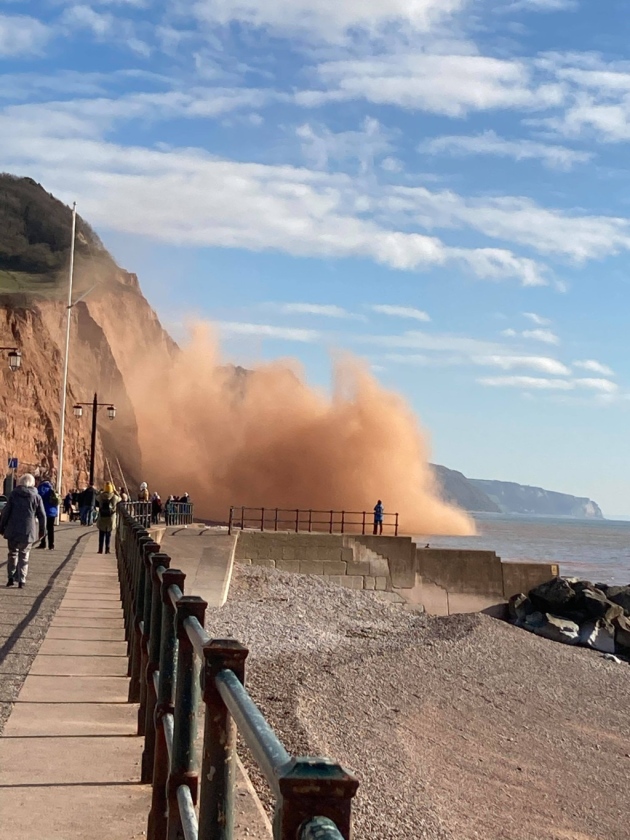
Caught on camera: dramatic cliff fall in Sidmouth – Friday

Go to Sidmouth Herald online to see more images

Alex Walton

PUBLISHED: 23:00 17 October 2020 www.sidmouthherald.co.uk 

Sidmouth cliff fall Picture: Linda Allen

A large cliff fall kicked up a dust cloud at East Beach in Sidmouth this morning (Friday, October 16).

Terry Whitmore from Exmouth was visiting the town and enjoying a walk along the seafront at the time of the fall.

She said: “It happened at 10.25am. There was a small fall just before the large one.

“It was an amazing sight. You could taste the dust.”

This latest cliff fall highlights just how dangerous this stretch of the coastline is and how susceptible it is to erosion.

It comes after a monitoring station was recently installed at Port Royal to observe and record changes caused by coastal erosion.

The public are strongly advised not to use this beach with fresh warning signs in place at the access point on the new bridge to deter any would-be adventurers.

Covid ‘clusters’ in 12 parts of East Devon with 69 new cases across district

Another 69 coronavirus cases have been confirmed in East Devon in the past week – with ‘clusters’ identified in a dozen of its wards.  

East Devon Reporter eastdevonnews.co.uk 

It means a total of 466 Covid-19 cases have now been recorded in the district, where the infection rate is 318.6 for every 100,000 people.

In Exeter, 379 new cases have been confirmed in the past seven days. The city’s overall total stands at 1,442 with an infection rate of 1,097.4.

There were 1,133 new cases across both Devon and Cornwall.

Statistics are from both ‘pillar one’ NHS data and ‘pillar two’ data from commercial partners.

Ninety-two new cases had been confirmed across East Devon – and 603 in Exeter -in the previous week.

However, around half of these were backdated due to a widely-reported national database glitch.

‘Clusters’ in 12 East Devon areas

A dozen ‘clusters’ – where three or more Covid cases have been confirmed – have been identified in East Devon in:

  • Cranbrook, Broadclyst and Stoke Canon (18 cases);
  • Exmouth Town (eight);
  • Clyst, Exton and Lympstone (seven);
  • Sidbury, Offwell and Beer (six);
  • Ottery St Mary and West Hill (five);
  • Exmouth Littleham (five);
  • Feniton and Whimple (five);
  • Axminster (four);
  • Exmouth Halsdon (four);
  • Budleigh Salterton (three);
  • Exmouth Brixington (three);
  • Exmouth Withycombe Raleigh (three).

The ‘clusters’ data, last updated yesterday afternoon (Friday, October 16), is based on a rolling rate of new cases by specimen date ending on October 11.

Figures are based on Middle Super Output Areas (MSOA) in England – broken down into zones of around 7,200 people.

‘Clusters’ have been identified in all of Exeter’s 15 wards:

  • Pennsylvania and University (193 cases);
  • Central Exeter (66);
  • St James Park and Hoopern (56);
  • Middlemoor and Sowton (28);
  • Mincinglake and Beacon Heath (23);
  • Alphington and Marsh Barton (20);
  • Pinhoe and Whipton North (19);
  • St Leonard’s (18);
  • Heavitree West and Polsloe (14);
  • Wonford and St Loye’s (14);
  • St Thomas East (12);
  • Heavitree East and Whipton South (ten);
  • Exwick and Foxhayes (nine).
  • St Thomas West (nine);
  • Countess Wear and Topsham (seven).

New cases across Devon and specimen dates

Some 943 new cases of coronavirus have been across Devon in the past week.

Of these, 69 were in East Devon, 379 in Exeter, 39 in Mid Devon, 50 in North Devon, and 176 in Plymouth.

There were 41 cases in the South Hams, 71 in Teignbridge, 88 in Torbay, 23 in Torridge and 27 in West Devon.

Cornwall recorded 170 new cases.

Of the 943 Devon cases, 581 had a specimen dare of between October 9 and October 15.

Fifty of these were in East Devon and 218 were in Exeter.

There were 109 in Plymouth, 45 in Torbay, 44 in Teignbridge, 40 in North Devon, 26 in the South Hams, 21 in Mid Devon, 15 in Torridge, and 13 in West Devon.

Eighty-two of Cornwall’s cases had specimen dates in the past week.

The number of people in hospital in the South West in the past week has risen to 151 from 77 and there are currently 17 people on a mechanical ventilator.

How the figures compare to the previous week

Of the 1,369 Covid cases confirmed across Devon and Cornwall in the week before last, 745 had a specimen date between October 2 and 8.

Some 310 of these were in Exeter and 45 were in East Devon.

Covid cases totals and infection rates

Devon has now recorded a total of 3,376 confirmed coronavirus cases. The county’s infection rate is 420.8 per 100,000 people.

Of these, 466 have been in East Devon, where the infection rate is 318.6.

Exeter’s total is 1,442 and its infection rate 1,097.4.

There has been a total of 1,268 cases in Plymouth, 550 in Torbay, 418 in Teignbridge, 320 in Mid Devon, 256 in North Devon, 220 in the South Hams, 137 in West Devon, and 117 in Torridge.

The total in Cornwall and the Isles of Scilly is 1,804 cases.

A total of 584,843 Covid-19 cases have been confirmed in England. The national infection rate is 1,039 per 100,000 people.

Hope for Covid vaccine at New Year

The NHS is preparing to introduce a coronavirus vaccine soon after Christmas. Trials have shown it will cut infections and save lives, Jonathan Van-Tam, the deputy chief medical officer, has privately revealed.

[Similar story carried here https://www.medscape.com/viewarticle/939260 ]

Tim Shipman and Andrew Gregory www.thetimes.co.uk 

He told MPs last week that stage three trials of the vaccine created at Oxford University and being manufactured by AstraZeneca mean a mass rollout is on the horizon as early as December. Thousands of NHS staff are to undergo training to administer a vaccine before the end of the year.

The government changed the law this weekend to expand the number of health professionals able to inoculate the public. The regulations will enable pharmacists, dentists, midwives and paramedics to administer jabs.

Van-Tam gave a briefing to MPs on Monday afternoon in which he said: “We aren’t light years away from it. It isn’t a totally unrealistic suggestion that we could deploy a vaccine soon after Christmas. That would have a significant impact on hospital admissions and deaths.”

The first vaccines will be given to the elderly and vulnerable and to vaccinate those most at risk will take several months. Most people will not be given the jab.

An MP who attended another briefing with Van-Tam said he was “very bullish about the third stage AstraZeneca results, which he expects between the end of this month and the end of next”. The MP said: “Van-Tam expects it to protect the elderly and vulnerable. He gave us to understand that it stopped the virus ‘shedding’ in the young. He said he would expect vaccination to start in January.”

Boris Johnson warned last week that there might never be a vaccine, but insiders say he did so because the government does not want to “overpromise and underdeliver”.

A health department official confirmed a “robust and comprehensive training programme” was being developed by the NHS and Public Health England to train more people to administer injections.

Matt Hancock, the health secretary, said: “These legal changes will help us in to make sure we are ready to roll out a safe and effective Covid-19 vaccine as soon as it has passed clinical trials and undergone rigorous checks by the regulator.” Van-Tam added: “Vaccines are being developed at a speed that, if successful, will save lives.”

Planning applications validated by EDDC week beginning 5 Oct

Coronavirus: Poll shows lack of trust in Boris Johnson as Britons feel the financial pinch from pandemic

British voters do not trust Boris Johnson and his health secretary Matt Hancock to beat coronavirus, according to a new survey – and less than a quarter (22 per cent) think it would be reasonable for ministers to expect them to keep obeying restrictions on their social and economic lives beyond the spring.

Andrew Woodcock, political editor www.independent.co.uk

The poll by BMG Research for The Independent laid bare the extent of financial hardship caused by the Covid-19 pandemic and the lockdown measures imposed by the government to fight it.

More than a quarter of those questioned (26 per cent) said that their household incomes had gone down as a result of the outbreak.

And some 3.4 per cent – the equivalent of more than 900,000 families or sole-person households – said their income had fallen by more than half.

The poll of 1,500 people was conducted as Mr Johnson struggled to maintain his grip on his regional coronavirus policy, with councils in the north rejecting his efforts to tighten local restrictions and Labour’s Sir Keir Starmer demanding a national “circuit-breaker” lockdown.

It found that just 36 per cent now trust the prime minister to lead the response to the pandemic, against 44 per who do not – an overall rating of -8. For Mr Hancock, the figures were more damning, with a trust rating of -13 based on just 26 per cent trusting him and 39 per cent expressing distrust.

The most trusted politician was chancellor Rishi Sunak, whose +19 rating of 44 per cent trust compared to 23 per cent distrust was no doubt buoyed by his role handing out close to £200bn in state support, including a furlough scheme paying up to 80 per cent of wages for employees unable to work.

Nicola Sturgeon had a +13 trust rating (42 – 29 per cent), soaring to +22 (52 – 30 per cent) in Scotland, while Starmer’s positive rating was a more modest +9 (36 – 27 per cent).

Levels of trust in the key pandemic experts were comfortably higher, with chief medical officer for England Chris Whitty scoring +25 (41 – 16 per cent) and chief scientific adviser Sir Patrick Vallance +21 (36 – 15 per cent).

The figure with lowest public credibility on dealing with coronavirus was US president Donald Trump, with just 11 per cent of Britons saying they trusted him  on the issue, against 73 per cent who did not.

There was little sign of optimism for an improvement to families’ financial position in the near future, with 25 per cent of those questioned saying that they expect their household income to decline further over the next six months. The period will see the replacement of Mr Sunak’s furlough scheme in November with a less generous system paying 22 per cent of wages – or 67 per cent for firms forced to close in tier 3 Covid alert areas.

And it will see the withdrawal in April of the £20-a-week temporary uplift to universal credit and working tax credit provided to help benefit claimants weather the coronavirus storm.

The poll found that those most likely to lose out financially due to coronavirus were 25- to 34-year-olds – those most likely to be bringing up small children – among whom 36 per cent said their household income had fallen, against just 10 per cent who said it had gone up. By contrast, just 8 per cent of over-65s reported financial loss.

Ethnic minority households were far more likely to report that they had lost income (35 per cent) than white British (24 per cent).

The director of policy at the Child Poverty Action Group, Louisa McGeehan, said the poll’s findings reflected the group’s own experience of families with children suffering money woes.

“As these figures suggest, parents of young children are more likely to be struggling due to falling incomes, lack of childcare and the additional costs of raising children,” Ms McGeehan told The Independent.

“Our own research found that eight in 10 hard-up families are financially worse-off as a result of the pandemic. Despite this, there has been no financial support from the government specifically targeted at families with children.”

Removing the benefit uplift in the spring “makes no sense”, said Ms McGeehan, calling instead for a  £10 weekly increase in child benefit to help protect children from hardship.

And Emma Revie, chief executive of foodbank charity the Trussell Trust, said: “It is shocking how many people have seen their incomes fall during the pandemic.

“This has led several thousands of people to be forced to use a food bank for the first time. This is not right.

“Our own research forecasts that if we don’t take action as a nation, our network of food banks will be giving out six food parcels a minute this winter.

“But it doesn’t have to be like this. This year we’ve seen the power of what happens when we stand together in the face of adversity. That is why we’re urging the government to preserve the lifelines that have saved many of us from destitution through this pandemic.”

Among the 26 per cent reporting a blow to their finances, around one in six (16 per cent) said their household income had fallen by less than 10 per cent, a quarter (25 per cent) said it was down by 10-19 per cent, a further 22 per cent had taken a hit of 20-29 per cent in their income, 10 per cent had lost 30-39 per cent, and 7 per cent had lost 40-49 per cent. But a staggering 13 per cent of this group – equivalent to 3.4 per cent of the population – said that the money coming into their home was down by more than 50 per cent as a result of the pandemic.

The poll found that 49 per cent of voters believe that the government is right to prioritise limiting the number of deaths caused by the disease, while 30 per cent say limiting the damage to jobs and the economy should come first.

But it also indicated that Britons’ patience may soon run out for the lockdown restrictions which have forced them to stay in their homes, give up visits to pubs and restaurants and limit socialising with friends and family.

A clear majority (65 per cent) said it was “reasonable” for the current restrictions in their area to continue until Christmas, against just 19 per cent who said it was not.

That majority fell if the restrictions were extended to the spring of 2021 – as Mr Johnson has suggested they might – with 46 per cent saying this would be reasonable and 34 per cent unreasonable.

But beyond this date, support for continued measures drops off a cliff, with 51 per cent saying it would be unreasonable to carry on to the end of 2021 and 59 per cent into 2022, even if no vaccine or effective treatment is found.

Only a hardcore 13 per cent of lockdown accepters said that it would be reasonable to keep measures going into 2022, and these people appear ready to maintain them almost indefinitely, as virtually the same proportion were happy to continue into 2023.

BMG head of polling Robert Struthers said: “Boris Johnson’s own personal ratings strengthened as the first wave of the pandemic hit the UK back in February and March of this year.

“Now, as the second wave of the virus takes hold, it appears public trust has slipped away. 

“The collapse in trust will likely worry those working across government, as the prime minister tries to reassure the public that the new measures introduced over the past week will be enough to halt the spread.”

Mr Struthers questioned whether Mr Sunak’s popularity would survive the  planned rollback of his support schemes.

“You might expect the trust ratings of the chancellor and prime minister to be closely aligned given how closely they will be working together at the top of government,” he said.

“However, this polling clearly shows that the public rate the chancellor’s performance and ability to hand the virus effectively – up until now at least – much more highly.

“However, as the second wave takes hold and economic support packages become more targeted and less generous, whether this trend continues is another matter entirely.”

– BMG Research questioned 1,500 UK adults between 8 and 13 October. 

Former Flybe shareholder Cyrus in talks about reviving collapsed regional airline

A shareholder in Flybe when it collapsed this year with the loss of thousands of jobs is in talks with its administrators about a potentially controversial bid to resuscitate the regional airline.

Mark Kleinman news.sky.com

Sky News has learnt that Cyrus Capital, a hedge fund with offices in Mayfair, is behind a plot to reacquire some of Flybe’s assets, despite the devastating impact of the coronavirus pandemic on Britain’s aviation industry.

Cyrus Capital, which is run in Europe by Lucien Farrell, is understood to be in discussions with EY – which was appointed to handle the company’s insolvency in March – about a deal.

It is said to want to relaunch a smaller version of Flybe next year, although the precise timetable would be subject to a recovery in passenger demand and the removal of coronavirus-related quarantine measures.

Flybe was Europe’s largest regional airline, carrying around 9m passengers annually and accounting for 40% of domestic UK flights.

It served more than 80 airports across Britain and Europe, including locations such as Belfast, Birmingham, Exeter, Manchester and Southampton.

It fought a frantic battle to survive, securing a rescue deal involving Cyrus Capital, Virgin Atlantic Airways and Stobart Group, the owner of Southend Airport, early last year.

However, it ran into fresh financial turbulence in January, with mounting losses prompting it to approach the government to seek emergency financial support.

Despite premature public comments from cabinet ministers including the transport secretary, Grant Shapps, that a deal had been struck to keep Flybe aloft, weeks of talks about a £100m state loan foundered.

Opponents of a government funding package were led by Michael O’Leary, the Ryanair boss, who called it “a billionaires’ bailout” in reference to Sir Richard Branson’s involvement in the ownership of Flybe.

The company eventually called in administrators in early March, causing more than 2300 job losses, with Virgin Atlantic’s refusal to inject new funding the eventual catalyst for its collapse.

Virgin Atlantic was forced to seek its own bailout this year following the slump in international air travel.

More than a dozen of Flybe’s routes have been taken on by Loganair, another regional carrier, although many remain unfilled.

Further details of Cyrus Capital’s plans to revive Flybe, including whether it would seek to use the defunct airline’s name, were unclear this weekend.

A number of former Flybe executives are understood to be involved in the proposed relaunch.

The hedge fund held a 40% stake in Connect Airways, Flybe’s parent company, before its insolvency.

According to an administrator’s report, it was also the largest secured creditor, with £53m of loans outstanding when EY was appointed.

Cyrus Capital and EY declined to comment.

As well as Virgin Atlantic’s privately funded rescue deal, International Airlines Group, the owner of British Airways and Aer Lingus, has tapped shareholders for more than £2bn of additional equity since the COVID-19 crisis began.

Sky News revealed earlier this month that easyJet had warned the government that it might require further state support beyond its access to the Bank of England’s coronavirus funding programme

Further evidence of the continuing crisis in the aviation sector was provided this weekend as the UK’s biggest airport entered into a new phase of consultation with employees, heightening the possibility of substantial job losses.

Heathrow Airport has been consulting with unions since early last month about revised pay deals for thousands of staff, but the statutory 45-day period expired on Friday with no deal in place.

That will involve individual consultations with up to 4700 affected employees, although the number of any eventual job losses will be significantly lower than that.

Kathryn Leahy, Heathrow’s director of operations, said: “In order to ensure our business recovers from this crisis and is sustainable and competitive in the future, changes need to happen.

“For the past 45 days we have been in formal talks with our unions, but we have been unable to reach an agreement.

“Whilst we will continue to talk, we now need to move on to the next stage of this process with our colleagues.”

She added that Heathrow, which has seen passenger numbers plummet this year, had “a new future ahead of it and in order to be competitive, we need to create cost efficiencies across the business”.

Ms Leahy insisted that the company’s pay offer meant there was “a job for everyone who wants one”.

Heathrow’s plan involves equalising pay, with a ‘buy down’ offer – for those whose salaries will be decreased – involving the difference being paid in a lump sum or in monthly instalments over a two-year period.

The airport has told unions that while no further pay deals will be considered until the beginning of 2023, that would be reviewed if passenger numbers return to at least 80% of 2019 levels across three consecutive months compared with the same three-month period in 2019.

Not following the science: How No 10 parted company with Sage

“The base will not be sufficient.”

Ian Sample www.theguardian.com 

With owlish understatement, the chief medical officer for England, Chris Whitty, made clear that Boris Johnson’s three-tier local lockdowns, which the prime minister had just set out alongside him in Downing Street, would not curb the second wave of coronavirus crashing over England.

Just hours later, a startling late-night document dump from the government’s Scientific Advisory Group for Emergencies (Sage) confirmed in stark terms that Johnson had parted ways with his scientific advisers.

With Sage’s call for action out in the open, it became clear that the national consensus in the fight against coronavirus, increasingly strained over the past six months, had ruptured. From Andy Burnham on the steps of Manchester city hall refusing to allow his city to become the “canary in the coalmine”, to furious Conservative MPs attacking the health secretary, to Keir Starmer calling for a “circuit breaker”, the prime minister was beset by critics on all sides.

And with winter approaching, there were growing concerns in government about the public’s willingness to comply with measures they could see being attacked from across the political spectrum.

The seeds of this week’s disarray were sown almost a month earlier. Whitty and the chief scientific adviser, Patrick Vallance – CMO and CSA as they are known in Whitehall – briefed Johnson on 16 September about what one person present called the “terrifying reality” of allowing the virus to go unchecked.

But eight months into the pandemic, Downing Street is unashamedly listening to other voices. “People will look at Sage papers and go, ‘Oh, they’re not following the science’, but Sage is only one part of the decision-making process, and always has been,” said a Downing Street aide.

Many key decisions are made by the Covid operations committee, which receives, as well as scientific papers, economic analysis, reports from the NHS and NHS Test and Trace, and gives updates on how other governments are managing the crisis.

“Fundamentally, this has always been the challenge the prime minister has,” the aide said. “Pretty much everyone else has a focused area. Understandably, because that’s their job – you have Alok [Sharma] looking at the impact on businesses, Rishi [Sunak] looking at the wider economy, Matt [Hancock] looking at health costs. The PM’s the one who has to tie all that together.”

Sunak allies say the chancellor is relentless in questioning the data and “pushy” where he feels ministers are parroting their department’s line without analysis to back it up. “There have been times when he’s been, like, ‘Sorry, what’s your basis for X?’, and it falls apart.”

Hancock was pressing for tough action to be taken urgently – but focused on the worst-affected areas.

By Monday 21 September, it was becoming increasingly clear inside government that Johnson had decided to try to walk a middle course, between the alarmed scientists and the lockdown sceptics in his party, including the chancellor.

“‘Circuit breaker’ felt a bit like a hammer to smash a walnut,” says a government source about the discussions that weekend, which went on late into Sunday night. “When you’re looking at cases in the south-west and south-east, to cripple those economies and totally ruin lives in a different way would feel a disproportionate response.”

While No 10 was quietly shifting towards a largely local approach, the experts on Sage were determined to send a strong message to Downing Street as they fired up Zoom for their 58th meeting on Monday 21 September.

Over the weekend, they had had time to read an eight-page paper summarising “the effectiveness and harms of different non-pharmaceutical interventions”. It was co-written by a number of Sage experts, with a cover note from Prof John Edmunds, dean of the faculty of epidemiology and population health at the London School of Hygiene and Tropical Medicine.

While most Sage papers are technical and dry, this one was different. The language was frank and bleak. It spoke of coronavirus cases rising around the country and intensive care beds filling up. A failure to act immediately, it warned, would unleash an epidemic with “catastrophic consequences”.

Most of those taking part in the meeting knew this all too well. From the opening moments, it became apparent that everyone felt the same: the situation demanded action, and fast.

They concluded that no single intervention would get on top of the outbreak. A second document, circulated before the session, gave the numbers: the impact different restrictions would have on R, which must be below 1 for the epidemic to shrink. At the time, Sage’s national estimate for R was 1.1 to 1.4. Close all bars, pubs, cafes and restaurants and R might fall by 0.2. Close the schools and it could fall by as much as 0.5.

 Boris Johnson delivers statement on new three-tier coronavirus restrictions for England – video

In the event, the experts proposed a package of interventions – “required urgently” – to push the rate of new infections down and prevent the epidemic spiralling out of control. On the shortlist were a circuit breaker, or two-week mini-lockdown; advice to work from home where people could; a ban on indoor mixing with other households; the closure of all bars, restaurants, cafes, indoor gyms and services such as hairdressers; and for all university and college teaching to be online unless absolutely essential.

They felt a two-week circuit breaker was particularly appealing. The mini-lockdown could replace two weeks of growth with two weeks of decline, pushing the epidemic back four weeks. England’s struggling test and trace system would likely catch more people. An inexorable rise might become a sequence of smaller, sawtooth peaks. All the measures had downsides, but doing nothing was worse. When the meeting wrapped up, the consensus was clear: England needed decisive action.

Yet the following day, when Johnson announced new restrictions, it became clear that Sage’s call to arms had gone unheeded. The centrepiece was a 10pm curfew on hospitality – and a reversal of Johnson’s message, a few weeks previously, to go back to the office.

Some Conservative MPs welcomed the prime minister’s willingness to deviate from the path set by the scientists. One former cabinet minister praised Johnson for his leadership. “Once you say publicly that you’re following the science, then you basically have to do everything that Chris Whitty says, and I think that’s very unhealthy, because that’s asking him to do something that he’s not actually qualified to do,” he said.

One Whitehall source remarked waspishly that if the government had followed Sage, “we would never have come out of lockdown”, adding, “They’ve always wanted to let nothing happen.”

Sceptics about the circuit-breaker plan argue that it merely buys time. “It doesn’t change the fundamental path of the virus. The argument that it changes the trajectory is scientifically wrong. Unless you’re expecting it to change behaviour, in which case it’s not a circuit breaker, it’s about frightening people, and there are better ways of doing that.”

But in the face of the government’s lack of action, Sage members turned to the media to hammer home their point. Edmunds and Graham Medley, a member of Sage and professor of infectious disease modelling at the London School of Hygiene and Tropical Medicine, went public with some of their concerns.

But inside government, negotiations were ongoing about the details of a three-tier local Covid alert system. Insiders said this was actually Hancock’s idea. “He’s pleased that approach has won out,” a source said, describing the policy as a result of the “healthy challenge” between those with different responsibilities.

Among the scientists, however, frustration was evolving into alarm and fear. At a subsequent Sage meeting, Whitty looked “quite murderous”, one researcher was told after the session.

It was his Sage co-chair, Vallance, who decided to publish the minutes of the committee’s fraught discussions of September. The timing was striking: it was the earliest moment Vallance could have made them public – and it dramatically reignited the public debate over a circuit-breaker lockdown.

The release of the papers had been signed off by the Cabinet Office. Downing Street hoped the more extreme options laid out would help reassure anti-lockdown renegades on the Tory benches that far from taking an extreme course, the prime minister was holding the line.

Instead, Steve Baker and his band of rebels underlined the prime minister’s fragile base by delivering a carefully calibrated symbolic rebellion, with 42 Conservative MPs voting against the government.

The sharp contrast between the scientists’ evident alarm and the government’s modest measures hadn’t gone unnoticed by Keir Starmer. “Constructive opposition requires a constructive government,” said one source close to the Labour leader. “There’s a frustration that every time we put a proposal, it’s dismissed, only to be adopted a couple of weeks later.”

Much of the decision-making about Labour’s handling of the pandemic takes place at Starmer’s Covid committee, an inner shadow cabinet. Meeting several mornings a week by Zoom, the group includes the shadow health, foreign and home secretaries, Starmer’s deputy, Angela Rayner, the shadow chancellor, Anneliese Dodds, and Rachel Reeves, the opposite number to the powerful Cabinet Office minister, Michael Gove.

Increasingly alarmed about the trajectory of the disease, they had been discussing the idea of a short-term circuit breaker since the idea emerged from leaked accounts of Sage meetings. By the time they met on Saturday 10 October, there was “pretty much a consensus” to back a short, sharp shutdown, but they decided to wait for the prime minister’s statement to parliament on Monday before taking a public stand.

The group met again on the Tuesday morning to make their final decision. It was signed off by the wider shadow cabinet at lunchtime, and Starmer’s team contacted Labour’s metro mayors to prepare the ground.

Later that day, Starmer gave his dramatic press conference at the Garden Museum just across the river from Westminster, endorsing a two- to three-week circuit breaker, albeit with schools kept open.

The prime minister’s allies insist that they are “really relaxed” about Starmer’s intervention. They believe when the hard winter has passed, Johnson will come into his own. “When we get to the spring, and we get over the hump of this, then it will all be about building confidence; and then it gets more like a campaign. That will be a very natural groove for him,” said one.

But the mood among scientists remains gloomy. Jeremy Farrar, a doctor on Sage and director of the Wellcome Trust, described the measures as “the worst of all worlds”. His comments reflect a pessimistic mood on Sage as Covid continues its relentless march.

On Friday, the Office for National Statistics estimated that 28,000 people had caught the virus each day between 2 and 8 October.

Stephen Reicher, a professor of social psychology at the University of St Andrews and a member of the behavioural science subgroup of Sage, said: “For me, this was not just another decision. It seemed to portend something much larger in terms of the way the science is treated.” The measures, he said were a “middle-of-the-road fudge … This is like going to sea in half a boat”.

How Boris Johnson’s indecision over a second Covid-19 lockdown is splitting the Conservative Party

Is the Covid-19 pandemic the start of a new era, or merely a painful interruption of the old one? The Conservative Party is split in its answer, and its fractious tribes reach these two conclusions through a ­variety of different routes.

By Stephen Bush www.newstatesman.com 

Rishi Sunak, the Chancellor, has used his private meetings with Conservative MPs not to advance his credentials as a ­future party leader, but to deliver an altogether bleaker message: that the economic ­activity lost during this period will not ­return. The British economy will be ­suffering from its own form of “long Covid” for some time. The biggest headache, as far as Sunak is ­concerned, is that the government’s debt will be more than 100 per cent of GDP for the foreseeable future, but the complications extend much further.

The Sunak economic remedy involves an immediate reduction of financial support for businesses, no second lockdown and a tax-raising budget sooner rather than later. The coronavirus crisis has robbed Sunak of the opportunity to use his first budget to hike taxes long before a general election, as chancellors tend to do, and both he and Treasury officials are keen to catch up as soon as possible.

For other Conservatives, the ­problem with lockdowns is as much social as it is economic: they bridle against the infringement of ­liberty and extensive involvement of the state in people’s lives. “It’s not a question of whether we can afford it,” one ­backbencher told me, “it’s a question of whether a Conservative Party should be locking people in their homes and forcing businesses to shut.”

For a third group, the central challenge is that the crisis is without a clear end. They note that it took the best part of a decade for medical science to produce an Ebola vaccine, and that vaccines for HIV/Aids or Sars have yet to arise. Palliative treatments have hugely advanced the care of patients with HIV/Aids, but they were the work of decades, not years.

Is it fair, some Tory MPs wonder, to ask people to spend years socially distancing from one another when there is no ­guarantee of a medical breakthrough? “We have to talk about quality of life,” says one veteran ­Conservative. “Is it really in anyone’s ­interests for an 87-year-old to spend the last years of their life locked up, unable to visit their family or attend a wedding, without a clear end date?”

All three groups, whatever route they take, reach the same conclusion: that the country needs to live with the new disease, not hide from it. Only a loud minority believes that there should be no restrictions on anything – in Westminster they are more commonly found not in the House of Commons but in the House of Lords, where among Conservatives there is a sizeable group of what one peer ­derides as “flat-earthers”.

Most think that some form of restrictions are necessary and a greater level of surveillance is a sad necessity, but that lockdowns – and painful limitations on ceremonies, religious worship and students – need to be scrapped, and government policy should facilitate a greater level of freedom and normality within those constraints.

On the other side are those who think coronavirus is something to be endured and overcome, not adapted to. Similarly, several different lines of thought lead to the same conclusion. There are those like Michael Gove, who has told MPs that the biggest weapon that Nicola Sturgeon has is the perception that she is a safe pair of hands, while Westminster is playing fast and loose with public health. There are those like Matt Hancock, whose overwhelming priority is to avoid a second spike that is more lethal than the first. And there are others who believe that there can be no economic recovery while social distancing remains in place – and that the time for the British government to grapple with the extraordinary debts it has taken on will come before, not after, lockdown measures are brought to an end.

These factions all come down in favour of something resembling a second lockdown and a series of economic measures to keep the economy in cryogenic suspension ­until either palliative treatments or a vaccine ­allows them to make progress.

The problem is that Boris Johnson is a member of neither movement, though he flirts with both. He talks up the importance of new treatments, and has imposed fresh lockdowns on large swathes of England: on 12 October he announced a three-tier system of restrictions, placing Merseyside in the highest category. Yet he rejected ­recommendations by Sage – the ad hoc body of medical and scientific experts that ­advises the government – for a swift reduction in freedoms and a second ­nationwide lockdown.

Johnson’s defenders like to describe the Prime Minister as someone finding a middle or third way between extremes. The problem is that the third way doesn’t exist: you either support the economy during lockdown, or you don’t. You either remove the barriers to the country learning to live with coronavirus, or you don’t.

The Prime Minister’s present course is the worst of all worlds: a lockdown without sufficient economic support, and a regulatory environment that prevents businesses from adjusting to the new world. The mess is not surprising given Johnson’s trajectory. His political success has always been based on telling the country it can have it both ways: spending rises and tax cuts, a close relationship with the European Union and a reclamation of sovereignty. Now, events have forced him to pick one of two options, and his approach is to pretend there is a middle way. It hasn’t worked. The question is how much damage his indecision will do to the country’s economic and physical health before he realises as much.

Improving Broadband – National Audit Office (NAO) Report

“Government has set a very challenging timeline in promising nationwide connectivity by 2025 and the experience from the Superfast Programme, as well as our previous work on major programmes demonstrates the importance of setting and publishing a realistic timetable and continuing to test whether this is achievable.”

Owl can read between the lines- don’t hold your breath!

www.nao.org.uk

Background to report

In 2010, government announced its aim for the UK to have the best superfast broadband network in Europe. It established the Superfast Broadband Programme (the Superfast Programme) to support broadband roll-out to areas which were not commercially viable. The Department for Digital, Culture, Media and Sport (the Department) allocated grant funding to local bodies (a local authority or group of local authorities, devolved governments or local economic partnerships). Local bodies would then provide additional funding and procure superfast broadband services for their areas. The Superfast Programme’s original target was for 90% of premises to have access to download speeds of at least 24 megabits per second by 2015. In June 2013, the Department revised its target to achieving 95% by 2017. These targets could only be met in conjunction with industry-funded roll-out.

Superfast broadband is fast enough for most household use today, but internet traffic is growing at around 40% each year driven largely by video streaming. In 2018, to meet future demands of consumers and businesses, government announced a new policy for the UK’s telecoms industry to provide gigabit-capable infrastructure to 50% of premises by 2025 and nationwide coverage by 2033. It has since committed to 2025 for nationwide coverage and has allocated £5 billion for its UK gigabit programme (the Future Programme), to subsidise roll-out to the most difficult to reach 20% of premises. The Department estimates that accelerating nationwide gigabit capability to 2025 will need government to subsidise roll-out of 20% of premises compared with only 10% for a 2033 timeline.

Scope of the report

This report considers what the Superfast Programme has delivered and how the UK’s broadband infrastructure has held up during the COVID-19 pandemic. We examine the lessons from the Superfast Programme and other comparative projects, and how the Department could apply these as it establishes its Future Programme.

The report focuses on the role of the Department and considers:

  • progress with superfast broadband (Part One);
  • managing current and future broadband provision (Part Two); and
  • learning lessons (Part Three).

The Department is still developing its plans for the Future Programme. It expects to let its first contracts in autumn 2021 and is currently awaiting approval of its outline business case. This report therefore does not examine the Department’s progress on the Future Programme in detail. Those that are digitally excluded out of choice or for financial or other reasons are also out of scope.

Report conclusions

The Superfast Programme has extended the nation’s broadband connectivity and has delivered benefits, which the Department expects will continue to increase with time. Better broadband has helped communities across the nation to work and study from home and stay connected during the COVID-19 pandemic in ways that would not have been possible five years ago. However, in managing the trade-off between coverage and speed, the UK has a broadband network that is not fully future-proof and, less than a decade after launching its Superfast Programme, government has identified the need to upgrade it again.

Government has set a very challenging timeline in promising nationwide connectivity by 2025 and the experience from the Superfast Programme, as well as our previous work on major programmes demonstrates the importance of setting and publishing a realistic timetable and continuing to test whether this is achievable. The Department is working towards finalising its plans for its Future Programme to support nationwide gigabit coverage. In doing so, it must manage the tension between meeting a timeline and serving those in greatest need. Failure to do so risks leaving those left behind by the Superfast Programme even further behind and widening the rural divide. The Department still has much to do to mobilise and deliver a substantial programme. It has applied some learning from the Superfast Programme but it has moved away from some of its more successful aspects in a bid to meet its challenging timeline. As the Department develops its approach for the Future Programme it will need to show that it has considered how best to mitigate any new risks arising.

Hotel industry reels as COVID three-tier system bites in Devon

“The value of the visitor economy to Devon is £2.5BN and people employed is 63,000 and the estimated loss of revenue due to the pandemic is £1.3BN. The visitor economy is vital to the region, and many businesses will not survive this next phase if further assistance is not forthcoming. “

Eye-watering numbers – Owl has always believed that our local economy is dangerously over-exposed to tourism. It is an economic sector which provides seasonal and low paid employment. Future recovery plans must look to diversification. Not an easy task when tourism is so entrenched.

Colleen Smith www.devonlive.com

The tourism and hospitality industry across Devon is reeling as the new three-tier COVID restrictions have started to hit hard with redundancies, closures and financial losses already amounting to hundreds of million pounds.

The largest hotel group in Devon, TLH Leisure Resort which employed 420 people in Torquay, has already made redundancies and has warned staff there will be more job losses to come.

Hotel and coach tour companies are reeling as the three-tier system of local lockdowns limits millions of people from travelling outside their local areas.

Sally Everton, Visit Devon’s tourism boss, said: “The repercussions this will have across the many tourism and hospitality businesses across the county is immense.

“With travel restrictions now in place for many people across the country, the adverse knock on effect into half term will be catastrophic for many. Cancellations had already started with the Rule of 6, which of course includes children, so many group and extended family group bookings had already gone affecting many self catered accommodation providers.

“I am now hearing of increasing cancellations across the county from all areas, which is a major concern. The lost revenue for October half term is estimated at over £287M which is hugely worrying for us.

“The value of the visitor economy to Devon is £2.5BN and people employed is 63,000 and the estimated loss of revenue due to the pandemic is £1.3BN. The visitor economy is vital to the region, and many businesses will not survive this next phase if further assistance is not forthcoming. “

Carolyn Custerson, Chief Executive Officer of the English Riviera BID Company Ltd, said that in Torbay alone the tourist industry has lost £138 million because of COVID: “All the new COVID restrictions are unfortunately going to have repercussions for our local Tourism and Hospitality businesses with a large part of our market now unable to travel on holiday.

“We have already seen notable Group Coach cancellations which is very worrying.

“We will continue to promote the English Riviera and Devon as a great year-round destination but have no choice but to focus our activity closer to home whilst these latest restrictions are in place.

“The English Riviera has lost £138 million so far from the impact of COVID.”

Torbay relies heavily on the tourist industry and many staff who were on furlough during the first lockdown will now be put on to the new and less generous Job Support Scheme (JSS) which will be introduced on November 1.

JSS will replace furlough from November 1 for six months. The Chancellor announced it will be targeted at businesses required to close entirely due to tighter local or national coronavirus restrictions.

Under these proposals, the government will pay two-thirds of wages for businesses forced to close in the coming months as it seeks to slow the rise in coronavirus cases.

Jason Garside the CEO of TLH Leisure Resort – a huge complex of linked hotels and leisure facilities covering 7.5 acres near the Riviera Conference Centre, said the business had gone from an annual turnover of £14m to a likely £8m this year – and that was boosted by the boom in August and September this year when guests flocked to the Bay.

He said: “We are currently dealing with the loss of all our Welsh business.”

Mr Garside said TLH was in a strong cash position before COVID and because of that the business will survive.

He said: “We will survive this and we want to retain our loyal dedicated workers – 70 of our staff have been with us for more than 10 years. It’s more costly to keep staff than it is to make them redundant.”

But he said that after making a strong start the Government was losing its way: “The new Job Support Scheme does not go far enough to support the hospitality business.

“It’s not going to mitigate fully against job losses. We will use it over the next six months and attempt to retain as much of our workforce as we can.

“Business levels are less than a third of historic levels for the next six months.

“We have already made some redundancies. We employ 420 people and initially we made around 32 full time equivalent posts redundant – less than 10 per cent. Now we are reviewing future redundancies.

“We are going to use JSS and we have informed our workforce that we will retain as many as we can.”

Mr Garside was part of a management buyout of the hotel group in 2018 along with fellow directors Iain Piercy and John Finnegan.

He said: “It’s frustrating that the government have not got to grips with track and trace and we are disappointed with how they are communicating through media announcements followed by late guidance.

“It’s further eroding confidence. We went to great lengths to ensure we were a COVID secure hospitality business.

“We experienced a boom in August and that was very positive for us. But then a week ago the Government announced tiering and further restrictions on parts of the country. “

Mark Wright, director of Majestic Tours and the Torquay Majestic Templestowe Hotel, said: “We have refunded in excess of £2million this year due to cancelled tours.

“It really is a scary time for everyone and it looks like a number of hotels along Belgrave Road have closed.”

Majestic Tours usually brings over 350 coaches of holidaymakers a year to Torquay.

“Hopefully, we will all be able to trade through the winter, all be it on reduced numbers of guests, able to keep all our staff employed – without the safety net of furlough.

“In relation to coaches from Wales, we haven’t had an arrival since South Wales went into lockdown.

“We cancelled all coaches departing from Wales from the 25th September immediately they had lockdown announced and refunded all clients.”

In the meantime the Templestowe is closed for a two week £100,000 refurbishment to the ballroom.

Cases rising steadily and rapidly in the North of England – Covid-19 symptom tracking app

16 October 2020. According to the data, Burnley and Manchester, the two regions already earmarked by the Government to be next to enter Tier 3, are top of the app’s Tier Prediction model. The next regions are; Newcastle upon Tyne, Nottingham, Bury, Hartlepool, Salford, Sheffield and Leeds.

covid.joinzoe.com

According to the COVID Symptom Study UK Infection Survey figures, there are currently, 27,762 daily new symptomatic cases of COVID in the UK on average over the two weeks up to 11 October (excluding care homes) [*]. This compares to 21,903 daily new symptomatic cases a week ago. This figure is based on the number of newly symptomatic app users per day, and the proportion of these who give positive swab tests. The latest survey figures were based on the data from 13,361 recent swab tests done between 27 September to 11 October.

The app’s data continues to show a big disparity between the North and South of England. This week the North West (7,313 new cases per day) has overtaken the North East and Yorkshire (5,762). The South West (1,279) remains the lowest region, followed by East of England (1,356) and South East (1,417).

The COVID Symptom Study is now using its symptomatic COVID estimates to predict which regions in the UK could be next to be put under Tier 3 restrictions. Using predicted symptomatic cases means that predictions can be made up to ten days before confirmed tested cases are made public. The new Tier Prediction model takes the Tier 2 regions as defined by the Government (100,000 cases per million), uses the average estimated cases over the last seven days and ranks the regions in descending order. The area with the largest weekly average prevalence is ranked the highest. According to the data, Burnley and Manchester, the two regions already earmarked by the Government to be next to enter Tier 3, are top of the app’s Tier Prediction model. The next regions are; Newcastle upon Tyne, Nottingham, Bury, Hartlepool, Salford, Sheffield and Leeds.

The COVID Symptom Study UK Infection Survey has been running since early May when the COVID Symptom Study commenced the daily swab testing programme provided by the Test and Trace. The CSS has so far recorded over a million swab results from app users. The COVID Symptom Study UK Infection Survey estimates the number of current COVID-19 positive cases in the community based on the information logged by users in the app and the results from the swab testing programme. It identifies differences in numbers within the regions throughout the UK, and tracks the change in estimated cases over time. It is the largest survey of its kind in the UK.

The COVID Symptom Study app is a not-for-profit initiative that was launched at the end of March 2020 to support vital COVID-19 research. The app was launched by health science company ZOE with scientific analysis provided by King’s College London. With over 4 million contributors, the Study is the world’s largest ongoing Symptom study of COVID-19.

Tim Spector, Professor of Genetic Epidemiology at King’s College London, comments:

“The data is no longer showing the exponential increases that we were seeing a couple of weeks ago, but is clearly showing new cases continuing to rise. The North West still has the most cases and the fastest acceleration of cases with doubling times of around 10 days. Slowing this rapid rise is a priority. Scotland, Wales, London and the Midlands are slowly increasing with a doubling time of 14-28 days and the South and East of England remaining relatively flat with five-fold fewer cases than the worst hit regions. Our data is roughly 7-10 days ahead of other sources meaning that it acts like an early warning system, whilst we wait for the data from the confirmed cases.

Our new Tier Prediction model highlights that nine out of 10 are in the North of England, where most of the cases currently are concentrated, unlike the North which is accelerating, London has been showing a steady linear increase, doubling every 21 (range 14-28) days so it will be interesting to see how the new Tier 2 restrictions influence the rate of new cases in the next two weeks.”