What are the rules of the new national Covid lockdown in England?

Boris Johnson has announced a four-week lockdown in England, following weeks of pressure from his own scientific advisers and opposition parties to introduce tougher measures to tackle coronavirus. The full details of the restrictions will be published on Tuesday before a vote in parliament, but this is what we know so far.

Jedidajah Otte www.theguardian.com 

When is England going into lockdown?

The measures will come into place at midnight on Thursday after MPs vote on them this coming week. While the lockdown will end on 2 December, it will be replaced with the current tier system and local restrictions will be introduced depending on an area’s infection rate.

Can different households mix indoors?

No, not unless they are part of an “exclusive” support bubble, which allows a single-person household to meet and socialise with another household.

However, people are allowed to meet one other person outside for “recreation” as well as exercise, and parents are allowed to form a childcare bubble with another household for the purposes of informal childcare, where the child is 13 or under.

What can I leave home for?

People can only leave home for the following reasons:

  • Education.
  • To go to work unless it can be done from home.
  • Outdoor exercise either with household members or with one person from another household.
  • For all medical reasons and appointments.
  • To escape injury or harm.
  • To care for the vulnerable or volunteer.
  • To shop for food and essentials.
  • To see people in your support bubble.
  • Children will still be able to move between homes if their parents are separated.

However, people could face fixed penalty notices from police for leaving their home without one of the above excuses.

Can I travel?

Most outbound international travel will be banned.

There is no exemption for staying away from home on holiday. This means people cannot travel internationally or within the UK, unless for work, education or other legally permitted exemptions.

Overnight stays away from primary residences will not be allowed, except for specific exceptions including for work.

Which businesses will close?

Everything except essential shops and education settings, which include nurseries, schools and universities, will close.

Entertainment venues will also have to close. Pubs and restaurants will have to close their doors once more. Takeaway and delivery services will still be allowed, while construction and manufacturing will stay open.

Parents will still be able to access registered childcare and other childcare activities where reasonably necessary to enable parents to work.

Public services, such as job centres, courts, and civil registration offices will remain open.

There is no exemption for communal worship in places of worship (except funerals and individual prayer), for organised team sports, or for children’s activities.

Elite sports will be allowed to continue behind closed doors as currently, including Premier League football matches.

Should some people be shielding?

The prime minister said that the clinically vulnerable or those aged over 60 should be especially careful and minimise contacts, but there would be no return to the shielding programme used in the first lockdown. Johnson said those in this category should work from home.

Will there be a return to the furlough scheme?

The furlough scheme was set to end on Saturday and be replaced by a less generous package of support for employers and businesses. But that was before the announcement of a second lockdown. The PM said on Saturday that the old scheme – which pays 80% of salaries – would now be extended throughout November. No further details were given.

Why has the decision been made?

Confirmed cases are rising steeply, with an estimated 568,100 people in households infected in the week ending 23 October. Scientists on the Scientific Advisory Group for Emergencies (Sage) have warned that deaths could potentially hit 500 a day within weeks and that coronavirus could kill 85,000 people this winter.

The group has been concerned that the number of infections and hospital admissions is “exceeding the reasonable worst-case scenario planning levels at this time” and they first called for a national lockdown on 21 September.

“We’ve got to be humble in the face of nature,” said Johnson on Saturday. “The virus is spreading even faster than the reasonable worst-case scenario of our scientific advisers.

“Unless we act, we could see deaths in this country running at several thousand a day – a peak of mortality, alas, bigger than the one we saw in April.”

What difference could a lockdown make?

A lockdown can stem the spread of the virus and thus reduce the reinfection rate.

“The idea of a lockdown is to save lives primarily,” Prof John Edmunds, a member of Sage, told BBC Radio 4’s Today programme on Saturday. “I think the only real way that we have a relatively safe Christmas is to get the incidence right down.”

Johnson warned that “Christmas is going to be different this year” but

added that by taking action now, he hoped that families could be together.

Add vitamin D to bread and milk to help fight Covid, urge scientists

Scientists are calling for ministers to add vitamin D to common foods such as bread and milk to help the fight against Covid-19.

James Tapper www.theguardian.com 

Up to half the UK population has a vitamin D deficiency, and government guidance that people should take supplements is not working, according to a group convened by Dr Gareth Davies, a medical physics researcher.

Low levels of vitamin D, which our bodies produce in response to strong sunlight, may lead to a greater risk of catching the coronavirus or suffering more severe effects of infection, according to some studies. Last week, researchers in Spain found that 82% of coronavirus patients out of 216 admitted to hospital had low vitamin D levels. The picture is mixed, however – some research shows that vitamin D levels have little or no effect on Covid-19, flu and other respiratory diseases.

Vitamin D deficiency can cause rickets in children and osteomalacia in adults – soft bones that lead to deformities – and children with severe vitamin D deficiency are prone to hypocalcaemia – low levels of calcium in the blood – which leads to seizures and heart failure.

However, Public Health England (PHE) and the Department of Health and Social Care have rejected calls over the past 10 years to fortify foods such as milk, bread and orange juice, which is the practice in Finland, Sweden, Australia and Canada.

“In my opinion, it is clear that vitamin D could not only protect against disease severity but could also protect against infection,” Davies said. “Food fortification would need careful planning to be rolled out effectively, particularly as people are now taking supplements. Picking the right foods to fortify would need to be done carefully.

“But it’s clear that the current policy is not working – at least half the population have a vitamin D deficiency.”

Adrian Martineau, professor of respiratory infection at Queen Mary University in London, who is not part of Davies’s group, is leading a clinical trial to examine whether vitamin D can reduce the risk of Covid-19, or its severity. The Coronavit study, which began last week and is backed by the Barts Charity, the Fischer Family Trust and the AIM Foundation, will follow more than 5,000 people through the winter.

“The government recommends that the whole population takes vitamin D supplements in winter months, and those in high risk groups take it all year round,” Martineau said. “But we know that people just aren’t doing that in any significant numbers. Even I forget to take my supplement sometimes, and I’m living and breathing this subject. Fortification is a really good way of eliminating deficiency.”

Our bodies produce vitamin D in response to strong sunlight. In the UK, that means that from October to March, people need to rely on other sources: oily fish, eggs and food supplements.

Some foods, such as breakfast cereals and mushrooms are fortified with vitamin D, and people in low-income households are entitled to free multivitamins. White flour in the UK is already fortified with vitamins B1 (thiamin) and B3 (niacin), and last year the government began a consultation on adding vitamin B9 (folic acid) to help prevent spina bifida and other birth defects of the brain and spine.

A 2019 study at the University of Birmingham, led by Magda Aguiar, a health economist, showed there would be at least 25% fewer cases of vitamin D deficiency over the next 90 years if flour fortification were adopted, saving about £65m.

In 2017, Professor Louis Levy, PHE’s head of nutrition science, responded to calls for fortification by saying that there was not enough evidence that vitamin D would reduce the risk of respiratory infections.

The Department of Health and Social Care was approached for a comment but failed to respond.

Recruitment to the clinical study trial at Queen Mary University has recently been extended. Observer readers who would like to find out more should email coronavit@qmul.ac.uk

For the health of the nation, shouldn’t Johnson’s medical fitness for office be scrutinised?

Just six words, Doctor Who said, would be enough to bring down the unprincipled prime minister Harriet Jones. “Don’t you think she looks tired?”

Would it work on a man?………

Catherine Bennett www.theguardian.com 

……. Time to find out. “I have read a lot of nonsense recently, about how my own bout of Covid has somehow robbed me of my mojo,” Boris Johnson said in his party conference speech. Was he thinking of the Daily Telegraph, where he appeared“strangely out of sorts”, or of the protracted lament by a former fan, the Spectator’s Toby Young: “What on earth happened to the freedom-loving, twinkly-eyed, Rabelaisian character I voted for?” Young cited one theory, “that the disease actually damaged his brain in some way”.

Covid-19 damage featured again in a Times report detailing the exhaustion of a miserable and forgetful prime minister, who was also struggling with his latest infant, whose exact age recently escaped him. “Physically, I think Covid has had huge impact, definitely,” a source said.

“Of course,” Johnson told conference, “this is self-evident drivel, the kind of seditious propaganda that you would expect from people who don’t want this government to succeed.” This seems unnecessarily harsh on some recently prized supporters, yet more unkind to the elderly huntsman Sir Humphry Wakefield, father-in-law of Dominic Cummings, who reportedly said that Johnson is so unwell he will step down in months and should not have gone back to work early because you’d never do that with a horse.

Johnson added, presumably for the benefit of the imaginary seditious propagandists to whom, in dreams, he shows scant mercy: “I could refute these critics of my athletic abilities in any way they want: arm-wrestle, leg-wrestle, Cumberland wrestle, sprint-off, you name it.” And if protecting the population in a pandemic ultimately came down to the prime minister’s victory in next summer’s Lakeland Games, while a non-catastrophic Brexit depended upon the physical humbling of Michel Barnier in a series of tap-room challenges, hopefully excluding the more cerebral skittles or darts, that might indeed have been one of Johnson’s more impressive performances since, well, maybe that time he identified as the Incredible Hulk?

Alas, the most convincing rebuttal of unkind post-Covid-19 “Don’t you think Johnson looks tired/sick/thick/dishevelled/shifty/dandruffy/unRabelaisian” commentary is the one line Johnson can’t deploy: what the hell did you think he was like before?

As it is, Johnson’s affirmation of undiminished mojo seems to have been roughly as effective as reports of Donald Trump’s alleged plan to prove his potency by ripping off his shirt to reveal a Superman T-shirt. Like Trump’s accompanying protestations of perfect health and eternal youth, the (unrealised) stunt only added to his critics’ case for invoking the 25th amendment, which allows Congress to rule a president unfit for office. Regular medicals, even if these duly descended into farce under Trump, also mean that, at least in theory, US politics legitimises public interest in a leader’s physical and intellectual fitness for the job.

However idiotic, Johnson’s boasting about Hulk-level athleticism suggests a measure of respect for the above principle and, perhaps, it follows, for the former MP Lord Owen’s proposal, that prospective leaders provide medical reports just as many CEOs are required to do. “I see every case for those who seek the highest political office at least subjecting themselves to a medical prior to nomination,” Owen wrote, years before Johnson’s serious illness indicated need for regular check-ups in order to address the – obviously minute – risk that an ailing leader could put personal ambition before the needs of the country.

Having continually advertised his prowess in everything from tennis to barging child sports opponents to the ground, while denigrating wetness, “malingering”, “languishing”, “girly swots” and, indeed, swotty girls, Johnson is now dismissing as “nonsense” public interest in his stamina. Maybe it’s unwise, in the long run, repeatedly to compare yourself to “a greased panther”? Since the suggestion that competitive virility denotes political prowess – possibly the result of some twisted public school code’s intensification within the legendary rough and tumble of the Johnson household? – must amount to a parallel concession that deficient greasiness will inevitably undermine a panther’s claim to authority. Actually, it’s tantamount to an admission, if it wasn’t obvious, that the peerless humanitarian Marcus Rashford, being also good at football and probably at leg-wrestling, would be a better leader than Johnson.

If unsuspecting US citizens have the right to know if their president becomes unfit, those of us currently at the mercy of Boris Johnson’s shambolic and recently Covid-19-infested cabal can surely be excused for wanting medical confirmation that his faculties are adequate to handle even a few more days of ignoring life-saving scientific advice.

You hardly need a doctor, it’s true, to see that as well as performing serial U-turns, appearing defeated, indecisive, irritable, incoherent and inept to the point of being owned by mayors, footballers and, worse, lefty lawyers, and too weak to dispense with an adviser who has single-handedly destroyed public compliance, Johnson does not even know his own Covid-19 regulations (“Apologies, I misspoke today”). Anyone, even anyone without a classics degree, must also have spotted his rhetoric declining from the showily ornate to “a stitch in time saves nine”, from the faux Churchillian to the full Gavin Williamson “I have had more than enough of this disease”.

But new findings, indicating “significant cognitive deficits” in coronavirus survivors, raise the possibility that the prime minister may more than tired. Researchers identified “pronounced problems”, with patients who had been hospitalised experiencing as much as an 8.5 point drop in IQ.

If only to signal the risks of pointless presenteeism Johnson would surely welcome the chance to confirm, via a thorough medical, that he is not in his current state a national liability; that is, no more so than usual.

• Catherine Bennett is an Observer columnist

Auction of former Budleigh care home to aid elderly through new East Devon charity

The closed Budleigh Salterton Shandford care home will be auctioned next week with funds going to a new East Devon charity set up for old people. [Guide price £750,000 – Owl]

About Author Becca Gliddon eastdevonnews.co.uk 

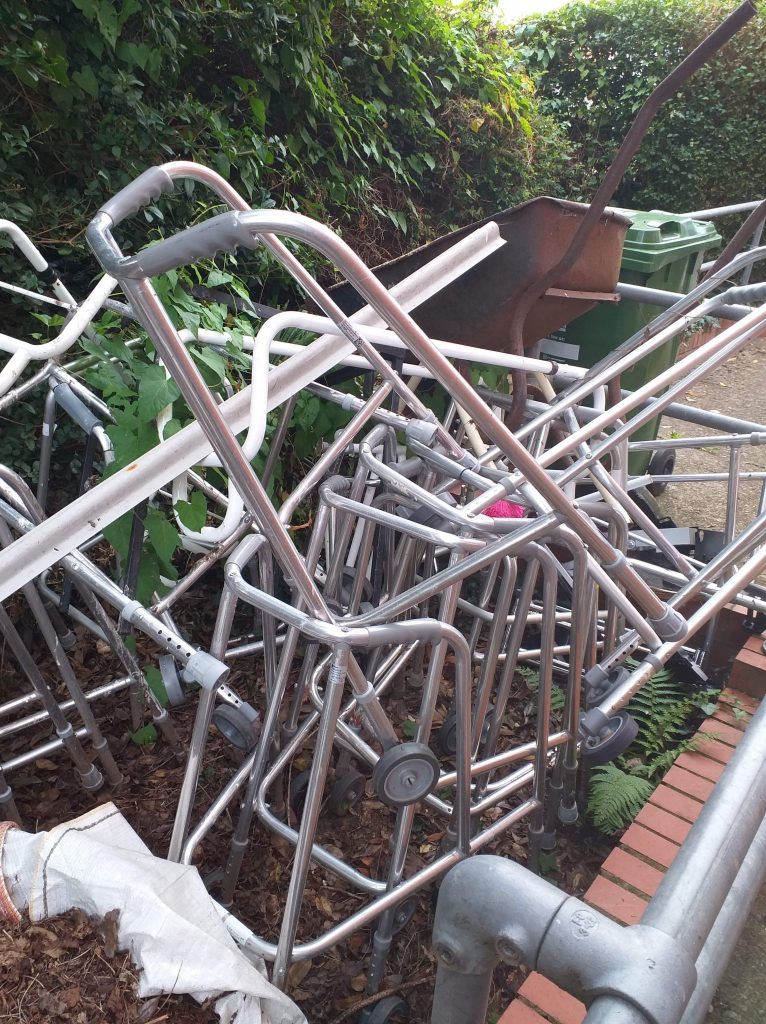
This poignant photo says it all – Owl

A pile of metal walking frames dumped at Shandford. Photo: Helen Tickle.

The Abbeyfield Society, site owners, said proceeds from the Tuesday, November 3 sale of Lot 68 will be given to newly-formed registered charity The Shandford Trust, to support older people in need who live within the area of Budleigh Salterton and the villages of East Budleigh, Otterton, Colaton Raleigh and Bicton.

The charity will be managed by a board of trustees drawn from the local community and one from The Abbeyfield Society.

When the funds become available, a new website will be launched to highlight the charity, its work, who can apply for financial support and how to apply.

A spokeswoman for The Abbeyfield Society said: “When Abbeyfield originally took over the site it was agreed that any funds raised from a potential sale would be used for the benefit of older people in Budleigh Salterton and other local communities, in line with the objectives of the charity which originally ran the Shandford home.

“In accordance with this, The Abbeyfield Society will be applying funds from the sale of Shandford to a new charity, The Shandford Trust.

“Its main purpose will be to support those older people in need who live within the area of Budleigh Salterton and the villages of East Budleigh, Otterton, Colaton Raleigh and Bicton.

“The Trust will be managed by a board of trustees drawn from the local community and one from The Abbeyfield Society.”

She added: “As soon as funds from the site sale are available, a fully structured website will be launched and publicised locally.

“This will give further details of the background and purposes of the Trust and the names of its trustees, together with information on the criteria for qualifying for support, and when and how to apply.”

The detached 26-bedroom former Shandford care home is being sold at auction through agent Savills, with a freehold guide price of £750,000.

Selling details, with photographs of the building and grounds, highlight the site’s vacant possession, off-street parking, rear garden, ground, second and first floors and ‘further potential subject to the usual consents’.

Abbeyfield said a pile of metal walking frames, dumped outside, are due to be cleared this week.

The former care home, in Station Road, fully-closed in March 2020, during the coronavirus lockdown.

The last remaining residents were moved to other care homes because of an earlier decision made by Abbeyfield that Shandford was ‘not a viable option’ to keep open.

At the time, Abbeyfield said the decision to close Shandford was ‘with great regret’ and taken after a lengthy review of the service, which took into consideration the future of the care home.

It said the decision to close was the result of a detailed review of the infrastructure, building condition and financial performance of the home.

A community drive by Budleigh residents to set up a Community Interest Company to run Shandford as a not-for-profit venture, with public volunteers and annual subscriptions, attracted ‘significant support’ but did not progress.

For more information about Registered Charity Number 1192048 The Shandford Trust, email shandfordtrust@gmail.com

The sad closure of Shandford, well recorded on EDW, raises issues. 

Shandford started as care home in 1958 for local people funded by the people of Budleigh Salterton. In 2012, the trustees ceded it to Abbeyfield.

The closure is based on Abbeyfield’s declared aim of “freeing up assets” as it changes its business model to concentrate on larger homes; and County Councillor Christine Channon’s handpicked adviser, Chris Davis, who claims that Shandford was no longer viable. Owl understands Chris Davis’ report has never been made public.

A local community effort to take back control, failed despite the intervention of newly elected Simon Jupp MP.

During this process Owl received plausible arguments that showed that there were grounds to challenge the case for non-viability.

The latest press report mentions the creation of a new charity to manage the funds “released”. This must have been so recently created that Owl has had difficulty tracking it down. However, Owl’s ferrets did find it through the link between trustees declared on the League of Friends of Budleigh Salterton Hospital.

From the list of the trustees for the newly created Shandford Trust Owl note that Chris Davis now Chairs both the Shandford Trust and the League of Friends. Who chose the trustees? Were the people of Budleigh Salterton consulted?

These Charities have distinctly different aims that do share some common elements. From a conflict of interest point of view, should they share the same Chair?

Hot on the heels of Shandford’s closure, Owl posted the sudden closure of Budleigh Salterton Age Concern facilities provided at the health and wellbeing hub because it was “economically unsustainable”. Examination of the last set of accounts posted on the Charity Commission web site shows assets of over £80,000. Where is this money going?

Owl simply draws attention to the lack of transparency over the way that assets donated by the community over many years has been handled in these cases.

Ladram Bay’s unauthorised “Viewing Deck” to be considered by EDDC Planning Committee Wednesday 4 Nov.

This isn’t just any old retrospective application but one in England’s first Natural World Heritage Site!

At the beginning of May, Owl’s attention was drawn to the latest retrospective application the Carters have made, in a catalogue of retrospective applications going back for years, during their development of Ladram Bay.

This is retrospective application 20/0297/FUL for the partial retention at Ladram Bay of a raised viewing platform including balustrade and storage areas.This raised viewing platform appeared without planning permission and was certainly seen by members of the public in the summer of 2018. 

An enforcement notice was issued by EDDC on the 26th June 2019 seeking the removal of the raised platform, in its entirety. The notice took effect on the 01/08/2019 and a subsequent appeal was lodged. 

Interestingly, the current application was lodged before the appeal was determined (a not unusual Carter practice).

The appeal was dismissed on 17 August 2020 and the enforcement notice was upheld for the removal of the platform in its entirety due to its unacceptable visual impact, lack of planning policy support given the location of the site in a designated World Heritage Coast, AONB and Coastal Preservation Area. The structure needs to be removed by the 17th March 2021.

Worth noting that it was within the power of the Inspector to allow the retention of part of the structure if she had found part of it to be acceptable. However, the appeal and Enforcement Notice upheld the removal of the whole structure.

The new application goes before EDDC’s Planning Committee on Wednesday 4 November 10.00 with a recommendation from officers to refuse.

 In Owl’s view the matter is straightforward and one of fundamental principles. You don’t go developing the Jurassic Coast World HeritageSite, without seeking planning permission. Any permission granted would have to pass a very high threshold indeed.

Surprisingly (or perhaps not, given the prominent part the first two played in trying to keep the Tories in power in the “changing of the guard” debates), the local ward councillors: Alan Dent, Tom Wright and “Ingham Indy” Paul Jarvis support the development valuing the economic benefit above the consequential environmental damage.

The most authoritative and persuasive case for refusal and has been made by the World Heritage Site/Jurassic Coast Management Team, including these points [Owl’s emphasis]:

  1. As with the previous application regarding the deck, the principle stands that retrospective planning consent is incompatible with the World Heritage Site. Although this new planning proposal has a much reduced impact on the WHS, it is still asking consent for an existing structure.
  2. No methodology has been provided for removal of part of the existing structure. This must be done in a way that minimises damage to the cliff face. We recommend that a methodology should be provided and approved before any work is undertaken, including in the case that this application is refused and the related enforcement is upheld.
  3. We can accept that the combe leading down to the beach is an area of development, but the buildings currently diminish gradually seawards, providing a ‘soft’ transition from the caravan site out into the natural environment of the beach / coast. The timber structure, within this context, would make that transition abrupt, with a high, imposing structure running alongside the path right down to the shingle. Paragraph 6.3 of the LVIA states that the developments within the Combe are largely obscured when viewed from outside it, but we note that retaining a portion of the timber deck will permanently introduce a visible built structure into that view. It will also interrupt the natural sweep of the cliff line in the bay, compromising the way in which the character of the WHS’s geomorphology is presented. We recommend that advice is sought from relevant landscape officers regarding the level / significance of these impacts.
  4. Although this application repeats the assertions from the previous application and appeal that the deck provides valuable access and amenity for disabled persons, there is still no evidence provided that establishes this need, or, more importantly, that alternative approaches to answer that need have been explored and discounted. As stated in previous responses, we would support any desire to improve access to the World Heritage Site, but we question whether this timber deck is the most appropriate way to do that in this location. 
  5. Following on from point 4 above, we remain concerned that the position of the deck means that users are being invited to dwell beneath what is a natural cliff face. The Geological Assessment appendix to the Planning Support Statement describes that the geology at Ladram Bay is susceptible to rock falls. The risk posed to users of the deck is obvious. Risk management is the responsibility of the landowner, and not within our remit. Our particular concern here is that any future rock fall above the deck could trigger a desire to stabilise the rock face in order to mitigate the risk to users. Such stabilisation would run counter to various different natural environment management policies at this site. 

Paul Arnott: Autumn in East Devon is very different in 2020

In his latest column, East Devon leader discusses how his usual autumn tradition has had to change, as has the district council’s constitution

Paul Arnott www.midweekherald.co.uk 

Autumn in Devon is my favourite time of year. Soon, the trees will have shed their golden leaves and make stark silhouettes on a Halloween morning. It’s a time of change – in many ways.

But this year, my Autumn will be missing its finest celebration, the Tar Barrels of Ottery St Mary. I first attended in 1980 and although not a big drinker if ever there is a time and a place to have a pint rooted to the spot as a man with a barrel on fire runs within a few feet of your head, this is it.

Over the last twenty years it has became important to my children too. Years ago, we’d drive them over and hold the hands of two children each as they were thrilled and terrified by the blaze appearing to come out of the back of some plucky Otteryman’s neck.

Cut forward ten years, when they or their friends could drive, and they’d disappear off into the seemingly infinite number of pubs with their mates, leaving my wife and I to get home exhausted in time for the ten ‘o clock news. They’d do whatever it was that teenagers do before returning at midnight. No Polos were strong enough to conceal their cider breath as they plonked themselves on the sofa and I’d look at them, a sentimental old fool, thinking: well, this is the life.

Ottery Tar Barrels 2019. Picture: Alex Walton Photography

Ottery Tar Barrels 2019. Picture: Alex Walton Photography

This autumn, three of our four children, plus a girlfriend, have been back with us again, like a Groundhog Day of what happened in March. They decided to escape the city before it went into a higher tier and are now all working from home here in East Devon.

We would have all loved to have gone together to the Tar Barrels again but it is not to be this year. And this time they might not have scarpered with their pals into the mischievous night, but would have probably actually have bought us a drink.

Yes, all middle age parents mark that day well, when a child buys you a pint, or even a meal, instead of the other way round. Of course, if you live to be about a hundred and fifty you might recoup the cost of all the drinks and meals you have bought for them.

Instead this year our kitchen surfaces are covered with local blackberries and apples cooked and then frozen to keep us until next year. We’ve had amazing homemade quince jelly with roast pork (my department), and astonishing blackberry jam on freshly baked scones. It might be a horrible year but a generation seems to have learned to cook.

My other reason for wanting to go with them to Ottery this year would have been to introduce a remarkable local person, Vicky Johns. Vicky is a district councillor who is part of the administration with me at East Devon – but she has also recently become the first ever female mayor of Ottery St Mary.

We had a great debate at East Devon last week to make sure our constitution was changed to be respectful of both men and women. This addresses issues of maternity rights for councillors too. And in future we won’t address women running our meetings with such archaic terms as ‘Madam Chairman’ or ‘Councillor Mrs Smith’. It’s the kind of thing you might have thought was done and dusted in about 1970.

There was much talk from some of the more cobwebbed members about how they would now find it difficult to address someone as ‘Chair’. I made the point that if MPs had tried saying Madam Mrs Prime Minister to either Margaret Thatcher of Theresa May they’d have got short shrift. But it’s in the constitution now and in the end if you want to secure change and not allow things to slip back, that’s what you have to do.