Inside celeb chef’s stunning new seafront venue

A sneak peek inside Exmouth’s new seafront casual seafront bar, restaurant and café has been revealed.

It has attracted mixed comments on the devonlive web-site including: 

“Looks like school dinner hall which I did my best to avoid”

A brave experiment, but will it regenerate Exmouth? – Owl

Anita Merritt www.devonlive.com

Exeter celebrity chef Michael Caines will open Mickeys Beach Bar and Restaurant alongside Sylvain Peltier and Michael’s Café Patisserie Glacerie in March 2021 as part of the Exmouth seafront regeneration project.

The project will incorporate a casual bar complete with resident weekend DJs, first floor destination restaurant with a glasshouse and outdoor terraces alongside neighbouring Café Patisserie Glacerie which will serve serve artisan pastries and ice-creams.

The opening hours will change with the seasons. Summer will see Mickeys Beach Bar and Restaurant serve breakfast, lunch and dinner seven days a week across each of the various outlets.

Mickeys Beach Bar and Restaurant in Exmouth

During the cooler months, breakfast will be served on weekends only with lunch and dinner available daily throughout the week.

Michael said: “Mickeys has been in development for five years and I am so excited to see the building finally come to life.

“The interior space, designed with Design Command, is fun, vibrant and in-tune with its surrounds and has the most remarkable views across the bay of Lyme.

Mickeys Beach Bar in Exmouth

“Mickeys will be a place to celebrate, to unwind, to pop-in for a takeaway or stay late into the night, underpinned by warm hospitality and excellent food.

“It is a space for the local community and beyond, above all its place of fun. I’m incredibly excited to be able to share more over the coming months as we approach the opening.”

The restaurant will offer a relaxed dining experience inspired by its maritime location and produce sourced from the South West. The ground floor bar is complimented by a seascape colour palette and large rough-stone statement bar.

It offers family and dog friendly spaces, delicious foods to eat in or takeaway or a place to simply relax and enjoy cocktails.

Café Patisserie Glacerie in Exmouth

The scheme at the waterfront has been developed by Grenadier Estates. The building itself has used sustainable materials and harnesses renewable energy technologies.

In keeping with Michael’s ethos of local and seasonal produce, Mickeys Beach Bar and Restaurant will source local produce to support the local community of food producers and farmers, reduce food miles and promote biodiversity.

The café, bar and restaurant will each operate in keeping with the green ethos of the project with a commitment not to use single-use plastics.

Adjacent to Mickeys Beach Bar and Restaurant will be Michael and Sylvain Peltier’s first Café Patisserie Glacerie franchise.

It will showcase the creations of Sylvain and Michael, including fresh French patisseries, house-made gelato ice-cream, artisan coffee, milk-shakes and available for grab and go hot pies and Cornish pasties, sandwiches and salads.

Patisserie chef Sylvain Peltier, who spent 10 years working as head pastry chef with Michael Caines at Michelin-starred restaurant Gidleigh Park, said: “I am proud and excited to be opening with Michael our first Café Patisserie Glacerie on the beautiful Exmouth seafront.

“This has been a dream of ours for the past 15 years and seeing the project come together is mind blowing. Being able to share your passion with others is an invaluable gift and we cannot wait to soon share it with you all.”

For further information including booking enquiries and project updates, please visit www.mickeybeach.co.uk [appears not yet operational – Owl]

Britain’s biggest businesses have a vision for the South West

Britain’s biggest business organisation has demanded an end to the “inequalities” which hold back the Westcountry when the nation rebounds from the coronavirus crisis.

Yawn – the needle’s got stuck in the same groove again by the same old voices. We need new blood with a much wider economic experience and a bit of political fervour. 

Susan Davy, the chief executive of one of the South West’s biggest businesses, South West Water owner Pennon, is also the CBI South West chair.  Says it all. – Owl

William Telford www.cornwalllive.com

The CBI echoes calls made by the Back the Great South West campaign – supported by CornwallLive, DevonLive, PlymouthLive and our print sister titles including the Western Morning News – when it calls today for targeted action to boost skills and develop physical and digital infrastructure in the Westcountry.

The campaign has been supported by the Local Enterprises Partnerships, local authority leaders and MPs across the South West.

The CBI warns that without investment there are grave risks that disparities across the regions of Britain could widen, damaging the recovery and the long-promised levelling up of those parts of the country left behind.

In its report, Reviving Regions, the CBI says: “For the South West, improvements to infrastructure – ranging from enhanced digital connectivity to rail and road projects such as long-awaited upgrades to the A303, M5 and M4 – have the potential to be transformational.”

Last week the Department for Transport gave the go-ahead for a crucial part of the A303 upgrades when it backed major improvements to ease the bottleneck around Stonehenge.

South West business leader Tim Jones said that project alone could give the South West region a lift worth around £4bn once it comes on stream.

The CBI says targeted action to boost skills and develop physical and digital infrastructure is vital if the South West is to attract the inward investment needed to build back better from the economic ravages of coronavirus. 

The business organisation’s paper, sponsored by Lloyds Banking Group, highlights long-standing regional inequalities across England which inhibit growth, opportunity and productivity.

It says the disparities in economic performance are large, both across England and within regions, and warns they are at risk of widening further if Government levelling-up ambitions falter in the wake of Covid-19.

The paper calls for a long-term strategic vision to guide the country through a vital post-Covid recovery and towards long-term prosperity.

For the South West, improvements to infrastructure – ranging from enhanced digital connectivity to rail and road projects such as long-awaited upgrades to the A303, M5 and M4 – have the potential to be transformational, the CBI predicts.

Increased spending on training and retraining is another regional priority. The pandemic has undermined the South West’s traditionally-strong levels of employment, and large numbers of workers, especially in hospitality and related tourism sectors, remain furloughed.

The CBI report says equipping them with new skills can protect individual livelihoods and support communities. It adds that “action on skills is essential in a region containing some of England’s areas of lowest productivity.” And it says underpinning all of this is a need to empower the South West’s local and regional leaders.  They must be able to “create a culture where businesses can operate, invest and grow with confidence.”

The report’s recommendations include: 

  • Building vibrant local labour markets
  • Transforming local infrastructure to facilitate new ways of working
  • Inspiring world-class, innovative businesses to invest in the regions
  • Intervening to close the gap in regional research and development funding

Susan Davy, the chief executive of one of the South West’s biggest business, South West Water owner Pennon, is also the CBI South West chair. She welcomed the report.

“The South West is a region with many examples of excellence, ranging from thriving cities like Bristol and Exeter to outstanding strength in sectors like advanced engineering, digital innovation and green industries,” she said.

“Yet these successes are not spread evenly, even within the region. Skills gaps and pockets of low productivity restrict opportunity and prosperity in parts of the South West, and challenges around connectivity – both physical and digital – have seen slow progress.

“Action on these issues is vital if the region is to enjoy a fair and sustainable recovery. We must attract the investment needed to enable South West businesses to enjoy success not just regionally or nationally, but globally too.”

The CBI believes the actions outlined can mitigate the regional impact of the pandemic as the nation rebuilds.

Devon gets £1.3 million for ‘active travel’

Devon County Council has been awarded almost £1.3 million for what’s called ‘active travel’ – which means cycling and walking whilst cutting car use.

Radio Exe News www.radioexe.co.uk 

Active travel filters in Heavitree, Exeter (courtesy: Exeter University)

Expect pop-up measures to become permanent

Devon County Council has been awarded almost £1.3 million for what’s called ‘active travel’ – which means cycling and walking whilst cutting car use.

The Department for Transport is giving the county £1,283,450 from its Emergency Active Travel Funding scheme. It’s the second wodge of government money to change travel habits since the start of the health crisis. The first lot went on“pop-up” temporary measures in Exeter, Barnstaple, Bideford and Newton Abbot to reduce the number of cars of the road.

Some of those temporary measures are likely to be made permanent. Last month, the Exeter Highways and Traffic Orders Committee (HATOC) said it backed making the pop-up stay popped up, while a public consultation is to be carried out on some other arrangements in the city. Other measures will also be progressed in Newton Abbot and Barnstaple.

Three Devon schools (Redhills Primary School in Exeter, Bradley Barton Primary in Newton Abbot and the Whipton Barton Federation in Exeter) have also introduced “School Streets” measures to restrict traffic outside their schools during drop off and pick up times.

Councillor Stuart Hughes, Devon County Council’s cabinet member for highway management, said: “Clearly we welcome this additional funding, although we will need to look closely at the small print. The Exeter HATOC has already set out that we’ll be carrying out consultation with local communities, which is something the government wants to see in awarding this second round of funding.

“We’re keen to encourage active travel in order to help tackle congestion, cut carbon emissions, and improve health. We will be working with local communities across Devon to ensure this funding is used to make it easier for people to walk and cycle.”

A study commissioned by the government has revealed that 65 per cent of people across England support reallocating road space to cycling and walking in their local area. Nearly eight out of 10 people (78 per cent) also support measures to reduce traffic in their neighbourhood.

As part of the DfT’s plan to ensure councils develop schemes that work for their communities, it has set out that they must:

  • -publish plans to show how they will consult their communities, including residents, businesses and emergency services, among others; 
  • show evidence of appropriate consultation prior to schemes being implemented;
  • submit monitoring reports on the implementation of schemes 6-12 months after their opening, highlighting how schemes have been modified based on local feedback to ensure they work for communities.

The funding will have to be spent or committed by March 2021.

Will Dominic Cummings seek revenge?

How Cummings chooses to throw the grenade of hard truth into the blancmange of Johnson’s Downing Street remains to be seen.

This looks very promising, can’t wait! – Owl

www.independent.co.uk 

Reports suggest it is in his mind. Asked about future plans, the prime minister’s former chief adviser makes a mime of pulling the safety pin out of a grenade and lobbing it with intent at some unspecified but easily identified object. He seems to be the sort of personality who likes to have the last word, and does not let go easily.  

When, for example, in 2014 he was special adviser to Michael Gove at education, the prime minister David Cameron fired Cummings, so troublesome was he. Yet he still turned up at the department and made no secret of his contempt for Cameron and most of his party (Cummings has never been a Tory member). Cummings detailed and lengthy blogs, and the equally meticulous briefings he sometimes offers journalists also point to his taste for explication and analysis, often through the prism of military or managerial strategy. 

Cummings has the great distinction of being sacked by three Tory leaders (he was also briefly and unhappily Iain Duncan Smith’s chief of staff) and banned by a fourth, Theresa May, who banished him and Gove from her sight for a while. Cummings has also made enemies of the likes of Sajid Javid (who tried to resist a takeover of the Treasury), Bernard Jenkin and Nigel Farage and has been held in contempt of parliament for effectively refusing to turn up to a select committee hearing to give evidence on the Vote Leave campaign.  

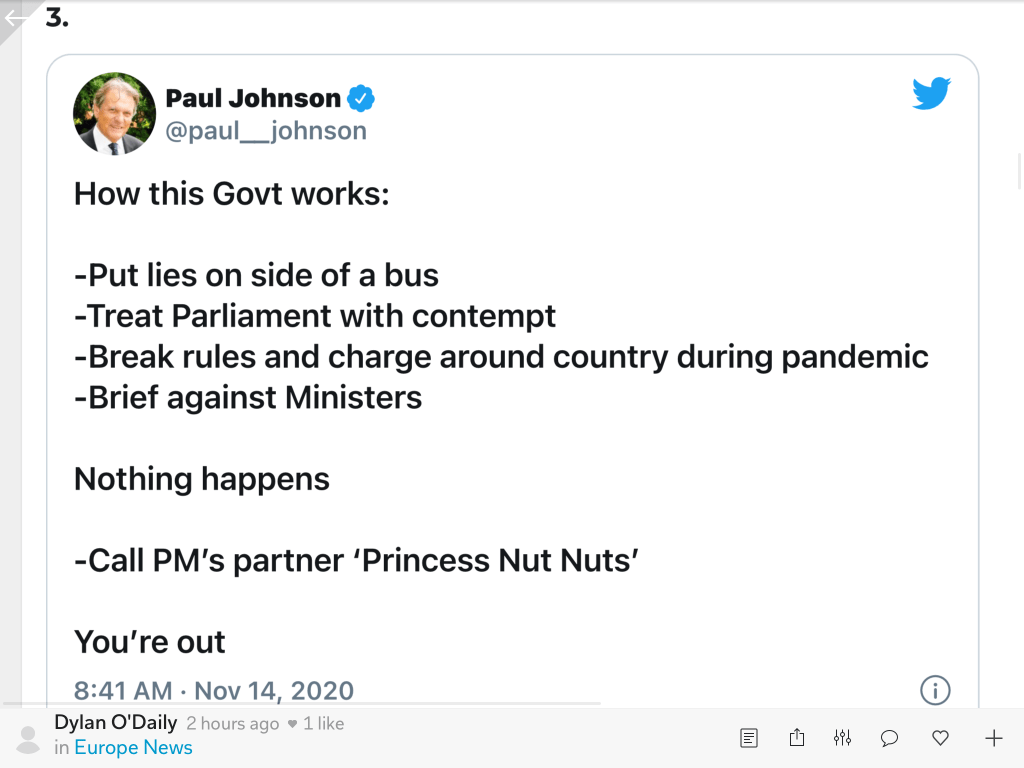
There is now plainly no love lost either with Carrie Symonds, the prime minister’s fiancee and known as “Princess Nut Nuts” to Cummings and his associates. Nor with Allegra Stratton, newly appointed spokesperson for No 10. It’s in fact tricky to find anyone to put on the list of Cummings’s allies.  

Despite some vague talk from Johnson about a return for Cummings and the ex-press secretary Lee Cain in time for the 2024 election, Cummings has little to lose from telling his side of the story. In truth it would be much more than gossip and score settling – though that might add to the gaiety of the nation in rough times. Indeed Cummings has something of a duty to report on the dysfunctionality of the Johnson administration and No 10 as it has faced and mismanaged the two overwhelming challenges of the Covid crisis and Brexit. Since the referendum campaign of 2016, and especially since Johnson became premier, Cummings has had a unique vantage point from which to observe and analyse what went wrong and what, if anything, went right. Has the PM lost his powers of communication since he had Covid? Does Carrie distract him with text messages and trivial media stories? Could Britain have made Brexit work? Would herd immunity ever have been the answer to covid? Is the Treasury too powerful? Is most of the civil service useless? How does Johnson make policy? Why did Johnson expend so much political capital on retaining him after the Barnard Castle incident, but ditched him so easily now? Is Gove running the country? Or Rishi Sunak? Or anyone?  

You’d suspect that, despite some temporary confluence of personal career and political interests, these men are not natural soulmates, in style or outlook or values. Cummings is constant in his beliefs, industrious, decisive and analytical. He has remarked publicly that he has no time for the public school bluffers so often found around Westminster and Whitehall. Johnson, by contrast, has wobbled around like a three-wheel supermarket trolley on Europe, likes his leisure time, dithers, and runs on instinct. He is a public school bluffer; some would attribute the classical references and long words to an Eton education and a gift for saying whatever it takes to get himself out of a tight spot. Both, arguably, though, are better campaigners than administrators.  

How Cummings chooses to throw the grenade of hard truth into the blancmange of Johnson’s Downing Street remains to be seen. There may be a very “hard rain” of multiple bombardments – the blog, interviews, columns, briefings… He might even, belatedly, accept the invitation to visit the House of Commons to give evidence on the role of the prime minister’s office. Funnily enough, the Public Administration and Constitutional Affairs Committee is taking evidence currently. It would make a fine sequel to the show he gave in the Downing Street garden last summer. If he doesn’t then what is left of his reputation will be shredded by the new gang. Always remember the night time is the right time to fight crime. 

Dominic Cummings writes slogans, networks, blogs! Give this man a job

The 48-year-old may well find, as many others have, that the jobs market is an unforgiving place for a middle-aged man with a mixed CV.

How will he pay the bills? – Owl

Matt Chorley www.thetimes.co.uk

Dominic Cummings is a man for hire. Cast out of Downing Street after just over a year as the prime minister’s top adviser, he joins the nation’s growing dole queue. The 48-year-old may well find, as many others have, that the jobs market is an unforgiving place for a middle-aged man with a mixed CV.

The best indicator of what “Dom” will do next is probably to examine what he did before. He has spent much of the past decade terrorising the occupant of No 10: first David Cameron over education reforms and later Brexit; then Theresa May during her three years in charge.

No doubt Cummings will consider critiquing Boris Johnson a full-time job, but how to pay the bills?

Blogger

This is a man who likes the sound of his own keyboard. He could go into newspaper columnising, following Nick Timothy, who moved seamlessly from overseeing May’s disastrous election campaign to telling grateful readers of The Daily Telegraph what the Tories need to do to win. But Cummings would probably struggle with the concept of a word count. When you are a free thinker, you need the space to expound your clever thoughts.

A book, perhaps? Kate Fall, who was deputy chief of staff to David Cameron, argues that it is “good therapy” and a way of drawing a line under a spell in power. “The solidarity of purpose of working in No 10 is difficult to replicate, so best not to try,” she adds.

Yet a book is a bit 18th-century for everyone’s favourite algorithm-muncher. You don’t need to be a superforecaster to know that a return to his blog is inevitable. It is already a vast archive of posts about critical thinking, prediction, physics, economics, war gaming and artificial intelligence. There are a lot of italics and CAPITALS so you know the bits to really focus on.

His last full post was in January, when he appealed for “weirdos and misfits” to work in No 10 — an initiative that led to the hiring and prompt firing of a guru called Andrew Sabisky, who turned out to be rather too keen on eugenics for the prime minister’s tastes.

Advertising copywriter

It’s a literary feast or famine with Cummings: a 20,000-word blog or a three-word slogan. The man who brought us Take Back Control, Get Brexit Done and Hands, Face, Space could be in demand in the advertising industry. There may not be huge demand, given that the advertising industry has been decimated by the pandemic and economic downturn, but Every Little Helps.

Policy wonk

The man who has been hugely critical of the Westminster bubble and its thinktankery inhabitants does know about something — data and artificial intelligence — and is genuinely passionate about the role of tech in changing the way the country is run, and how we live our lives.

Exasperated by the archaic structures of meetings in the fusty cabinet room and ministers making decisions based on printed reports in their red box, he tried to shake things up by creating a Nasa-style mission control in Whitehall, but it was little more than some widescreen TVs on the wall of a bare meeting room.

Having struggled to change things from the inside, he may have more success making the case from the outside. Anthony Seldon, the historian and political biographer, says Cummings should be put in charge of Britain’s national effort to embrace artificial intelligence. “He gets it, hardly anybody else does, he’ll shake everybody up — we need it, and he’ll make it happen. It’ll be our meal ticket post-Brexit.”

Craig Oliver, No 10’s director of communications under Cameron, agrees. “Dominic’s passion is preparing the UK for an AI/tech-driven future. He could do a lot worse than use his undoubted talent to set up a think tank focused on that.” Alternatively, Oliver suggests, not entirely seriously, “he could listen to his bad angel and create a future-gazing agency, calling it FarQ”.

Lobbyist

The natural path for someone ousted from government is to move out, then spend the time lobbying those still on the inside. Good lobbyists boast of having the numbers of all the key decision-makers, which Cummings does. Whether they will take his call is more doubtful.

His track record isn’t great, though. Even when in government he struggled to get his way. He opposed HS2 and was overruled. He backed Huawei and was overruled. He even tried to move Boris Johnson out of No 10 and got overruled.

It is also not totally clear that he would enjoy being a man for hire. Famously blunt about what does (and does not) interest him, he is unlikely to want to spend his days lobbying on behalf of Acme Inc, no matter how well it pays.

Academic

Maligned as a stupid person’s idea of a clever person, Cummings has played down his intellect, writing in The Spectator in 2017 with admirable honesty: “I am not clever, I have a hopeless memory, and have almost no proper ‘circle of competence’.”

He also once railed against “Oxbridge English graduates who chat about Lacan at dinner parties”, which was quite something for an Oxford history graduate. It might do him good to update his reading, though.

After a blogpost this year about the possible uses of artificial intelligence, Lord O’Donnell, the former cabinet secretary, said the future-thinker was actually stuck in the past. “When you look at the articles he goes to in science, I mean they’re like going back 30, 40 years as if behavioural [science] never existed.”

Media personality

Some of those who leave government “do”, others just “talk”. The best example of this is Steve Hilton, who was Cameron’s scruffily dressed blue-sky thinker who tried to smash up Whitehall, grew frustrated and then flounced out when it all got a bit tough. Sound familiar?

Hilton is now a host on Fox News in the US, where he has been an outspoken supporter of President Trump while railing against woke political correctness. Cummings could follow suit in the UK, but we’ve already got Piers Morgan.

Fashionista

For a man who appears to be permanently dressed for an autumnal morning spent rotavating the vegetable plot, it is perhaps fitting he has been put on gardening leave. In politics it is still women who have their appearance endlessly critiqued, but Cummings has waged a one-man fightback for fashion equality.

Normally, when people say cracks are appearing in Downing Street they mean political divisions, not the cleavage emerging over the slumping belt line of ill-fitting jeans. But Cummings often struck a bum note on his arrival at No 10.

The beanie, the gilet, the bovver boots, the straw hat, the Big Sur cap, the tote bag, all thrown over studiously unironed shirts or unsubtle slogan T-shirts, were carefully chosen to show just how little he cared.

It didn’t always work. Early in lockdown Johnson held a briefing to reassure the nation that the sharpest minds were at work, while at the back of the room Cummings was spotted with his jumper inside out.

Still, a fashion range aimed at the new dressed-down generation of lockdown home workers can’t be ruled out. Dom at Asda, anyone?

A proper job

He has prided himself on being in touch with the common working man, unlike all those effete elitists in Whitehall. This seems to be based on a spell as a doorman at Klute nightclub in Durham (owned by his uncle; meritocracy in action), which was once voted the second worst club in Europe by FHM magazine, until the one in first place burnt down, allowing it to take the top spot. His nightclub experience of telling people they were going to leave whether they liked it or not obviously made quite the impression on him politically.

Cummings has also boasted of his business experience, including starting businesses in Russia. This amounted to a spectacularly unsuccessful airline that once left without its only passenger.

If he is looking for a return to something customer-facing, an advertisement has gone online for an optical assistant apprenticeship at Specsavers in Barnard Castle. The successful applicant, the advert states, “must be happy to travel”.

Exeter sees highest rent increase in England

New research shows that Exeter has seen the highest increase in average rent across whole of England over the past five years.

Howard Lloyd www.devonlive.com

Average rent in the city has jumped an incredible 39 per cent in five years, according to findings from international rental marketplace Spotahome.

According to numbers from the Office for National Statistics, in 2015 the average monthly rent stood at £853. It has gone up now to an eye-watering £1,201 – a £337 difference.

Nowhere else in England has seen a rise of that magnitude.

Nadia Butt, UK and Ireland country manager of Spotahome, said: “While London remains the most expensive place to rent in the UK this causes many tenants to automatically assume that this cost has continued to increase over the last few years and this simply isn’t the case.

“When you consider the higher cost of renting within the capital is partially offset by the higher wages on offer, and that this wage growth has remained fairly consistent, it means that London tenants are actually much better off now than when compared to five years ago.”

Second on the list is Oxford, which has seen a 32 per cent rise. Rent there in 2015 averaged £1,204, but it now stands at £1,588 – an increase of £384.

Newcastle-under-Lyme is third, with rent increasing from £506 to £662 – a growth of £156 – while Bristol is joint-fourth with Newcastle upon Tyne, Leicester and Norwich.

The South West city has gone from averaging £915 to £1,175 – a £260 increase equating to 28 per cent.

Interestingly, three London boroughs are among the 10 areas to have seen the largest declines in the past five years – Hounslow, Richmond and Kingston.

The figures are also set against a backdrop of the South West seeing the biggest reduction in rental affordability year on year.

While the average net wage in the region has increased by +1.7 per cent to £1,890 in the last year, the average monthly rent has also jumped by +6.1 per cent to £892 today – the largest increase of all regions.

As a result, the cost of renting now requires 47.2 per cent of the average monthly earnings in the region, up +1.9 per cent from 45.2 per cent last year.

Founder and CEO of Howsy, Calum Brannan, added: “The cost of renting has continued to climb across much of the nation and as a result, many tenants are now paying more of their monthly earnings on rent despite a steady increase in income.

“The current impact of the pandemic is perhaps clearest within the capital where a severe fall in demand levels has seen rents tumble.

“However, while the topline figures show that London’s tenants are now paying less of their income on rent, this won’t be the reality for many who find themselves out of work or on furlough as a result of the current landscape.”

Go-between paid £21m in taxpayer funds for NHS PPE

A Spanish businessman who acted as a go-between to secure protective garments for NHS staff in the coronavirus pandemic was paid $28m (£21m) in UK taxpayer cash.

By Phil Kemp www.bbc.co.uk

The consultant had been in line for a further $20m of UK public funds, documents filed in a US court reveal.

The legal papers also reveal the American supplier of the PPE called the deals “lucrative”.

The Department of Health said proper checks are done for all contracts.

A legal dispute playing out in the courts in Miami has helped shine a light on the amount of money some companies have made supplying the NHS with equipment to protect staff from Covid infection.

Earlier this year, as the coronavirus pandemic was spreading rapidly around the world, Florida-based jewellery designer Michael Saiger set up a business to supply PPE to governments.

He used his experience of working with factories in China to land what are described as “a number of lucrative contracts” supplying protective gloves and gowns to the NHS.

Mr Saiger signed up a Spanish businessman, Gabriel Gonzalez Andersson, to help with “procurement, logistics, due diligence, product sourcing and quality control” of the PPE equipment. In effect, Mr Andersson was expected to find a manufacturer for deals that had already been done.

Further $20m pledged

Mr Andersson was paid more than $28m (£21m) for his work on two government contracts to supply the NHS. He was described in court documents as having done “very well under this arrangement”.

image captionEarlier in the year there was a shortage of protective equipment for NHS medics

In June, Mr Saiger signed three more agreements to supply the NHS with millions of gloves and surgical gowns.

When the UK government paid up, his go-between, Mr Andersson, would have been in line for a further $20m in consulting fees.

But the court documents allege that once the agreements had been signed, Mr Andersson stopped doing any work for Mr Saiger. It’s not clear whether Mr Andersson received any of the money for this second batch of deals.

This led to PPE deliveries being delayed to NHS frontline workers, Mr Saiger claims, and the company “scrambling” to fulfil the contracts by other means.

So far the UK’s Department of Health and Social Care (DHSC) has published contracts with Mr Saiger’s company, Saiger LLC, totalling more than £200m. These were awarded without being opened to competition.

‘Huge profits’

Alongside the legal dispute in Florida, the deals are set to be challenged in UK courts, by campaign group the Good Law Project. It accuses government ministers of not paying “sufficient regard” to tax-payers’ money over a contract with the firm.

“We do not understand why, as late as June, government was still making direct awards of contracts sufficiently lucrative as to enable these sorts of profits to be made,” Jolyon Maugham, the project’s director told the BBC.

“The real criticism that is to be made here is of the huge profits that government allows to be generated.”

This is not the first time concerns have been raised about PPE contracts the DHSC signed during the first wave of the coronavirus pandemic.

Earlier this year, the BBC revealed that 50 million face masks the government bought could not be used in the NHS because of safety concerns. And last week, it exposed concerns that the government had leaned on safety officials to certify PPE which had been wrongly classified.

A DHSC spokesperson said the department had been “working tirelessly” to deliver PPE, with more than 4.9 billion items delivered to frontline health workers so far and nearly 32 billion items ordered “to provide a continuous supply”.

They added: “Proper due diligence is carried out for all government contracts, and we take these checks extremely seriously.”

The BBC asked Gabriel Gonzalez Andersson for comment but he has not so far responded.

Saiger LLC said: “At the height of the pandemic, and at a time when the NHS was in need of high-quality PPE that met the required safety standards, we delivered for Britain, on time and at value.

“At no time have we ever used any ‘middlemen’. We have few full-time staff so for large projects we bring in short-term contractors for additional expertise and capacity, allowing us to deliver what is needed.

“We are exceptionally proud to have played our part in providing frontline workers in the UK, including nurses, doctors and hospital staff, with the millions of pieces of PPE they need to stay safe and to save lives.”

‘As fit as a butcher’s dog’ – the meaning and origin of this phrase

 Meaning: Very fit.

The allusion to a butcher’s dog is to a dog that would be expected to be very well fed from scraps. Why that is considered to epitomize fitness isn’t clear, as it might be thought more likely that the dog would be overweight than fit [no comment – Owl]. John Camden Hotten, in A Dictionary of Modern Slang, Cant and Vulgar Words, 1859, defined ‘butcher’s dog’ this way:

“To be like a butcher’s dog, that is, lie by the beef without touching it; a simile often applicable to married men.”

That’s clearly a different meaning, that is, butcher’s dog was then a metaphor for ‘something we are close to but cannot have’. That meaning has gone out of use. [Or perhaps not? – Owl]

Gary Martin www.phrases.org.uk 

Since this post is still viewed on a daily basis Owl feels the need to add the context.

The phrase was used by Boris Johnson whist self-isolating after he had been in contact with an MP who had tested positive for Covid in November 2020. Johnson had been hospitalised with Covid in early April.

No 10 women call time on incompetence

Rachel Sylvester www.thetimes.co.uk 

The queen’s gambit is an aggressive opening chess move, in which a player sacrifices a pawn to gain control of the centre of the board. In the hit Netflix series, it is also a metaphor for the way in which a female prodigy has to fight sexism and disadvantage to get to the top of a male-dominated game. There is a parallel with the power struggle in Downing Street last week that culminated in the departure of Dominic Cummings, the prime minister’s senior adviser, and Lee Cain, his communications director. The women around Boris Johnson mounted a daring attack on the Vote Leave bully boys in an attempt to force the prime minister into a more moderate, consensual approach on the centre of the political board. They also exposed a culture of misogyny that had grown up in No 10.

The briefing war that erupted over the weekend only reinforced the extent to which the machismo had taken hold. Carrie Symonds, the prime minister’s partner, was described as “Princess Nut Nuts” while simultaneously being portrayed as a manipulative Lady Macbeth figure. Allegra Stratton, Mr Johnson’s new press secretary, was reported to have been reduced to tears by the viciousness of the co-ordinated personal attacks on her.

It was part of a pattern that had seen Sonia Khan, a Treasury special adviser, marched out of Downing Street by armed police and Munira Mirza, the head of the policy unit, earmarked for demotion. The atmosphere had become so poisonous that some young female staff felt scared to go into work and former aides were diagnosed with post-traumatic stress disorder. One No 10 insider says “the Vote Leave lot have manipulated the idea of scheming women” but the “toxic masculinity” had to be challenged and a sense of order restored at the heart of government. “It was about calling time on incompetence,” according to the source.

There is a widespread sense of relief among senior Conservatives who believe that a shift in tone and attitude was long overdue. One former cabinet minister yearns for “a return to civility and decency in politics”. A female Tory peer says: “We can only hope that this signals a dialling down of the pathetic frat boy machismo where a bunch of grown men ran around giving each other nicknames, behaving like minor tyrants to junior colleagues and trying to pretend that picking fights and boycotting news organisations passed for either a legislative agenda or communications policy.”

Amber Rudd, the former home secretary, is convinced that having more women involved in making decisions will improve the running of the government. “The Vote Leave crew wanted to turn everything into a battle. It was deliberately violent, the language was terrible and they made the rules to suit them,” she told me. “Being consensual doesn’t mean you are weak. Looking around the world it is extraordinary how the women like Jacinda Ardern and Angela Merkel have handled Covid better — it’s about temperament, leadership and bringing people with you.”

The prime minister has already started building bridges with MPs who were treated with contempt by Mr Cummings and Mr Cain. Ironically, this is what forced him to self-isolate, as Lee Anderson, one of the “red wall” Tories invited into No 10 for breakfast has since tested positive for Covid-19. But it is an important first step towards repairing relations with a parliamentary party that had felt neglected and unloved.

Under the new, “kinder” Downing Street, there will be no more talk of people or institutions being “whacked” and an end to the culture wars that were designed to polarise the population. Instead of crossing the road to pick a fight, Mr Johnson’s team is determined to get a grip. One source said the “incompetence and lack of compassion” revealed by the handling of Marcus Rashford’s campaign on free school meals was “startling” and needed to be addressed. In policy terms, this may also entail making permanent the increase in Universal Credit that is due to expire in the spring.

The Northern Research Group of MPs is concerned that the attempt to soften the government’s image, promote the green agenda and emphasise the prime minister’s “liberal instincts” will alienate voters in red wall seats. But there is something deeply patronising about the idea that voters in these northern and Midlands constituencies are all socially conservative white men who do not care about the future of the planet. Half of them are women apart from anything else and there is scope for environmentally friendly policies to spread wealth around the country through investment in hydrogen production in Teesside or offshore wind farms near Grimsby. “Levelling up and green jobs go together,” says a senior Tory who also rails against the “sexist idea that girls are interested in yoga and huskies and boys are interested in the north”.

Mr Cain’s allies have suggested that a cabal of “posh southern women” have ousted him, a working-class man from Lancashire. In fact Ms Stratton spent five years as national editor for ITN, reporting from disadvantaged communities around Britain. She was embedded with the police in Birmingham, going out on multiple overnight calls, and spent a week sleeping in the trauma unit of Aintree hospital in Liverpool to report on knife crime victims. In the week before the last election she travelled from Wrexham to Grimsby talking to around 150 people in the red wall and concluded that the Tories could win these seats but also that former Labour voters had only “leant” Mr Johnson their support. Friends say that a “passion for levelling up” is why she made the jump from journalism to politics. Neil O’Brien, the new head of the prime minister’s policy board, also led the Northern Powerhouse initiative under George Osborne.

The women in No 10 may be asserting themselves but they are individuals with different priorities and temperaments. Ms Symonds is a green campaigner, Ms Stratton wants to address regional inequalities and Ms Mirza, a former member of the Revolutionary Communist Party, remains wedded to fighting a culture war. They have united around a common cause of overturning the macho culture in Downing Street, but — in the absence of clear leadership from the top — tensions between them are bound to emerge over time.

“It’s insecurity that defines this No 10,” says one senior Tory. “Boris builds you up then cuts you down. That’s why there is constant in-fighting and it will soon no doubt be characterised as cat-fighting. The real problem is that Boris is prime minister and he’s not willing to make decisions.” The queen’s gambit is an opening move on the chess board but what really matters is the position of the king.

Save Our Hospital Services +++

mailchi.mp

Two campaign links from Save Our Hospital Services Devon.

1.

2. Vital information about covid and workplace safety:

COVID Transmission and Killer Workplaces

Click here to watch full film (26:27)

Click here to watch trailer (90 secs)

“The workplace is the source of infection and the site of spreading infection.It’s being completely ignored – it really is the workplace stupid, and they are completely ignoring it.” – Hilda Palmer, the Hazards Campaign

We are not being told the truth about the pandemic – and the failure to do that is going to cost thousands more lives. The evidence is now overwhelming – the main source of COVID-19 transmission is through tiny particles called aerosols.

It explains why the virus is so dangerous indoors, where aerosols can build up in the air – and particularly dangerous in workplaces, where people spend the most time in an enclosed space in close proximity to others. It’s also why ventilation is so important – another issue that is barely being mentioned.

This film, made with the Hazards Campaign, explains what you can do to keep yourself and your workmates safe – using the latest information about COVID-19, extensive case studies of superspreader events and successful collective struggles by well-organised workplaces.

Find out what you can do to shut down your work if it’s non-essential, make your workplaces as safe as possible if you’re a key worker, and get full sick pay if you need to stay off work.

The government is committing social murder on a mass scale. It’s time to stand up and stop them.

#ShutTheSites  #PAYEveryWorker #PPENow

‘Warring factions’ at Spectator after Dom’s departure – the fallout spreads

The fallout from Dominic Cummings’s exit from Downing Street has spread out of No10, leading to “warring factions” at the nearby Spectator magazine between the key players’ spouses.

Is anyone following Sasha Swire’s example by keeping a secret diary? Princess Nut Nuts perhaps? Owl very much hopes so.

www.standard.co.uk 

Mr Cummings’s wife Mary Wakefield, who is the Spectator’s commissioning editor, is said to be “fuming” that her husband left his job as the PM’s chief adviser after a falling out with No 10 colleagues including Allegra Stratton, who is the PM’s new spokesperson.  

The conflict comes because Ms Stratton is married to the Spectator’s political editor James Forsyth, which one colleague said made things “awkward” in the office. Ms Stratton, who started her new role this month, is said to have had a hand in the departure of former comms chief Lee Cain and Mr Cummings last week.

Mr Forsyth wrote a positive blog about Mr Cummings soon after his departure, calling him “one of those rare individuals who has bent the arc of history”, which left Ms Wakefield unimpressed. Mr Cummings was sometimes seen at the Spectator’s office, a short walk from Downing Street.

The well-connected Spectator, once edited by Boris Johnson, has a history of political drama. Editor Fraser Nelson might be planning an online  Christmas party this year.

Consultation on plan for new Clyst Valley Regional Park in East Devon

A public consultation is under way over proposals for a huge new regional park spanning the Clyst Valley in East Devon.

This adds a little more detail to the previous post – Owl

East Devon Reporter eastdevonnews.co.uk 

The green space will take in Clyst St George, Broadclyst, Poltimore, Killerton, Ashcylst Forest, Cranbrook, Whimple and Bishops Court.

Many areas mooted for the Clyst Valley Regional Park are not currently accessible to residents and visitors.

A masterplan for the project proposes to restore nature and historic buildings, create trails, and tackle climate change and flooding.

East Devon District Council (EDDC) launched a consultation and survey on the scheme on Monday (November 9). It runs until Thursday, January 7, 2021.

Poltimore Park in East Devon. Picture: Simon Bates

Poltimore Park in East Devon. Picture: Simon Bates

EDDC leader Councillor Paul Arnott said: “This exciting project is central to East Devon’s commitment to conserving beautiful areas not protected by formal status as well as encouraging the return of the bio-diversity the world is in desperate need of in the 2020s.

“I would encourage everyone to take part in this consultation.”

Some of the ideas mooted in the masterplan include:

  • A Clyst Valley Trail linking the Exe Estuary Trail to the Exe Valley Way;
  • An extension to Cranbrook Country Park;
  • A land-based learning centre and café at Broadclyst Community Farm;
  • A new cycle trail linking Cranbrook to Exeter along a quiet route;
  • Renaturalising the River Clyst between Clyst Honiton and Cranbrook;
  • A major increase in trees through both planting and natural regeneration;
  • A new visitor hub at Ashclyst Farm and cycle/pedestrian links into the forest from Cranbrook, Broadclyst and Killerton.
The area covered by the proposed Clyst Valley Regional Park. Image: EDDC

The area covered by the proposed Clyst Valley Regional Park. Image: EDDC

East Devon portfolio holder for coast, country and environment Cllr Geoff Jung added: “Although the concept of the Clyst Valley Regional Park was agreed through the East Devon Local Plan in 2016, this consultation proposes many exciting and creative additions to help provide easier access for people to enjoy this wonderful countryside area on Exeter’s doorstep.

“It will also improve and enhance the biodiversity and habitat, to protect this special area for the long-term.

“Therefore, it is vital that you tell us how you would like to see this valuable ‘green space blueprint’ develop and grow.

“I would like all residents and businesses to help us define the priorities of the park, as it takes shape over the coming years.”

The view for a Whimple Orchard. Image from the masterplan

The view for a Whimple Orchard. Image from the masterplan

The masterplan says: “The Clyst Valley Regional Park is crucial for the health and wellbeing of a growing population, and to restore the natural capital on which we all depend.

“The purpose of this masterplan has been to set out a long-term, broad guide to how the regional park could develop.

“It is a first draft and is not perfect.

“A five-year action plan for delivery will then follow and progress will be monitored and reported annually to EDDC.”

East Devon residents can take part in an online survey here.

Any enquiries about the masterplan can be emailed to sbates@eastdevon.gov.uk.

Image from the Clyst Valley Regional Park masterplan.

Image from the Clyst Valley Regional Park masterplan.

Clyst Valley Regional Park major projects

Ashclyst Forest

The National Trust provides access to 272 hectares of the forest along a choice of colour-coded trails ranging from 2.4 km to 11.3 km, and including a 3.5 km butterfly trail suitable for wheelchairs and buggies.

The forest is an important site for pearl-bordered and small pearl-bordered fritillary butterflies, 12 species of bats, dormice, and breeding birds. It is probably of national importance.

The National Trust plans to make the forest a more attractive and enjoyable destination for walking, cycling and horse-riding.

The intention is to create a visitor hub at Ashclyst Farm and an outdoor field studies centre at Caddihoe, the latter in collaboration with the Scout Association.

Bishops Court

A hugely important piece of the jigsaw. Ownership is split across three private land holdings, but all have a desire to protect and enhance the natural and built heritage.

Over the next five years, parkland tree planting should continue alongside protection and maintenance of the existing old trees, one of which, an English oak, is estimated to be 700 years old.

A new permissive path and picnic area in Alder Croft woodland could create a circular trail from Sowton Village without needing to use Bishops Court Lane, which is a ‘rat-run’ during rush hour.

A strategy needs to be defined, and funding secured, to restore, and if possible, provide public access to the tithe barn and stables.

Clyst Valley Trail

The Clyst Valley Trail will be a commuting and recreational trail for walkers, cyclists, mobility scooters and, where feasible, horse riders.

It will link the Exe Estuary trail with the historic Killerton House and park via an existing multi-use trail from Broadclyst.

There is future potential to reach Ashclyst Forest and the Exe Valley Way.

It will provide a direct, safe, green route to employment centres at Science Park, Sky Park, and close access to Exeter Business Park and Sowton Industrial Estate.

On the way, it passes through historic parkland at Poltimore, forming the backbone of the new Clyst Valley Regional Park.

Hayes Farm

It provides a green buffer between the housing at Mosshayne and the Lidl warehouse as, without this, the landscape of the park would be severed at this point.

The site is the only remaining recreational green space of useable size for the community of Clyst Honiton.

Planning obligations secured the enhancement of wetland habitats within this project area, including reed bed and additional wet woodland.

There is potential to site a bird hide overlooking this small reserve and a remote camera in the ‘bat house’, designed solely for the protection of a population of bats, could be an excellent educational resource.

Lower Clyst

This is a very significant area of freshwater grazing marsh and fen.

It is at risk from sea level rise and the river banks downstream of Winslade Barton will not be defendable in the long-term.

Sea level rise will lead to the loss of internationally-important mud and sand flats on the Exe Estuary, and this loss will have to be compensated by inter-tidal habitat creation elsewhere.

The route of the proposed Clyst Valley Trail from Darts Farm follows the ridge to the east of the river.

This will be a multi-use trail, but a return footpath following the toe of the ridge back to Darts Farm offers great opportunities for screened wildlife viewing of the river and marsh, while also providing a beautiful circular walk for all abilities.

Mosshayne

Mosshayne Farm is situated just north of Blackhorse/Clyst Honiton and, together with the Hayes Farm site, is an important piece of green infrastructure between the new Lidl distribution centre to the east and land allocated for housing to the west.

The owner is keen to explore options for willow biomass or habitat creation (meanders, ponds, fen, wet woodland, marshy grassland) in conjunction with 1.7km of river restoration and enhanced public access.

Pin Brook

The brook is an important wildlife corridor flowing out of Pinhoe and into the River Clyst and is being delivered in connection with Linden Homes.

The seven-hectare Minerva Country Park has now been delivered by Barratt David Wilson Homes and, subject to contract, will be managed by the EDDC Countryside team.

A further three hectares immediately adjacent to it has been secured as public green space.

Poltimore House and park

Poltimore House Trust and its dedicated volunteers continue to make excellent progress towards the conservation of the house and gardens.

Paths in the arboretum have been improved and there are plans for a disability ‘sensory garden’ route.

Full restoration of the house is acknowledged as a multi-million pound project.

A planning obligation has secured the restoration of 34 hectares of this parkland in connection with housing at Old Park Farm, which includes the restoration of the old carriageway and establishment of a public bridleway along it, extensive tree planting and linear permissive public access for 30 years.

A further 13 hectares of this land is part of the 1840s parkland extension.

The land should be protected via extension of the regional park policy boundary, with new public access and replacement tree planting delivered as part of a holistic restoration scheme.

Winslade Park

Winslade Park is a late 18th century mansion built for an East India merchant.

The sale particulars of 1905 noted the ‘pleasure grounds of great natural beauty’.

They slope away from the mansion in a southerly direction and contain a large number of specimen trees.

The terrace walk (early 19th century) along Grindle Brook, an ornamental lake formed by the widening of the stream, and parts of the kitchen garden survive.

It is hoped that a mixed-use redevelopment of the site could secure the historic park and garden for public access along with the restoration of the sweeping carriageway, possibly as part of the Clyst Valley Trail.

Aylesbeare Stream and Holbrook

The Aylesbeare Stream and Holbrook are important biodiversity corridors connecting extensive habitat on the heathlands at Aylesbeare with extensive habitat in the Lower Clyst valley.

They also connect with hotspots of biodiversity at Rockbeare (park land), Beautiport Farm (broadleaved woodland and grasslands), and Farringdon (park land and ancient woodland).

Grindle Brook

The Grindle Brook is characterised by smaller floodplain meadows and patches of riverine woodland.

There are also some traditional orchards. It is an important biodiversity corridor.

A public footpath passes through the site, too.

No other land is in an agreement and in many places intensive arable cultivation takes place right up to the river.

The reversion of arable to pasture and new woodland via natural regeneration would considerably enhance biodiversity, landscape, water quality and provide greater natural flood storage.

Treasbeare

Land is safeguarded as SANGs [Suitable Alternative Natural Greenspaces]and is contiguous with the existing Cranbrook County Park and also with the proposed green space at Rockbeare Court.

The potential therefore exists to create a large, linked publicly-accessible green space with natural habitats, and enhanced landscape, as a buffer to Rockbeare village.

Cranbrook to Exeter

As Cranbrook expands eastwards and new housing comes forward at Tithebarn and Mosshayne, this will provide an alternative off-road commuting and recreational route .

The route begins at Station Road and proceeds around the back of the Amazon/Lidl warehouses.

A new bridge crossing of the River Clyst estimated at £1million is required.

Planing applications validated by EDDC week beginning 2 November

Chumocracy first in line as ministers splash Covid cash

As a former head of MI5, Lord Evans of Weardale spent a career defending British democracy against immediate threats. Last week he warned against a more insidious danger to public life.

Gabriel Pogrund and Tom Calver www.thetimes.co.uk

Evans was making a speech in his role as chairman of the committee on standards in public life — the anti-corruption watchdog — on whether the country was now in a “post-Nolan age”.

That refers to Lord Nolan, first holder of the position, who was drafted in to clean up Westminster 25 years ago when it emerged that MPs had been bribed in cash to ask questions in parliament.

The verdict given by Evans at a virtual conference was damning. “Quite simply,” he said, “the perception is taking root that too many in public life, including some in our political leadership, are choosing to disregard the norms of ethics and propriety that have explicitly governed public life for the last 25 years and that, when contraventions of ethical standards occur, nothing happens”.

Those warnings are given new urgency this weekend as it is revealed that the government has awarded £1.5bn of taxpayers’ money to companies linked to the Conservative Party during the coronavirus pandemic. None of the firms were prominent government suppliers before this year.

In normal times, ministers must advertise contracts for privately provided services so that any company has a chance of securing the work. A person’s connections are not supposed to help.

The government is also legally required to publish details of awarded contracts within 30 days, so the public knows how its money is being spent.

During the pandemic, neither has happened. Facing a sudden need to deliver millions of items of PPE, test kits and vaccines, ministers used emergency procedures to award work directly.

According to Tussell, a data provider on official spending, Whitehall departments have taken an average of 72 days to publicise who has received money, meaning public debate has often moved on before decisions can be scrutinised.

It is a less straightforward situation than the bribery or “cash-for-questions” scandal investigated by Nolan. As the government mounted a war effort to combat Covid-19, it has instead resembled more of a “chumocracy”.

This is a world in which ministers have turned to friends with links to the Conservatives because of a mixture of trust, convenience and a panicked need to deliver, rather than a desire to benefit themselves financially.

STN.HANCOCK.15.11.20.R

The end result, however, is arguably similar: friends of the Conservatives have played a central role in responding to the pandemic, securing high-profile positions and contracts along the way.

This pattern of conduct became visible in May, with Britain in lockdown, when Boris Johnson and the health secretary Matt Hancock turned to trusted contacts to run parts of the pandemic response.

Baroness Harding, a Conservative peer and the wife of John Penrose, a Tory MP, was appointed to run NHS Test and Trace. The former TalkTalk executive, 53, had spent a career in the private sector before Hancock awarded her the position, announcing it in a tweet.

In the same month Kate Bingham, a family friend of Johnson’s whose husband, Jesse Norman, is a Tory MP and Treasury minister, was appointed to oversee the vaccines taskforce. She accepted the position after decades in venture capital, having received a personal call from the prime minister.

According to a speech that Bingham, 55, gave to a group of US venture capitalists, she responded to Johnson’s offer by saying: “I’m not a vaccine expert, why should I be the right person?”

Then there is the layer of “chums” who have been brought in as advisers and intermediaries between Whitehall and outside companies. Some have sat in on meetings with ministers and contacts who go on to secure lucrative contracts.

In March, for example, Lord Feldman of Elstree, former chairman of the Conservative Party, was quietly appointed as an unpaid adviser to Lord Bethell, a hereditary peer and nightclub baron turned health minister.

According to a government source, Feldman’s role, which was never announced publicly, was to assist Bethell, 53, in his “work with industry” during the pandemic.

That included sitting in on a phone call on April 6 between Bethell and Meller Designs, which supplies high-street shops with home and beauty products. It is owned by David Meller, who would have been a familiar face to Feldman.

Meller, 60, is a Tory donor who has given more than £63,000. Most of that came during Feldman’s spell as chairman, when he was responsible for fundraising. Meller Designs later secured £163m in PPE contracts.

Government transparency data suggests such coincidences are not unusual.

Three days later, on April 9, Owen Paterson, a Conservative MP and former secretary of state for Northern Ireland, took part in a phone call with Bethell and Randox, a Northern Irish diagnostics company. Randox pays Paterson £100,000 a year as a consultant.

It is also linked to Harding, who sits on the board of the Jockey Club, the horse racing body. Its biggest annual event, the Grand National, is sponsored by the company. Paterson’s late wife, Rose, also sat on the Jockey Club board.

It is unclear why Paterson, 64, was on the call, but government sources say it was a “courtesy call” to discuss testing and the MP was involved because of his role for Randox. The company has received £479m in government testing contracts this year, acquiring more orders even after it had to recall half a million tests because of safety concerns.

Whole organisations have achieved remarkable penetration within Whitehall during the pandemic, often under the cloak of secrecy. They include Portland Communications, a political lobbying firm whose clients include HSBC, Pfizer and BAE Systems. It employs a number of former Tory advisers.

In March its chairman, George Pascoe-Watson, was parachuted into government, again without any announcement, to advise Harding and Bethell on strategy and communications.

It is understood that Pascoe-Watson, a former political editor of The Sun, participated in their daily calls, prompting civil servants to raise concerns about “appropriate channels”. A source said: “Nothing happened. They loved him.”

Pascoe-Watson appears to have made the most of his access, sending advance information about policy to paying clients. He also defended the government against criticism on social media, while failing to disclose his role.

For instance, when The Sunday Times revealed that Bingham had charged the taxpayer £670,000 for boutique PR consultants last week, he responded on Twitter: “Only in this country could we shaft a true hero.”

He also said that Bingham and Harding, whom he advises, should be cherished. “We should celebrate that two highly distinguished women are in critical roles in this country,” he said.

For months, Pascoe-Watson was joined by Lord O’Shaughnessy, a Tory peer who served as David Cameron’s policy chief. Today it can be revealed that he was both a paid “external adviser” to the Department of Health and Social Care (DHSC) and a paid Portland adviser at the same time.

The apparent conflict of interest went further when, in May, O’Shaughnessy took part in a call with Bethell and Boston Consulting Group (BCG), a client of Portland’s. BCG has received £21m in Covid-19 contracts, with some of its advisers paid £7,000 a day.

Over the past month, a number of ministers appear to have acknowledged that some contracts have not given value for money.

Lord Agnew, the Cabinet Office minister, has expressed frustration with the amount spent on consultants, writing in a leaked letter that Whitehall had become “infantilised” by reliance on outside professionals. He even floated the idea of creating an in-house consultancy of civil servants, called Crown Consultancy.

Yet when it comes to those who have received high-profile roles, or large contracts, the government has been outwardly defensive. Last week, Johnson himself wrote in support of Bingham.

Hancock has rewarded Harding for her work on NHS Test and Trace, which Sage advisers say has had a “minimal impact” on Covid-19 transmission, by appointing her as head of the National Institute for Health Protection, the successor body to Public Health England.

When details of Feldman’s role emerged, the government thanked him.

Such conduct might help to explain why Evans last week added: “It is not unusual or wrong for governments to want to appoint people who share their views, and political activity is not a bar, but it cannot be a reason for appointment. Merit must be at the heart of the system, not cronyism or patronage.”

He added: “The government’s ability to lead the country through the coronavirus crisis will be strengthened, rather than undermined, by an adherence to high standards.”

Last night the DHSC said: “As part of an unprecedented response to this global pandemic we rightly have drawn on the expertise of a number of private sector partners who provided advice and expertise to assist in the vital work.

“As a result of public and private sector organisations working together at pace, we were able to strengthen our response to the pandemic.”

Pascoe-Watson said: “I was honoured to be asked to serve the NHS Test and Trace service in my personal capacity as an unpaid adviser. I fully declared my role and responsibilities at Portland Communications to the DHSC.”

O’Shaughnessy said he was proud to be involved, adding: “This role, which involved providing policy advice to DHSC ministers and officials around testing innovation, was approved by the permanent secretary and declared in my register of interests.”

INSIDE TRACK: THE LOBBYIST

EMAIL 1

Pascoe Watson to clients — 12.30pm, 15 October

All,

I have been privately advised that tier 2 restrictions will be imposed on London until at least the spring of next year. This will be subject to review every few weeks. But the decision-makers have told me personally that spring is likely to be the first opportunity to lift the restrictions (1). The impact of this is clear. No meeting of people from different households INSIDE (a house, a bar, a restaurant) and essential travel only. Offices and schools remain exempt although the advice is to wfh rather than travel.

1 “The decision-makers have told me personally that spring is likely to be the first opportunity to lift the restrictions”

Publicly, ministers had refused to be drawn on when London’s tier 2 restrictions might be eased. The health secretary, Matt Hancock, said the situation would be “reviewed fortnightly”

EMAIL 2

GPW

George Pascoe Watson, chairman of Portland

Portland to clients —29 October

From a senior partner at Portland

National restrictions

We are told that as it stands, it is likely that the PM will announce next week that he is prepared to “sacrifice November to save December” (1)

● This would mean London and the South joining the rest of the country in tier 3 restrictions

There are discussions ongoing about whether this should be extended to a new tier 4 which would be closer to national lockdown (2) (and could include closures of non-essential retail)

● If no action is taken, the whole country will be in tier 3 restrictions by Dec 11 anyway, which means Christmas will happen with no social contact 6 So it seems inevitable there will be fresh restrictions on London and the South in November

● Should it be tier 3 — that means bars and pubs to close (unless they serve full meals) and restrictions on travel. They could go further but the PM would not countenance a French system of carrying papers

● The PM hopes that if this strategy is implemented then he will be able to lift restrictions in December for the sake of the economy and for families to enjoy Christmas

He particularly wants hospitality and retail to benefit from the Christmas period (3)

● They are then weighing up a week’s break from restrictions over Christmas — during which people will have to take responsibility for their own behaviour and they will be warned to be very careful about who and how they mix with others

This debate in ongoing for the next few days but as it stands, a decision is due by the middle of next week.

1 “We are told that as it stands, it is likely that the PM will announce next week that he is prepared to ‘sacrifice November to save December’ ”

On October 31 — two days after the email was sent — Johnson announced a lockdown lasting until December 2. He later said the country would “open up again in December” if the measures worked.

2 “There are discussions ongoing about whether this should be extended to a new tier 4, which would be closer to national lockdown”

The day the email was sent, the communities secretary, Robert Jenrick, said the government was doing “everything in [its] power to avoid a blanket national lockdown”. Two days later the stricter measures were announced.

3 “He particularly wants hospitality and retail to benefit from the Christmas period”

On October 31 , Johnson said that he wanted to “give people the chance of some shopping and economic activity in the weeks … up to Christmas and beyond”.

Covid ‘clusters’ in EVERY East Devon ward – with 217 cases in a week

Coronavirus ‘clusters’ have been identified in every ward in East Devon – with 217 new cases confirmed across the district in the past week.

East Devon Reporter eastdevonnews.co.uk

 All 20 wards in the area – spanning Exmouth, Honiton, Sidmouth, Budleigh Salterton, Ottery St Mary, Seaton, Axminster and Cranbrook – currently have three or more Covid infections.

The highest numbers are in Exmouth Town (22) and Ottery and West Hill (18).

And the new cases recorded in East Devon in the last week represent an increase of ten when compared to the previous seven-day period.

There were 189 new cases in Exeter – a small week-on-week decrease.

A total of 1,130 Covid-19 cases have now been confirmed in East Devon and 2,279 in Exeter.

Some 2,068 new coronavirus cases have been recorded in the last seven days across Devon and Cornwall – the highest weekly number yet.

The previous seven days (October 31 – November 5) had seen 1,946 cases recorded.

A total of 14,071 cases have been confirmed in both counties since the beginning of the pandemic.

‘Clusters’ in 20 East Devon areas

 Twenty ‘clusters’ – where three or more Covid cases have been confirmed – have been identified in all of East Devon’s wards:

  • Exmouth Town (22 cases);
  • Ottery St Mary and West Hill (18);
  • Cranbrook, Broadclyst and Stoke Canon (17);
  • Exmouth Littleham (17);
  • Exmouth Withycombe Raleigh (15);
  • Newton Poppleford, Otterton and Woodbury (15);
  • Feniton and Whimple (15);
  • Clyst, Exton and Lympstone (13);
  • Honiton South and West (12);
  • Honiton North and East (nine);
  • Budleigh Salterton (eight);
  • Seaton (eight);
  • Exmouth Halsdon (eight);
  • Sidmouth Town (seven);
  • Axminster (seven);
  • Exmouth Brixington (five);
  • Sidbury, Offwell and Beer (five);
  • Kilmington, Colyton and Uplyme (five);
  • Dunkeswell, Upottery and Stockland (four);
  • Sidmouth Sidford (four).

The ‘clusters’ data, last updated yesterday afternoon (Friday, November 13), is based on a rolling rate of new cases by specimen date ending on November 8.

Figures are based on Middle Super Output Areas (MSOA) in England – broken down into zones of around 7,200 people.

‘Clusters’ have also been identified in all of Exeter’s 15 wards:

  • Pennsylvania and University (28 cases);
  • St James Park and Hoopern (26);
  • Wonford and St Loye’s (20);
  • Central Exeter (16);
  • St Leonard’s (16);
  • Middlemoor and Sowton (14);
  • Pinhoe and Whipton North (14);
  • Heavitree West and Polsloe (12);
  • Countess Wear and Topsham (ten);
  • Mincinglake and Beacon Heath (ten);
  • Heavitree East and Whipton South (nine);
  • Alphington and Marsh Barton (seven);
  • St Thomas West (five);
  • Exwick and Foxhayes (five);
  • St Thomas East (three).

New cases across Devon

Of the 2,068 new coronavirus cases confirmed in Devon and Cornwall since November 6, 217 were in East Devon and 189 in Exeter.

There were 67 in Mid Devon; 108 in North Devon; 496 in Plymouth; 73 in the South Hams; 100 in Teignbridge; 270 in Torbay; 52 in Torridge, 56 in West Devon; and 440 in Cornwall.

Of the 2,068 new cases across Devon and Cornwall, 1,558 had a specimen date between November 6 – 12.

And of these 165 were in East Devon, 147 in Exeter, 53 in Mid Devon, 78 in North Devon, 348 in Plymouth, 58 in the South Hams, 71 in Teignbridge, 200 in Torbay, 46 in Torridge and 43 in West Devon.

There were 349 cases in Cornwall.

Total Covid cases

A total of 1,130 Covid-19 cases have now been confirmed in East Devon and 2,279 in Exeter.

Torridge has had 263 positive cases; West Devon 327; with 502 in the South Hams; 559 in Mid Devon; 586 in North Devon; 827 in Teignbridge; 1,530 in Torbay; 2,984 in Plymouth; and 3,084 in Cornwall and the Isles of Scilly.

Covid-related deaths

No coronavirus-related deaths were recorded in East Devon and Exeter in the latest weekly figures.

It means the district has gone a fortnight without a fatality due to the virus and the city four months.

Weekly Office for National Statistics (ONS) figures published on Tuesday (November 10) show 11 Covid-related deaths have been logged across all of Devon.

Six of these were in Torbay, two in Plymouth, and one in each of Mid Devon, the South Hams, and Torridge.

The data relates to deaths that occurred during the week of October 24 – 30, but were registered up to November 7.

Across Devon, Exeter has gone 20 weeks without a coronavirus-related death, West Devon eight weeks, East Devon two weeks, and North Devon and Teignbridge one.

Cornwall had gone three weeks.

In total, 50 Covid-19 deaths have been registered in East Devon; 19 of them in hospital, 29 in care homes and two at home.

The total for Exeter is 39; 16 of them in hospital, 21 in care homes and two at home.

Some 624 coronavirus-related deaths have been registered across Devon and Cornwall; 332 in hospitals, 245 in care homes, 46 at home, one in a hospice, and one ‘elsewhere’.

Of these, 106 have been in Plymouth, 77 in Torbay, 35 in Teignbridge, 27 in North Devon, 22 in Torridge, 21 in Mid Devon, 19 in West Devon, and 14 in the South Hams

A total of 213 deaths due to the virus have been registered in Cornwall.

The ONS figures for Devon and Cornwall include people who have died at home, in hospital, in care homes, hospices, ‘other’ communal places, or ‘elsewhere’.

They are broken down by the local authority area in which the deaths were registered.

Hospital admissions

The number of people in hospital in the South West has risen to 759 from 514 from last week, but admissions data has stopped rising.

And the most recent day of data available was the lowest since October 30, while there are currently 58 people on a mechanical ventilator, down from 67 as of last Friday.

NHS England figures show that, as of Tuesday morning (November 10), there were 220 patients in hospital across Devon and Cornwall after a positive Covid-19 test.

Of them, 69 were in the Royal Devon and Exeter Hospital (up from 38); 43 in Torbay Hospital (38), 19 in North Devon District Hospital (16), 76 in Derriford Hospital in Plymouth (64), three in Cornish Partnership Trust hospitals (0), and four at the Royal Cornwall Hospital (down from six).

The number of patients in mechanical ventilation beds has fallen from 18 to 17 in the last seven days (as of November 10).

Two of these were at the RD&E, one was at Torbay Hospital, five in Derriford Hospital, and nine in North Devon District Hospital.

‘Fewer people are out and about’

Devon County Council leader John Hart has thanked residents for responding positively to the national lockdown restrictions.

Councillor Hart said: “The figures suggest that fewer people are out and about, and making journeys only if and when they’re necessary.

“That’s what we need to see. I want to thank our residents for the positive way that they have so far responded to this second national lockdown.

“Even with the welcome announcement this week of a vaccine, we must not become complacent.

“While that of course is an excellent breakthrough, we must not relax our efforts. We must continue to follow the national rules around Space, Face and Hands.”

Flybe revival hopes hit by Irish contract miss

Flybe’s hopes of returning to the skies have been dealt a blow after missing out on a key contract to run flights to Ireland.

By Oliver Gill 15 November 2020 www.telegraph.co.uk 

Aer Lingus sprung a surprise over the weekend by handing control of its regional operations to Emerald Airlines, a new carrier set up by to Irish businessman Conor McCarthy.

Hedge fund Cyrus Capital, Flybe’s former owner, announced plans in October to restart the airline next year.

Flybe was one of a number of regional carriers bidding to run the Aer Lingus Regional franchise, The Telegraph understands.

Others are believed to have included Loganair and Stobart Air, which had run services on behalf of Aer Lingus for the past decade.

Stobart Air has been put up for sale by its listed parent, who also owns Southend airport. Boss Warwick Brady was hopeful earlier this month that a deal could be struck to continue running services for Aer Lingus for another 10 years.

Mr McCarthy was Stobart Air’s chairman between 2018 and 2019. He previously worked for Aer Lingus and Ryanair, and set up Dublin Aerospace, an engineering firm that has maintenance contracts with the likes of Lufthansa and Saudi Airlines.

Flybe collapsed into administration in March after ministers rejected a plea by its owners, which also included Sir Richard Branson’s Virgin Atlantic, for a bailout of up to £100m.

Cyrus Capital relaunched the carrier last month after acquiring Flybe’s brand, stock and equipment from administrator EY.

At the time, Flybe’s new owner warned the relanch was subject to “certain confidential conditions” and was hoping to convince the UK’s aviation regulator to grant it a new operating licence.

Mr Brady said: “Whilst a disappointing decision by Aer Lingus, we believe that Stobart Air is a strategic and attractive asset for a potential buyer with a number of options open to it in terms of continued operations beyond its current franchise agreement with Aer Lingus.”

Flybe declined to comment.

‘Half a million victims of long Covid’ to be cared for in mini-hospitals

The NHS is to set up more than 40 mini-hospitals to treat “long Covid” patients, amid concerns that up to 500,000 may be suffering lasting effects.

Would these be like the “community hospitals” that our CCG has spent so much energy getting rid of? – Owl

Andrew Gregory, Health Editor www.thetimes.co.uk 

The centres will offer care to those displaying persistent symptoms such as breathlessness, chronic fatigue, brain fog, anxiety and stress. Experts believe a significant proportion of patients cannot shake off some of the serious negative effects of the disease many months after falling ill.

Sir Simon Stevens, chief executive of NHS England, said the health service needed to mobilise to help long Covid patients in the same way that it rapidly reorganised to deal with acute Covid-19 infections earlier this year.

“Long Covid is already having a very serious impact on many people’s lives and could well go on to affect hundreds of thousands,” Stevens said.

The development follows the recent official recognition of long Covid by the National Institute for Health and Care Excellence (NICE), the body that determines which treatments and drugs NHS patients are entitled to.

About one in 20 people experience symptoms including fatigue, breathlessness, muscle pain and loss of taste and smell for 12 weeks or more after contracting the virus, a recent study found. This rises to one in 10 people under the age of 50, the research by King’s College London revealed. Different features of long Covid may emerge and overlap as the illness progresses.

There are no precise figures for how many people in total are affected. However, MPs have been told that up to 500,000 people in Britain are living with the long-term effects.

More than 230,000 patients have used an NHS online service launched in July called Your Covid Recovery, which gives patients general information and advice on living with long Covid.

NHS England has provided £10m to fund the specialist centres, which will see patients who have been in hospital, officially diagnosed after a test or who reasonably believe they had Covid earlier in the year before testing was widely available. Some will be mini-hospitals set up inside large hospitals, while others will be based at standalone NHS sites or launched as clinics at GP surgeries.

Ten sites will open in the Midlands, seven in the northeast of England, six in the east, six in the southwest, six in the southeast, five in London and three in the northwest. Of the 43 sites, 13 are already open. The rest are due to start work by the end of this month.

Each of the specialist centres will bring together new teams of doctors, nurses, therapists and other NHS staff to conduct physical and psychological assessments of those patients experiencing enduring symptoms.

Nice is examining which drugs and other therapies improve long Covid patients’ physical and mental health and how best to provide long-term recovery and rehabilitation services.

There is mounting concern that some of the worst affected by long Covid are younger adults and particularly those who in normal times were fit and active.

Dan Scoble, 23, a personal trainer from Oxford, used to breeze through 10-mile runs, but said in June that he was stunned to find himself bed-bound months after contracting Covid-19. Five months later, he said he was still suffering from the effects of the virus. He presumed it would eventually blow over, but he is not back to normal. “I still can’t go for a walk,” he said this weekend.

“I can’t cook for myself — I can shower and dress myself but that’s about it.”

Scoble still suffers from crippling fatigue, migraines and a persistent sore throat, as well as abdominal and musculoskeletal pain. Months of ill-health have taken their toll. “My body was strong going through the hard times, but now it’s weak,” he said.

“Psychologically, it’s bloody tough. The only thing I can control is the controllable — which is my mindset. I’ve been doing two hours of meditation a day to keep me going.”

Scoble said he welcomed the launch of long Covid clinics in the NHS, but the help had come too late for him: “I ended up going private. I do think the NHS is starting to recognise the scale and seriousness of the problem, but I couldn’t wait.”

More than two-thirds of patients hospitalised because of the coronavirus continue to suffer from debilitating symptoms more than seven weeks after being discharged, according to a study in the medical journal Thorax last week.

Researchers found that 54 days after discharge, 69% of patients were still experiencing fatigue and 53% were suffering from persistent breathlessness. They also found that 34% still had a cough and 15% reported depression.

In addition, 38% of lung x-rays remained abnormal and 9% were getting worse, according to the study done in collaboration with the Royal Free London and University College London (UCL) Hospitals NHS Trust.

Dr Swapna Mandal, an honorary clinical associate professor at UCL division of medicine, said the data proved that long Covid was a real phenomenon. Colleague Professor John Hurst said: “Understanding long Covid is critical in helping people who have been through this life-changing experience return to health.”

@AndrewGregory

George Pascoe-Watson among lobbyists given secret access to Covid meetings

One of Britain’s most influential lobbyists secretly served as an adviser to a health minister for six months — before sending sensitive information on lockdown policy to paying clients.

[More on “Chumoracy” – Owl]

Gabriel Pogrund, Whitehall Correspondent www.thetimes.co.uk 

George Pascoe-Watson is chairman of Portland Communications, a lobbying firm that represents pharmaceutical companies, weapons manufacturers and banks.

The Department of Health and Social Care (DHSC) appointed Pascoe-Watson, 55, a former journalist, as an adviser during the pandemic’s first wave on April 9 without announcing the move.

He participated in daily strategic discussions chaired by Lord Bethell, a hereditary peer and former lobbyist who serves as test and trace minister, for six months. Bethell, 53, was a surprise appointment in March having chaired Matt Hancock’s leadership campaign in 2019 and giving a £5,000 donation. Hancock, the health secretary, and Baroness Harding, the head of test and trace, are understood to have joined calls including Pascoe-Watson and senior officials about how to communicate announcements and policy.

The disclosures will reignite the row over “chumocracy”. Pascoe-Watson is the latest person to have been given a role and access to Whitehall without any public process or announcement.

Civil servants expressed concerns about Pascoe-Watson’s role — which was unpaid — but he remained until October 7. On October 15, he emailed clients revealing he had been “privately advised” that restrictions in London launched that day would run to spring 2021, adding: “Decision-makers have told me personally.”

A fortnight later, Portland partners wrote to clients informing them that Boris Johnson was considering a national lockdown — and that he was likely to “announce next week that he is prepared to ‘sacrifice November to save December’”. The note came three days before details appeared in newspapers, prompting the PM to order a leak inquiry.

Whitehall sources insist Pascoe-Watson had no warning of the second lockdown, which was not discussed formally until after the October 29 email was sent.

Lord Feldman, a lobbyist and former chairman of the Conservative Party, also advised Bethell between March and May, a role that was not declared either.

Sir Alistair Graham, former chairman of the committee on standards in public life, said Pascoe-Watson’s appointment was “incomprehensible”. He said: “I think the public interest requires that appointments to public office should go through a public process.” Labour’s deputy leader, Angela Rayner, described it as an “insult to the British people” and called for an inquiry.

The DHSC and Pascoe-Watson declined to say whether he signed a confidentiality agreement. A friend said his role involved giving his thoughts on the “media landscape”.

Another Portland consultant and Tory peer, Lord O’Shaughnessy, was paid by the government for his work as an “external adviser” until August. O’Shaughnessy, 44, took part in a phone call with Bethell and Boston Consulting Group, a Portland client that has gone onto receive more than £20m in government contracts.

Portland has a number of former Tory advisers on its staff. It is owned by Omnicom, a New York media company with annual revenue of $15bn. Recent clients include Pfizer, Barclays and HSBC.

The DHSC said: “We have drawn on the expertise of a number of private sector partners who provided advice and expertise to assist in vital work.”

Pascoe-Watson said: “I fully declared my role and responsibilities at Portland Communications to the DHSC … the information shared with clients on October 15 and 29 was in no way connected to the test and trace calls, in which I was no longer a participant.”

O’Shaughnessy said his role had been approved by the DHSC and declared in his register of interests.