Green light for longer and heavier lorries on roads

How is Sidbury, as an example, going to cope with this? – Owl

Click to Download SidburyTrafficJam

Grant Shapps, the transport secretary, said that trials of longer trailers “clearly show the benefits for business and the environment”.

Graeme Paton, Transport Correspondent www.thetimes.co.uk

A new generation of “mega-lorries” could take to roads under government plans to cut overall vehicle emissions.

Ministers are preparing to outline proposals that would allow heavier and longer HGVs to operate, enabling them to carry more freight. The Department for Transport (DfT) plans are aimed at cutting down the number of journeys needed to transport goods.

The maximum weight of lorries on British roads would increase by four tonnes to 48 tonnes and trailer lengths would be extended by two metres.

There are concerns that population growth and demand for online shopping is leading to a sharp increase in lorry traffic. Latest DfT figures show that HGVs covered 17.4 billion miles on Britain’s roads last year, a rise of almost 13 per cent compared with the mid-1990s.

Road safety groups have opposed bigger lorries, insisting that the extra length and “tail swing” when turning threatens pedestrians and cyclists. Many cyclists have been killed at junctions by left-turning lorries.

However, the government insists that previous trials show that the larger vehicles cut emissions and accidents by taking more lorries off the road.

Under the reforms, the maximum length of a “semi-trailer” — a trailer without a front axle which is pulled by a lorry tractor unit — will increase. These trailers are limited to 13.6 metres at present but the reforms would create a maximum length of 15.6 metres.

The DfT said that the longer trailers would be able to carry two more rows of pallets or at least three rows of supermarket goods cages on each journey.

An official trial started in 2012 and was intended to last 15 years. However, the DfT is proposing to end it early and reform laws around HGVs to permit all operators to use the longer trailers.

A consultation on the measures will open today and run until the new year. Separately, the DfT will run a second consultation on plans for a trial involving heavier lorries. The change would allow the direct transportation of heavier containers from freight trains to lorries, making it easier to shift cargo between rail depots and road distribution centres.

Grant Shapps, the transport secretary, said that trials of longer trailers “clearly show the benefits for business and the environment”.

In Europe only the Netherlands and Norway allow lorries bigger than the proposed 48 tonnes, with 50-tonne limits. In the US, lorries are limited to 36 tonnes for interstate journeys, but individual states allow higher loads.

White Stuff boss loses bid to save unlawful Devon skate park

A millionaire fashion mogul has lost a bid to save a skate park, tennis court and garage unlawfully constructed on a Devon beauty spot.

Retrospective in AONB turned down by South Hams District Council – Owl

BBC News www.bbc.co.uk 

Aerial image of site

image South Hams District Council/Apex

Sean Thomas, founder of the White Stuff fashion brand, had his plans to plant 1,000 trees to screen the site turned down by South Hams District Council.

The authority said the construction near Salcombe was “detrimental” to the “highly sensitive” local environment.

It said formal enforcement action would begin. Mr Thomas is yet to comment.

Mr Thomas has six months to appeal against the decision. He may have to tear down the development, the Local Democracy Reporting Service reported.

He built the additions to land adjoining his home in the South Devon Area of Outstanding Natural Beauty (AONB) and alongside the Salcombe to Kingsbridge Estuary Site of Special Scientific Interest.

After complaints from residents about the “eyesore” development, a retrospective planning application was refused in 2019.

In April, Mr Thomas submitted the plans to plant more than 1,000 native trees.

Refusing the proposals, the council report described the constructions as an “incongruous development in a highly sensitive area of the open countryside”.

The district council report said: “The development has a detrimental impact upon the surrounding landscape… resulting in adverse impacts to the natural beauty, special qualities, distinctive character, landscape and scenic beauty of the South Devon AONB.”

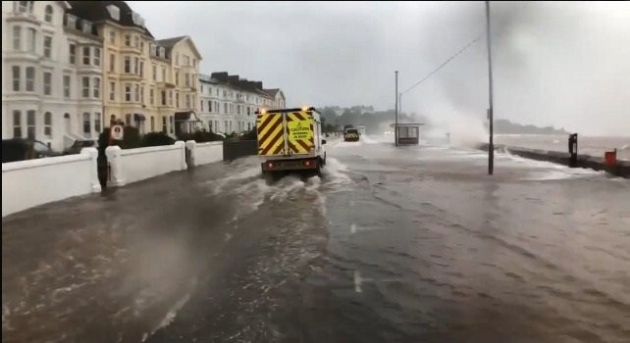
Control of Exmouth seafront flood gates taken over by East Devon District Council

Control of highway flood gates in Exmouth will be taken over by East Devon District Council.

Remember in February Council Leader, John Hart’s solution to flooding: encourage a modern day dad’s army of individuals, villages and Parish Councils, where they care, to do more for themselves. Self-help, he said, is going to be the order of the day. – Owl

Daniel Clark www.exmouthjournal.co.uk

Installed on the seafront, the flood gates are considered essential, and if they are not operated, up to 1,500 residential properties plus numerous commercial properties will remain at flood risk during a storm event.

They have been operated by the Environment Agency, but with it facing cutbacks, East Devon’s cabinet meeting on Wednesday (October 28) night it was no longer feasible for them to be the primary responder and in charge of closing the flood gates when storm events are predicted.

Councillors unanimously agreed that it would be sensible for East Devon District Council (EDDC) to be the primary operator of the highways gates, and a community group operating under Exmouth Town Council, will be the primary operators of non-highways gates.

Exmouth seafront

Supporting the move, Cllr Geoff Jung, cabinet member for coast, country and environment, said: “The scheme to get volunteers to work on the gates has worked elsewhere in Devon and this will be very welcome for the residents of Exmouth to be protected from storms and rising sea levels.”

In the event of storm conditions forecast, EDDC would receive a warning from the Environment Agency at least six hours before gate closures would be required.

EDDC would then close the central route, via Alexander Terrace, with gates opposite Morton Road and the Eastern Route, via the Esplanade, and adjacent to the Premier Inn.

The western route, via the Esplanade, with gates adjacent to The Grove, would be the last gate to be closed, as it has the highest threshold.

Once the central and eastern route gates have been closed, EDDC staff would man the western route gates, only allowing vehicles out of the impounding area. Once all vehicles have been removed, the western route gates would be closed.

Once the storm, or series of storms has passed, the Environment Agency will indicate the gates can be opened. EDDC will then open the gates at the earliest opportunity, the meeting heard.

In regards to the non-highway gates, it is envisaged there will be two separate community volunteer groups, one based at the Camperdown area, and another based at the seafront, which will be responsible.

Vaccine tsar Kate Bingham runs up £670,000 PR bill

“It is unclear how Boris Johnson came to appoint Kate Bingham to chair Britain’s vaccine taskforce, because there was no formal process. The 55-year-old venture capitalist’s establishment connections are unlikely to have hurt, however.

Her father, Lord Bingham, who served as lord chief justice, was hailed as the greatest English judge since the Second World War. Her husband, Jesse Norman, is a Conservative minister who went to Eton at the same time as Boris Johnson.

Bingham went to school with Johnson’s sister, Rachel, and studied at Oxford at the same time as the prime minister.”

All clear?-Owl

Gabriel Pogrund, Whitehall Correspondent www.thetimes.co.uk

The head of the government’s vaccine taskforce has charged the taxpayer £670,000 for a team of boutique relations consultants.

Kate Bingham, a venture capitalist married to Jesse Norman, a Conservative minister, was appointed to the role by Boris Johnson.

Since June she has used eight full-time consultants from Admiral Associates, a London PR agency, to oversee her media strategy.

According to leaked documents, she has already spent £500,000 on the team, which is contracted until the end of the year. It means each consultant is on the equivalent of £167,000 a year — more than the prime minister’s salary.

Bingham, 55, is said to have “insisted” on hiring them despite concerns they would duplicate the work of about 100 communications staff at the Department for Business, Energy and Industrial Strategy (BEIS), in which her taskforce sits.

The decision was signed off by civil servants, not Alok Sharma, the business secretary.

It has also emerged that Bingham will address a virtual conference of “executives, bankers [and] venture capitalists” held by a California biotech company next year, with tickets priced at $2,460 (£1,870).

A brochure refers to Bingham in her government role and not as managing director of SV Health Investors, a venture capital firm.

It says she will discuss her efforts to “find and manufacture a Covid-19 vaccine”. The disclosures will add to pressure for Bingham to resign.

Last night BEIS declined to give detail of the consultants’ work. They are understood to help Bingham prepare for media appearances, draft statements and to oversee a vaccines podcast on Spotify.

One Whitehall source said: “I don’t know what they do.” Another said: “They’re bossing around civil servants but no one knows who they are, what their experience is or what authority they have.”

A third Whitehall source said the team of consultants helped Bingham with day-to-day “comms works”, such as appearing in interviews and preparing press statements, and had set up a podcast co-presented by Bingham called Covid-19: The Search for a Vaccine.

Yet despite average earnings equivalent to £167,000 a year the consultants have not helped Bingham answer a number of questions stemming from last week’s revelations.

On Wednesday, Bingham told a joint select committee that our report last week was “nonsense”, “inaccurate” and “irresponsible”. Asked if she had disclosed information not in the public domain to the financiers, she told MPs: “No.”

We then sent BEIS a list of statements made by Bingham during the talk, asking for evidence that the information was already public. None was supplied.

It is unclear how Boris Johnson came to appoint Kate Bingham to chair Britain’s vaccine taskforce, because there was no formal process. The 55-year-old venture capitalist’s establishment connections are unlikely to have hurt, however.

Her father, Lord Bingham, who served as lord chief justice, was hailed as the greatest English judge since the Second World War. Her husband, Jesse Norman, is a Conservative minister who went to Eton at the same time as Boris Johnson.

Bingham went to school with Johnson’s sister, Rachel, and studied at Oxford at the same time as the prime minister.

In May, Johnson called Bingham and asked her to take the role, prompting her to say: “I’m not a vaccine expert, why should I be the right person?” Johnson reassured her the skills she had gained working in private equity would help.

On saying yes, Bingham became a more influential public servant than most ministers. She is responsible for investing billions of pounds of taxpayers’ funds in Covid-19 vaccines that could offer a route out of repeated lockdowns as soon as next spring.

The questions about her suitability do not concern her record on delivering vaccines — though last week she was forced to admit Britain will have just four million doses of AstraZeneca’s vaccine by the end of the year, not the 30 million promised by September — but her wider conduct.

Like others parachuted into Whitehall during the pandemic, Bingham has spent her career in the private sector. But she has chosen not to step down from her role as managing director of SV Health Investors, a private equity firm operating in Boston, Massachusetts, and London.

According to Sir Alistair Graham, a former chairman of the committee on standards in public life, such situations create a conflict of interest: “Whose interests does she serve?”

Is it possible to separate her public and private responsibilities?

Last week Bingham offered an answer to that question, when she appeared before MPs after we reported she had shared “official sensitive” information about Britain’s vaccine efforts at the $200-a-head event for US venture capitalists.

During an hour-long talk to the financiers, she had given some of the most detailed insight to date about the UK’s immunisation programme, including confidential data about the government’s investment priorities.

She then used an appearance at the science and health joint select committee on Wednesday to attack our reporting.

Asked whether she had disclosed anything that was not in the public domain, she said: “No. And there have been a lot of nonsense reports, and inaccurate, and I’m afraid to say irresponsible, reports suggesting that I did,” she told Greg Clark, the Tunbridge Wells MP. Her account is understood to have been met with scepticism in Downing Street.

Today, new evidence makes the questions more urgent still. In February, Bingham is due to appear at another elite function: a conference hosted by Biocom, a Californian biotech firm, charging $2,460 (£1,870) a ticket to bring together “executives, bankers [and] venture capitalists”. It promises networking that will “be fruitful for your business ventures this year and for many years to come”.

In brochures, Bingham is advertised solely as head of the UK vaccine taskforce and the literature says she will discuss her work “to find and manufacture a Covid-19 vaccine”.

During her talk to venture capitalists last month, Bingham showed guests a confidential list of 51 vaccines in development. Of these, Bingham told guests, officials had marked 14 as priority one, meaning they expect to place orders worth hundreds of millions of pounds. “We haven’t necessarily signed contracts with all of them so far, but they’re all in our sights,” she said, pointing to a slide in which the relevant treatments were split into blue, representing priority one, or purple, priority two.

For those present this was sensitive information they could use to make investments of their own. Bingham even showed the estimated price of vaccines per dose, based on an analysis prepared by Rx Securities, an investment bank.

She went on to predict that everyone over 50 will have a vaccine available to them by Easter, but produced documents showing that government scientists believe up to 40% of people may reject it.

Parliament, and the general public, would usually expect to be briefed by the vaccines chief before a paying American audience. The business department that hosts Bingham’s team did not quite back her assertion that nothing new appeared in her talk, simply saying there was “little that expert delegates at the conference could not deduce themselves”.

There is also confusion about whether Bingham received approval to give the talk. BEIS said “the fact of her appearance and the content of her presentation received approval”, but officials have since cast doubt on that narrative.

On Thursday we provided Bingham and the department with a list of statements she had made during the talk, which, we contended, had not appeared in public.

The department was invited to provide evidence that such information was already public and, failing that, to retract the claim. It did neither.

A BEIS spokesman said: “As we have already made clear, Kate Bingham’s role as chair of the vaccines taskforce includes appearing at conferences, speaking to media and liaising closely with wider stakeholders.”

The department did not provide details of the process by which she received approval for the talk, or say whether her next appearance at the California conference was appropriate.

Biocom did, though, edit its online description of her upcoming talk to say she would discuss only the “public effort” driving the vaccine programme.

The revelations come amid questions about the role of the private sector in the government’s pandemic response.

Lord Agnew of the Cabinet Office is working to create an in-house consultancy — dubbed “Crown Consultancy” — to cut the government’s dependence on high-charging private sector firms.

Critics of the government have focused on what looks to them like a network of personal appointments. Baroness Harding, the head of the NHS test-and-trace service, is married to John Penrose, another Conservative MP, and landed the role after presiding over a cyber-security scandal at TalkTalk.

Others have focused on value for money as well as transparency: Michael Gove, the Cabinet Office minister, was recently forced to defend leaked documents showing test-and-trace was spending £7,000 a day on consultants.

Research by Tussell, the data provider, shows that the government takes an average of 2½ months to publish Covid-related contracts, exceeding the legal limit of 30 days.

Bingham encompasses all these concerns, but initially attracted only passing interest. That may be due to the ambiguity of her role: she officially reports directly to the prime minister, but sits in BEIS. She is thought to interact with Matt Hancock, the health secretary, as well as Alok Sharma, the business secretary, but is supervised by neither on a daily basis.

Even the membership of the vaccines taskforce is unknown. When a member of the public sought to find out recently, using powers under the Freedom of Information Act, they received three pages of redacted names. An official said: “Please note that some information has been redacted under section 40 [personal information] of the act.”

Some sources are trying to illuminate Whitehall’s dark corridors. One said: “There’s so much money sloshing around, but people just don’t know what’s happening over here.”

Asked to describe the role of the PR consultants, BEIS would not comment.

Last night, Rachel Reeves, the shadow Cabinet Office minister, said: “At a time of national crisis, people don’t want to see huge sums of taxpayers’ money needlessly sprayed on spin doctors or management consultants.

“There needs to be a breakdown of this expenditure and proper justification as to how it actually helps the national effort in tackling this pandemic.”

Marcus Rashford forces Boris Johnson into second U-turn on child food poverty

The PM called the footballer on Saturday night to confirm latest about-face for the government

Haroon Siddique www.theguardian.com 

On the day his political soulmate was being urged to belatedly show some humility after defeat in the US election, Boris Johnson once again bowed to the better judgment of a 23-year-old footballer, in the latest of a series of high-profile U-turns.

After weeks of digging in his heels and refusing to cede to calls to extend free school meals to children from low-income families during school holidays in England, Johnson phoned the Manchester United and England footballer Marcus Rashford on Saturday night to inform him of his change of heart.

The package includes a £170m Covid winter grant scheme to support vulnerable families in England and an extension of the holiday activities and food programme to the Easter, summer and Christmas breaks next year.

The reversal came after a crescendo of criticism, led by Rashford, but also from charities, the opposition, media on both sides of the political divide and even some Conservative MPs, who realised how out of tune their party was with the public mood.

It was the second time the Manchester United star had forced the government to change course this year. On the previous occasion, which last month earned Rashford an MBE, No 10 had initially rejected his plea for it to keep paying for £15-a-week food vouchers for some of England’s poorest families over the summer, only to cave in amid a public outcry.

Just under five months later, the Old Etonian prime minister picked up the phone and again called Rashford, who has spoken of his experience of food poverty growing up in Wythenshawe, breaking the news in what the striker described as a “good conversation”.

Showing diplomatic skills to match his footballing prowess, Rashford said: “There is still so much more to do, and my immediate concern is the approximate 1.7 million children who miss out on free school meals, holiday provision and Healthy Start vouchers because their family income isn’t quite low enough. But the intent the government have shown today is nothing but positive, and they should be recognised for that.”

Among those who hailed Rashford’s role were Save the Children UK, the Royal College of Paediatrics and Child Health and the archbishop of Canterbury. The tennis coach, Judy Murray simply tweeted: “Rashford 2 Johnston [sic] 0.”

The children’s commissioner for England, Anne Longfield, said: “I welcome these steps towards providing more free meals and healthy diets for children who need them and holiday activities. Families are facing hard times financially and this will help.”

Longfield had previously likened the debate over the issue to something out of the pages of Charles Dickens’ 19th-century novel Oliver Twist. Tory MPs had suggested that extending free school meals would increase dependency or destroy the currency because of the cost.

One Conservative MP, Brendan Clarke-Smith, called for “less celebrity virtue-signalling on Twitter by proxy and more action to tackle the real causes of child poverty”. After the Conservatives’ defeat of a Labour motion to extend free school meals prompted councils, local businesses, charities and community groups to step in to fill the void over half-term, opposition and accusations of virtue-signalling appeared ever further removed from reality. Nevertheless, Downing Street repeatedly declined to praise the organisations, saying only that it did not believe free school meals were necessary outside term.

In a year that has also seen U-turns on the second national lockdown, extending the furlough scheme and A-level and GCSE results, Rashford’s warning that “there is still so much more to do” may be liable to bring Johnson out in a cold sweat.

Of the three demands in Rashford’s petition to end child food poverty, which has attracted more than 1m signatures, the one that remains unfulfilled is: “Expand free school meals to all under-16s where a parent or guardian is in receipt of universal credit or equivalent benefit.” The government is also poised for a battle over the £20-a-week pandemic supplement to universal credit, which is due to end in April.

Longfield and the Trussell Trust were among those who tempered their appreciation for the latest policy about-face by calling for the £20 universal credit increase to be retained. Becca Lyon, head of child poverty at Save the Children UK, said: “Families need to know that they’re not going to be £1,000 down next year, when the increase ends in April.”

Nightingale hospitals grounded by staff shortage

Each patient so far admitted to the Nightingale hospitals has cost £1m to treat, an analysis reveals.

Caroline Wheeler and Tom Calver www.thetimes.co.uk

Seven Nightingale hospitals were built, at a total cost of £220m, to ease pressure on the health service during the first wave of the Covid-19 pandemic, but some may never fully open because of a staff shortage. The aim was to provide critical care in the event that NHS hospitals became overwhelmed.

Only two, in London and Manchester, looked after anyone, caring for about 200 patients in total during the first wave.

Despite England being plunged into a second national lockdown amid fears the NHS was reaching breaking point, only the Nightingale in Manchester is currently taking patients. Harrogate’s and Exeter’s are reportedly being used for non-Covid diagnostic care, such as cancer screening.

Chris Hopson, chief executive of NHS Providers, said there are “not the hundreds or thousands of NHS staff waiting to be deployed into those hospitals”.

He added: “In effect, you would have to take them from existing hospitals. Clearly what you want to do is to carry on treating patients in existing hospitals for as long as you possibly can until all of the existing capacity is used and then you flip to your insurance policy of using the Nightingales.

“But as soon as you start doing that, you will start drawing staff from existing hospitals, so the patient-to-members-of-staff ratio will start dropping, which will mean more pressure on quality of care.”

He claims the makeshift hospitals were only supposed to be deployed as a “last resort insurance policy” if the capacity in existing hospitals was reached.

However, Hopson said that the NHS Nightingale hospitals, inspired by the example of Italy’s Covid response, remain on standby to be used for when the last bit of capacity in the health service has been squeezed, adding: “The idea that you don’t need a lockdown because you are not using your Nightingale capacity is not true.”

The revelation comes just days after Sir Simon Stevens, the chief executive of NHS England, revealed that about 30,000 NHS staff are self-isolating or off work because of the coronavirus. The NHS employs 1.3m people in England.

Last week a senior intensive care specialist warned that reopening Nightingale field hospitals during the second peak of the coronavirus risks poaching staff from already overburdened hospitals.

Speaking at a Royal Society of Medicine webinar on Thursday, Dr Gary Masterson, a consultant at the Royal Liverpool University Hospital, said Nightingale hospitals had been a good idea in principle, but added: “I think perhaps the thinking was done before we had any understanding of this disease process.”

He said they were likely to be of little value because it is already hard to find the numbers of multi-disciplinary staff needed for our standard hospitals.

“There was an impression that if you stick a ventilator by a bed you get an intensive care bed space — that’s simply not true,” Masterson said.

“Once you ventilate a patient, these patients are often very, very sick and require advanced therapies.

“We are struggling to staff our normal NHS hospitals with self-isolation, with staff sickness and so forth — how are we going to staff Nightingale hospitals? I really don’t understand that.”

The Birmingham Nightingale, based at the National Exhibition Centre, cost £66.4m and was the most expensive to set up. Despite a capacity of 4,000 beds, it has yet to treat a single patient.

The cost of the Exeter Nightingale, at £23m, included £113,000 in management consultant fees. It opened on July 3 — well after the worst of the first wave — and never admitted a single Covid patient. Along with Harrogate, it has been used for CT scans since the summer.

Manchester Nightingale is finally being used for patients, but not Covid ones. It reopened at the end of last month, but if trusts want to use the £23.4m facility they have to supply their own nurses.

In the first wave the hospital cared for just over 100 patients in total. However, it is not an intensive care hospital, instead it is used for those who “no longer need to be in a critical care environment”.

ExCeL London and the NEC, which had already been earmarked to be decommissioned as hospitals, were set to reopen for events from October 1 until the government delayed the restart date.

Between them the seven Nightingales had a maximum stated capacity of 10,126 beds, around half of which were intensive care. However, because patient numbers were so small or non-existent, the actual number of beds was just 1,700.

Yesterday, the Royal College of Nursing (RCN) warned that nursing shortages across the NHS could lead to staff burnout and risk patient safety this winter.

The nursing union said that a combination of staff absence due to the pandemic, and around 40,000 registered nursing vacancies in England, was putting too much strain on the remaining workforce.

Mike Adams, RCN’s England director, said: “The NHS is now at its highest level of preparedness as it faces the prospect of an extremely challenging winter.

“We already know that frontline nurses — in hospitals, communities and care homes — are under huge strain.

“Anecdotally we’re hearing that in some hospitals they [nurses] are becoming increasingly thinly spread on the ground, as staff become unwell or have to isolate, at the same time as demand on services continues to increase.”

Second wave past its peak?

Owl has always regarded the Covid-19 symptom tracker app as being the best tool available to give early indications of change in the pandemic. Over 3 million individuals across the country are sampled on a daily basis and in a consistent way. The only caveat is that these individuals are self-selecting.

The current chart of the evolution of infections on a daily basis is very interesting. It shows that the infection rate began to reduce around 31 October. The infection then appears to have peaked around 4 or 5 November and is now falling. 

With an incubation period of up to two weeks (though there is now some suggestion that it might be only one) there will always be a lag of at least this time between imposing any lockdown control and observing any effect. For the government, there are then additional delays before the testing regime produces results, especially at week-ends.

The changes in the chart, therefore, relate to what has been happening as a result of the imposition of the tier system, before lockdown 2. We can reasonably assume that lockdown 2 will have an additional effect to that of the tier system. We will have to wait to see just how large an effect that is.

Meanwhile the omens are encouraging. 

Developers building new homes with same fire-safety defects as high-rise flats

At Greenacres in Exeter, Paul Frost, 56, a snagging inspector, found his family’s five-bedroom detached Persimmon house lacked fire barriers after a 2018 blaze at a terraced house on the estate quickly spread next door.

After he pushed Persimmon to investigate, the housebuilder found more than a third of homes at Greenacres had the same defect, and it wrote to more than 1,000 people in the southwest, saying their properties needed checking.

Martina Lees, Senior Property Writer www.thetimes.co.uk 

Houses are now being caught in the building safety crisis that has paralysed the market for modern flats in the wake of the Grenfell Tower fire.

Fire risks similar to those in flats have been discovered at thousands of recently built houses. In one case, a bank asked a house buyer for an “external wall system” (EWS1) form, requiring an invasive fire-safety survey designed for tall blocks of flats.

One of the first analyses of the crisis by economists warns it could leave the property market “significantly weaker” than their already grim forecasts due to coronavirus. Capital Economics said up to 900,000 flats — 4.5% of England’s private property market — faced mortgage problems because their blocks lacked EWS1 sign-off. Without this, banks will not lend and owners cannot sell, leaving millions trapped.

Industry figures say a review of the EWS1 form, which flat owners had hoped would unblock the mortgage logjam, is “not EWS2” and will have limited effect.

The scandal is hitting houses too. At the Hamptons, a 650-home Berkeley development in Worcester Park, southwest London, missing fire barriers in cavity walls allowed a block of flats to burn down in 11 minutes in September. Houses on the estate have the same defect.

In one £600,000 terrace, contractors will need a month to fix fire-safety defects, including missing fire barriers. “I feel really nervous living in my own house,” said the owner. St James, the Berkeley subsidiary that built it, said “work will be completed as quickly as possible and signed off by an independent fire engineer”.

At Greenacres in Exeter, Paul Frost, 56, a snagging inspector, found his family’s five-bedroom detached Persimmon house lacked fire barriers after a 2018 blaze at a terraced house on the estate quickly spread next door.

After he pushed Persimmon to investigate, the housebuilder found more than a third of homes at Greenacres had the same defect, and it wrote to more than 1,000 people in the southwest, saying their properties needed checking.

Last year an independent review found Persimmon had overseen a “systemic nationwide failure” to fit fire barriers in its timber-frame properties. The company’s annual profit has topped £1bn in the past two years and it paid its chief executive a £75m bonus in 2018. “For it not to install cavity barriers that cost a few pounds — there’s no excuse,” Frost said. Persimmon is inspecting 16,000 homes and promised to fix those affected.

In Wales, it told hundreds of homeowners in Bryn, Llanelli, and Sketty, Swansea, of the same defects only a week ago.

On a Devon estate by another housebuilder, a retired couple must move out of their new timber-framed terraced house to allow faults, including missing fire stops, to be fixed. “You expect it to be safe. You don’t expect the next-door neighbour’s cooker to kill you,” the wife said. They also own an unmortgageable London flat in a low-rise block with no EWS1 form. “When you’re living in two £0-rated properties, that’s not good,” she said.

A Sunday Times campaign to end the hidden housing scandal calls for a fairer, faster process to replace the EWS1 form. The campaign revealed that 9 in 10 buildings have failed the checks. Leaseholders must then pay to fix cladding, insulation, balconies and wall structures. It can cost £75,000 per flat and take 5-10 years.

Even new-build houses with no known fire risks can be affected. In Birmingham, the sale of a terraced house stalled for two months after the buyer’s lender, TSB, wanted an EWS1 form, said Tania Rawle, 49, the owner. TSB’s valuer asked whether two small panels of cladding on the house, built 10 years ago, were flammable. “I had never noticed them before,” she said.

Fewer than 300 fire engineers can perform EWS1 checks. Rawle said she struggled to find one. “It’s a lender being ridiculously overcautious and potentially harming the flow of properties. And it’s bloody annoying.”

TSB said later that the valuer had requested the EWS1 “in error” and waived the demand. It does not require EWS1 forms for houses “as there is no government requirement”.

The form was designed to reassure lenders on flats in blocks taller than 18 metres (59 ft, or six storeys) after the Grenfell fire, which killed 72 people in 2017, exposed a nationwide failure of building regulations. Since January, when the government tightened safety advice for all flats, some banks have refused to lend even on three-storey brick blocks without EWS1 forms.

Capital Economics said the forms could be required for up to 900,000 private flats — the number in modern blocks over three storeys . The “downside risks are significant” for housing transactions in 2021.

It said: “Problems may become more important next year, as any cladding delays cool housing demand on top of any weakness arising from a fragile economy and the end of the stamp duty cut.”

Planning applications validated by EDDC for week beginning 26 October

What transport in Exeter could look like by 2030

“On yer bike” – No Sidmouth or Seaton on the transport network – Owl

Daniel Clark www.devonlive.com

Park and ride sites on every corridor into Exeter, enhanced rail services, and a new single ticketing platform to boost the convenience of non-car travel into and around the city are all part of the long awaited Exeter Transport Strategy.

More than 14 months the plan was due to be adopted by Devon County Council, the Exeter Transport Strategy 2020-2030 is finally set to be agreed by the council’s cabinet when they meet on Wednesday.

The strategy set out ambitious aspirations to support healthy, active lifestyles, a growing economy and a positive response to reduce the carbon emissions from transport in Exeter and has been updated to give greater emphasis on reducing carbon throughout the strategy.

The strategy outlines that the balance of travel for Exeter residents has already shifted to a point where the majority of Exeter residents now travel to work by sustainable modes but that they still account for 35 per cent of car-based commute trips to a destination in the city

However travel behaviour differs significantly for commuters living outside the city, with 80 per cent of trips into the city being made by car and in rural areas, where there is limited alternative to car, the car dominance is even more prominent with over 90 per cent travelling to the city by car.

This article has been produced for the Annual Business Guide Top 150, sponsored by PKF Francis Clark.

The guide profiles the biggest firms in Devon and Cornwall and takes a comprehensive look at the sectors that dominate the regional economy.

We examine how they have been affected this year and chart the COVID-19 bounceback.

See the full list, published on October 22, at BusinessLive and in print in the Western Morning News, or sign up to the WMN newsletter, here.

You can also view it here.

It recognises the importance of supporting essential business travel and maintain efficient public transport corridors but that as the city is built upon a historic road network, is constrained by limited road crossings of the River Exe and has limited scope for additional widening and capacity improvements and building extra physical highway capacity is probably not possible within the city.

Central to the strategy is ensuring there is a comprehensive, accessible and coherent cycle and pedestrian network in Exeter that connects residential areas with schools, key economic hubs, public open space and transport interchanges so that 50 per cent of trips within the city are being made on foot or by bike.

The Consistent Standard of Sustainable Transport providing a Connected City Region across Exeter

The Consistent Standard of Sustainable Transport providing a Connected City Region across Exeter

When they meet on Wednesday, Devon County Council’s cabinet are asked to support the adoption of the Exeter Transport Strategy and that the contents in the strategy provide the basis for developing transport projects, and infrastructure in the Exeter and Greater Exeter area.

The plan includes:

  • The transport strategy will facilitate decarbonisation of transport in the Greater Exeter city region by providing a sustainable and reliable transport system, allowing people and goods to move around the network efficiently
  • Creating a comprehensive, accessible and coherent cycle and pedestrian network in Exeter that connects residential areas with schools, key economic hubs, public open space and transport interchanges so that 50 per cent of trips within the city are being made on foot or by bike
  • Progressing opportunities to remove or reduce traffic on some routes to create “green lanes” and support active travel access from villages on the edge of the city
  • A new, high-quality strategic cycle link creating a city region strategic leisure network to encourage short to medium distance trips from existing settlements into Exeter and the Exe Estuary Trail
  • Supporting enhanced bus frequency on key interurban routes, with an aim of achieving 15 minute bus frequency or better on key inter-urban routes into the city from Cranbrook, Crediton, Cullompton and Newton Abbot. This level of frequency provides a ‘turn-up-and-go’ service where users will no longer feel the need to consult a timetable.
  • Enhanced bus corridors and improvements at key junctions, with particular focus will be given to enhancing Heavitree Road to achieve more reliable journey times on a key, busy public transport route to growth in the East of Exeter and achieving an improved environment for residents, pedestrians and cyclists
  • Delivery of the cleanest bus fleet with onboard WiFi allowing more productive travel and reduced transport costs with a greater influence on the routes being run.
  • The continued improvement of ‘Devon Metro’ rail services improving the connectivity within the city region so that the towns of Cranbrook, Crediton, Dawlish, Dawlish Warren, Exmouth, Honiton, Newton Abbot and Teignmouth are served by at least half hourly rail frequency.
  • New rail connectivity to Mid Devon, with a station at Cullompton, will also be investigated.
  • In combination, the enhanced rail, bus and active travel links between key settlements and Exeter form the basis of a Connected City Region network
  • Park & Ride sites on all key corridors of Alphington Road, A377 to Crediton, B3181 to Broadclyst and A376/A3052 to provide a realistic sustainable travel option for those trips from rural areas into the city that can’t feasibly be served by traditional public transport services.
  • Potential of Park & Ride to also provide frequent cross city connections as well as from the city centre out to employment and amenities at Marsh Barton and Sowton / East of Exeter will also be promoted, and bus priority to increase attractiveness of new Park and Ride routes to the city
  • Refine and optimise bus routes with enhanced bus priority at major junctions of Exe Bridges, Clyst St Mary and Countess Wear and “Red Routes” on key corridors including Heavitree Road, Pinhoe Road and Cowick Street.
  • To protect and enhance strategic rail, road and air connectivity into the city and South West Peninsula so that it retains momentum and continues to offer an attractive place for sustainable growth.
  • To work with and support the private sector to develop innovative solutions in the city and in securing external funding for new initiatives and to share data with partners to improve collaboration and support innovation.
  • To facilitate an accelerated change in transport conditions in the city and to be more dynamic in testing and trialling of new measures and highway changes.
  • To look into innovative car parking strategies in the city centre, which encourages longer stays in the evening and off-peak, whilst discouraging car travel at peak times
  • To expand the electric bike hire to provide the largest on-street electric bike scheme in the UK and will continue to expand and electrify the already well utilised car club fleet
  • Exeter has an extensive bus network which together provide core elements to build upon to create a single ticketing platform that is right for the attributes of Exeter. The plan aims to introduce a new single ticketing platform and shared mobility to boost the convenience of non-car travel into and around the city
  • Improved IT systems to improve real time information, journey time reliability and payment methods.
  • The emergence of electric bus funding opportunities, along with electric car club vehicles and bike hire unlock the potential for the delivery of the UK’s first zero-emission transport subscription service.
  • Improved resilience, capacity and journey times on rail mainlines as well as ‘working office’ capabilities on new rolling stock, as well as enhanced resilience of M5 J29 – J31 / Splatford Split and to improve access to Exeter Airport by sustainable modes

Dave Black, head of transportation, planning and environment, in his report to the cabinet said: “The Exeter Transport Strategy focuses on improving travel choices, creating better places for people and taking advantage of technology opportunities to influence travel behaviour in a positive way.

“The focus is to address constraints on sustainable transport networks to provide the basis of a connected city region, deliver interventions that contribute to improved quality of life and to utilise technological advancements to integrate services and engage with people to influence how and when they travel.

“The proposals aim to provide an ambitious, but realistic, transport strategy that is embodied in the three key themes.

“Greater Connectivity, which this focuses on travel into the city from outside Exeter’s boundaries, by providing a consistent standard of frequency of both rail and interurban bus routes and delivering strategic cycle trails between key settlements.

“To capture those from the rural hinterland with limited sustainable travel choices, there will be a Park and Ride on all key corridors into the city.

“Greater Places for People, which relates to travel within the city, and focuses on increasing the number of trips made on foot or by bike and urban bus corridors. This will be done through enhancing pedestrian/cycling networks to connect residential areas and villages on the edge of the city to economic hubs, reallocating road space for walking and cycling, creating more attractive public spaces and working with operators to provide a reliable low carbon network of buses.

“Greater Innovation will see the Council looking to work with private sector partners to test and implement innovative technology solutions to make travel easier, encourage mode shift and help the city’s transport networks operate more flexibly and efficiently.

“The strategy has been well supported by the public and is aligned to current priorities in supporting a low carbon economy and healthy lifestyles. An updated Exeter Transport Strategy will ensure a transport strategy that is aligned with current local and government policies and enables the County to be opportunistic when funding becomes available.”

For more of the latest news near you, sign up to receive our newsletters.

The daily and weekly bulletins are simple, easy to read and we’ll only send the most important stories.

Our teams are committed to bringing you the latest news, guiding you through this global pandemic and writing the stories that matter.

See our Devon newsletters here, sign up for bulletins from Cornwall here and pick your Plymouth emails here.

The plan recognises that outside of Exeter, the towns of Newton Abbot, Tiverton, Cullompton and Honiton will experience significant growth and the new town of Cranbrook will grow to a size similar to Tiverton during the current Local Plan periods, and additional travel demand within these towns and towards Exeter will need to be accommodated sustainably.

But that although car ownership has been rising, car usage is falling, which provides a great opportunity to promote shared mobility, such as car clubs / bike hire and other non-car travel modes, as a lower carbon alternative to car ownership.

“Devon County Council has a strong track record of delivering transport infrastructure in Exeter,” the plan says. “Nevertheless, the transition to a carbon neutral transport system will require an accelerated change and a key challenge will be how best to embrace innovation and invention to support this transition and ensuring the safety of all users in a complex highway environment.”

It says that for the three key themes of Greater Connectivity, Greater Places for People and Greater Innovation, at least 70 per cent of respondents during the consultation phase expressing a level of support for each theme, that there was strong support for Park & Ride, active travel networks, and the rededication of highway space for pedestrians and cyclists in the city centre.

It adds: “Looking forward over the next 20-25 years, the numbers employed in Exeter are expected to increase by another 25-30 per cent. With existing transport networks already at capacity in peak periods and a need to ensure increased demand does not lead to increased carbon emissions, providing capacity for future growth will depend on effective sustainable alternative travel choices and more sophisticated management of existing transport corridors.

“Technology will unlock new ways to manage the network, such as real time wireless methods of corridor control, which could optimise the operation of the network, providing additional capacity and reliability on core highway routes. This could support reallocating road space for an improved walking and cycling environment on other routes.”

When the cabinet meet on Wednesday, they will be asked to give final approval of the Exeter Transport Strategy 2020- 2030.

Opportunities to align the delivery of the strategy with planned maintenance and/or renewals will also be identified, and the integration will ensure better value for money and reduce disruption for users of the transport network.

Test and trace needs radical reform in England, health experts say

The government faces renewed calls for the central NHS test and trace system to be scrapped in favour of handing responsibility for contact tracing to local public health teams.

Mattha Busby www.theguardian.com 

Weekly test and trace figures for England show it reached just under 60% of close contacts of people testing positive, the lowest since the service began. It comes as the Office for National Statistics indicated the steep rise in new infections was levelling off in England and stabilising at about 50,000 a day.

Sir John Oldham, adjunct professor in global health innovation at Imperial College London and former leader of large-scale change at the Department of Health, said “lockdown will be a letdown” unless trust was increased through radical reform of test and trace.

“I think this probably includes increasing the number of small labs to decrease turnaround time and, crucially, the results to go to local directors of health and for them to have teams to undertake the contact tracing,” he told BBC Radio 4’s Today programme.

“I’d probably get the resources for that by scrapping the failing central call centres. I think the whole system should be under the purview of public health, which gets us as close to the effective system we had before 2012 NHS reforms. I think they have demonstrated that they have the capability and effectiveness – they are running at 95% contact tracing; the national call centre is at 60%.”

Oldham suggested lockdown could be futile unless there was an effective test and trace system – “such as in South Korea, New Zealand, and Germany” – to keep numbers down after restrictions were relaxed. “This we’ve been continually promised but there has been a failure to deliver,” he said.

He added that trust was paramount as he advocated the use of local contact tracers. “The pandemic is seen as a political campaign with huge promises and slogans. The virus does not tweet back or send out press releases. We just need some truthfulness, transparency about the data and the outcomes and decision making … Greater understanding gives greater trust and greater adherence for what we want people to do.”

Thousands of people were tested in Liverpool on the first day of the mass pilot scheme on Friday. The programme aims to test up to 50,000 people a day once fully operational, said Matt Ashton, the city’s director of public health.

He said: “We are still working on the numbers but we think [there were] about 1,500-2,000 people per testing centre, so really good numbers and really good interest, so it was very encouraging.”

The scheme has drawn criticism from health experts, however, who have described it as not fit for purpose. Allyson Pollock, professor of public health at Newcastle University, said plans to test asymptomatic people went against advice from the Scientific Advisory Group for Emergencies to prioritise testing for those who were displaying symptoms.

Meanwhile, Chris Lovett, the deputy director of public health for the City of London and Hackney, said his team of six were being asked to reach people in their area whom NHS test and trace had not been able to contact. Of 700 cases transferred in the past six weeks, just under half were reached and brought into the scheme, he said.

“Right at the beginning of the pandemic, our local mayor and many others did ask for local systems to take control of test and trace,” he said.

“At this stage, its going to be very difficult for us to mobilise all the resources necessary to take on the full contact tracing, but certainly working in much closer partnership with local organisations, the councils, the NHS, so we can ensure this important control measure works is what we’re committed to do.

“Our local residents have often said how important it has been to have that local contact, local knowledge and knowledge of what works for our communities.”

Mr President, I have a Mr Johnson on the line… will you accept the call?

Tommy Vietor, a former Obama press aide, responded to Johnson’s congratulatory tweet last night by calling him a “shapeshifting creep”, adding: “We will never forget your racist comments about Obama and slavish devotion to Trump.”

Tim Shipman, Political Editor www.thetimes.co.uk 

When Boris Johnson discussed the presidential election with aides on Friday, he was upbeat about developing a special relationship with the winner. “Joe Biden is one of the few world leaders I haven’t insulted,” he joked.

No 10 officials laughed, but this weekend they are engaged in a diplomatic dance following warnings from those close to the president-elect that Johnson’s past will make that difficult.

Downing Street is wargaming Johnson’s first phone call with Biden to help achieve the best personal and political connection.

It is understood the prime minister will ask Biden to join him in seeking a bold outcome to the UN climate summit the UK is hosting next year and to set up a “D10 coalition of democracies” at the G7 summit in June, which Johnson is to chair.

The PM will point out that both he and Biden have vowed to “build back better” after the Covid-19 crisis.

In a tweet last night Johnson congratulated Biden and his vice president-elect Kamala Harris for taking charge of “our most important ally” and called for them to work “closely together” on “climate change” as well as “trade and security”.

But this weekend, one of Biden’s campaign team accused Johnson of making “racist comments” in the past, compared Britain’s immigration policies to Trump’s and criticised British ministers’ stance towards Black Lives Matter.

“They do not think Boris Johnson is an ally,” the Democratic source said. “They think Britain is an ally. But there will be no special relationship with Boris Johnson.”

A senior US politician who is expected to take a job in the Biden administration recently told a British friend those views were shared by Harris. “If you think Joe hates him, you should hear Kamala,” the senior figure said.

Biden’s ire dates to comments Johnson made during the EU referendum, when he wrote that Obama’s decision to remove a bust of Winston Churchill from the Oval Office was a “symbol of the part-Kenyan president’s ancestral dislike of the British empire”.

Tommy Vietor, a former Obama press aide, responded to Johnson’s congratulatory tweet last night by calling him a “shapeshifting creep”, adding: “We will never forget your racist comments about Obama and slavish devotion to Trump.”

The source said: “Biden’s got a long memory and Boris is not in his good books. Biden and Obama are like family. Many of the people around Biden have been talking about Boris Johnson. The Kenyan remark has never gone away. They see Boris and [Dominic] Cummings like Trump and Bannon.”

Johnson’s relationship with Trump, and his past association with the alt-right strategist Steve Bannon, also make him an object of suspicion to Biden and to the Obama-era advisers who will form the core of his White House team, the campaign source said.

In fact, Cummings, Johnson’s most senior aide, has been withering in private about the president, telling colleagues months ago: “Trump is toxic” and urging ministers to keep their distance from him.

Aides said the mood in No 10 last week was one of satisfaction with the election.

But people around Biden, including Ben Rhodes, an Obama adviser now expected to take a national security role, have argued for Johnson to receive the cold shoulder.

In a TV address on Friday, Biden stressed tackling “systematic racism” as a priority. “Leaders who are not seen as allies on race, there will be big problems for those leaders,” the campaign insider said.

“He doesn’t want to work with people who project those views,” the aide said, and he was “shocked at the dismissiveness of black rights” after Dominic Raab, the foreign secretary, called Black Lives Matter protestors taking the knee, “a symbol of subjugation and subordination” and said that he would kneel only before the Queen or when proposing to his wife.

Britain’s hardline approach on immigration has also unnerved some of the team. “They see some of the policies that Priti Patel [the home secretary] is doing as similar to what Trump is doing on the border here,” the aide said.

The outspoken attack was not a sanctioned briefing against Johnson. But in laying bare the full extent of the Biden camp’s private views of the PM it reveals the mountain he has to climb to develop a close partnership with the new president.

Biden’s priorities on the world stage will be to reconnect with the EU and Nato and rejoin the Paris climate accord. That leaves little room for Britain’s hopes of securing a free trade deal.

There is hope in Downing Street that Biden, having failed to win a landslide and control the Senate, may need to be more conciliatory. “I do wonder if a not-so-strong result will make life easier,” said a cabinet source, who also conceded, however: “There’s a group of people in the Democratic camp who want a very public rejection of everything that Trump stood for. There is always the risk that that includes Boris.”

Johnson’s aides, aware of the tensions, stress common interests. One said: “The PM and Joe Biden share common ground and have a similar outlook on key issues like climate change and on our foreign policy priorities like strengthening Nato and our commitment to build back better from the pandemic.

“We are in the same place on Iran and Hong Kong. We have shared security goals in the Middle East and addressing the challenges posed by China. It is hard to think of any substantive differences.”

Knowing political relations could be strained, backroom staff, civil servants and military leaders are trying to cement relations with their opposite numbers in the US.

The key figure in No 10 is John Bew, Johnson’s foreign policy adviser, who spent time in Washington as Kissinger fellow at the Library of Congress.

“He’s part of the circle around Henry Kissinger, which includes Democrats and Republicans,” a colleague said. “He has close links to senior Democrats around Biden. He will be a pivotal figure. He’s just very well plugged in.”

Simon Case, the cabinet secretary, is also understood to be contacting Ron Klain, tipped to be chief of staff.

Intelligence chiefs will be urged to help persuade Biden that Britain is America’s key security ally. “Our best card is going to be security, defence and intelligence,” a diplomat said. “That’s the main thing we bring to the table.”

The British embassy in Washington, under ambassador Karen Pierce, has good relations with Tony Blinken, tipped as Biden’s secretary of state or national security adviser. They are also working on Larry Strickling, who is helping to develop Biden’s global policy.

Whitehall is also discussing plans to butter up Biden by offering him a state visit next year, tacked on to either the G7 or the climate summit. “There have been informal discussions,” a source said.

Tory circles are awash with speculation about who Biden will send as ambassador. One Conservative with a friend in Biden’s circles, claimed: “I have heard there is a possibility that Obama could be asked as a thank you.”The Biden source said they had not begun to think about that: “We are still working on the cabinet.”

Boris Johnson’s next transport mega-project won’t be in the South West

Boris Johnson looks into building tunnel under the Irish Sea

Boris Johnson has signed off on a review to explore the possibility of building a rail tunnel between Scotland and Northern Ireland, despite criticism that the multi-billion pound venture would be impractical. 

[Boris loves to splash other people’s cash. Is this announcement intended to distract attention from the key issues of the day? – Owl]

Clea Skopeliti www.independent.co.uk 

The prime minister has repeatedly spoken in favour of building a fixed link between the countries, with Downing Street confirming earlier this year that the government was “looking at a wide range of schemes across the UK which could improve connectivity”. 

The chairman of Network Rail, Sir Peter Hendy, has asked experts to research the possibility of building a tunnel between Stranraer and Larne.

He told the The Daily Telegraph: “If you look at the distance between Northern Ireland and Scotland it is actually no further than the Channel Tunnel.

“I said to Boris, I am not going to get any further than finding out whether it is feasible, how long it will take and how much it might cost.”

Significantly, any infrastructure built would have to avoid Beaufort’s Dyke, a natural trench between Northern Ireland and Scotland where tonnes of munitions were dumped in the aftermath of the Second World War.

Earlier this year, Labour condemned the plan for a 21-mile bridge as “a distraction”, while one retired offshore engineer blasted the notion as being “about as feasible as building a bridge to the moon”.

Alister Jack, the Scottish secretary, later told MSPs that said the bridge was a “euphemism” for a tunnel.

Sir Peter told the Railway Industry Association annual conference: “The government’s policy is to bring the United Kingdom closer together. The quest for economic growth, particularly in the light of Brexit, is a common desire for Westminster and for the devolved administration governments.”

The review comes after Mr Johnson pledged £100m on 29 road projects during a speech in July on how to kick-start the economy following the coronavirus pandemic.

Politicians from Scotland and Northern Ireland told the transport secretary in March that the multi-billion pound budget would be better spent on vital infrastructure projects.

Michael Matheson, Scotland’s transport secretary, had previously said the review has been “organised with virtually no consultation”, despite transport being a devolved issue. 

He said: “We absolutely want to see improved transport and connectivity links beyond Scotland’s borders – under any constitutional arrangements.

“But this study is clearly part of the Tory government’s wider agenda to undermine the devolution settlement across a whole range of policy areas.”

Former Budleigh care home to return to auction in December

The former Shandford care home, in Budleigh Salterton, will return to auction in December after it failed to reach its reserve at this month’s sale.

Will this publicly subscribed for asset now go for a song? Are we witnessing the start of the property crash that will surely follow the Covid-19 economic crash? – Owl

Author Becca Gliddon eastdevonnews.co.uk 

The detached 26-bedroom building and grounds was on Tuesday, November 4, auctioned through agent Savills, with a freehold guide price of £750,000.

Abbeyfield, who took over the former care home, said the site – with off-street parking, rear garden, ground, second and first floors and ‘further potential subject to the usual consents’ – will be for sale in December after the auction reserve price has been reassessed.

A spokeswoman for Abbeyfield said: “Abbeyfield plans to reconsider the level of the reserve and return to auction in December.”

The Abbeyfield Society last week revealed how proceeds from the sale of the site will be given to newly-formed registered charity The Shandford Trust, to support older people in need who live within the area of Budleigh Salterton and the villages of East Budleigh, Otterton, Colaton Raleigh and Bicton.

The Trust will be managed by a board of trustees drawn from the local community and one from The Abbeyfield Society.

When the funds become available, a new website will be launched to highlight the charity, its work, who can apply for financial support and how to apply.

The former care home, in Station Road, was permanently closed in March 2020, during the coronavirus lockdown and residents were moved to other care homes.

At the time, Abbeyfield said the decision to close Shandford was ‘with great regret’ and taken after a lengthy review of the service which took into consideration the future of the care home, finding it was ‘not a viable option’ to keep open.

It said the decision to close was the result of a detailed review of the infrastructure, building condition and financial performance of the home.

A community drive by Budleigh residents to set up a Community Interest Company to run Shandford as a not-for-profit venture, with public volunteers and annual subscriptions, attracted ‘significant support’ but did not progress.

For more information about Registered Charity Number 1192048 The Shandford Trust, email shandfordtrust@gmail.com 

Calls to suspend licence allowing waste dredged from Exmouth to be dumped at sea

Calls have been made for the suspension of a licence that allows dredged waste from Exmouth Marina to be dumped at sea.  

Daniel Clark eastdevonnews.co.uk 

Teignmouth residents were outraged in 2018 when its beaches suddenly turned black because the spoil was being disposed of nearby Sprey Point, writes Local Democracy Reporter Daniel Clark.

And following angry protests, the Marine Maritime Organisation (MMO) suspended a licence that MarineSpace Ltd, on behalf of Exmouth Marina Ltd, had been granted for maintenance dredging and disposal of 10,000 tonnes of materials.

But in September the MMO lifted the suspension and consented Exmouth Marina Ltd to restart dredging operations.

It was agreed the waste would be dumped at a disused off-shore disposal site approximately 7.7km off Teignmouth, which should ensure its beaches do not turn black.

The black sludge on Teignmouth beach in 2018.

The black sludge on Teignmouth beach in 2018.

However, Teignbridge District Council’s executive committee this week raised questions around the sampling methodology that had been used.

Members agreed to ask the MMO to suspend the licence while a review takes place.

Councillor Jackie Hook, executive member for climate change, coastal protection, and flooding, said all recalled the ‘environmental catastrophe’ when black sludge washed up on Teignmouth beach as a result of disposal of waste at Sprey Point.

She added: “Our principle objections relates to sampling, as surely it is obvious that without knowing what is dredged, it is impossible to determine permission to dredge.”

She said that the council could choose to do nothing, support a judicial review, or lobby the MMO for additional clarification.

Cllr Hook added: “More information needs to be sampled and there is a need for us to lobby them to apply the sampling, as we need to stop the disposals of marina sludge in our seas.”

Cllr Martin Wrigley added that it appeared ‘the process has led to a wrong decision from the MMO’, adding: “As part of the lobbying, we should request that they suspend the licence pending the new sampling process we are requesting. There is no expectation they will, but we should ask them to.”

Cllr Nina Jeffries added that all councillors heard from the local communities and businesses and fishermen who were effected.

Cllr Alan Connett, leader of the council, slammed the ‘air of arrogance’ from the Government organisation that led to the authority having to consider a judicial review just to net some engagement.

The executive agreed to maintain its existing objection to the licence and to lobby for additional clarification of sampling methodology to be carried out.

Members also recommended that the MMO properly supports that representative sediment testing methodologies be incorporated within licence criteria.

Covid cluster map of Exeter and East Devon shows improving areas

The latest official daily data shows there have been 22 new daily cases of coronavirus in Exeter and 24 across East Devon.

Paul Greaves www.devonlive.com

Figures released on Thursday, November 5 which have details over the seven days up to October 31 reveal there has now been 2,057 people in the city that have tested positive for Covid-19, with 22 of these being new cases.

In the South West, there have been 1,215 new cases, bringing the region’s cumulative total to 48,329 positive cases.

Former Covid hotspots in Exeter continue to see a decline in infection rates, with the overall picture for the city showing a slight downward trend.

The seven–day rolling rate of new cases up to October 31 gives a picture of which neighbourhoods in Exeter and East Devon have the most infections.

Exeter and East Devon Covid map up to October 31

Exeter and East Devon Covid map up to October 31

While Pennsylvania & University in Exeter still has the city’s highest number of confirmed cases – 29 – this has significantly decreased from the 72 reported on October 16.

The area with the second highest number of confirmed cases of coronavirus in Devon is St James Park & Hoopern with 26 while Middlemoor & Sowton has 16.

Areas to see a slight increase include Starcross & Exminster and St Thomas West.

East Devon has reported 24 new cases up to November 5 with infections currently rising slightly overall with 152 currently active.

A closer look at the cluster map reveals Cranbrook, Broadclyst and Stoke Canon to have the highest rolling number of cases with 21. This, however, is down by 3 on the last count.

Exmouth Withycombe and Raleigh have seen an increase of seven.

See the map here.

Lord of misrule – Boris Johnson: an amoral figure for a bleak, coarse culture

“Johnson is after all the most accomplished liar in public life – perhaps the best liar ever to serve as prime minister. Some of this may have been a natural talent – but a lifetime of practice and study has allowed him to uncover new possibilities which go well beyond all the classifications of dishonesty attempted by classical theorists like St Augustine. He has mastered the use of error, omission, exaggeration, diminution, equivocation and flat denial. He has perfected casuistry, circumlocution, false equivalence and false analogy. He is equally adept at the ironic jest, the fib and the grand lie; the weasel word and the half-truth; the hyperbolic lie, the obvious lie, and the bullshit lie – which may inadvertently be true.”

In an acerbic review of Tom Bower’s controversial biography of the prime minister, The Gambler, Stewart – who was kicked out of the Conservative party by Johnson last year – pointed to his “lack of moral conviction” and mocks his affection for mythological figures like Pericles. www.thelondoneconomic.com 

Rory Stewart upstages the the book he reviews in the Times Literary Supplement: “Boris Johnson: The gambler, by Tom Bower” – Owl

rory stewart www.the-tls.co.uk 

Lord of misrule

Boris Johnson: an amoral figure for a bleak, coarse culture

On Boris Johnson’s desk in Number 10 stands a bust of the Athenian leader Pericles – his “hero” and “inspiration” for forty years. Tom Bower, who has made his name trying to destroy the reputation of famous figures (from Richard Branson to Prince Charles), chooses in this new biography of Boris Johnson to provoke through rehabilitation – to invite comparisons with figures such as Pericles by praising Johnson’s personality, talents, political successes and character.

Bower tells us that Johnson can be warm-hearted, kind and genuinely polite, that he is not gossipy or malicious, and that he is generous, believes the best of people and lacks pettiness or envy. He reminds us of “Johnson’s magic combination of intelligence, wit, cunning and exhibitionism” which – allied to a formidable memory, and a facility with words – has made him one of the most highly paid writers and speakers of his generation. He minimizes Johnson’s misdemeanours – not by omitting them, but rather by listing so many that they lose their power to shock. Thus, the first time he describes Johnson cheating on his wife, and lying, it is disturbing; but when Bower describes the fourth affair and Johnson’s claim that “It is complete balderdash. It is an inverted pyramid of piffle. It is all completely untrue and ludicrous conjecture …”, it is bathetic.

Things that would seem humiliating lapses in others (such as Johnson’s prevarications to avoid leaving his official residence when he resigned as foreign secretary) are made to seem predictable and “authentic”. The countless times when he lets people down subliminally readjust our expectations, so that on the rare occasions when Johnson does what is required for the job (gets up early to read his briefings as mayor of London, for example) it appears a sign of heroic diligence. And when Johnson behaves particularly badly, Bower is able to excuse it as a product of an unhappy childhood, with a mother who had a breakdown and a stingy father who (according to Johnson’s mother) kept them in cold houses, cheated on her, and hit her in front of their young son.

There are other compliments that could be paid to Johnson. Bower is not strong on his sense of humour, or flashes of learning. He passes quickly, for example, over the impressive lecture Johnson gave on the Latin poet Horace in 2004. There are some characteristic Johnson touches in that speech (he emphasizes Horace’s hypocrisies, cowardice and compromises over the more dignified and stoical elements in the Odes; and reduces the poetry to the question of whether journalists are more important than politicians). But it is impossible to deny the ease and enjoyment with which Johnson cites Latin verse. And few other public figures would have observed that “there is a final sense in which Horace is not just a ward and protégé of Mercury but also carries out the ultimate function of that divinity”.

It is above all, however, as a successful politician that Bower invites us to admire Johnson. He bet on the side of Leave in the Brexit referendum when the polls were against it. He persevered after his first failed leadership campaign. He resigned as foreign secretary, although resignation is generally fatal to a political career. And on the basis of all this became prime minister, just as he twice before became a Conservative mayor in a Labour city. Then – having defied parliament and the Supreme Court, brought in an unpopular and provocative Chief Adviser, fired some of the most senior and well-known members of his own party (and also others including me), and called an election when the polls were unpromising – he won an astonishing majority. He appears able to sense and grab the tail of the galloping horse of history, when everyone else is still wondering where it might be stabled.

Even this underestimates his achievement. Johnson is not simply an opportunist, exploiting impersonal historical forces; he has often created these events – whistling the horse of history to himself, and whipping it on its way. In 2019, he faced the same Labour leader and the same Brexit conundrum that led Theresa May to lose her majority two years earlier, and with a highly personal and idiosyncratic campaign won an eighty-seat majority. And his disproportionate impact on that election, which was not apparent in the early polls, also suggests that he did not simply benefit from the vote for Brexit, but made it happen. Bower concludes, therefore, that those of us who criticize him – as I am about to do – are narrow-minded, prudish, inadequate or envious.

Perhaps it is envy. Johnson is after all the most accomplished liar in public life – perhaps the best liar ever to serve as prime minister. Some of this may have been a natural talent – but a lifetime of practice and study has allowed him to uncover new possibilities which go well beyond all the classifications of dishonesty attempted by classical theorists like St Augustine. He has mastered the use of error, omission, exaggeration, diminution, equivocation and flat denial. He has perfected casuistry, circumlocution, false equivalence and false analogy. He is equally adept at the ironic jest, the fib and the grand lie; the weasel word and the half-truth; the hyperbolic lie, the obvious lie, and the bullshit lie – which may inadvertently be true. And because he has been so famous for this skill for so long, he can use his reputation to ascend to new levels of playful paradox. Thus he could say to me “Rory, don’t believe anything I am about to say, but I would like you to be in my cabinet” – and still have me laugh in admiration.

But what makes him unusual in a politician is that his dishonesty has no clear political intent. Lyndon Johnson’s corrupt and dishonest methods were ultimately directed towards Civil Rights Reform; Alberto Fujimori’s lies enabled a complete restructuring of the Peruvian economy. Machiavelli argues on the basis of such examples that dissimulation may be necessary for effective political action. But Johnson proves that it is not sufficient.

I saw almost daily, when he was foreign secretary and I was one of his Ministers of State, how reluctant he was to push through even those policies that he professed to endorse. He demanded, for example, to know why we were not doing more for “charismatic megafauna”, but when I came back with a £9 million programme to work with the German development agency on elephant protection in Zambia, he simply laughed and said “Germans? Nein. Nein …”. He said, “Rory: Libya. Libya is a bite-sized British problem. Let’s sort out Libya”, but when I proposed a budget, and some ideas on how we might work with the UN and the Italians in the West of Libya, he switched off immediately. “Cultural heritage”, he told me, “is literally the only thing I care about in the world”, but again I could not get him to support a fund on cultural heritage. Even when he did rouse himself to action, as mayor, the results often seemed not what he intended – having campaigned against skyscrapers, for example, and in favour of emulating the architecture of Periclean Athens, he left a legacy of some of the most ill-considered, inhuman towers in London (Nine Elms in Vauxhall being a dramatic example).

Why? Was it that implementing his policies would have involved challenging another point of view and he did not want to make anyone unhappy? Did he lose interest because I had reduced “charismatic megafauna” to actual elephants, or “the bite-sized British problem” to a slow multilateral effort? Was it allergy to detail, which meant that, two-and-a-half years after the Brexit vote, he still struggled to understand the Customs Union, was blind to the issue of Irish borders, and kept saying that we could have a transition period without an agreement? Why did he fail to grasp the implications of Coronavirus in February?

Johnson’s explanation for all these things is that he suffers from the classical vice of akrasia. He knows what the right thing to do is but acts against his better judgement through lack of self-control. He is, in Aristotle’s words, like “a city that votes for all the right decrees and has good laws but does not apply them”. But Johnson’s lack of so many of the other virtues listed by Aristotle – temperance, generosity (he is notoriously reluctant to reach for his wallet), realistic ambition, truthfulness or modesty – is startling. It is hard to accept that in every case he agrees on what is good, and intends it, but somehow frustrates himself from achieving it – rather than in fact having quite different beliefs, priorities and intentions.

This lack of moral conviction is not a secret. Rather than fooling everyone, he has in a sense never fooled anyone. Siblings, parents, teachers, bosses, subordinates, colleagues and friends have always seen through him. His housemaster at Eton wrote about the teenage Johnson’s “gross failure of responsibility” and his sense that he was “an exception, one who should be free of the network of obligation which binds everyone else”. His first Editor at The Times fired him thirty years ago for lying. His next editor at the Daily Telegraph called him “a morally bankrupt cavorting charlatan, rooted in a contempt for the truth”.

And the public are fully aware of this. Nevertheless, millions voted for him to be prime minister – some with great enthusiasm. Is this because many assume that no politician could actually be diligent, competent or sincerely dedicated to public service? And that if someone – a Theresa May or Keir Starmer, for example – claims to be one of these things, they must be deceiving us? Johnson believes so, and this frames his political approach. “Self-deprecation is a very cunning device”, he explains, “all about understanding that basically people regard politicians as a bunch of shysters.”

His speeches, therefore, are written not to dampen but to titillate the public’s sense of scandal, and embarrassment. Take his most familiar speech, which begins with an attack on regulations, and Health and Safety, but continues:

“Which is why my political hero is the mayor from JAWS.”

Laughter.

“Yes. Because he KEPT THE BEACHES OPEN.”

“Now, I accept,” he goes on in an uncertain tone, “that as a result some small children were eaten by a shark …”

The audience follows Johnson down the path of their shared hatred of Health and Safety, only to discover with delight that he has, apparently inadvertently, endorsed the eating of children. Johnson never poses as our better – rather he goes out of his way to exaggerate his incompetence. Take again his central speech during the election campaign, when he stood in front of a row of police and asked:

You know the police caution? (Long pause while he apparently tries to remember) “You do not have to say anything …” Is that right? “But anything you say …” (pause) No … “but if you fail to mention something which you later rely on” … hang on let’s get this right … (pause) anyway you get the gist.

Instead of the politician who tries to impress us with knowledge, Johnson flatters us by allowing us to feel we always know more than him.

Why is this so particularly appealing? Is it that voters want him to confirm their distrust of all elites and high-minded stories? Or to validate some conviction that there can be no true moral or political purpose, no sincere vision of self or country? Or does his disregard for red lights, the edges of racism and homophobia in his humour, the flamboyant ricketiness of his life and finances, his refusal (until very recently) to eat well, drink sensibly, watch his weight, and still less act professionally, tuck in his shirt or brush his hair – while still becoming prime minister – make us feel better about ourselves? Is he a carnival lord of misrule allowing us to rebel against the oppressive expectations of our age, or a hand-grenade to be thrown at the establishment?

Whichever it is, Bower is wrong to suggest that Johnson is seeking to emulate the heroes of ancient Greece. Johnson states grandly that “every skill and every pursuit and every practical effort or undertaking seems to aim at some good, says old Aristotle, my all-time hero. And that goal is happiness”. But Johnson’s notion of happiness seems a much thinner thing than Aristotle’s life of honour and virtue. It is more akin to pleasure, and insufficient to provide a rich, flexible or satisfying purpose to his political life. Again, Johnson often compares himself to Pericles on the grounds that they both enjoy good speeches, democratic engagement, big infrastructure and fame. But Pericles built the Parthenon, not the Emirates Cable Car. And if, like Johnson, he had made and lost a £1,000 bet, he would have wanted to pay it, and be known to have paid it (rather than sending Max Hastings an envelope with a note saying “cheque enclosed” with no cheque).

These differences are not trivial. It is not simply that Pericles had more self-control, allowing him to act more prudently. It is that Pericles’ understanding of which drama and architecture to sponsor, when not to attend a private party, when to speak and when to be silent, and why fame was worthwhile, was rooted in a notion of personal honour, and the honour of the state. Gladstone and Churchill, also – in their very different context – had a sense of personal and national honour (and it can be traced from Churchill’s grand historiographical writing to his micromanagement of the detailed designs of a bomb shelter). Johnson does not. And if Johnson is not a virtuous Greek, still less is he a stoical Roman. Johnson’s delight in bluff, and in what the Romans would have called levitas and impudentia, is the antithesis of the Roman ideal – and a direct rejection of the Roman statesman’s dignitas and gravitas.

Instead, Johnson’s way with words, his irrepressibility, his recklessness (and caution with money), his lofty references and brutal politics, and his tricks echo the less familiar moral universe of Norse literature. Like Egil’s saga, his life shocks and impresses us with the resilience, shamelessness and cunning (disguised as simplicity) that allows him to continually embarrass and defeat every conceivable authority and constraint – teacher and colleague, boss and husband – seizing power through trickery.

Johnson may have a bust of Pericles on his desk. But he is not, as he pretends, a man suffering from akrasia – someone who struggles, with shame, to live up to the ideals of a complex classical civilization. Rather, he is an amoral figure operating in a much bleaker and coarser culture. And it is in his interest – and that of other similar politicians around the world – to make that culture ever coarser. But unless we begin to repair our political institutions and nurture a society that places more emphasis on personal and political virtue, we will have more to fear than Boris Johnson.

Rory Stewart is a Senior Fellow at the Jackson Institute at Yale University

Number of RD&E staff test positive for COVID-19

A “significant” number of staff who work on a ward at the Royal Devon and Exeter Hospital (RD&E) have tested positive for coronavirus, prompting safety concerns to be raised.

Anita Merritt www.devonlive.com 

DevonLive understands that more than half of the workforce on the ward at the hospital have tested positive at the site.

The hospital trust has confirmed a “number of staff” have been diagnosed with the virus, but has refused to disclose to DevonLive how many of its staff on the ward have COVID-19, how many are self-isolating, whether the ward remains open and how many of its other hospital staff have tested positive.

The RD&E has said that rigorous contact tracing has been carried out.

It added the personal protective equipment (PPE) staff wear is effective in containing the spread of the virus.

However, a source connected to the hospital – who asked to remain anonymous – claimed that at least half the members of staff on the ward have now tested positive.

They said: “There have now been a significant number of positive cases and large numbers of staff on the ward are self-isolating. Frontline staff are not being screened routinely, and when they are tested they are not being provided with the results urgently.

“More broadly we are hearing from staff who are dissatisfied that they are working when they should be isolating. That’s my greatest concern.

“For those working at the RD&E there needs to be a duty of care with routine testing in place.

“If staff are unknowingly carrying it and being made to work then this is already out of control. The public confidence in the hospital is essential, but equally inpatients and staff are now being very much compromised.

“Once staff are under pressure and are desperately short staffed they end up cutting corners, and then it gets even worse. The UK has lost more than 500 NHS care workers during the first wave. The price is too high.”

An RD&E spokesperson said: “We take infection prevention and control extremely seriously at the RD&E and have very strong processes in place.

“We have had a number of staff who have tested positive for COVID-19 and have carried out rigorous contact tracing. Any staff or patients who have had contact where there might be a risk of transmission have been asked immediately to self-isolate.

“In line with national guidance, staff in clinical areas are required to wear appropriate and effective PPE at all times, and we have evidence that this is effective in preventing the spread of infection.

“Additionally, as part of the COVID-Genomics UK consortium, we are pioneering using ground-breaking genetic sequencing to help understand and control outbreaks in the region.”

Exclusive: ‘Covid graphs were wrong in suggesting daily deaths would soon surpass first wave’

Government forced to reissue key charts used to justify second lockdown after admitting projected fatalities were overstated.

“The use of data has not consistently been supported by transparent information being provided in a timely manner. As a result, there is potential to confuse the public and undermine confidence in the statistics.” – The Office for Statistics Regulation

By Laura Donnelly, Health Editor and Harry Yorke, Political Correspondent www.telegraph.co.uk

Official projections which pushed the country into a second lockdown have been quietly revised to no longer suggest deaths could soon overtake those at the peak of the first wave, The Telegraph has learned.

Graphs presented at a televised Downing Street press conference on Saturday suggested that the UK would see up to 1,500 Covid deaths a day by early December, far beyond the numbers seen in the first wave.

But documents released by Government show that the figures were far too high and have been “amended after an error was found”. The forecast has been revised, reducing the upper end of the scale to around 1,000 deaths a day by December 8 – on a par with the peak of the pandemic in April.

Presenting the graphs on Saturday, Sir Patrick Vallance, Boris Johnson’s chief scientific adviser, said the statistics, which covered a six-week period, presented “a very grim picture” with “greater certainty” than long-term modelling could provide.

But the Government Office for Science has now corrected two of the slides, reducing both the upper end of the range for deaths and that for hospital admissions by one third. While the presentation suggested daily hospital admissions could reach up to 9,000 in early December, the upper end of the range has now been cut to 6,000 in the updated slides.

It comes days after it emerged that separate modelling showing a worst-case scenario of 4,000 deaths a day by the end of December was based on out of date data which has also since been updated.

The revelation prompted former Prime Minister Theresa May to question the Government’s use of statistics and ask whether “figures are chosen to support the policy rather than the policy being based on the figures”.

On Thursday night, leading scientist Professor Carl Heneghan, of Oxford University, said the graphs presented at the weekend had been found to be “riddled with errors”, raising concern that a desire for lockdown had seen forecasts “systematically” exaggerated.

Greg Clark, the chairman of the Commons science and technology committee, said the belated admission of errors was “of great concern”, adding that the changes to the upper range in the forecast on hospital admissions was particularly concerning as this was “the key projection” in the case for lockdown.

Steve Baker, a backbench Tory MP given advance sight of the projections ahead of the Downing Street briefing, said: “Government must accept that public confidence rests on not over-egging the pudding.”

On Thursday, the UK statistics watchdog criticised the Government for a lack of transparency about the data driving its lockdown policies, warning that the failings could create confusion and undermine public confidence.

In other developments, Rishi Sunak, the Chancellor, extended the furlough scheme, under which the Treasury covers 80 per cent of the wages of employees unable to work, until March. 

Dominic Raab, the Foreign Secretary, announced that he was self-isolating after coming into contact with someone who has coronavirus.

Matt Hancock, the Health Secretary, said people were allowed to leave their homes to travel abroad for assisted dying during the lockdown.

Last Saturday, when Boris Johnson announced the lockdown, Sir Patrick presented a series of slides on the outlook for the pandemic including the now-disputed 4,000 deaths graph.

On Tuesday, Sir Patrick and Professor Chris Whitty, the chief medical officer, were questioned by the Commons science and technology committee about the use of the modelling scenarios which MPs said had frightened the public.

Sir Patrick said he “regretted” it if he had not made it clear that these scenarios were models rather than projections and were “not as reliable” as the six-week forecasts he had also presented. He told MPs: “The right graphs to focus on are the six-week medium-term forward projections,” describing the slides on hospital admissions and deaths as the ones “that are important”.

Amid bad-tempered discussions about the long-term scenarios, Prof Whitty said he had “never used anything beyond six weeks in anything I have ever said to any minister on this issue”.

But an addendum to the published slides has revealed that these forecasts contained significant mistakes. A note added to the presentation said: “Plots on slides 4 and 5 have been amended after an error was found in the interquartile ranges for SPI-M [Sage’s Scientific Pandemic Influenza Group on Modelling] medium term projections.

“This does not affect the insights that can be taken from this analysis.”

Although the central forecasts remain unchanged, forecasting 750 deaths a day and 4,290 hospital admissions by December 8, the upper end of the range has been revised down. Instead of 1,500 deaths, it suggests an upper figure of 1,010, while the top range for daily hospital admissions falls from around 9,000 to 6,190.

The changes significantly alter the appearance of the graphs, meaning the shading no longer suggests that deaths in the weeks up to December 8 could dwarf those of the first wave.

Prof Heneghan, the director of the Centre for Evidence-Based Medicine at Oxford University, raised concerns that incorrect data was “systematically” being used to drive the country into lockdown, saying: “It really worries me that, on matters that are this important, we are finding that the data is absolutely riddled with errors.

“I don’t know if the data is being rushed through or if what we are seeing is bias being introduced, but what we are seeing looks systematic. All the mistakes are consistently in one direction, so you have to ask whether it is being done on purpose to suit the policies, like lockdown, they want to impose.”

He urged ministers to be more transparent, saying revisions to data should not be “snuck out” and adding: “We’re in an era where public compliance is essential to public health, and in due course we will need people to take the vaccine. That requires people to trust the Government.”

The SPI-M projections, dated October 28, were a central part of the weekend presentation, with Sir Patrick and and Prof Whitty since emphasising that they were more reliable than long-term scenarios.

SPI-M includes Professor Jonathan Van Tam, the deputy chief medical officer, Professor Neil Ferguson, of Imperial College London and Professor John Edmunds, of the London School of Hygiene and Tropical Medicine, all of whom have advocated national action (watch Boris Johnson giving an update after the start of the national lockdown in the video below).

At a Downing Street briefing on Thursday, Sir Simon Stevens, the head of the NHS, said services were now dealing with the equivalent of 22 hospitals of Covid patients.

Amid growing rows over the figures presented in the case for lockdown, he contrasted the NHS data with other charts, saying: “Those are facts. Those are not projections, forecasts, speculation. Those are the patients in the hospital today. 

“And as we think about the next few weeks, in a sense we already know what is likely to happen, because today’s infection is the intensive care order book for a fortnight’s time.”

Earlier, Professor Yvonne Doyle, the director of health protection at Public Health England (PHE), defended the models used to justify the second national lockdown, saying they were “presented to aid planning”.

The Office for Statistics Regulation criticised the Government for a lack of transparency over publication of data about the pandemic amid concern that it failed to publish the data sources, models or assumptions on the case for lockdown for several days after the televised presentation, only doing so the night before MPs voted on the restrictions.

In a damning statement, it said: “The use of data has not consistently been supported by transparent information being provided in a timely manner. As a result, there is potential to confuse the public and undermine confidence in the statistics.”

A Government spokesman said: “The main consensus projection remains unaltered. The data still clearly shows, and the consensus remains, that without intervention we are likely to breach the first wave of hospital admissions and deaths in a matter of weeks.”